CCPA compliance means a for-profit business doing covered business in California must meet the state's privacy requirements if it meets at least one statutory threshold: $26.625 million or more in annual gross revenue, handling personal information from at least 100,000 California consumers or households annually, or deriving at least 50% of annual revenue from selling or sharing that information. A Washington company can be covered without a California office if its California-facing activities and business model bring it within scope.
A familiar discovery often starts with a marketing review. A Seattle software company serves California customers, adds advertising pixels to its website, and learns that analytics and campaign data flow through several vendors. The privacy policy may describe some of those practices, but it doesn't make the underlying data flows visible or ensure that consumer choices reach every system.
CCPA compliance is better understood as an operating system for privacy. It connects data mapping, product decisions, consumer rights, vendor contracts, security, and evidence of how the company handles personal information. The practical sequence is to determine whether the law applies, map the data and obligations, make rights requests work across systems, assess vendors, and verify that the controls operate as intended.

Why CCPA Compliance Matters
The company in that scenario doesn't need a California office for its website to reach California consumers. Its advertising technology may collect information about visitors, while its analytics, customer relationship management (CRM), and cloud tools move or use that information in different ways. The compliance question isn't whether the business has a privacy policy. It's whether the business understands and controls what happens to personal information throughout those relationships.
For a startup, that work can touch several teams. Marketing chooses tracking tools; product decides what data a feature collects; engineering determines where information is stored; customer support receives privacy requests; and legal or leadership may negotiate vendor terms. If each team makes decisions independently, a notice can become inaccurate, an opt-out may fail to reach a tracking partner, or a deletion request may leave data in a system nobody remembered to check.
Practical rule: A privacy statement describes practices. A compliance program helps the company make those practices real and prove that it followed them.
CCPA compliance brings several connected responsibilities into view: transparent collection notices, ways for consumers to exercise applicable rights, procedures for handling requests, controls over service providers and contractors, and reasonable data-security practices. Those responsibilities aren't solved by adding a privacy page to a website and leaving it untouched. Product changes, new vendors, advertising campaigns, and new uses of data can all make the documented picture drift from actual operations.
A useful starting point is to give someone responsibility for coordinating the work, even if a startup doesn't have a dedicated privacy department. That person can ask engineering for a system map, marketing for its tracking and advertising tools, procurement for vendor contracts, and support for its request-handling process. This turns compliance from an abstract legal topic into a set of observable business practices.
The central concern for Washington technology companies is California reach, not just California presence. A business may encounter California consumers through its customers, website visitors, or advertising activity. The sections that follow build from the scope decision to the data and rights workflows, then to vendors, enforcement, and a practical review plan.
Understanding the CCPA Framework
A house offers a useful way to understand the law. The roof is the overall privacy framework, while its rooms represent scope, personal information, consumer rights, business duties, and oversight. A company can't keep the house in order by decorating one room, such as its privacy-policy page, while leaving the data, vendors, and request process unmanaged.
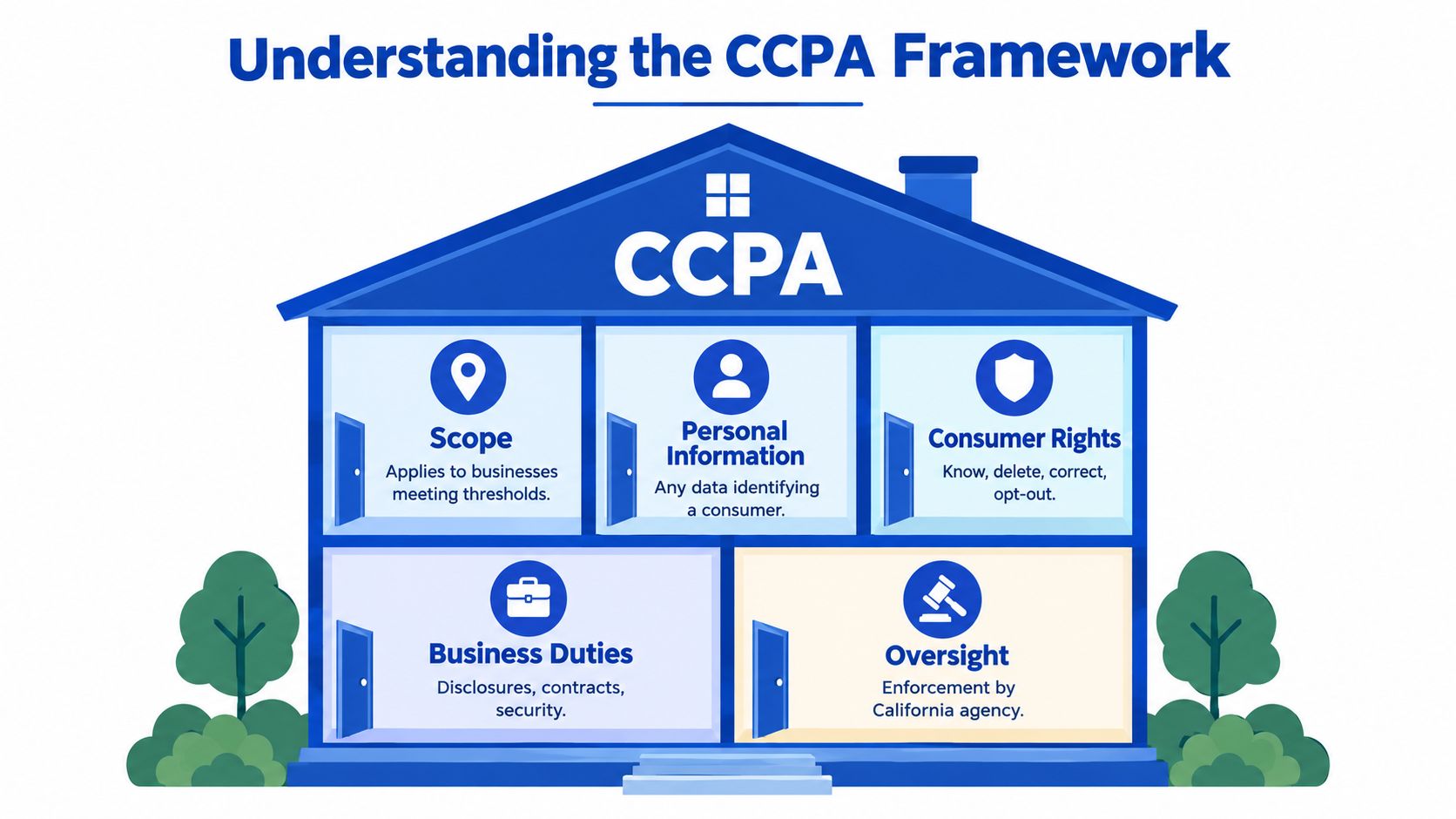
Personal information is not limited to a name written into a customer database. An identifier, combined with online activity or information held elsewhere, may reveal or relate to a consumer. For a software company, the relevant picture could span account details, website interactions, support records, and advertising-related data. The practical task is to understand how information connects to people and households across the company's systems and partners.
The framework also follows the data lifecycle. A business controlling collection must disclose what categories of personal information it plans to collect and why, whether it plans to sell or share that information, and the retention period or criteria for setting it. Collection, use, retention, and sharing must be reasonably necessary and proportionate to the disclosed purposes, as stated in California Civil Code section 1798.100.
That requirement has practical consequences. If a product begins collecting new information or using existing information for a different purpose, the team should check whether its notices and controls still match. If an old data set no longer serves a disclosed purpose, the company should consider whether its retention practices remain justified. A policy that describes one practice while the product performs another is not a dependable control.
Build the records behind the policy
A useful compliance foundation includes a current data inventory, accountable owners, records of vendor roles, and repeatable procedures. Documentation helps teams answer concrete questions: which system holds a data category, why it was collected, who receives it, and how the company responds when a consumer asks to exercise a right.
Privacy governance also depends on records that leadership can review. Teams developing their reporting approach may find audit and risk reporting best practices useful for thinking through how controls, risks, and accountability can be documented. The value lies in connecting each written requirement to a responsible person and an observable process.
The house analogy also explains why the framework needs more than a legal owner. Product and engineering help govern collection and retention; marketing manages advertising relationships; procurement reviews vendors; and support helps operate consumer request procedures. A policy can set expectations, but repeatable work across those teams is what makes the expectations usable.
Determining CCPA Applicability
A Washington startup can sell to California customers without opening an office there. A California-focused ad campaign, customer growth, or new data-sharing arrangement can also change the company's CCPA analysis. Applicability depends on the business's California activities, how it handles personal information, and whether it meets a statutory threshold.
The general test applies to a for-profit business doing business in California that determines the purposes and means of processing personal information and meets at least one threshold. For the revenue path, the threshold is annual gross revenue of at least $26.625 million during the preceding calendar year, as of January 1, 2025. The other paths involve buying, selling, or sharing personal information of at least 100,000 California consumers or households annually, or receiving at least 50% of annual revenue from selling or sharing California residents' personal information. The California Attorney General's CCPA applicability guidance explains these criteria.
| Coverage Path | Question to Answer | Evidence a Startup Should Preserve |
|---|---|---|
| Revenue | Did annual gross revenue meet the threshold during the preceding calendar year? | Revenue records and the documented calculation period |
| Consumer or household volume | Did the business buy, sell, or share personal information for at least the stated California consumer or household volume? | Data-volume methodology, system records, and documented assumptions |
| Revenue from selling or sharing | Did selling or sharing California residents' personal information account for at least the stated share of annual revenue? | Revenue analysis, business-model documentation, and data-sharing records |
Use the matrix as an initial screen, not a final legal conclusion. A startup should record its ownership structure, California-facing activity, processing volumes, advertising and data-sharing arrangements, and role in each relationship. The California Privacy Protection Agency’s CCPA frequently asked questions also provide a reference point for evaluating applicability and business roles.
Revisit the decision as the company changes
A new product, a larger California customer base, a shift in advertising technology, or a change in revenue model can alter the analysis. Review applicability when those facts change, rather than treating the assessment as a one-time checkbox.
A company below the revenue threshold may still meet another coverage path. For example, a startup that earns modest revenue but shares personal information through advertising technology should examine its data flows and consumer volumes. The question is how the business operates, not whether it has a California office.
Write down which paths the company assessed, the evidence supporting its conclusion, unresolved facts, and whether counsel should review the result. That record gives founders a reasoned starting point while making uncertainty visible.
Honoring California Consumer Rights
A consumer right is a legal entitlement; a company needs an operational capability to honor it. The difference becomes clear when someone submits a request through a support ticket, marketing preference page, or another channel. Staff need to recognize the request, route it to the right people, locate relevant information, assess any applicable limits, and document the result.
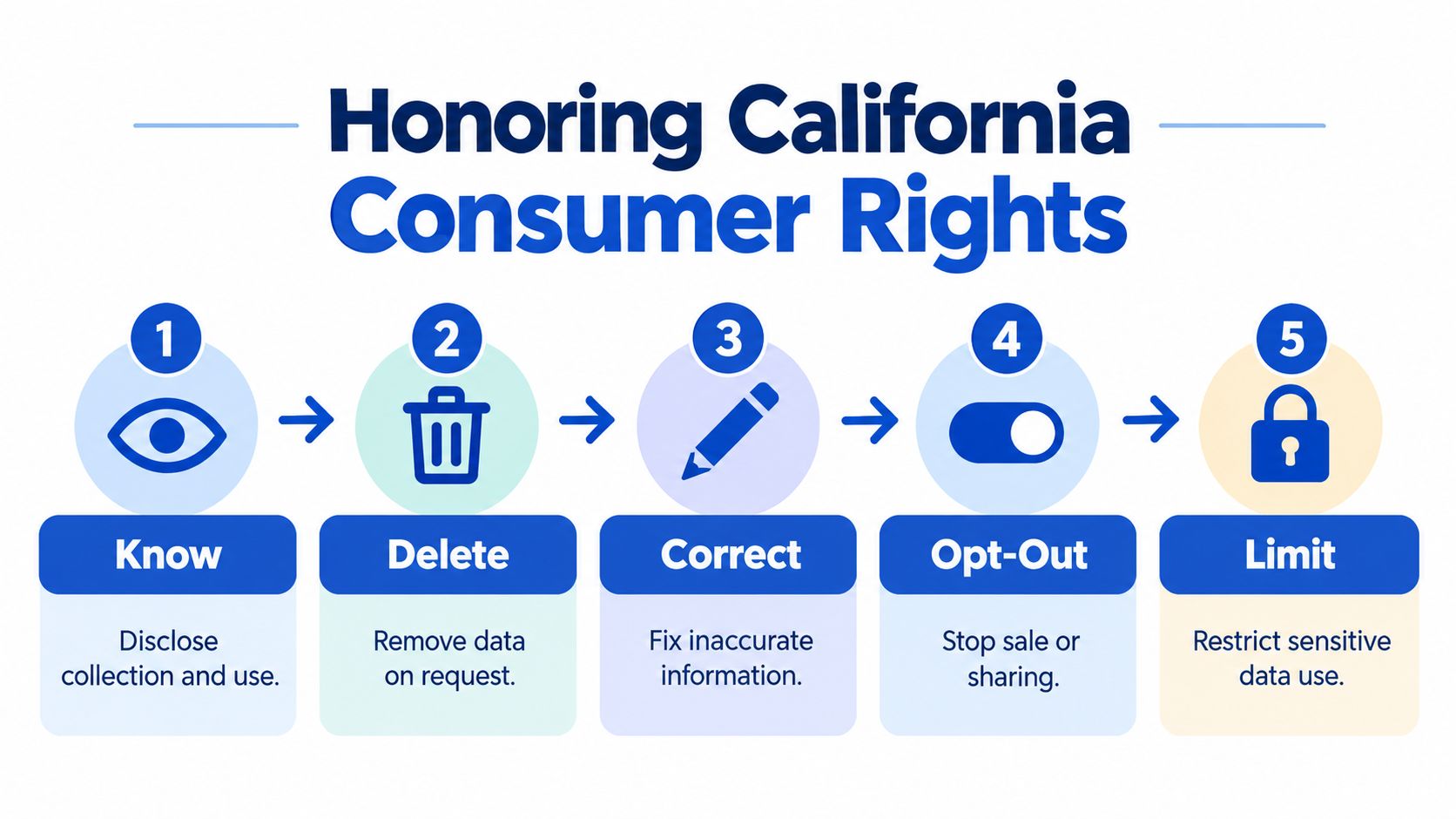
The rights include the ability to know what personal information a business collects and how it uses that information; request deletion, subject to statutory exceptions; request correction of inaccurate information; opt out of the sale or sharing of personal information; and limit certain uses and disclosures of sensitive personal information. Each right has a corresponding task for the business.
A request workflow should connect intake, identity verification, data discovery, legal review of exceptions, response, and recordkeeping. For example, if a customer asks for deletion, a support agent may need to send the request to a privacy owner who can locate data in the CRM, product database, and relevant vendor systems. A preference page that records an opt-out is useful only if the signal also reaches the tools that need to honor it.
Access and deletion requests aren’t unlimited. A business may decline a request when it can’t verify that the requester is the consumer or an authorized agent. Other statutory exceptions may affect a deletion request, so the company needs a process to assess the specific circumstances rather than treating every request as an automatic instruction to erase all records.
Make the result traceable
Useful records include the request received, the steps taken to verify identity, the systems searched, decisions about exceptions, any vendor actions, and the response sent. Those records help a company show how a request was handled and help teams find process gaps when a request gets stuck. They also connect consumer rights to engineering and vendor responsibilities instead of leaving the work with customer support alone.
Consumers generally can’t sue for ordinary CCPA violations. A private action is primarily available for certain data breaches involving nonencrypted and nonredacted personal information caused by inadequate security procedures, as explained by the California Attorney General’s privacy guidance. That distinction doesn’t remove the need for a reliable rights workflow, but it helps separate consumer-request handling from the law’s limited private-action route.
A website privacy policy can provide context for the process, but it isn’t the same as a working intake and response system. For teams assessing that distinction, this guide to whether a website needs a privacy policy can help frame the document’s role alongside operational procedures.
The video below offers another overview of consumer privacy rights and the compliance questions businesses should consider.
Building the Operational Compliance Program
A Washington startup can trigger California privacy obligations through its customers, advertising, or data practices, even without an office in the state. For example, a software company might use advertising pixels, analytics, cloud hosting, a CRM, customer support tools, and an AI feature. Its first practical step is a data inventory linking each personal-information category to its source, purpose, systems, recipients, retention period, and responsible owner. California Attorney General guidance describes documentation of data practices, ownership, revenue, consumer volume, and data-sharing flows as useful parts of a compliance program.

For a CRM record, the inventory could show that a customer provided information through an account form, the company uses it to manage the relationship, and the CRM provider stores it. It should also identify who decides how long the record is kept. For an advertising pixel, the map should reveal what the tool collects and who receives the information, so marketing and legal can compare actual data flows with the company’s notices and opt-out process.
Translate the inventory into controls
The data map should inform product decisions and engineering requirements. If a feature reuses information for a purpose that the existing notice does not describe, review the change before launch. If a retention schedule says information should be deleted, the relevant systems and vendor processes need a way to carry out that rule.
Vendor review begins with the parties’ actual roles. Determine whether a provider acts as a service provider or contractor, whether another party may qualify as a business, and which contract terms fit each relationship. Check downstream transfers, too. A vendor’s standard terms may not address every responsibility. A data processing agreement guide can help teams assess what these contractual terms do.
Written policies describe controls; software and team procedures make them work. A notice can explain why a company collects information, while product settings and engineering controls help keep use within those purposes. An opt-out process needs to pass a consumer’s choice to relevant advertising tools. Retention rules need an owner and a system process, and vendor obligations need contract terms and a way to check performance.
Teams that track risks and safeguards may use a 2026 risks and controls matrix guide to organize evidence by risk, control, owner, and review status. The aim is practical: make decisions visible and testable, rather than create paperwork that no one uses.
For the startup, marketing might maintain the tracking inventory, engineering might implement signal handling and retention controls, and procurement might review vendor terms. Support can route requests to the right team, while a privacy or legal owner coordinates the work and keeps evidence such as approved notices, system maps, and contract reviews. This shared operating system connects data mapping to product choices, vendor responsibilities, consumer rights, security, and AI governance.
Understanding Enforcement and New CPRA Duties
A common misconception is that compliance work can wait until a consumer complains. That overlooks the oversight role of the California Privacy Protection Agency, which can investigate possible violations, audit businesses, and bring administrative enforcement actions. A company may need to explain how it governs data, vendors, security, and consumer choices, not just point to a policy page.
For 2025, administrative fines can reach $2,663 per violation and $7,988 for each intentional violation or violation involving a consumer under 16. Separately, qualifying data breaches may expose a business to actual damages or statutory damages of $107 to $799 per affected consumer per incident, whichever is greater, under the California Privacy Protection Agency’s 2025 penalty adjustment information. These figures describe potential exposure, not a prediction of what a particular company would owe. Legal review is important before applying them to a specific situation.
The enforcement framework also distinguishes agency action from a consumer lawsuit. As covered above, a private action is primarily available for certain qualifying data breaches, rather than ordinary CCPA violations. That makes security and incident response central parts of the compliance program, even when a company’s consumer-request process appears straightforward.
Prepare for privacy, security, and AI oversight
The California Privacy Rights Act amendments expanded the framework and established a broader governance structure. New regulations finalized in 2025 and effective January 1, 2026 introduce privacy risk assessment and cybersecurity audit requirements for certain businesses. Automated decisionmaking technology requirements begin January 1, 2027, and the largest businesses face an April 1, 2028 cybersecurity-audit certification deadline, according to the California Privacy Protection Agency’s CCPA updates.
Those developments matter to technology companies because privacy decisions often appear inside product and security workflows. A hiring tool, fraud-detection system, personalization feature, or generative-AI pipeline may raise questions about what information is used, why it is used, what safeguards apply, and how the company documents its decisions. Teams should identify relevant uses early rather than trying to reconstruct those decisions after systems and contracts have grown more complex.
The practical response is coordinated governance. Privacy owners, security staff, procurement, product, and engineering should share an understanding of the data involved and the controls that apply. When incidents arise, teams may also need a clear communication process; guidance on preparing a data breach notification letter can support planning for that distinct response task.
Building a Startup Compliance Checklist
A Washington startup can have California privacy obligations without an office there. A California customer, an ad campaign reaching residents, or growth in the amount of personal information handled may change the scope analysis. Keep a short record of why the company believes the law does or does not apply, and assign someone to revisit that decision as the business changes.
- Record the scope decision. Document the company information and California-facing activity reviewed, the threshold analysis, supporting evidence, and questions for counsel.
- Map personal-information flows. List information categories, collection sources, purposes, systems, recipients, advertising tools, retention rules, and accountable owners. A guide to classifying data by sensitivity and type can help teams use consistent categories.
- Compare notices with product behavior. Save approved notice versions and review them when a product, tracking tool, or data use changes.
- Test consumer request handling. Confirm that support and privacy owners can route requests, verify requesters, search relevant systems, assess exceptions, and keep response records.
- Review tracking and vendors. Check how opt-out choices reach advertising tools, determine each provider’s role, retain review records, and align contracts with actual data practices.
- Operationalize security and retention. Assign responsibility for retention rules, document security procedures, and set an escalation path for incidents and control failures.
- Set recurring review triggers. Reassess after a product launch, vendor change, new AI use, incident, or relevant regulatory update.
For example, adding an analytics vendor should trigger a review of the data it receives, the relevant notice, opt-out handling, and contract terms. That review connects product choices, vendor oversight, consumer rights, security, and AI governance in one operating system for privacy work.
Keep the scope assessment, data inventory, notice history, request logs, vendor records, and retention schedule together as an evidence set. A checklist cannot replace legal advice. It can give a small team a clear owner, a current record of its practices, and a way to track gaps through to resolution.
By Design Law Firm & Legal Consultancy, PLLC advises businesses on privacy policies, data privacy compliance, vendor agreements, and breach response, helping Washington technology companies turn CCPA obligations into workable processes. Founders can discuss a scope assessment or compliance program by visiting By Design Law Firm & Legal Consultancy, PLLC. Contact our law office at (206) 593-1519.