Yes, a website almost certainly needs a privacy policy, and 76 of the top 100 U.S. websites failed to honor required opt-out consent signals in a 2024 privacy report. A small website isn't automatically exempt just because it has no online store.
The popular advice, “only large companies need privacy policies,” is wrong in practice. A contact form records personal information. Analytics code observes visitor activity. An embedded video, map, scheduling tool, or social widget may involve a third party processing visitor data. The site may look informational while operating as a data collector behind the scenes.
The practical question isn't whether the website sells products. It is what the website collects, which tools receive that information, and where visitors are located. Those answers determine whether the site needs a privacy policy, a cookie notice, a consent banner, opt-out controls, or all of them.
The Unexpected Short Answer to Your Privacy Question
A tiny website can have meaningful privacy obligations. A consultant's brochure site with a contact form may collect names, email addresses, message contents, and technical information. A nonprofit site may use analytics. A local service provider may embed a booking calendar that sends visitor details to another company.
Each feature changes the legal analysis.
A purely static site that doesn't collect personal information, use analytics, place non-essential cookies, or load third-party widgets has a narrower compliance profile. That type of site is unusual. Most websites use hosting logs, forms, analytics, fonts, videos, maps, chat tools, or marketing scripts, and each tool should be included in the site's data inventory.

The small-site decision test
A website owner can make an initial assessment by asking four direct questions:
- Does the site request information? Contact forms, newsletter subscriptions, account creation, surveys, comments, and appointment forms all count as obvious collection points.
- Does the site observe behavior? Analytics platforms, advertising pixels, session tools, and similar scripts may collect information about visits and devices.
- Does the site embed another service? YouTube, Google Maps, social media feeds, payment tools, scheduling platforms, and chat widgets can introduce separate data practices.
- Does the site attract visitors from regulated regions? A business's physical location doesn't eliminate obligations created by visitors in California, the EU, or other jurisdictions.
Practical rule: If a website uses a contact form or analytics, the owner should treat a privacy policy as necessary rather than debate whether the site is “too small.”
The enforcement environment supports that conservative approach. A 2024 report found that 76 of the top 100 U.S. websites did not honor opt-out consent signals required by California's CPRA, showing that even complex organizations can fail to connect their disclosures, consent systems, and actual practices. The figure doesn't make noncompliance safe for smaller businesses. It shows why a published policy must match the technology operating on the site. The 2024 privacy report provides the relevant compliance context.
Mapping the Legal Triggers, Federal, State, and International Laws
The United States doesn't provide one simple answer that applies to every website. Privacy obligations come from a patchwork of state rules, sector-specific requirements, consumer-protection principles, contracts with technology providers, and international laws that can apply based on visitor location.
California remains a central trigger. CalOPPA, enacted in 2003, requires commercial websites that collect personally identifiable information from California consumers to conspicuously post a privacy policy. California's CCPA notice framework separately requires a privacy-policy link containing the word “privacy,” such as “Privacy Policy” or “California Privacy Policy.” The notice must describe relevant information practices, including the categories of information collected and how the business handles that information. California's Attorney General notice explains these requirements.
A practical legal landscape
- California visitors: A commercial site collecting personal information from California consumers should publish a conspicuous privacy policy and make the link easy to find.
- EU visitors: The GDPR requires clear information when an organization processes personal data, including the purpose, legal basis, retention, rights, and contact details. The GDPR took effect on 25 May 2018, creating a broad disclosure framework for organizations handling personal data.
- Other U.S. states: State privacy rules can impose different notice, rights, consent, and opt-out requirements. The United States therefore operates as a patchwork, not as one national privacy regime.
- Cross-border operations: A website may need to explain international transfers and vendor relationships when information moves between countries.
A business doesn't need a physical office in Europe to consider GDPR exposure. A website that deliberately serves or collects information from EU individuals must assess the regulation's reach and design its notice accordingly. Cross-border processing also creates contractual and transfer questions, which makes this cross-border data transfer mechanisms guide useful for identifying the safeguards that may be relevant.
For a broader review of the legal building blocks surrounding an online business, the Helbling Digital Media legal guide offers practical context. It shouldn't replace jurisdiction-specific legal advice, but it can help a founder identify missing website documents and operational issues.
The right conclusion is straightforward: visitor origin and data handling matter more than business size. A Washington startup with California and European visitors may face a more demanding disclosure analysis than a larger company serving only a narrow local audience.
Comparing Global Standards, GDPR vs CCPA Obligations
GDPR and CCPA or CPRA obligations overlap, but they aren't interchangeable. A privacy policy written for one framework may omit the rights, legal bases, disclosures, or consent mechanisms required by the other.
The GDPR begins with a rights-based transparency model. An organization must explain why it processes personal data, identify the legal basis, describe recipients, state retention information, and explain data-subject rights. Where a website uses non-essential cookies or trackers, EU rules require prior, unambiguous consent before those trackers are placed. The notice must explain the trackers, their purposes, and whether third parties place them. Termly's EU privacy-policy guidance describes this relationship between tracking technology, consent, and disclosure.
CCPA and CPRA analysis places strong emphasis on consumer notice and control, including rights concerning the sale or sharing of personal information and the ability to opt out where applicable. California also requires a conspicuous privacy link on the homepage. The business must explain its information practices and tell consumers how to exercise their rights.
The differences that change implementation
| Issue | GDPR | CCPA and CPRA |
|---|---|---|
| Core orientation | Transparency, lawful processing, and individual rights | Consumer notice, access, deletion, and opt-out controls |
| Tracking | Non-essential tracking generally requires prior consent in the EU | The analysis focuses on disclosures, sharing, sale, and applicable opt-out rights |
| Notice content | Purpose, legal basis, recipients, retention, and rights | Categories, purposes, information practices, rights, and request methods |
| Website placement | Notice should be accessible where collection occurs | Privacy link must be conspicuous and use the word “privacy” |
| Operational focus | Consent records and lawful processing | Rights response and preference management |
A global website should not publish one generic paragraph and assume the problem is solved. The stronger approach is to identify the strictest applicable requirement for each activity, then build a policy and consent experience that accurately reflects the actual data flow. A business tracking European visitors may need a consent banner even when its California-facing disclosure already exists.
Regulatory developments also make periodic review important. Businesses tracking international requirements can use resources such as these GDPR updates, but a current resource isn’t a substitute for reviewing the actual scripts and vendors installed on the site.
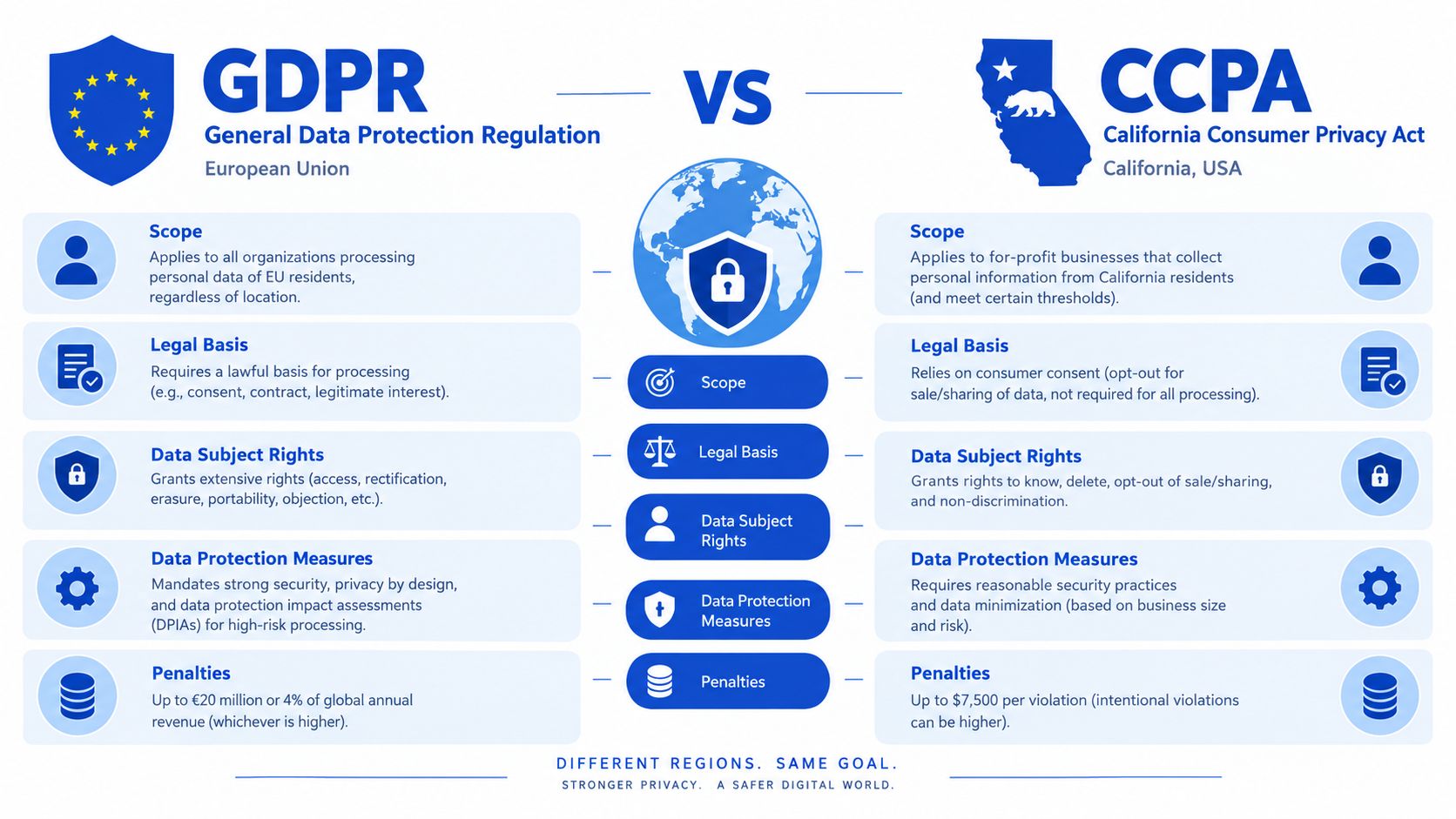
A short visual comparison can help a founder distinguish a document requirement from a consent requirement. The following video provides additional context for the broader privacy-policy question.
Essential Elements Your Policy Must Include
A privacy policy should describe the website’s actual data practices, not serve as decorative legal text. The document must be specific enough for a visitor to understand what happens to information after submission, observation, storage, or disclosure.
Under the GDPR, a notice must be concise, transparent, intelligible, easily accessible, and written in clear, plain language. It must disclose the processing purpose and legal basis, recipients or recipient categories, retention periods, and data-subject rights. GDPR.eu’s privacy-notice overview sets out those core elements.
The operational checklist
-
Identify the data collected. List information from contact forms, newsletters, accounts, purchases, cookies, analytics, devices, and embedded tools. Avoid saying only “personal information” when the site can identify the relevant categories.
-
State the purpose. Explain why the business collects each category, such as responding to an inquiry, delivering a requested service, securing the site, measuring traffic, or sending marketing.
-
Name the legal basis where required. GDPR notices should identify the legal basis for each processing activity. Consent, contract, legal obligation, and legitimate interests aren’t interchangeable labels.
-
Explain sharing. Identify analytics providers, email platforms, payment processors, hosting providers, advertising partners, scheduling systems, and other recipients that receive or access information.
-
Describe retention. State how long each category is kept, or explain the criteria used to determine the retention period. A vague promise to retain data “as long as necessary” may not give visitors meaningful information.
-
Explain rights and requests. Tell people how to seek access, correction, deletion, restriction, portability, or applicable opt-out rights.
-
Cover cookies and tracking. The policy should identify cookie categories, purposes, third-party involvement, and preference controls. It shouldn’t claim that the site uses only necessary cookies if analytics or advertising scripts are active.
-
Provide contact details. Give a practical privacy contact method and identify any required representative or data protection contact.
A founder looking for plain-language orientation can consult this privacy policy overview, then have the final document reviewed against the site’s actual tools and jurisdictions. Businesses with mobile applications should also consider whether their mobile app privacy policy needs separate treatment for app-specific collection.
The Reality of Compliance and Policy Visibility
Having a privacy policy is only one part of compliance. Accuracy, visibility, and operational follow-through matter just as much. A link buried in an inaccessible page won’t help a visitor understand data practices, and a polished policy that omits an active analytics script can create a mismatch between the document and reality.
Large-scale research has found substantial gaps in both policy availability and compliance. The market data summarized in the 2026 research cited in the privacy report found detectable privacy-policy links in only 37.2% of snapshots for sites ranked in the top 1,000 by traffic, with visibility falling to 9.6% for sites ranked below 1 million. Those figures show that smaller sites are particularly likely to lack an obvious policy link, not that smaller sites are exempt.
Why visibility matters
A conspicuous footer link labeled “Privacy Policy” gives visitors a predictable route to the notice. A link labeled “Legal” may be less clear where a law requires the word “privacy.” A form that collects an email address should also make the relevant notice available near the collection point when the applicable law requires information at the time of collection.
The problem is often operational rather than intentional. A marketing contractor adds a Meta pixel. A developer embeds a scheduling tool. A staff member activates Google Analytics. Nobody updates the policy or consent configuration. The site then makes promises that no longer match its technology.
A privacy policy is a control document. If the website changes, the document and consent experience must change with it.
Businesses can use a compliance checklist for providers as a starting point for organizing reviews. The checklist should cover the public notice, forms, scripts, vendors, permissions, retention, request handling, and evidence of consent rather than focusing only on page publication.
The enforcement data doesn’t justify copying whatever competitors display. It supports a more disciplined conclusion: common practice is not the same as compliant practice. A business should identify its own collection and sharing activities, make the policy visible, and document the processes that support the statements.
Taking Action, Maintenance, Updates, and Consent Flows
A privacy policy should be treated as part of the website’s operating system. The first task isn’t drafting attractive legal language. It is identifying every place where the site collects, receives, stores, observes, or shares information.
Start with the technology inventory
A website owner should inspect:
- Forms: Contact, quote, newsletter, registration, comment, and appointment forms.
- Scripts: Analytics, advertising, heat maps, chat, conversion tracking, and security tools.
- Embeds: Videos, maps, social feeds, calendars, payment forms, and third-party content.
- Vendors: Hosting companies, customer relationship systems, email services, payment providers, and marketing platforms.
- Storage: Email inboxes, databases, customer records, backups, and exported spreadsheets.
- Geography: The locations of customers and visitors, not just the business address.
The inventory should record what each tool collects, why it collects it, where the information goes, how long it remains available, and whether the tool operates before consent. That exercise often exposes the gap between a website owner’s assumptions and the site’s actual behavior.
A policy alone doesn’t solve every tracking issue. It tells visitors what the business does, but it may not obtain the consent required before a non-essential cookie or advertising pixel is placed. A cookie banner or preference center may therefore be a separate compliance component.
Separate the policy from the consent mechanism
These tools perform different jobs:
- Privacy policy: Explains the broader information practices, rights, vendors, retention, legal bases, and contact procedures.
- Cookie notice: Describes cookies and similar technologies, including their purposes and third-party involvement.
- Consent banner: Requests permission before applicable non-essential trackers load.
- Preference center: Lets visitors change selections and withdraw consent where required.
- Opt-out mechanism: Supports rights such as opting out of applicable sale, sharing, or targeted advertising activities.
For an EU-facing website, analytics and advertising scripts shouldn’t load first and ask for permission afterward when prior consent is required. The technical configuration must support the legal promise. A banner that has no effect on the scripts is a design element, not a functioning consent mechanism.
California also imposes an ongoing maintenance duty. The CCPA and CPRA privacy-notice rule requires a conspicuous homepage link using the word “privacy,” and the required information must be updated at least once every 12 months. The current California statute makes clear that publication is not a one-time event.
Build a repeatable review process
A responsible business should review the policy whenever it:
- adds an analytics, advertising, chat, booking, or payment tool;
- changes hosting, email, customer relationship, or payment vendors;
- begins serving a new geographic market;
- changes retention or deletion practices;
- introduces a new form, account feature, or mobile application;
- changes consent choices or opt-out handling.
The website footer should link to the policy from every page where practical. Collection forms should provide an accessible notice at or before submission. The business should retain enough internal documentation to explain which version was active, what tools were present, and how requests were handled.
Website contracting choices can also affect consent and enforceability. Businesses reviewing online acceptance flows may find this discussion of clickwrap versus browsewrap useful, although contractual acceptance doesn’t replace a privacy notice or tracking consent.
A generator can help with a simple site, but it can’t discover every script or decide whether the policy accurately describes a complicated data ecosystem. A lawyer should review sites handling sensitive information, serving multiple jurisdictions, using extensive advertising technology, or sharing data with numerous vendors. The safest answer to “do I need a privacy policy for my website” is yes, followed by a technology audit that determines what else the site needs.
By Design Law Firm & Legal Consultancy, PLLC helps businesses draft and review privacy policies, assess website data practices, and build practical privacy and consent programs. Visit By Design Law Firm & Legal Consultancy, PLLC to discuss a website compliance review matched to the business’s tools, markets, and risk profile. Contact us at (206) 593-1519.