European regulators recorded approximately €7.1 billion in cumulative GDPR fines by 10 January 2026, with about €1.2 billion issued during 2025 alone, according to DLA Piper's January 2026 GDPR Fines and Data Breach Survey. For founders outside the European Union, that figure changes the question. The issue isn't whether a startup has an EU office. The issue is whether its product, staff, vendors, analytics, or artificial intelligence systems touch people in Europe.
The most useful 2026 development isn't another abstract interpretation of the Regulation. The European Data Protection Board is moving toward ready-to-use compliance templates for records of processing, privacy notices, breach notifications, legitimate interest assessments, and data protection impact assessments. Small teams finally have a practical starting point, rather than a compliance program built from scattered guidance and expensive reinvention.
Why GDPR Updates Matter More Than Ever in 2026
The enforcement picture is large enough to affect budgeting decisions. As of 1 March 2026, the CMS GDPR Enforcement Tracker recorded 2,685 fines across 32 countries, an increase of 440 fines from its prior report, with approximately €6.11 billion in recorded fines. When cases with limited information were included, the tracker counted 3,062 cases, as reported in the CMS GDPR Enforcement Tracker numbers and figures.
Those totals don't mean every startup faces a billion-euro penalty. They do show that enforcement is no longer an occasional shock reserved for household-name platforms. Regulators are building a larger enforcement record, and companies that process EU personal data without basic documentation give investigators an easy place to start.
The practical turning point
The EDPB's 2026–2027 work programme promises practical compliance templates covering legitimate interest assessments, records of processing activities, privacy notices and policies, breach notifications, and DPIAs. The stated direction matters because standard forms can reduce inconsistent drafting and help smaller organizations produce repeatable governance documents. The EDPB announcement on making GDPR compliance easier identifies the initiative directly.
The European Union's artificial intelligence rules add another layer. A startup using personal data to train, test, or operate an AI product may need to analyze GDPR lawful basis, transparency, security, data subject rights, and automated decision-making alongside AI governance duties. The practical answer isn't to wait for perfect regulatory certainty. It's to document the data and decisions already being made.
Practical rule: A founder who can show a current data map, vendor register, lawful-basis analysis, and incident plan is in a materially stronger position than one who merely says the company takes privacy seriously.
Non-EU teams should treat this quarter as a remediation window. A focused sprint can identify whether GDPR applies, expose unsupported transfers, and create the records regulators expect. Founders looking for a plain-language starting point can use this data privacy guide for SaaS teams, then turn its concepts into company-specific records.
Who the New Rules Actually Apply To
The simplest working rule is this: if a company touches an EU resident's personal data, GDPR may apply. Physical presence isn't the test. A Seattle startup can fall within scope without an EU subsidiary, European employees, or a local data center.
The first trigger is offering goods or services to people in the European Union. Payment isn't required. A free application, trial account, newsletter, marketplace profile, or online service can still indicate that the company is targeting or serving EU residents.
The scope triggers founders miss
A second trigger is monitoring behavior. Product analytics, advertising identifiers, behavioral profiles, session recordings, location signals, and retargeting tools can create a monitoring analysis even when the company describes them as ordinary marketing. The question is what the system does to people in Europe, not what the marketing team calls it.
A third trigger arises when the startup processes data for an EU-based controller. A US-based software vendor can become a processor for an EU customer and inherit contractual and operational duties. A fourth is employment. An organization with EU staff handles employee personal data and must address GDPR obligations for that processing.
A founder should examine these scenarios:
- EU customers: The product offers goods or services to EU residents, whether paid or free.
- EU visitors: Analytics or advertising tools monitor their behavior.
- EU business customers: The company processes data for an EU controller.
- EU personnel: The organization employs people located in the European Union.
- EU-facing AI: An AI system places outputs into the EU market, creating a separate need to analyze the AI Act's reach alongside GDPR.
The European Commission's GDPR overview provides the baseline regulatory context, but founders need an operational test. List every EU-facing product flow, tracking function, customer integration, and employment process. Then identify the controller, processor, purpose, data categories, retention period, and transfer destination for each one.
A single EU customer can matter. So can one tracked visitor or one EU hire.
This is why secure architecture and disciplined secure data handling belong in the product plan, not just the legal folder. Cross-border processing also deserves a dedicated review, particularly for US-hosted services. A useful companion resource is this guide to cross-border data transfers after Schrems II, which focuses on data-flow mapping, contractual safeguards, transfer impact assessments, and supplementary measures.
The EDPB Compliance Templates That Change the Game
The EDPB template initiative is the headline practical relief of the 2026 GDPR updates. The work programme specifically identifies templates for legitimate interest assessments, records of processing activities, privacy notices and policies, breach notifications, and DPIAs. It doesn't establish a magical safe harbor, and it doesn't eliminate judgment. It does give a small team a regulator-facing structure for turning legal duties into operating documents.
The distinction matters. A startup shouldn't copy a template, fill in a company name, and assume the analysis is complete. It should use each template as a controlled workflow, assign an owner, record decisions, and connect the document to product and vendor changes.
What each template should do
The Article 30 records of processing template should become the company's central inventory of processing activities. It can organize purposes, data categories, recipients, retention, security measures, and international transfers in one place.
The Article 33 breach notification form should sit inside the incident runbook. It gives legal and security teams a common structure for describing the event, affected data, likely consequences, and mitigation steps.
The Article 35 DPIA template should guide risk analysis for processing likely to create a high risk to individuals. It's particularly useful for behavioral analytics, sensitive data, large-scale monitoring, biometrics, and AI-enabled decisions.
The EDPB work programme does not, in the verified material, confirm the exact release of an Article 28 processor contract checklist or a cross-border transfer impact assessment template. Teams shouldn't describe those documents as officially released until the EDPB publishes them. For now, companies should use a sound data processing agreement template for Article 28 requirements and maintain a separate transfer assessment process.
| Template | GDPR Article | Time Saved |
|---|---|---|
| Records of processing activities | Article 30 | Reduces blank-page drafting and creates a repeatable inventory workflow |
| Breach notification form | Article 33 | Speeds collection of facts during an incident |
| DPIA template | Article 35 | Gives teams a consistent risk-assessment structure |
| Legitimate interest assessment | Articles 5 and 6 | Organizes necessity, balancing, and safeguards analysis |
| Privacy notice and policy template | Transparency duties | Creates a structured base for audience-specific notices |
The founder's Monday-morning move is simple. Download the official materials when available, nominate one document owner, create a version-controlled compliance folder, and require product, security, HR, and sales teams to update the relevant record when processing changes.
Fine Trends and Enforcement Pressure
Founders need a risk model, not a frightening headline. Under GDPR Article 83, one class of infringement can carry a maximum administrative fine of €10 million or 2% of worldwide annual turnover, whichever is higher. The more serious class can reach €20 million or 4% of worldwide annual turnover, whichever is higher, as summarized in the Article 83 GDPR fine limits.
Those are statutory ceilings, not automatic invoices. Regulators assess factors such as nature, gravity, duration, intent, mitigation, cooperation, prior infringements, and the categories of personal data involved. A startup should still budget against the consequences of a systemic failure, because a small headcount doesn't make large-scale processing low risk.
The enforcement record
The CMS tracker recorded 2,685 documented fines as of 1 March 2026, with approximately €6.11 billion in directly recorded fines. Including matters with limited information brought the count to 3,062. The tracker also recorded 440 more fines than in the previous edition, which points to sustained enforcement activity rather than a dormant regulatory environment. Those figures appear in the CMS GDPR Enforcement Tracker report.
A separate EDPB annual report recorded approximately €1.145 billion in fines during 2025, with Ireland's Data Protection Commission accounting for €530.8 million. The EDPB annual report for 2025 links the highest-risk outcomes to cross-border transfers and platform processing. That makes transfer impact assessments, vendor-chain controls, and clear controller-processor governance immediate priorities for multinational technology businesses.
The European Commission's simplification proposal would extend the Article 30(5) record-keeping derogation to smaller and medium-sized organizations with fewer than 750 employees, but only where processing isn't high risk, as described in the European Commission simplification proposal summary. This is a proposal, not a reason to abandon records. If a startup handles sensitive data, extensive monitoring, or complex vendor flows, a record of processing remains the sensible operating control.
| Tier | Maximum Fine | Triggering Violations |
|---|---|---|
| Lower Article 83 class | Up to €10 million or 2% of worldwide annual turnover, whichever is higher | Certain controller, processor, certification, and organizational obligations |
| Higher Article 83 class | Up to €20 million or 4% of worldwide annual turnover, whichever is higher | More serious violations involving core principles, rights, or transfers |
The practical takeaway is sharp. A company processing EU data at scale can face serious exposure even if its engineering team is small. Founders who need to understand how an incident can become litigation should also review this overview of data breach lawsuits.
A Practical Compliance Roadmap for Startups and Tech
A workable GDPR sprint needs owners, outputs, and deadlines. One part-time operations hire can coordinate the work, but engineering, security, HR, sales, and leadership must supply the facts. The goal isn’t a beautiful binder. It’s a defensible record that matches the product.
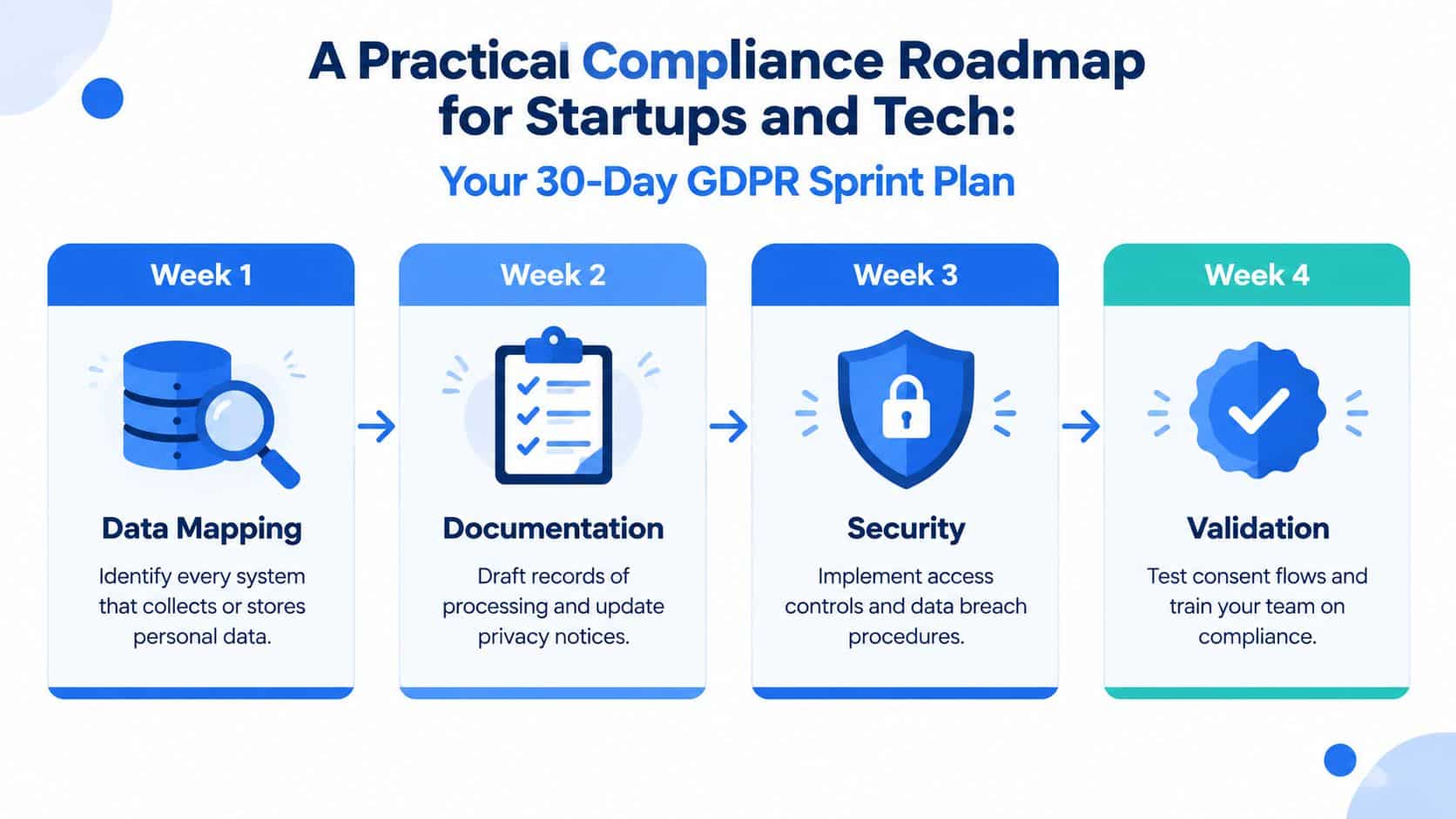
Week one focuses on data mapping
Identify every system that collects, stores, accesses, or exports EU personal data. Include the application database, customer relationship management platform, support desk, payment processor, analytics tools, email system, cloud storage, employee systems, and development environments.
The deliverable is a single source-of-truth register. Each entry should identify the data subject, purpose, lawful basis, retention, access group, vendor, hosting location, and deletion process. The team should also flag special-category data, children’s data, profiling, and any processing likely to require a DPIA.
Week two closes vendor gaps
Pull every vendor agreement into one review queue. Confirm that each processor has a data processing agreement, that the services match the authorized instructions, and that subprocessors are disclosed and controlled.
For US or other third-country processors, record the transfer mechanism and complete a transfer impact assessment where needed. The deliverable is a vendor register with signed agreements, transfer safeguards, subprocessor status, and an owner for each relationship.
Week three tests breach readiness
Create a one-page incident runbook. It should identify who receives the first alert, who preserves evidence, who decides whether notification is required, who contacts the supervisory authority, and who communicates with affected individuals.
The current GDPR operating deadline remains 72 hours for notifying a supervisory authority when a personal data breach is not unlikely to result in a risk to individuals. The team should wire that clock to the moment an authorized employee becomes aware of a suspected breach, not to the moment every fact is confirmed. The deliverable is a notification template, escalation list, evidence checklist, and tabletop test.
Incident rule: Uncertainty is a reason to escalate quickly, not a reason to leave the incident in the security queue.
Week four validates the human layer
Run privacy training for everyone with access to personal data. Test consent flows, deletion requests, access requests, role permissions, and vendor offboarding. Set a quarterly review cadence so the register doesn’t become a historical document.
Technical teams can also automate technical privacy controls for repeatable tasks such as access reviews, retention workflows, and evidence collection. The broader data privacy and compliance resource can help founders organize the legal and operational work. A realistic sprint assigns internal owners and records actual effort rather than pretending that every task takes the same amount of time.
The following video can help teams frame the implementation conversation:
The Strategic Upside of Getting This Right
GDPR compliance is a market-access control, not merely a regulatory expense. European customers, investors, procurement teams, and channel partners often ask how a vendor handles personal data before they approve the relationship. A startup that can produce a coherent privacy package moves through that review with less friction than one that starts assembling documents after a buyer raises concerns.
The strongest advantage comes from architecture. If the product stores unnecessary fields, shares data broadly, lacks deletion logic, or sends information to vendors without a transfer analysis, legal remediation becomes an engineering project. Teams then have to identify historical flows, redesign permissions, migrate records, revise interfaces, renegotiate contracts, and explain why previous notices didn’t match actual processing.
Templates lower the barrier, not the standard
The EDPB’s planned templates make documentation easier to start and easier to repeat. They don’t excuse shallow analysis. A legitimate interest assessment still needs a real purpose, necessity analysis, balancing exercise, and safeguards. A DPIA still needs to address risks to individuals and the measures that reduce those risks.
That distinction creates a useful founder strategy:
- Build the data map before scale: Product decisions become cheaper to correct when the team knows what data exists and why.
- Make vendor review part of procurement: No new processor should enter production without an owner, contract, and transfer decision.
- Treat privacy evidence as sales material: A current ROPA, security summary, DPA, and incident plan answer recurring buyer questions.
- Keep records alive: A template completed once won’t protect a company after a new feature changes the processing.
Privacy creates commercial leverage when the company can prove what it does, not when it merely promises to do better.
Early compliance also helps a startup distinguish genuine product value from data accumulation. The company can retain what it needs, delete what it doesn’t, and give customers a clearer explanation of how the service works. That discipline supports market expansion without forcing every new deal into a rushed legal and engineering cleanup.
Next Steps and How By Design Law Can Help
Founders should match legal support to the next compliance milestone, not a vague goal to “get GDPR done.” The 2026 EDPB templates make that choice easier. They give small teams a practical starting point, while counsel helps turn the paperwork into an operating process.
The readiness audit
A free 30-minute GDPR readiness audit fits a founder who does not know whether the company is in scope or where the largest gaps are. The discussion should cover EU-facing services, tracking, employee data, vendors, international transfers, breach readiness, and the documents a buyer or regulator would request first. The result should be a prioritized work list, not a generic score.
The implementation sprint
A fixed-fee privacy program build suits a team that needs execution. It can cover DPIA templates, records of processing activities, and transfer agreements for teams of up to 50 employees. Require a defined scope, named document owners, product and vendor interviews, and a handoff process. The company must be able to maintain the program after the sprint ends.
Ongoing counsel
An outside general counsel retainer fits a business treating privacy as continuing infrastructure. Counsel can review new vendors, product launches, AI features, customer contracts, incidents, data subject requests, and quarterly governance records. That support keeps ordinary changes from becoming emergency projects.
Start with a call to (206) 593-1519. A same-week conversation should determine whether the company needs a narrow transfer assessment, a documentation sprint, or continuing privacy support. Ask for concrete deliverables, owners, and a completion date.
By Design Law Firm & Legal Consultancy, PLLC is a Seattle-based business and technology law firm advising startups and established companies on privacy programs, cross-border data issues, contracts, incident response, and AI governance. Founders can use its GDPR legal and compliance counsel to turn the 2026 updates into documented operating procedures rather than another deferred task.
The firm also helps technology companies build programs around data mapping, DPIAs, vendor agreements, transfer assessments, and incident readiness. Put the quarter’s highest-risk gap first, assign an owner, and use the templates to produce evidence your team can maintain. Contact our law office today at (206) 593-1519.