A founder can spend a week negotiating price, scope, and launch timing, then lose the deal's practical meaning in a poorly coordinated exhibit. The signature page may be flawless, yet a schedule changes the payment trigger, a data processing addendum creates a broader security obligation, or an AI-use provision limits rights granted in the main agreement. Learning how to draft a contract therefore means more than filling in a template. It means building a document that still says what the parties intended when the relationship gets difficult.
A sound contract identifies the parties, records their agreement, exchanges value, assigns responsibility, and gives decision-makers a workable path when performance breaks down. The drafting process should move in that order: prepare the deal, write clear clauses, audit every incorporated document, close the redlines carefully, and bring in counsel when the risk justifies the cost.
The Moment a Contract Actually Matters
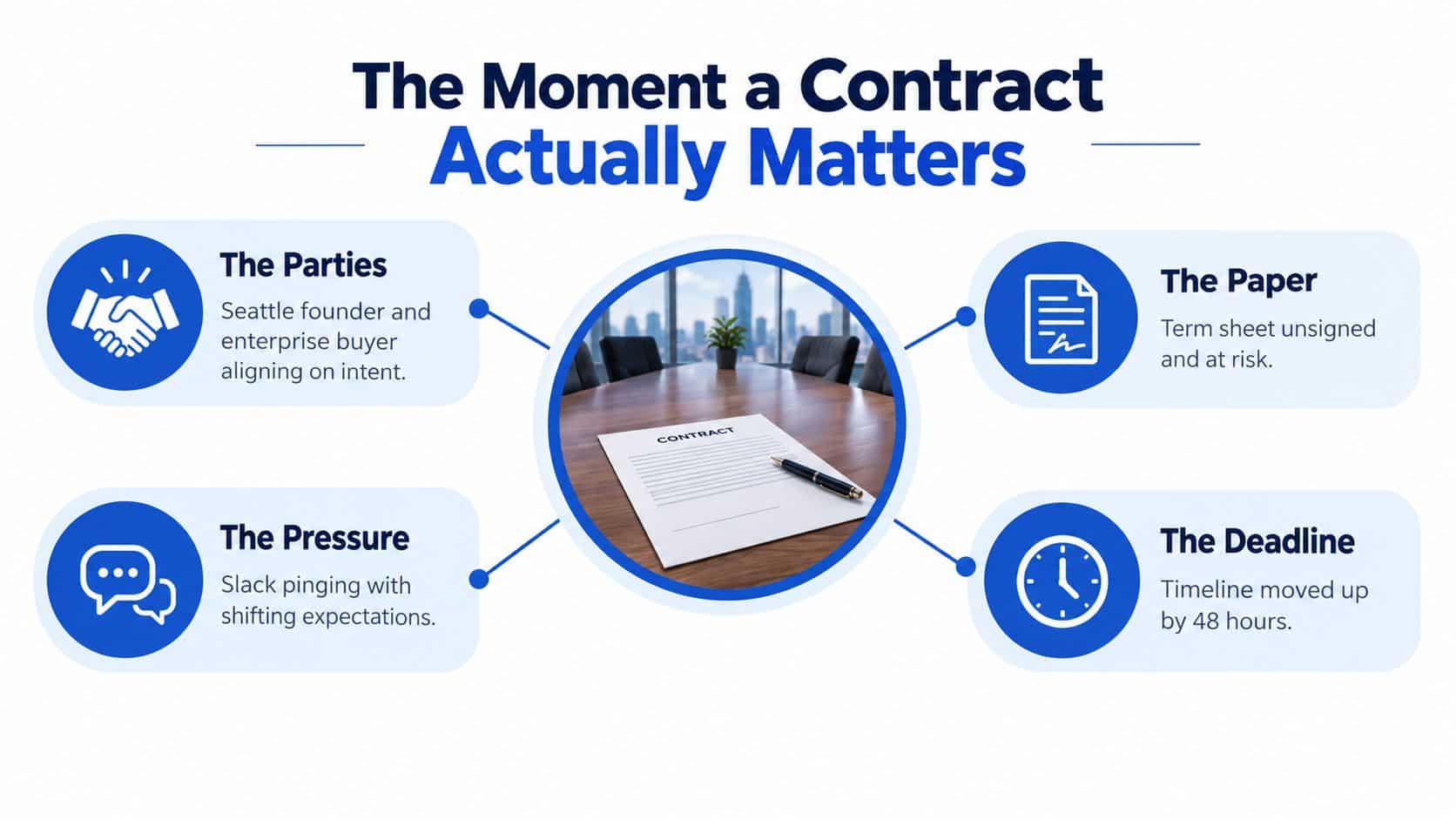
It's a Tuesday morning in Seattle. A startup founder is across the table from a prospective enterprise customer, the term sheet remains unsigned, Slack is full of increasingly specific promises, and the customer's implementation deadline has moved up by 48 hours. The founder wants to keep momentum. The customer wants certainty. Both sides are tempted to treat the contract as paperwork that can catch up later.
That instinct causes trouble because contracts rarely receive their hardest test on signing day. They matter six months later, when the product launch slipped, the customer remembers a different scope, and the people who negotiated the deal no longer agree about what “included” meant.
The legal foundation
A legally binding commercial contract commonly rests on offer, acceptance, consideration, and an intention to create legal relations, as summarized by Muckle LLP's explanation of legally binding contracts. In practical business drafting, the parties also need sufficiently definite essential terms, legal capacity, a lawful transaction, and the proper form where writing is required, points addressed in business-law guidance on contract formation.
That translates into four questions:
- Did the parties agree? The offer and acceptance must identify the deal rather than leave material terms open.
- Did value move between them? Payment, services, access, a license, or another exchange can provide consideration.
- Did the parties show assent? Signatures help, but conduct can also matter, particularly where the parties perform before signing.
- Is the transaction lawful and properly documented? Some transactions require a written agreement with essential terms and an appropriate signature.
An executory contract still has obligations left to perform, while an executed contract has been fully performed by the relevant parties. The distinction matters because most startup agreements remain executory for much of their operational life.
Practical rule: Informal language isn't automatically defective. Ambiguous language is. A friendly agreement can still work if it identifies obligations and allocates risk precisely.
The UNIDROIT Principles of International Commercial Contracts offer a useful global drafting reference. First published in 1994, the Principles have expanded through later editions, and the 2016 edition contains 211 Articles across 11 Chapters. They're designed as a non-binding restatement of international contract law used across different legal traditions, and they emphasize that parties are generally free to determine contract content without a required form unless the parties choose one. That framework is especially useful for cross-border transactions involving performance standards, interpretation, and remedies.
A contract fails when it leaves a material promise undefined, assigns a risk to the wrong party, or lets an attachment contradict the body. The cure isn't decorative legal language. It's disciplined preparation, precise drafting, document control, and a final review that treats every incorporated term as part of the deal.
Preparing the Deal Before You Draft a Single Clause
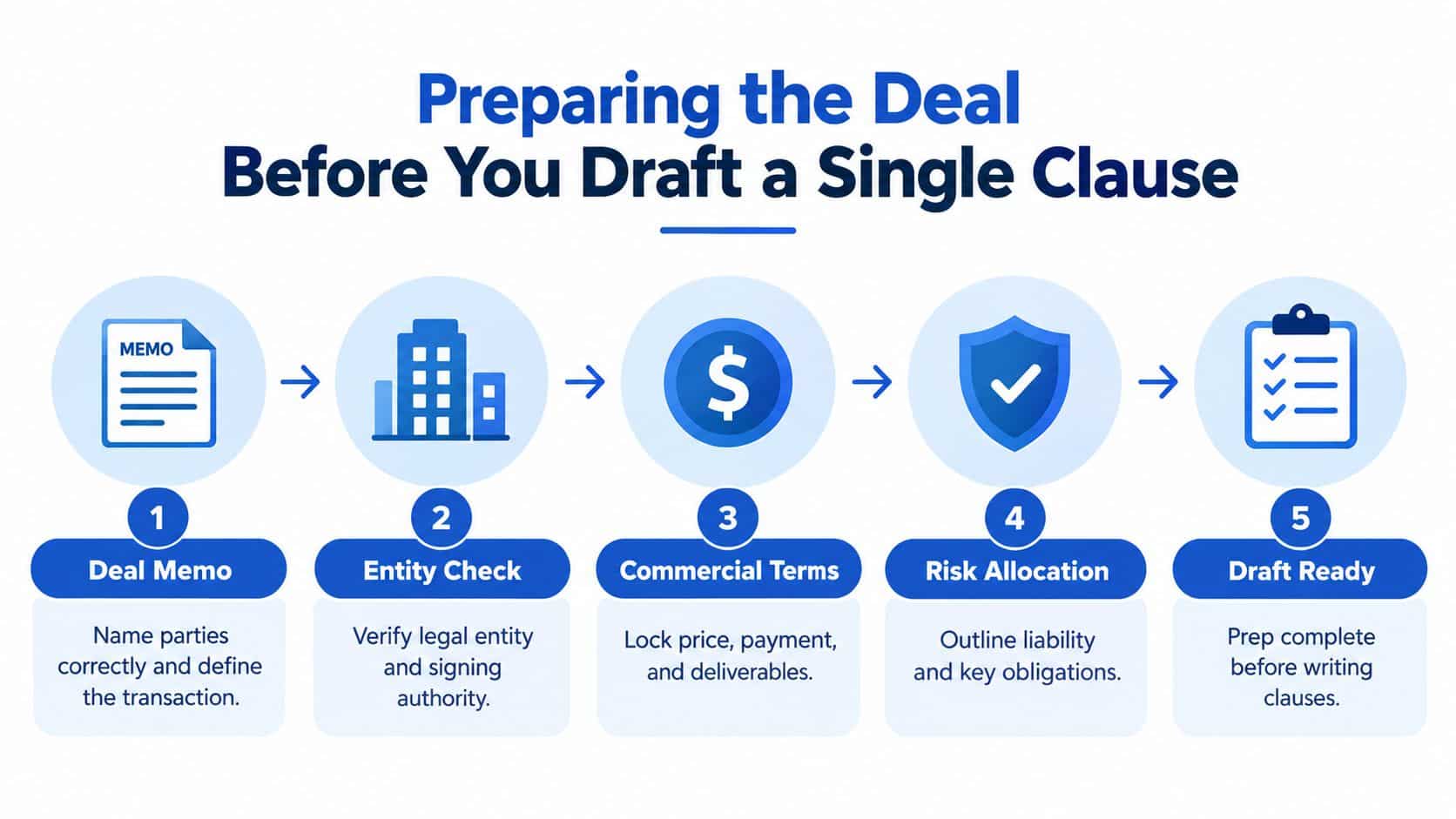
The draft usually reflects the quality of the business conversation that came before it. Before opening a template, the parties should create a short deal memo that names each legal entity correctly, identifies whether it's a C-corporation, LLC, or sole proprietorship, and states the commercial objective in two sentences.
That memo prevents common errors. A brand name may not be the contracting party. A parent company may not be responsible for a subsidiary's obligations. A person described as a “founder” may lack authority to sign for the entity.
Turn the term sheet into a clause map
A term sheet should become a clause map, not a document that gets filed and forgotten. Each negotiated point should have a destination in the agreement, a preferred position, and a fallback position.
For example:
- Scope: The target position may be a defined implementation package. The fallback may be a narrower launch with separately priced change orders.
- Payment: The target may be an upfront deposit and recurring fees. The fallback may be milestone billing tied to objective acceptance criteria.
- Exclusivity: The target may be no exclusivity. The fallback may be a narrow, time-limited restriction tied to a specific market.
- Termination: The target may include termination for convenience. The fallback may be termination only after uncured material breach.
This exercise exposes unresolved business decisions before they become dense prose. Teams that skip it often produce a polished agreement with no clear answer to the questions that matter most.
Collect the satellites
Gather every document that could affect performance:
- Prior agreements and amendments
- The customer's standard master services agreement
- Statements of work and pricing schedules
- Data processing addenda
- Security exhibits
- Product policies and linked online terms
The review should also identify governing law and venue early. Governing law selects the state's substantive law used to interpret the contract, while venue selects the court or arbitration forum where a dispute will be filed and heard, as explained in this guide to governing-law and venue clauses. Those choices can affect whether litigation or arbitration is practical, where witnesses must appear, and how enforcement will work.
A founder preparing for negotiation can also use contract negotiation guidance for business agreements to separate commercial priorities from points that merely feel important.
Decide risk allocation before drafting
The business team should answer four questions in plain English:
- Who owns new intellectual property?
- What pre-existing technology remains with its original owner?
- Who indemnifies whom, for which claims, and subject to what limits?
- What liability cap matches the realistic exposure, and which carve-outs apply?
The answers should appear in the deal memo before anyone drafts Section 7 or the indemnification article. Drafting first and deciding risk later encourages accidental allocation through boilerplate.
A drafting protocol keeps the work controlled. Use one master document, tracked changes for every revision, a single glossary for defined terms, and a 72-hour turnaround SLA between rounds. After each round, send a concise summary of accepted points, open points, and requested business decisions. That email gives the negotiation a record and reduces the chance that someone works from a stale file.
The visual workflow below captures the preparation sequence.
Essential Clauses Explained in Plain English
Most commercial contracts use a familiar architecture, but familiar doesn't mean safe. Each clause should answer a business question, connect to the negotiated deal, and avoid creating obligations that no one intended.
| Clause | What It Does | Common Mistake |
|---|---|---|
| Parties and recitals | Identifies the entities and commercial context | Using a brand name instead of the legal entity |
| Definitions | Gives recurring terms a consistent meaning | Defining terms that never appear again |
| Scope of work | Describes services, deliverables, and acceptance | Hiding changing deliverables in the body |
| Payment | Sets price, invoicing, timing, and consequences | Omitting the invoice trigger or disputed-invoice process |
| Term and termination | Establishes duration, renewal, and exit rights | Failing to track auto-renewal or cure periods |
| Intellectual property | Allocates ownership and licenses | Assigning background code or tools unintentionally |
| Confidentiality and data protection | Protects information and regulates data handling | Treating a DPA as separate from the security promise |
| Indemnification | Allocates specified third-party or other claims | Leaving defense control and notice unclear |
| Limitation of liability | Controls financial exposure | Setting a cap below realistic risk |
| Warranties and disclaimers | Defines promised performance and excluded guarantees | Using disclaimers that conflict with express warranties |
| Force majeure | Addresses extraordinary events outside a party's control | Using a vague list with no notice or mitigation duty |
| Dispute resolution | Selects law, forum, seat, or arbitration process | Naming a forum without checking practicality |
The opening provisions
The parties clause should state each entity's full legal name, entity type, jurisdiction of formation, and notice address. The signature block should match that identity and name the person signing in an authorized capacity.
Definitions should improve readability, not turn the agreement into a dictionary. If “Services,” “Confidential Information,” or “Customer Data” is capitalized, the defined meaning should remain stable throughout the document. A term that appears only once probably doesn't need a capitalized definition.
The scope clause should point to a Statement of Work or exhibit where deliverables can be described with operational detail. For example: “Provider will perform the implementation services described in Exhibit A, including the listed milestones and acceptance criteria.” Keeping variable work in an exhibit makes change orders easier, provided the agreement states which document controls if terms conflict.
Money, timing, and exit
Payment language should identify the amount, currency, invoice mechanics, due date, late charges if permitted, taxes, expenses, and the process for disputing an invoice. Net 30 is a common default, but it shouldn't appear without a clear event that starts the clock. The contract should say whether payment is due thirty days after invoice receipt, service commencement, acceptance, or another defined trigger.
Term and termination provisions need separate treatment. State the effective date, initial term, renewal mechanism, termination for cause, termination for convenience, notice requirements, and cure period. The agreement should also explain what survives termination, including confidentiality, payment obligations, licenses, limitations, and dispute provisions.
The representations and warranties section deserves careful treatment because the words can create promises beyond the founder's operational control. A practical explanation of these provisions appears in this guide to representations and warranties.
The risk clauses
IP language should distinguish newly created work from pre-existing code, tools, models, documentation, and know-how. Work-for-hire language may not cover every type of technology or every jurisdiction, so the agreement may also need an assignment and a license. If AI tools generate material, the contract should address who may use the output, who bears infringement risk, whether confidential information may be submitted to a model, and whether human review is required.
Confidentiality should identify protected information, permitted use, exceptions, security expectations, compelled disclosure procedures, and survival after termination. Where personal data is involved, the main agreement should align with the data processing addendum rather than treating the DPA as an unrelated attachment. For teams evaluating plain-language resources, family-friendly AI terms can provide a useful comparison point when thinking about accessible explanations of AI-related usage rules.
Indemnification is not a general apology clause. It should identify covered claims, the parties entitled to protection, defense control, settlement consent, notice requirements, exclusions, and the relationship between indemnity and the liability cap. A vendor might indemnify a customer for third-party IP infringement, while the customer might indemnify the vendor for unlawful data supplied by the customer. Those are different risks and should not be blended.
The liability clause should state the cap, the damages excluded, and the exceptions. A mutual structure is often easier to administer, but the parties may negotiate different caps for confidentiality, data security, IP infringement, fraud, or willful misconduct. Warranties should describe the actual promise, and disclaimers should be drafted carefully. Fraud should not be disguised as a warranty disclaimer.
Force majeure language should enumerate relevant events, including pandemics or cyber incidents where appropriate, and require notice and reasonable mitigation. Dispute provisions should identify governing law, the arbitration body if applicable, the seat, procedural rules, and the court available for provisional relief.
Founders most often underweight IP ownership, indemnification scope, and the liability cap. Those clauses determine who carries the expensive consequences when the commercial relationship stops being cooperative.
Where Modern Contracts Quietly Break
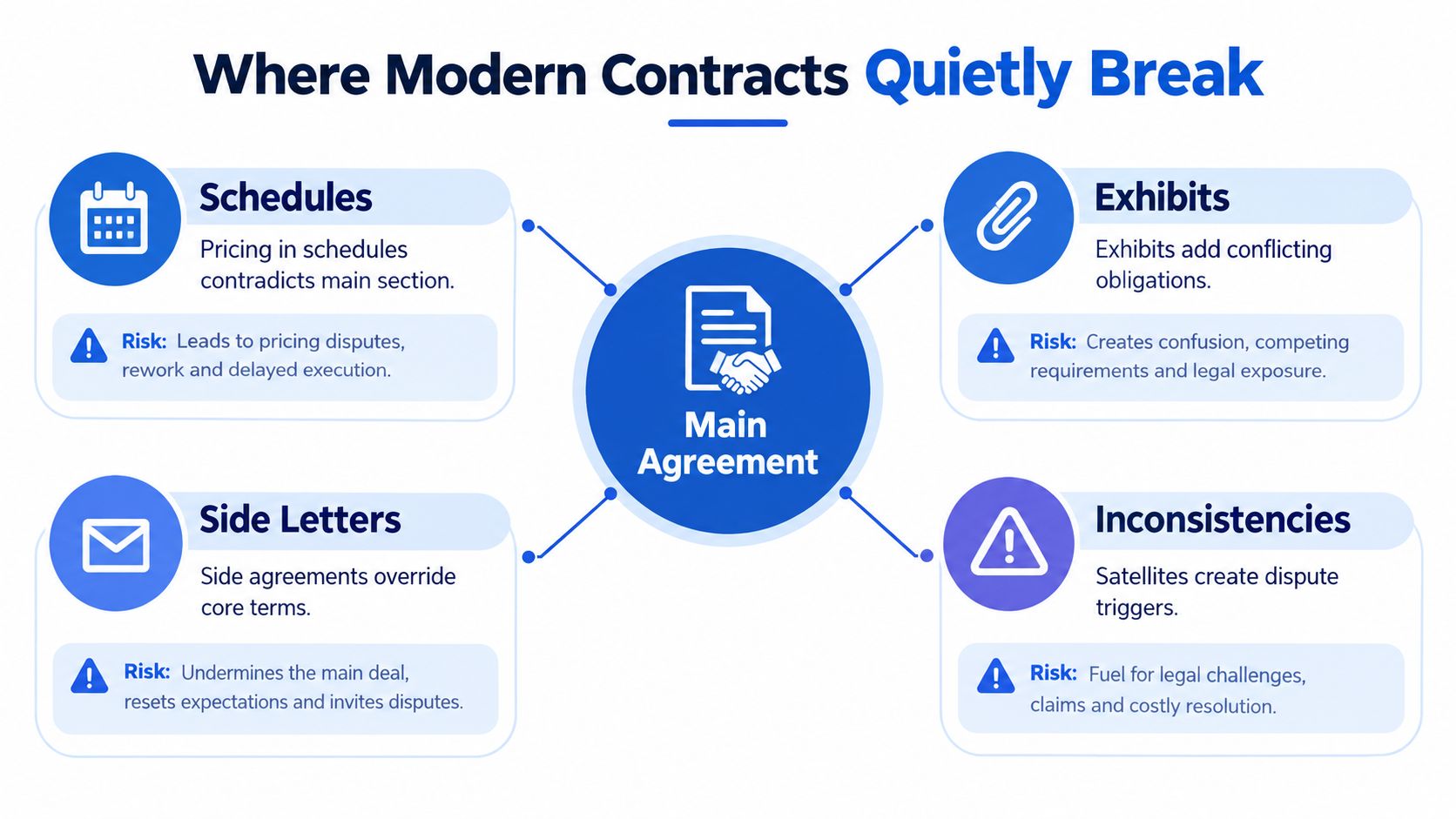
The main agreement isn't necessarily the deal. In a modern SaaS transaction, the operative obligations may be spread across the MSA, Statement of Work, pricing schedule, security exhibit, DPA, acceptable-use policy, and linked product terms. A signature on the MSA doesn't resolve contradictions among those documents.
Consider a simple conflict. The MSA excludes a particular sub-processor, while the DPA permits that sub-processor under a broader authorization. The contract may contain carefully drafted data obligations, yet the customer and provider still disagree about which document controls.
A second conflict can arise in IP language. Section 7 may assign all work product to the customer, while an AI-use provision in an exhibit reserves model inputs, outputs, or provider tooling. If the exhibit has priority, the supposedly broad assignment may be narrower than the business team expects.
Build a document hierarchy
Every agreement should state which document controls in a conflict. A typical hierarchy might place the negotiated order form above the MSA, the MSA above a standard policy, and a DPA above conflicting data-processing language. That isn't a universal answer. The correct hierarchy depends on the transaction and should be negotiated deliberately.
A consistency audit should compare each satellite against the operative clauses:
- Commercial alignment: Pricing schedules must match payment terms, renewal language, taxes, and acceptance triggers.
- Scope alignment: Statements of Work must not add services, service levels, or deliverables without a change-control mechanism.
- Data alignment: DPAs, security exhibits, incident duties, subprocessors, retention, and deletion terms must fit together.
- IP alignment: Assignment, license, feedback, model training, and usage restrictions must use compatible definitions.
- Priority alignment: Every conflict rule must identify the controlling document and the affected subject.
Teams that share exhibits through online portals should preserve the exact version reviewed at signature. A responsive PDF embed with LinkShip can help present a stable reference copy for internal review, but presentation is not document control. The signed record still needs the final PDF, editable source, and all incorporated attachments stored together.
The need for this process is reinforced by contract-analysis findings. An analysis of more than 3,000 public-company contracts covering 60,000 pages found that 60% contained drafting issues, while 2.5% were classified as high-risk because the issue could materially change the agreement's meaning for one party, according to Canadian Lawyer's report on Spellbook's contract analysis. The same report identified an average ranging from 0.18 issues per contract to 3, with larger companies averaging 0.85 errors per contract compared with 1.31 for others. It also reported a 15% high-risk rate for note purchase agreements, compared with about 3% across contract types. Those findings show why a polished form doesn't eliminate review risk.
AI makes the problem more subtle. AI tools trained on large contract collections can produce fluent first drafts, but platforms may generate materially different clause language for the same contract type. AI can flatten deal-specific nuance or import language from an unrelated precedent. A usable workflow therefore standardizes prompts, approved clause libraries, prohibited terms, review thresholds, and cross-document testing before anyone treats the draft as contract-ready.
A practical test asks whether the review process can identify an obligation changed by a schedule, exhibit, addendum, or external policy link. If it can't, the process is reviewing prose rather than the contract.
Contract-management controls should also preserve ownership, renewal dates, notice obligations, and final versions, as discussed in these contract management best practices.
Redlines, Signatures, and Washington State Rules
Redline hygiene is a legal control, not an administrative preference. Track changes should remain on during negotiation, comments should contain real questions rather than private drafting notes, and filenames should identify the date and round number. After each pass, one summary email should identify agreed language, unresolved issues, and the exact version under discussion.
Before signature, the deal team should confirm:
- No placeholders remain: Bracketed names, dates, fees, options, and notice details are resolved.
- Defined terms match: Capitalization and usage are consistent in the body and attachments.
- Exhibits are final: Every referenced schedule, SOW, DPA, and security exhibit is attached.
- Priority rules work: The conflict hierarchy produces the intended result.
- The record is complete: The clean PDF and editable file are stored together with the final exhibits.
Washington's Electronic Authentication Act, codified in RCW 19.34, generally gives qualifying electronic signatures the same legal weight as ink signatures for commercial contracts. The statute excludes categories such as real estate deeds, wills, and certain family-law documents, so the transaction type still matters. A commercial SaaS agreement usually doesn't need a witness or notary merely because the parties sign electronically.
Governing law and venue should also reflect the business reality. A Seattle company may choose a Washington forum, but a contract can select a county, federal district, or arbitration seat. King, Pierce, and Snohomish County disputes may involve different travel, cost, and availability considerations. A venue clause should identify the actual court or arbitration forum rather than vaguely naming a state.
Real-property documents require additional caution. A contract affecting real property may need acknowledgment and recording with the county auditor, depending on the document and the rights being created. Notary and witness requirements also vary by document type. Most ordinary business-to-business agreements need neither, but deeds, certain guarantees, and other specialized instruments shouldn't be signed using a generic commercial workflow.
| Contract Type | E-Signature OK | Notary Required | Witness Required | County Recording |
|---|---|---|---|---|
| Ordinary B2B services agreement | Generally | Usually not | Usually not | No |
| SaaS agreement with DPA | Generally | Usually not | Usually not | No |
| Commercial guarantee | Often, subject to transaction details | May apply in some circumstances | May apply in some circumstances | Usually no |
| Real-estate deed or similar instrument | Special rules apply | Often | Depends on document | Often |
| Will or certain family-law document | Excluded or restricted | Document-specific | Document-specific | No |
Indemnification deserves a focused Washington review because scope, defense control, and statutory context can change the practical exposure. Founders can use this discussion of indemnity clauses in Washington State contracts as a starting point, then obtain transaction-specific advice where the clause affects material risk.
Pitfalls, AI Drafts, and When to Call Counsel
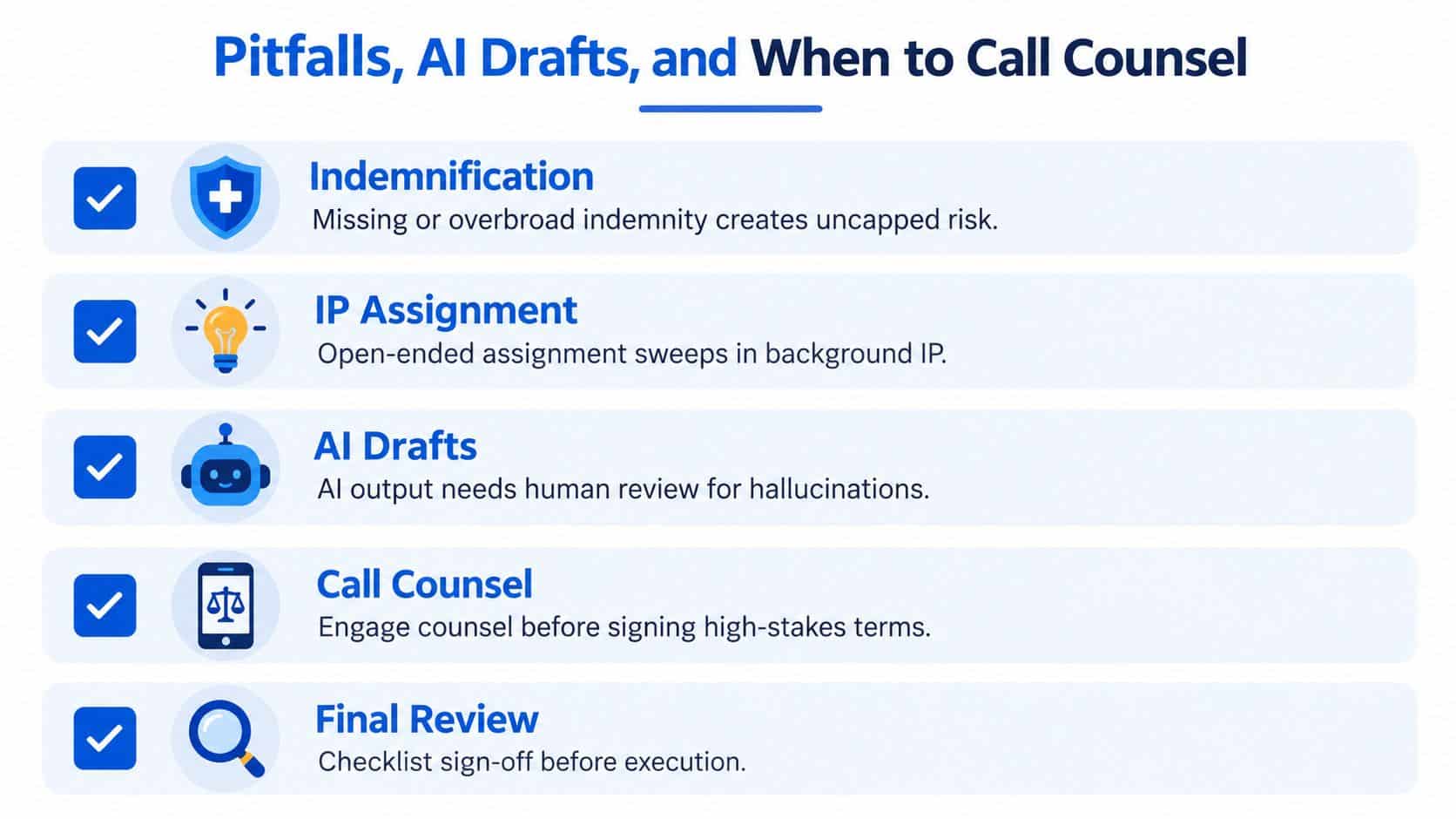
Founder-stage agreements tend to fail in recognizable ways. The company assigns pre-existing code, accepts an indemnity with no meaningful boundaries, sets a liability cap below realistic exposure, forgets an auto-renewal date, or accepts a forum that sends a Seattle dispute to Delaware Chancery without understanding why.
A short final checklist should test the business outcome, not just the typography:
- Risk allocation: Does each indemnity cover a defined risk, with defense and settlement mechanics?
- Background IP: Does the assignment exclude tools, code, models, and know-how that existed before the engagement?
- Liability: Does the cap correspond to the likely exposure, and are carve-outs intentional?
- Renewal: Does someone own the notice date and termination decision?
- Forum: Can the company realistically litigate or arbitrate in the selected venue?
AI can support first-pass drafting, but the prompt should identify governing law, counterparty type, deal value band, business objective, approved positions, and prohibited clauses. Every output then needs human review against a clause-by-clause checklist because models can invent defined terms, create cross-references to nonexistent sections, and import language from foreign jurisdictions.
Contract operations teams may also use tools that turn signed documents into searchable obligations. A practical overview of how Matil extracts contract data illustrates the distinction between drafting assistance and post-signature contract control.
Counsel should be engaged before signature for any deal above a threshold the company sets for itself, any agreement involving regulated data, any cross-border element, any exclusivity or non-compete, and any counterparty form that arrives first. The cost of review is easier to control before a dispute than after the parties have built their positions around conflicting language.
By Design Law Firm & Legal Consultancy, PLLC helps Washington startups and growing companies draft, review, negotiate, and manage agreements involving technology, intellectual property, data privacy, and commercial risk. Visit By Design Law Firm & Legal Consultancy, PLLC to discuss a contract that needs clearer allocation of risk, coordinated exhibits, or careful review before signature. Contact our law office at (206) 593-1519.