A founder in Seattle has just paid a freelance developer, designer, or technical advisor to help launch a product. The files are in the company workspace, the invoices are paid, and everyone assumes the business owns the result. Months later, an investor asks for signed invention and copyright assignments. The contractor says the agreement covered services, not ownership. Suddenly, a routine funding discussion becomes a title problem.
Payment and possession aren't the same as legal ownership. An intellectual property assignment is the written transfer that moves rights from an inventor, author, designer, contractor, or other rights holder to a company or buyer. Without that transfer, a startup may have permission to use its product while lacking the clean ownership record investors, lenders, and acquirers expect.
The risk extends beyond patents. Copyrighted software, brand assets, product designs, trade secrets, technical documentation, and future inventions can all require careful ownership language. The sections below explain what assignment does, what the agreement should contain, how each type of IP is treated, why recordation matters, and how Washington-specific rules affect employee inventions.
Introduction Why Ownership Does Not Transfer Automatically
A startup often begins with informal arrangements. A co-founder writes code before formation. A contractor creates a logo after a short email exchange. An early employee develops a process at home and later improves it with company resources. Everyone may understand the business purpose, but the legal record can remain incomplete.
That gap matters because the person who creates intellectual property may initially hold rights unless an effective agreement transfers them. An employment relationship, an invoice, or access to company equipment doesn't automatically produce a complete chain of title for every kind of IP. Contractor-created work deserves particular attention because contractors generally retain ownership unless a written agreement provides otherwise, as explained in this discussion of independent contractor IP protection.
Practical rule: A company should document ownership when the relationship begins, not wait until an investor, buyer, or lender asks for proof.
An assignment solves the ownership question by transferring specified rights, title, and interest to the assignee. The document can cover existing work, work created during a defined engagement, and future rights to the extent applicable law permits. It can also address background materials, confidentiality, further signatures, warranties, and assistance with patent or copyright filings.
The public record shows why this work matters. The U.S. Patent and Trademark Office Patent Assignment Dataset contains detailed information on 10.5 million patent assignments and other transactions recorded since 1970, covering roughly 18.8 million patents and patent applications. Those records help markets verify ownership, support financing transactions, and investigate disputes.
A founder reviewing title should ask three questions:
- Who created the asset? The answer may include employees, contractors, advisors, co-founders, and outside vendors.
- What document transferred rights? A services agreement may not contain sufficient assignment language.
- Was the transfer recorded where appropriate? A private contract and a public chain of title serve different purposes.
The practical objective is simple. A business should be able to show exactly how each important asset moved from creator to company, and from company to a later buyer if a transaction occurs.
What Intellectual Property Assignment Really Means
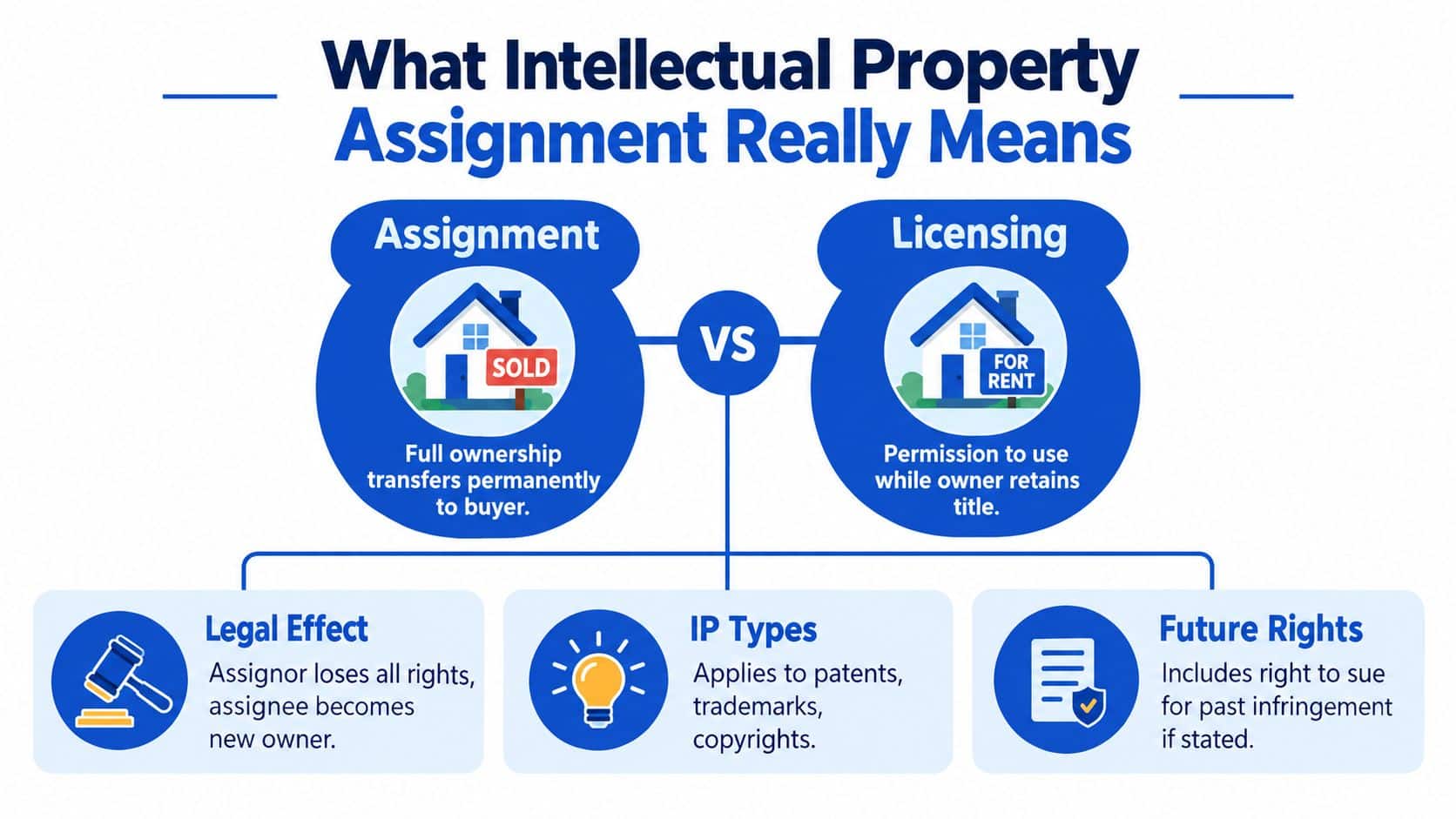
The clearest analogy is a house. An assignment is like selling the house. A license is like renting it. The buyer receives ownership, while the renter receives permission to use the property under agreed conditions.
For IP, the “house” is a patent, copyright, trademark-related interest, trade secret, design, software work, or another legally protected asset. The assignor transfers rights to the assignee. A complete assignment generally aims to transfer the assignor's relevant right, title, and interest, while a license leaves ownership with the licensor.
A license can be narrow or broad. It may be exclusive, nonexclusive, worldwide, limited by field of use, or limited by time. A software creator might license a company to use background code while assigning newly developed code to the company. A trademark owner might license a retailer to use a mark without transferring the mark itself.
An assignment is usually the better fit when the business needs ownership for formation, investment, acquisition, collateral, or centralized enforcement. A license is often more suitable when the creator needs to retain ownership, when several businesses need use rights, or when the company only needs access to pre-existing materials.
The distinction affects enforcement. An assignee generally becomes the new rights holder for the transferred interest. A licensee receives only the rights the license grants, so its ability to sue, sublicense, modify, or commercialize the asset depends on the agreement and governing law. If the parties want the assignee to pursue earlier infringement, the assignment should address that point expressly rather than leaving it to implication.
The difference also appears in business records. The RNC Group IP assignment guide can serve as a supplementary reference for founders comparing assignment language and transaction structure. Businesses evaluating a license instead can review intellectual property licensing considerations before choosing between a transfer and permission to use.
A public record can grow quickly when businesses buy, sell, finance, and reorganize IP. The USPTO's dataset reflects a searchable ownership history, not merely a stack of private contracts. That history lets a buyer trace title and identify recorded licenses, security interests, mortgages, liens, mergers, and name changes.
A useful decision test is:
- Ownership needed: Use an assignment when the company must control the asset as its own.
- Use rights needed: Use a license when another party should retain title.
- Mixed needs: Assign newly created work and license clearly identified background IP.
- Future transaction expected: Draft for recordation, successor entities, enforcement rights, and further assurances.
Essential Elements Every Assignment Agreement Needs
A strong assignment agreement does more than state that “all IP belongs to the company.” It identifies the parties, describes the property, states the exchange, and creates a document that can withstand later scrutiny. A practical U.S. checklist expects the agreement to be written, identify all parties, specify the IP transferred, state consideration, and be properly executed by the assignor.
Identify the parties and the asset
The agreement should name the correct legal entities and individuals. A founder signing personally is different from a company signing through an authorized representative. The document should also distinguish an entity's former name, current name, subsidiaries, and successors where those details affect title.
The IP description needs equal care. Patent numbers, application numbers, trademark registrations, copyright registrations, software repositories, design files, written works, technical specifications, and schedules can provide useful precision. Broad language may supplement a schedule, but it shouldn't replace a clear description of what the parties intend to transfer.
Use present assignment language
Language such as “assigns” or “hereby assigns” signals a present transfer. A promise to assign later can create a different legal result and may require another document. Agreements often address both current rights and an obligation to sign additional documents for future filings or newly created work.
State consideration and include protections
Consideration is the value exchanged for the transfer. It may be stated as cash, compensation, equity, royalties, continued engagement, or another negotiated benefit, depending on the arrangement and applicable law. The document should avoid ambiguity about whether the transfer is part of compensation or a separate transaction.
Representations and warranties can cover ownership, authority, noninfringement to the extent negotiated, prior licenses, liens, encumbrances, and the absence of conflicting grants. These provisions help a buyer or investor understand what the assignor is promising and where liability may be limited.
Core principle: The agreement should make the ownership transfer understandable to a person who wasn't in the room when the deal was made.
Execute the document correctly
The assignor should sign in the correct capacity. Signature blocks should match the party names, and the company should confirm that the signer has authority. Digital signatures may be acceptable in many transactions, but recordation offices and foreign jurisdictions can impose additional requirements.
A founder can use this short review list before relying on a template:
- Party names: Do the legal names match formation and vendor records?
- IP schedule: Can an outsider identify the transferred asset?
- Transfer wording: Does the document assign rights now, not merely promise a later transfer?
- Consideration: Does the agreement state what the assignor receives?
- Execution: Are signatures, dates, capacities, and required formalities complete?
Precision prevents the common dispute in which everyone agrees about the business goal but disagrees about the asset, timing, or scope of the transfer.
How Assignment Works for Copyrights Patents Trademarks and Trade Secrets
Different IP rights carry different transfer mechanics. A single generic clause may start the process, but it shouldn't be treated as a complete solution for every asset.
| IP Type | Writing Required | Special Transfer Rule | Recordation Venue |
|---|---|---|---|
| Copyright | Generally, a writing signed by the owner or authorized agent | The document should identify the transferred rights and address priority concerns | U.S. Copyright Office |
| Patent | A written assignment is used to transfer ownership interests | Chain of title should connect inventors, employers, founders, and later owners | USPTO |
| Trademark | A signed writing is required for validity | The mark must transfer with the goodwill connected to the business | USPTO |
| Trade secret | Contractual documentation and confidentiality controls are central | The recipient must preserve secrecy and define permitted access and use | No single public registry for the secret itself |
Copyright
For U.S. copyrights, an assignment generally must be in writing and signed by the owner or an authorized agent. The agreement should identify the work and the rights transferred, such as reproduction, distribution, public performance, display, adaptation, or other rights relevant to the business.
Software assignments should account for source code, object code, documentation, interfaces, and contributions from multiple creators. The company should also identify third-party or open-source components because an assignment cannot give the company rights the assignor never owned.
Patents
Patent title often begins with the inventor and moves through an employer, startup, acquirer, or financing party. Each transfer should fit into a consistent chain. Missing inventor signatures or assignments from former contractors can create a gap even when the company paid for development.
Patent documents can also address applications, continuations, divisionals, foreign counterparts, and the right to claim priority. A diligence reviewer will compare the agreement with USPTO records and corporate changes, so names and entity history should remain consistent.
Trademarks
Trademark assignments require special care. Under the Lanham Act, a mark is assignable only with the goodwill of the business connected to the mark, and a signed writing is required for validity. An assignment that separates the mark from its goodwill can be an invalid assignment in gross, as described in the Ninth Circuit trademark assignment guidance.
A trademark transfer should therefore identify the relevant business goodwill, related assets, and quality-control responsibilities. Founders comparing brand protection options can also review trademark, copyright, and patent distinctions.
Trade secrets
Trade secrets don’t move through a single public registry. The assignment should describe confidential information without disclosing it unnecessarily, while related confidentiality, access, return, and security provisions preserve secrecy. A company should document who may use the information, for what purpose, and what happens when the relationship ends.
Recordation and Public Chain of Title at the USPTO and Copyright Office
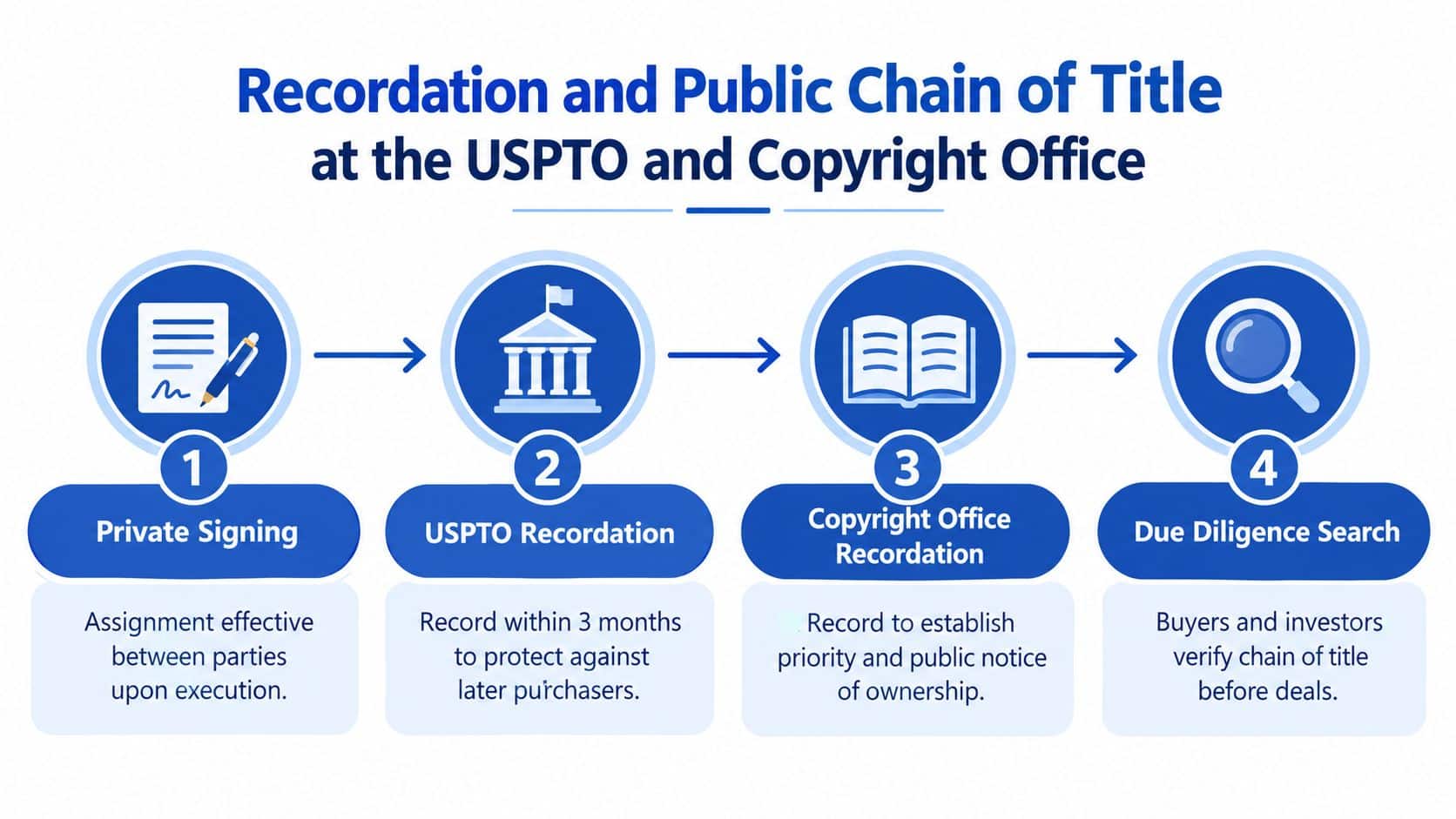
Signing creates the private relationship. Recordation creates public notice and helps establish priority. The two steps work together, but they aren’t interchangeable.
The historical connection is well established. In the late nineteenth century, U.S. copyright law required an assignment to be in writing, signed by the proprietor, and recorded to be effective against later purchasers without notice. The historical account of the 1870 Copyright Act illustrates why public recordation became part of ownership practice rather than a purely administrative afterthought.
Patent recordation
Patent assignments and related transactions are recorded with the USPTO. For U.S. patent assignments, recording within three months can protect the transfer against later purchasers without notice, as summarized in U.S. intellectual property transaction guidance. A late recordation doesn’t necessarily erase the private agreement between the parties, but it can weaken the assignee’s position against certain later interests.
The USPTO record may include assignments, name changes, mergers, licenses, security interests, mortgages, and liens. A buyer or lender searches those records to determine whether the seller owns the asset free of competing claims.
Copyright recordation
Copyright assignment recordation is generally optional, but it can affect priority against later conflicting transfers. The Copyright Office record provides public notice and gives a diligence reviewer a place to verify the transfer. The agreement should still be preserved with signature records, schedules, and supporting entity documents.
Cross-border complications
A cross-border assignment can require more than an English-language signature. WIPO materials on patent assignment formalities identify possible requirements such as notarization, translation, a local agent, fees, and recordation. Requirements vary by jurisdiction and by IP type.
Deal discipline: Record the transfer promptly, then search for licenses, liens, mortgages, security interests, and earlier assignments before representing that title is clean.
If a signature is missing, the parties may use a confirmatory assignment, obtain a former contractor’s signature, update a name record, or address the defect through transaction warranties and indemnities. The solution depends on the gap. A confirmatory document can’t safely be treated as a universal cure without reviewing prior transfers and intervening rights.
Founders preparing a brand filing can also use a practical logo trademark process checklist, while keeping trademark recordation distinct from the underlying business transfer.
Consideration Taxes and Negotiation Tips for Founders and Businesses
The signature page is where legal ownership meets business advantage. A founder may offer cash, equity, royalties, continued work, or another benefit as consideration. The agreement should state the exchange clearly, while tax counsel evaluates whether the transaction is treated as compensation, a sale, a royalty arrangement, or another category.
Tax characterization can affect both parties, but the assignment agreement shouldn’t promise a tax result. Founders should coordinate with tax professionals before choosing language that could conflict with payroll, equity, accounting, or withholding treatment.
Separate employees from contractors
Employees and contractors shouldn’t be placed in the same ownership bucket. Employees may create IP in the course of employment that the employer owns under applicable rules and agreements, while contractors generally need a written assignment. The agreement should identify pre-existing materials and provide a license if the contractor’s background tools, templates, code, or processes remain embedded in the deliverable.
A startup should also avoid assigning unrelated personal work through an overbroad clause. The scope should connect the transfer to company services, company resources, business activities, or defined deliverables, subject to governing law.
Apply Washington’s invention limits
Washington law limits employee invention assignment clauses. If an employee creates an invention entirely on personal time without using employer equipment, supplies, facilities, or trade secret information, the clause doesn’t apply unless the invention relates directly to the employer’s business, anticipated research and development, or work the employee was hired to perform. For agreements entered after September 1, 1979, the employer must provide written notice of that carveout when the agreement is made, under RCW 49.44.140.
That rule makes an invention schedule and a clear notice valuable. A Washington employer should identify prior inventions, avoid claiming more than the statute permits, and review assignments before using them in a financing or acquisition.
Negotiate the protections
Negotiation should address more than the transfer sentence:
- Ownership warranties: Confirm that the assignor owns the rights and has authority to transfer them.
- Existing encumbrances: Identify licenses, liens, security interests, and prior commitments.
- Creator rights: Address attribution, moral rights, approval rights, and waiver language where applicable.
- Future inventions: State how future work will be assigned and what additional signatures may be required.
- Liability limits: Define indemnity scope, caps, exclusions, survival, and procedures for an IP claim.
The earlier the company raises these issues, the more options it has. Asking a former contractor to repair title during a financing can give that contractor practical influence that didn’t exist when the engagement began.
Putting Your Assignment Strategy Into Action
A founder can treat the IP portfolio like a property portfolio. Each asset needs a deed, a clear owner, and a record showing how title moved. A license may be the right equivalent of renting, but a financing or sale often requires the company to own the core assets outright.
The cleanup process should be practical:
- Inventory the assets: List software, inventions, designs, written works, brands, data, trade secrets, and technical materials.
- Trace the creators: Identify employees, contractors, advisors, co-founders, vendors, and prior employers involved in development.
- Collect the documents: Find employment agreements, consulting agreements, PIIAs, purchase agreements, licenses, schedules, and signature records.
- Flag gaps: Separate missing assignments from unclear descriptions, wrong entity names, absent signatures, and unrecorded transfers.
- Repair before diligence: Obtain confirmatory assignments, update records, review encumbrances, and prepare ownership warranties before a financing or acquisition.
- Maintain the file: Store executed agreements with IP schedules, filing receipts, amendments, and entity records.
A business due diligence checklist can help organize the broader review. For related context on confidentiality, registrations, contracts, and other methods of protecting intellectual property, founders can consult additional legal resources.
By Design Law Firm & Legal Consultancy, PLLC advises founders and businesses on IP ownership, licensing, assignments, contracts, and transaction diligence. The firm can review existing agreements, prepare assignment documents, and help clean up chain-of-title issues before a funding round or sale.
By Design Law Firm & Legal Consultancy, PLLC can review founder, employee, advisor, and contractor agreements to confirm whether the company owns its core IP. Visit By Design Law Firm & Legal Consultancy, PLLC to schedule guidance on assignments, recordation, and ownership cleanup before the next financing, acquisition, or product launch. Contact our law office today at (206) 593-1519.