A startup founder gets the call every growing company hopes for, and dreads a little. A larger business wants to use the software, brand, data set, or product concept that took months or years to build, and it wants to do it under an intellectual property licensing deal. That moment is not just a legal conversation, it's a business decision about control, reach, and how much risk the company is willing to carry while someone else turns protected rights into revenue.
A license is a permission slip, not a sale. The owner keeps title, while the other side gets authorization to use defined rights for a defined purpose, time, and place, often in exchange for a lump sum, recurring royalties, or both, as WIPO explains in its business guidance on assignment and licensing. That distinction matters because licensing is one of the main ways companies monetize innovation without giving up the asset itself, and the market is large enough to show that this is a core commercialization channel, not a niche legal tactic, especially in North America where the U.S. intellectual property leasing industry was estimated at $72.4 billion in 2026 within a global market of roughly $340 billion in 2024 (IBISWorld).
For a founder worried about copycats or overexposure, the right resource on combating intellectual property infringement can help frame the enforcement side of the equation, but licensing itself is usually the cleaner growth play when the business wants to expand without giving up ownership.
Understanding Intellectual Property Licensing
A licensing deal starts with a practical question. Who gets to use the asset, for what purpose, and how far does that permission extend? The answer has to be precise, because the licensor needs room to preserve value outside the deal while the licensee needs enough certainty to commercialize without crossing the line.
Licensing sits at the center of growth strategy because it lets a business earn from protected rights without giving up control of the underlying asset. That matters for patents, brands, creative works, and confidential know-how, especially when the owner wants distribution, speed to market, or a partner relationship without a full sale. It also explains why the market for protectable rights keeps expanding. WIPO reported that in 2024, patent applications rose to 3.7 million, utility model filings reached 3.3 million, design filings climbed to 1.6 million, and patents in force worldwide grew to an estimated 19.7 million (WIPO IP Facts and Figures 2025).
A license should preserve bargaining power. A broad grant with no clear limits can start to resemble a transfer, which usually weakens the startup's position later.
Founders also need to separate licensing strategy from enforcement strategy. If the business is already dealing with misuse or copying, combating intellectual property infringement may be part of the response, but licensing works best when the company uses it to control access, set reporting expectations, and protect future deal value. For a clear overview of the different rights that can be licensed, see the main types of intellectual property rights.
The Four Pillars of Intellectual Property
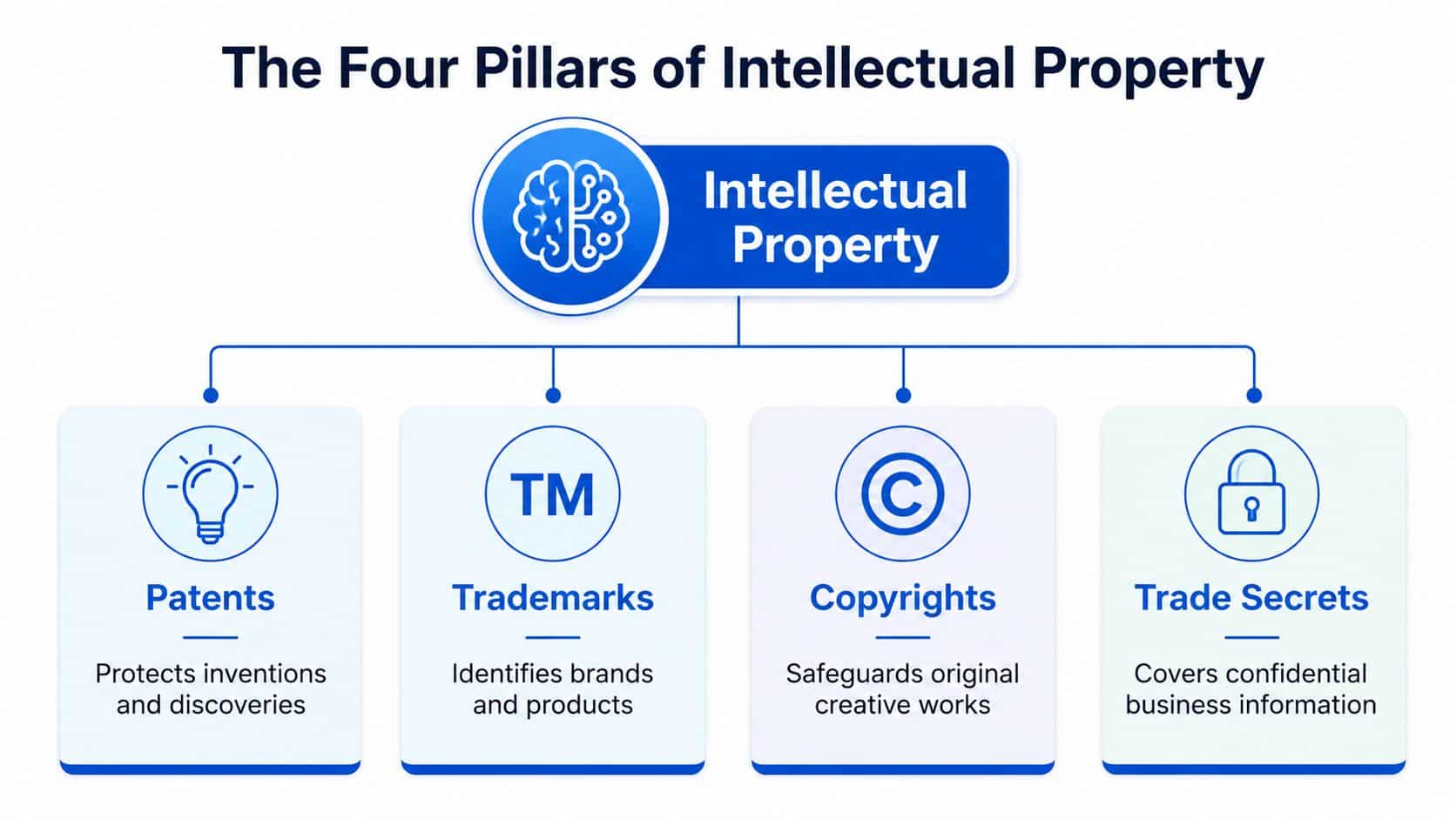
Before anything can be licensed, the owner has to know what the company really owns. That sounds obvious, but many businesses mix up the invention, the brand, the content, and the confidential process that made the business work in the first place. Those are different assets, and each one carries different licensing value.
Patents and trademarks
A patent protects the function of an invention, like the blueprint for how something works. In a licensing setting, that matters because the license can be tied to a specific product, method, or technical field, and the owner can still reserve other uses. Think of it as a controlled pass to use the invention's core mechanics, not a blank check to copy the whole business model.
A trademark protects brand identity. It tells the market who made the product or service, so the license has to police quality, presentation, and the way the mark appears in commerce. That's why a trademark license without brand standards can erode value faster than it creates it.
Copyrights and trade secrets
A copyright protects original expression, including software code, written materials, images, and other creative works. In practice, the license should spell out which versions, formats, and derivatives are included, because copyright deals often break down when the parties assume “the content” means the same thing to both sides.
A trade secret covers confidential business information, the stuff that gives the company a competitive edge because it isn't public. In licensing, the challenge isn't just permission, it's containment, access control, and proof that the recipient will keep the information confidential enough to preserve its value. The internal taxonomy of rights matters here, and a useful explainer on intellectual property rights types can help a business sort those assets before negotiations start.
Some businesses have one licensable asset. Most have four, and they're rarely packaged the same way.
Key Licensing Structures and Models
A license structure does more than label the deal. It controls how much freedom the owner keeps for other transactions, and how much certainty the licensee has to spend, build, and train a team around the rights. In practice, that choice can decide whether a startup gets room to scale or ends up boxed in by a narrow grant.
An exclusive license gives one licensee the right to use the asset within the agreed scope, so the licensor gives up the ability to place the same rights with another party in that space. A non-exclusive license leaves room for multiple licensees, which can be the better commercial fit when the technology, brand, or content can support parallel deals without undercutting itself. A sole license splits the difference. The licensee gets the only operating right, but the owner still keeps its own right to use the asset.
Choosing the right lane
The right structure depends on what the licensee is buying. If the counterparty is funding development, entering a new market, or taking on meaningful integration work, an exclusive deal can justify that commitment because it reduces competitive leakage. If the asset has broader utility, a non-exclusive model often creates more total value by letting the owner place the same rights with several users instead of betting everything on one channel.
Field-of-use restrictions sharpen that decision. Cambridge's licensing framework treats licensed rights and the field of use as separate ideas, which is exactly how a careful licensor keeps one partner in a defined market while reserving other markets for different deals or internal use (Cambridge license building blocks). That distinction matters in technology and AI agreements, where the same underlying system may be useful in healthcare, logistics, or consumer software, but each use carries different risk, support burden, and compliance pressure.
For a founder, the trade-off is practical. Broader exclusivity can help close a strategic partner, but it can also lock up future revenue if the scope is drawn too wide. Narrower rights preserve optionality, yet they may leave a licensee unwilling to invest unless the contract gives enough certainty around market, geography, or customer segment.
| Attribute | Exclusive License | Non-Exclusive License |
|---|---|---|
| Right to use | Granted to one licensee only | Granted to multiple licensees |
| Owner's ability to license others | Usually barred | Preserved |
| Commercial upside | Higher value per deal, less flexibility | Broader reach, more parallel revenue paths |
| Best fit | Strategic partnership, heavy investment | Scalable monetization, broad distribution |
Sublicensing adds a second layer of control. If the licensee can pass rights to distributors, implementers, or affiliates, the agreement should say who approves those downstream users, what standards they must follow, and who bears the risk if a sublicensee drifts outside the permitted use. Without that guardrail, the licensor may still own the IP on paper while losing practical control over how it is deployed.
Dissecting Key Commercial Terms
The economics of a license live in the details, not the label on the deal. A term sheet that looks generous on paper can become expensive or hard to enforce if the scope is vague, the royalty base is wrong, or the termination language leaves both sides guessing. In a startup deal, those drafting choices decide whether the license supports growth or becomes a recurring source of friction.
Scope, royalties, and timing
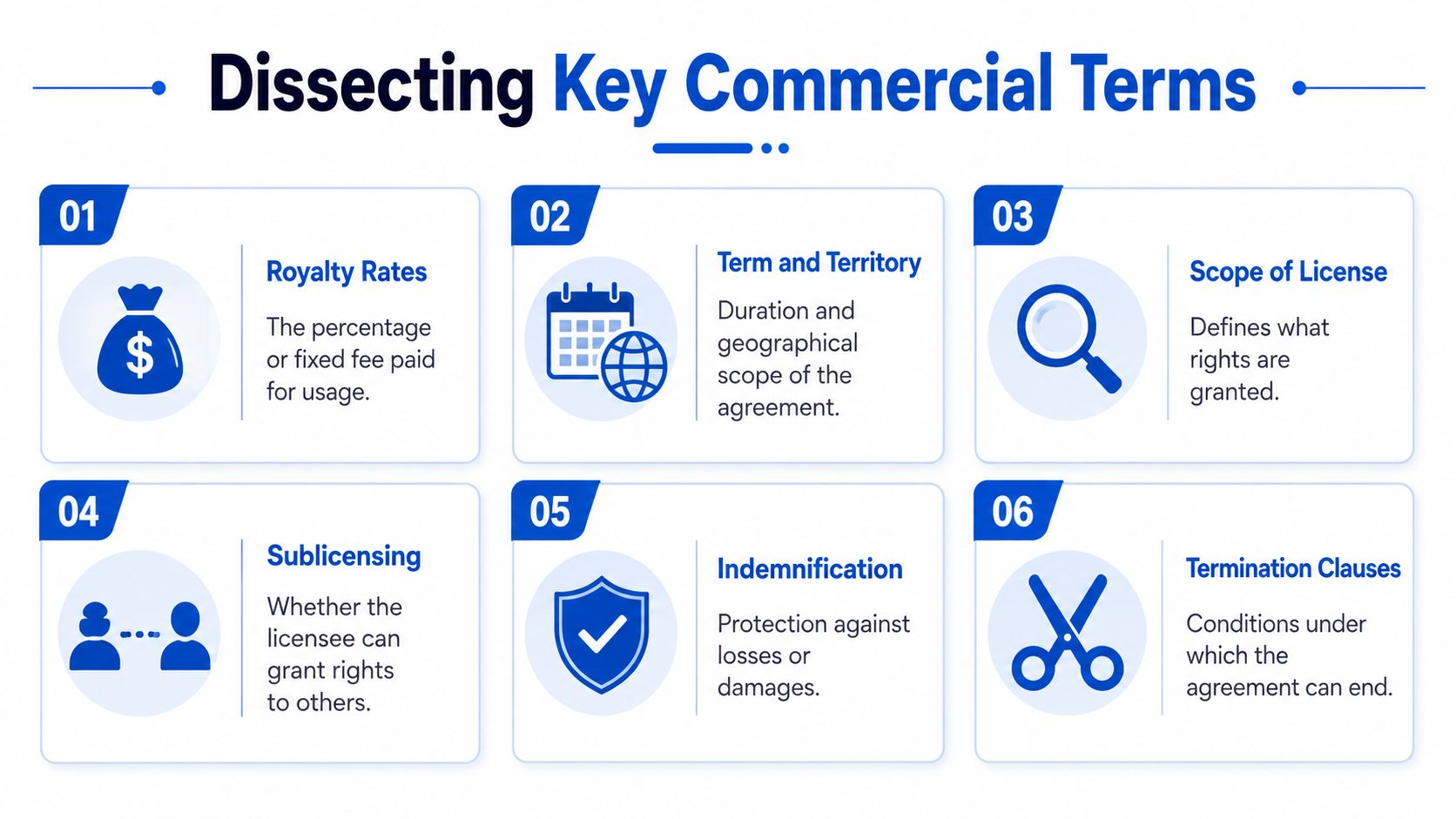
Scope needs to be specific. A sound license defines the exact rights granted, the products covered, and the activities allowed, because ambiguity over scope is where disputes usually start. Separate the field of use from the licensed product definition so royalty obligations attach to the right commercial activity, not to something merely adjacent to it.
Royalty mechanics can take different forms. Licenses are commonly priced through a lump sum, recurring royalties, or both, and some agreements use an upfront payment while others use running royalties tied to sales and units sold. That mix matters because the payment formula changes not only revenue timing, but also auditability and enforcement power.
A few terms deserve special attention:
- Royalty base: The contract should say whether the fee is based on net sales, gross revenue, or another measure. A royalty on gross revenue means the licensor gets a percentage of the total sale price. A royalty on net sales allows deductions such as returns or shipping costs, which can change the final payment materially.
- Term and territory: The parties need a real end date and a real geographic boundary, not a vague promise.
- Termination triggers: Breach, nonpayment, and insolvency should be spelled out, because “reasonable notice” is too loose when money is on the line.
- Warranties and indemnities: These clauses tell each side who is responsible if the licensed rights are challenged or the use causes loss.
If the agreement cannot answer how money is counted, it is not ready for signature.
For a founder, the takeaway is direct. A good commercial structure makes the relationship easy to operate, easy to audit, and hard to misunderstand. A sloppy one turns every invoice into a dispute.
Commercial terms also have to survive the day after closing. A clean signature does not fix a weak royalty report, a drifting sublicensee, or a product team that starts using the licensed material in a new AI workflow without checking the grant. If the deal touches code, datasets, or model outputs, the operating rules should be documented in writing, and they should align with our platform’s legal guidelines and a clear non-disclosure agreement drafting guide so the business can control access as the relationship grows.
A practical example helps. A licensee that sells software through enterprise contracts may want net sales treatment, because support credits, refunds, and reseller fees can materially affect the cash that comes in. The licensor may prefer gross revenue because it is easier to track and harder to manipulate. That is not a theoretical dispute. It is the difference between a royalty stream that matches the business model and one that forces repeated accounting fights.
Post-signature governance matters just as much as the first draft. Someone has to monitor usage, verify reports, approve any sublicensing, and confirm that the licensee has not expanded into an unapproved channel or trained an AI model outside the agreed scope. If those controls are missing, the licensor may still hold title to the IP while losing practical control over how it is commercialized.
Drafting Negotiation and Due Diligence
Good licensing deals are built before the first redline comes back. The party with the cleaner diligence usually has the stronger negotiating position, because it knows what the asset is, who owns it, and where the pressure points live. That preparation also keeps the discussion focused on business reality instead of wishful thinking.

What each side should check
A licensee should verify ownership, chain of title, encumbrances, and whether the asset is usable for the intended business model. A licensor should check the other side’s financial strength, technical capacity, and ability to report accurately, because a weak licensee can create a weak royalty stream even when the contract looks strong.
A practical checklist helps both sides stay disciplined:
- Confirm ownership. Make sure the licensor really controls the rights being offered.
- Map the use case. Align the contract with the actual product, channel, or market.
- Test reporting systems. If royalty tracking is clumsy now, it won’t get better after launch.
- Review confidentiality controls. That matters especially when the deal touches code, data, or manufacturing know-how.
For teams that want a clear negotiation baseline, our platform’s legal guidelines are a useful reference point for thinking about document discipline, but the primary value comes from pairing process with careful drafting.
The NDA often comes first, and it should be built to support the license discussion instead of muddying it. A practical guide on how to draft a non-disclosure agreement can help businesses protect the information that has to move during diligence without overpromising confidentiality that cannot be enforced.
Negotiation leverage without the drama
The strongest negotiating positions usually come from clarity, not aggression. A licensor with strong records can push for tighter scope and stronger audit rights, while a licensee with a meaningful commercialization plan can ask for field-of-use protection, approval rights, or limited exclusivity. The point is not to win every clause, the point is to make sure the deal can operate after everyone stops talking.
Midway through that process, a short working session often helps more than another markup. A neutral review of assumptions, payment mechanics, and operational dependencies prevents the contract from becoming a beautiful document that nobody can administer.
Common Pitfalls and Post-Signature Governance
Many teams celebrate when the signature page is complete, then stop paying attention. That’s a mistake. Value from a license is protected or lost after signing, when invoices go out, reports come in, and someone has to decide whether the other side is staying inside the box.
Why the back end matters more than the handshake
WIPO’s licensing materials emphasize ongoing management, reporting, and auditing as core parts of a successful licensing relationship, and they also flag the importance of due diligence and long-term oversight (WIPO SME licensing guidance). That aligns with what happens in practice. A license can look perfect at signing and still fail because the royalty reports are late, the payment formula is disputed, or the licensee starts drifting beyond the permitted scope.
Rule of thumb: if there’s no audit path, the royalty stream is only as good as the licensee’s goodwill.
Governance is also where regulatory and competitive issues can surface. If a license restricts use of competing technologies or operates in a market with strong concentration, poor drafting and weak oversight can create broader antitrust concerns, not just payment disputes. The license should therefore anticipate how compliance will be checked, who keeps records, and what happens when numbers don’t reconcile.
A trade secret license is especially sensitive here. The internal discipline around access, confidentiality, and use restrictions has to stay active throughout the relationship, not just at the start, which makes a focused reference on trade secret protection particularly relevant for businesses sharing manufacturing methods, source code, or product formulas.
How to keep the deal enforceable
The operating playbook should include reporting deadlines, audit rights, notice provisions for breach, and a cure process that is realistic. If the licensee exceeds the scope, the owner needs a clear path to enforce the agreement without waiting for the damage to compound. If the contract is silent on remedies, the parties end up negotiating under pressure, which is the most expensive time to be vague.
A good post-signature process also supports future renewals and amendments. Businesses that track performance carefully have more bargaining power when it’s time to expand territory, add a product line, or renegotiate economics.
The New Frontier AI and Washington State Considerations
AI is forcing licensing to evolve faster than many templates can keep up. Traditional contracts know how to handle patents, copyrights, territory, and royalties, but they often miss the harder questions, like who can use training data, how provenance is documented, and whether the output can be commercialized without creating downstream liability.

AI changes the licensing questions
WIPO’s podcast transcript on IP matters notes that standard licensing guides often miss model training rights and data provenance, even though those issues are now central to data-driven business models (WIPO IP Matters transcript). That is the key shift. The contract is no longer only about whether a party may copy, distribute, or display a work, it’s also about whether a model may ingest data, retain patterns, and generate outputs that echo the underlying materials.
That is where rights-cleared datasets become strategically important. A resource on rights-cleared egocentric data is useful context for teams that want to understand how data rights and downstream usage restrictions are being treated in the market. The issue is not academic. If the chain of permission is unclear, the entire licensing stack becomes harder to defend.
For Seattle and the broader Washington tech ecosystem, the practical problem is speed. Startups want to move quickly, but AI licensing deals can bind the company to promises about training, confidentiality, indemnity, output use, and human review that are easy to underappreciate in a first draft. A local contract lawyer who understands software, data, and commercial licensing can help a founder avoid signing a template that fits yesterday’s deal but not today’s product.
When to stop DIY drafting
The DIY approach stops making sense when the deal includes any of these moving parts, proprietary data, model training rights, sublicensing, or a brand that could be damaged by sloppy downstream use. It also stops making sense when the business can’t easily explain how it will monitor compliance after launch.
A focused reference on IP challenges in the age of AI can help a leadership team see why these clauses need more than a generic software contract. The core business objective is simple, protect the asset, preserve optionality, and make the agreement enforceable when the relationship gets complicated.
By Design Law Firm & Legal Consultancy, PLLC helps Washington businesses structure, negotiate, and enforce intellectual property licensing agreements that work effectively in practice, especially when software, data, brands, and trade secrets are all in play. For founders and operators who need practical legal guidance on licensing, AI risk, and long-term governance, visit By Design Law Firm & Legal Consultancy, PLLC and start with a conversation built around the deal you’re trying to close. Call our law office today at (206) 593-1519.