A founder signs a proposal for a promising product, pays the first invoice, and watches the development team begin work. Weeks later, the founder expects a production-ready application, while the developer believes the engagement covers an evolving set of services. The statement of work says “build the platform,” the deadline moves, new features appear in meetings, and nobody can identify the precise moment when a milestone becomes complete. By the time the disagreement reaches the lawyers, both sides may have spent substantial money and still lack a usable agreement about what was supposed to be delivered.
Software development agreements prevent that outcome by converting commercial expectations into operational rules. They define the work, assign intellectual property, connect payment to delivery, establish testing procedures, and determine who carries the risk when assumptions fail. For a Washington startup, the agreement also needs to account for data handling, contractor relationships, source-code access, and the growing use of artificial intelligence in development.
Understanding Software Development Agreements
A software development agreement is the contract between a customer and a development provider for creating, modifying, testing, deploying, or supporting software. It can stand alone for a single build, or it can work with a master services agreement and separate statements of work for an ongoing relationship. Unlike a basic services contract, an SDA must address technical deliverables that evolve through design, coding, testing, deployment, and maintenance.
The practical comparison is a construction contract. A homeowner wouldn't hire a builder with only the instruction “construct a house.” The parties would identify the plans, materials, responsibilities, schedule, payment stages, inspection process, change orders, and remedies for defective work. Software is less visible than a building, but the same discipline applies. A phrase such as “modern user experience” doesn't tell anyone which screens, workflows, integrations, performance requirements, or accessibility standards belong in the deliverable.
Historically, software development contracts emerged as software moved from being bundled with hardware to a separate commercial product. A 2018 law review article traces modern industrial-scale software development to the 1950s System Development Corporation and explains that these contracts increasingly addressed functionality, operation, ownership, usage rights, and maintenance obligations before and during development. Earlier academic material places the waterfall model, closely associated with contract-driven delivery, around 1970 and summarizes that more than 50% of large projects may be delayed, abandoned, unusable, or otherwise unsuccessful. These historical patterns help explain why contract structure remains central to software delivery. The University of Michigan software development lecture materials provide that background.
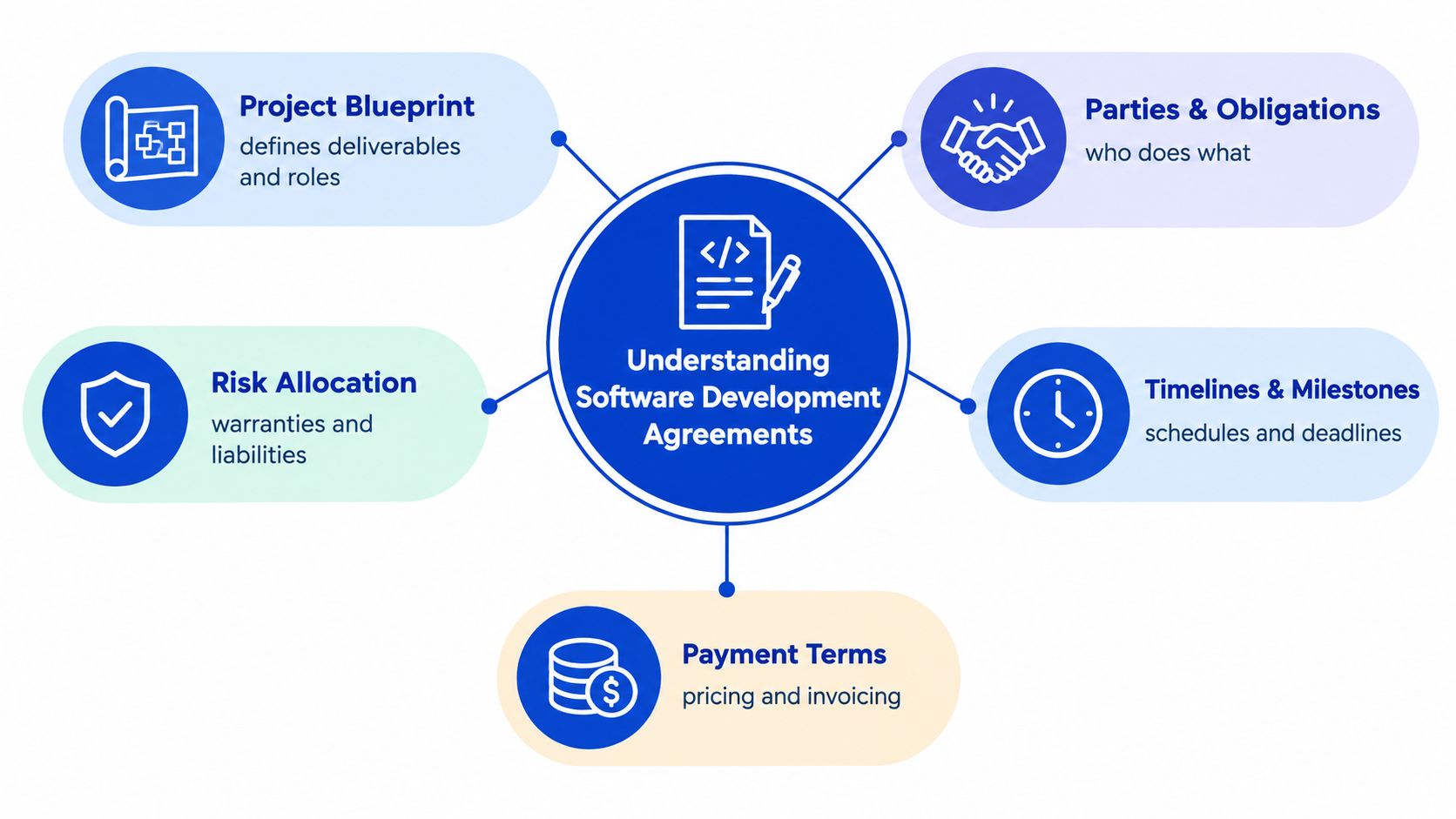
What the agreement must accomplish
A sound SDA aligns four groups of expectations:
- Product expectations: What features, interfaces, integrations, documentation, and environments will the developer deliver?
- Commercial expectations: How will the customer pay, and when does the developer earn each payment?
- Control expectations: Who owns the code, who may use reusable components, and who can maintain the system later?
- Risk expectations: What happens if the software fails testing, infringes third-party rights, exposes confidential information, or the relationship ends early?
The agreement also distinguishes a development partnership from a simple vendor transaction. A capable team may contribute architecture, technical judgment, and reusable tools. A customer may contribute product decisions, data, access credentials, testing resources, and regulatory requirements. The contract should allocate those contributions instead of assuming that one party controls the entire project.
Founders evaluating the relationship itself may benefit from the practical discussion in Software Development Partnership That Delivers Value, particularly when the provider will remain involved beyond the initial build. For broader service relationships, a founder should also understand how an MSA agreement can hold recurring legal terms while each project receives its own statement of work.
Practical rule: If the product team, engineering team, and finance team would describe “complete” differently, the contract isn't ready to sign.
Key Clauses in Every Software Development Agreement
The strongest software development agreements connect legal language to the way the team will work. A clause shouldn't merely announce that the parties will cooperate. It should identify the artifact, decision, test, notice, or payment event that proves performance.
Scope and deliverables
The statement of work should identify the functional requirements, technical assumptions, exclusions, dependencies, documentation, deployment responsibilities, and post-launch services. “Build a customer portal” is a business objective, not a deliverable. A usable scope might identify user roles, authentication methods, required integrations, reporting functions, supported environments, data migration responsibilities, and the documents delivered at handoff.
Scope also needs a change-control mechanism. A request that alters features, architecture, timeline, or staffing should require a written change order identifying the effect on price and delivery. Informal approvals in email or chat can be recognized if the parties want that flexibility, but the agreement should identify who has authority to approve them.
Payment and acceptance
Payment terms should follow delivery risk. A developer shouldn't have to finance an entire build while waiting for an undefined final approval, and a customer shouldn't pay the full fee before receiving meaningful work. Milestone invoices work only when the milestone has an objective definition and an acceptance procedure.
A U.S. government defense study of 371 software projects found a median planned duration of 28 months compared with an actual duration of 34.9 months, median duration growth of 12%, and only 21 projects, or 6%, finishing within 12 months or less. The same report found average contract cost growth of 138% and total software development budgets of $7.6 billion across the contracts studied. Those figures come from the Defense Industrial Base software acquisition study, and they illustrate why an SDA needs more than a headline fee and target date.
Intellectual property
The agreement should state who owns source code, object code, designs, documentation, updates, inventions, and other project-specific material. It should separately address pre-existing tools, reusable frameworks, third-party libraries, open-source components, and embedded services. WIPO identifies four common ownership mechanics, IP assignment, IP licensing, work-for-hire, and joint ownership, and the agreement should choose deliberately among them rather than use “work made for hire” as a substitute for complete drafting. WIPO's guide to securing software IP ownership explains those approaches.
Warranties, indemnities, and liability
Warranties should match the actual promise. A fixed-scope build may warrant conformity with the specifications and correction of defects. An ongoing platform engagement may also need service levels, security commitments, maintenance obligations, and defined exclusions.
Indemnities allocate third-party claim risk, such as infringement allegations arising from developer-supplied code. Liability caps should distinguish ordinary breach from exceptional risks such as confidentiality violations, fraud, willful misconduct, or certain IP claims. A startup shouldn't accept unlimited exposure automatically, but it also shouldn't assume that a low general cap protects the company from every serious loss.
Termination and continuity
Termination provisions should address convenience termination, cause, cure periods, payment for completed work, partially completed milestones, transition assistance, delivery of repositories and documentation, and survival of confidentiality and IP terms. A useful discussion of vendor dependence appears in SpecStory, Inc. on avoiding lock in. The central question is practical: if the relationship ends next week, can another team take over without rebuilding the product from scratch?
Navigating Scope, Milestones, and Acceptance Criteria
Scope disputes usually begin with language that sounds precise during a sales call but cannot be tested by an engineer, product manager, or neutral reviewer. “Fast,” “intuitive,” “scalable,” and “production-ready” may describe goals, but they don't establish pass or fail conditions.
A stronger requirement identifies the user action, system response, relevant environment, data condition, and expected result. Instead of “the dashboard must be user-friendly,” the statement of work might identify the permitted user roles, required report filters, export format, error behavior, and test data. The parties can then decide whether the deliverable meets the agreement without relying on competing impressions.
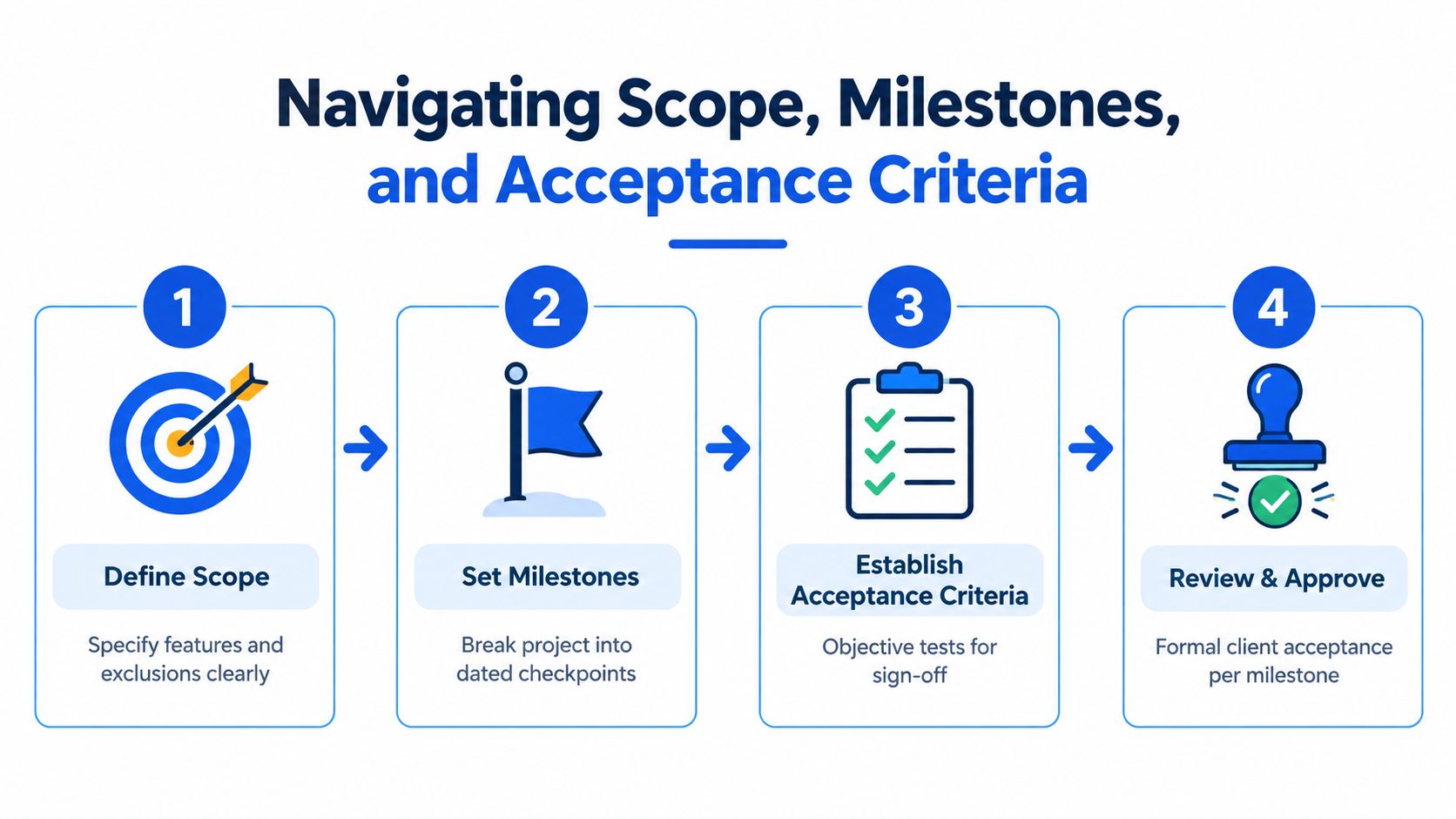
Build milestones around evidence
Milestones should divide the work into checkpoints that produce identifiable evidence. A design milestone might produce approved interface files and a documented design system. A development milestone might require a working integration in a staging environment. A testing milestone might require completed test scripts, defect logs, and deployment documentation.
Payment should follow those checkpoints, not vague declarations of effort. The parties should also state whether the customer may withhold only the disputed portion of an invoice or the entire milestone payment while a defect remains unresolved.
A statement of work should identify:
- The deliverable: Name the file, feature, environment, release, or service being provided.
- The test method: Identify test cases, data, environments, performance conditions, and responsible reviewers.
- The response period: Give the customer a defined period to accept or reject the deliverable.
- The cure process: Give the developer a reasonable opportunity to correct a documented failure.
- The change boundary: Separate defects against the specification from new requirements.
Make rejection defensible
Expert drafting guidance recommends an acceptance process that permits the customer to review and approve each deliverable before the developer proceeds. The criteria should use measurable pass or fail standards, and a rejection should identify the requirement or test the deliverable failed. This approach reduces scope disputes and helps stop defects from compounding across later milestones. Software development agreement drafting guidance from K&L Gates addresses that relationship between acceptance, payment, and downstream delivery.
A government-published template illustrates how specific the mechanism can become. It uses a 21-business-day acceptance period, requires acceptance tests to be documented before testing begins, and treats a passed or deemed-passed test as ending the customer's right to rely on warranty claims tied to software conformity. The published software development agreement template shows why the acceptance clause should be coordinated with warranty language rather than drafted in isolation.
For a practical starting point, a founder can organize requirements in a statement of work template, then have counsel adapt it to the product, development method, and payment model. The document should remain usable by the project team. A perfect legal standard that nobody follows won't protect the project.
Intellectual Property Ownership and Licensing Strategies
The central IP choice is whether the customer receives ownership, an exclusive license, or a narrower right to use the software. Each model can work, but the commercial consequences differ.
| Structure | Customer position | Developer position | Best fit |
|---|---|---|---|
| Assignment | Receives specified rights in the project deliverables | Gives up assigned rights but may retain defined background IP | Bespoke product central to the customer's business |
| Exclusive license | Receives broad control without necessarily holding title | Retains ownership subject to negotiated restrictions | Product built from a developer's platform or reusable foundation |
| Nonexclusive license | Receives permission to use the software within stated limits | Can reuse or license the underlying technology | Configurations, tools, and standardized components |
| Joint ownership | Shares rights with the developer | Retains a continuing ownership role | Special situations where both parties will develop and exploit the asset |
The contract should separately identify background IP and foreground IP. Background IP includes pre-existing frameworks, utilities, templates, and know-how. Foreground IP includes project-specific code, designs, documentation, and other material created for the engagement. If the developer retains background IP embedded in the deliverable, the customer needs a license broad enough to operate, maintain, modify, and transfer the software as the business requires.
A work-for-hire provision may help in some circumstances, but it shouldn’t stand alone. The agreement should include an express present assignment, contributor obligations, further-assurance language, and delivery of materials needed to exercise the rights. A customer should also confirm that subcontractors have signed matching assignments. For a focused review of transfer language, founders can use an intellectual property assignment resource before negotiating the full SDA.
AI-assisted development changes the drafting baseline
AI coding tools create questions that traditional ownership clauses often leave unanswered. Recent contract guidance asks whether contractors may use AI tools, what use must be disclosed, who bears infringement risk, and how provenance will be documented. These issues are especially important when developers handle confidential source code, personal information, regulated data, or commercially sensitive product plans. Recent guidance on software development agreements and AI use identifies this emerging gap.
A balanced clause can permit approved AI tools while requiring human review, confidentiality safeguards, disclosure of material AI-assisted contributions, and records sufficient to investigate provenance. A stricter customer may prohibit external tools from receiving source code or confidential prompts. The right position depends on the product and the customer’s risk tolerance, but silence is rarely a deliberate allocation of risk.
Open-source and third-party materials
The agreement should require disclosure of embedded components, compliance with applicable licenses, and delivery of notices or attribution materials. It should also address prohibited licenses if the customer distributes or commercializes the product. Ownership of custom code doesn’t give the customer unrestricted ownership of third-party material, so the delivery package should distinguish those categories clearly.
Mitigating Risks with Warranties, Indemnities, and Liability Caps
Risk clauses work when they track control. The party best positioned to prevent a particular loss should generally bear the responsibility, subject to negotiated limits and insurance realities.
A developer warranty may cover conformity with the specifications, professional performance, authority to enter the agreement, and the right to provide developer-supplied materials. It should also identify exclusions for customer modifications, unsupported environments, third-party services, and misuse. One model agreement provides a one-year warranty running from user acceptance, with commitments that the software will be fit for requirements, largely defect-free, and substantially conforming to specifications. Thomson Reuters’ discussion of software warranties and IP ownership provides that example.
Indemnity language should distinguish developer-controlled code from customer instructions, customer content, and unauthorized combinations. The parties should address control of the defense, settlement approval, notice, and available remedies. For AI-assisted code, the agreement should state whether the developer bears infringement or license risk connected to permitted tools, and what records the developer must preserve to investigate a claim.
Liability caps deserve the same specificity. A general cap may apply to ordinary breach, while confidentiality, data protection, IP infringement, fraud, or willful misconduct may receive separate treatment. A customer-facing system handling sensitive information can justify a different allocation from an internal prototype. Practical guidance on internal tool deployment risks can help a team identify operational exposures before turning them into contract language.
Data provisions should identify permitted processing, security measures, incident notices, subcontractors, retention, deletion, and cooperation duties. For a founder working through representations, warranties, and disclosure obligations, a targeted representations and warranties reference can help organize the issue list without replacing project-specific drafting.
Washington State Considerations and When to Hire Counsel
Washington founders should treat the governing-law clause as only one part of the analysis. The agreement may also intersect with Washington rules affecting restrictive covenants, employee and contractor relationships, privacy, cybersecurity, and breach response. A developer cannot solve every compliance issue through a warranty, and a customer shouldn’t assume that a generic confidentiality clause covers regulated data.
Non-compete provisions deserve particular care. Their enforceability can depend on the worker’s status, compensation, scope, duration, geography, and the legal context surrounding the relationship. A customer seeking protection from competition may need a narrower and more defensible combination of confidentiality, trade-secret, invention-assignment, customer-protection, and access-control provisions rather than copying an employment restriction into an independent contractor agreement.
Washington data breach obligations can also affect development work where the provider accesses personal information or production systems. The SDA should assign security responsibilities, incident escalation, cooperation, forensic access, notification support, and costs. Counsel should review the data flows instead of treating “reasonable security” as a complete technical standard.

Preserve proof while the project is running
Acceptance language doesn’t help much if the parties cannot prove what happened. Recent guidance recommends an evidence file containing the master agreement, statements of work, change orders, test plans, version histories, screenshots, rejection notices, and payment records. The practical point is simple: a dispute may turn on documentation quality rather than on whether the contract contains an acceptance clause. Guidance on documenting software acceptance and milestones explains why the record should be built during delivery.
A project manager should maintain a dated approval log and store test results with the relevant release. A developer should preserve repositories, build instructions, dependency records, and written responses to rejection notices. A customer should avoid treating silence as an informal rejection or approval when the contract requires a written response.
Evidence rule: Every milestone should leave behind a record showing what was delivered, what was tested, who reviewed it, and whether the result was accepted, rejected, or corrected.
An exit clause should make continuity possible. One set of software development terms allows termination for convenience on 30 days’ written notice, termination for cause after a 14-day cure period, and payment for completed work and accrued expenses, including pro-rata milestone amounts for partially completed work. FindLaw’s overview of typical technology contract clauses illustrates those mechanics. The appropriate terms depend on the deal, but the agreement should address repository access, credentials, work in progress, documentation, transition support, and payment at termination.
The following checklist identifies common failure points:
- Scope: Attach a sufficiently detailed statement of work and list exclusions.
- Authority: Identify who may approve requirements, changes, acceptance, and invoices.
- Ownership: Separate project deliverables, background IP, open-source code, and third-party services.
- AI use: State whether coding tools are allowed, what must be disclosed, and how provenance is recorded.
- Testing: Define test cases, review periods, rejection notices, cure rights, and deemed acceptance.
- Security: Match technical obligations to the data and environments the developer can access.
- Exit: Require delivery of code, documentation, credentials, and transition materials when the relationship ends.
Counsel becomes particularly valuable when the software is central to fundraising, a regulated workflow, a customer-facing platform, or a future acquisition. A lawyer should also review the deal when subcontractors, foreign contributors, sensitive data, open-source dependencies, AI-assisted coding, unusual licensing, or substantial milestone payments are involved. The cost of review is easier to manage before the parties start work than after ownership, acceptance, and payment positions have hardened.
By Design Law Firm & Legal Consultancy, PLLC helps founders draft and negotiate software development agreements, statements of work, licensing terms, IP assignments, and technology contracts that address scope, ownership, acceptance, AI use, data protection, and exit rights. Visit By Design Law Firm & Legal Consultancy, PLLC to discuss a Washington-focused contract review before development begins. Contact our law office at (206) 593-1519.