Entity formation is the legal process of creating a distinct business entity through state filing, which provides limited liability and defines tax treatment. In August 2026, the U.S. Census Bureau reported 28,501 projected business formations within four quarters, showing that formation is measurable in real time, not merely recorded years later.
A Washington founder may start with a name, a few client conversations, and a promising product. The assumption is understandable: once the business has a website and begins accepting work, it feels real. Legally, however, a business name isn't the same as a legal person. The founder may still be the contracting party, the account holder, and the person exposed when a customer claim, unpaid debt, or employee dispute arises.
The practical question isn't only “What is entity formation?” It's whether the filing, ownership records, governance documents, tax registrations, and financial practices all work together. For a Seattle technology startup, an owner-operated consulting company in Tacoma, and a multi-founder venture in Bellevue, the right answer can look very different.
Why Your Business Needs a Legal Identity
A founder signs a software contract under a new brand name. The client pays invoices made out to that brand, and the founder assumes the arrangement has created a company. Then a product failure causes a customer loss, and the demand letter names the founder personally. The brand may be recognizable, but recognition doesn't create a separate legal entity.
Entity formation creates the legal separation between the business and its owners. In the United States, that separation generally comes from filing with the relevant state, not from a founder's private intention. A corporation normally uses articles or a certificate of incorporation, while an LLC typically uses articles or a certificate of organization. The formation instrument establishes the entity's legal existence and helps encode ownership, liability, and tax treatment. The U.S. Small Business Administration's launch guidance describes formation as part of the legal foundation for operating a business.
Once properly created, an entity can generally own property, enter contracts, open accounts, and incur obligations in its own name. Depending on the structure, it can also provide limited liability, support perpetual existence, and allow interests to be transferred. Those protections aren't automatic permission to ignore the entity. Courts and creditors can examine whether the company was genuinely operated as separate from its owners.
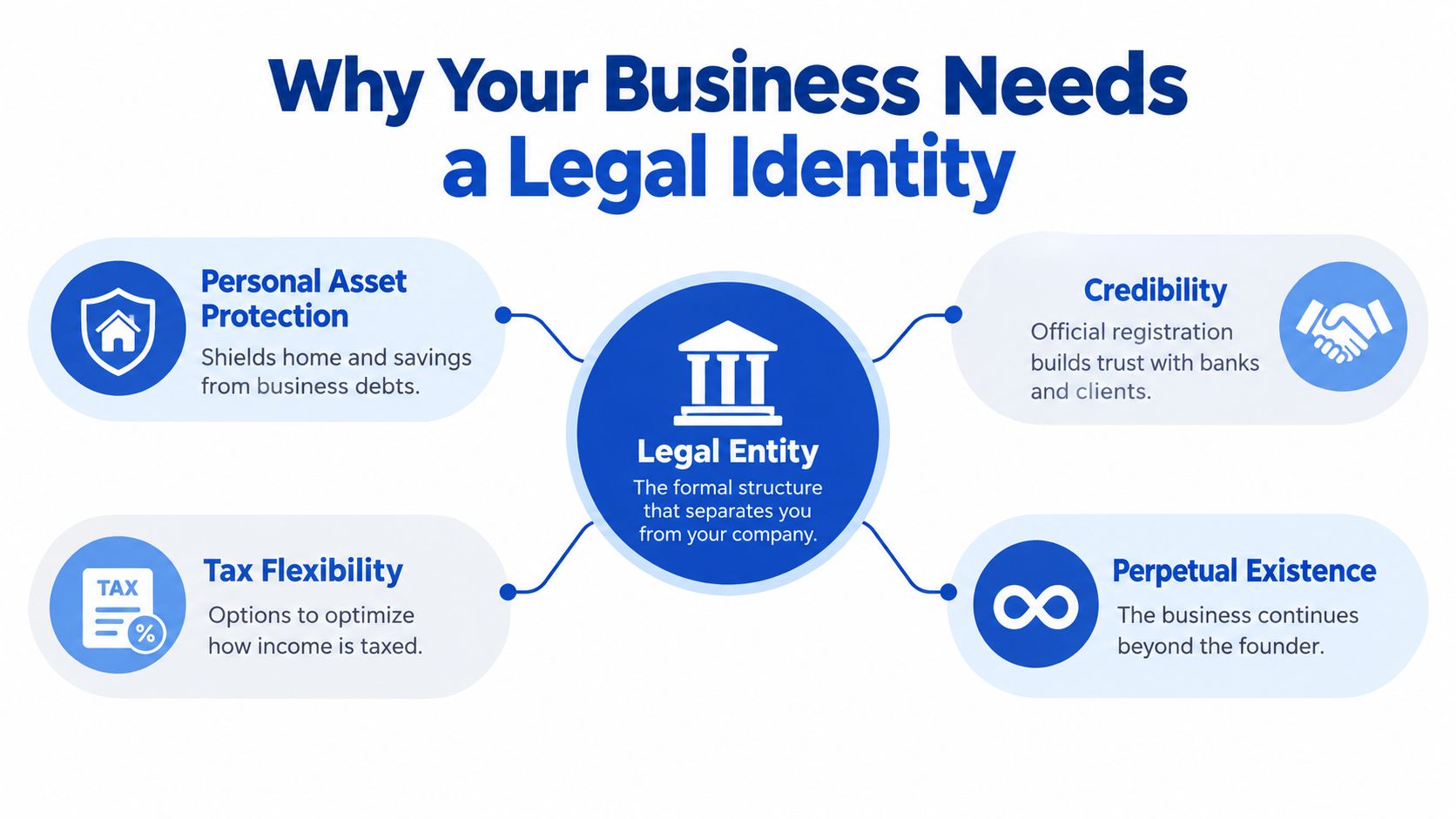
A name doesn't create the shield
A trade name, domain name, business license, or assumed-name registration can help a company operate publicly. None, by itself, necessarily creates a distinct juridical person or separates business liabilities from personal assets. Founders should also distinguish entity formation from licensing. A company may need both a legal entity and the permits required for its industry and location. A practical explanation of that separate licensing question appears in this guide to determining whether a business license is required.
The separation becomes meaningful only when the company behaves consistently with its legal status. Contracts should identify the entity, revenue should flow into company accounts, expenses should be recorded properly, and the ownership structure should match the formation documents. If the filing says one thing while the operating agreement, cap table, and actual payments say another, a dispute can become harder to resolve.
Practical rule: A state approval proves that an entity was created. It doesn't prove that the entity is adequately capitalized, governed, or ready for every business activity.
Common Types of Business Entities Explained
The structure should follow the company's ownership, financing, tax objectives, and management needs. An LLC may suit a closely held consulting company, while a corporation may fit a startup that expects institutional investment and multiple equity classes. A founder evaluating international structures may also benefit from a resource on how to choose the right firm type in Dubai, although Washington law governs a Washington entity.
LLCs
An LLC combines liability protection with flexible management. Members can usually decide through an operating agreement how the company will allocate economic interests, approve decisions, admit new members, and handle departures. For federal tax purposes, an LLC may receive pass-through treatment by default, subject to its ownership and elections. That flexibility can be useful for owner-operated companies and startups that haven't yet committed to a corporate financing model.
The risk is informality without documentation. A short filing won't answer who owns what, who can sign a contract, or what happens when two founders disagree. The operating agreement needs to reflect the actual arrangement, not a generic template that conflicts with the capitalization records.
C corporations
A C corporation is a separate corporate entity with formal governance. Shareholders own stock, directors oversee the corporation, and officers manage day-to-day operations under the corporation's governing documents. This structure can work well for companies expecting outside investment, stock-based compensation, or a complex ownership base.
The trade-off is administrative discipline. The corporation needs bylaws, organizational resolutions, stock issuances, a capitalization record, and reliable minutes or written consents. Federal tax treatment may involve taxation at the corporate level and again when earnings are distributed to shareholders, so tax advice should be coordinated with the formation decision.
S corporations
An S corporation is generally a tax election available to an eligible corporation or LLC, rather than a completely separate state-law entity type. It can offer pass-through taxation and may affect how owner compensation is structured, but eligibility rules and operating restrictions matter. The election shouldn't be treated as an automatic tax-saving answer because payroll, reasonable compensation, ownership, and filing requirements must be handled correctly.
Partnerships
A partnership can arise through an agreement to conduct business together, and its default rules may not match the founders' expectations. A general partnership can expose partners to business obligations personally, while a limited partnership or limited liability partnership may provide different protections and management rights. The agreement should address contributions, authority, profit allocation, disputes, and exit rights before the business takes on meaningful risk.

For a professional services company, the relevant comparison may be narrower than the full menu. Founders can review business-entity considerations for consulting companies before choosing a structure that creates unnecessary complexity.
Comparing Liability, Taxes, and Governance
Entity selection becomes clearer when the founder compares consequences instead of labels. Limited liability addresses the company's obligations, taxation determines how income and distributions are treated, and governance controls who has authority to make decisions. These categories overlap, but none should be allowed to substitute for the others.
| Entity Type | Liability Protection | Taxation | Governance |
|---|---|---|---|
| LLC | Members generally receive limited liability when the company is properly formed and maintained | Often pass-through by default, with possible tax elections | Flexible, usually governed by an operating agreement |
| C corporation | Shareholders generally receive limited liability | May involve taxation at the corporate level and again on distributions | Formal structure with directors, officers, bylaws, and corporate records |
| S corporation | Liability protection comes from the underlying corporation or LLC | Pass-through treatment may apply if eligibility and election requirements are satisfied | Corporate formalities generally remain important |
| Partnership | Protection varies by partnership form, and general partners may face personal exposure | Often pass-through treatment under applicable tax rules | Determined by agreement and applicable default law |
Liability is a practice, not a slogan
A founder can have a valid LLC and still create avoidable risk by signing personally, mixing funds, or failing to identify the company in contracts. Limited liability also doesn’t normally protect someone from their own tortious conduct, personal guarantees, or obligations imposed directly on them. Insurance, sound contracting, and adequate capitalization remain important.
Tax treatment needs a separate decision
An LLC’s default tax classification may be simple at launch, but a growing company might later consider an election. A C corporation may better accommodate certain investment arrangements, even though its tax consequences can be less attractive for a company distributing earnings directly to owners. An S corporation election may be useful for some eligible businesses, but it brings restrictions and compliance responsibilities.
Governance determines operational authority
Flexible governance works only when the owners document it. An LLC agreement should identify voting thresholds, manager authority, distributions, transfers, and deadlock procedures. A corporation’s bylaws and board actions should support stock issuance, major contracts, compensation, and related-party transactions.
The structure that looks cheapest on filing day can become expensive when an investor, lender, co-founder, or buyer asks for records that were never created.
The Entity Formation Filing Process
Formation follows a sequence, but the sequence should be treated as a legal design process rather than a form-submission exercise.
-
Choose the structure. Review ownership, liability exposure, tax objectives, financing plans, and management. A founder shouldn’t select an LLC or corporation solely because a form provider presents it first.
-
Check the name. Search Washington’s records, assess whether the name is distinguishable, and check trademark conflicts before investing in branding. A state-available name may still create infringement risk elsewhere.
-
Prepare the formation document. An LLC generally files articles or a certificate of organization. A corporation generally files articles or a certificate of incorporation. The document should accurately identify the entity, registered or statutory agent, purpose where required, and other state-required information.
-
File with the state. Submit the document and required fee to the Washington Secretary of State. Keep the accepted filing and state confirmation in the company’s permanent records. A practical comparison of filing workflows can be found in this Sunbiz registration guide, although Florida procedures shouldn’t be copied into a Washington filing.
-
Complete federal and operational setup. The IRS says the entity should be formed before the founder applies for an Employer Identification Number. The EIN is commonly used for tax filings and banking, and the IRS also notes that certain entities may have beneficial ownership reporting obligations involving FinCEN. The IRS EIN guidance addresses that order directly.
Founders who want counsel on selecting the structure, preparing documents, and coordinating the filing can review the role of a business formation attorney.
A short visual walkthrough can reinforce the sequence:
Washington State Entity Formation Specifics
Washington startups need to treat formation as a state-specific project. The core concepts are national, but the filing office, required information, agent rules, and continuing registrations depend on Washington law and the company’s activities.
The founder should confirm the entity name through the Washington Secretary of State, identify a suitable registered agent, and submit the correct formation document for the selected structure. The agent must be able to receive official papers for the company. Using an unreliable address creates a practical failure: the company may miss service of process, state notices, or compliance communications.
Annual maintenance matters
Washington entities generally have ongoing reporting obligations, including annual reports. The company should maintain a calendar that tracks the report, tax registrations, licenses, insurance renewals, and any local requirements applicable to its work location. A Seattle software company, a construction business operating across counties, and a home-based consultancy may face different licensing and regulatory questions even if they use the same entity form.
Washington also has no individual or corporate income tax in the traditional sense, but that doesn’t mean a company has no state tax obligations. Business and occupation tax, sales tax, payroll-related obligations, industry rules, and local licensing can still matter. The formation filing doesn’t determine every tax account the business may need.
Washington check: The entity name, statutory-agent information, annual-report calendar, tax registrations, licenses, and contract signatures should all point to the same legal business.
A founder should also assess whether the company will hire workers, collect personal information, sell regulated products, or commercialize software and intellectual property. Those facts influence employment, privacy, consumer-protection, and ownership planning. A broader discussion of state incorporation choices is available in this Washington business incorporation guide, but entity selection still requires facts specific to the company.
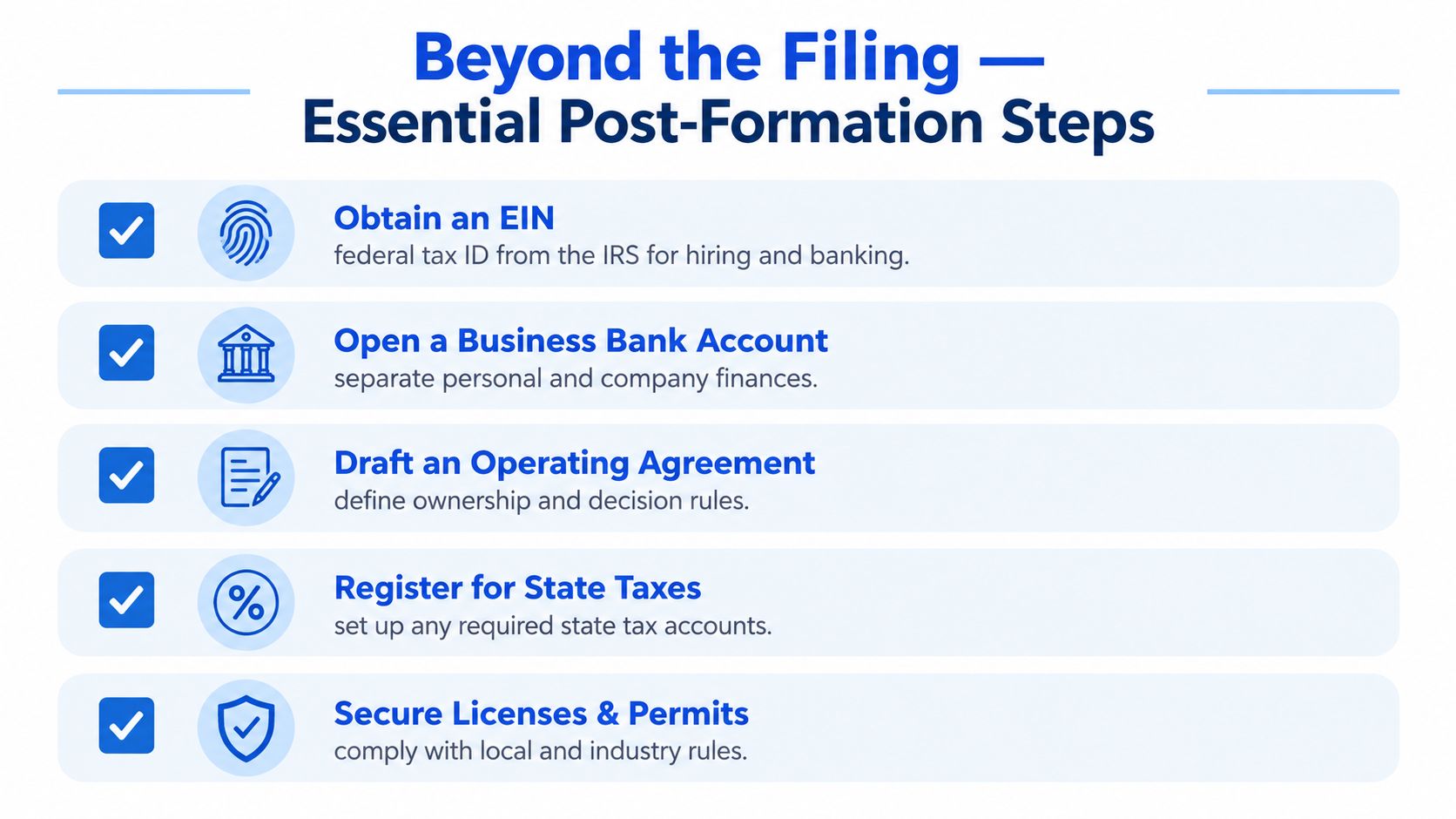
Beyond the Filing, Essential Post-Formation Steps
State approval creates the entity. It doesn’t allocate equity, establish decision rights, open a bank account, or make a founder’s records consistent with the company’s legal identity.
The first post-formation task is to adopt the governing documents. An LLC needs an operating agreement that addresses ownership, contributions, voting, management, distributions, transfers, and dissolution. A corporation needs bylaws and initial board and shareholder actions that establish officers, approve the share issuance, and authorize core transactions.
Build the company’s evidence
A company should create a formation record that another lawyer, investor, lender, or buyer can understand without interviewing the founders. That record commonly includes:
- Ownership evidence: Membership ledgers, subscription agreements, stock certificates or electronic records, and a current capitalization table should match the formation documents.
- Authority evidence: Written consents, resolutions, and delegated signing authority should show who can bind the company.
- Financial separation: The company should use its own bank account, pay company expenses from company funds, and record owner contributions or loans accurately.
- Tax identity: The founder should obtain the EIN after formation and coordinate federal, state, and local registrations with a tax professional.
- Compliance evidence: Licenses, permits, insurance, contracts, privacy policies, and intellectual-property assignments should identify the correct entity.
Beneficial ownership reporting also requires care where it applies. FinCEN guidance defines a beneficial owner through substantial control or ownership or control of at least 25% of ownership interests, and post-2023 formations may also need to identify a company applicant. The beneficial ownership reporting explanation from the American Institute of CPAs describes those mechanics.
FinCEN’s filing instructions state that beneficial-owner information is entered in dedicated fields 35 through 51 and includes identifying information such as name, date of birth, address, and a unique identification-document number. The official BOI filing instructions should be used rather than an informal checklist.
The timing rules have changed. IRS guidance ties the initial report to actual notice that creation or registration is effective, or public notice from a secretary of state, whichever is earlier, while older formation dates had different deadlines. The IRS beneficial ownership reporting guidance should be checked at filing because current requirements may differ from older startup materials.
Frequently Asked Questions About Entity Formation
Is an LLC or corporation better for a startup?
Neither is universally better. An LLC offers flexible governance and often pass-through taxation, while a corporation may fit outside investment, stock issuance, and complex ownership.
Does an LLC need an operating agreement?
Yes, it should have one even when state law doesn’t require a public filing. The agreement records ownership, authority, contributions, distributions, and dispute procedures.
What is an EIN used for?
The IRS EIN identifies the business for federal tax administration and is commonly needed for banking, hiring, and tax filings. The entity should be formed before applying.
Is filing enough to preserve limited liability?
No. The company should keep finances separate, use accurate contracts, maintain governance records, and comply with reports, taxes, licenses, and ownership-reporting rules.
For Washington founders, the durable answer to “what is entity formation” is therefore broader than a state receipt. It is the coordinated creation and operation of a separate legal business, with a structure that fits the ownership and financing plan.
By Design Law Firm & Legal Consultancy, PLLC advises Washington startups and established companies on entity selection, formation filings, operating agreements, bylaws, ownership records, contracts, privacy, and ongoing governance. Visit By Design Law Firm & Legal Consultancy, PLLC to schedule a consultation and turn a Washington formation filing into an operational legal foundation. Contact our law office at (206) 593-1519.