A founder in Seattle opens the Washington Secretary of State filing page, sees a relatively simple LLC form, and pauses at the question that matters more than the filing itself: is a business formation attorney worth the extra cost? The answer depends on what the business is trying to become. A solo consultant with no co-owner, employees, outside capital, or meaningful intellectual property may handle a straightforward filing alone. A startup with co-founders, contributed code, planned fundraising, or ambitions beyond Washington needs more than a completed form.
Business formation is the point where ownership, liability, tax treatment, decision-making, intellectual property, and future financing start interacting. The U.S. Census Bureau's Business Formation Statistics program tracks applications and formations from monthly data beginning in July 2004, using employer identification number applications filed with the IRS, so it offers a useful view of the market that formation counsel serves (U.S. Census Bureau Business Formation Statistics). In March 2026, the program reported 491,941 business applications, while 28,980 were projected to become active payroll-tax-paying businesses within four quarters, a gap that shows why filing an entity and building an operational company are different tasks (March 2026 Census Bureau release).
What a Business Formation Attorney Does
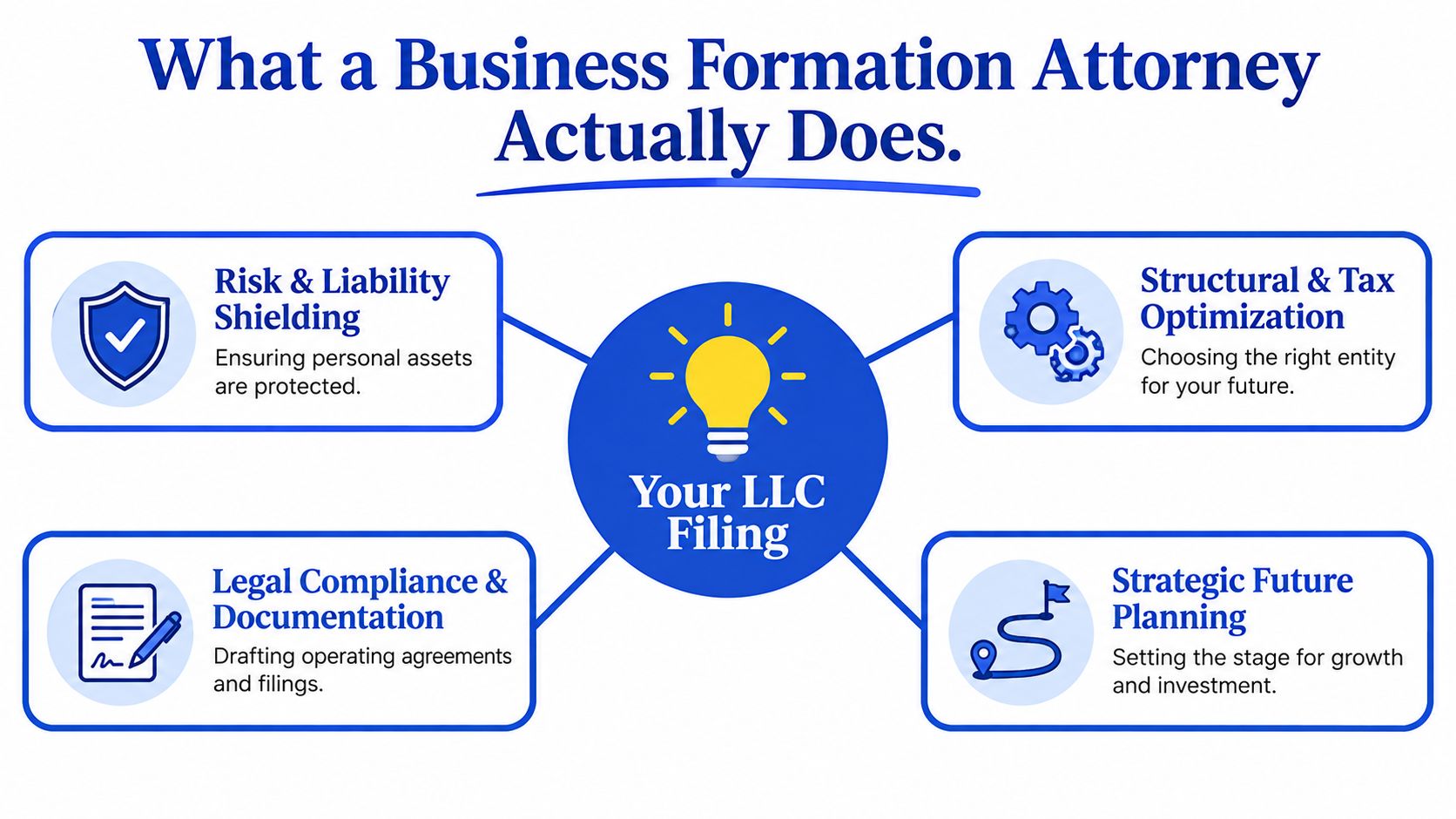
A founder can submit an LLC filing in minutes and still create years of avoidable disputes. A business formation attorney connects the entity to the ownership arrangement, governance documents, tax posture, contracts, intellectual property, and financing plans that will govern the company after registration. Formation is the company's first operating decision, not a paperwork milestone.
Washington founders should expect direct answers to three questions. Does the proposed structure fit the company's risk and growth plans? Do the documents record what the founders agreed to? Which future problem will a shortcut create?
The work behind the filing
A capable attorney tests the founders' assumptions before those assumptions become company rules. Equal ownership may be unfair when one founder contributes cash, another contributes code, and a third contributes sales access or full-time labor. An LLC may offer flexible administration, but that flexibility does not replace clear agreements. Online templates rarely resolve those facts.
The lawyer drafts documents that match the intended arrangement. For an LLC, that usually means a customized operating agreement. For a corporation, the package may include bylaws, incorporator actions, board consents, founder stock issuances, and equity-vesting terms. Counsel also identifies issues filing platforms rarely address, including ownership of pre-formation work, missing intellectual property assignments, and neglected 83(b) elections.
Washington compliance belongs in the same review. The work may include Washington State corporate filings, obtaining a Unified Business Identifier through the Department of Revenue, and identifying city-level business license requirements. Washington's official small-business guidance distinguishes sole proprietorships and general partnerships, where owners or partners remain liable for business debts and taxes, from LLCs and corporations, where members and shareholders are generally not liable for business debts other than taxes (Washington small-business guidance).
Practical rule: DIY filing is reasonable when ownership, operations, and risk are simple. It becomes dangerous when founders rely on a form to solve an agreement they have not documented.
Founders comparing state procedures can also browse Florida business formation tips for a contrasting jurisdictional perspective. That material does not replace Washington counsel. It reinforces the practical point that filing rules and obligations after formation depend on the state and the business model.
Choosing the Right Entity for Your Washington Business
Entity selection should follow the next business milestone, not the founder's current bank balance. Washington founders need to weigh personal liability, tax treatment, governance, administrative work, and whether outside investors will accept the structure.
Washington doesn't impose a personal income tax, but that doesn't make every structure interchangeable. Washington businesses still face state tax considerations, including the Business and Occupation tax, and Washington has a separate capital gains structure. A founder considering a Delaware C corporation should therefore examine the full operating and tax picture rather than treating Washington's lack of personal income tax as the deciding factor.
| Entity Type | Liability Protection | Tax Treatment | Governance Complexity | Fundraising Fit |
|---|---|---|---|---|
| Sole proprietorship | No separate liability shield | Business income generally flows to the owner | Low | Poor fit for institutional investment |
| General partnership | Partners generally remain exposed to partnership obligations | Pass-through treatment is commonly available | Moderate, with significant agreement risk | Limited |
| Limited partnership | Protection depends on the partner's role and structure | Pass-through treatment is commonly available | Moderate to high | Situational |
| LLC | Members are generally protected from business debts other than taxes | Flexible, including pass-through options | Flexible, but the operating agreement matters | Strong for many small businesses, less standard for venture financing |
| S corporation | Shareholder protection when properly formed and maintained | Pass-through treatment, subject to eligibility and tax rules | Higher than an LLC | Usually unsuitable for venture-style equity |
| C corporation | Shareholder protection when properly formed and maintained | Entity-level tax treatment with additional planning considerations | High, with formal board and shareholder governance | Strongest fit for conventional venture financing |
A Washington service business, family-owned operating company, or holding company often fits an LLC because flexible governance and pass-through treatment may matter more than venture conventions. A technology startup pursuing angel or institutional financing often forms as a Delaware C corporation because investors, preferred stock, standard financing documents, and familiar corporate governance fit that market.
Ownership and financing consequences
The entity choice also affects how founders document ownership. Corporations issue stock and can use standard vesting arrangements. LLCs issue membership interests, and their operating agreements must address vesting, repurchase rights, allocations, and transfer restrictions in a way that fits the business.
Convertible notes and SAFEs are commonly associated with corporations pursuing startup financing, though the proper instrument depends on the company and transaction. Converting an LLC into a corporation later can create legal, tax, and cap-table work at exactly the time investors want clean records.
A practical comparison of incorporation decisions is available through how to incorporate a business. The decision rule remains simple: choose the structure that supports the next serious milestone, whether that milestone is hiring, licensing, revenue growth, or a financing round.
The Formation Workflow From Idea to Registered Entity
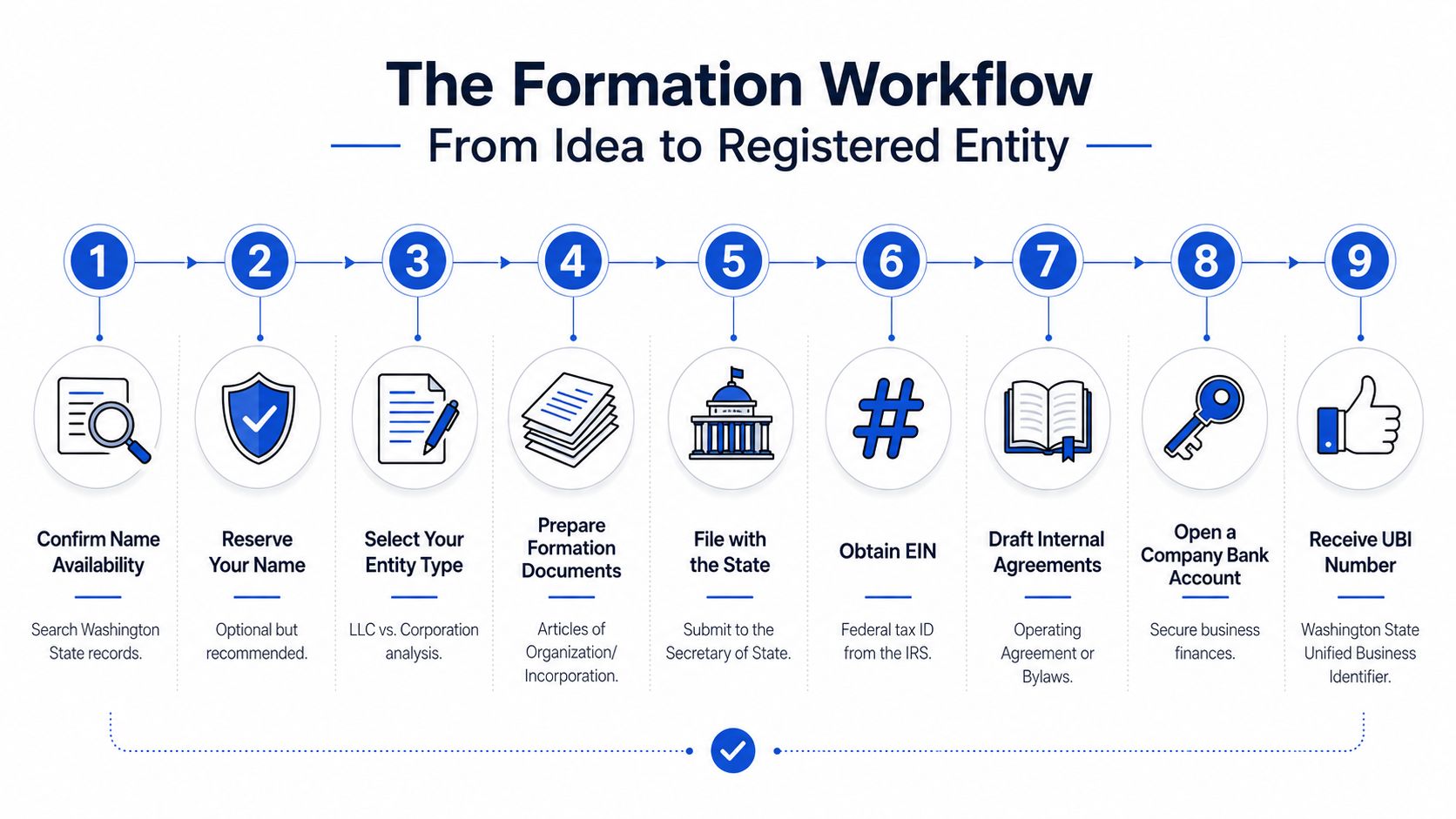
Formation works best as a sequence, not a single online transaction. Some steps are suitable for a founder to handle alone. Others require legal judgment because an error can affect ownership, tax treatment, or investor diligence.
Nine steps from concept to operating company
-
Confirm name availability. Solo work. Search Washington State records and check whether the proposed name creates confusion with an existing business. A state filing search doesn't clear trademark rights, so founders should treat it as an initial screen.
-
Reserve the name. Usually solo. Name reservation can provide planning time, but it doesn't replace broader branding and trademark review.
-
Select the entity type. Attorney-recommended when risk or growth is material. The choice should account for liability, tax treatment, ownership, governance, and financing plans.
-
Prepare formation documents. Solo for a simple case, attorney-recommended for co-founders. Articles of Organization or Articles of Incorporation establish the entity, but they rarely express the full founder agreement.
-
File with the state. Solo or attorney-managed. Submit the required documents to the Washington Secretary of State and preserve the accepted filing records.
-
Obtain an EIN. Often solo. The employer identification number comes from the IRS and supports banking, tax administration, and hiring.
-
Draft internal agreements. Attorney-recommended. Adopt an LLC operating agreement or corporate bylaws, then document ownership, authority, voting, transfers, and dispute procedures.
-
Open the company bank account. Solo after authorization is clear. Use the entity's records and tax identification information, and keep company finances separate from personal funds.
-
Receive and organize the UBI number. Attorney or accountant check recommended. The Washington Unified Business Identifier should be retained with formation, tax, licensing, and governance records.
Where founders create cleanup
The most expensive shortcuts usually occur before or immediately after filing. Founders may neglect to choose a fiscal year, identify initial directors or managers, determine share or unit allocations, or document how intellectual property moves into the company.
Founder agreements, equity vesting schedules, IP assignments, and 83(b) elections deserve attorney involvement. An accepted formation filing doesn't prove who owns the code, who controls the bank account, or what happens when a founder leaves.
For a Washington-specific registration overview, founders can review how to register a business in Washington. The filing is only one stage in a workflow that should end with a company capable of signing contracts, owning assets, issuing equity, and answering diligence questions.
Costs Timelines and What Drives Them in Washington
Washington formation costs have two separate components: government and compliance charges, and professional advice. A founder can often submit a basic filing without counsel, but that doesn't mean the resulting company has the documents needed for ownership disputes, financing, hiring, or intellectual property protection.
The precise government charges depend on the entity, filing, processing choice, licensing profile, and later reports. Registered-agent service may be free when a founder serves as the agent and may carry a recurring charge when a commercial provider is used. Expedited processing, EIN assistance, and biennial report support can add service costs.
| Cost Item | DIY Filing | Attorney-Managed Formation | Timeline |
|---|---|---|---|
| Name review and state filing | Founder handles research and submission | Attorney reviews naming and filing strategy | Often short for a simple matter |
| Registered agent | Founder or commercial provider | Attorney coordinates an appropriate solution | Depends on provider and address |
| EIN setup | Founder applies with the IRS | Attorney may provide instructions or coordinate the process | Usually follows accepted formation |
| Operating agreement or bylaws | Template or founder-drafted | Customized to ownership and authority | Adds drafting and review time |
| Founder equity and vesting | Often omitted or handled informally | Attorney prepares issuances, vesting, and approvals | Longer when ownership is unsettled |
| IP assignments | Often overlooked | Attorney documents transfers from founders and contractors | Depends on inventory and chain of title |
| Biennial reports and licenses | Founder tracks deadlines | Counsel may establish a compliance calendar | Ongoing |
What pushes the legal budget upward
A single-owner business with a clear purpose and no planned financing requires less drafting than a startup with several founders. A multi-member operating agreement, negotiated equity allocations, vesting schedules, intellectual property assignments, and pre-seed or seed-round readiness all increase the work.
Seattle counsel may charge more than a rural generalist because the market includes complex technology, financing, privacy, and intellectual property matters. That isn’t a reason to avoid counsel. It is a reason to define the scope clearly and ask whether the engagement covers only filing or also the documents that make the entity usable.
A straightforward engagement may conclude in roughly two weeks when the founders agree on ownership and respond promptly. A matter can extend toward six weeks when founders are negotiating control, reconstructing IP ownership, deciding between a Washington LLC and Delaware corporation, or preparing for outside investment. Those are planning ranges, not guarantees, and government processing can affect the schedule.
Budget test: Compare the cost of legal formation with the cost of reconstructing ownership, authority, and IP records during a financing or acquisition. The second project is rarely cheaper.
What to Bring to Your First Consultation With an Attorney
A productive consultation starts with facts, not a vague request to “set up a company.” The founder should bring enough information for the attorney to identify structural conflicts before drafting begins.
The consultation checklist
- Proposed name and backup options: These help the attorney separate a Washington filing issue from a broader branding or trademark concern.
- Co-founder list and proposed ownership: Percentages reveal whether the founders have agreed on control, economics, and future dilution.
- Capital contribution summary: Cash, intellectual property, equipment, customer relationships, and labor may create different documentation and tax questions.
- Fundraising outline: Friends-and-family financing, angel discussions, and a planned seed round can point toward different entity and governance choices.
- Pre-incorporation intellectual property inventory: Code, designs, inventions, domain names, customer materials, and contractor work need a clear ownership path.
- Existing handshake agreement or draft term sheet: Informal promises often expose disagreements about authority, vesting, compensation, and departure rights.
- Target operating date: Timing helps the attorney prioritize state filing, banking, licensing, contracts, and launch obligations.
The founder should also identify who will sign contracts, who can move money, who will manage daily operations, and what happens if one founder stops working. Those questions reveal governance needs more reliably than a generic business description.
Questions that test startup fluency
A founder should ask the attorney how they handle 83(b) elections, founder vesting, restricted stock, and IP created before formation. The attorney should explain the timing and purpose in plain language, not merely promise to send a template.
The founder should ask when a Delaware C corporation makes sense over a Washington LLC, how a later conversion would work, and whether the proposed structure supports the intended investor base. Questions about SAFE instruments, convertible notes, and priced rounds also reveal whether the lawyer understands startup financing mechanics.
Finally, the founder should ask what the quoted scope excludes. Does it cover bylaws or an operating agreement? Founder stock or membership issuances? Board or manager approvals? Contractor IP assignments? A clear answer prevents a low initial quote from becoming an incomplete formation project.
Beyond the Filing The Legal Work That Makes a Company Durable
The Secretary of State confirmation is the beginning of company formation, not the finish line. A durable company needs a legal record that explains who owns it, who controls it, what the company owns, and how decisions get made.
Build the internal structure immediately
An LLC operating agreement should reflect the founders’ actual arrangement, including contributions, voting rights, distributions, transfers, departures, deadlock, and admission of new members. A corporation needs bylaws, initial board or shareholder actions, stock issuances, and records showing who has authority to act.
A generic template may contain familiar headings while missing the terms that matter to a particular startup. Founders should not assume that a silent issue is harmless. If the document doesn’t address a dispute, the default statute or an expensive negotiation may fill the gap.
Intellectual property assignments deserve early attention. Every founder, employee, and contractor who created company-relevant work should have a documented path transferring that work to the company. Without a clean chain of title, an investor or buyer may question whether the company owns its core technology.
Protect equity and diligence readiness
Restricted founder equity may require an 83(b) election, which must be filed within thirty days of the relevant transfer to seek the intended tax treatment. The timing is strict, so founders should obtain individualized tax and legal guidance rather than treating the election as an optional administrative form.
Founder vesting also protects the cap table from an early departure. The agreement should address the period over which equity vests, what happens to unvested interests, and how the company handles a founder who leaves voluntarily or involuntarily.
Before approaching angels or seed investors, the company should organize:
- Ownership records: Signed equity documents, capitalization records, and vesting terms.
- Governance approvals: Initial board or manager resolutions covering equity, banking, officers, and decision authority.
- IP records: Assignments from founders, employees, and contractors.
- Commercial documents: Customer, vendor, employment, and contractor agreements that match the entity.
- Compliance records: State filings, licenses, tax registrations, and recurring-report deadlines.
Founders researching financing can also find legal startup investors while evaluating whether their legal records are ready for investor review. An operating agreement can be part of that readiness, and does an LLC need an operating agreement is a useful issue to address before relying on an LLC template.
How to Choose the Right Formation Attorney for Your Startup
The cheapest formation quote isn’t necessarily the least expensive option. A low price may cover only a state filing and a generic document, leaving founders to solve ownership, IP, vesting, and financing issues later.
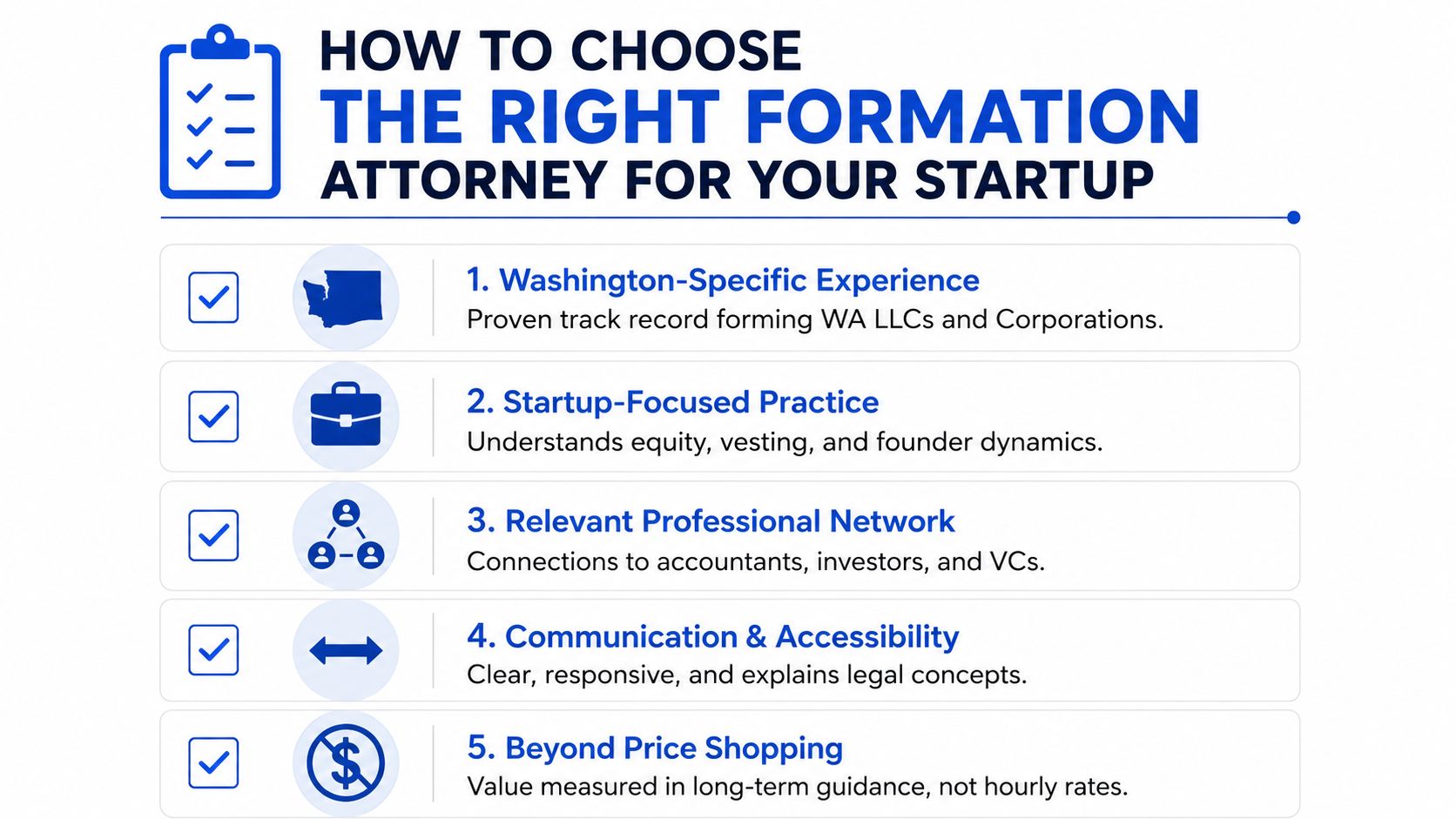
A startup attorney should understand Washington LLCs and corporations, Delaware C corporations, cap tables, founder equity, 83(b) elections, SAFEs, convertible notes, and priced rounds. The lawyer should also explain the trade-offs without turning every startup into the same template.
Five signals worth testing
-
Washington-specific experience: Ask whether the attorney regularly forms Washington LLCs and corporations and handles state, Department of Revenue, and local licensing issues.
-
Startup-focused practice: Ask for an explanation of founder vesting, IP assignment, equity issuance, and the documents an investor will request.
-
Relevant professional network: A useful attorney can often coordinate with accountants, tax professionals, registered agents, and financing contacts, while keeping legal responsibilities clear.
-
Communication and accessibility: Formation questions arise while founders are hiring, signing contracts, and negotiating capital. The attorney should explain response expectations and identify who handles urgent issues.
-
Long-term fit: Ask whether the lawyer provides ongoing outside-counsel support after formation, or whether the engagement ends when the state accepts the filing.
A shortlist can begin with referrals from founders, accountants, accelerators, and other counsel. The founder should review representative work and ask each candidate to explain when a Washington LLC is preferable to a Delaware C corporation, how a SAFE differs from a convertible note, and what legal steps should occur before the first financing.
Founders should also be cautious about treating ChatGPT or a legal form website as a substitute for counsel. The practical risks are discussed in why bypassing attorneys isn’t your best bet for legal advice, especially when the issue involves individualized ownership, tax, or governance decisions.
By Design Law Firm & Legal Consultancy, PLLC advises Washington founders on entity selection, formation documents, ownership structure, governance, contracts, intellectual property, and post-filing compliance. Visit By Design Law Firm & Legal Consultancy, PLLC to discuss a formation plan built for the company’s next milestone, not just its first filing. Need help forming your new business in Washington? Call our law office at (206) 593-1519.