Data privacy regulation is increasingly focused on how businesses obtain the consent of its users. Is it better to use browserwrap or clickwrap agreements? While browserwrap offers easier implementation and less user friction, clickwrap provides active consent, better enforceability, and an audit trail.
The popular advice is simple: use clickwrap, reject browsewrap, and move on. That advice points in the safer direction, but it misses the issue that decides most disputes: implementation details. A checkbox can be poorly presented. A browsewrap flow can sometimes benefit from unusually strong notice and repeated exposure. Courts examine what the user saw, what the user did, what the business can prove, and whether the disputed term was fairly presented.
For a Washington business, that difference can affect whether a forum-selection clause, arbitration provision, class waiver, limitation of liability, or other important term reaches the merits of a dispute. The interface is part of the contract record, not merely a product-design choice.
Why Online Agreement Design Creates Legal Risk
A Seattle SaaS startup can place its master subscription agreement behind a Terms of Service link in the footer and still face a serious enforcement problem. Customers may create accounts, purchase plans, and use the software without checking a box. If a customer later challenges arbitration or a Washington forum clause, the company must prove more than that the terms were available. It must show that the customer had a legally meaningful reason to understand that the transaction or continued use signified assent.
That is the central issue in clickwrap vs browsewrap analysis. A clickwrap agreement requires an affirmative action, such as checking an “I agree” box or selecting a clearly labeled acceptance button, before the user proceeds. A browsewrap agreement seeks assent through continued website or application use while placing the terms elsewhere, often behind a footer hyperlink. Clickwrap creates a discrete assent event. Browsewrap asks a court to infer assent from the interface and surrounding facts.
Practical rule: The more important the term, the less sensible it is to rely on an inference that the user agreed.
The consequences reach beyond whether a contract exists. A business may want to compel arbitration, enforce a class waiver, select a forum, limit damages, protect intellectual property, or impose usage restrictions. If the interface did not give adequate notice, or the records do not show what the user encountered, the court may never reach the disputed clause. The issue can arise in Washington superior court or federal court in the Western District of Washington, where the terms, user journey, and retained records will be examined together.
The same problem appears in other consent-sensitive workflows, including application liability in social connection apps. A business recording customer calls, for example, must evaluate the applicable phone call consent requirements rather than assume a general privacy notice resolves every consent question. Online contracting requires the same operating discipline: identify the action that creates assent, provide clear notice before it, and preserve evidence afterward.
The practical choice is not maximum friction or no contract. A carefully configured clickwrap flow can keep the transaction easy while placing the agreement beside the action that matters. Browsewrap may have a limited role in low-risk settings, but it is a poor default for provisions the business expects to enforce.
How Courts Developed Clickwrap and Browsewrap Standards
Courts enforce online contracts only when the user receives clear notice and takes an affirmative step showing assent. Online assent doctrine arose from earlier shrinkwrap and box-top license disputes. Those cases asked whether a purchaser could be bound by terms supplied with a product after the transaction began. Online agreements created a more difficult variation because the user might never see the terms, might not know that a hyperlink contained contractual language, and might complete the primary action without any indication that the action carried legal significance.
Clickwrap received early judicial recognition in 1996, through ProCD, Inc. v. Zeidenberg, a milestone often treated as the starting point for modern enforceability analysis of online assent. By 2002, clickwrap litigation was already appearing in court, and a 2021 litigation report observed that such cases had risen sharply since then, illustrating how quickly clickwrap became the dominant benchmark for enforceable online terms in major markets. Those milestones are discussed in the Berkeley Technology Law Journal analysis of online agreements.
Why Specht changed browsewrap analysis
The leading warning against passive assent came from Specht v. Netscape Communications Corp. The users downloaded software from a page where the relevant terms appeared below the download button and below the visible screen area. The court refused to enforce those terms because the download action didn’t clearly communicate agreement to contractual language that the user wasn’t reasonably shown.
The decision sharply narrowed browsewrap doctrine in 2002. A user may continue browsing without knowing that a footer link contains terms, so continued use alone doesn’t necessarily show mutual assent. Later Ninth Circuit reasoning reinforced that browsewrap generally needs to resemble clickwrap through conspicuous notice and an unambiguous assent action. The distinction is practical: clickwrap asks the user to do something that carries contractual meaning, while browsewrap asks a court to assign that meaning after the fact.
How later cases added factual nuance
Cases such as Register.com and related decisions examined whether repeated use, prominent notice, or a user’s relationship with the service supplied actual or constructive knowledge. The Fourth Circuit’s approach in Berke v. Pyrex likewise illustrates a fact-specific inquiry rather than a universal label. The question isn’t only whether a business calls its process browsewrap. The court examines the placement, wording, visibility, and conduct surrounding the alleged assent.
The Ninth Circuit’s framework in Nguyen v. Barnes & Noble.com is especially important for Washington companies because it emphasizes that inquiry notice isn’t enough by itself. Browsewrap is more likely to be considered where the arrangement requires affirmative acknowledgment before use or where the site gives explicit textual notice that continued use will constitute assent. Hidden footer links and passive browsing ordinarily leave the business with a much weaker position. The framework is summarized in this analysis of Nguyen and mandatory arbitration terms.
Washington courts applying general contract principles under the Restatement (Second) of Contracts have generally followed the same direction. The label doesn’t decide enforceability. Reasonable notice, objective assent, and fair presentation do.
A business drafting its terms should therefore understand the difference between an express agreement and an implied one. The discussion of what constitutes an express contract provides useful background, but the interface still must translate that legal concept into a concrete user action.
Comparing Notice Assent Evidence and Enforceability
The strongest online agreement records connect four events: the user receives clear notice, the user can access the terms, the user takes an unmistakable action, and the system preserves the surrounding facts. A footer-only link usually establishes less. A checkbox beside a sentence linking to the agreement establishes more, especially when the account or purchase can’t proceed while the box remains unchecked.
The following framework separates the design features courts commonly examine.
Clickwrap vs Browsewrap Notice Assent Evidence and Risk
| Dimension | Clickwrap, Affirmative Assent | Browsewrap, Continued-Use Notice |
|---|---|---|
| User action | The user checks a box, clicks “I agree,” or completes another clearly identified acceptance action. | The user browses, uses the service, or completes a transaction without a separate acceptance action. |
| Notice placement | Terms appear beside the assent control, with a prominent, accessible link. | Terms commonly appear through a footer or other hyperlink that may be distant from the primary action. |
| Evidentiary value | The business can usually connect the account, timestamp, version, checkbox state, and acceptance event. | The business must prove visibility, actual or constructive knowledge, and why continued use objectively signified assent. |
| Residual risk | Risk remains if the control is preselected, confusing, inaccessible, misleading, or disconnected from the terms. | Risk is materially higher because the user may never have seen the terms or understood that use constituted agreement. |
| Common litigation failure | The business can't identify the version accepted or can't show the acceptance screen as it appeared. | The link is buried, the terms sit below the fold, the notice is vague, or passive use is the only alleged assent. |
A scroll-to-bottom design can improve the record when the user must move through the terms before clicking acceptance, but scrolling alone doesn’t replace a clear assent action. Box-checking is useful because it creates an objective event, not because every checkbox automatically proves a valid contract. A signed-account variant can be stronger still when the business can connect the account holder, the acceptance flow, and the applicable version.
Hover-state disclosures and footer-only notice tend to perform poorly because they depend on user behavior that may never occur. A hover event can be difficult to interpret, difficult to preserve, and inaccessible to some users. A footer link may be technically available while remaining practically invisible.
What the litigation record should show
User testimony that the terms were never seen doesn’t necessarily resolve the dispute. Courts may consider server logs, dated design screenshots, account records, consent receipts, version identifiers, and evidence that the acceptance control was required. But a business shouldn’t assume that a log showing “accepted” will cure a defective interface. The record must show what “accepted” meant and what the user encountered.
A consent receipt is only as persuasive as the process it records.
That is why contract operations matter as much as contract drafting. Teams handling version control, retention, and auditability should incorporate the workflow into their contract management best practices. Outcomes remain fact-sensitive. Neither clickwrap nor browsewrap is automatically enforceable or automatically invalid in every setting.
Choosing an Approach for Common Business Use Cases
A single website may need different agreement patterns because users enter different relationships with the business. Choose the mechanism based on the transaction, the user’s expectations, the terms’ importance, and the evidence the business can preserve if a dispute arises. Implementation details often determine the result more than the label “clickwrap” or “browsewrap.”
SaaS sign-up
A SaaS provider should generally require explicit click-through acceptance before activating an account. The registration page can place a linked Terms of Service beside an unchecked box stating that the user agrees to the terms. Keep the activation control unavailable until the user acts. Identify supplemental documents, such as an acceptable-use policy or data processing agreement, so the user can tell which documents govern the subscription.
The flow matches the transaction. The customer is creating an account and beginning a continuing commercial relationship, so a separate acceptance event is connected to the service being purchased.
Marketplace onboarding
A marketplace should separate seller obligations from incidental site policies. Terms covering commissions, payment, intellectual property licenses, prohibited conduct, indemnity, and dispute resolution should receive clickwrap treatment during seller onboarding. A banner or browsewrap notice may work for supplementary materials, but key commercial obligations call for affirmative assent.
The same analysis applies when evaluating form backend usage terms. A service that processes submissions or supports a business workflow should identify the terms governing the account relationship and obtain acceptance when that relationship begins. The interface should show the relevant documents, not merely link to a general policy page.
Consumer checkout
Consumer checkout should use an unobstructed click-to-accept flow linked directly to the terms and return policy. Place the acceptance language near the purchase button rather than in a distant footer. If the return policy determines customer rights, the customer should be able to open it without leaving the checkout context or losing the transaction.
The business should also preserve the version presented at purchase. A later policy update cannot reliably establish what the customer saw during the original checkout.
Mobile app installation
A mobile app should present a pre-install or first-use screen with affirmative assent, particularly when it includes an end-user license agreement, restrictions on copying or reverse engineering, arbitration, or forum provisions. Require acceptance before access to the relevant service. The mobile layout should maintain clear notice, readable links, and an assent control that is distinct from merely opening the app.
A technically available link is weaker when the screen makes its significance difficult to see.
Informational site use
An informational website with no account creation or commercial transaction may use a banner notice linking to terms. The evidence burden is higher because the operator may lack a registration event, payment record, or required checkbox connecting a person to those terms. Reserve this lighter approach for lower-risk content. It should not carry important contractual provisions by itself.
Privacy and data relationships require separate analysis. A business should align its contract flow with data processing agreement guidance, rather than assume a general website notice covers every processing relationship. The choice should reflect who handles the data, which obligations apply, and where the user encounters those obligations.
Implementing Online Agreements With Stronger Evidence
A Washington product, legal, and engineering team can reduce enforcement risk by treating agreement design as a controlled release. The legal department drafts the terms, product places them in the user journey, engineering records the event, and operations preserves the evidence. No single team can create a reliable record in isolation.
Draft for comprehension
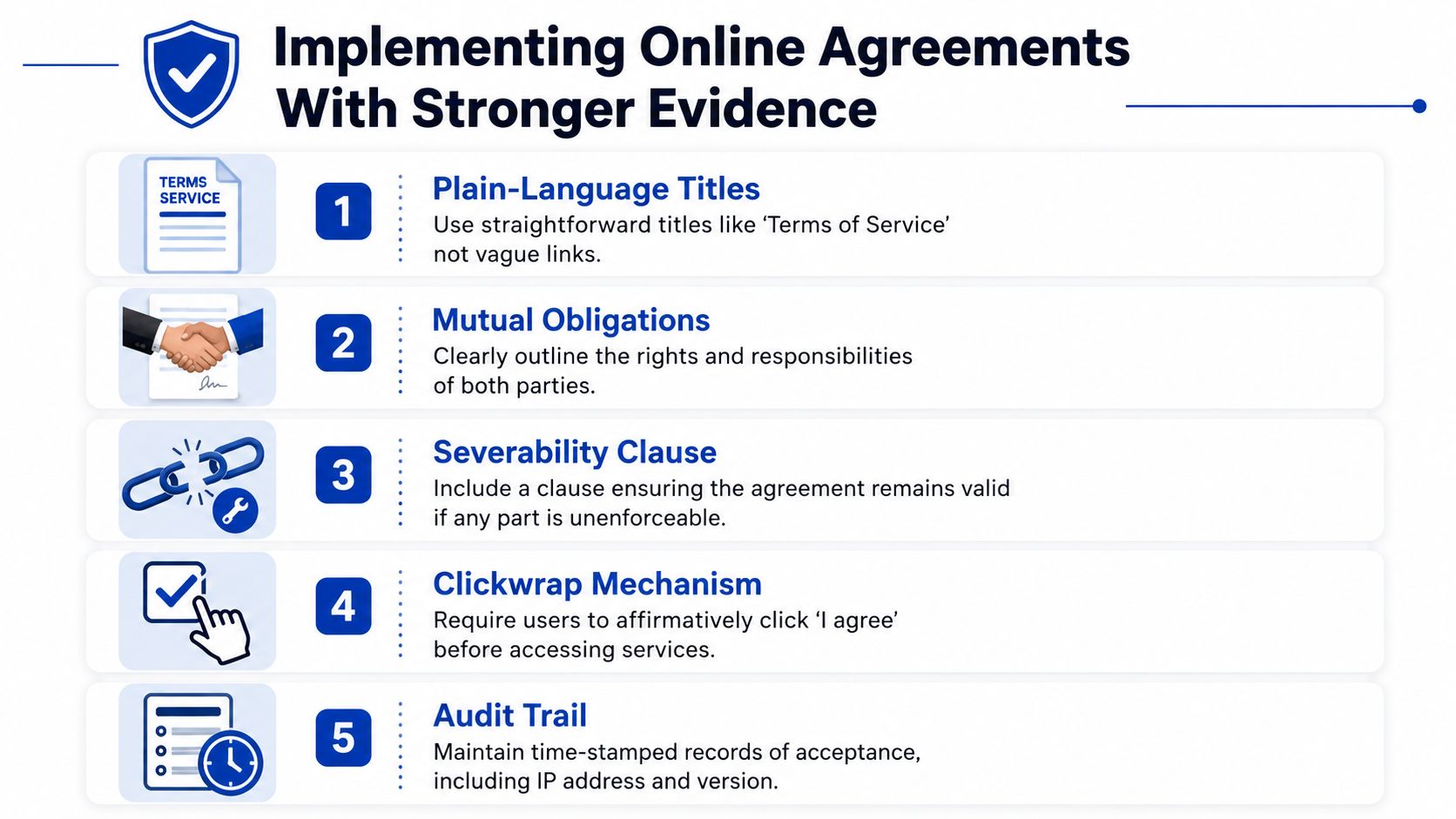
Use a plain-language title such as Terms of Service, Subscription Agreement, or End User License Agreement. Avoid vague link labels that don’t tell the user what opens. The document should state the parties’ mutual obligations, explain material restrictions, include a severability clause, and identify governing law and forum clearly, whether the chosen forum is Washington or another mutually agreed location.
These drafting choices don’t guarantee enforcement. They help the court understand what the user was asked to accept and reduce the risk that a critical provision appears hidden inside an otherwise opaque document.
Build the assent control around the agreement
Place the agreement link immediately beside the acceptance control. Use legible text, sufficient contrast, and a layout that works on desktop and mobile screens. The box should be unchecked by default, and the user shouldn’t be able to complete the relevant transaction while it remains unchecked.
A scroll requirement may be appropriate where the business needs stronger evidence that the terms were displayed, but forcing a user to scroll through a long document can create accessibility and usability problems. The more important point is that the final action must clearly communicate assent.
Preserve a tamper-evident audit trail
At minimum, a prudent record should capture the timestamp, IP information, user agent, accepted version or version hash, and checkbox state. The system should retain the record for at least the applicable statute of limitations period, subject to the business’s retention policy and legal advice. A log that merely says “terms accepted” lacks the surrounding context needed to defend the event.
Versioning should use sequential identifiers and preserve prior versions. A material change should trigger renewed consent rather than replacing the document behind an old link. Product teams should test re-consent behavior before launch, including account migration, mobile updates, and interrupted registration flows.
Test accessibility and review the journey
Screen-reader compatibility, keyboard navigation, focus order, link activation, and error messaging should be tested as part of the assent flow. An inaccessible checkbox may undermine both user fairness and the reliability of the acceptance record.
Periodic review should occur annually and after significant product changes. A new payment screen, account path, mobile redesign, or third-party authentication flow can separate the agreement from the action that supposedly accepts it. The legal text and the actual user journey must remain synchronized.
When Browsewrap May Still Have a Narrow Role
Browsewrap isn’t obsolete in every market or use case. The more accurate conclusion is that pure browsewrap is a litigation-risk tradeoff, and the business must justify that tradeoff with facts that show notice and assent.
A lighter-touch notice may have a narrower role in a long-standing user relationship where the operator can establish actual or constructive prior notice. Repeated exposure to clear terms, recurring banners, or a user’s documented navigation through the agreement may strengthen the position. Internal or employee-facing access terms may also present a different factual setting, particularly where access follows an established policy and the user has received direct notice through workplace systems.
A purely informational site with no account creation or commercial transaction may have fewer practical reasons to impose extensive contractual terms. Even there, the operator should distinguish a general notice from provisions it expects to enforce. A footer link may communicate availability of information, but it may not establish assent to arbitration, a class waiver, or a broad liability limitation.
Evidence must carry the design
A company choosing browsewrap should preserve dated screenshots, contemporaneous notice logs, records of repeated in-product banners, and evidence that the user went past the linked terms. It should also document the wording, placement, contrast, and behavior of the notice as it appeared during the relevant period.
The Ninth Circuit decisions often cited in support of browsewrap are fact-bound. Nguyen recognizes potential enforceability where a site requires affirmative acknowledgment or gives explicit notice that continued use constitutes assent, but that reasoning doesn’t convert every conspicuous link into a contract. The analysis described in recent Ninth Circuit discussion of clickwrap and browsewrap underscores how much turns on the details.
A small engineering change can be cheaper than proving a passive-assent theory under litigation pressure.
Global and multi-state businesses should be especially cautious. Online contract standards aren’t fully uniform, and courts continue to examine notice closely rather than apply one bright-line rule. Browsewrap may be defensible in a narrow setting, but it shouldn’t be selected merely to avoid adding a checkbox.
Recommendations for Washington Businesses
Washington businesses should choose the interface by examining four questions. What transaction is taking place? Who are the users? Which legal and regulatory risks matter? What evidence will remain if the user disputes assent years later?
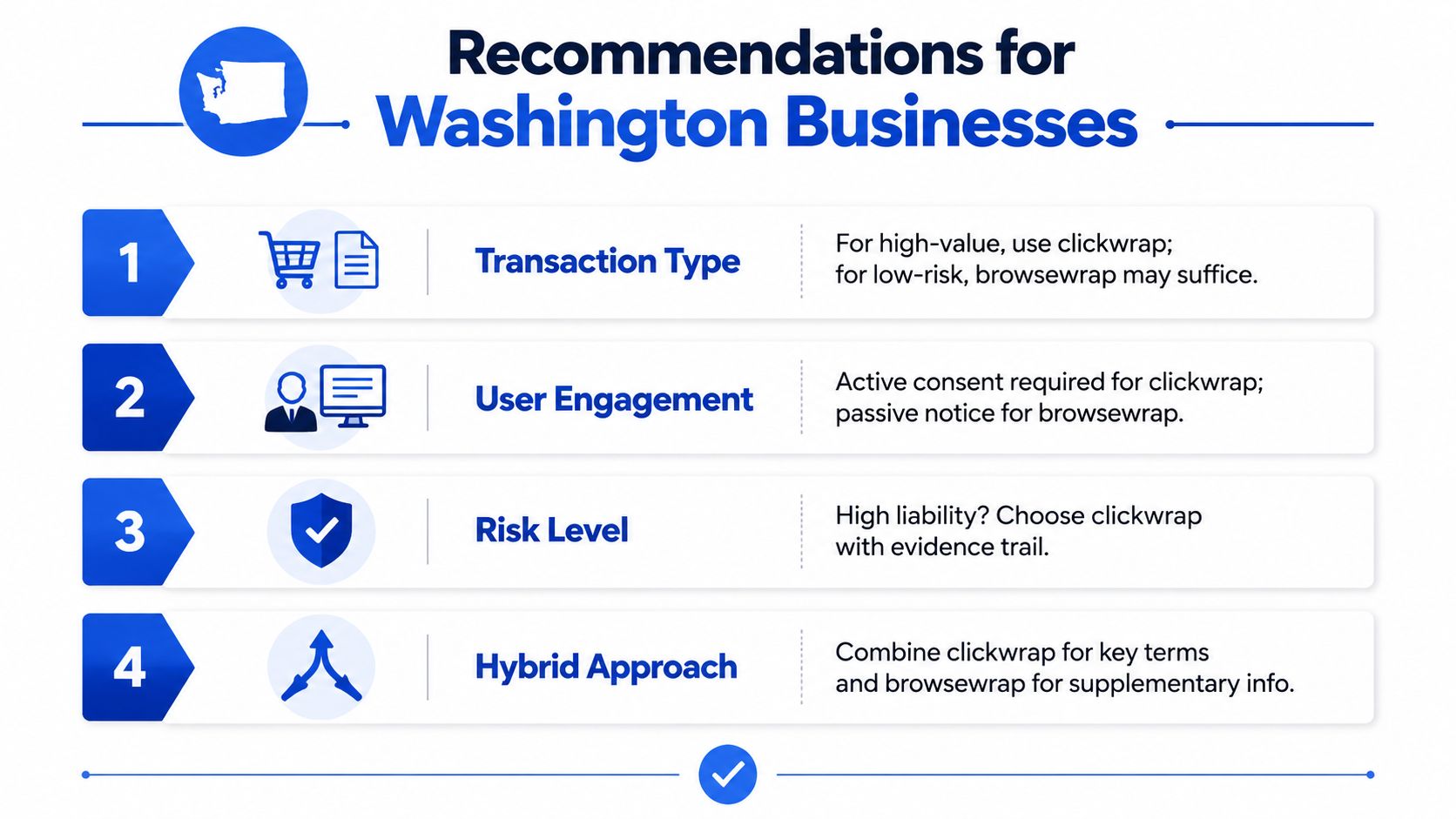
For subscriptions, purchases, marketplace participation, app access, and other relationships involving meaningful obligations, clickwrap should be the baseline. Use clear drafting, conspicuous placement, an unchecked acceptance control, and a version-stamped record. A hybrid approach can work where clickwrap covers core terms and browsewrap or banner notice covers supplementary information that doesn’t carry the same enforcement burden.
A practical decision framework
- Transaction type: Use affirmative assent for a sale, subscription, account, license, or marketplace relationship. A low-risk informational page may support lighter notice.
- User population: Consumers, sellers, business customers, employees, and anonymous visitors may encounter different expectations and evidence conditions.
- Regulatory exposure: Arbitration, class waivers, privacy permissions, consumer restrictions, and liability limitations deserve especially careful presentation.
- Evidence strength: If the business can’t preserve the screen, version, event, and user association, it shouldn’t rely on a difficult assent theory.
Washington and federal consumer-protection requirements may impose obligations beyond contract formation, and the enforceability of a particular clause can depend on fairness, clarity, and applicable law. Out-of-state precedent can be persuasive but isn’t automatically controlling in Washington courts. Arbitration and class-waiver provisions also warrant individualized review because their enforceability may depend on both assent and the clause’s substantive presentation.
The implementation checklist is short:
- Identify every flow that creates an account, sale, license, or continuing relationship.
- Place the relevant terms beside the action that accepts them.
- Require an unambiguous assent event for material obligations.
- Preserve versioned, tamper-evident records.
- Test accessibility, mobile presentation, and re-consent after changes.
- Have counsel review the flow before launch and after material redesigns.
By Design Law Firm & Legal Consultancy, PLLC helps Washington startups and established businesses draft online terms, design defensible assent flows, and preserve the evidence needed to support enforcement. Visit By Design Law Firm & Legal Consultancy, PLLC to discuss a pre-launch contract review, agreement redesign, or broader technology and privacy counsel. Call our law office today at (206) 593-1519.