A founder sends a Slack message confirming scope. A contractor replies by email with a thumbs-up and starts work. A product team pastes AI-generated deal terms into a shared document, planning to “clean it up later.” Then the invoice arrives, the deliverables don't match expectations, and everyone insists there was a deal, just not that deal.
That's where many early-stage businesses get hurt. The problem usually isn't bad faith. It's vague agreement, scattered communications, and no single record that captures who promised what, when performance is due, and what happens if things go sideways.
An express contract fixes that problem. In plain English, it's a legally binding agreement where the parties state the terms explicitly, either orally or in writing. In business, the written version matters most because it creates a durable record, reduces ambiguity, and gives a court, arbitrator, or mediator something concrete to enforce. For founders trying to move fast without inviting preventable disputes, that clarity is a commercial advantage, not paperwork for its own sake.
The Foundation of Every Solid Business Deal
Most business disputes start with a sentence that sounded clear at the time.
A startup hires a designer after a quick call. The founder thinks the quoted fee covers revisions, file handoff, and launch support. The designer thinks the price covered initial concepts only. Nobody writes down the details. Payment becomes a fight, the launch slips, and both sides feel misled.
That's the practical answer to what is an express contract. It's the professional version of a business promise. The parties state the essential terms directly instead of leaving them to implication, memory, or later interpretation. Those terms can be oral or written, but written contracts are the safer tool because they preserve the actual agreement instead of relying on competing recollections.
A strong express contract does more than create legal rights. It sets expectations, allocates risk, and forces the parties to confront details before money changes hands. That's why written agreements are the default in serious commercial work, especially where deliverables, payment timing, intellectual property, confidentiality, or long-term obligations matter.
For startup teams building their contract stack, a practical place to begin is a guide to essential contracts for business owners. The point isn't to over-lawyer every transaction. The point is to stop treating important deals like casual conversations.
Clear contracts don't slow a business down. Unclear deals do.
The Anatomy of an Enforceable Express Contract
A founder approves terms in Slack. The contractor starts work based on that thread. Two weeks later, the founder says legal still needs to sign off, and the contractor says the deal was already accepted. That fight usually turns on contract formation, not on anyone's intentions.
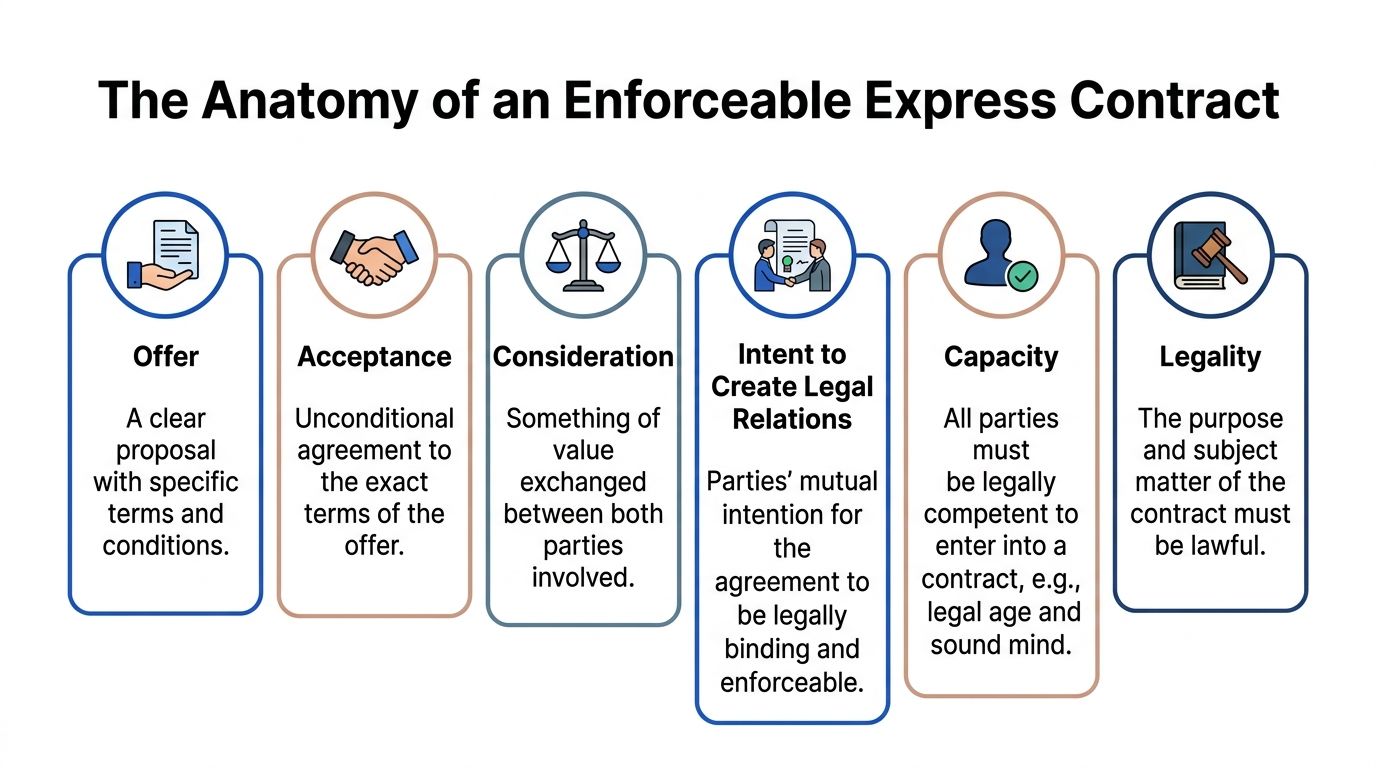
An enforceable express contract comes down to a short list of basics: a clear offer, a clear acceptance, consideration, capacity, lawful subject matter, and objective evidence that the parties meant to make a binding deal. The law does not reward vagueness. In a startup, vague language usually shows up in the same places. Email summaries, redlined PDFs no one fully signs, procurement portals, text messages, and AI-generated drafts that sound polished but leave key business terms unresolved.
Offer and acceptance
The offer has to be definite enough that a court can tell what was proposed. “Need design help next week” is a business conversation. “Deliver three homepage concepts, one final homepage file, and two revision rounds for a fixed fee due on receipt” is much closer to an offer a court can enforce.
Acceptance also has to be clear. If the response changes a material term, such as scope, timing, price, or ownership, that usually operates as a counteroffer rather than acceptance.
Digital tools create real risk. One person approves the pricing in email. Another revises the scope in a Google Doc. A third sends “looks good” in chat. If the team cannot identify which version was accepted, enforceability gets harder and litigation gets more expensive. For Washington businesses, that practical problem matters because courts look for objective manifestations of assent. The question is not what someone privately meant. The question is what the parties said and did in a way that shows agreement.
Consideration and intent to be bound
Each side must exchange something of value. Money for services is the obvious example, but consideration can also be access to software, a license, exclusivity, a release of claims, or a promise to perform future work.
Intent also matters, especially for founders who negotiate informally. A message saying “let's get started” can create problems if the surrounding facts show the parties had already settled the key terms. On the other hand, language such as “subject to definitive agreement” or “pending legal review” can help show the parties were still negotiating, if their conduct matches those words.
I see this mistake often with startup teams using templates or AI drafting tools. The document looks finished, so everyone acts like the legal work is done. But if the draft leaves open who owns deliverables, what triggers payment, whether auto-renewal applies, or which entity is signing, the contract may be far less enforceable than it appears.
If a deal matters, the record should show who is promising what, on what timeline, for what payment, under which version of the document.
Capacity and lawful purpose
The parties also need legal capacity to contract, and the agreement must concern lawful activity. For companies, capacity issues often show up less as age or competency questions and more as authority questions. Did the person who accepted the deal have authority to bind the company? Startups get this wrong when a project manager, advisor, or cofounder approves terms without clear signing authority.
Lawful purpose sounds obvious, but the business version is broader than outright illegal conduct. A contract can become difficult to enforce if it conflicts with licensing rules, consumer protection requirements, industry regulations, or restrictions tied to the services being sold.
Why founders should care about the details
Founders should care about the contract details because formation rules decide if the contract is a real asset or only messy evidence later. Use one final version, the right signing entity, and keep approval channels consistent.
That is why clean process matters as much as legal doctrine. Use one final version. Identify the signing entity correctly. Keep approval channels consistent. Confirm material changes in writing. If the agreement includes post-closing risk allocation, review provisions like indemnity clauses in Washington State contracts, because formation is only the first enforceability question. The next one is who carries the loss when something goes wrong.
Express vs Implied Contracts Why The Difference Matters
An express contract exists because the parties say what the deal is. An implied contract exists because conduct, surrounding circumstances, or business behavior suggests a deal existed, even if nobody stated all the terms directly.
That difference matters most when a dispute lands in front of a judge, arbitrator, or mediator.
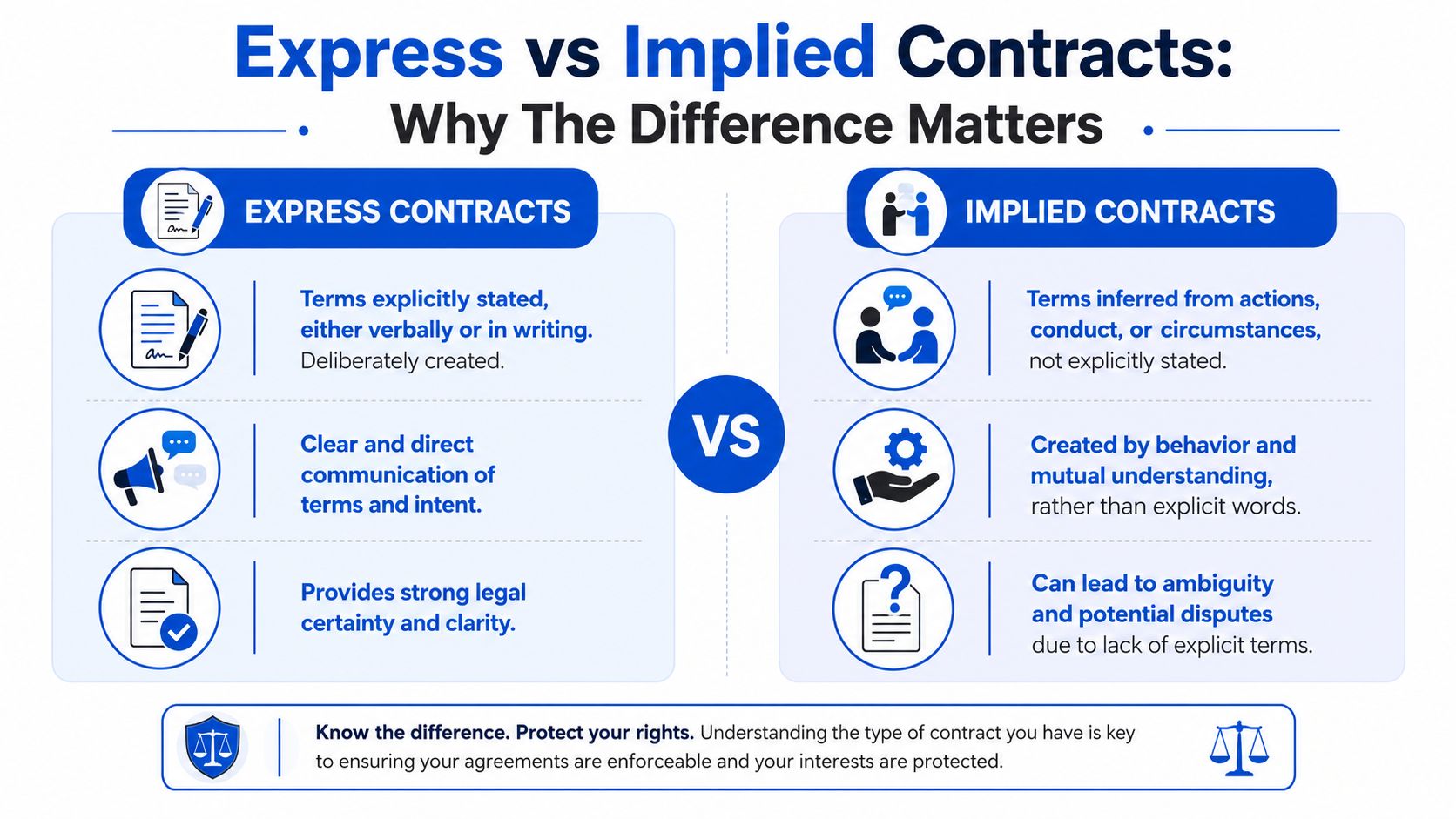
Ironclad explains the distinction well in its discussion of express and implied contracts. In legal practice, implied contracts are inferred from conduct or circumstances, while express contracts leave far less room for misinterpretation because the terms are clearly articulated. That's why businesses generally prefer express contracts for deals involving money, compliance, or continuing obligations.
Side by side comparison
| Issue | Express contract | Implied contract |
|---|---|---|
| How it forms | Through explicit words, orally or in writing | Through actions, conduct, or circumstances |
| How it's proved | Usually by a document, recorded terms, or clear statements | By inference and surrounding facts |
| Risk level | Lower ambiguity when drafted well | Higher ambiguity and more room for dispute |
| Best use | Commercial deals, service agreements, licensing, employment terms | Limited situations where conduct clearly shows mutual understanding |
A short explainer can help clarify the distinction in practical terms.
Why startups should care
Implied contracts can arise when a company repeatedly accepts work, pays invoices without a signed master agreement, or allows a vendor relationship to continue based on custom rather than documented terms. Sometimes that helps the party seeking payment. More often, it creates uncertainty around scope, ownership, cancellation rights, and liability caps.
For startups, that uncertainty is expensive. Investors want clean documentation. Procurement teams want defined obligations. A future acquirer won't enjoy hearing that a critical commercial relationship rests on “the way everyone understood it.”
The strongest business position is rarely “we can probably prove what we meant.” It's “the signed agreement already says it.”
Express contracts also reduce accidental promises. If a founder wants negotiations to remain nonbinding until a formal signature, the communications and draft paperwork should say that clearly. Without that discipline, routine business conversations can drift into arguments about whether the parties already committed themselves.
Putting It on Paper Enforceability and the Statute of Frauds
A common founder question is simple. Does an express contract have to be in writing?
Not always. Oral express contracts can be binding if the required legal elements are present. But oral agreements are harder to prove, harder to interpret, and much harder to enforce cleanly when the parties later disagree about terms. In real business settings, that's reason enough to default to writing.
There's also a legal overlay. Some contracts must be in writing to be enforceable. Lawyers often group these rules under the Statute of Frauds. In Washington practice, that means founders should pause before relying on a handshake, a phone call, or a loosely documented text exchange for certain categories of deals.
Washington-focused situations that call for writing
For Washington businesses, written agreements are especially important for categories commonly understood to require formal documentation, including:
- Real estate transactions: Deals involving the transfer or significant rights in real property generally belong in a written agreement.
- Agreements that can't be performed within one year: If the deal, by its terms, cannot be completed within a year, writing becomes critical.
- Certain sales of goods under the UCC: Commercial sales of goods often trigger writing requirements once the transaction reaches the threshold set by applicable law.
- Guarantees and similar undertakings: If one party is backing another's obligation, founders should expect a writing requirement and draft accordingly.
Washington-specific details depend on the transaction and the statutes in play, so this is one area where founders shouldn't improvise from internet snippets or recycled templates.
What works and what doesn't
What works is simple. Put the full agreement in one document. Identify the parties correctly. Define scope, payment, timing, ownership, termination, and dispute procedure. Make sure the right people sign.
What doesn't work is splitting the deal across a proposal, invoice, Slack thread, and oral side promises, then hoping a court stitches it together later. Courts can interpret records. They can't rescue avoidable ambiguity.
A useful practical example is reviewing service agreement details to see how business terms, conditions, and responsibilities are organized in a single written framework. The point isn't that every business should use the same language. The point is that enforceability improves when obligations live in one place.
The startup rule of thumb
For any agreement that affects revenue, ownership, compliance, customer delivery, or a long-term vendor relationship, a written contract should be treated as mandatory even if the law might allow an oral one.
That approach does two things. It strengthens enforceability. It also forces the business to confront issues early, before they become expensive facts.
Practical Drafting and Negotiation Tips for Startups
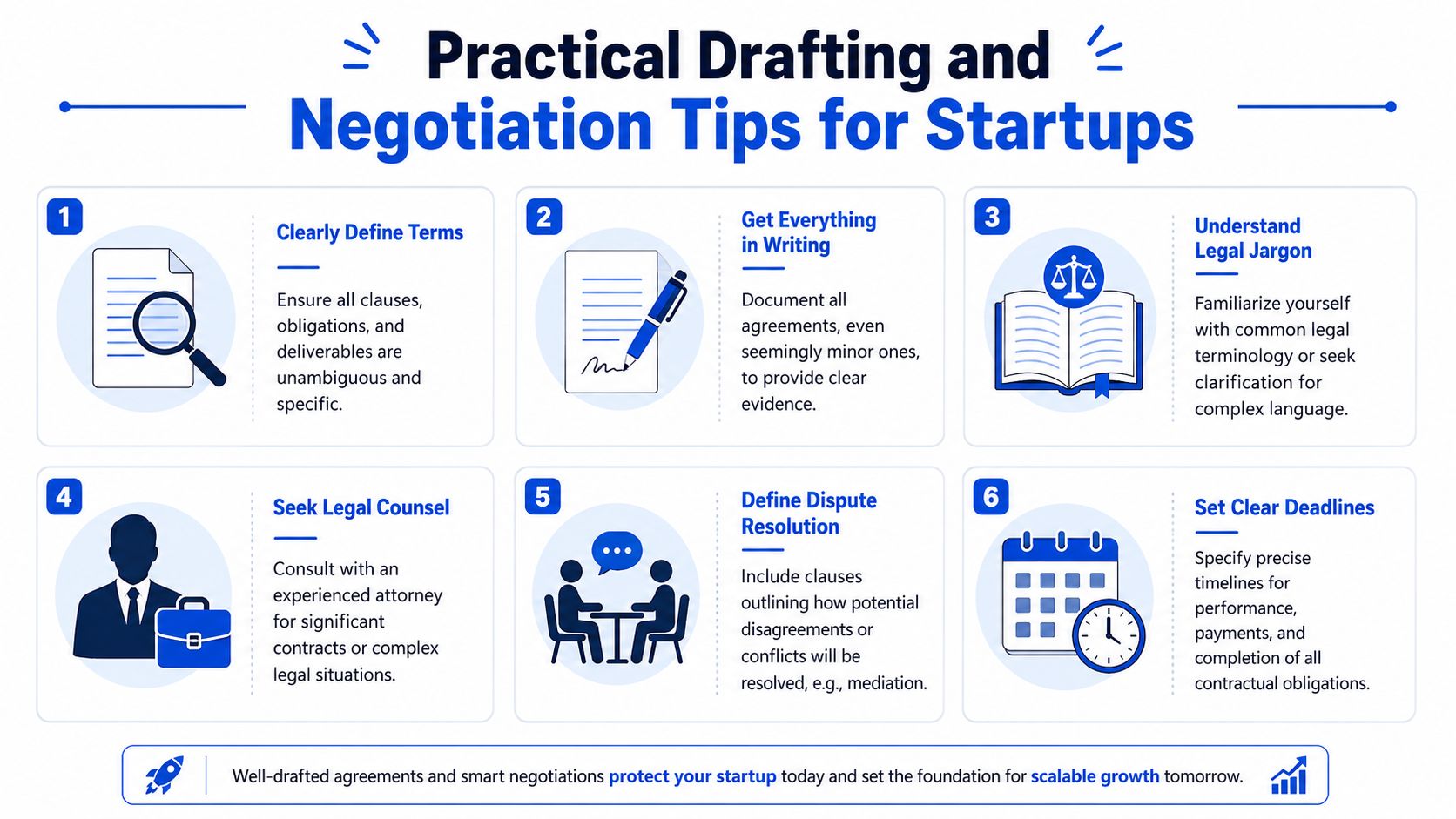
Most contract problems don't come from obscure doctrine. They come from ordinary omissions. Undefined deliverables. Missing deadlines. Payment language that looked obvious until the invoice dispute arrived.
That's why a startup should draft with one operating principle. Clarity first.
Draft like an operator, not a philosopher
A useful contract answers practical questions fast.
- Define the work clearly: If the agreement is for software development, identify modules, milestones, testing responsibility, acceptance criteria, and handoff obligations.
- Spell out payment mechanics: State the amount, due date, invoice trigger, late-payment consequences if applicable, and whether expenses need preapproval.
- Address ownership directly: For startups, intellectual property shouldn't be implied. The contract should say who owns code, content, designs, training data outputs, and derivative work.
- Set deadlines that can be measured: “Promptly” is a fight waiting to happen. Specific dates, review windows, and approval periods are better.
A founder using a project-based contract can save time by starting with a solid statement of work template. A proper SOW often determines whether the larger agreement functions in practice or collapses into scope disputes.
Negotiate for the dispute you hope never happens
The best time to handle conflict is before anyone is upset.
Contracts should assume that memory will fail, personnel will change, and business pressure will distort what each side thinks was “understood.”
That means including terms such as:
| Clause area | Why it matters |
|---|---|
| Governing law | Tells everyone which state's law controls the agreement |
| Venue | Identifies where disputes must be filed or heard |
| Dispute resolution | Can require mediation, arbitration, or a defined escalation path |
| Termination rights | Clarifies how either side exits the relationship |
| Confidentiality | Protects sensitive information shared during performance |
For Washington startups, governing law and venue deserve special attention. If the company is based in Seattle or elsewhere in the Puget Sound, it often makes sense to specify Washington law and an agreed forum such as King County, depending on the transaction and negotiating power.
Clean process beats heroic cleanup
Founders often focus on getting the signature. The better habit is controlling the process around the signature.
Use version control. Mark drafts clearly. Keep negotiation comments out of the final agreement. Make sure exhibits are attached. Confirm that the signer has authority to bind the company. If the contract references a data processing addendum, pricing sheet, or statement of work, attach it before execution, not after.
A contract should read like a final operating manual, not a reconstruction of rushed conversations.
Common Pitfalls in Express Contracts and How to Avoid Them
A founder approves pricing in email, a project manager confirms timing in Slack, and the vendor starts work before anyone signs the order form. By the time payment is disputed, the argument is no longer about the business deal. It is about whether those scattered messages formed an enforceable contract, who had authority to commit the company, and which terms control.
That problem shows up often in startup practice because express contracts fail for practical reasons, not just legal ones.
Vague language that creates expensive factual disputes
A SaaS startup hires a consultant under a short agreement requiring “best efforts” for a product launch. The consultant reads that as strategy support and weekly check-ins. The founder expects lead generation, sales materials, launch coordination, and investor messaging.
The contract exists. The problem lies in terms that sound acceptable in a rush but collapse under pressure.
Words like “reasonable support,” “market rate,” “promptly,” and “as needed” should be tied to something measurable. Define deliverables, deadlines, approval rights, response times, and payment triggers. If a term matters to revenue, product timing, or customer commitments, write it so a stranger could administer it six months later.
Missing terms about what counts as the full deal
Informal negotiations create another trap. A founder may believe a vendor promised exclusivity on calls and a custom dashboard by email, while the signed contract says nothing about either one. Without clear language stating that the written agreement is the complete agreement, each side has room to argue about what was supposedly part of the deal.
This gets harder in a digital-first company, where negotiations may sit across Gmail threads, Slack channels, redlines, AI-generated drafts, and comments inside a shared document. If the final contract does not clearly supersede those discussions, the record becomes messy fast.
Use one rule. Business terms that matter belong in the contract itself, not in the chat history around it.
Weak termination language traps startups in bad relationships
Startups often spend their energy getting a deal signed and too little time on how the deal ends. That creates trouble when a vendor misses deadlines, a pilot underperforms, or the company changes direction after a fundraising delay.
Termination language should answer four practical questions: when a party can terminate, how much notice is required, what fees remain due, and what obligations continue after exit. If data return, transition help, confidentiality, or IP ownership matter after termination, say so directly.
In Washington, this is especially important for service relationships that evolve quickly. A vague termination clause can turn a simple exit into a dispute over unpaid invoices, access to work product, or whether post-termination restrictions still apply.
Digital communications can accidentally form, change, or undermine the contract
Founders often assume the definitive contract is the PDF in DocuSign. Courts do not always see it that way. Email exchanges, chat messages, attached proposals, tracked changes, and approval messages can all become evidence of offer, acceptance, changed terms, or waiver.
Authority is usually the hidden issue. A sales lead, operations manager, or product employee may sound definitive in Slack without possessing authority to bind the company. If the other side relies on that message, the business may still end up spending real money to fight over enforceability.
A common example looks like this: “Approved. Let’s launch next week at the pricing we discussed.” If pricing, scope, term length, and signer authority are not clear, that message creates risk for both sides. It may be enough to start a dispute and too incomplete to resolve one cleanly.
The safer process is simple. Use chat and email to negotiate, then move final terms into one execution-ready document. State who can approve the deal. State when the parties are legally bound. If your agreement requires mediation, arbitration, or a particular court, build that into the paper and understand how dispute resolution clauses affect the cost and speed of a future fight.
AI drafting speeds up paperwork and increases review risk
AI tools can help generate first drafts, summarize redlines, and suggest fallback language. They also create a false sense of completion. I see founders rely on AI-produced contracts that sound polished but miss basic deal mechanics, mismatch defined terms, or import clauses from another state that do not fit the transaction.
For Washington startups, that last point matters. Governing law, venue, noncompete limits, consumer-facing rules, and industry-specific compliance issues can all affect enforceability. A contract assembled from chat prompts still needs legal review for the actual deal, the actual parties, and the actual state law involved.
Speed helps only if the final document matches the business reality.
Your Express Contract Checklist and Final Takeaways
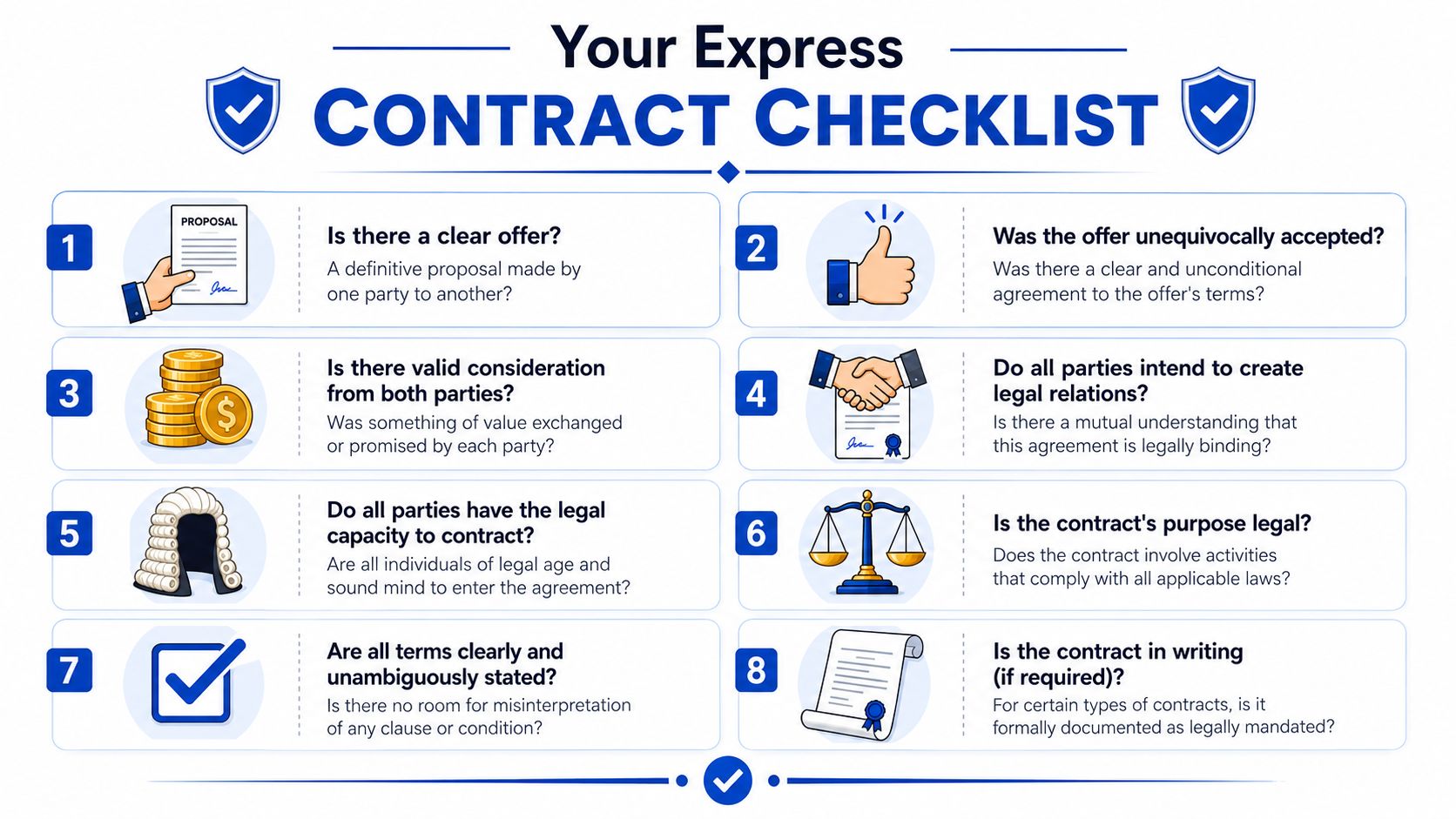
A good contract review process should be short enough to use and disciplined enough to catch real risk. For founders, the question isn’t only what is an express contract. The better question is whether the specific agreement in front of the business is enforceable, usable, and clear enough to survive stress.
A practical review list
- Clear offer: Does the contract state exactly what one side is proposing?
- Unequivocal acceptance: Did the other side accept those terms without making unstated changes somewhere else?
- Real consideration: Is each side giving or promising something of value?
- Intent to be bound: Does the language show a binding agreement rather than a draft, proposal, or discussion?
- Capacity and authority: Are the parties legally competent, and are the signers authorized to bind the business?
- Lawful purpose: Is the subject matter permissible under applicable law and regulation?
- Specific terms: Are scope, pricing, deadlines, ownership, confidentiality, and termination rights stated clearly?
- Writing when needed: For this type of agreement, has the business reduced it to writing and gathered the proper signatures?
The practical takeaway
Founders often treat contracts as a closing step. That’s backwards. The contract is part of how the business designs the relationship itself. It decides what gets delivered, who carries risk, how money moves, and what happens when expectations diverge.
An express contract is valuable because it turns assumptions into language. In a digital-first company, that discipline matters even more. Teams move quickly, decisions happen in chat, AI tools generate drafts instantly, and cross-border work creates jurisdiction questions that informal communications don’t answer well. A clean written agreement remains the best protection against speed becoming sloppiness.
Strong contracts don’t just help in court. They help companies avoid court.
For a Washington startup, that’s the business case. Better contracts preserve cash, shorten disputes, support diligence, and build trust with customers, investors, vendors, and employees. That isn’t bureaucracy. It’s infrastructure.
By Design Law Firm & Legal Consultancy, PLLC helps Washington startups and established businesses build durable legal foundations for growth. From contract drafting and negotiation to technology, privacy, and AI-related risk, the firm provides practical counsel that turns complex legal issues into clear business decisions. Learn more at By Design Law Firm & Legal Consultancy, PLLC. Contact our law office for a complementary consultation at (206) 593-1519.