A Washington startup signs a promising customer, brings on a critical vendor, or closes a financing round. Everyone wants to get the deal done. The business terms get negotiated hard. The dispute section gets skimmed.
That's usually where trouble starts.
When a relationship breaks down, the contract stops feeling abstract. A founder dealing with a missed software implementation, a reseller withholding payment, or a former partner claiming ownership of IP needs answers fast. Which law applies. Where the fight happens. Whether the company has to mediate first. Whether emergency court relief is still available. Those questions often turn on a few clauses that were treated like boilerplate at signing.
The Handshake Deal Is Over Now What
A founder in Seattle signs a vendor agreement on Friday because the product team needs the integration live by Monday. Six months later, the vendor misses milestones, blames the startup's internal team, and refuses a refund. The startup believes the sales process included misleading statements. The vendor says the contract limits the dispute to a narrow breach claim.
That's when the dispute resolution clause stops being back-office language and becomes a control panel.

Boilerplate that decides leverage
A well-drafted dispute clause tells the parties where they'll fight, what rules apply, and whether they must try to settle before filing a claim. A weak one invites a second dispute about the process itself. For a startup, that procedural fight can drain management time before the merits are even addressed.
Empirical research shows how common these clauses have become. In a study of international supply agreements, 99% included a choice-of-law clause, 55% included an arbitration clause, and 36% included a forum-selection clause. The same study found that 80% of choice-of-law clauses did not define scope, leaving uncertainty about whether the selected law applied only to contract claims or also to related tort and statutory claims, according to the Vanderbilt study on boilerplate and international supply contracts.
That combination matters. Businesses almost always include these clauses, yet many still draft them loosely enough to create avoidable motion practice later.
Practical rule: If the clause doesn't clearly answer who decides, where they decide, and what claims are covered, it probably hasn't finished the job.
Why this matters in Washington startup deals
Washington companies often contract across state lines. A Seattle SaaS company may have customers in California, infrastructure vendors in another state, and investors tied to Delaware entities. That makes dispute planning more important, not less.
A founder doesn't need a law-school definition of dispute resolution clauses. The useful framing is simpler:
- They allocate risk: The clause can make a claim cheap to pursue or expensive to enforce.
- They shape settlement pressure: A private arbitration in a selected city creates different incentives than public court litigation.
- They affect business continuity: A clause can preserve access to emergency relief, require continued performance during a dispute, or force a pause for negotiation.
The old handshake approach works until someone's cash flow tightens, a milestone slips, or the cap table changes. Once that happens, process becomes strategy. Startups that treat dispute language as routine often learn too late that the “legal boilerplate” was one of the most important business terms in the contract.
Choosing Your Path Litigation Arbitration or Mediation
Most founders think in terms of winning or losing. The better question is how the company wants a dispute handled before the conflict exists. Court, arbitration, and mediation all solve different business problems.
What companies actually choose
Despite how often arbitration gets discussed in startup circles, litigation remains a frequent contractual choice. An empirical review of 187 international contracts found that 57.8% used a litigation clause while 21.93% used an arbitration clause, according to the Cornell review of international contracts and dispute design.
That doesn't mean litigation is better. It means parties often decide that public courts, established procedures, and appellate review fit the deal better than a private arbitral process.
Dispute Resolution Methods Compared
| Feature | Litigation (Court) | Arbitration | Mediation |
|---|---|---|---|
| Decision maker | Judge or jury | Private arbitrator or panel | Neutral mediator |
| Privacy | Usually public | Usually more private by agreement and rules | Private settlement process |
| Appeal rights | Broader opportunities to challenge rulings | Usually limited | No binding result unless parties settle |
| Speed control | Court schedules largely control timing | Parties can shape procedure more directly | Flexible and often early-stage |
| Business relationship impact | Can harden positions quickly | More formal, but less public | Often best for preserving working relationships |
| Best fit | Precedent-sensitive disputes, injunction-heavy matters, clear statutory claims | Cross-border deals, confidentiality concerns, expert decision makers | Payment disputes, project friction, founder or vendor relationship repair |
A founder who wants a plain-English primer can also review how WeUnite explains mediation versus arbitration. It's a useful comparison before clause drafting starts.
How the trade-offs play out
Litigation works well when a business may need court remedies, broad procedural tools, or a public judgment. It can also make sense when one party expects the possibility of multiple related claims involving non-signatories. Founders dealing with courtroom disputes can get a practical overview from this business litigation explainer.
Arbitration is often attractive when confidentiality matters, when the contract is cross-border, or when the parties want a chosen decision maker with industry familiarity. But arbitration isn't automatically simple. The clause has to specify the administering institution, rules, seat, language, and how arbitrators are appointed if the parties want fewer procedural surprises.
Mediation serves a different role. It's usually not about deciding who is legally right. It's about getting to a workable commercial solution before fees, discovery battles, and management distraction become a substantial problem.
A startup doesn't need one favorite process. It needs the right process for the type of dispute that's most likely to hit the business.
For many Washington startups, the strongest answer isn't choosing one lane at all. It's using a sequence. Negotiate first, mediate if needed, arbitrate or litigate after that, with narrow carve-outs for urgent injunctions or IP misuse. That structure gives the company room to settle while preserving a real enforcement path if talks fail.
Drafting an Enforceable Clause in Washington State
A dispute clause only works if a court or arbitrator can enforce it without guessing what the parties meant. In Washington deals, three drafting choices do most of the heavy lifting: governing law, forum, and scope.
Start with the non-negotiables
Governing law answers which state's substantive law applies. Forum selection answers where a court case must be filed, or where an arbitration is legally seated and physically heard if the clause separates those ideas. Scope answers which claims the clause captures.
Scope is where many clauses break down. If a contract says only that disputes under the agreement go to arbitration, someone may later argue that fraud, negligent misrepresentation, statutory claims, or disputes over contract formation fall outside the clause. A better clause states that it covers disputes “arising out of or relating to” the agreement and then specifies whether formation, validity, interpretation, performance, breach, termination, and enforceability are included.
For startups negotiating customer MSAs, licensing terms, or technology services agreements, this is the same drafting discipline used elsewhere in risk allocation. The logic is similar to careful indemnity clause drafting in Washington contracts. Precision lowers the odds of expensive threshold fights.
Multi-tier clauses need objective steps
Negotiation and mediation provisions look sensible on paper, but they fail when the language is aspirational. Courts and tribunals increasingly focus on certainty. Vague promises to negotiate “in good faith” are often treated as unenforceable, while mandatory wording like shall and concrete timelines improve the odds that the pre-arbitration step will be upheld, as described in this analysis of multi-tiered dispute resolution clauses.
That means a Washington-focused clause should avoid loose language such as:
- Soft verbs: “may discuss,” “will attempt,” or “should consider mediation”
- No trigger: no notice requirement, no start date, no completion standard
- No consequence: no statement that the step is a condition precedent to arbitration or suit
A stronger version usually includes the opposite:
- A written notice trigger that starts the process.
- A fixed negotiation window measured from receipt of notice.
- A named mediation provider or selection method if mediation is required.
- Condition precedent language making completion of the step mandatory before the next forum opens.
- A carve-out for temporary restraining orders, injunctions, or other urgent relief.
Drafting warning: If the clause requires pre-suit talks, it should say exactly who participates, when the talks begin, and when that phase ends.
Washington-specific business judgment
Washington founders should also think operationally. If the company is based in Seattle but signs a clause requiring hearings across the country, the legal issue isn't abstract fairness. It's whether the company can realistically enforce its rights when cash is tight and key employees are needed at work.
The best clause is usually the one the business can effectively use. Enforceability starts with legal drafting, but practicality decides whether the clause provides an advantage or just creates paperwork.
A Practical Drafting Checklist and Sample Clauses
A startup usually discovers whether its dispute clause works after a deal has gone sideways. The customer stops paying, the vendor misses a deadline, or a financing-side document points to a different forum than the main agreement. At that point, the clause needs to answer practical questions fast: Where does the case go, who decides it, what happens first, and can the company still get immediate relief if confidential information or IP is at risk?
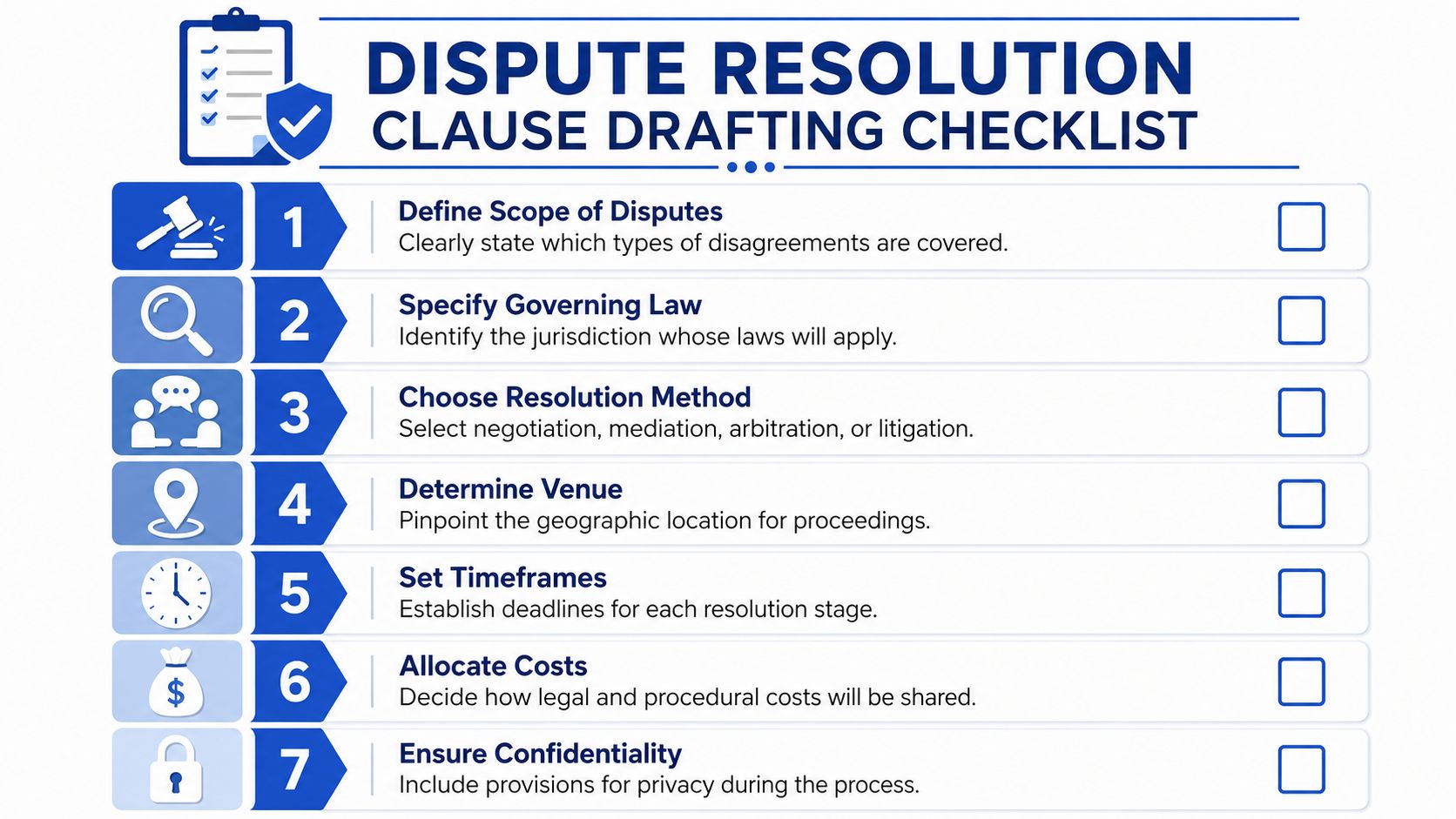
Clause drafting checklist
For Washington startups, the best checklist is not just legal. It is operational. A clause should fit the company's likely disputes, budget, and contract stack.
- Define the dispute scope: Use broad language such as disputes “arising out of or relating to” the agreement, and state whether formation, validity, interpretation, breach, termination, and enforceability are covered.
- Align governing law and forum: If Washington law applies, make sure the forum choice does not create unnecessary cost or friction for a Seattle or Bellevue team trying to enforce the contract.
- Name the forum precisely: Identify the court, city, or arbitral seat. For arbitration, name the administering institution and rules.
- Draft any tiered process so it can be enforced: If negotiation or mediation must happen first, set a written notice trigger, deadlines, required participants, and clear condition precedent language.
- Preserve emergency court access: State that either side may seek temporary, preliminary, or injunctive relief when delay would cause immediate harm.
- Spell out procedure and cost points: Address the number of arbitrators, confidentiality, language, fee allocation, and how an arbitrator is appointed if the parties cannot agree.
- Check every related document: SAFE side letters, investor rights agreements, MSAs, SOWs, SaaS terms, IP assignments, and vendor paper should not send the same dispute into different forums.
General drafting guidance also favors clear scope language and express treatment of threshold issues such as validity and termination, as discussed in this drafting guide on dispute resolution clauses. For startups, that point matters most when several agreements are signed in the same transaction. A workable clause in one document can still create problems if the companion documents use different rules or stay silent.
The same contract review often raises another issue. Force majeure language, termination rights, and the dispute clause should point in the same direction, especially in technology and supply arrangements. If you are reviewing templates as a package, it helps to revisit what a force majeure clause does in business contracts.
A short walkthrough can help teams spot drafting gaps before signature:
Sample clause for a tiered process
This format works best when the parties want a short off-ramp before paying for a full proceeding, but still need certainty if settlement talks fail.
Any dispute, claim, or controversy arising out of or relating to this Agreement, including its formation, validity, interpretation, performance, breach, termination, or enforceability, shall be initiated by written notice from one party to the other describing the dispute in reasonable detail. Within ten (10) business days after receipt of that notice, each party shall designate a representative with authority to settle the dispute, and those representatives shall meet and confer in good faith. If the dispute is not resolved within twenty (20) business days after the notice is received, the parties shall submit the matter to mediation administered under identified rules in a stated location. Completion of the mediation, or written confirmation that the mediation ended without resolution, is a condition precedent to commencing arbitration or litigation, except for a request for temporary, preliminary, or injunctive relief.
Sample carve-out for urgent relief
A startup with code, customer data, or proprietary product plans usually cannot wait for a full mediation cycle before acting.
Notwithstanding the dispute resolution process above, either party may seek temporary, preliminary, or injunctive relief in a court of competent jurisdiction to prevent unauthorized use or disclosure of confidential information, infringement or misuse of intellectual property, solicitation in violation of a restrictive covenant, or other harm for which monetary damages would not be an adequate remedy. Seeking that relief shall not waive any requirement to arbitrate or litigate the underlying dispute in the forum otherwise required by this Agreement.
Common Pitfalls for Startups and How to Mitigate Them
Startups rarely have one contract. They have a stack. Founder agreements, advisor agreements, customer MSAs, order forms, cloud vendor terms, financing documents, contractor IP assignments, and channel partnerships. That's where otherwise decent dispute resolution clauses start colliding.

The multi-contract problem
Standard templates often assume one contract and two parties. Real startup transactions don't look like that. Guidance on clause drafting for modern commercial deals highlights a critical but often overlooked issue: multi-contract and multi-party disputes create serious procedural challenges because interlocking agreements are common in startup financing, joint ventures, and vendor stacks, as discussed in this article on clause design in complex deal structures.
A common example is easy to spot. The MSA requires arbitration in one state, the statement of work points to local courts, and the data processing addendum is silent. When a service failure creates a privacy issue and a payment dispute at the same time, the parties can end up fighting about where to fight.
What goes wrong most often
- Inconsistent forums across related agreements: Different documents send related claims to different places.
- No joinder or consolidation planning: The clause doesn't address whether related claims can be handled together.
- Remote and expensive venues: A startup agrees to a distant forum because it wants the deal closed.
- Overbroad confidentiality assumptions: The clause assumes privacy without tying it to the selected rules or agreement terms.
- Hybrid clauses drafted sloppily: Some claims go to court, others to arbitration, but the line between them is unclear.
Startups don't usually lose control because they chose court over arbitration. They lose control because their contract set has no unified process.
What to do instead
For vendor stacks and financing rounds, the practical fix is coordination, not just better wording in a single document.
Use a short internal review checklist before signing any related agreement:
| Risk area | Better approach |
|---|---|
| Different dispute forums | Align all core agreements on law, forum, and escalation path where possible |
| Multiple entities or signatories | Check whether affiliates, founders, guarantors, or investors need to be expressly included |
| Urgent IP or confidentiality issues | Preserve a narrow court carve-out for injunctive relief |
| Fragmented procedures | Use consistent institutions, seats, language, and appointment mechanics |
| Procurement pressure | Escalate venue and process terms early rather than at signature hour |
A Washington startup should also ask a blunt question before accepting an out-of-state forum: if the other side breaches, will the company file there? If the honest answer is no, the clause may be relinquishing an advantage at the front end.
Founders often focus on headline economics. The legal process term hidden near the end of the contract can matter just as much when the relationship turns.
Building Your Business on a Solid Legal Foundation
Dispute resolution clauses aren’t just for worst-case scenarios. They shape how a business behaves when a deal gets stressed. A company with a clear process can maintain its strong position, protect relationships where possible, and move faster when enforcement becomes necessary.
That matters in Washington’s startup market, where companies often scale through a mix of software contracts, services agreements, partnerships, and investment documents. One weak dispute clause might be manageable. A full contract stack with inconsistent ones becomes a governance problem.
The broader compliance mindset
The same discipline that improves dispute language usually improves the rest of the company’s contracting. Teams that define scope precisely, assign responsibility clearly, and plan for evidence tend to manage conflict better when it arrives.
For example, if a dispute later turns on recorded calls, meeting notes, or internal escalations, operational rules matter. Founders dealing with consent and recording practices can review audio recording laws explained before building those habits into sales or support workflows.
Businesses that want stronger contract systems, not just one-off clauses, often need broader contract and transactional law support so templates, negotiations, and enforcement strategy line up.
The practical takeaway
A strong clause does three things well:
- It creates predictability by naming the law, forum, and covered claims.
- It reduces friction by making pre-dispute steps objective instead of aspirational.
- It fits the business by matching the company’s actual operating realities, including where it can enforce rights and how many related contracts are in play.
The best dispute clause usually won’t feel dramatic when it’s signed. It will feel clear.
That’s the point. Good drafting removes room for gamesmanship. It turns a future disagreement into a defined process rather than a second negotiation under stress. For founders, that isn’t legal ornament. It’s part of building a company that can absorb conflict without losing direction.
By Design Law Firm & Legal Consultancy, PLLC helps Washington businesses draft, review, and negotiate contracts with dispute provisions that match real operating risk. Companies that want a clearer process for vendor agreements, customer contracts, financing documents, or active contract disputes can learn more at By Design Law Firm & Legal Consultancy, PLLC. Call our law office today at (206) 593-1519.