A founder usually doesn't start the week expecting to think about litigation. The plan is to ship a release, close a customer, hire an engineer, or fix churn. Then a distributor stops paying, a co-founder claims ownership of code, a former employee takes customer lists to a competitor, or a demand letter lands in the inbox and turns a business problem into a legal one.
That's where the practical version of what is business litigation begins. It isn't just a courtroom fight. It's the formal process businesses use to resolve disputes tied to contracts, ownership, employees, intellectual property, money, and commercial conduct when direct negotiation no longer gets the job done.
For Washington companies, especially in tech, SaaS, e-commerce, AI, and data-heavy businesses, litigation risk often starts long before anyone files a complaint. It starts in product decisions, access controls, equity documents, vague statements of work, and the quiet assumption that everyone remembers the deal the same way.
When Business Disputes Escalate Beyond Negotiation
A business dispute becomes litigation when the parties stop relying on goodwill and start relying on legal rights, procedural rules, evidence, and deadlines. In plain terms, business litigation is the court-based process for resolving commercial conflicts. That can include a claim for unpaid invoices, breach of contract, fiduciary misconduct, trade secret theft, shareholder conflict, or an injunction to stop harmful conduct.

What pushes a dispute into litigation
Most business conflicts don't begin with a lawsuit. They begin with missed deadlines, conflicting interpretations, internal mistrust, or silence after repeated attempts to fix the problem. Sometimes a carefully drafted demand letter works. Sometimes a founder needs to understand whether a cease and desist letter is a pressure tactic, a genuine pre-suit warning, or the last stop before filing.
Once the dispute crosses that line, the conversation changes. The questions are no longer just "Who's right?" They become:
- What can be proven: Courts care about admissible evidence, not assumptions.
- What needs immediate protection: Cash flow, customer relationships, confidential data, and operational continuity may all be at risk.
- What does the timeline look like: Delay can become its own business cost.
- What strategic advantages exist now: A strong record can improve settlement prospects before trial is even realistic.
Why founders should take it seriously early
Business litigation isn't rare background noise. In fiscal year 2024, U.S. district courts saw a 22% increase in civil filings, and about 18 to 20% of federal civil cases involve business-related issues. The financial stakes can be substantial too. Thirty-three percent of large corporations spend over $200,000 per litigation matter, according to the figures summarized by MBH Fort Worth's business litigation statistics overview.
Practical rule: The earlier a company treats a dispute as an evidence problem instead of an emotions problem, the more options it usually keeps.
For a startup, that matters because litigation can pull attention away from product, fundraising, recruiting, and customer delivery. Even when the company is legally right, weak documentation and inconsistent internal practices can make a manageable problem expensive.
Business litigation is often described as a legal event. For founders, it's better understood as a business stress test.
Common Battlegrounds in Business Litigation
Some disputes show up so often that they function like predictable fault lines in commerce. For startups and growing companies in Washington, the usual flashpoints aren't mysterious. They tend to sit where money, ownership, data, and people intersect.
Contract disputes
Contracts are the most common source of business conflict because every side usually thinks the document says something slightly different. A payment term looks clear until a milestone is disputed. A limitation of liability clause looks solid until fraud is alleged. A statement of work looks detailed until the project scope expands by email.
Examples that fit the Seattle startup ecosystem are easy to spot:
- SaaS delivery conflict: A customer says the platform never met promised functionality and refuses final payment.
- Vendor failure: A development contractor misses deadlines, and the missed launch costs the company a partnership.
- Channel dispute: A reseller claims exclusivity that the company says it never granted.
Ownership and internal governance fights
Some of the hardest cases aren't external. They're internal. Founders split over authority, equity, dilution, access to company accounts, or whether someone was pushed out unfairly.
These disputes often involve records that should already exist but sometimes don't, such as board consents, cap table history, employment status documents, and IP assignment agreements.
A few recurring versions include:
- Founder breakup: One founder claims a larger ownership stake based on early oral promises.
- Investor conflict: A minority investor argues the majority acted in a way that harmed minority interests.
- Manager authority dispute: A business partner signs a deal that another partner says was never authorized.
Intellectual property and trade secret claims
For technology companies, IP disputes often hit the core asset of the business. The dispute may involve code ownership, branding, customer lists, technical know-how, marketing content, or training data.
A trade secret case often turns on who had access, what controls existed, and whether the company treated the information as confidential. That's why founders facing suspected misuse often need a focused understanding of trade secret misappropriation before deciding whether to threaten suit, seek an injunction, or tighten internal controls first.
Concrete examples include unauthorized reuse of source code, a contractor claiming rights in a product feature, or a former employee taking pricing models and customer information to a competitor.
A company usually doesn't lose an IP case because the idea lacked value. It loses leverage because ownership, access restrictions, and chain of creation weren't documented cleanly.
Employment disputes
Employment claims sit at the intersection of contracts, policy, and changing law. They can involve compensation, classification, restrictive covenants, confidentiality obligations, discrimination allegations, or retaliation claims.
The law in this area moves fast. The Federal Trade Commission's 2024 rule to ban most non-competes faced legal challenges and injunctions, leaving enforceability unsettled and making proactive drafting and employee-mobility planning especially important, as discussed in Kennyhertz Perry's overview of business litigation issues.
For founders, that means old templates can create new risk.
Regulatory and courtroom spillover
Some business disputes begin as compliance problems and then become litigation. Data handling, consumer practices, privacy promises, franchise disclosures, and industry-specific rules can all trigger claims once a regulator, customer, or competitor gets involved.
When a case reaches hearings or trial-related proceedings, even non-lawyers benefit from seeing how evidentiary fights work in practice. A concise set of practical courtroom objection examples from CasePulse helps illustrate why testimony, documents, and phrasing matter once a dispute becomes formal.
The Anatomy of a Business Lawsuit
A business lawsuit feels less chaotic once it's viewed as a roadmap instead of a single event. The path is usually predictable even when the outcome isn't. Most commercial cases move through a sequence of fact gathering, formal pleadings, information exchange, legal challenges, and possible resolution.
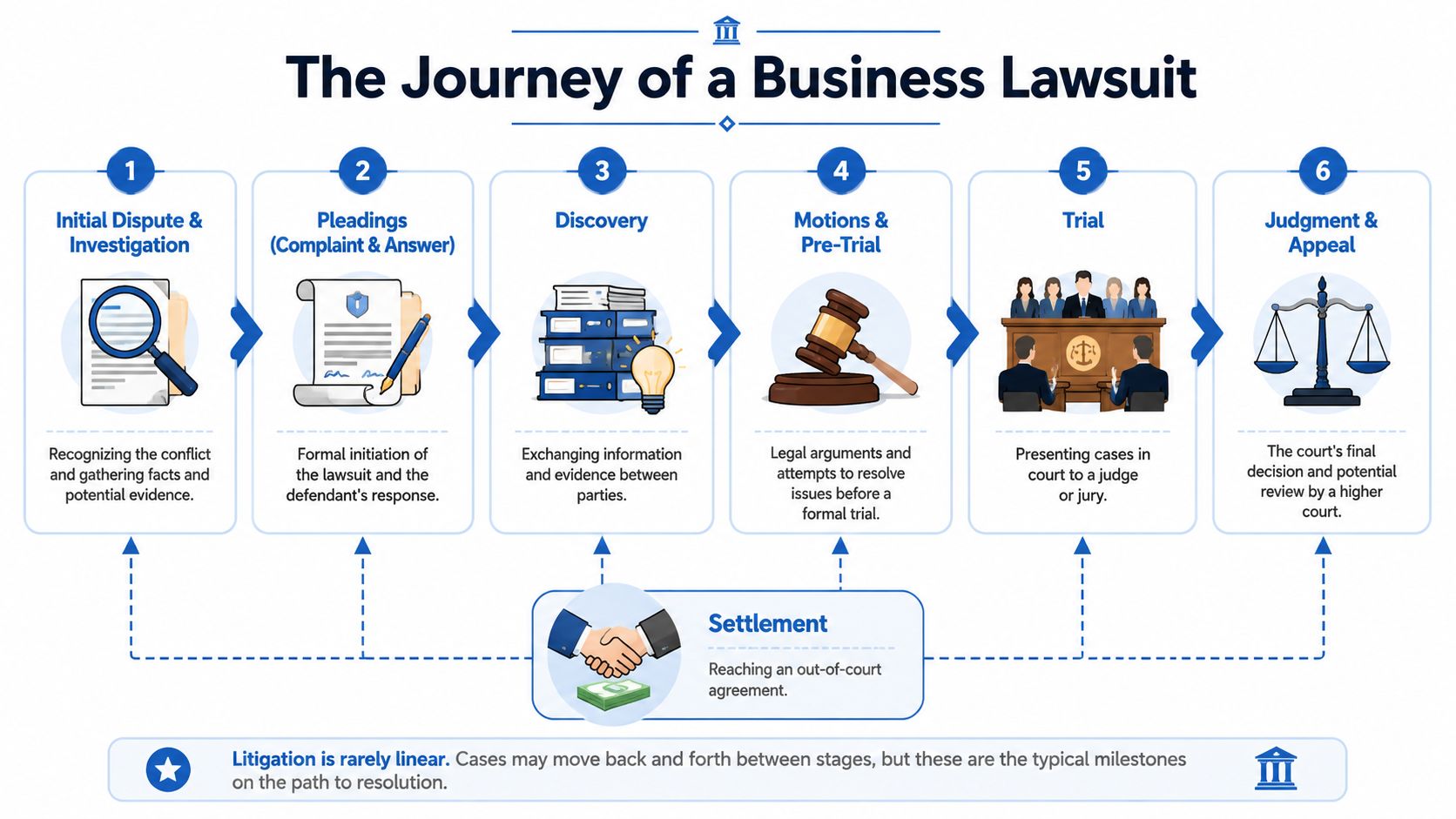
Investigation and case framing
Before filing, counsel usually tries to answer basic but expensive questions. What happened. What documents exist. Who made the relevant decisions. Is urgent relief needed. Is this a contract dispute, a tort claim, an employment matter, or a mix of several theories.
This stage often determines whether the case should be filed at all. A strong legal position with weak records may still call for a negotiated solution. A weaker legal theory with excellent evidence and urgent harm may justify fast action.
A useful outside comparison point for founders working across borders is Lighthouse Consultants' guide to litigation, which explains the procedural logic of court disputes in practical terms even though it addresses the UK system.
Pleadings and the first procedural deadlines
The lawsuit begins with a complaint. That document states the facts alleged, the legal claims asserted, and the relief requested. The defendant then responds, often with an answer, defenses, and sometimes counterclaims.
This is the point where many founders first see the difference between business reality and litigation reality. The complaint is not a neutral history. It's a strategic document. The answer isn't just a denial. It's the beginning of positioning.
Common early decisions include whether to challenge the pleading, remove the case to a different court if available, preserve insurance notice rights, and issue a litigation hold so records aren't lost.
Discovery is where the real work happens
For most businesses, discovery is the center of gravity, a phase in which each side demands documents, sends written questions, and takes sworn testimony. Discovery is usually the most resource-intensive phase of litigation, and for tech companies the strength of the case often depends on data governance and recordkeeping practices that existed long before filing, as explained in this overview of business litigation stages.
That has direct consequences in startup environments. Slack messages, email threads, Git history, cloud storage, ticketing systems, CRM exports, board decks, and phone texts may all become part of the factual record. If those systems are fragmented, access is uncontrolled, or retention practices are inconsistent, litigation gets harder and costlier quickly.
The side with the cleaner transaction trail usually negotiates from a stronger position.
A practical way to think about discovery is this:
- Custodians matter: Who touched the issue can matter as much as the contract itself.
- Systems matter: Information stored across Google Workspace, Microsoft 365, Slack, HubSpot, Jira, and cloud drives has to be identified and preserved.
- Timing matters: Once a dispute is foreseeable, routine deletion can become dangerous.
- Narrative matters: Documents don't speak for themselves. They create a timeline that each side will interpret.
This short explainer gives a visual overview of how that process unfolds:
Motions, settlement pressure, and trial risk
After discovery starts, cases often turn on motions. One side may ask the court to dismiss claims, compel production, exclude evidence, or decide the case without trial if the facts are not in dispute.
This phase creates pressure from several directions at once. Legal fees rise. Executives lose time to document review and testimony prep. The court may signal how it views key issues. Settlement discussions often become more serious here because both sides understand the evidentiary picture better than they did at filing.
Trial is still possible, and appeal may follow, but by this point many business disputes have already shown their true economic shape.
Avoiding the Courtroom with Alternative Dispute Resolution
Litigation isn't the only path, and in many business disputes it shouldn't be the first choice. Mediation, arbitration, and direct settlement each offer a different mix of speed, privacy, bargaining power, and finality. The right option depends less on abstract principle and more on what the company needs to protect.
A founder dealing with a former executive may care most about confidentiality. A company chasing unpaid fees may care most about speed and collectability. A business trying to preserve an important commercial relationship may need a process that allows problem-solving without public escalation.
Why ADR matters in real disputes
Business litigation rarely ends in a dramatic courtroom verdict. In the federal system, only a small minority of civil cases reach trial, while the vast majority terminate through settlement, dismissal, or other pretrial resolutions, as described in Krebs Law's discussion of what litigation means for a business.
That matters because founders often overestimate trial risk and underestimate process risk. The heavier burden usually comes from discovery cost, management distraction, and the bargaining pressure that builds while the case is pending.
Comparing the main options
| Factor | Traditional Litigation | Mediation | Arbitration |
|---|---|---|---|
| Cost | Can become expensive because procedure is broad and discovery can be extensive | Often lower when parties are motivated to resolve early | Can be narrower than court, but cost depends heavily on the clause, forum, and scope |
| Speed | Often slower because of court schedules and motion practice | Usually faster if both sides participate in good faith | Often faster than court, though complex cases can still stretch out |
| Confidentiality | Usually more public | Typically private by agreement | Typically more private than court proceedings |
| Formality | High | Low to moderate | Moderate to high |
| Control over outcome | Judge or jury controls result if no settlement | Parties control whether to settle and on what terms | Arbitrator decides outcome if parties don't settle |
How to choose wisely
Mediation works best when both sides need help getting from entrenched positions to a business solution. It is facilitated negotiation, not a ruling. That makes it useful where relationships, reputation, or custom deal terms still matter.
Arbitration can be a better fit when parties want a binding result outside the public court system. But the clause matters. A badly drafted arbitration provision can create mini-litigation over forum, scope, and procedure before the merits are ever addressed.
Direct settlement remains the most underused skill in business disputes. It works when someone has enough authority, enough information, and enough discipline to separate legal theater from real business value.
A good resolution isn’t the one that sounds toughest. It’s the one that solves the actual business problem at the lowest acceptable cost and risk.
Practical Strategies for Managing Litigation Risk
A founder signs a fast customer deal on Friday, a contractor leaves on Monday, and by the following month the company is arguing over scope, code ownership, unpaid invoices, and who promised what in Slack. That is how many business lawsuits start. Not with a dramatic breach, but with ordinary operating shortcuts that become expensive once the relationship breaks down.
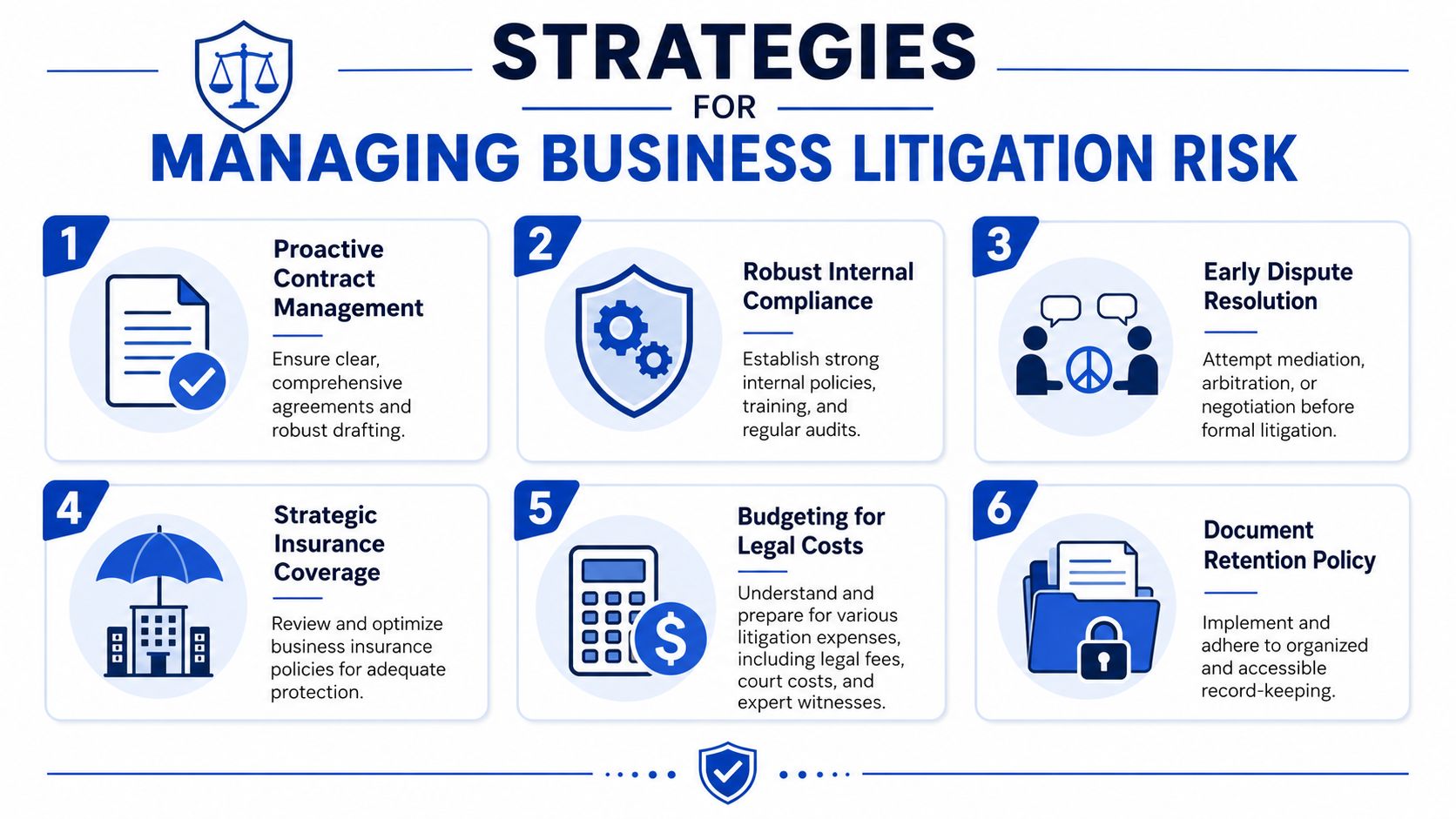
Treat legal hygiene like operational infrastructure
Litigation risk is easier to manage when founders treat it as a business process, not a rare legal emergency. In practice, that means identifying the points where disputes usually begin, then putting controls around them early.
Cost is one reason to do that. Average outside litigation costs for major companies rose from US$66 million in 2000 to nearly US$115 million in 2008, a 73% increase, according to the U.S. Courts litigation cost survey of major companies. Startups are not spending at that scale, of course, but the pattern is familiar. Once a dispute hardens, legal fees follow the complexity of the facts, the quality of the records, and the number of issues the company left undefined.
Founders already build systems for cloud costs, product releases, and sales approvals. Contracts, governance, document retention, manager training, and insurance deserve the same treatment. Those are strategic levers. Pull them early and the company usually has more options later.
A risk checklist that holds up under pressure
The best prevention work is specific. It ties legal risk to the way the company operates.
- Tighten core contracts: MSAs, statements of work, contractor agreements, licensing terms, and founder documents should state deliverables, ownership, payment triggers, confidentiality obligations, venue, and dispute procedures in plain language. Even a practical tool like a service level agreement template for defining operational commitments helps surface promises the business is already making but has not documented well.
- Clean up ownership records: Equity grants, board consents, invention assignments, and delegated authority should match reality. If the paperwork says one thing and the company has been acting another way for a year, opposing counsel will notice.
- Build retention rules around actual tools: If teams work in Slack, Google Drive, Notion, HubSpot, GitHub, or Jira, preservation rules need to cover those systems. A policy that lives in a handbook but ignores the actual data trail will not help much in a dispute.
- Train managers before problems surface: A surprising number of employment claims begin with inconsistent performance feedback, loose recruiting statements, or a termination process that was improvised under stress.
- Review insurance before a claim arrives: Coverage fights often turn on notice deadlines, exclusions, and whether the company gave the carrier enough information at the right time.
- Escalate legal review sooner: Early review usually costs less than rebuilding a record after someone has left, deleted files, or rewritten the story.
What founders should actually watch for
The strongest risk controls are usually the least glamorous. Current templates. Signed agreements. Approval paths that people follow. A cap table that matches commitments. Offboarding steps that cut access, preserve data, and confirm what the departing person can and cannot use.
The weak points are also predictable. Unsigned drafts. Scope changes buried in email. Shared passwords. Founder side deals. Screenshots with no context. A manager saying, “We all understood the arrangement,” when no final document says so.
In Washington’s tech economy, those failures often sit where contracts, IP, privacy, and employment practices overlap. A software company may frame the issue as a product delay, while the legal problem is really a chain of unclear promises, messy repositories, and ownership documents that were never finished. That is why litigation management works best as an operating discipline. Good records narrow the issues. Clear contracts reduce room for spin. Early legal input helps a company choose where to fight, where to settle, and where to fix the process that created the dispute.
By Design Law Firm & Legal Consultancy, PLLC handles business, technology, privacy, and dispute-related legal work for companies building and scaling in Washington.
Strong litigation posture usually comes from ordinary business discipline practiced early, not from clever arguments invented late.
Building a Legally Resilient Business in Washington
A resilient company doesn’t assume disputes won’t happen. It assumes they can happen and builds systems that make them less damaging. That’s the most useful answer to what is business litigation for a Washington founder. It isn’t a separate universe reserved for courtroom specialists. It’s the downstream result of commercial decisions, documentation habits, governance discipline, and risk allocation.
That perspective matters in Washington’s business environment, where startups often move fast, collaborate across state lines, depend on intangible assets, and manage large volumes of digital information. In that setting, legal resilience comes from clear contracts, protected IP, disciplined employment practices, clean records, and early intervention when a conflict starts to harden.
The strongest position is usually built before anyone says the word “lawsuit.” A thoughtful non-solicitation covenant, a current cap table, a signed invention assignment, a preserved message history, or a properly scoped customer agreement can change the dynamic of a dispute before the first demand letter is drafted. Founders thinking through workforce mobility and customer-protection issues should pay attention to tools such as a non-solicitation agreement, especially where employee transitions and client relationships create avoidable exposure.
Litigation will always involve uncertainty. But the process is more manageable than it looks from the outside. Companies that treat dispute prevention and response as part of operations, not as an emergency add-on, usually preserve more options and make better decisions under pressure.
If a business in Washington needs help strengthening contracts, protecting IP, improving governance, or responding to a dispute that may turn into litigation, By Design Law Firm & Legal Consultancy, PLLC offers business and technology counsel designed for startups and established companies that need practical legal infrastructure as well as dispute support. Call us today at (206) 593-1519.