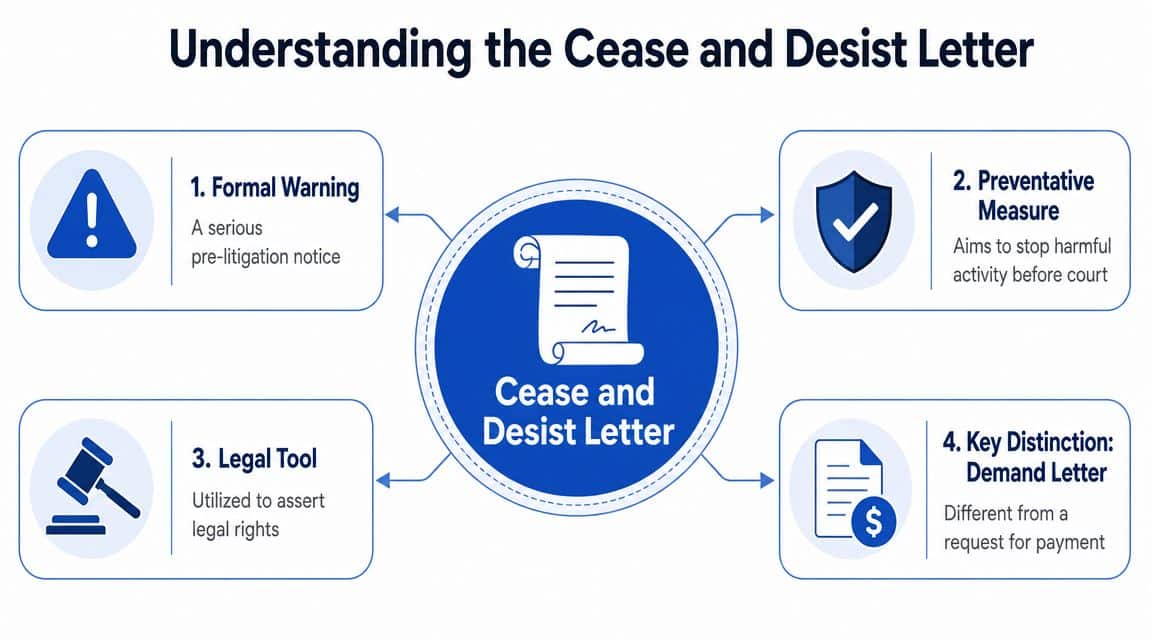
A cease and desist letter is usually a pre-litigation tool, not a court order. It typically gives the recipient a deadline to comply, identifies the conduct at issue and the legal basis for the claim, and warns that legal action may follow if the conduct continues.
A cease and desist letter is a formal written demand that an individual or business stop a specific activity and not restart it, often sent as a warning before taking legal action. For a startup founder in Seattle, that usually becomes real in one of two moments. A competitor starts using a confusingly similar brand name after months of product work, or a lawyer for a larger company sends a sharply worded letter claiming the startup crossed a line.
Both situations create the same immediate problem. The founder has to decide whether this is a serious legal event, a negotiating move, or an overreach that needs a firm response. That decision matters because even though the letter itself doesn't carry immediate legal force, it often shapes everything that happens next.
Your First Encounter with a Cease and Desist
A founder launches a new software tool, buys the domain, files marketing assets in Figma, and starts outreach. Two weeks later, customers forward screenshots of another company using a name that looks close enough to cause confusion. Sales calls get awkward. Investors ask whether the brand is protectable. That is often the point where someone asks, "What is a cease and desist letter, and should one go out now?"
On the other side of the table, another founder opens an email from opposing counsel with allegations about trademark use, copied website language, or misuse of confidential information. The subject line alone can create panic. The first instinct is often the wrong one. Delete nothing, admit nothing impulsively, and don't assume the loudest letter has the strongest claim.
Practical rule: Treat the letter as a business dispute with legal consequences, not just a legal document with business side effects.
In startup practice, these letters come up in disputes over:
- Brand identity: a product name, logo, tagline, or app store listing that another business says infringes its rights.
- Confidential information: a former employee leaves and a company suspects customer lists, code, pricing terms, or internal playbooks followed them.
- Online statements: a competitor, ex-founder, or unhappy former partner posts claims that threaten customer trust.
- Contract-based restrictions: a vendor, collaborator, or former team member acts outside agreed limits.
A cease and desist letter sits at the intersection of law, strategic advantage, and timing. It can stop harmful conduct early. It can also inflame a dispute if it's sent too fast, drafted too broadly, or unsupported by evidence.
That is why founders shouldn't think of it as legal theater. They should think of it as a strategic move, one that either narrows the problem or makes the next phase harder.
The Purpose and Power of a Cease and Desist Letter
A cease and desist letter is best understood as a formal warning shot in a business dispute. It tells the recipient what conduct must stop, why the sender believes that conduct is unlawful, and what may happen if the issue isn't resolved.
The key distinction is simple. It is not a court order.
According to Harper James on cease and desist letters, a cease and desist letter is usually a pre-litigation tool, not a court order. It is sent before formal proceedings begin, gives the recipient a deadline to comply, and typically identifies the conduct, the legal basis, and the consequences of noncompliance. That source also notes that in U.S. practice, the letter itself has no immediate legal force, while only a court or government-issued cease and desist order can be legally binding.
What the letter actually does
The power of the letter comes from process, not magic language on law firm letterhead. In practical terms, it usually serves four functions:
- It gives formal notice: the recipient can't later say the issue came out of nowhere.
- It frames the dispute: the sender defines the claim, the facts, and the requested fix.
- It creates a record: that matters if settlement talks fail and litigation follows.
- It opens a business off-ramp: many disputes are better resolved through redesign, rebranding, licensing, or a narrower agreement than through a lawsuit.
That last point is the one many founders miss. A good letter isn't always trying to start a fight. Often it's trying to avoid one.
What it does not do
A cease and desist letter doesn't, by itself, force anyone to act. There is no automatic penalty for receiving one and no immediate contempt risk attached to ignoring a private demand letter. That is why weak letters get ignored all the time. A vague accusation with no legal support often signals bluff more than strength.
A strong cease and desist letter doesn't just accuse. It gives the other side a reason to take the accusation seriously.
For startups, the strategic question isn't just whether rights were violated. It is whether sending the letter now improves one's position or hardens resistance. If the facts are still developing, if ownership isn't clean, or if a business solution is still possible, the timing may need adjustment.
Founders dealing with names, content, code, and brand assets should also understand the underlying rights before escalating. A practical starting point is this guide on protecting intellectual property, because the strength of the letter depends on the strength of the right behind it.
Anatomy of an Effective Cease and Desist Letter
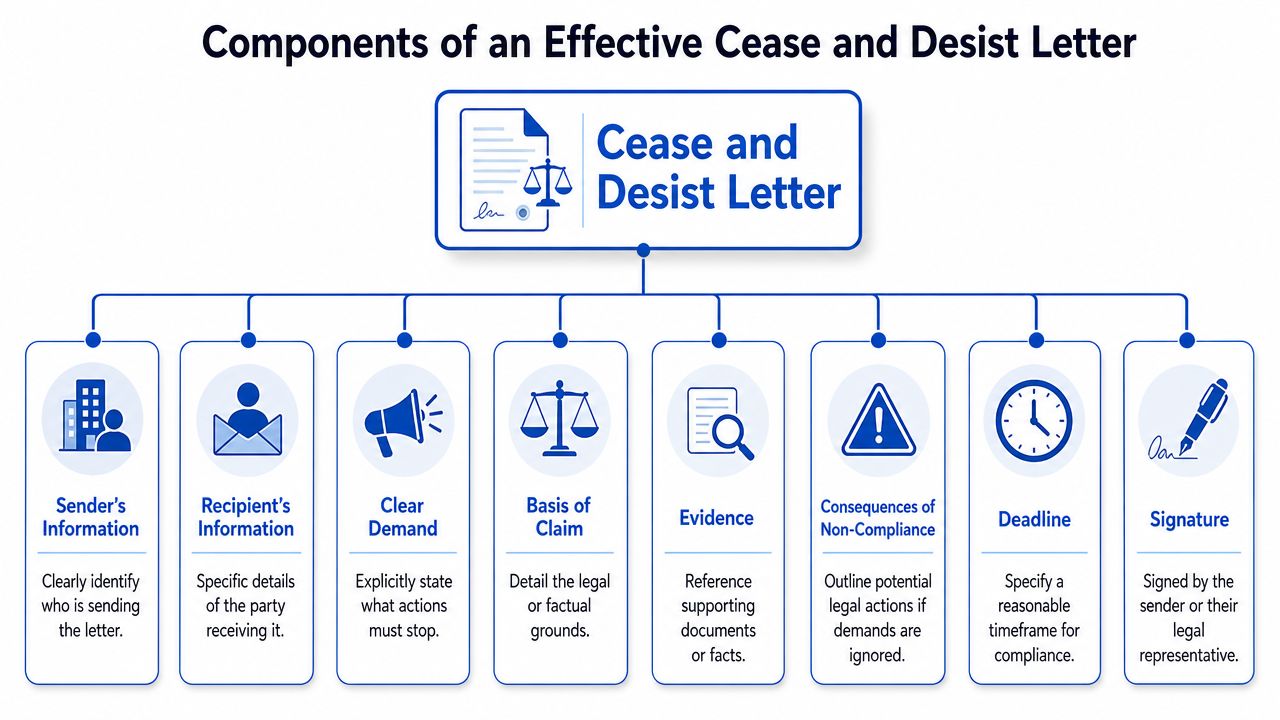
The letters that work are usually built like an evidence packet, not a rant. According to Heer Law's discussion of cease and desist letters, the most effective letters identify the right at issue, describe the conduct with enough specificity to map facts to a legal theory, attach proof of ownership or infringement, and set a deadline for response or compliance. That structure matters because vague demands are easier to ignore.
The parts that give the letter weight
An effective letter usually includes the following components, but not all components carry equal value.
- Clear identification of the parties: Who owns the right, who is accused of violating it, and what relationship exists between them.
- A precise description of the conduct: Screenshots, dates, product listings, URLs, contract excerpts, version histories, customer confusion examples, or side-by-side comparisons.
- The legal basis: Trademark infringement, copyright violation, breach of contract, trade secret misuse, unfair competition, or another claim supported by actual facts.
- A direct demand: Stop using the mark, remove the content, return confidential material, stop contacting customers, preserve evidence, or confirm in writing that the conduct has ended.
- A deadline: Enough time to evaluate and respond, but short enough to preserve urgency.
- Consequences of noncompliance: Usually that the sender will consider suit, injunctive relief, or another formal step.
What weak letters get wrong
Many bad letters share the same defects. They overclaim, under-document, and ask for everything.
A startup founder sometimes wants the letter to say, in effect, "You copied us, you're liable, shut it all down immediately." That approach feels satisfying, but it often backfires if ownership isn't fully documented or if the alleged harm is broader than the facts support.
Common mistakes include:
- Leading with outrage instead of proof. Courts and opposing counsel care about records, not indignation.
- Making claims broader than the law supports. An aggressive but weak theory invites a forceful denial.
- Skipping the business objective. If the primary goal is a coexistence agreement or license discussion, the letter should leave room for that.
- Ignoring collateral risk. A public accusation or overbroad demand can trigger counterclaims and reputational blowback.
The best letters narrow the dispute. The worst letters multiply it.
For IP-heavy companies, the details matter. If the issue is a trademark, the sender should identify the mark and relevant registration details if available. If it is copyright, the sender should identify the protected work and the copied material. If it is a trade secret or confidential information matter, the sender should avoid publicly disclosing the very information it is trying to protect while still describing the issue clearly enough to support the claim.
Common Scenarios for Washington Startups and Businesses
Seattle-area companies don't usually encounter cease and desist letters in abstract law-school hypotheticals. They encounter them during hiring disputes, product launches, investor diligence, and brand rollouts.

Brand conflict after launch
A Seattle e-commerce company spends months building packaging, social handles, and a Shopify storefront. Then a larger business claims the new name is too close to its existing brand. This is one of the most common situations where founders first ask what is a cease and desist letter. The issue is rarely just the name. It is the rebrand cost, channel disruption, investor perception, and customer confusion that follow.
Former employee and sensitive information
A Bellevue software startup sees unusual overlap between its internal product roadmap and a former engineer's new venture. The company may not have enough facts for immediate litigation, but it may have enough concern to act. In disputes involving confidential know-how, customer lists, or internal technical materials, a letter can demand preservation of evidence, return of company materials, and confirmation that misuse has stopped.
Washington businesses dealing with those issues often need a focused trade secret analysis, especially when the facts involve employee mobility and competitive activity. A practical overview of that category appears in this discussion of trade secret misappropriation.
Online content and reputation disputes
A creative agency in Tacoma or Seattle may discover copied website copy, unauthorized use of portfolio assets, or damaging online statements from a former collaborator. These disputes move fast because search results, social sharing, and customer screenshots can outpace a calm legal review. A measured cease and desist letter can force the other side to choose between pulling the content, defending the claim, or escalating openly.
Not every conflict should begin with a letter. Some should begin with internal investigation, evidence preservation, and a decision about the primary business objective. If the company wants a fast quiet fix, the letter should be drafted one way. If it expects a hard-fought injunction fight, it should be drafted another way.
How to Respond When You Receive a Cease and Desist Letter
The worst response is silence mixed with panic. Founders sometimes assume that because the letter isn't a court order, it can be ignored. That is often a mistake.
According to HCH Lawyers on cease and desist strategy, a common gap in public guidance is the practical question of what happens if the recipient ignores the letter. That source emphasizes that a cease and desist letter has no direct legal force, but the key strategic choices after delivery usually fall into a decision tree: respond, comply, negotiate, or file preemptive litigation. That is especially relevant for startups because a poorly timed or overbroad letter can escalate a dispute instead of resolving it.
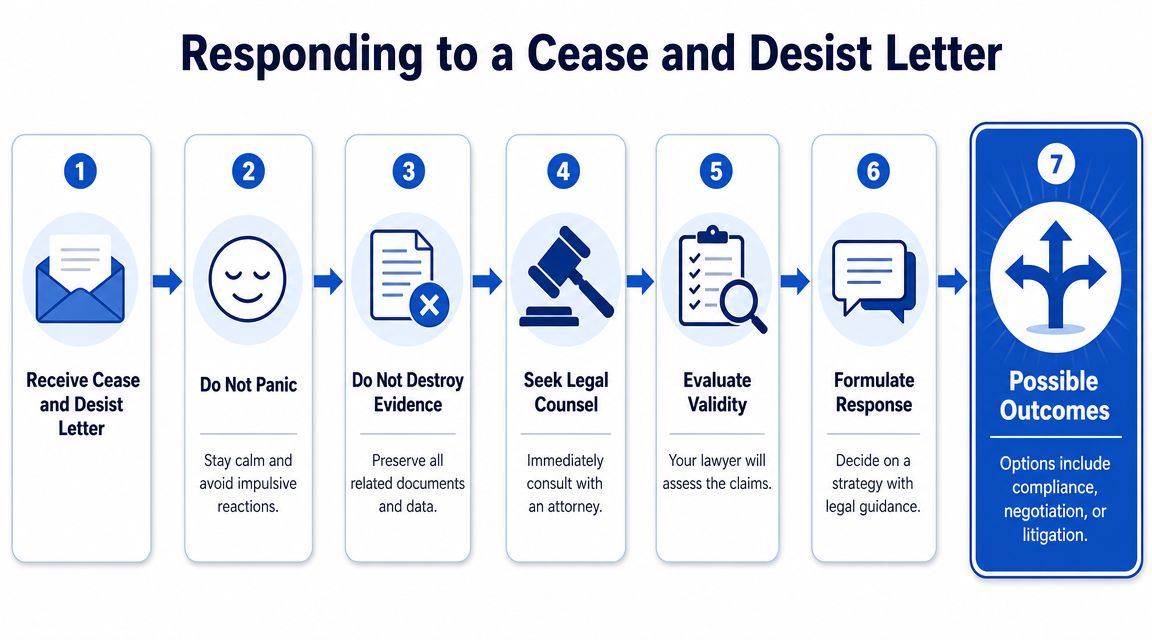
A disciplined response process helps management avoid making the case worse before counsel has assessed it.
Immediate actions in the first window
Start here:
- Preserve documents: Keep emails, Slack messages, drafts, screenshots, contracts, Git records, invoices, and marketing files.
- Stop ad-lib responses: Founders shouldn't send emotional replies from their own inbox.
- Check the actual claim: Is this about a trademark, code ownership, a contractor agreement, defamation, or a former employee issue?
- Review the timeline: When did the complained-of conduct start, and what proof exists on both sides?
This short video is a useful companion to the written guidance:
Choose the response based on risk, not emotion
The right response depends on three things. First, whether the sender's claim appears legally credible. Second, how much operational harm a change would cause. Third, whether a negotiated business solution exists.
| Response Strategy | Best For… | Potential Upside | Potential Downside |
|---|---|---|---|
| Full compliance | Claims that appear strong and where the disputed conduct can be stopped quickly | Can reduce escalation and show good-faith resolution | May concede ground too early if the claim is overstated |
| Negotiation | Disputes where both sides have something to lose, such as naming conflicts, content disputes, or overlapping rights | Can lead to coexistence, redesign, license, or phased transition | If handled poorly, can reveal weakness or delay needed action |
| Formal challenge | Situations where the legal theory is weak, facts are wrong, or the sender is overreaching | Can shut down baseless demands and protect the company's position | May trigger faster escalation if the other side is prepared to litigate |
| Preemptive litigation | Cases where the dispute threatens core operations and uncertainty itself is damaging | Lets the recipient choose forum, timing, and legal framing in some cases | Expensive, public, and risky if the facts aren't ready |
Business reality: A startup doesn’t need the morally satisfying response. It needs the response that protects runway, reputation, and leverage.
Internal review questions that matter
Before a response goes out, leadership should answer a few practical questions:
- What does the company need most? Time, quiet resolution, advantage, or a clean defense.
- What evidence exists internally? Registration records, design histories, contract assignments, onboarding materials, repository logs, or customer communications.
- Who else needs to know? Co-founders, board members, insurers, or key investors in a material dispute.
- What can safely stop now without admitting liability? Sometimes temporary changes reduce risk while preserving legal arguments.
A thoughtful response may also depend on the agreements already in place, especially if the issue touches vendor obligations, ownership clauses, confidentiality terms, or founder arrangements. Contract review often drives the next move, which is why transactional context matters as much as litigation posture. For companies evaluating that overlap, it helps to understand the role of contract and transactional law in dispute prevention and response.
When to Engage a Washington Business Attorney
There are moments when a founder can gather facts internally and slow the situation down. There are also moments when legal counsel should be involved immediately.
One trigger is complexity. If the dispute involves trademarks, trade secrets, software ownership, post-employment restrictions, or competing contract interpretations, a lawyer should evaluate the claim before any substantive response goes out.
Another trigger is asymmetry. If the letter comes from a large company, outside litigation counsel, or a party threatening injunctions and substantial damages, the business risk rises fast even when the claim is imperfect.
According to the CSULB Legal Resource Center on cease and desist letters, the practical force of a cease and desist letter comes from documenting notice and signaling that the sender may file suit. That notice can later be used as evidence that the recipient knew about the claim, which can strengthen later requests for injunctive relief or damages. That is why early legal assessment is such a critical control point.
When sending one
A lawyer adds the most value when the company needs a letter that is forceful but accurate. That includes:
- Disputes with incomplete facts: Counsel can frame the demand without overcommitting to claims the evidence may not fully support.
- IP enforcement: Ownership chains, registrations, assignments, and scope all matter.
- Sensitive trade secret matters: The company needs to protect confidential information without disclosing too much in the letter itself.
When receiving one
Counsel is especially important when:
- The deadline is short
- The demanded relief would disrupt product, branding, or revenue
- The allegations could affect investors, customers, or key partnerships
- The dispute overlaps with Washington-specific business issues
For growing companies, this is also where outside counsel often shifts from reactive help to ongoing risk management. A business attorney who already understands the cap table, contracts, IP posture, and operating realities can respond much faster than someone starting from zero. That broader framework is part of business and corporate law, not just dispute response.
Frequently Asked Questions
Can a business owner write a cease and desist letter without a lawyer
Yes. A business owner can send one. But self-drafted letters often suffer from the same problems that weaken legal positioning later. They can be vague, overbroad, emotionally charged, or legally inaccurate.
That matters because the letter may shape negotiations from the first exchange. If the company has a strong claim, a sloppy letter can undermine it. If the claim is weaker than expected, an aggressive letter can provoke a response the sender wasn’t prepared to handle.
What is the difference between a cease and desist letter and an injunction
A cease and desist letter is a private, non-binding legal notice. It tells someone to stop conduct and warns of possible legal action. An injunction is a court order. The court can compel compliance with an injunction, and violating it can create immediate legal consequences.
That distinction is the center of the answer to “what is a cease and desist letter.” It is a strategic pre-lawsuit demand, not judicial enforcement.
How quickly should someone respond to a cease and desist letter
The recipient should act promptly, even if the merits aren’t yet clear. That doesn’t always mean giving a full substantive response immediately. It often means preserving evidence, evaluating the claim, and deciding whether to comply, negotiate, challenge, or seek more time.
A founder shouldn’t assume the deadline in the letter is automatically reasonable. But a founder also shouldn’t let it pass in silence unless counsel has made a deliberate strategic choice.
If a Washington startup or business is dealing with a cease and desist issue, either as the sender or the recipient, By Design Law Firm & Legal Consultancy, PLLC helps companies assess risk early, protect intellectual property and confidential assets, and respond with a strategy that fits the business objective rather than just the immediate pressure. Call us today at (206) 593-1519.