A founder signs a payroll provider, a cloud storage tool, an outsourced developer, and a customer support platform in the same quarter. None of those decisions feels dramatic. Then one vendor has a security incident, or pushes a bad update, or changes its own subcontractors, and suddenly payroll is delayed, support goes dark, or customer data is exposed.
That's vendor risk in ordinary business clothes.
For startups and small to mid-sized businesses, the mistake isn't usually carelessness. It's assuming vendor risk assessment is something only banks, hospitals, and public companies need. In practice, small companies often have more concentrated exposure. One critical SaaS platform can hold customer data, run internal operations, and support revenue collection at the same time. If that vendor fails, the business feels it immediately.
In Washington State, that problem gets sharper for technology companies, data-driven businesses, and any company selling into larger enterprise customers. Buyers, investors, insurers, and regulators increasingly ask the same question in different forms: how does the company vet the vendors it trusts with sensitive data and core operations?
Why Vendor Risk Is Your Risk
The 2024 CrowdStrike outage made vendor dependence visible in a way board memos rarely do. A company didn't need to be a CrowdStrike customer to feel the effect. If a payroll processor, logistics partner, managed service provider, or internal IT consultant depended on the affected systems, operations could still stall.
That's the point founders need to internalize. A vendor's outage becomes the company's outage. A vendor's weak controls become the company's legal, operational, and reputational problem.
Vendor risk assessment starts from that reality. It isn't a paperwork exercise. It's the process of identifying which third parties can materially harm the business, understanding how they could do it, and deciding what controls are necessary before trust is extended.
Why small companies can't treat this as optional
The exposure is broad. 98% of companies have at least one vendor with a documented security breach, and that near-universal risk was illustrated by the global disruption tied to the 2024 CrowdStrike outage, as noted by CrossCountry Consulting's vendor risk management guide.
That statistic matters because it kills the comforting assumption that careful companies can avoid risky vendors. Most businesses already have exposure somewhere in the stack. The issue is whether that exposure is known, ranked, and managed.
Practical rule: If a vendor can interrupt revenue, access regulated data, or lock the team out of a critical workflow, that vendor belongs inside a formal review process.
A startup usually feels this risk in three places first:
- Operations stop: An identity provider, cloud host, payment processor, or outsourced IT shop fails and internal work stops with it.
- Compliance breaks: A vendor handling personal data, payment data, or sensitive customer information creates legal exposure the company still owns.
- Deals slow down: Enterprise customers and investors ask for proof of third-party diligence, and the company has nothing organized to show them.
What actually works
What doesn't work is waiting for procurement maturity, a dedicated security team, or an expensive third-party risk platform.
What does work is a right-sized program. It starts with a complete vendor list, ranks vendors by actual risk, uses shorter questionnaires for lower-risk vendors, verifies important claims with evidence, and pushes key protections into the contract.
That approach aligns with the practical guidance in Cyber Command's risk management insights, which is useful reading for businesses trying to build sensible third-party controls without overengineering the process.
A founder doesn't need a Fortune 500 budget to do this well. The company needs discipline, a repeatable process, and the willingness to treat outside dependencies as part of its own risk surface.
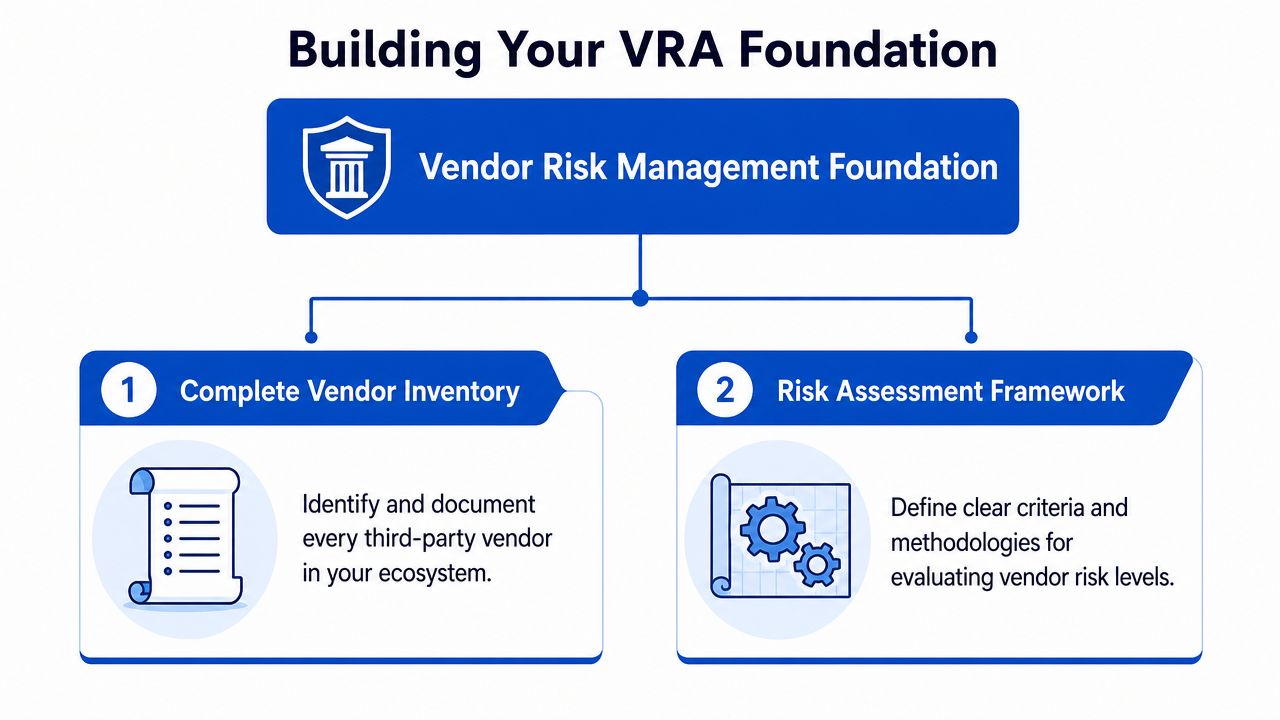
Establish Your Vendor Risk Management Foundation
Most weak vendor risk assessment programs don't fail at the questionnaire stage. They fail earlier, when the business doesn't know who its vendors are.
That blind spot is more common than many founders expect. Up to 30% of supply chain risk can originate from “shadow vendors” that aren't officially cataloged in procurement systems, according to HITRUST's discussion of vendor assessment blind spots. For a startup, those shadow vendors are often ordinary tools bought on a company card, a founder's old SaaS subscription, or a consultant who got access through convenience rather than process.
Build the inventory before building the form
A complete inventory should include more than “companies paid by accounts payable.” It should capture any outside party that stores data, processes data, supports internal systems, touches customer workflows, or can materially disrupt operations.
A useful starter inventory usually pulls from:
- Accounting records for paid vendors and recurring subscriptions.
- Company credit card statements for tools bought outside procurement.
- IT and identity systems such as Google Workspace, Microsoft 365, Okta, or device management platforms.
- Department interviews with engineering, finance, HR, sales, and customer support.
- Existing contracts in email, shared drives, and signature platforms.
The inventory should list the vendor name, service provided, internal owner, data involved, systems accessed, contract term, and whether the vendor uses subprocessors.
Unknown vendors create legal problems before they create security problems. A company can't impose security obligations, audit rights, or notice requirements on a vendor it never formally identified.
Use simple tiering, not perfect scoring
Once the list exists, each vendor should be assigned a rough inherent risk tier. Simple is better than elaborate.
Tier 1 usually includes vendors that host core systems, process sensitive customer or employee data, support security functions, or would materially interrupt operations if unavailable.
Tier 2 includes vendors with meaningful but narrower exposure, such as specialized SaaS tools with limited internal data access.
Tier 3 covers low-risk vendors with minimal access and low operational dependency, such as a scheduling app with little sensitive information.
A practical tiering model should ask:
- Data access: Does the vendor receive personal, confidential, payment, or regulated data?
- System access: Can the vendor connect to internal systems, admin tools, code repositories, or production environments?
- Operational dependency: Would downtime materially affect revenue, payroll, support, or product delivery?
- Regulatory impact: Does the vendor help the company meet or miss legal obligations?
- Subprocessor reliance: Does the vendor depend heavily on other vendors the company doesn't directly control?
For companies that need a practical starting point, these actionable IT vendor management tips offer useful operational habits that complement legal review. For a contract and governance perspective, this guide to vendor management best practices is also a strong reference point.
A lean foundation is enough to start
A startup doesn't need a dedicated governance platform on day one. A spreadsheet, a shared document repository, and one accountable internal owner can support a credible foundation.
What matters is that the inventory stays live. New vendors should enter the list before contract signature, not after deployment. If the company waits until a renewal, breach, or customer diligence request, the inventory becomes a reconstruction project instead of a control.
Conduct Insightful and Tiered Risk Assessments
The fastest way to make vendor risk assessment useless is to send every vendor the same bloated questionnaire.
Small businesses do this because it feels efficient. It isn't. Low-risk vendors ignore it, internal teams stop chasing responses, and risky vendors hide inside a pile of generic yes-or-no answers. A tiered process works better. Cynomi's overview of vendor risk assessment describes a best-practice methodology that follows a risk-tiered process, notes that Tier 1 vendors require annual reassessments, Tier 2 vendors every 18 to 24 months, and Tier 3 vendors every 2 to 3 years, and warns that 68% of organizations fail to complete due diligence before signing contracts.
Keep the questionnaire proportionate to the risk
A low-risk vendor shouldn't get the same review as a cloud provider or managed service provider. The question set should reflect what the vendor does and what harm could follow if it fails.
For a Tier 3 vendor, the company may need only a short intake form. For a Tier 1 vendor, the assessment should go deeper into security controls, incident handling, subprocessors, access management, and resilience.
The legal reason is straightforward. If the business later needs to justify why it trusted a vendor, a proportionate and documented process is easier to defend than a one-size-is-all checklist no one properly reviewed.
Ask for information that changes a decision
Questions should produce facts the company can act on. Good questions reveal access, dependencies, and gaps. Bad questions produce polished reassurance.
Useful categories include:
- Data handling: What data does the vendor store, process, or transmit?
- Access control: Who can access the company's data or systems, and how is access limited?
- Security program: Does the vendor maintain written security policies and role-based controls?
- Incident response: How does the vendor detect, escalate, investigate, and notify customers about security events?
- Subprocessors: Which subcontractors or cloud providers materially support the service?
- Business continuity: What happens if the vendor's service is disrupted?
- Compliance alignment: Which legal or contractual obligations does the vendor support?
A short comparison makes the distinction clearer.
| Risk Tier | Example Vendor Type | Key Questionnaire Focus Areas |
|---|---|---|
| Tier 1 | Cloud hosting provider, managed IT provider, payroll processor | Data security, admin access, encryption practices, incident response, subprocessors, backup and recovery, audit reports, contractual security commitments |
| Tier 2 | CRM platform, HR software, analytics provider | Data categories, user permissions, retention practices, breach notification process, subprocessor visibility, role-based access |
| Tier 3 | Scheduling tool, basic design app, office productivity add-on | Account access, minimal data collection, deletion process, basic availability expectations |
Tailor the form to the vendor type
The assessment should also change depending on what kind of vendor is being reviewed.
A payment-related vendor raises different issues than a marketing plugin. A developer with repository access raises different concerns than a benefits broker. That's why legal and operational teams should avoid treating questionnaires like generic compliance artifacts. They're decision tools.
For higher-risk vendors, it helps to ask open questions such as:
- How is production access approved and revoked?
- Which subprocessors host or support the service?
- What customer data is used in testing, logging, or support workflows?
- What is the vendor's notice process if a material security control changes?
For lower-risk vendors, shorter questions often work better:
- Does the tool store company or customer personal data?
- Who administers the account?
- Can data be deleted on request?
- Does the service integrate with other internal systems?
A founder or operations lead can manage this without building a massive library. Three templates are often enough: one for high-risk vendors, one for moderate-risk vendors, and one brief intake for low-risk vendors. This kind of practical review pairs well with a legal checklist like this vendor security assessment resource, which helps translate technical responses into contract and governance decisions.
A short, well-targeted questionnaire beats a long generic one. The first helps the company decide. The second mainly creates inbox traffic.
Analyze Findings to Make Defensible Decisions
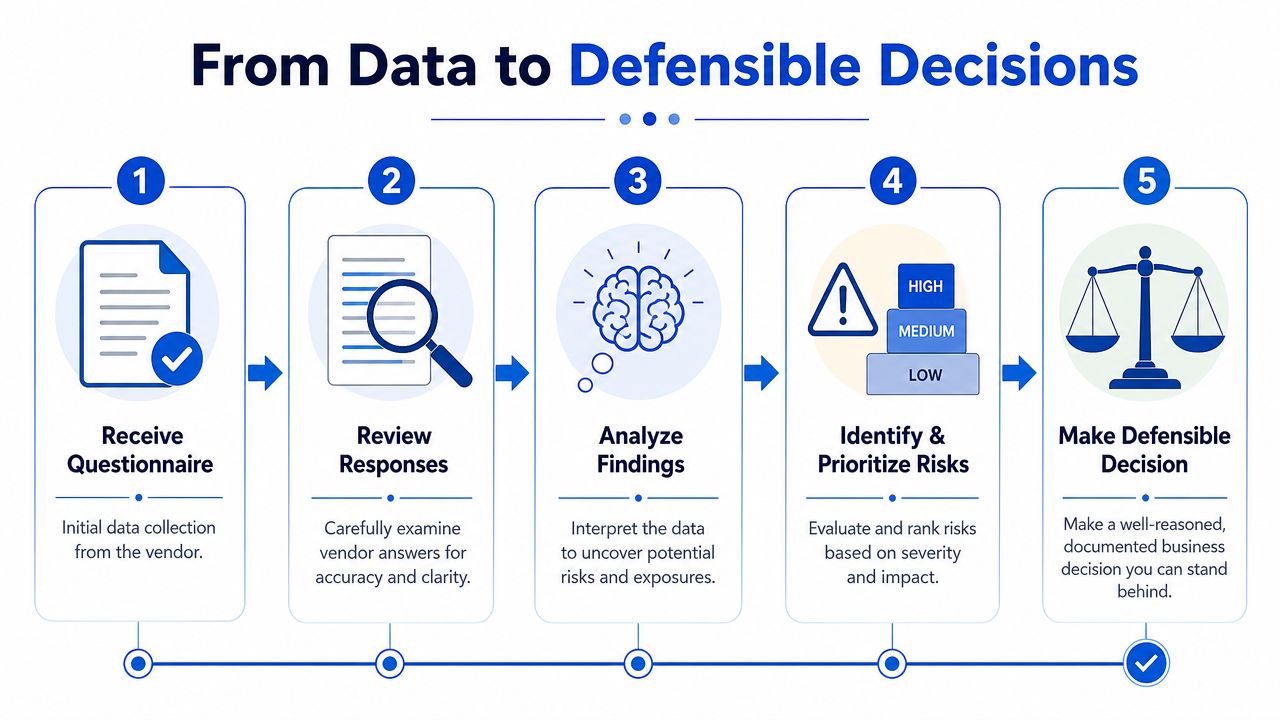
A completed questionnaire is not due diligence. It's a starting record.
Many companies stop too early. They collect a form, file it, and assume the vendor has been vetted. That approach creates false comfort, especially when responses are self-reported and written in polished sales language. 52% of organizations accept questionnaires without evidence verification, leading to a 2.8x higher rate of false-negative risk identification, and standardizing questionnaires by tier can reduce manual effort by 40%, according to UpGuard's vendor risk assessment analysis.
Review the answers like a counterparty, not a customer
A vendor saying “yes, we maintain strong security” isn't useful by itself. The company needs to know what that means in practice and whether the statement is current, scoped appropriately, and supported.
Three review habits help:
- Look for evasive wording: Phrases like “industry standard,” “commercially reasonable,” or “aligned with best practices” may be too vague to rely on.
- Check for missing scope: A vendor may describe corporate controls that don't apply to the specific service being purchased.
- Spot internal inconsistency: A vendor that claims strict access controls but can't explain user provisioning or admin review probably needs follow-up.
Verify with evidence
For significant vendors, the business should ask for objective support. Common examples include a SOC 2 report, an ISO 27001 certificate, a penetration test summary, a security white paper, a disaster recovery summary, or documented policies.
The point isn't to collect every document available. The point is to verify the claims that matter to the risk decision.
What to look for in practice:
- SOC 2 report: Confirm the report is current, check the services in scope, and review exceptions or control gaps.
- ISO 27001 certificate: Confirm that the certificate covers the relevant entity and service scope, not just a parent or affiliate.
- Penetration test summary: Check the date, whether material findings were addressed, and whether the test covered the environment that affects the company.
- Incident response material: Look for a defined notice path, named responsibilities, and escalation procedures.
A useful primer on evidence review follows below.
Turn findings into a documented decision
A lean risk register usually works better than long narrative memos. For each vendor, record the risk tier, summary issues, evidence reviewed, unresolved gaps, business owner, legal owner if applicable, and final decision.
That decision should fit one of four categories:
- Approve as is
- Approve with remediation
- Approve with compensating controls
- Decline or replace
The company doesn't need perfect certainty. It needs a documented basis for trusting, limiting, or rejecting a vendor.
That distinction matters when a customer asks how the vendor was vetted, when an insurer asks about third-party controls, or when counsel needs to reconstruct the diligence trail after an incident.
Use Contracts to Enforce Security and Remediate Gaps
A vendor questionnaire tells the company what the vendor says. The contract determines what the vendor is obligated to do.
That's why contract review is the definitive pressure test in vendor risk assessment. If a startup identifies a gap but never translates it into binding obligations, the gap isn't mitigated. It's merely documented.
The contract is a security control
Founders often treat vendor paper as a pricing and liability document. It is that, but it's also an operational control set.
If the vendor handles sensitive information or supports important systems, the contract should require specific behavior. General promises to maintain “reasonable security” usually aren't enough on their own. The better approach is to tie key obligations to the vendor's role, the data involved, and the consequences of failure.
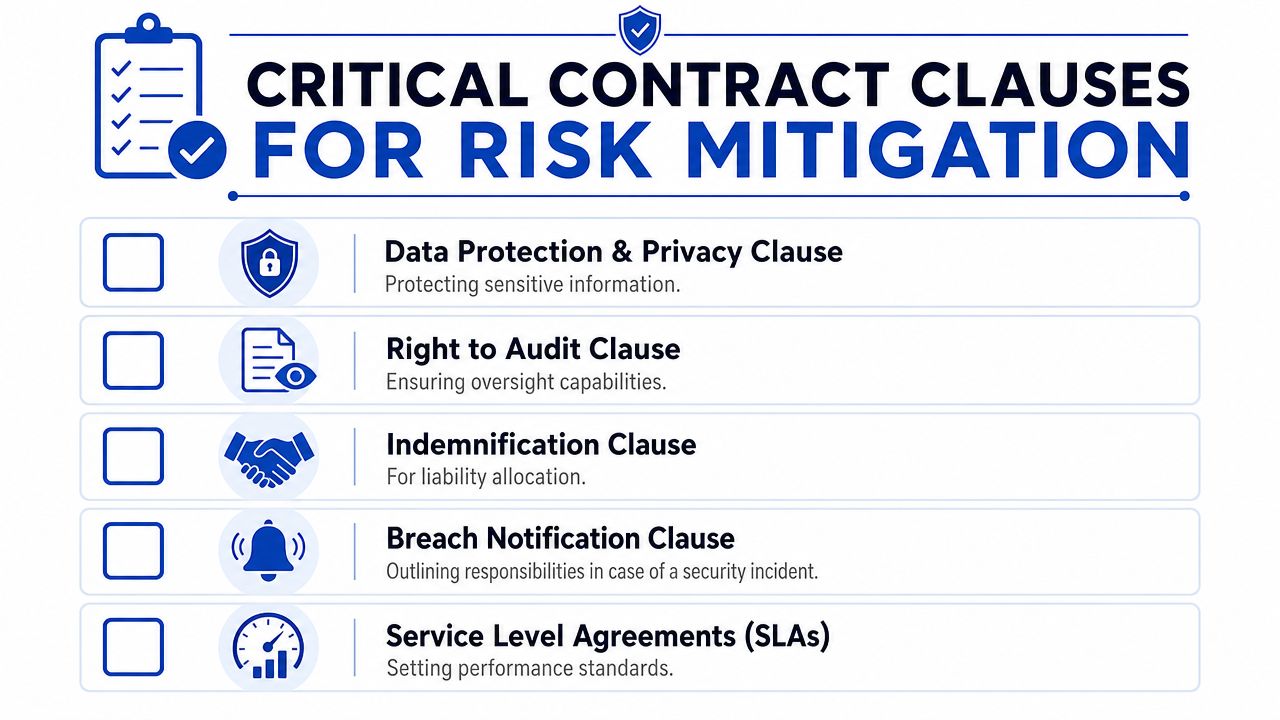
A solid vendor agreement often addresses:
- Security requirements: Written commitments around access controls, encryption practices, secure deletion, and administrative safeguards.
- Breach notification: A clear obligation to notify without unreasonable delay and to provide useful facts, not just a generic alert.
- Subprocessor controls: Notice of new subprocessors, responsibility for subcontractor performance, and restrictions on unauthorized sharing.
- Audit or evidence rights: The right to request relevant reports, certifications, or other proof of control effectiveness.
- Data return and deletion: What happens to company data at termination, in what format it will be returned, and when deletion occurs.
- Business continuity obligations: Backup, restoration, and service continuity expectations when the vendor is operationally important.
- Liability allocation: Indemnity, exclusions, caps, and carveouts that match the actual risk profile rather than boilerplate assumptions.
Don't ignore the remediation schedule
When diligence finds a real issue, the contract should capture the fix.
That might mean the vendor agrees to implement role-based access, improve logging, narrow subprocessor use, provide current security documentation, or update its incident notice process by a stated date. A remediation exhibit, email side letter, or security addendum can all work if drafted carefully and tied to the main agreement.
A startup doesn't need to win every clause negotiation. But it should identify the points it can't safely waive. For a critical vendor, those usually include notice rights, data handling obligations, subprocessor transparency, termination support, and workable liability treatment.
If a vendor says a control exists, the contract should either require it, verify it, or create consequences if it disappears.
Match the legal terms to operational reality
Some clauses only matter if the company can use them in practice. Audit rights that require expensive on-site inspections may be unrealistic for a small business. A better version might allow the company to request a current SOC 2 report, updated security documentation, or a written response to material changes.
Service levels fit the same pattern. The company doesn't need an enterprise-grade SLA schedule for every tool, but it should define availability, support response expectations, and escalation paths for vendors that affect customers or revenue. For teams comparing practical monitoring options, this Fivenines review of SLA tools is helpful background on how service commitments can be tracked operationally.
Where a vendor processes personal data, a separate data processing agreement is often necessary to address instructions, confidentiality, subprocessors, security obligations, and data subject support. A practical starting point is this data processing agreement template.
For Washington companies, legal and operational discipline intersect. The business is rarely protected by what it assumed the vendor would do. It's protected by what the vendor promised, in writing, with terms that can be enforced when pressure hits.
Implement Ongoing Monitoring for Lasting Resilience
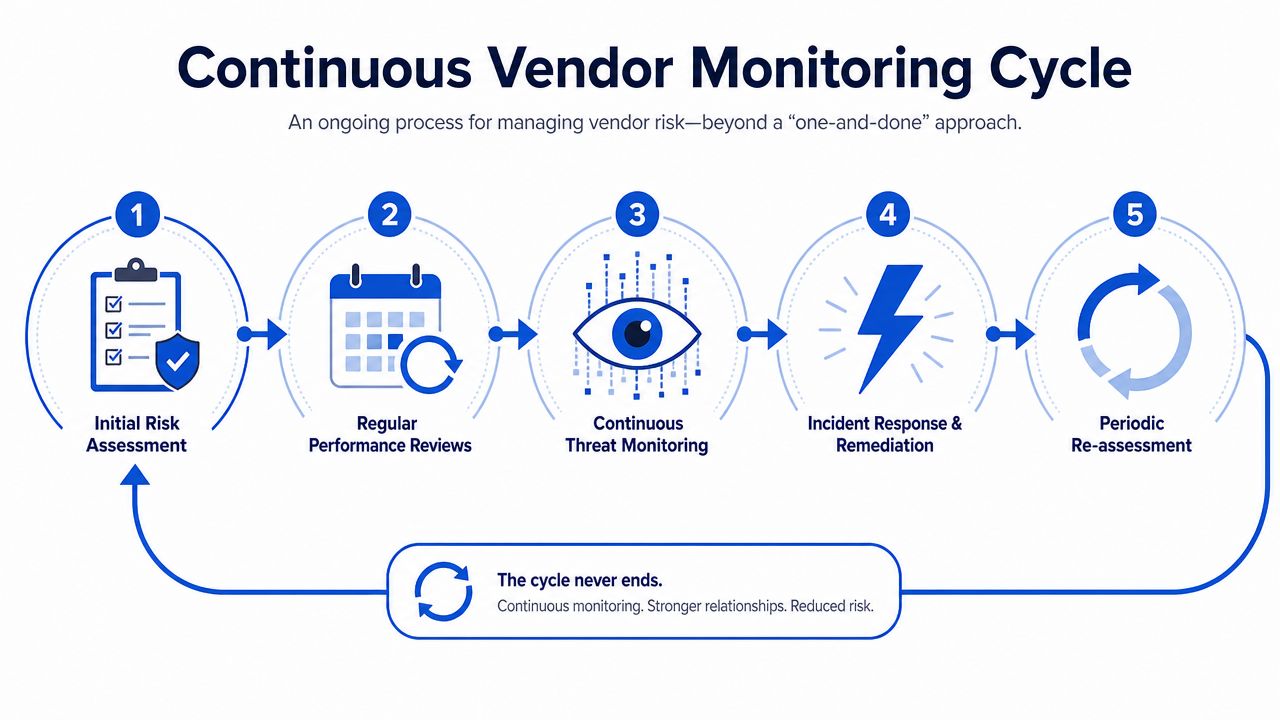
The most common conceptual mistake in vendor risk assessment is treating onboarding diligence as the finish line.
It isn't. Vendors change hosting providers, add subprocessors, get acquired, reorganize support teams, change access methods, and update products in ways that matter to risk. 65% of third-party security breaches happen after the initial assessment, often due to unmonitored changes in the vendor's own supply chain, according to Censinet's guide to vendor risk scoring.
Build a monitoring rhythm the company can actually sustain
A small business doesn't need an enterprise platform to monitor vendors intelligently. It needs repeatable habits.
A workable monitoring cycle usually includes:
- Renewal reviews: Before renewal, confirm whether the vendor's service scope, data use, or subprocessor list has changed.
- Annual check-ins for critical vendors: Ask whether there have been material security incidents, control changes, certifications, or hosting changes.
- News and alert monitoring: Track major public reports about vendor outages, breaches, sanctions, or litigation that may affect service trustworthiness.
- Internal owner confirmation: Require each business owner to confirm the vendor is still needed, still properly tiered, and still using the expected data.
- Offboarding discipline: When a tool is retired, confirm account closure, access revocation, and data return or deletion.
Use contract notice obligations to support monitoring
Monitoring works better when the vendor contract requires disclosure of material changes.
That can include changes to subprocessors, material security incidents, changes in control environments, or shifts in data hosting locations. Without a contractual notice obligation, the company may learn about those changes late, or not at all.
For startups without dedicated security teams, a manual approach can still be credible:
| Monitoring Activity | Low-cost Method | Best Use Case |
|---|---|---|
| Vendor incident awareness | Public news alerts and vendor status pages | Critical SaaS and infrastructure vendors |
| Subprocessor tracking | Contract notice clause plus annual confirmation email | Vendors handling sensitive data |
| Control updates | Request current reports or policy summaries at renewal | Tier 1 and Tier 2 vendors |
| Internal access review | Check admin lists and integrations quarterly | Vendors connected to internal systems |
Tie monitoring to incident response
Monitoring matters most when something goes wrong. That’s when the company needs internal and external roles to line up.
A practical response plan should identify who contacts the vendor, who assesses legal obligations, who handles customer communications, and who preserves records. If a vendor event could affect regulated data or critical services, waiting to assign these roles during the incident wastes time the business won’t have.
Vendor monitoring and incident response are part of the same loop. Monitoring helps detect trouble early. Incident response turns detection into action.
Critical vendors should also be mapped into the company’s broader response planning. If a payroll vendor, cloud platform, or customer support tool goes down, the response playbook should already identify fallback processes, decision-makers, and communication channels. This cyber incident response plan resource is a useful reference for turning that expectation into something operational.
A one-time assessment can satisfy a filing cabinet. Ongoing monitoring protects an actual business.
Turning Vendor Risk into a Competitive Advantage
A disciplined vendor risk assessment program does more than prevent trouble. It makes the company easier to trust.
That matters because the market is moving toward more mature third-party oversight. The global vendor risk management market is projected to grow from $8.3 billion in 2026 to $22.77 billion by 2035, according to Atlas Systems’ third-party risk management statistics. That projection signals something practical for founders. Buyers, partners, and investors increasingly expect vendor diligence to be part of normal business operations, not an enterprise luxury.
Why this becomes a sales and diligence asset
A startup that can show a live vendor inventory, risk tiers, targeted assessments, evidence review, key contract controls, and an ongoing monitoring cadence presents as more investable and more enterprise-ready.
That credibility shows up in ordinary moments:
- Customer diligence questionnaires get answered faster.
- Insurance applications become easier to support.
- Investor and acquirer review faces fewer surprises.
- Internal teams choose vendors with more discipline and fewer last-minute legal scrambles.
The practical takeaway
The strongest programs usually aren’t the most complicated. They are the ones the company can consistently run.
That means knowing which vendors matter most, asking better questions before signature, verifying important claims, contracting for the controls that matter, and revisiting risk after onboarding. For startups and SMBs in Washington, that approach is realistic, defensible, and commercially valuable.
Vendor risk won’t disappear. But handled well, it becomes one more proof point that the business is built to last.
By Design Law Firm & Legal Consultancy, PLLC helps Washington startups and growing businesses build practical legal frameworks for vendor contracting, data privacy, cybersecurity, incident response, and day-to-day operational risk. For companies that need outside counsel who can translate technical and compliance issues into workable business decisions, By Design Law Firm & Legal Consultancy, PLLC offers Seattle-based support designed for growth, resilience, and clear execution.
Contact our law offices at (206) 593-1519 for a complementary consultation.