A startup founder signs a payroll platform, a customer support tool, and an AI transcription service in the same quarter. Procurement moves fast. Engineering connects APIs. Legal rubber-stamps the vendor paper because the deal feels routine.
Then the founder learns the hard way that the company's security posture now depends on controls it doesn't own, subcontractors it's never seen, and promises buried in vendor PDFs that nobody verified.
That's why a vendor security assessment matters. It isn't a paperwork exercise for procurement or an annoyance delegated to the security team. It's a business control, a litigation defense, and often the only thing standing between an ordinary software contract and a painful breach response.
Why Every Vendor Relationship Is a Security Risk
Most founders still underestimate the legal exposure created by third parties. They focus on product velocity, revenue, and uptime. The attacker focuses on the vendor with weak controls, broad access, and a direct path into systems or data.
That gap is where losses happen.
A recent guide reports that 74% of healthcare breaches involve third-party vendors and that third parties can account for more than 60% of enterprise risk in some contexts, which is why vendor exposure is no longer a side issue in modern risk management (SecurityScorecard vendor security assessment guidance). Even outside healthcare, the lesson is obvious. A vendor that stores sensitive data, connects into production systems, or supports a critical workflow can create operational, contractual, and regulatory consequences overnight.
The real risk isn't just technical
A weak vendor can trigger more than a security incident. It can also create:
- Contract risk: customer agreements may require minimum security controls, vendor oversight, or breach notification duties.
- Privacy risk: data-sharing arrangements can create compliance obligations that survive long after the deal is signed.
- Board risk: once leadership knows a vendor is critical, failing to assess that vendor stops looking like oversight and starts looking like neglect.
- Insurance friction: insurers often want to see disciplined third-party controls when a claim arrives.
Practical rule: If a vendor can interrupt revenue, touch regulated data, or reach a core system, that vendor belongs in a formal risk process.
Founders who need a broader operating view should also understand how security fits inside procurement and ownership. This guide to IT vendor management is useful because it frames vendors as ongoing business dependencies, not one-time purchases.
The legal side matters just as much. Security reviews should align with privacy obligations, data handling terms, and incident response planning. That's where a startup's broader data privacy and compliance approach has to connect directly to vendor onboarding.
A defensible program beats informal judgment
An email thread saying “vendor seems fine” won't help much after an incident. A defensible program will.
That means the company can show it identified vendors, ranked them, reviewed the risky ones more thoroughly, documented findings, and imposed contractual controls where risk justified it. Courts, regulators, customers, and acquirers tend to care less about perfect security than about whether leadership acted reasonably and consistently.
Scoping Your Program and Ranking Vendor Risk
Most companies already have more vendors than they think. The forgotten ones are the problem. Browser-based tools, billing add-ons, analytics tags, outsourced developers, AI plug-ins, and managed service providers all belong in the same universe of review if they affect data or operations.
The first move is simple. Build a real inventory.
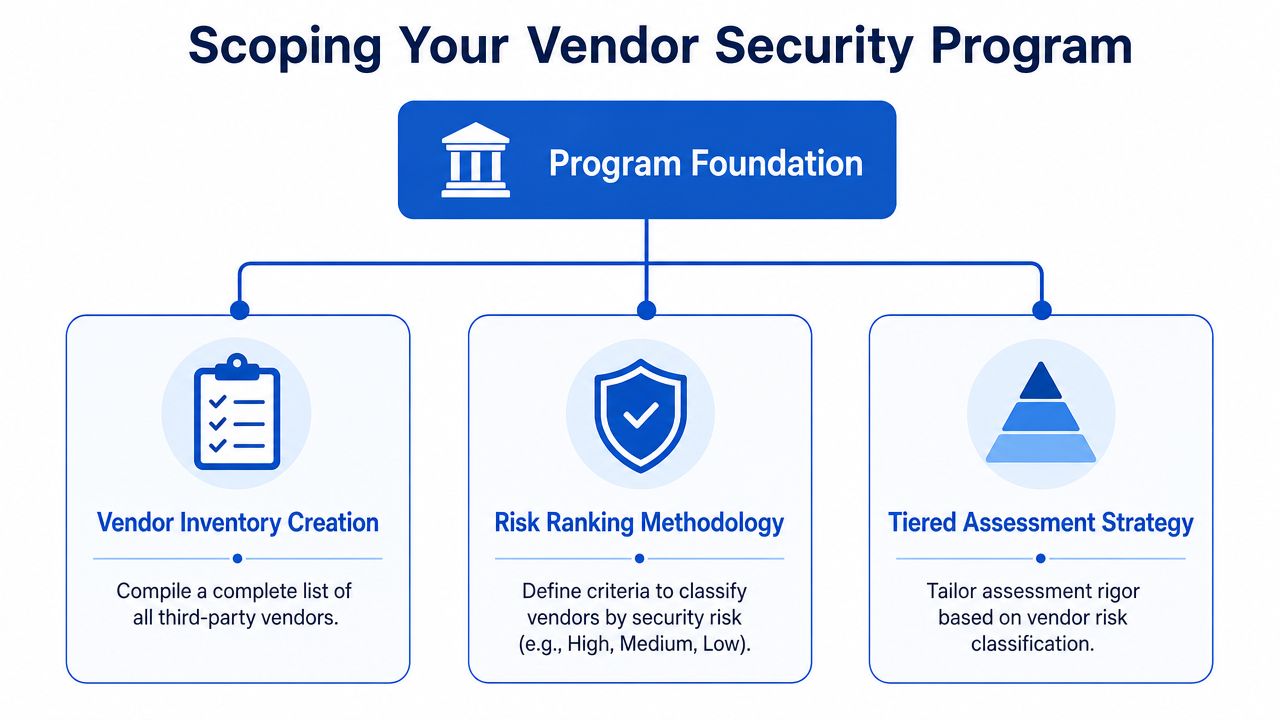
Start with an inventory that legal can use
A useful inventory isn't just a spreadsheet of names. It should let legal, security, and operations answer a few practical questions fast:
- What does the vendor do
- What data does the vendor receive, process, store, or access
- How integrated is the vendor
- How painful would an outage be
- Which contract governs the relationship
- Who inside the company owns the vendor
A founder doesn't need a fancy GRC platform on day one. A disciplined register works if it's maintained. What matters is that someone owns accuracy.
A practical supplement is a standard intake form tied to procurement. If nobody can buy or renew a service without answering data access and criticality questions, the inventory stays alive instead of becoming shelfware. For teams refining that intake process, this overview of 2025 cybersecurity risk assessment steps offers a useful operational framing for identifying and sorting business risk.
Stop treating all vendors the same
The fastest way to waste resources is to send the same heavyweight questionnaire to every vendor.
Recent guidance suggests that lower-risk vendors may only need reassessment every two to three years, rather than getting dragged into constant review cycles that absorb time without reducing meaningful exposure (SAFE vendor questionnaire best practices). That point matters for startups. The company should spend its limited legal and security budget where a failure would hurt.
A workable ranking model usually turns on three variables:
- Data sensitivity: Does the vendor handle customer data, employee records, financial information, source code, or regulated datasets?
- Operational criticality: Would downtime block revenue, payroll, support, development, or customer delivery?
- System integration depth: Does the vendor have SSO, API access, admin privileges, network connectivity, or production environment access?
A low-risk marketing widget doesn't deserve the same treatment as a cloud provider with production access.
A simple tiering model
| Tier | Typical profile | Assessment approach |
|---|---|---|
| High | Sensitive data, critical operations, deep integrations | Full assessment, supporting evidence, contract negotiation, monitoring |
| Medium | Limited sensitive data or moderate operational dependency | Standard questionnaire, selected evidence, focused contract terms |
| Low | Minimal or no sensitive data, low criticality, little integration | Lightweight screening, basic terms, less frequent reassessment |
For founders who need a starting document, a vendor risk assessment template can help standardize what the company collects before a contract is approved.
Executing Assessments with Questionnaires and Evidence
A questionnaire is useful. A questionnaire by itself is weak.
Vendors know how to answer “yes” to policy questions. The harder question is whether they can prove those answers with evidence that survives scrutiny from a customer, regulator, or opposing counsel.
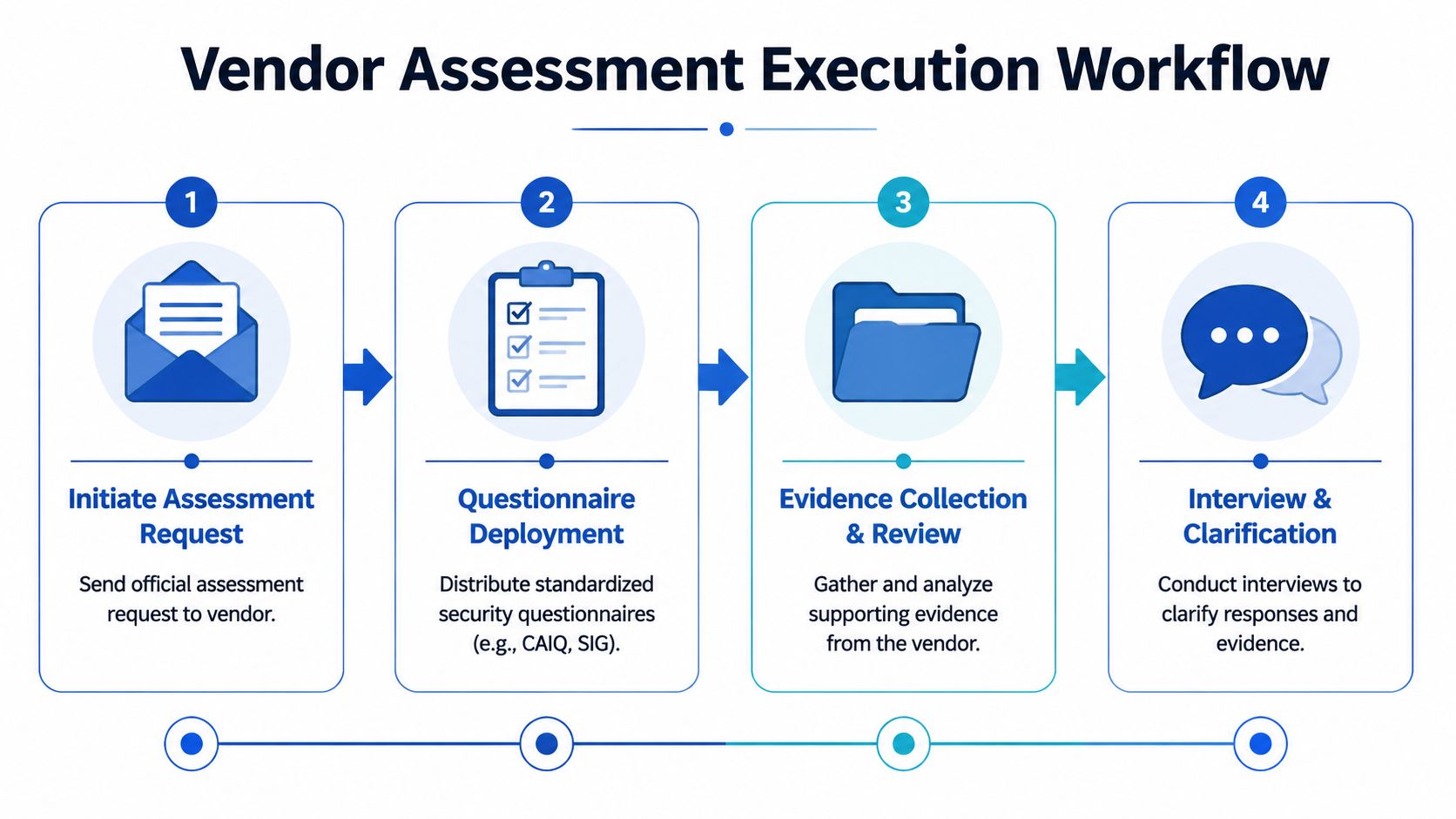
To structure the actual review, this workflow visual helps teams keep the process disciplined:
Use a questionnaire, but don't stop there
For medium and high-risk vendors, standardized questionnaires such as CAIQ or SIG can create consistency. They give security and legal teams a repeatable baseline and force the vendor to state its controls in writing.
That said, the strongest methodology uses multi-source validation. The UK NCSC position, as summarized here, is that objective assessment requires evidence from the vendor, testing to validate claims, and third-party evidence such as SOC 2 or ISO 27001 (Sprinto vendor security assessment overview).
That should change how founders read vendor responses. A completed form isn't proof. It's a lead.
What evidence to request
For high-risk vendors, the assessment package should usually include some mix of the following:
- Independent assurance reports: SOC 2 Type II is often more useful for security control review than marketing assurances. Teams that confuse report types should review the differences discussed in this Nexus explanation of SOC 1 report differences, especially when finance teams assume all SOC reports answer the same questions.
- Certification evidence: ISO 27001 certification materials can help validate the presence of a management system, though they shouldn't replace direct inquiry.
- Penetration test summaries: a recent summary, scope description, and remediation status tell more than a generic “we test annually” statement.
- Incident response documentation: the company should confirm whether the vendor has a documented process, escalation path, and customer notification workflow.
- Subprocessor or subcontractor list: even if limited, it's often the first clue to hidden downstream risk.
The assessment should test whether the vendor can produce evidence quickly, coherently, and without evasion. Delay is often a signal.
The company should also ask targeted follow-up questions instead of forwarding a giant spreadsheet and waiting passively. Good examples include:
- Access control: Which roles have administrative access to customer environments, and how is that access reviewed?
- Encryption: Where is customer data stored, and what protections apply at rest and in transit?
- Incident handling: What triggers customer notice, who sends it, and how does the vendor preserve logs and forensic evidence?
- Business continuity: What happens if the vendor's primary service region, major cloud dependency, or authentication provider fails?
- Data lifecycle: How long is customer data retained, and how is deletion verified at termination?
A company that needs to align assessment findings with internal governance should map these questions into its own retention and deletion rules. A data retention policy template can help legal and security teams compare the vendor's practices against internal expectations before signing.
A short explainer can help non-technical stakeholders understand how the review process should flow:
The judgment call that matters
The practical question isn't whether a vendor has any issues. Every mature vendor has findings, exceptions, or roadmap items. The question is whether the vendor's control environment is credible enough for the data and access involved.
If a high-risk vendor gives polished answers but thin evidence, that's not a paperwork problem. It's a trust problem.
Weaving Security Requirements into Vendor Contracts
A vendor security assessment without contract language is just organized optimism.
If the company identifies weak areas but never turns those expectations into binding obligations, the vendor can change behavior later, deny responsibility, or hide behind vague language. Founders should assume that any security promise not reflected in the contract may become hard to enforce when it matters most.
Non-negotiable clauses for risky vendors
The contract has to do two jobs at once. It has to describe what the vendor must do, and it has to preserve remedies if the vendor fails.
| Clause | Purpose |
|---|---|
| Security controls clause | Requires the vendor to maintain defined administrative, technical, and organizational safeguards appropriate to the services and data involved |
| Data use and handling restriction | Limits how the vendor may access, process, retain, disclose, or reuse company data |
| Incident notification clause | Requires prompt notice, a clear escalation path, cooperation, and preservation of relevant evidence after a security incident |
| Audit and assessment rights | Gives the company a right to request evidence, review reports, and in appropriate cases conduct or commission additional review |
| Subcontractor controls | Requires approval, disclosure, or flow-down obligations for subprocessors and other downstream vendors |
| Remediation obligation | Forces the vendor to correct identified security gaps within defined timelines |
| Liability and indemnity clause | Allocates financial responsibility for security failures, data misuse, and third-party claims |
| Termination right for security breach | Allows the company to suspend or end the relationship when the vendor creates unacceptable risk |
| Data return and deletion clause | Requires orderly return, deletion, and certification or confirmation at offboarding |
| Business continuity commitment | Preserves access, transition support, and recovery obligations if the vendor suffers an outage or disruption |
What founders should push for in negotiation
Some clauses deserve extra attention because vendors resist them first.
- Breach notice language: “Without undue delay” sounds nice and often means nothing. The contract should define process, responsible contacts, and cooperation duties with enough specificity that the vendor can’t stall while the company faces customer notice deadlines.
- Audit rights: many startups accept a watered-down right to receive a report once per year. That may be enough for some medium-risk vendors, but not for a provider with deep access or sensitive data exposure.
- Termination triggers: if the vendor suffers a material security failure, loses a key certification, or refuses remediation, the company needs a practical exit path.
- Subprocessor flow-downs: if the vendor uses downstream providers, the contract should require equivalent security and confidentiality obligations all the way down.
Contracts should reflect the actual assessment result. If the review surfaced a gap, the contract should either force remediation or limit the scope of data and access.
For companies building these terms into recurring procurement workflows, a service level agreement template can help align uptime, response, and escalation obligations with security expectations.
Security exhibits are often the cleanest solution
Rather than overloading the main agreement, many companies use a security addendum or exhibit. That approach can work well if the exhibit is clearly incorporated and survives renewal changes.
The key is consistency. If sales promises one thing, the MSA says another, and the security exhibit says something softer, the vendor will point to ambiguity later. Legal should make sure the documents tell one story.
Managing Remediation and Continuous Monitoring
The assessment is only the starting snapshot. Risk changes after signature. Vendors add features, change cloud providers, acquire companies, hire subcontractors, and integrate new AI services without announcing every internal shift to customers.
That’s why a serious vendor security assessment program includes remediation tracking and ongoing review.
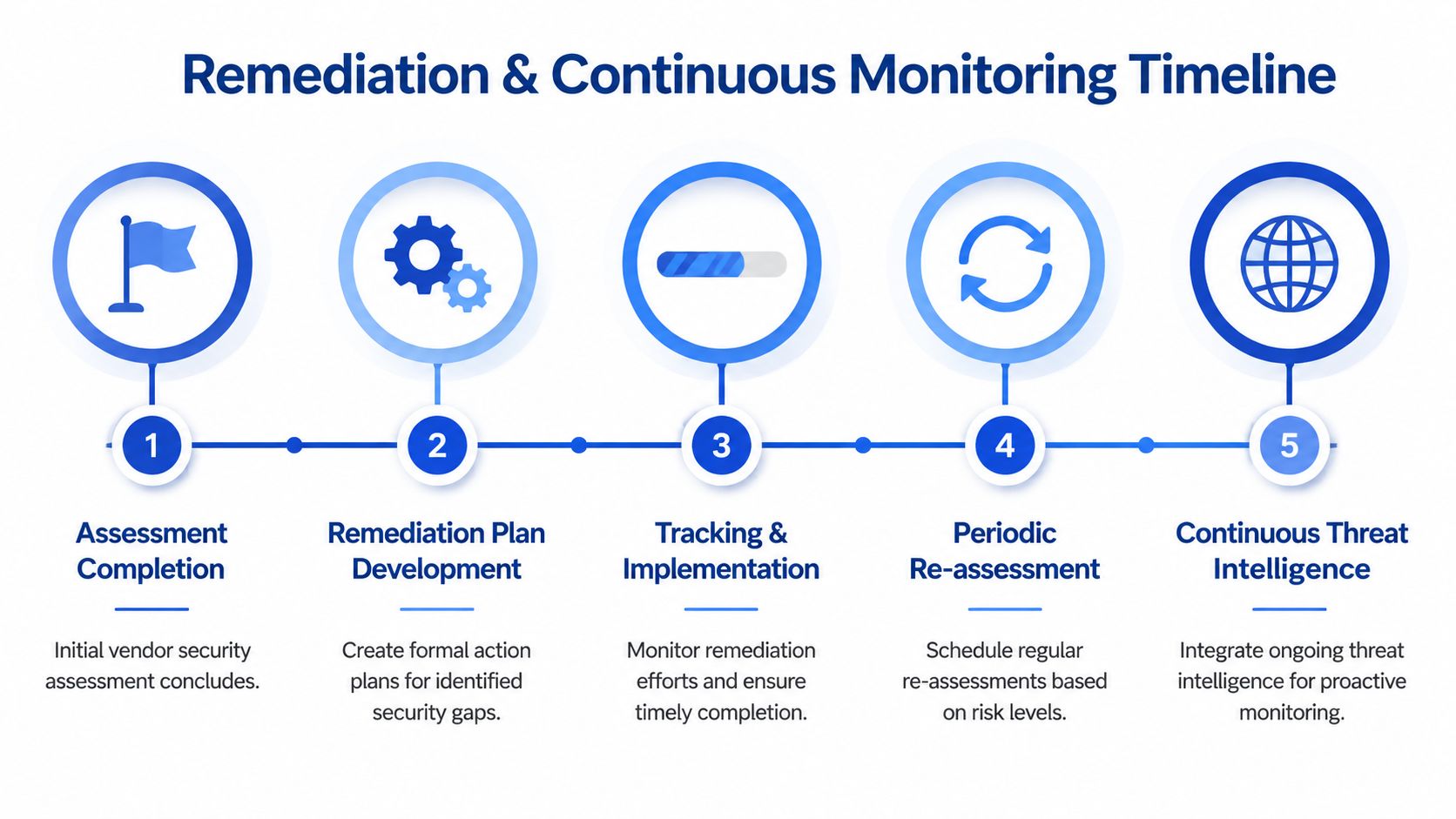
Turn findings into action items
If the company identifies a gap, it should classify the issue, assign an owner, document the agreed fix, and set a deadline. Vague assurances such as “planned for a future release” shouldn’t close a finding.
A remediation record should capture:
- The issue itself: for example, missing MFA for administrative access, incomplete logging, or no documented incident playbook.
- The vendor’s commitment: what will change, who owns it, and what evidence will prove completion.
- Interim safeguards: reduced access, narrower data scope, or delayed rollout if the issue can’t be fixed immediately.
- Escalation consequences: procurement hold, contract amendment, or executive review if the deadline slips.
This is also where business judgment matters. Not every issue requires blocking the deal. Some require compensating controls, limited deployment, or stronger contract terms until remediation is complete.
Continuous monitoring has to include hidden dependencies
Vendor-risk programs are increasingly expected to address fourth-party risk by asking vendors to identify critical subcontractors and integrating continuous monitoring, because a vendor relationship is really a chain of dependencies rather than a single company boundary (Optro guidance on vendor security assessment and fourth-party risk).
That point matters even more for startups using outsourced infrastructure and AI-enabled services. The direct vendor may look mature while relying on downstream processors, model providers, support contractors, or cloud tooling that the customer never reviewed.
A vendor can’t meaningfully protect company data if the company has no visibility into the vendor’s own critical dependencies.
What ongoing monitoring should look like
A workable monitoring program usually combines several signals rather than relying on annual questionnaires alone.
- Contract-triggered updates: require notice of material changes in subprocessors, control environment, hosting model, or incident status.
- Periodic reassessment: align the frequency to the vendor’s tier and the sensitivity of the relationship.
- Security posture alerts: use external monitoring or ratings services as prompts for follow-up, not as substitutes for due diligence.
- Renewal review: don’t auto-renew a critical vendor without checking whether the original assumptions still hold.
- Exit readiness: maintain a realistic offboarding plan for critical vendors whose risk increases or whose remediation stalls.
For legal teams, fourth-party oversight should be contractual as well as operational. The agreement should require the vendor to identify material subcontractors, impose comparable obligations downstream, and notify the customer when those dependencies materially change.
Red Flags and When to Engage Legal Counsel
Some vendors make the risk obvious. Others look polished until the details are tested. Founders shouldn’t waste time trying to rescue every deal.
A few red flags justify immediate caution.
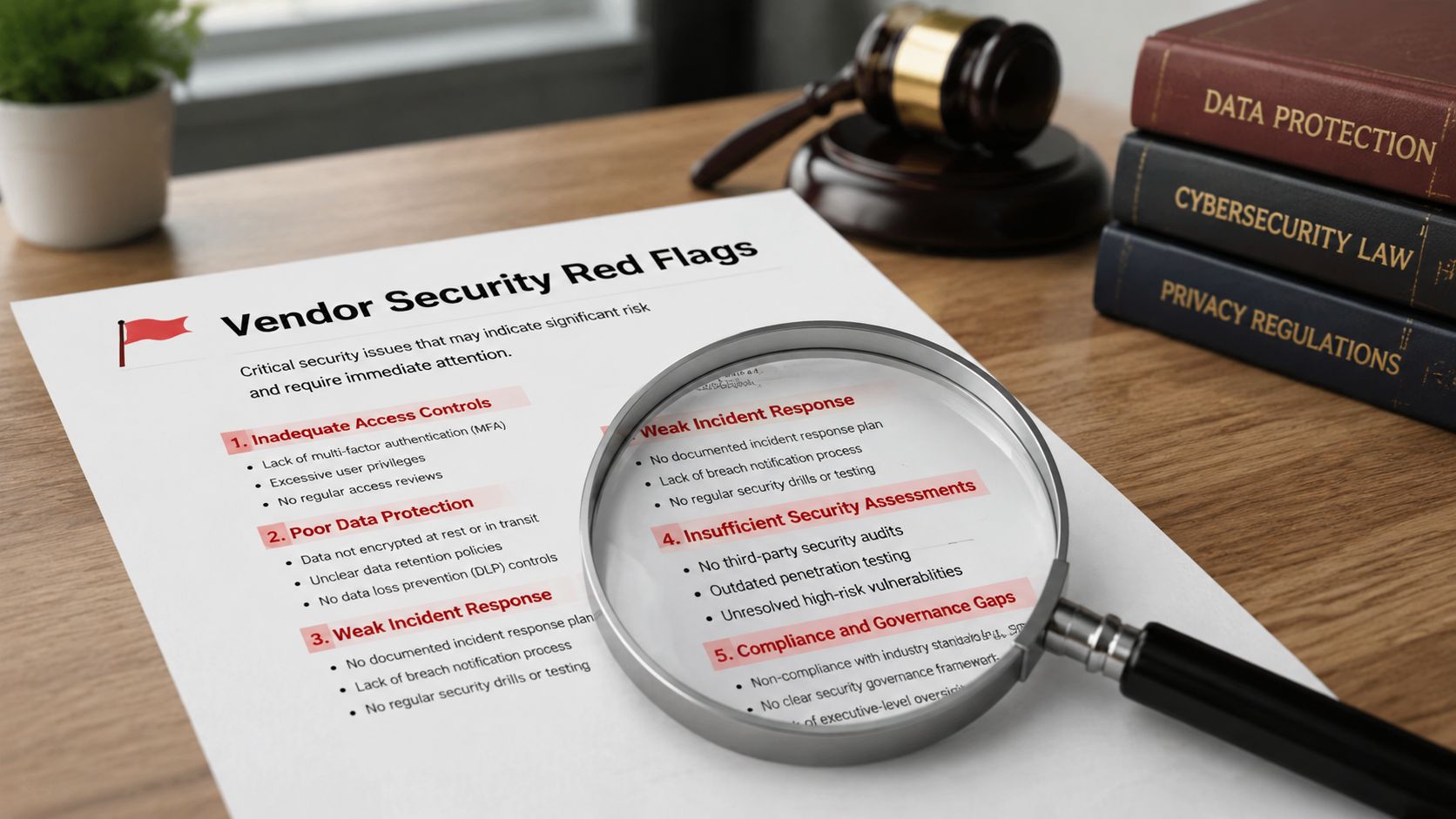
Red flags that shouldn’t be rationalized
- They refuse evidence: the vendor will complete a questionnaire but won’t provide supporting reports, summaries, or policy excerpts.
- They resist basic contractual obligations: breach notice, audit rights, subprocessor disclosure, and deletion commitments are treated as unreasonable asks.
- They don’t know their own environment: the sales team says one thing, security says another, and legal can’t reconcile the documents.
- They lack a security owner: nobody is accountable for controls, incidents, or remediation.
- They hide subcontractors: the vendor won’t identify critical downstream providers that support the service.
- They offer only marketing language: terms like “bank-grade” or “enterprise-ready” appear everywhere, while concrete control descriptions are missing.
- They push urgency over diligence: pressure to sign before review is complete usually benefits only one side.
- They won’t commit remediation in writing: verbal assurances substitute for deadlines and deliverables.
If a vendor gets defensive when asked for ordinary proof, the company has already learned something useful.
When legal counsel should step in
A founder can handle low-risk vendors with a disciplined intake process and a lightweight template. That approach stops being sensible when the relationship creates serious legal exposure.
Legal counsel should be involved when:
- The vendor is high-risk. If the vendor touches sensitive customer data, employee data, source code, or production systems, the contract and assessment need legal review.
- The vendor caused or may have caused an incident. Notice duties, privilege, evidence preservation, customer communications, and indemnity rights should not be improvised.
- The contract terms are heavily negotiated. Liability caps, disclaimers, subprocessor language, and security exhibits often look harmless until an incident reveals the gaps.
- The company wants audit rights or custom remediation obligations. Those terms need drafting discipline or they become symbolic.
- The company is terminating for security reasons. A bad exit can trigger service disruption, payment disputes, or claims of wrongful termination.
- The company operates in a regulated or customer-audited environment. Third-party controls have to line up with contractual and compliance commitments already made upstream.
Some companies use outside counsel only at the contract stage. That’s often too late. The better approach is to involve counsel when the assessment uncovers a meaningful gap, when a critical vendor is being onboarded, or when the business team wants to accept a known risk and needs that decision documented cleanly.
For startups and growth-stage companies, one practical option is to involve a firm that handles contracts, privacy, and cyber matters together rather than splitting the issue across separate advisors. By Design Law Firm & Legal Consultancy, PLLC provides that kind of business, contract, and cyber counsel for companies that need vendor risk addressed as a legal and operational issue, not just a checklist item.
A company that wants help building a defensible vendor security assessment process, tightening vendor contracts, or responding to a third-party security issue can contact By Design Law Firm & Legal Consultancy, PLLC for practical legal guidance aligned with startup and SMB realities. Contact us today at (206) 593-1519.