You've probably got the company half-built already. The incorporation filed, the logo sketched, maybe a draft pitch deck in motion, and a cheap sense that the “real legal stuff” can wait until someone wires money. That's the trap. Corporate law for startups isn't a one-time filing, it's the legal operating system that decides who controls the board, how clean your cap table looks, whether an investor can close, and how painful an exit becomes later.
Why Corporate Law Matters Before Your First Round
The day incorporation gets real is usually not the day the entity is formed. It's the day a co-founder asks who owns what, a prospective investor asks for the board consents, or a customer wants a signed contract before they'll even pilot the product. At that point, sloppy formation work stops being paperwork and starts becoming a strategic advantage, or the lack of it.
Startup law is built around repetition. You form once, then you finance, hire, grant equity, sign vendor contracts, protect IP, and eventually negotiate a sale or a second round. A weak structure at the beginning forces expensive cleanup later, and cleanup is always worse when a lender, investor, or buyer is watching.
Practical rule: founders should treat the first filing as the first move in a long governance game, not as a box to check and forget.
A recent Oxford analysis of startup and VC growth backs that up with a useful distinction. Corporate law has adapted selectively, not uniformly, to startup needs, and the politically easy reforms, like multiple-vote shares, have moved faster than deeper governance rules around boards and shareholder control. That matters because startups depend on aligning control and capital across repeated rounds, not just at formation, and voting rights can shift negotiating power without changing the whole framework underneath. The same analysis connects this to a global unicorn dataset, which is a reminder that startup corporate law is now a policy issue, not a niche technicality. Oxford analysis on hidden legal constraints to startup and VC growth
The practical takeaway is simple. The founder who gets entity choice, equity design, and governance right early spends less time untangling preventable problems later. The founder who doesn't tends to pay for rework in financing friction, diligence delays, and founder disputes.
Where Startup Legal Spend Goes
| Stage | Typical Legal Work | Fee Range |
|---|---|---|
| Formation | Entity choice, incorporation documents, founder agreements | Fixed-fee packages are often used |
| Seed and early growth | Cap table cleanup, option plans, investor docs | Higher than formation work |
| Scale-up | Financing rounds, governance changes, M&A prep | Meaningfully more complex |
| Exit planning | Transaction docs, diligence responses, closing support | Highest complexity |
That progression is why a startup legal page like funding and seeding matters to founders even before they’ve raised their first outside dollar. The legal spend follows the company’s growth path, not just the first filing.
Choosing the Right Entity for a Startup
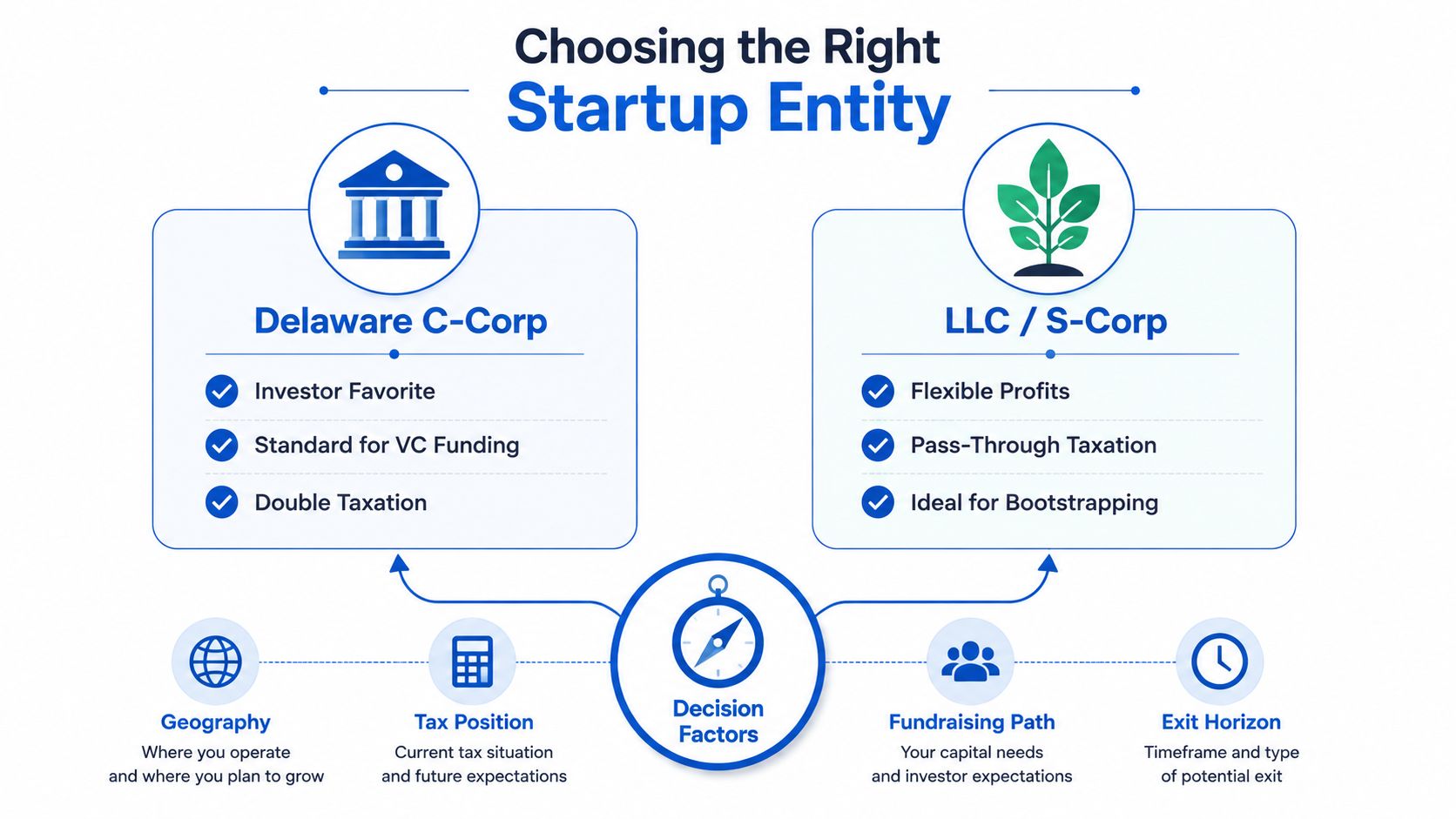
Most founders default to a Delaware C-corporation because investors expect it. That’s usually the right answer for a venture-backed startup, but not always the right answer for every founder. The better question is whether the business is aiming for institutional capital, founder-friendly tax treatment, geographic flexibility, or a clean path to a later sale.
LLC, C-corp, and S-corp side by side
A C-corp is the standard venture structure because it handles stock issuance, option plans, preferred rounds, and future M&A cleanly. A Delaware C-corp is especially common because outside investors know the playbook. A Washington C-corp can work too, especially if the company is staying local for a while and wants to avoid unnecessary foreign qualification complexity. A Washington LLC can make sense for a bootstrapped company or a consulting-heavy business that wants pass-through taxation and flexible profits. An S-corp is usually the least attractive startup option for a company that expects outside investment, because the ownership and structural limits get in the way of venture financing.
Clear recommendation: if the company wants outside capital, form a C-corp. If the company is intentionally staying small, profitable, and founder-owned, an LLC may be the cleaner fit.
Decision criteria are boring, but they’re decisive: investor compatibility, taxation, governance flexibility, and conversion cost. Investors overwhelmingly prefer a C-corp because the equity stack and board mechanics are familiar. LLCs are attractive for pass-through treatment and flexibility, but they complicate equity compensation and institutional fundraising. S-corps can be tax-efficient in some narrow cases, but they’re often a mismatch once the company starts hiring, issuing equity, or courting VC.
Washington founders also need to think about geography. A local company can form in Washington and operate there, or form in Delaware and qualify to do business in Washington. The difference is not philosophical, it’s operational. If the startup is bootstrapped, service-based, and likely to stay small, a Washington LLC may be perfectly sensible. If the plan is venture capital, use the structure investors expect and avoid forcing a conversion later.
For a plain-English operating agreement benchmark, the internal guide on how to write an operating agreement is useful context for founders comparing LLC governance against corporate governance.
Formation Mechanics and Founder Agreements
Formation is where founders make expensive mistakes while feeling productive. They file the entity, open a bank account, and assume the hard part is done. It isn’t. The order of the formation steps matters because every later financing round depends on whether the first records are clean.
The filings need to match the actual deal
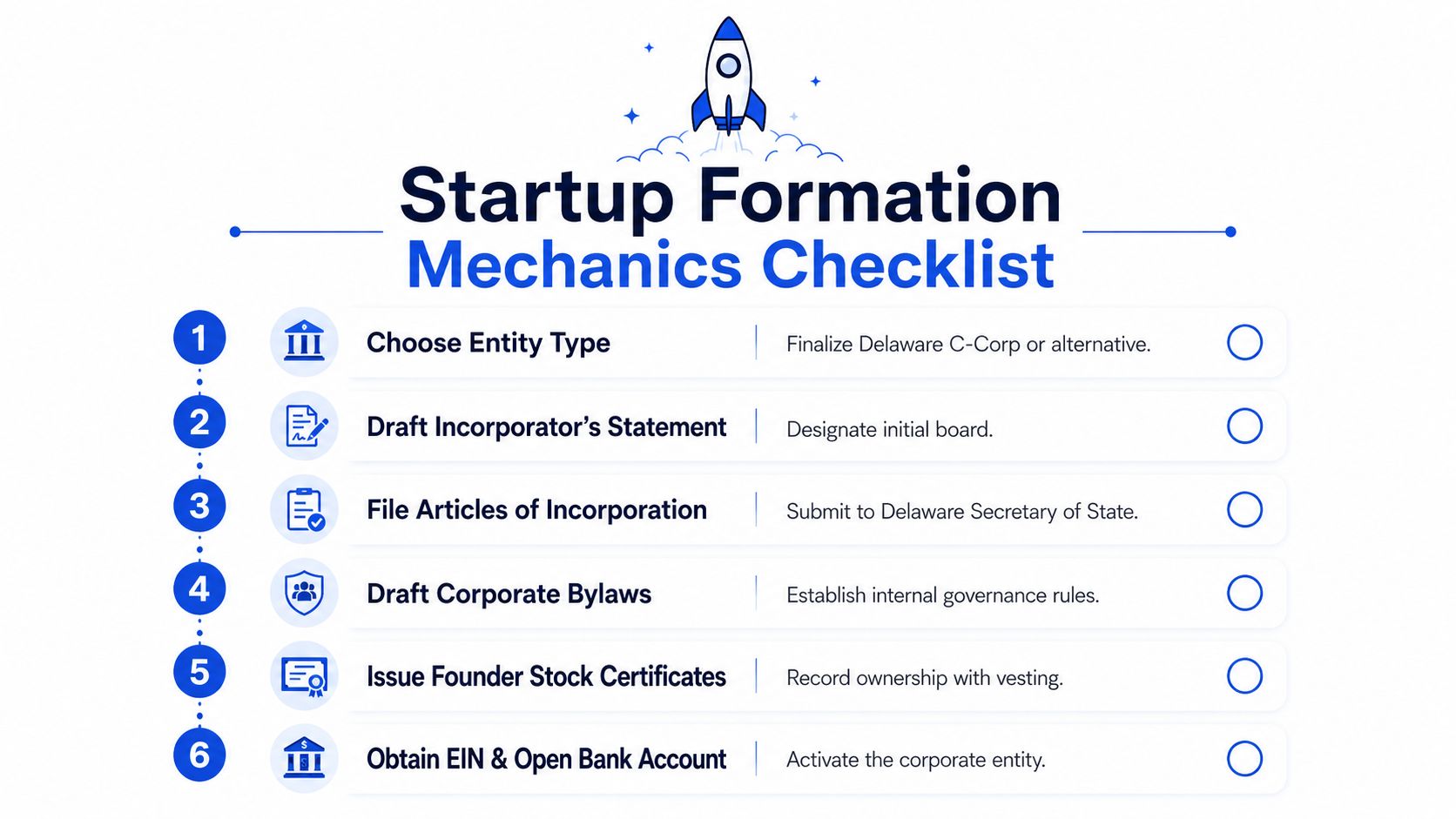
If the company is forming in Washington, the filing runs through the Washington Secretary of State. The entity documents should match the ownership split, board structure, and founder intentions on day one, not some version of the story that gets revised later in a pitch deck. The founders should also adopt bylaws, issue stock properly, and create the paper trail that shows who authorized what.
Founder equity should not be handed out casually. Stock issuance needs the right approvals, the right purchase documents, and the right vesting structure. That vesting matters because it protects the company if someone leaves early, and it keeps one founder from walking away with a large chunk of the business before proving long-term commitment.
A startup that skips vesting is handing future leverage to the wrong person.
The 83(b) election is another line item founders can’t treat lightly. It only helps if it’s filed on time, and late filings don’t get a do-over. The form is simple, but the consequences of missing it can be ugly because tax treatment can change in ways founders never intended.
Founder agreements should cover three things
A real founders’ agreement should spell out vesting, IP assignment, and what happens if a co-founder leaves. That second item is the one too many teams treat as boilerplate. It isn’t. If a founder worked on a side project before joining the startup, the company needs a clean assignment story or the first investor diligence process can stall.
The practical formation checklist is short, but it has to be done in order:
- Form the entity.
- Adopt governance documents.
- Authorize and issue founder stock.
- File the equity-related tax election on time.
- Sign the founder agreements.
- Create a clean ownership record from day one.
For a more detailed operational lens on early-stage setup, the internal guide on intellectual property rights types is helpful background before founders start signing invention assignments and founder-side IP paperwork.
Cap Table Hygiene and Equity Plans
A cap table is not a spreadsheet. It is the legal record of who owns what, what they’ve been promised, and what can still be issued, exercised, or converted later. If the cap table doesn’t reconcile with the board consents, stock purchase agreements, and option paperwork, the company is building a diligence problem before the first financing even starts.
Treat the cap table like a control system
The rule is blunt. Every issuance, repurchase, option grant, and exercise has to be recorded and reconciled as it happens. That discipline matters because even small mismatches can create ownership disputes and stall a round or acquisition. A startup legal guide that focuses on scaling makes the same point plainly, the cap table is diligence-critical, not decorative. Cap table integrity and growth-stage review
That’s also why stock option administration isn’t a side task. An equity incentive plan governs how the company grants options, reserves shares, and tracks exercisable rights over time. ISO and NSO options are not interchangeable, and the company needs to know what it’s granting before a compensation package gets promised to a hire.
Equity decisions should be made before they become urgent
Founders should reserve equity early enough to support hires, but not so carelessly that the reserve becomes a junk drawer. Too many startups wait until a recruiter says compensation is a blocker, then rush out grants without checking the underlying plan capacity or board approvals. That’s how a company ends up with documents that look fine on the surface and fail under diligence.
The cap table also needs housekeeping around exercise windows, 409A timing, and grant tracking. If a former employee leaves and the company doesn’t know the exercise deadline or the current status of the grant, the issue is no longer a paperwork problem. It’s a valuation and ownership problem.
A well-run startup keeps a continuous record of:
- Founder issuances and any later transfers.
- Option grants with board approval dates.
- Repurchases when someone leaves.
- Exercises and the resulting ownership changes.
- Historical filings that support the chain of title.
That’s the value of cap table hygiene. It makes the company financeable, saleable, and credible. For a deeper framework on keeping equity records clean, the internal guide on capitalization table management belongs in every founder’s reference stack.

Governance, Board Practices, and Investor Agreements
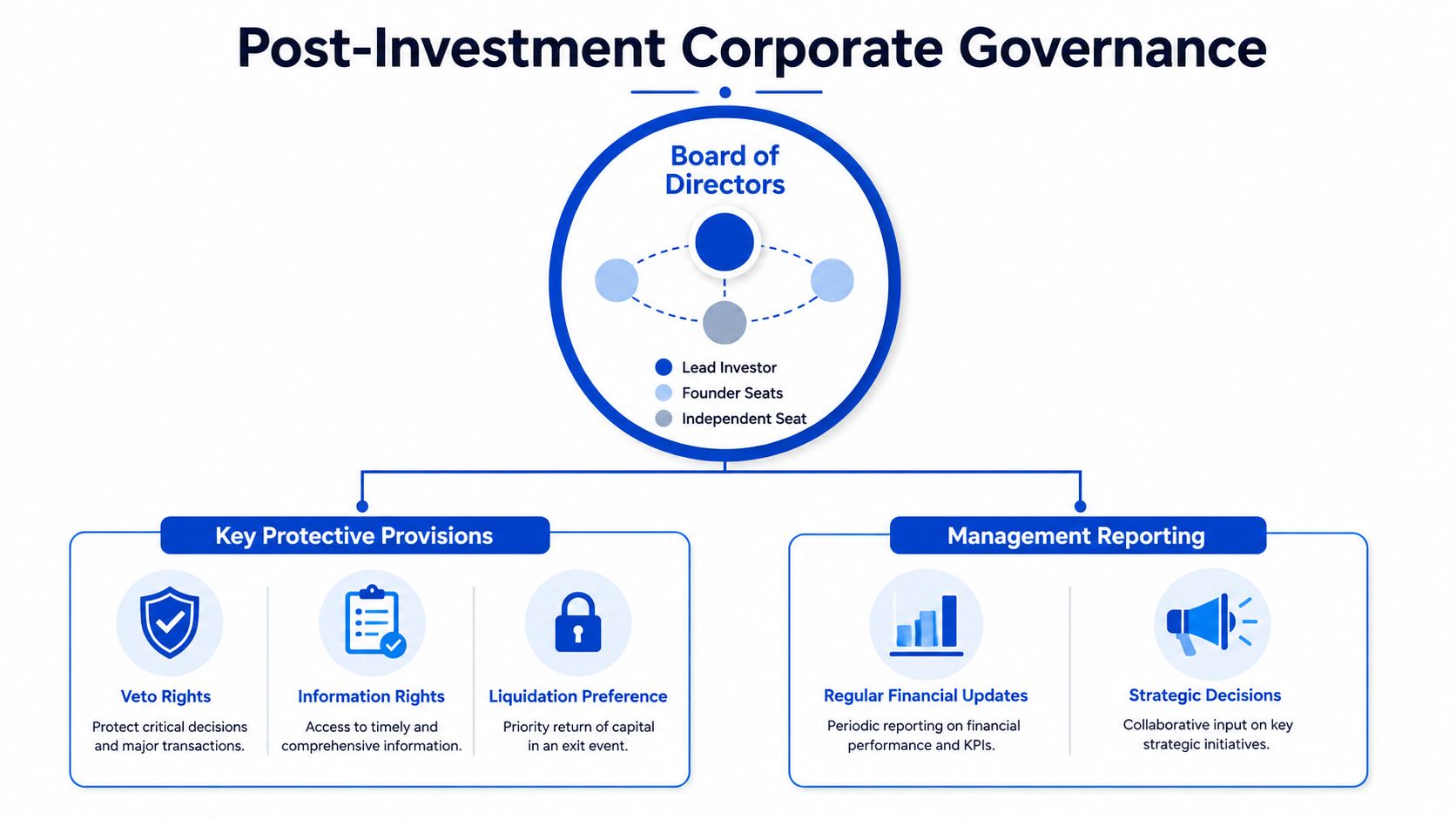
The first institutional investor changes the company’s legal life. The board gets resized, protective provisions appear, and founders start sharing control in a way that was irrelevant at the formation stage. That’s not a paperwork footnote, it’s the mechanism by which the company becomes financeable at scale.
What the term sheet really does
A venture term sheet is not just a valuation sheet. It drives the final charter, investor rights agreement, voting agreement, and board setup. Once the deal closes, the board composition and approval rules determine what founders can do alone and what needs investor consent. The old casual style of “founders run everything” disappears quickly once protective provisions and information rights are in place.
The Oxford analysis from earlier is relevant here too. Corporate law has loosened some voting-right constraints, but deeper governance rules have not changed as much, which is why board control remains one of the most contested startup-law issues across jurisdictions. That is exactly where founders lose leverage if they stop paying attention after incorporation.
Board control is where startup law becomes real. Everything before that is preparation.
Washington founders also need to document board action correctly. Consent forms, resolutions, and meeting records should be clean enough that a future investor or buyer can trace authority without guessing. Director fiduciary duties matter too, because once outside capital enters the company, the board is no longer just a founder formality.
The clauses that actually shape exit leverage
Three terms matter more than most founders realize: protective provisions, information rights, and drag-along rights. Protective provisions give investors veto power over major moves. Information rights keep investors updated. Drag-along rights shape how a future sale can be forced through if the majority wants liquidity.
A solid board structure usually has to balance founder seats, investor seats, and sometimes an independent seat. That balance affects who can steer the business in the next round, not just who signs off on a financing. The founder who accepts governance casually in the seed round may find the Series B influence gone before the company reaches real scale.
The governance gap is also where many founders benefit from outside help. A Washington startup attorney, a Delaware specialist, or a firm with formation and financing experience can all add value here. By Design Law Firm & Legal Consultancy, PLLC is one option for founders who need formation, governance, and contract support under one roof.
IP, Data Privacy, and Everyday Contracts
Most startup legal exposure lives outside the boardroom. It sits in the codebase, the privacy policy, the MSA, the NDA, the customer contract, and the vendor file. Founders who ignore that layer usually discover the problem only when a customer procurement team, investor, or acquirer starts reading the documents line by line.
IP has to belong to the company, not the individuals
The company should own the core IP through written assignment, not handshakes and assumptions. That means founder invention assignments, employee invention agreements, and contractor work-made-for-hire style paperwork need to be cleaned up early. If a founder brings in a side project or preexisting code, the company needs a clear paper trail showing what belongs to the startup and what does not.
That’s also why trademark and trade secret hygiene matters. The brand should be protected before the market gets crowded, and internal know-how should be treated as confidential before it gets casually shared in a Slack channel or vendor workflow. If the company is building or protecting digital assets, a resource like safeguarding digital creations can help founders think more carefully about ownership, control, and protection strategies.
Privacy is an operating issue, not a policy page
For startups handling personal data, the legal controls have to be baked into the product and vendor stack from day one. Guidance under PIPEDA points to appointing a privacy officer, limiting collection to necessary data, obtaining meaningful consent, disclosing transfer risks, and binding third parties to equivalent protections. Weak vendor governance or poor notice can trigger compliance headaches fast, especially when data moves across borders. PIPEDA startup privacy guidance
A startup also needs a real privacy policy, terms of use, vendor DPAs, and incident-response planning. Those documents are not there for show. They give the company a baseline if a customer asks questions, a regulator asks questions, or a breach needs to be handled quickly.
Template the routine, review the risky
Founders can usually template the low-risk agreements. NDAs, basic vendor forms, and straightforward customer paperwork often fall into that category. But once the contract touches indemnification, IP warranty, liability caps, or termination leverage, the company should stop improvising. Those clauses decide who pays when something breaks.
A Carnegie Mellon startup-law checklist adds another practical point. Founders should not rely on confidentiality agreements alone, should stage disclosure, and should pay attention to the term of the agreement and remedies such as collection of legal fees. Carnegie Mellon startup law checklist
For a broader contract and IP framework, the internal guide on revenue-based financing compliance is worth a look if the company is exploring nontraditional capital or revenue-linked deal structures.
Compliance, Risk Management, and When to Engage Counsel
A founder can DIY some legal work. That’s fine. The mistake is thinking DIY is always cheaper. Once the company starts hiring, taking data, signing customers, or talking to institutional investors, the cost of fixing a missed issue usually exceeds the cost of doing it right the first time.
The recurring obligations are not optional
Startup compliance keeps showing up in the same places. State annual reports. Registered agent maintenance. Securities paperwork for option grants. Industry licensing. Franchise or entity-level tax obligations where applicable. None of that is glamorous, and all of it becomes annoying the minute a filing is missed.
The point is timing. Compliance work is cheaper when it’s routine and expensive when it’s reactive. A missed filing can create a scramble during a financing or acquisition, exactly when leverage is supposed to be on the company’s side.
These moments justify outside counsel
Some inflection points should trigger a call to counsel without debate:
- First institutional investor. The documents get real, and so does the influence.
- First employee with source-code or customer-data access. IP and privacy exposure increase immediately.
- First data incident. The response has to be coordinated, fast, and documented.
- First cross-border sale. Privacy, tax, and contracting issues start overlapping.
- First acquisition conversation. Diligence will expose every missing paper trail.
If a founder waits until diligence to fix legal sloppiness, the other side now controls the timetable.
Washington-based founders also need to pay attention to state-specific rules like annual filing deadlines. In the UK, by contrast, a company’s annual accounts must be filed within 9 months of the accounting reference date, and for a 31 December year-end that means by the end of September the next year, which is a good reminder that jurisdiction-specific timing rules matter and vary by place. UK startup annual accounts filing guide
Founders exploring more structured capital alternatives should also read carefully before assuming every financing is simple. Revenue-based financing compliance is one of those areas where generic templates tend to break down fast.
Your Startup Legal Roadmap and Common Questions
In incorporation week, lock the entity, board, founder stock, and IP assignments. At the first hire, tighten employment, confidentiality, and invention paperwork. At the first priced round, clean the cap table and board records, then let counsel draft the financing stack. At the first exit, stop improvising and run diligence like the buyer will ask for every missing document.
Common question one, Washington C-corp or Delaware C-corp? If venture capital is the plan, Delaware is usually the cleaner choice. If the business is small, local, and unlikely to raise institutional capital, a Washington structure may be enough.
Common question two, does the 83(b) election matter? Yes. It matters whenever founder stock is vesting and the company wants the tax treatment set early. Miss the deadline and the damage is hard to unwind.
Common question three, what if a co-founder leaves early? Vesting and repurchase rights need to be in the documents before that happens. If they’re not, the company is negotiating from weakness.
Common question four, what about AI-specific legal risk in 2026? The company should treat AI like any other product risk category, which means data rights, vendor terms, privacy, IP ownership, and customer disclosures all need review before launch.
By Design Law Firm & Legal Consultancy, PLLC helps founders with formation, governance, contracts, privacy, and IP so the legal structure matches the business they’re building. If the company needs clear startup counsel in Washington or support on a financing, governance, or contract issue, visit By Design Law Firm & Legal Consultancy, PLLC and start the conversation before a small paperwork problem turns into a financing delay. Call our law office today at (206) 593-1519.