A founder reaches this point fast. The product is finally real enough to demo, the brand name is on a pitch deck, maybe a contractor has already touched the codebase, and someone asks the uncomfortable question: who owns all of this, and how is it protected?
That's when most conversations about intellectual property rights types start. Not in a law school classroom. In a Slack thread, during diligence, after a developer leaves, or when a competitor launches something that looks a little too familiar.
For startups, IP isn't a trophy case. It's a set of legal tools for separating what can be copied from what can be defended, licensed, sold, or enforced. The mistake isn't failing to file everything. The mistake is treating all business value as if it fits into one bucket. It doesn't. Code, branding, product design, data handling methods, internal playbooks, and technical inventions all sit in different legal categories, and each category behaves differently.
A good IP strategy works like architecture. It identifies the parts of the business that are visible, the parts that should stay hidden, and the parts worth turning into registered rights. That's especially true for software, consumer products, and AI-enabled tools, where one product often contains multiple protectable assets at the same time.
Your Idea Is Brilliant Now How Do You Protect It
A common startup scenario looks like this. A Washington founder launches a SaaS platform with a distinctive name, a polished interface, a novel workflow engine, customer onboarding materials, and a backend method that gives better results than competitors. The founder asks one question, but it usually hides five separate legal issues: “How do we protect the idea?”
The short answer is that the law usually doesn't protect an idea by itself. It protects the specific assets built from that idea. That difference matters because founders often spend time worrying about someone “stealing the concept” while ignoring the contracts, filings, and confidentiality steps that create an advantage.

What founders usually have to protect
Early-stage companies rarely own just one thing. They usually own a mix of assets, including:
- Brand assets like the company name, product name, logo, app icon, and taglines
- Creative assets like source code, website copy, training materials, videos, UI graphics, and documentation
- Technical assets like a new machine, process, architecture, or software functionality
- Confidential assets like algorithms, prompt structures, pricing logic, customer lists, and internal operating methods
A founder who says “the app” often means all four.
Practical rule: Start by inventorying assets, not legal categories. Once the business knows what it has, the right protection path becomes much clearer.
What usually goes wrong
Two errors show up constantly.
First, founders disclose too much too early. They pitch without NDAs when secrecy matters, publish technical details that should have stayed internal, or let contractors build core assets without clean assignment language.
Second, founders over-focus on one form of protection. They chase a patent and ignore trademark clearance. Or they rely on secrecy even though the product's core feature is visible to every user. Or they assume copyright covers the underlying business method when it really covers only the code or content expressing it.
The actual task isn't choosing a favorite category from a list of intellectual property rights types. It's matching the legal tool to the business asset, then deciding what deserves budget and attention first.
The Four Pillars of Intellectual Property
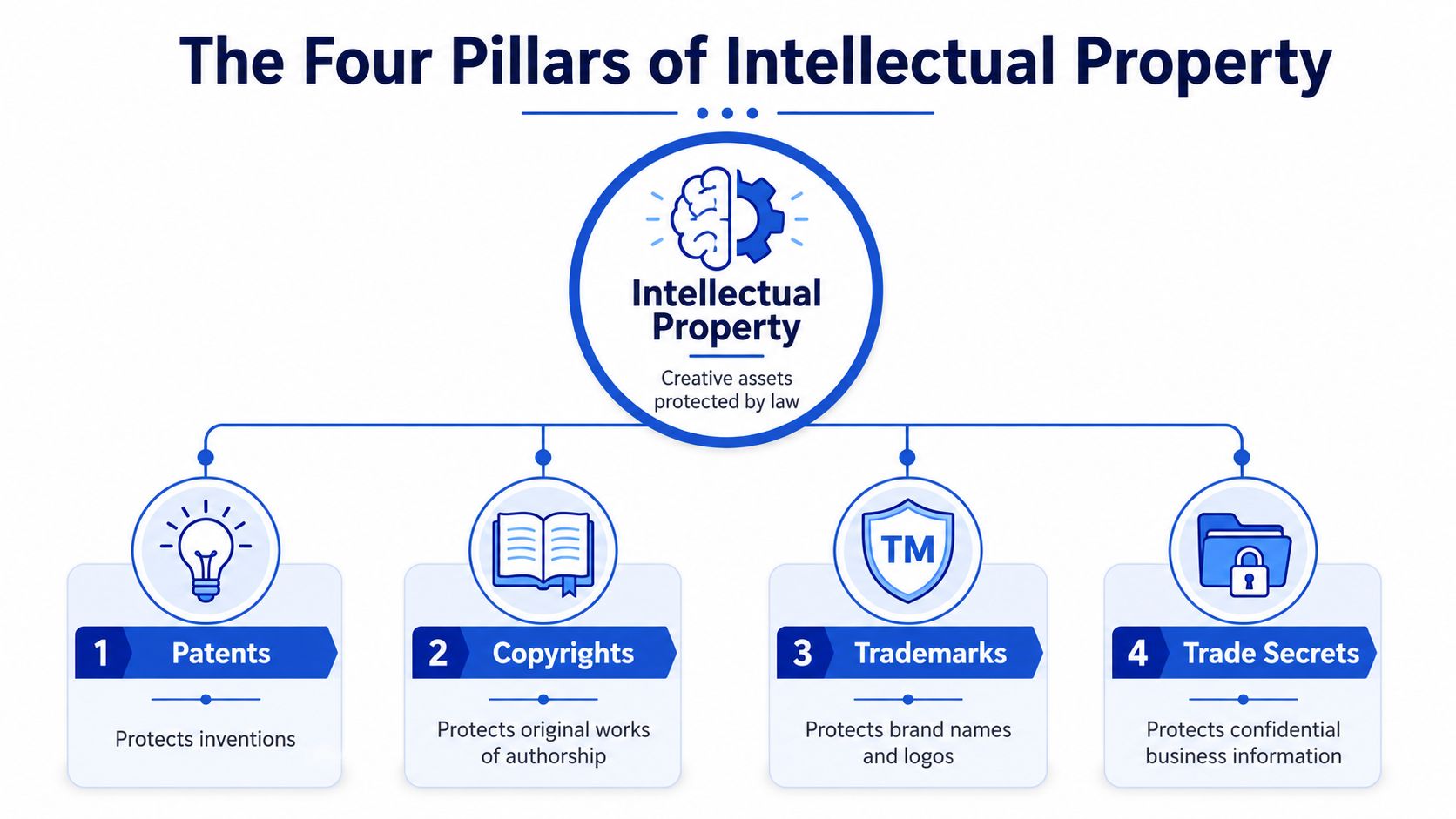
A founder launches a product and asks a simple question: “How do I stop competitors from copying this?” The legal answer depends on what “this” includes. A single product can contain an invention, a brand, creative content, and confidential know-how at the same time. The four pillars of intellectual property matter because each one protects a different business asset, and the right strategy often combines several of them.
Patents protect inventions
A patent protects new inventions and certain ornamental designs. For startups, that usually means technical functionality, product architecture, hardware features, manufacturing methods, or a novel process that creates a real competitive edge.
Patents are the most formal of the four pillars. They require filing, examination, cost, and patience. In exchange, the business can get a time-limited right to exclude others from making, using, or selling the claimed invention.
That trade-off matters.
Patent protection usually makes sense when a competitor can study the product, reverse engineer the feature, and build something close to it. It also matters when investors, acquirers, or strategic partners will ask whether the company owns protectable technology rather than just a head start.
Trademarks protect source identity
A trademark protects the identifiers customers use to recognize the source of goods or services. That can include a company name, product name, logo, slogan, or other branding used in commerce.
Early-stage companies often treat trademark work as a naming exercise. It is more than that. A strong mark lowers confusion in the market, supports marketing spend, and becomes more valuable as reputation grows. If customers ask for the brand by name, trademark rights may outlast the first version of the product itself.
Brand presentation can also matter beyond words and logos. Packaging, product appearance, and visual branding can raise trade dress issues that affect brand identity, especially for consumer products and software with distinctive visual interfaces.
Copyright protects original expression
A copyright protects original expression fixed in a tangible medium. In a startup, that often covers source code, website copy, user guides, product photos, videos, pitch decks, training materials, and interface artwork.
Copyright is broader than many founders assume in some ways and narrower in others. It arises automatically when the work is created, but it protects the expression of an idea, not the idea, system, or business method itself. If a competitor writes different code to achieve the same function, copyright may not stop them. If they copy your code, documentation, or design assets, it may.
For software companies, this distinction is easy to miss. The codebase may be protected by copyright, while the underlying functionality may point toward patent analysis, and unreleased logic may belong in a trade secret program.
Trade secrets protect confidential advantage
A trade secret protects information that derives value from not being generally known and remains subject to reasonable secrecy measures. Typical examples include algorithms, internal models, pricing logic, customer lists, manufacturing tolerances, supplier terms, and operational playbooks.
Trade secrets can be powerful because they do not require public filing. They can also last indefinitely if the information stays secret. But they are only as strong as the company's actual practices. Loose access controls, casual disclosures, missing contractor agreements, and public product demos can destroy the protection quickly.
This is often the best fit for know-how that cannot be readily reverse engineered and would lose value if disclosed in a patent application.
Why founders should view these as complementary tools
The four pillars are easiest to understand by asking what each one is built to protect.
| IP type | What it protects | How rights begin | Best startup use |
|---|---|---|---|
| Patent | Inventions and certain designs | Filing and successful grant | Protecting technical features competitors can copy |
| Trademark | Brand identifiers | Use in commerce, often strengthened by registration | Protecting name recognition and customer trust |
| Copyright | Original expressive works | Automatic on creation | Protecting code, content, and creative assets |
| Trade secret | Confidential business information | Secrecy plus reasonable safeguards | Protecting hidden know-how and internal advantage |
The practical point is not memorizing definitions. It is deciding which pillar matches which asset, then building layers where the product justifies the cost. A medical device, SaaS platform, or consumer product rarely fits into only one box. The strongest position usually comes from stacking protections on the same business from different angles.
A Strategic Comparison for Choosing Your Protection
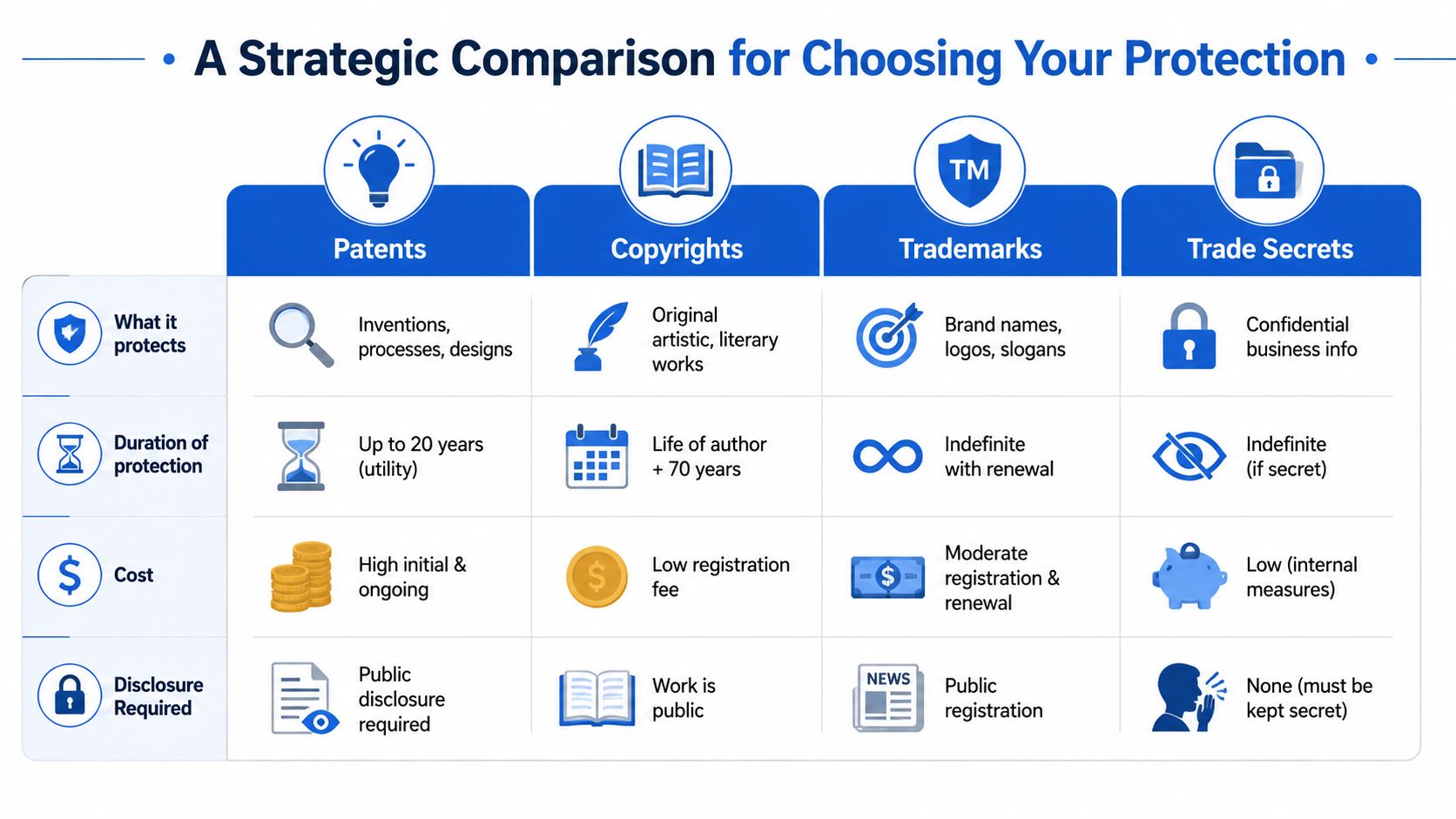
Knowing the four pillars is useful. Choosing among them is where founders usually need real judgment.
The fastest decision filter
A startup can usually sort its assets by asking four questions:
- Is the asset public-facing or confidential
- Is the value in the technical function, the expression, or the brand
- Will competitors be able to reverse engineer it
- Does the company want disclosure in exchange for exclusivity
Those questions often narrow the field quickly.
A side-by-side business view
| Question | Patent | Copyright | Trademark | Trade secret |
|---|---|---|---|---|
| What is protected | Inventions and certain designs | Original expression | Source identifiers | Confidential business information |
| Disclosure required | Yes | No filing required for basic existence | Public marketplace use, often public registration | No, secrecy must be maintained |
| Timing | Slow and formal | Immediate on creation | Built through use, often formalized by registration | Immediate if secrecy measures exist |
| Duration logic | Time-limited | Long-lived creative protection | Can continue as long as used and protected | Can continue as long as secret |
The patent versus trade secret fork
For operating companies, the hardest call often isn't trademark versus copyright. It's patent versus trade secret.
A patent grants a time-limited exclusive right after public disclosure. A trade secret can last indefinitely, but only while the information isn't generally known and reasonable steps protect it, as explained in Dennemeyer's discussion of the four types of intellectual property and how to protect them.
That means the two options create opposite strategic regimes.
- Choose patent protection when the invention is likely to become visible, inspectable, or reverse engineered
- Choose trade secret protection when secrecy is realistic and the business can maintain disciplined internal controls
- Avoid split-the-difference thinking when it leads to accidental public disclosure before the company has decided which path it wants
A patent trades secrecy for exclusivity. A trade secret trades public rights for confidentiality.
What works and what doesn't
What works is aligning the protection method with how the product reaches the market.
A medical device with visible engineering features may justify a patent review. A backend fraud-detection method that users never see may be a stronger trade secret candidate. A SaaS brand almost always needs trademark analysis earlier than founders expect. A codebase built by employees and contractors needs chain-of-title review whether or not a patent is ever filed.
What doesn't work is using patents as investor theater, treating NDAs as a complete trade secret program, or assuming software is “automatically protected” without asking which part is protected by which doctrine. Founders building technical products should also understand the practical issues discussed in software patent guidance for Seattle companies, because timing and disclosure decisions are often harder than the filing itself.
Beyond the Big Four Other Important IP Rights
A founder launches a product with no clear utility patent story, then watches a competitor copy the look, packaging, or regional identity that customers notice first. That is usually the moment the conversation expands beyond patents, trademarks, copyrights, and trade secrets.
For startups, these narrower rights are not academic add-ons. They can protect the part of the business customers buy with their eyes, or the part distributors value because of origin and reputation. In practice, they matter most when a company is deciding what to protect first, what can wait, and which rights are worth pursuing only if the business plans to sell outside the United States.
Design rights and design patents
In the United States, design patents protect the ornamental, non-functional appearance of an article of manufacture. The question is not whether the product works differently. The question is whether its visual design is distinctive enough to justify protection.
That distinction matters for consumer products, packaging, wearables, medical devices, and some screen-based interfaces. I often see founders overlook design rights because they are focused on technical novelty, even though the copy risk sits in the product's shape, surface styling, or visual presentation. If a competitor can make a functionally similar product and win by mimicking appearance, design protection deserves an early review.
There is a trade-off. Design patents can be narrower than founders hope, and they will not stop copying of functional features. But they can still be commercially sharp tools, especially where product differentiation depends on appearance and a utility patent case is weak, expensive, or uncertain.
Industrial designs and geographical indications
Outside the United States, founders will also encounter industrial design regimes and, in some sectors, geographical indications. Those rights do different work from the big four.
Industrial design protection often addresses product appearance in jurisdictions that frame the issue differently from U.S. design patent law. Geographical indications matter more for food, beverage, agricultural, and artisanal businesses whose value is tied to place of origin. A startup selling coffee, wine, specialty foods, or region-linked goods may care as much about origin signaling as it does about invention.
International strategy can get expensive if handled late. A company that plans to manufacture in one country, brand in another, and sell in several markets should not assume the same asset gets the same treatment everywhere.
Why these rights matter
Startups do not build value in one legal bucket. A single product can carry value in function, branding, code, appearance, packaging, and origin at the same time.
The practical question is narrower. What part of the product drives buying decisions, and what kind of copying is most likely?
If the risk is visual imitation, review design-focused rights. If the risk is misuse of place-based reputation, examine origin-based protection. If neither issue matters to the business model, skip them and spend the budget elsewhere. Good IP strategy is partly about coverage and partly about restraint.
IP in Action How Protections Layer on a Single Product
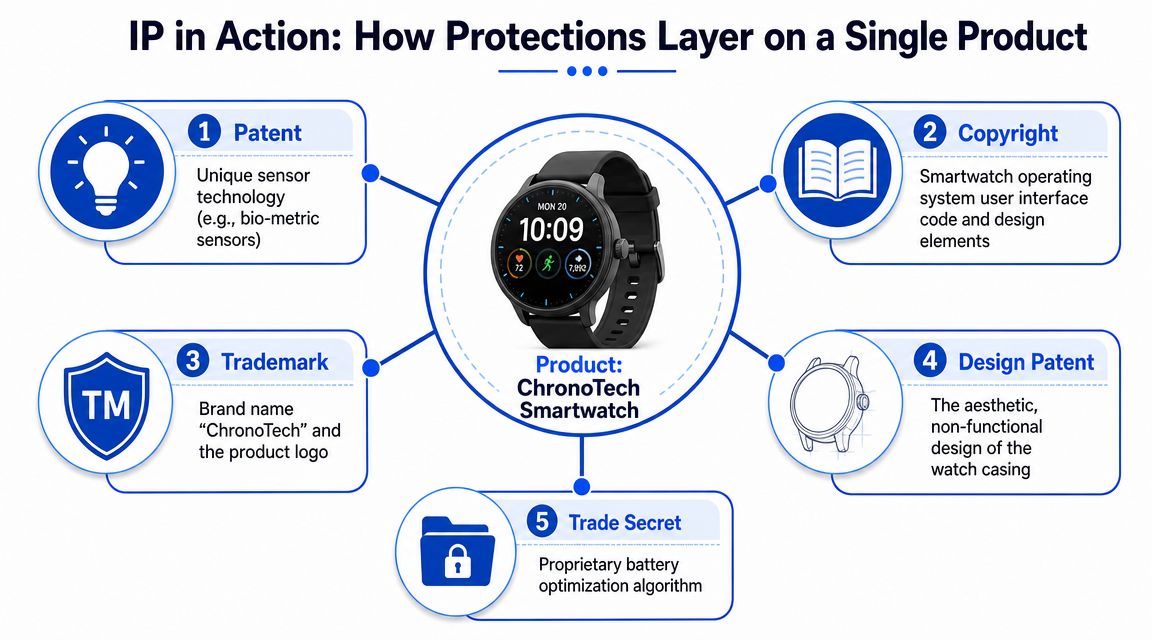
The most useful shift for founders is this one: stop asking which IP category applies to the product. Ask which category applies to each component of the product.
A startup product broken into assets
Take a Washington company building an AI-enabled workflow platform for enterprise teams. The platform has a name, logo, codebase, training materials, interface design, model orchestration layer, customer-specific implementation methods, and internal evaluation process.
Those pieces don't share one legal answer.
According to Tulane's discussion of types of intellectual property protection, software can be covered simultaneously by copyright for source code and documentation, patent for new technical functionality, trademark for the brand, and trade secret for confidential algorithms or internal know-how. That's the right way to think about layered protection.
What each right can cover
-
Trademark for the market-facing identity
The company name, product name, and logo help customers identify source. If the startup rebrands later because someone else owns a confusingly similar mark, the technical strength of the platform won't save the lost goodwill. -
Copyright for the expressive materials
Source code, onboarding guides, website text, help center content, pitch videos, and certain interface graphics all fall into the expression bucket. Copyright won't stop someone from building a competing workflow platform from scratch, but it can help address copying of the company's actual materials. -
Patent for a qualifying technical advance
If the platform includes a novel technical method, not just an abstract business idea dressed up as software, patent analysis may be appropriate. That might involve a particular system architecture, data processing method, or other technical functionality. -
Trade secret for what should stay hidden
Internal tuning methods, non-public prompt structures, model evaluation criteria, customer segmentation logic, and certain datasets may be more valuable as secrets than as disclosures.
The founder's real job
The founder's real job is allocation. Which assets deserve registration, which should remain confidential, which need contract cleanup, and which need ordinary business hygiene?
Strong IP portfolios are usually layered, not singular.
A practical mapping exercise
A useful internal exercise is to create a product asset map with four columns:
| Asset | Visibility | Best-fit protection | Immediate action |
|---|---|---|---|
| Product name | Public | Trademark | Clearance and filing review |
| Source code | Internal and shipped | Copyright plus contracts | Confirm ownership assignments |
| Backend method | Hidden | Trade secret or patent analysis | Decide disclosure strategy |
| User manuals and videos | Public | Copyright | Register key materials when appropriate |
This is also the point where legal counsel becomes operational rather than theoretical. One option is working with a firm such as By Design Law Firm & Legal Consultancy, PLLC, which advises businesses on IP, contracts, technology, and related risk issues. The legal value isn’t just filing paperwork. It’s coordinating ownership, disclosure, enforcement posture, and product strategy before problems harden. Call us today at (206) 593-1519.
Securing and Enforcing Your Rights in Washington
Protection strategy only matters if the company follows through. In Washington, that usually means combining federal rights, state-level considerations, contracts, and internal controls.
Registration and ownership discipline
For patents and federal trademarks, founders typically deal with federal systems. Copyright exists automatically for eligible works once created, but companies still need clean documentation showing who created what and whether the business owns it.
Ownership problems often start with ordinary business shortcuts:
- Contractor gaps where a developer or designer was paid, but IP assignment language was missing
- Co-founder confusion where pre-incorporation work was never properly transferred
- Loose repository access that undermines trade secret arguments
- Brand-first launches before trademark review, which can force expensive pivots
For Washington companies, local counsel can help align those federal rights with the company’s corporate records, employment agreements, vendor terms, and enforcement plan.
Enforcement is a business process
Enforcement usually starts before any lawsuit. It starts with preserving evidence, reviewing contracts, checking the scope of ownership, and deciding whether a letter, negotiation, takedown request, or litigation posture makes sense.
A useful first step in many disputes is understanding what a cease and desist letter does and when to use one. Sometimes a measured notice resolves the problem. Sometimes it escalates it. That choice should be strategic, not emotional.
The strongest enforcement position usually comes from boring discipline done early: signed assignments, confidentiality controls, consistent branding, and records that show who owned what when.
Washington-specific practical reality
Seattle-area startups often move fast, rely on contractors, and collaborate across multiple states or countries. That increases the odds of fragmented ownership and accidental disclosure. A Washington business that wants durable protection should treat IP as part of company formation and operations, not as a cleanup project after fundraising or after a dispute lands.
Building Your Legal Moat A Call for Strategic Action
A founder launches a product, hires a contractor to polish the code, posts a demo video, and starts talking to investors. Six months later, a competitor adopts a similar name, a former freelancer claims ownership of key assets, and the company realizes its best protection should have been trade secret treatment, not public disclosure. That is how good products lose legal ground early.
Startups rarely need every form of protection at once. They need the right combination for the product, the market, and the company’s budget. A software company might rely on copyright for code, trademark for the product name, trade secret controls for backend processes, and a patent filing only if the technical advantage is both protectable and worth the cost and delay. A consumer product company may make a different call. The point is strategy, not collecting filings.
Timing matters, but the harder question is allocation. Some rights arise quickly. Others take time, money, and public disclosure. Founders should ask three practical questions: What creates the company’s margin? What can a competitor copy fast? What asset will matter in diligence, licensing, or acquisition?
That framework usually produces better decisions than treating IP as a checklist. It also helps avoid a common startup mistake. Teams often spend money protecting the visible part of the business while leaving ownership, confidentiality, and branding discipline loose in the background. Investors and acquirers notice those gaps.
Founders who want a practical roadmap should review these tips for building a strong IP strategy. The strongest legal moat is built in layers, with each protection matched to a specific business risk and supported by clean contracts, filing priorities, and internal controls.
By Design Law Firm & Legal Consultancy, PLLC helps startups and established businesses in Washington evaluate, secure, and enforce intellectual property as part of a broader business strategy. For founders dealing with trademarks, copyrights, patents, trade secrets, contracts, or technology-driven risk, the firm can help translate product assets into a concrete legal plan that supports growth. Call us today at (206) 593-1519.