A Washington startup often knows its crown jewels without calling them that. It might be the ranking logic behind a SaaS product, the prompt workflow that makes an AI tool usable, a pricing model, a sales pipeline, or a customer list built through expensive trial and error. None of that shows up on a patent certificate hanging on a wall. It still may be the asset a competitor wants most.
That reality matters even more in Washington's tech market, where founders hire fast, collaborate with contractors, share data with vendors, and compete for talent with larger employers across Seattle, Bellevue, Redmond, and the broader Puget Sound region. In that environment, trade secret protection isn't an academic exercise. It's an operating discipline.
Your Competitive Edge is Your Secret
A trade secret usually sits inside the ordinary flow of business. Product teams keep it in source code and model tuning decisions. Sales leaders keep it in deal strategy and account intelligence. Operations teams keep it in process know-how that lowers cost or speeds delivery. The value comes from the same fact in each case. Other people don't have it, and they can't easily get it through proper means.
That's why many startups underestimate the issue. They spend time on trademarks, maybe patents, and basic incorporation work, but leave their most sensitive information scattered across shared drives, Slack threads, personal devices, and contractor accounts. When a dispute starts, the problem isn't just theft. The problem is proving that the business treated the information like a secret in the first place.
The legal framework in the United States is strong, but it rewards discipline. The United States holds the world's strongest trade secret protection framework, ranking at the top of the OECD Trade-Secret Protection Index, and that position is anchored in the Defend Trade Secrets Act of 2016, which created a federal private civil cause of action for misappropriation according to Bloomberg Law's report on the OECD trade-secret protection index.
Practical rule: Courts protect secrets that businesses actively protect. They don't rescue information that a company treated casually.
For Washington companies, that means the best time to think about trade secret protection is before fundraising diligence, before an employee departure, and before a vendor relationship sours. A founder who can identify the company's confidential assets, limit access, and document those controls has a far better position than one who starts organizing after data has already walked out the door.
Defining a Protectable Trade Secret
The legal test is simpler than many founders expect. The hard part is living it consistently.
Under federal law, a trade secret must satisfy two key criteria: the owner must have taken “reasonable measures” to keep it secret, and the information must derive “independent economic value, actual or potential,” from not being generally known, as summarized in this overview of trade secret law. Internationally, the same core idea is often described as a three-part structure: the information is secret, it has economic value because it's secret, and the owner took reasonable steps to keep it that way.
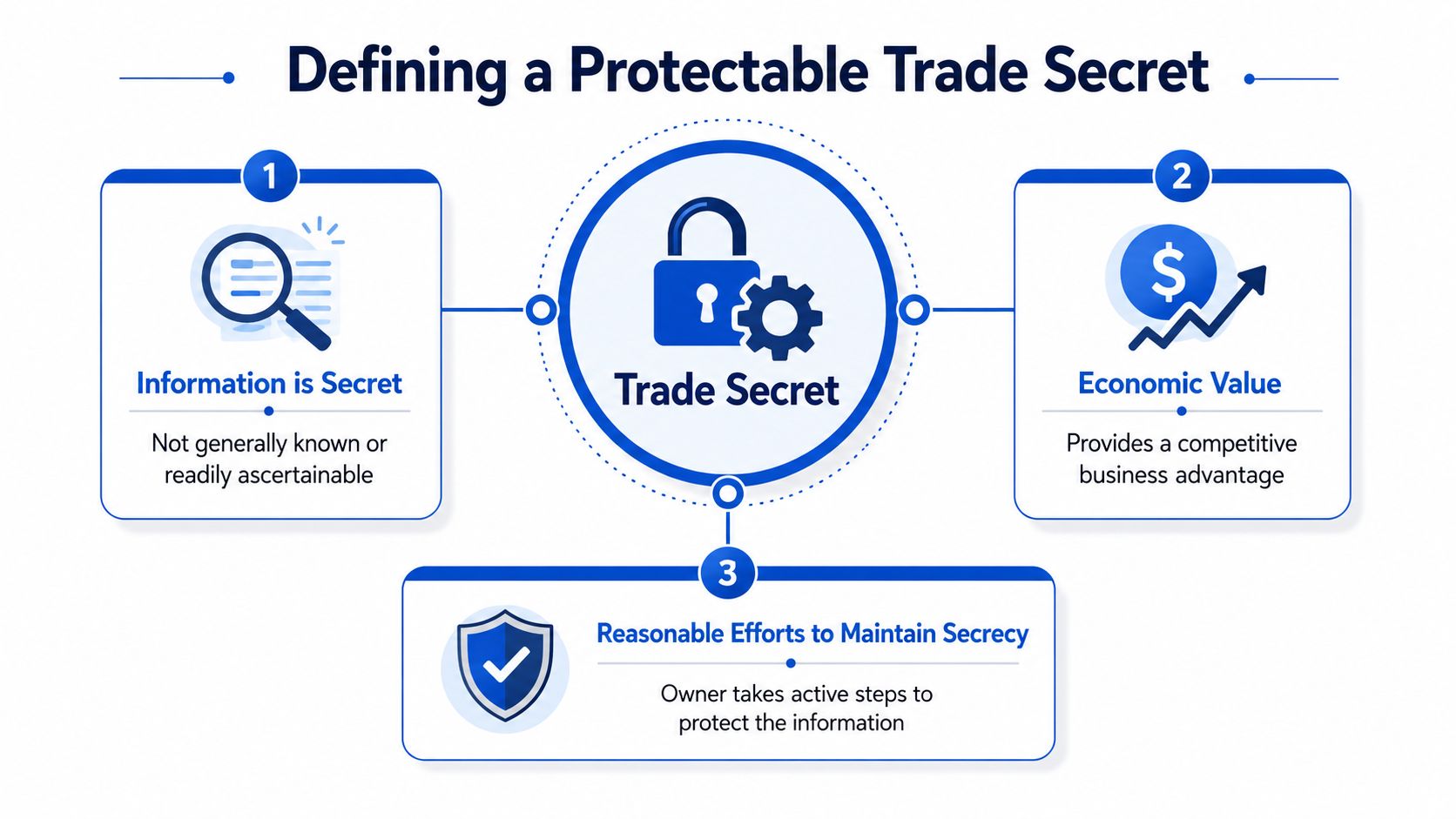
The three questions that matter
A useful way to evaluate an asset is to ask three questions.
| Question | What it means in practice |
|---|---|
| Is it actually secret | It isn't publicly posted, casually shared, or easily found by anyone in the industry. |
| Does secrecy create value | A competitor could benefit from having it, or the business would lose advantage if it became known. |
| Did the company protect it | The business used contracts, access limits, labels, security controls, and internal discipline. |
A recipe analogy still works. A sauce formula kept in a restricted system, known only to a few people, can be a trade secret. The same formula printed in a public cookbook cannot. The information didn't lose value because the recipe changed. It lost value because secrecy disappeared.
What counts as a trade secret in a startup
A trade secret in a startup is valuable confidential business, technical, or operational information, like source code, pricing models, or vendor criteria. It must be information you keep confidential and treat that way.
- Product intelligence such as source code, architecture decisions, deployment workflows, prompts, internal tooling, and data labeling methods.
- Commercial information such as pricing models, customer lists, renewal playbooks, and pipeline forecasts.
- Operational know-how including manufacturing methods, testing protocols, vendor selection criteria, and process shortcuts.
- Strategic material such as fundraising strategy, roadmap sequencing, and market-entry plans.
The statutory definition is broad enough to cover financial, business, scientific, technical, economic, and engineering information in many forms, including electronic storage. That matters for cloud-based businesses because valuable confidential information rarely lives in one place.
A startup doesn't need a patentable invention to own a protectable trade secret. It needs valuable confidential information and proof that it treated that information accordingly.
How trade secrets differ from other IP
A founder choosing an IP strategy needs clean distinctions.
- Patents protect inventions, but they require disclosure and don't last forever.
- Copyrights protect original expression, not a secret process or internal method.
- Trademarks protect brand identifiers like names and logos.
- Trade secrets protect information that stays valuable because it stays confidential.
That makes trade secret protection especially useful when public disclosure would destroy the advantage. It also makes it fragile. Once secrecy is lost, protection often becomes much harder to enforce.
For founders sorting out which rights fit which assets, this overview of types of intellectual property rights is a useful starting point.
Building Your Fortress Practical Steps for Protection
Trade secret protection is built in layers. One NDA won't save a company with open permissions. A strong technical stack won't help much if contractors never signed the right agreement. What works is a coordinated system that shows the business knew what was sensitive and controlled it accordingly.
A practical visual helps frame that approach.
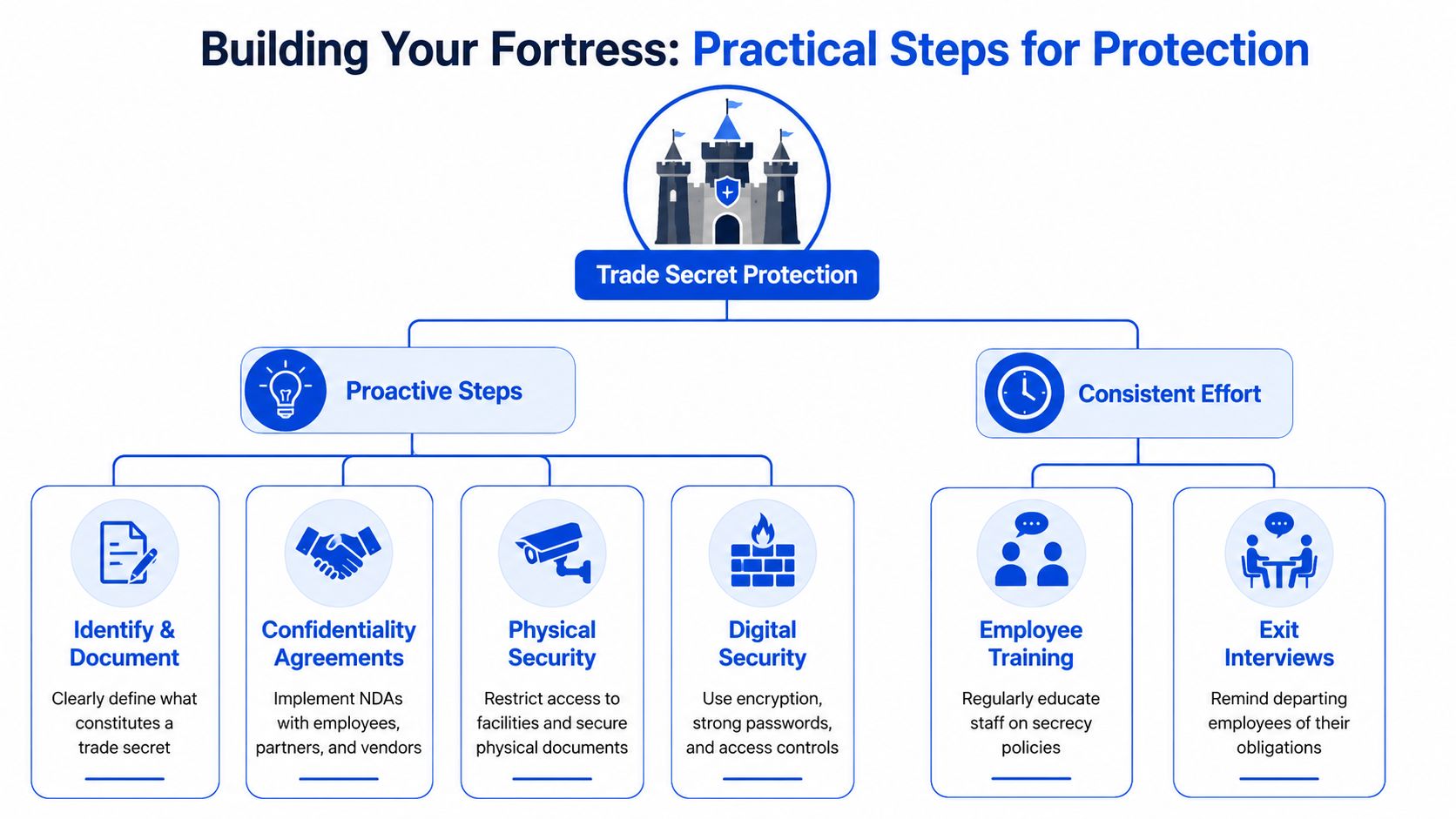
Start with legal controls
Contracts are the outer wall. They define confidentiality obligations, ownership, use restrictions, and return-of-property duties. They also remove the later argument that nobody told the employee, developer, advisor, or vendor what was off limits.
A startup should review at least these documents:
- Employee agreements that include confidentiality obligations and IP assignment.
- Contractor agreements that address ownership of work product, confidentiality, and access limits.
- Vendor agreements that restrict use of shared data to the contracted purpose.
- NDA forms that fit actual workflows, not just fundraising conversations.
A generic form pulled from the internet often fails where it matters most. It may be too narrow, too broad, or silent on digital repositories, AI inputs, or post-termination obligations. Founders who need a baseline reference can compare their process against this discussion of what an NDA agreement is.
Build technical controls that create evidence
The legal standard for reasonable measures is highly practical. Courts want to see real controls, not slogans in a handbook. A critical benchmark for “reasonable measures” is a tiered “need-to-know” access control system coupled with routine trade secret audits. Businesses must also conduct exit interviews with departing employees to obtain written acknowledgments of their confidentiality obligations and immediately terminate all system access, as described in the Fenwick trade secrets protection guide.
That benchmark should shape system design.
- Need-to-know access means engineers don't automatically get full access to every repository, and sales staff don't automatically get the complete pricing logic archive.
- Logging and access records matter because they show who touched which systems and when.
- Encryption and strong authentication help support the claim that the company took baseline technical precautions.
- Trade secret audits catch permission creep, abandoned accounts, and sensitive files sitting in the wrong tools.
For founders thinking about this as a broader security design problem, ARPHost security in layers overview is a helpful companion resource because trade secret protection works best when legal, identity, access, and infrastructure controls reinforce one another.
A short briefing on the operational side is worth watching here:
Don't ignore physical and workflow discipline
Startups sometimes hear “trade secret” and think only about hackers. The more common failures are ordinary. Shared credentials. Personal cloud uploads. Draft contracts with no confidentiality marking. Ex-employees whose access remained active. A founder forwarding key files to a personal email account for convenience.
Those failures are preventable with ordinary process:
- Identify the secrets. Create an internal inventory. If leadership can't name the top confidential assets, nobody can protect them consistently.
- Classify the information. Mark sensitive files and repositories clearly. “Confidential” still matters.
- Control device use. Limit personal storage tools and removable media for business data.
- Back up securely. Daily backups matter, but so do custody rules around who can restore and export data.
- Train teams in plain language. Employees should know what information is confidential and what they're allowed to do with it.
Operational takeaway: The best trade secret program is boring on purpose. It relies on repeatable controls, not trust-based exceptions.
Offboarding is where many cases are won or lost
The most dangerous time is often the last week before departure. A company may trust the employee and still need to act like access is a risk variable.
A sound offboarding process includes immediate access termination, device return, a written acknowledgment of continuing confidentiality duties, and confirmation that no confidential materials remain in personal accounts or devices. In a Washington startup, that process should be standard whether the person is leaving for a competitor, starting a new company, or just taking a break.
What doesn't work is delay. If access remains live after resignation, the company has created its own evidentiary problem.
When Secrets Are Stolen Enforcement and Remedies
A common pattern looks like this. A senior employee resigns. Access logs show unusual downloads shortly before departure. A customer mentions hearing a suspiciously familiar pitch from a new competitor. The company now has two urgent jobs. Stop further use and preserve proof.
The first mistake is improvisation. The second is waiting too long.
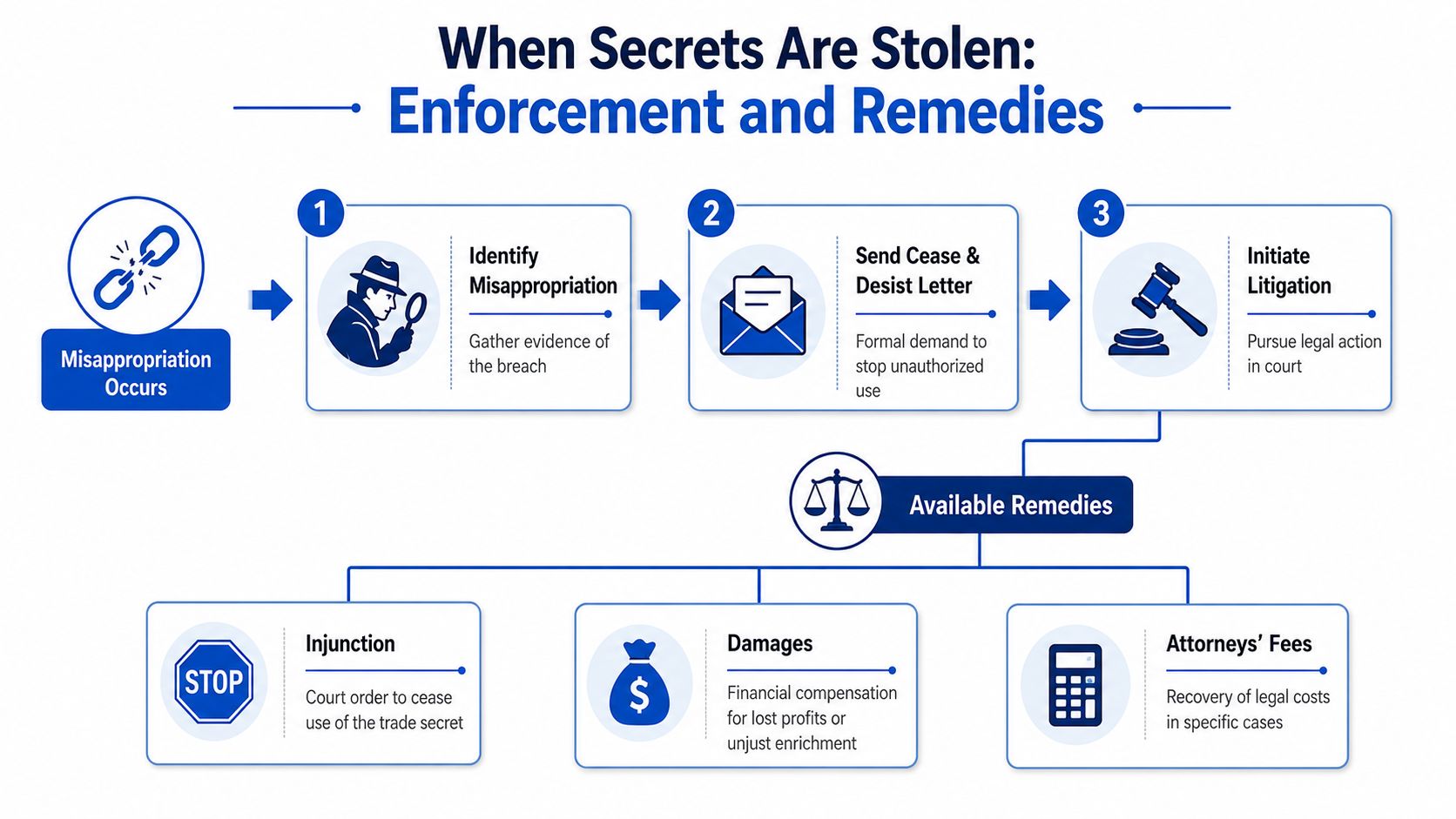
The first seventy-two hours
A disciplined response usually includes the following actions:
- Preserve evidence immediately by retaining logs, account histories, email records, device information, and repository activity.
- Secure systems by cutting remaining access, rotating credentials where appropriate, and preventing further exports.
- Send preservation demands so the former employee, vendor, or competitor can't later claim ignorance.
- Assess urgency to determine whether a cease and desist letter is enough or whether court intervention is necessary.
This is also the point where legal positioning matters. A company that can produce agreements, access records, classification policies, and offboarding records walks into the dispute with credibility. A company that never labeled anything confidential and gave broad access to everyone starts from the opposite position.
What a lawsuit can actually do
Many founders overfocus on money and underfocus on speed. In trade secret cases, the most valuable remedy is often an injunction that stops use before the secret spreads further.
Under civil trade secret law, courts may award compensatory damages for actual loss, punitive damages up to twice that amount for willful and malicious misappropriation, and reasonable attorney's fees to the prevailing party, in addition to injunctions to stop the use of the secret, according to the USPTO trade secret protection materials.
That remedy mix changes the business analysis. Sometimes the right move is immediate litigation. Sometimes a forceful letter backed by strong evidence resolves the dispute. Sometimes the company needs both, with a filing ready if the other side won't stand down.
A founder dealing with an active dispute should also understand the core mechanics of a trade secret misappropriation claim, especially the proof issues around secrecy, value, and reasonable protective measures.
Fast action has a legal purpose. Delay lets the other side argue there was no real emergency and the information wasn't treated as important.
Criminal exposure can exist too
Trade secret theft can also cross into criminal law. The federal Economic Espionage Act creates criminal penalties for theft of trade secrets, including fines and imprisonment, with higher penalties where foreign government benefit is involved, as outlined in NIST materials summarizing the Economic Espionage Act. That doesn't mean every dispute becomes a criminal matter. It does mean some fact patterns are much more serious than a typical employment disagreement.
For a startup, the practical point is straightforward. Preserve evidence as if the facts will be scrutinized closely, because they may be.
Special Considerations for Washington State Businesses
Washington companies need to think on two levels at once. Federal law matters, especially when speed, interstate conduct, or federal court access changes the litigation strategy. State law still matters because trade secret protection remains rooted in state doctrine and local facts.

Washington businesses need a dual-track strategy
Trade secret protection is primarily a matter of state law, which means owners faced limited recourse across state lines before the DTSA created a federal option. Understanding both a state's specific UTSA statutes and the federal DTSA is essential for a complete protection strategy, as explained in this Congressional Research Service overview of trade secret law.
For a Washington founder, that translates into a practical question. Is the company relying on a generic national template, or are its agreements and procedures built for Washington employment realities, Washington litigation risk, and Washington employee mobility?
That question matters because Washington's startup ecosystem moves quickly. Employees leave established tech employers for startups. Founders hire former colleagues. Contractors move between clients. Investors and acquirers ask diligence questions about ownership, confidentiality, and controls. In that setting, the company needs stronger confidentiality architecture, not wishful thinking about loyalty.
Employee mobility changes the playbook
Washington businesses can't rely on sweeping restrictions to solve every confidentiality problem. A better approach is narrower and more defensible.
| Weak approach | Stronger approach |
|---|---|
| Broad restriction on everything an employee learned | Clear definition of confidential information and proprietary assets |
| Universal access during employment | Role-based access tied to actual business need |
| Minimal offboarding | Immediate shutdown of systems, device recovery, and written acknowledgment |
| Vague handbook language | Signed agreements plus documented workflows |
This is one reason well-drafted confidentiality and non-solicitation provisions often matter more than founders expect. A company can’t assume that broad post-employment restrictions will carry the day. It needs to prove that the specific information at issue was confidential, valuable, and protected during the relationship.
For businesses reviewing their hiring and offboarding documents, this employee confidentiality agreement template discussion is a practical reference point.
Washington tech companies should think beyond litigation
In the Seattle area, trade secret risk often shows up long before a lawsuit. It appears in diligence requests, security questionnaires, enterprise sales cycles, and acquisition reviews. Buyers and larger partners want to know whether the company owns what it built and whether sensitive information is controlled.
Recent commentary in the trade secrets bar has also focused on a developing tension between secrecy obligations and cyber-incident disclosure expectations, especially for companies navigating investor scrutiny and regulatory overlays. For Washington technology businesses, that means legal, security, and communications planning should align before an incident happens. A company that treats trade secret protection and cybersecurity as separate silos will usually discover the gap at the worst possible time.
A Washington startup should build its confidentiality system with two audiences in mind. A judge, and a future diligence team.
Your Trade Secret Protection Checklist
A checklist works best when it’s specific enough to expose weak spots. This one is meant for founders, operators, and in-house leaders who need to know where to start Monday morning.
Legal documentation
- List the assets. Identify the company’s core confidential information by category. Source code, prompts, customer data, pricing logic, manufacturing steps, strategic plans, and internal tools shouldn’t live as unwritten assumptions.
- Review agreements. Employee, contractor, advisor, and vendor agreements should address confidentiality, ownership, return of materials, and access boundaries.
- Match documents to reality. If the business uses GitHub, cloud storage, AI tools, and outside developers, the agreements should reflect those workflows.
- Use clear definitions. Don’t rely on “all company information” as the only definition of confidential material.
Employee management
- Train with examples. Teams should know what counts as confidential in day-to-day work.
- Limit access. Grant permissions based on role, not convenience or seniority.
- Run exit procedures every time. Departing personnel should return devices, lose access immediately, and sign a written acknowledgment of ongoing obligations.
- Document exceptions. If someone needs increased access temporarily, record it and remove it when the need ends.
Digital security
- Enable strong authentication. Sensitive systems shouldn’t rely on single-factor logins.
- Encrypt protected data. Confidential information should be protected in storage and transit where appropriate.
- Keep access records. Logging is part of the proof structure in a dispute.
- Audit permissions routinely. Old accounts, inherited privileges, and shared folders create silent exposure.
Physical and operational controls
- Mark important materials. Labels help show that a reasonable person would understand the information is confidential.
- Control devices and storage. Personal cloud tools and removable devices should be restricted or governed.
- Protect meetings and spaces. Whiteboards, printed drafts, and visitor access still matter.
- Preserve evidence procedures. If misappropriation is suspected, the company should know who secures logs, devices, and records.
Bottom line: Trade secret protection isn’t one policy. It’s a pattern of conduct the company can prove.
A founder who can answer three questions is in much better shape: What are the secrets, who can access them, and what record proves the company protected them? If those answers are fuzzy, the work should start now, not after a resignation or a breach.
By Design Law Firm & Legal Consultancy, PLLC helps Washington businesses build practical trade secret protection programs that hold up in daily operations, diligence, and disputes. From confidentiality agreements and vendor contracts to cybersecurity alignment, employee offboarding, and enforcement strategy, the firm advises startups and established companies across the Greater Puget Sound with clear, business-focused guidance. Learn more at By Design Law Firm & Legal Consultancy, PLLC. Contact By Design Law Firm PLLC today at (206) 593-1519 for a complementary consultation.