A Seattle founder hires a first engineer, gives that engineer access to GitHub, Figma, a product roadmap, and an investor update draft, then pulls a free NDA off the internet five minutes before onboarding. That sequence is common. It's also where avoidable risk starts.
An employee confidentiality agreement template helps fix that problem, but only if it's treated as a business system rather than a paper exercise. For Washington companies, especially tech companies handling code, customer data, AI prompts, and distributed teams, the draft needs to match how people work. A generic form that says “keep company information secret” won't do much if employees use personal devices, sync files into personal cloud accounts, or paste internal material into external AI tools.
A strong agreement does two jobs at once. It protects assets that matter now, and it shows investors, customers, and commercial partners that the company takes internal controls seriously. That's why confidentiality language belongs in onboarding before broad system access is granted, not after a problem appears.
Why Your Business Needs a Confidentiality Agreement Now
Your business needs a confidentiality agreement now because early hires can access sensitive data fast. The first sales lead may see pricing and target accounts, and other early staff may see code or payroll details.
None of that means a founder should approach hiring with suspicion. It means the company should define the rules before information starts moving.
Confidentiality is now standard, not niche
A major legal turning point came with the Uniform Trade Secrets Act in 1979, which helped move confidentiality obligations from narrow trade-secret language into standard workplace agreements. It was later enacted by 48 U.S. states, plus the District of Columbia, Puerto Rico, and the U.S. Virgin Islands, and Washington adopted its version in 1981 (reference). That shift gave employers a more uniform framework and made confidentiality provisions a routine part of onboarding.
For a Washington startup, that history matters because modern agreements still follow the same core structure. They define what counts as confidential information, limit use, address duration, carve out exceptions, and preserve remedies if disclosure happens.
Practical rule: If a company would be harmed by an employee emailing it to a friend, uploading it to a personal drive, or taking it to a new employer, that category should be addressed in the agreement.
The agreement supports growth, not distrust
Founders often think of a confidentiality agreement as a defensive legal form. In practice, it's also a growth document.
It helps with:
- Hiring clarity by telling employees what information they can use, where, and for what purpose
- Investor diligence by showing the company has basic IP and data-protection discipline
- Dispute readiness by creating a signed record of expectations if misuse later becomes an issue
- Trade secret protection by supporting the company's position that it treated sensitive information as confidential
For Washington companies building software or data products, the agreement also sits next to broader trade secret planning. Founders who want a more detailed overview of how misuse claims are analyzed should review this guide to trade secret misappropriation.
A business doesn't need a massive legal stack on day one. It does need to stop treating confidential information as something protected by assumption alone.
Your Customizable Employee Confidentiality Agreement Template
A workable employee confidentiality agreement template should be easy to customize, readable by a non-lawyer, and tied to actual company practices. The sample below is a strong starting point for a Washington business. It is not a substitute for role-specific review, especially where the employee will handle source code, regulated data, or sensitive customer information.
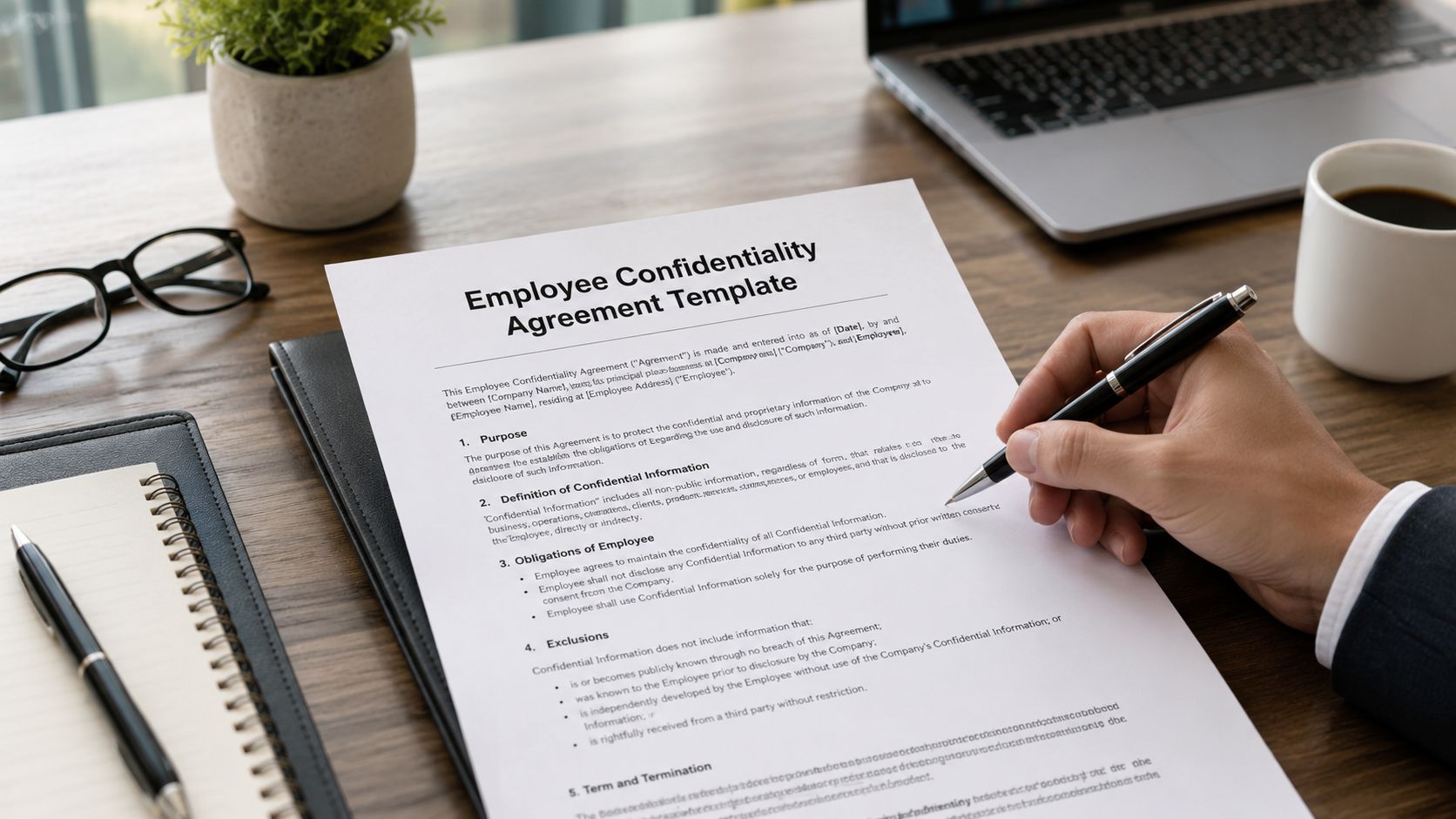
Founders who want a second practical reference point can compare their draft against this HR guide to employee agreements, then bring the language back to Washington-specific requirements.
Core template language
Employee Confidentiality Agreement
This Employee Confidentiality Agreement (“Agreement”) is entered into by and between [Company Legal Name], a [State] company, and [Employee Name], effective as of [Effective Date].
1. Confidential Information. “Confidential Information” means non-public information disclosed or made available to Employee by Company, whether in written, oral, visual, electronic, or other form, including without limitation source code, product plans, technical documentation, research, customer and prospect information, internal processes, financial information, pricing, marketing strategy, business plans, intellectual property, and other proprietary information.
2. Permitted Use. Employee may use Confidential Information only as necessary to perform authorized job duties for Company and for no other purpose.
3. Non-Disclosure and Protection Duties. Employee will not disclose, share, copy, forward, photograph, print, download, transfer, or otherwise use Confidential Information except as authorized by Company. Employee will follow Company security requirements, including access restrictions, approved storage locations, and reporting procedures for suspected misuse or unauthorized access.
4. Exclusions. Confidential Information does not include information that becomes public through no wrongful act of Employee, was lawfully known to Employee without restriction before disclosure by Company, is lawfully received from a third party without a duty of confidentiality, or is independently developed without use of Company Confidential Information.
5. Return and Deletion. Upon request by Company or upon termination of employment, Employee will promptly return Company materials and, where authorized by Company, delete Confidential Information from personal devices, accounts, or storage locations, and certify compliance if requested.
6. Duration. Employee's obligations under this Agreement continue during employment and after employment ends. Confidentiality obligations for information that is not a trade secret will continue for [X years] from the last disclosure or as otherwise stated by Company policy. Obligations relating to trade secrets continue as long as the information qualifies for trade secret protection.
7. Required Disclosures. If Employee is legally required to disclose Confidential Information, Employee will provide prompt notice to Company unless prohibited by law, so Company may seek appropriate protection.
8. Remedies. Employee acknowledges that unauthorized use or disclosure may cause irreparable harm and that Company may seek injunctive relief and any other available remedies.
9. Governing Law. This Agreement is governed by the laws of the State of Washington, without regard to conflict-of-law rules.
10. Acknowledgment. Employee acknowledges reading and understanding this Agreement and agrees to comply with it.
[Company Signature Block]
[Employee Signature Block]
Where founders should customize it
This template becomes useful only after tailoring. The main edits usually involve role, data type, and workflow.
A founder should focus on these pressure points:
- Role-specific examples. An engineer should see code, architecture, product telemetry, and model-related materials called out. A sales hire should see customer lists, pipeline notes, pricing, and renewal strategy.
- Real systems. If the company uses Google Workspace, Slack, GitHub, Notion, Linear, or Jira, the agreement should line up with those access patterns.
- Offboarding mechanics. If employees can work from personal devices, the return and deletion clause should say what must happen at departure.
- Correct parties and signatures. Practical templates work best when every person or entity with access is clearly identified, with names, addresses, an effective date, and signed coverage for all relevant recipients (reference).
A template should describe the company the founder actually runs, not the company a random website imagined.
Deconstructing the Agreement Key Clauses Explained
Most disputes over confidentiality don't start with dramatic espionage. They start with ambiguity. The agreement was too broad to administer, too vague to enforce, or too disconnected from daily work to matter.
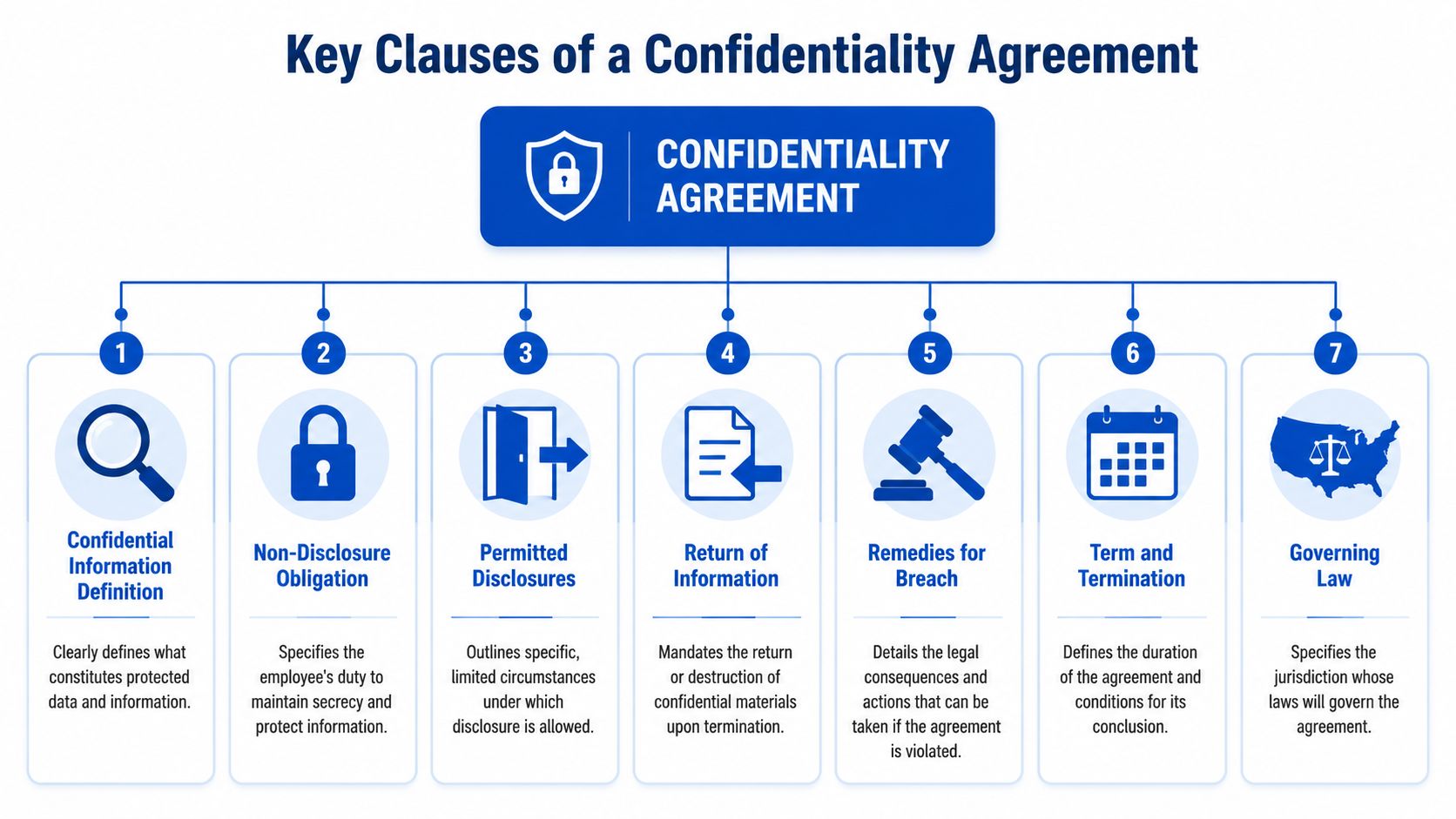
Definition and scope
The definition of Confidential Information is where most templates either become useful or collapse. If it only lists “trade secrets,” it may miss customer data, internal financials, business methods, and pre-release product work. If it says “everything the company touches is confidential,” employees won't know what is important.
A better draft names categories and ties them to how the employee works. For a Seattle software company, that usually includes source code, system architecture, unreleased features, customer implementation details, pricing strategy, and internal roadmaps.
The obligation clause should then answer one direct question: what can the employee do with that information? A solid answer is narrow and practical. Use it only for company duties. Don't share it outside approved channels. Don't copy or transfer it except as authorized.
For founders thinking about code, inventions, and ownership more broadly, this overview of intellectual property rights types helps separate confidentiality from other IP protections.
Duration and exceptions
Duration is one of the most misunderstood parts of an employee confidentiality agreement template. Modern agreements often separate ordinary confidential information from trade secrets. Some templates use a fixed period such as five years from the last disclosure, while trade secrets can be protected indefinitely (reference).
That distinction matters for Washington tech companies. A launch plan may age out. Core source code, training methods, or a non-public algorithm may not.
A simple comparison helps:
| Clause area | What works | What fails |
|---|---|---|
| Duration | Different treatment for trade secrets and other confidential material | One blanket period for every category |
| Exceptions | Public information, lawful prior knowledge, lawful third-party receipt, independent development | No exceptions at all |
| Permitted use | Limited to job duties and authorization | “Business purposes” without limits |
Remedies and return obligations
A remedy clause tells the employee and a future court what the company may seek if misuse happens. It usually preserves injunctive relief and other available remedies. That doesn't guarantee an injunction. It does show the parties agreed misuse could cause harm that money alone may not fix.
Return and deletion language is just as important. If a departing employee keeps Slack exports, downloaded CSVs, or local copies of product specs, the problem often becomes operational before it becomes legal.
The strongest clause is the one a manager can explain in plain English on day one and enforce on day one hundred.
Tailoring Your Agreement for Washington State and Tech Risks
A Seattle startup hires a senior engineer on Monday. By Friday, that engineer has production access, uses a personal laptop at home, tests an outside AI assistant with snippets of internal code, and syncs work files to a private cloud account for convenience. If your confidentiality agreement still reads like a generic HR form, it is not covering the actual risk.
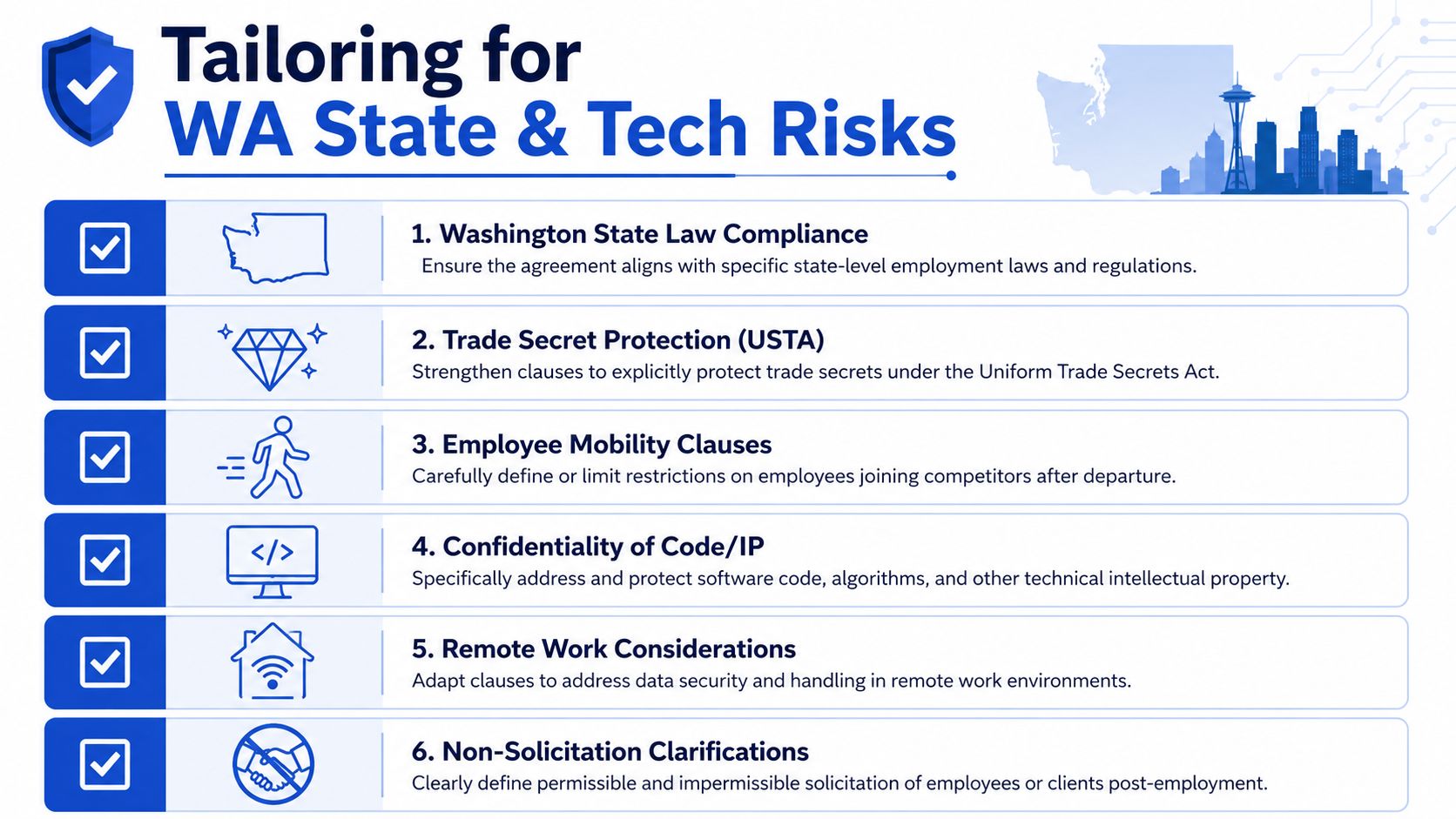
Don't let confidentiality language act like a disguised noncompete
Washington businesses need a clean line between confidentiality protection and restrictions on post-employment competition. I see founders blur that line when they try to stop every future risk with one sweeping clause. The result is usually a document that reads aggressively, but holds up poorly if challenged.
Draft the confidentiality section to protect nonpublic business information, trade secrets, and internal materials the employee accesses through the job. Do not draft it so broadly that it appears to bar someone from using general skills, industry knowledge, or experience gained over time. That is where scrutiny starts, especially for Washington employers already dealing with state limits on restrictive covenants.
Founders following the broader policy debate can review Paradigm International on noncompetes for context on why overreach in this area gets scrutiny.
Write for the way tech teams actually handle data
A useful agreement for a Washington tech company should reflect current workflows, not office assumptions from ten years ago. Remote access, contractor-heavy product teams, AI-assisted coding, and distributed customer support all change where confidential information lives and how it can leak.
Some newer templates address personal email forwarding, cloud storage, and secure deletion requirements (reference). For a software company, I would usually go further and spell out the specific behaviors that are off limits:
- Remote work access. Limit access to approved devices, networks, and company-managed systems.
- Personal devices. If BYOD is permitted, require mobile device management, local encryption, and prompt deletion on request or separation.
- Shadow IT and file sharing. Bar uploads to personal drives, unsanctioned project tools, or private messaging apps used for work files.
- AI tool usage. Prohibit employees from entering source code, customer data, internal prompts, pricing, security documentation, or roadmap materials into external AI tools unless that use has been approved and vetted.
- Local copies and synced folders. Cover browser downloads, desktop exports, cached files, screenshots, and auto-synced folders, which are common points of loss in remote teams.
This level of detail is not overkill. It gives managers clear rules to enforce and gives departing employees less room to argue that they did not understand the boundaries.
Use examples that fit Washington tech operations
A strong draft names the information your business cares about. For a Seattle or Bellevue software company, that often includes Git repositories, deployment credentials, API documentation, customer implementation files, internal analytics, model training methods, prompt libraries, pricing logic, and product strategy documents.
Specificity also helps when enforcement becomes necessary. If an employee leaves with customer migration runbooks or copies internal code into an outside tool, you want contract language that maps to the incident. If the breach starts with a warning letter rather than a lawsuit, a founder should understand how a cease and desist letter can be used to address misuse of confidential information.
The agreement also needs to match reality. If the company labels everything confidential but runs broad Slack channels, shared credentials, and unmanaged endpoints, the contract will look disconnected from actual practice. Courts and opposing counsel notice that mismatch quickly.
Beyond the Signature Onboarding and Enforcement Best Practices
A signed PDF in an HR folder doesn't protect much by itself. What protects the business is a repeatable process that tells employees what information is sensitive, who may access it, and what to do when something goes wrong.

A robust agreement should operate as a workflow: define protected information, limit use to a strict need-to-know basis, prohibit unauthorized copying or sharing, and require prompt reporting of suspected misuse (reference).
Build confidentiality into onboarding
The right time to present the agreement is before broad access is granted. That doesn't mean dropping a dense legal packet on someone without context. It means tying the document to the employee's role.
A practical onboarding sequence looks like this:
- Offer stage. Tell the candidate that the role includes standard confidentiality and IP-related documents.
- Pre-start packet. Provide the agreement with enough time for review.
- First-day training. Walk through examples tied to the employee's tools and duties.
- Access provisioning. Grant systems access based on role, not convenience.
- Manager reinforcement. The direct manager should explain what “confidential” means in the employee's actual workflow.
Employees usually comply better when the company gives examples they recognize, not abstract warnings.
Keep training and enforcement close to daily work
Annual training alone isn't enough for a remote-first or engineering-heavy company. Employees need situational guidance.
That might include short reminders on:
- Customer data handling in support tickets and exports
- Repository access for contractors and temporary staff
- Prompting rules for AI-assisted coding and document drafting
- Travel and public Wi-Fi expectations for remote employees
- Offboarding steps when someone resigns or is terminated
A short video can help reinforce those expectations for managers and team leads:
Respond quickly when misuse is suspected
When a company suspects a breach, delay makes everything harder. Devices change hands. Logs roll. Employees leave. Stories shift.
The first steps are usually practical, not dramatic:
- Preserve evidence. Secure accounts, devices, logs, and chat records.
- Limit further access. Narrow permissions immediately if risk is ongoing.
- Review the agreement and policies. Confirm exactly what obligations applied.
- Coordinate messaging. HR, legal, and IT should work from the same facts.
- Assess next steps. In some cases a formal demand is appropriate, including a cease and desist letter.
Consistent handling matters. If one employee is corrected for misconduct and another is ignored for similar conduct, enforcement gets harder and culture gets weaker.
Common Red Flags and Drafting Mistakes to Avoid
The biggest drafting mistake is overbreadth. Founders often believe broader means stronger. In confidentiality agreements, broader often means vaguer, harder to administer, and easier to challenge.
Overbroad definitions and missing carve-outs
If the agreement says all information is confidential, including whatever the employee learns while employed, the company creates two problems. First, employees can't tell what deserves special care. Second, the clause may look like an attempt to control general skill and experience rather than protect legitimate confidential information.
A better draft identifies categories, gives examples, and includes real exceptions. Public information, lawful prior knowledge, lawful third-party disclosures, and independent development should be addressed clearly.
Unilateral versus mutual isn't a trivial choice
Many employment templates are unilateral, protecting only the employer. A mutual agreement can make sense in narrower situations, such as when an employee discloses sensitive information during hiring, founder collaboration, or side-project review (reference).
That doesn't mean every startup should switch to mutual forms. It means the company should make a conscious choice instead of copying the default.
A quick decision guide helps:
| Drafting issue | Better approach |
|---|---|
| Employee brings no sensitive information into the relationship | Unilateral is usually cleaner |
| Candidate shares proprietary material during diligence or role design | Consider a mutual structure |
| Clause tries to cover solicitation, competition, secrecy, and IP in one paragraph | Split the issues into separate provisions |
| Affiliates, founders, or contractors receive access but don't sign anything | Fix signatory gaps immediately |
Signatory gaps and related restrictions
Another recurring problem is incomplete coverage. If a founder shares confidential material with a contractor, advisor, affiliate, or fractional executive who never signed the right document, enforcement may have obvious holes. The agreement should match the actual flow of information.
Confidentiality also shouldn’t be drafted as a substitute for every other protective covenant. If a business also needs customer or employee non-solicitation terms, those should be handled directly and carefully. Founders reviewing that issue can compare it against this overview of a non-solicitation agreement.
A Washington startup usually doesn’t need more paperwork. It needs sharper paperwork that fits the business it’s running. By Design Law Firm & Legal Consultancy, PLLC advises Seattle and Washington businesses on contract drafting, technology transactions, trade secret protection, privacy, and AI-related risk, including employee confidentiality agreements that are built for real onboarding, real remote work, and real enforcement. Call us today at (206) 593-1519.