A founder in Seattle hires a strong sales leader, gives that person access to the company's best accounts, and watches revenue accelerate. Then the resignation email lands. Within days, key customers start taking meetings elsewhere, and two employees suddenly become “open to work.”
That's the moment when a non-solicitation agreement stops looking like boilerplate and starts looking like risk management. For Washington businesses, especially those built on recurring client relationships, specialized talent, or founder-led sales, the primary asset often isn't inventory or equipment. It's the web of relationships the business spent years building.
A well-drafted non-solicitation agreement doesn't try to stop someone from earning a living. It tries to stop a departing insider from using the company's own goodwill, team access, and relationship map against it. That distinction matters in Washington, where employers already operate in a more constrained environment around restrictive covenants and where courts tend to scrutinize overreach carefully.
Protecting Your Business When a Key Employee Leaves
A common pattern shows up in founder-run companies. One employee becomes the face of the business to major customers. That employee also knows which accounts are fragile, which ones are price-sensitive, which employees are unhappy, and which prospects are close to closing. Once that person leaves, the business risk isn't abstract. It's immediate.
For many companies, the first loss isn't a trade secret in the dramatic sense. It's the quiet migration of relationships. A former employee calls familiar contacts, sends a few targeted messages, and frames the move as “just letting people know where to reach me.” If the contract language is weak, the company may have little ability to stop customer poaching or team raids before the damage spreads.
That's why non-solicitation terms often sit next to confidentiality and trade secret protections, rather than replacing them. A company may need all three. Protecting customer lists, pricing strategy, pipeline details, and internal recruiting information often overlaps with protecting legally recognized confidential information and trade secret misappropriation issues.
Practical rule: If the business would suffer because a departing employee knows who to call, what to say, and which relationships are vulnerable, a non-solicitation agreement probably deserves attention.
Non-solicitation agreements also solve a narrower problem than non-competes. That narrower focus is often the point. Many founders don't need to block a former employee from joining a competitor. They need to block the former employee from harvesting the company's customers or staff on the way out.
In relationship-driven sectors, that distinction can preserve continuity without creating an unnecessarily aggressive contract. It also gives the company a more credible story if enforcement becomes necessary: the business wasn't trying to suppress competition broadly, only to protect specific relationships it paid to develop.
What Is a Non-Solicitation Agreement
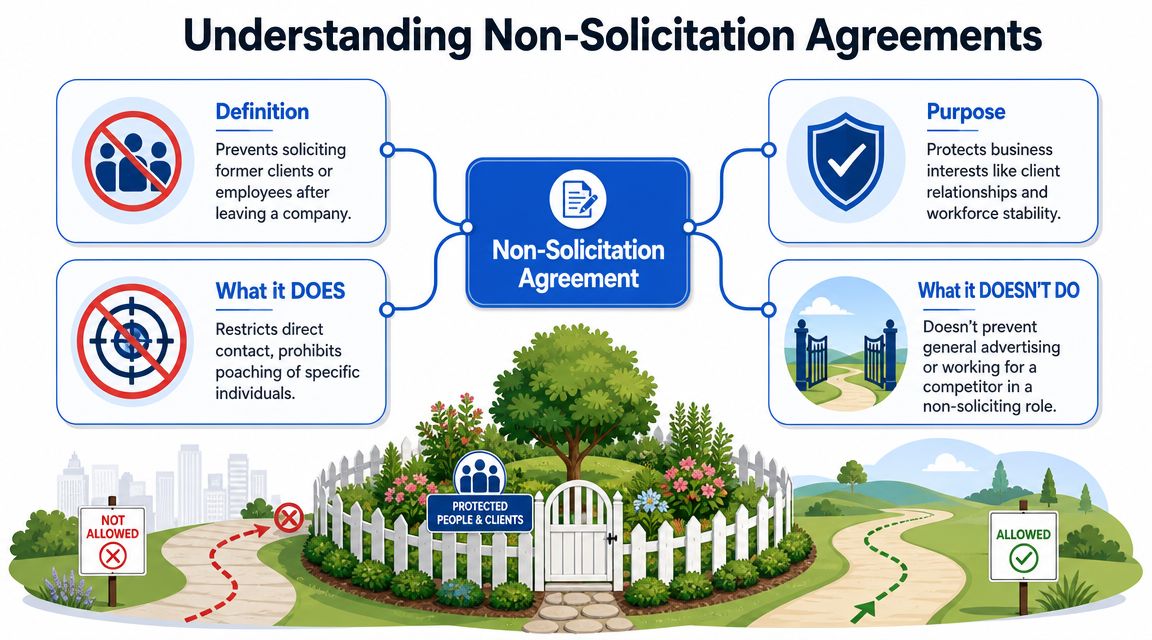
A non-solicitation agreement is a contract provision that restricts a departing worker from targeting defined customers, employees, or sometimes other business relationships after the working relationship ends. It's narrower than a non-compete. The former worker can usually still join or start a competing business, but can't use certain relationships as a launchpad.
That narrower structure is one reason these clauses are often treated more favorably than broader restraints. Employment-law guidance also notes that these agreements are commonly drafted to last about 6 months to 2 years to protect client and workforce relationships after a departure, as discussed in Butler Snow's analysis of non-solicitation covenants.
Two versions that matter most
Most companies use one or both of these:
- Customer non-solicitation. This restricts former personnel from contacting or targeting customers they served, managed, supported, or learned about through the company.
- Employee non-solicitation. This restricts efforts to recruit co-workers, direct reports, or team members to leave and join a new venture or competitor.
The easiest way to think about it is a focused garden fence. The fence doesn't lock someone on the property. It states they can't walk out carrying the company's prize roses.
What it does and what it doesn't do
A practical non-solicitation agreement usually does these things:
| Allows | Restricts |
|---|---|
| Working for a competitor | Directly targeting covered customers |
| Starting a new business | Recruiting covered employees to leave |
| General market participation | Using defined relationships for competitive advantage |
That last category is where founders often get tripped up. A clause that tries to ban “competition” in substance, while calling itself a non-solicit, may create the same legal problems as a badly drafted non-compete.
The strongest non-solicitation clauses read like a map of real business exposure, not like a punishment for leaving.
In practice, the agreement works best when it matches the employee's actual role. A senior account executive with deep customer ownership may justify customer restrictions. A manager with influence over hiring may justify employee non-solicitation. A junior worker with little relationship access usually doesn't justify broad restraints.
Key Elements and Modern Gray Areas
The hardest disputes rarely involve the label “non-solicitation.” They involve the word solicit. In 2026, that question often turns on digital behavior, not old-fashioned cold calls.
A useful starting point is precision. The clause should identify who is protected. “All customers” is often sloppy. A better draft narrows the protected group to customers the departing worker served, pitched, supervised, or learned confidential information about through the role. The same logic applies to employees. Restricting recruitment of every worker in the company, regardless of contact, tends to invite trouble.
Defining the protected relationships
A founder reviewing a clause should ask:
- Which customers are covered? Current customers only, or also former customers and active prospects?
- Which employees are covered? Direct reports, employees in the same department, or anyone at the company?
- What business context matters? Is the restriction tied to competing services, or is it written so broadly that it reaches unrelated activity?
These questions matter because the agreement has to tell a court, and the departing employee, what conduct is off-limits.
What counts as solicitation online
Modern disputes usually arise from LinkedIn, email, Slack, text messages, CRM exports, and social posts. The legal boundary is often less dramatic than founders expect. A simple LinkedIn employment update is usually not solicitation, but conduct beyond a plain announcement can cross the line. Enforceability often turns on the exact clause wording and on who initiated the contact, as explained in High Swartz's discussion of digital solicitation issues.
That means context drives the analysis.
A passive post saying someone has joined a new company is different from a sequence of direct messages sent to former clients. An updated email signature is different from a personalized note asking a former customer to move business. Responding to an unsolicited inbound message may be treated differently from engineering that outreach in the first place.
Here's a practical way to think about common scenarios:
| Conduct | Risk level |
|---|---|
| Plain LinkedIn job-change announcement | Lower |
| Direct message to former client inviting a meeting | Higher |
| General website biography update | Lower |
| Private outreach to former co-workers about joining new company | Higher |
Founders also need to align the non-solicit with operational paperwork. In remote and hybrid teams, legal review often breaks down because HR uses one onboarding packet, managers use another, and signatures live in scattered systems. Consolidating agreements with organized non-disclosure and HR forms can reduce version-control problems and make later enforcement less chaotic.
If a company can't quickly prove which version of the agreement was signed, by whom, and when, enforcement gets harder before the legal argument even begins.
Another gray area is indirect conduct. A founder's concern shouldn't stop at “Did the former employee send the message personally?” It should also include referral channels, coordinated introductions, and requests made through third parties. If the company cares about those behaviors, the contract should say so in plain terms.
Enforceability in Washington State and Beyond
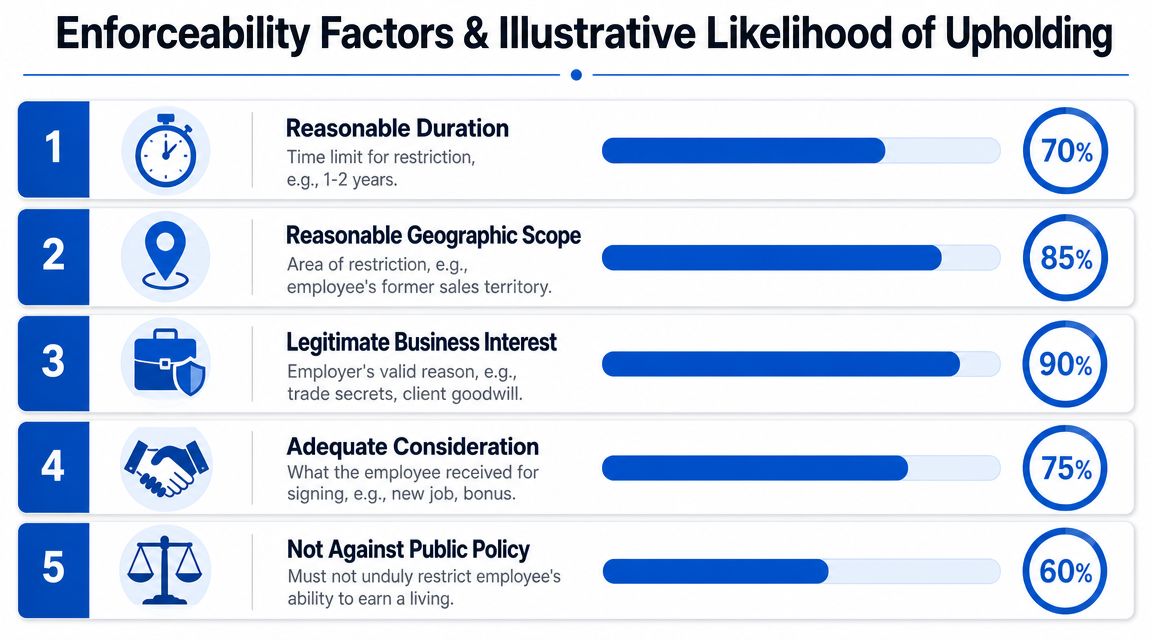
In Washington, enforceability usually comes down to two practical questions. Is the agreement protecting a legitimate business interest? And is it drafted with reasonable limits rather than broad, punitive language?
That framework matters even more because Washington businesses already operate against the backdrop of statutory limits on non-competes under RCW 49.62. A non-solicitation agreement isn't automatically valid just because it isn't labeled a non-compete. Courts and agencies look at substance. If the restriction effectively prevents someone from working in the market, the label won't save it.
To illustrate how legal scrutiny tends to work, the main factors usually include scope, duration, clarity, and fit with the employee's actual role.
Narrow tailoring still does the heavy lifting
The core drafting principle hasn't changed. A non-solicitation agreement is most enforceable when it's narrowly designed to protect a legitimate business interest and limited to customers the worker directly contacted, rather than functioning as a broad restraint on competition, as outlined in PandaDoc's overview of non-solicitation enforceability.
For Washington employers, that means a clause should usually answer four points clearly:
- Who is protected. Named categories should be knowable and tied to real exposure.
- What conduct is barred. “Solicit,” “recruit,” and similar terms should have workable definitions.
- How long the restraint lasts. The company should be able to justify the period selected.
- Why the business needs it. Customer goodwill, workforce stability, and confidential relationship information are common examples.
A judge reading the agreement should be able to see the business logic without rewriting the contract.
Federal labor scrutiny changed the risk analysis
The bigger shift for 2026 is that enforceability isn't only about reasonableness anymore. It's also about labor-law risk.
Recent developments show a more aggressive stance toward employee-facing restrictions. The NLRB has drawn increased attention to whether non-solicitation provisions for non-supervisory employees could chill protected activity, and an ALJ in J.O. Mory, Inc. found certain provisions unlawful under the NLRA using the Stericycle framework, as discussed in Felhaber Larson's analysis of the NLRB's expanding scrutiny.
That matters for Washington employers with broad handbook language, standardized offer letters, or one-size-fits-all agreements. A restriction aimed at stopping competitive poaching can create separate exposure if it also appears to interfere with protected employee communications or organizing activity.
This video gives useful background on restrictive-covenant concepts and enforcement dynamics:
The 2023 and California signal founders should notice
The policy direction has also become more nuanced. In 2023, several legal developments distinguished non-solicitation agreements from broad non-compete bans. One prominent example is California's SB 699, effective January 1, 2024, which voided non-compete agreements but explicitly left employee non-solicitation agreements outside that ban, as noted in Mintz's year-in-review of laws affecting employee non-competition and non-solicitation. The same source cites Federal Reserve Bank of Minneapolis reporting that 11.4% of adult workers in the 2022 SHED data had non-competes, with higher rates in professional services (19.2%) and finance (18.2%) than in public administration (4.7%).
For Washington founders, the takeaway isn't “copy California.” It's that lawmakers and regulators increasingly distinguish between broad restraints on work and narrower protections for relationship-based business interests. That distinction creates opportunity, but only for careful drafting.
Drafting an Effective Non-Solicitation Clause
Bad non-solicitation clauses usually fail in predictable ways. They cover too many people, define nothing, and read like the company wanted every possible advantage in every possible scenario. Good clauses do the opposite. They limit the restraint to the actual risk.
A strong draft starts with business facts, not legal templates. Which relationships matter enough to protect? Which employees truly influence those relationships? What communication methods create practical enforcement issues in a remote workforce? The clause should answer those questions directly.
What a workable clause should include
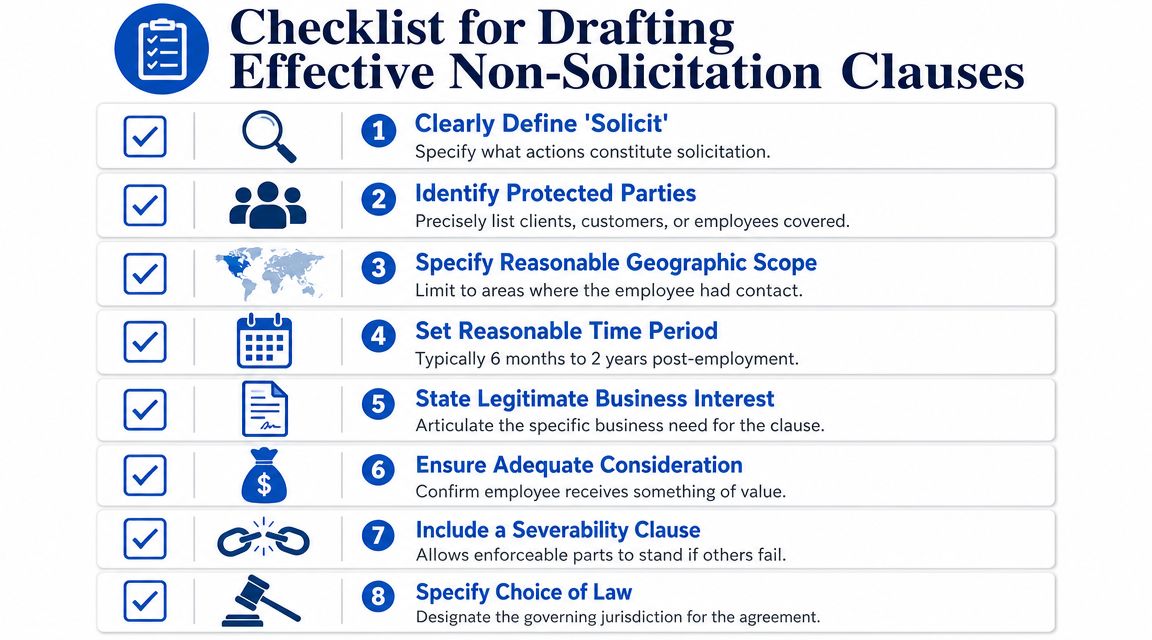
A draft is usually stronger when it includes:
- A precise definition of covered customers. Limit the scope to customers or accounts the worker contacted, serviced, managed, or learned confidential details about.
- A realistic employee group. Restrict recruitment of employees the person supervised, worked with closely, or had reason to influence.
- A clear definition of prohibited conduct. State whether the clause covers direct outreach, indirect outreach through others, or targeted digital contact.
- A fixed post-employment period. The duration should connect to the company's legitimate need to stabilize relationships after departure.
That approach tracks the basic rule that a non-solicitation agreement is most enforceable when it's narrowly designed for a legitimate business interest and limited to customers the worker had contact with, rather than broad competition restraints, as summarized in the earlier-cited PandaDoc guidance.
Sample clause with annotations
Below is a practical example, not a one-size-fits-all form:
For a period of twelve months following the end of Employee's employment, Employee will not, on behalf of Employee or any other person or entity, directly solicit any customer of the Company with whom Employee had material business contact during the last twelve months of employment for the purpose of providing services that compete with those offered by the Company.
Why this works better than a generic version:
- “For a period of twelve months” gives the court a concrete, reviewable limit.
- “Directly solicit” is narrower than vague bans on “interference” or “competition.”
- “Any customer… with whom Employee had material business contact” ties the restriction to known relationships, not the whole market.
- “For the purpose of providing services that compete” reduces the chance that unrelated conduct gets swept in.
A separate employee non-solicitation clause should be drafted independently, not stapled on as an afterthought.
Common drafting mistakes
A founder reviewing a contract should flag these quickly:
| Red flag | Why it causes trouble |
|---|---|
| “All company clients” | Too broad and often unknowable |
| No definition of solicit | Invites disputes over ordinary communication |
| No role-based tailoring | Looks detached from legitimate business need |
| One clause for every employee | Ignores different levels of exposure |
For businesses building a broader contract system, essential contracts for business owners can help place non-solicitation terms in context with confidentiality, IP, and service agreements.
Negotiation Strategies and Strategic Alternatives
Not every company should insist on a non-solicitation agreement in every hire. Sometimes the better strategy is a narrower clause. Sometimes it’s a different tool entirely.
That’s especially true in Washington’s startup and tech market, where overly aggressive restrictions can hurt recruiting, create internal distrust, and still fail under scrutiny. The smarter move is often to calibrate the agreement to the role and pair it with other protections.
Employer and employee negotiation positions
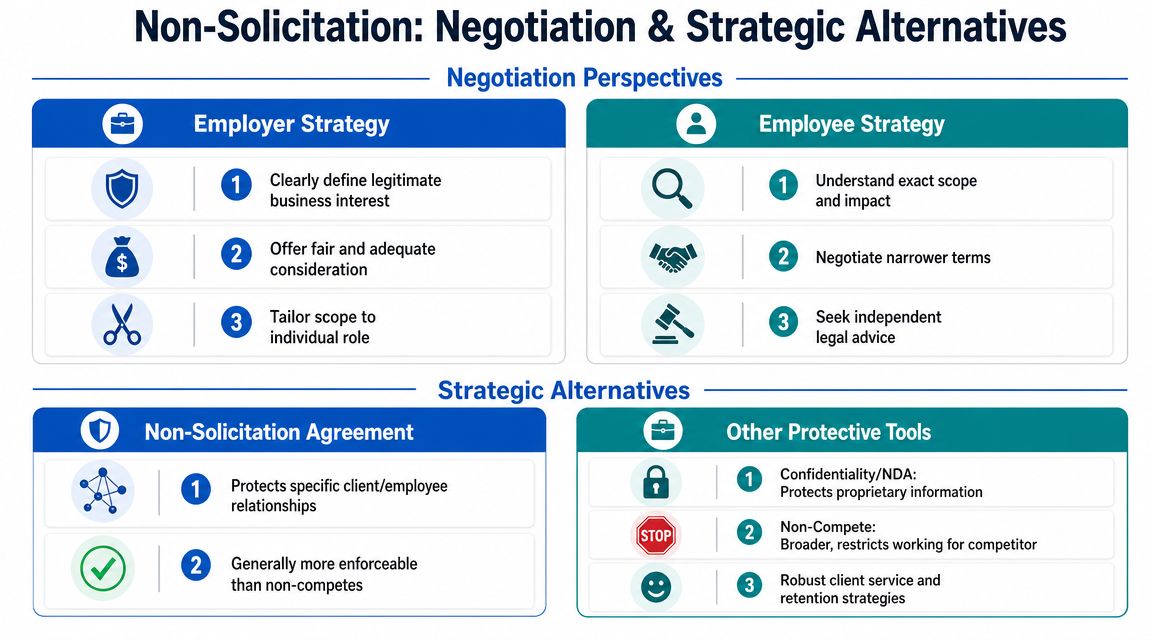
Employers usually improve their position when they present the clause as a specific protection for relationships the business invested in, not as a blanket anti-competition measure. Employees usually improve their position by forcing precision.
A practical negotiation checklist looks like this:
- For the employer. Tie the restriction to customer goodwill, workforce stability, and access level.
- For the employee. Ask which customers or employees are covered and how solicitation is defined.
- For both sides. Confirm whether digital outreach, inbound contact, and public social posts are addressed expressly.
For readers who want a broader commercial lens on process and negotiating strength, these tips for negotiating contracts offer a useful framework for narrowing disputes before signature.
When another tool may work better
A non-solicitation agreement protects relationships. It does not replace the rest of the legal stack.
Consider alternatives or complements such as:
- Confidentiality and NDA language. Useful when the primary concern is misuse of pricing, pipeline, code, data, or internal strategy.
- IP assignment clauses. Important where value comes from software, content, product design, or inventions.
- Operational retention strategies. Strong client service, account transitions, and team culture often reduce solicitation risk before lawyers are needed.
- Contractor-specific terms. Many Washington companies rely on consultants and fractional talent, which raises different classification and drafting issues than standard employment relationships. This legal guide to working with contractors in Washington State is useful when the worker relationship itself changes the contract analysis.
There’s also a broader policy point. Legal developments beginning in 2023 showed that lawmakers may distinguish non-solicitation agreements from broad non-compete bans, rather than treating all restrictive covenants the same, as covered in the earlier-cited Mintz discussion of California’s SB 699. That makes strategic tailoring more valuable than ever.
A company with disciplined confidentiality controls, clean offboarding, and targeted non-solicitation language is often in a better position than a company relying on one broad clause to do everything.
By Design Law Firm & Legal Consultancy, PLLC is one option Washington businesses use for drafting and negotiating business contracts that combine non-solicitation language with confidentiality, IP, and operational risk controls.
Enforcement and Remedies When an Agreement Is Breached
Once a breach appears, speed matters. Delay can weaken both the business position and the legal record.
The first practical step is usually documentation. Preserve emails, screenshots, CRM notes, Slack exports, customer reports, and internal witness accounts. The question isn’t only whether solicitation happened. It’s whether the company can prove who contacted whom, when it happened, and which contract language applies.
First moves after discovering a breach
A typical response path often looks like this:
- Confirm the contract record. Locate the signed agreement, amendments, and any later policies that affect interpretation.
- Assess the conduct quickly. Separate rumor from provable conduct. A customer following a person voluntarily may be treated differently from targeted outreach.
- Send a demand letter. A specific cease and desist letter can put the former worker and, in some cases, the new employer on notice.
- Consider emergency relief. If customer or employee poaching is active, counsel may evaluate a temporary restraining order or preliminary injunction.
What remedies are usually in play
If the company proves a breach, the available remedies often include court orders stopping further solicitation and monetary damages tied to actual business loss. Some agreements also include fee-shifting provisions, which can affect litigation strategy substantially.
Not every case should be filed. Some should be settled fast. Some should be used to send a clear signal internally and externally. Others are better handled through negotiated restrictions, customer outreach, or a transition protocol with the new employer. The right answer depends on proof, contract quality, and how much harm is still preventable.
Washington businesses don’t need the broadest possible restrictive covenant. They need one that fits the role, reflects current labor and regulatory realities, and gives the company a practical path to enforcement if a departure turns hostile. By Design Law Firm & Legal Consultancy, PLLC advises Seattle and Washington companies on drafting, reviewing, and enforcing business agreements that protect client relationships, teams, and confidential business assets without relying on overbroad language. Call our law offices today at (206) 593-1519.