A founder usually discovers trade secret risk at the worst possible moment. A lead engineer gives notice. A sales executive leaves for a competitor. A contractor asks for one more export of product documentation before the project ends. Nothing looks dramatic on the surface, but the company's real advantage often sits in exactly those files, prompts, datasets, roadmaps, customer notes, pricing logic, and source code repositories.
For startups and smaller technology companies, trade secret misappropriation isn't an abstract intellectual property issue. It's a business continuity issue. The “secret sauce” may be a machine learning workflow, a deployment playbook, a product design process, a specialized vendor list, or a customer acquisition model that took years to refine. If that information walks out the door or gets fed into the wrong tool, the damage can spread fast. Founders already dealing with security exposure should also understand how legal risk can overlap with broader breach claims, as seen in this discussion of the growing wave of data breach lawsuits.
Table of Contents
The Growing Threat of Trade Secret Misappropriation
A startup can lose more value from one quiet disclosure than from a failed launch. Trade secrets often include the materials a business relies on every day but rarely labels with enough discipline. Product specs in Notion, pricing models in Google Sheets, source code in GitHub, prompt libraries in ChatGPT Enterprise or other LLM tools, customer segmentation in HubSpot, and internal research in shared drives can all become part of the dispute.

The litigation trend shows this risk is expanding, not shrinking. According to a 2025 trade secret and restrictive covenant year-in-review, federal filings for trade secret cases in the first half of 2025 were up 15% versus the first half of 2024, and the same review reported an approximately 80% jump in “artificial intelligence” trade secret cases. For a founder, that matters because the dispute category is no longer limited to classic manufacturing espionage. It now reaches ordinary product development, hiring, vendor transitions, and AI-enabled workflows.
Why startups get exposed faster
Larger companies usually have friction built into their systems. Startups often don't. Speed creates blind spots:
Shared access expands too far: Early teams commonly give broad repository and drive access because everyone is building.
Documentation lives everywhere: Slack, Linear, Jira, Figma, Notion, email, and cloud storage each hold part of the company's know-how.
Vendor use scales before legal review: The business adopts AI tools, analytics tools, and contractors before it sets data handling rules.
Employee exits happen mid-sprint: Offboarding gets treated like an HR task instead of an IP protection event.
Practical rule: If a company can't identify its crown-jewel information within a few hours, it probably can't prove later that it treated that information like a trade secret.
Trade secret misappropriation becomes expensive because it often starts with routine operational shortcuts. What works is early classification, narrower access, and contracts tied to the systems people use. What fails is assuming that “everyone knows this is confidential” will hold up when a dispute turns hostile.
What Qualifies as a Protectable Trade Secret
A founder approves a new AI workflow, the team feeds internal data into it, and six months later the company is in a dispute over whether that data was ever protected in the first place. That fight often turns on a narrower question than people expect. The issue is not whether the information felt confidential inside the company. The issue is whether it meets the legal standard for a trade secret and whether the company treated it that way before anything went wrong.
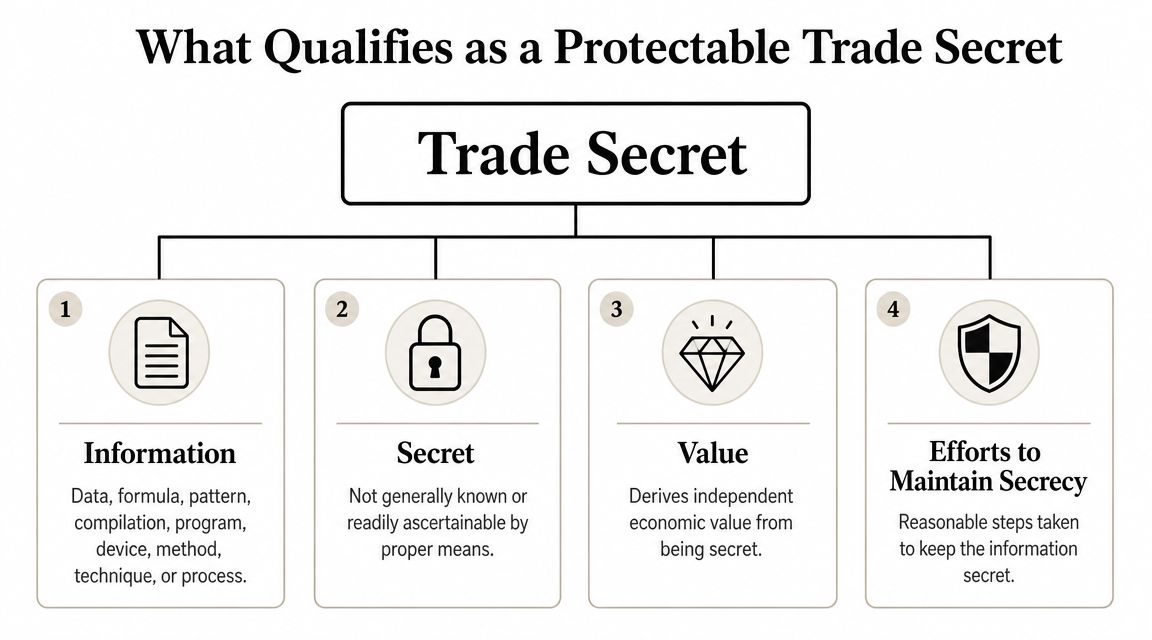
Trade secret protection usually rests on three points. The information is not generally known or readily ascertainable by proper means. It has independent economic value because it remains secret. The business uses reasonable measures to keep it secret. Those are the core elements reflected in the Uniform Trade Secrets Act and discussed by the Legal Information Institute's overview of trade secret law.
For startup leaders, that means a trade secret is often less about a single brilliant idea and more about a specific implementation. The protectable asset may be a training-data selection method, an internal evaluation rubric for model outputs, a pricing logic engine, a customer renewal scorecard, or a technical workflow spread across code, prompts, and internal documentation. For a broader view of how these assets fit into an IP strategy, see protecting intellectual property for growing companies.
The three core elements
| Element | What it means in practice | Common startup example |
|---|---|---|
| Secrecy | The information is not generally known or easy to figure out through lawful means | Internal model tuning methods, private API architecture, unreleased pricing strategy |
| Economic value | The secrecy gives the company a business advantage | A customer qualification framework that shortens enterprise sales cycles |
| Reasonable secrecy efforts | The company took real steps to control access and use | Role-based permissions, NDAs, labeling, limited exports, tracked offboarding |
The third element decides many cases. Courts do not expect perfection, especially from smaller companies. They do expect evidence of deliberate controls. If a startup stores sensitive material in open drives, leaves contractor access in place, or allows employees to paste proprietary material into public or poorly governed AI tools, it becomes harder to argue later that the information was treated as a trade secret.
What usually qualifies and what usually does not
Founders often overestimate protection for information that is merely internal and underestimate protection for curated know-how that creates real advantage.
Usually stronger candidates
Source code and system design: A proprietary implementation, architecture decision, or deployment method that is not public.
Customer and market compilations: A database built from internal experience, including contacts, buying patterns, pricing history, objections, and renewal timing.
Operational methods: Fraud detection rules, QA workflows, manufacturing methods, sales playbooks, or prompt libraries tied to measurable business results.
AI workflow assets: Fine-tuning approaches, retrieval structures, private evaluation datasets, and internal guardrail logic, if they are kept confidential.
Usually weaker candidates
General skill and experience: What an engineer, salesperson, or operator learned by working in the field.
Public or obvious information: Published features, marketing claims, public documentation, or material that a competitor can reverse engineer without improper conduct.
Poorly controlled internal material: Files available to the whole company by default, documents sent to personal accounts, or data shared with vendors without clear restrictions.
A useful test is practical. If the company cannot identify who had access, why they had access, and what rules applied to that information, trade secret protection gets much harder to prove.
Reasonable efforts are where legal theory meets operations
Reasonable efforts should match the risk and the stage of the company. A ten-person startup does not need the same controls as a public company. It does need a system that shows intent and discipline.
That usually includes classifying sensitive information, limiting access by role, using confidentiality terms in employment and contractor agreements, marking high-value materials, controlling downloads and exports, and shutting off access cleanly when people leave. For tech companies, it also means reviewing how AI tools, cloud vendors, and collaboration platforms handle submitted data. A privacy setting buried in an admin panel can affect whether the company kept control over its own know-how.
A court will look at those facts later. Investors, acquirers, and counterparties will too.
Information becomes a protectable trade secret because the company built value into it and preserved its secrecy through ordinary, repeatable controls. Without those controls, the argument weakens fast.
Defining Trade Secret Misappropriation Under Law
A founder hires a senior engineer from a competitor. In the first week, that engineer drops a pricing model, a customer migration checklist, and a set of architecture notes into the team workspace and says, “This will save us months.” That is where trade secret misappropriation problems often start. Not with a break-in, but with information that arrives too easily and gets used too quickly.
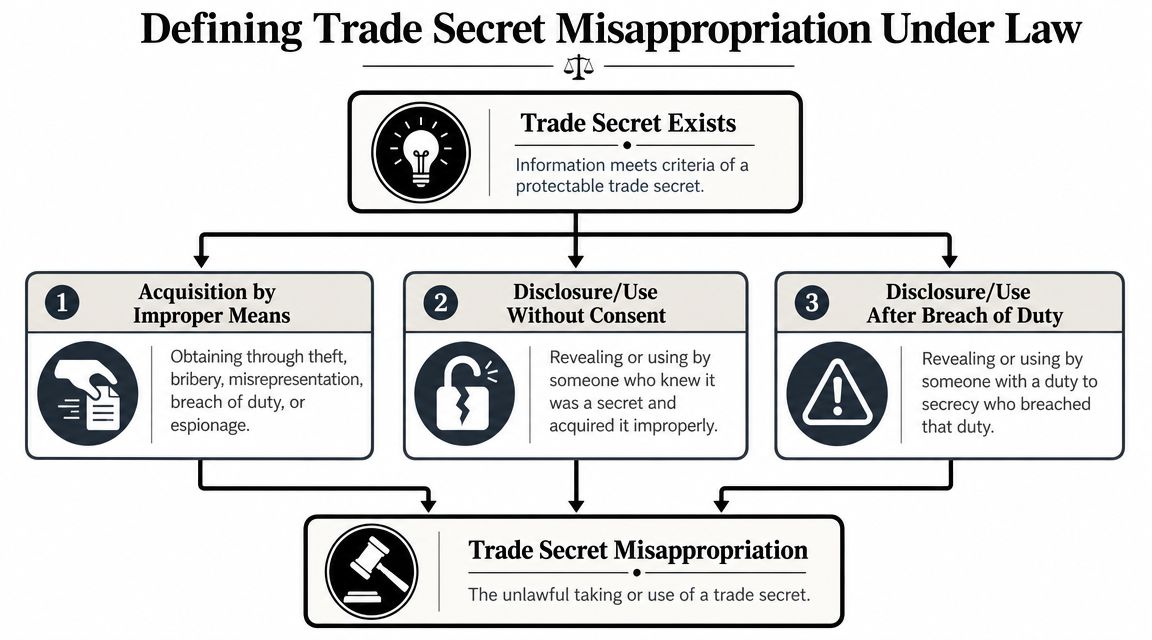
Under U.S. trade secret law, misappropriation usually falls into three buckets: improper acquisition, unauthorized disclosure, and unauthorized use. The concept also reaches recipients who knew, or had reason to know, that the information came from a breach of confidence or other improper conduct. The legal rule matters because startups often create risk through speed, weak intake controls, and poor judgment at the edges, not through deliberate espionage.
The three forms of misappropriation
Improper acquisition
This covers getting trade secret information through theft, deception, unauthorized access, or a breach of duty. A few common startup examples are easy to miss: a new hire bringing over a former employer's internal playbook, a contractor retaining technical documents after the engagement ends, or a founder using credentials that should have been disabled after a partnership collapsed.Unauthorized disclosure
Disclosure does not require a public leak. It can happen when someone shares protected information with a person or system that was not authorized to receive it. Sending source code to a vendor outside the approved process, forwarding confidential files to a personal email account, or uploading internal documents into a third-party AI tool without approved terms can all create disclosure exposure.Unauthorized use
Use is usually the hardest issue in practice. A person may never download a file and still use another company's confidential methods, product decisions, training data, or customer-specific knowledge to speed up development or sales. In litigation, this is often where facts get messy and where internal messages, version history, and product timelines start to matter.
The Uniform Trade Secrets Act, which many states have adopted in some form, and the federal Defend Trade Secrets Act both frame misappropriation around those concepts. The Legal Information Institute's summary of the federal statute reflects the same structure and is a better legal reference point than shorthand descriptions founders often hear in business settings: 18 U.S.C. § 1839 definitions.
Why “should have known” creates startup risk
The “should have known” standard changes the analysis for growth-stage companies. If a sales leader joins with oddly detailed competitor pricing logic, or a machine learning hire imports labeled datasets with unclear provenance, the company cannot treat that as somebody else's problem. A court may ask whether the business ignored obvious warning signs.
That is why intake discipline matters. Companies should ask where sensitive material came from, whether any prior employer restrictions apply, and whether the team can build the same result from clean-room work, public information, or its own records. If those questions are not asked early, the business may spend far more on forensic review and injunction practice later.
Federal and state law usually intersect
For Washington startups and SMBs, these disputes often raise both federal and state issues at the same time. The Defend Trade Secrets Act creates a federal claim. State trade secret statutes and related contract or fiduciary duty claims may travel with it. That affects where the case is filed, how fast emergency relief is sought, what evidence needs to be preserved, and how carefully the company should communicate internally once suspicion arises.
I often tell founders to slow down for one hour before they act. Preserve logs. Lock relevant accounts. Stop casual Slack speculation. Do not accuse an employee or competitor before counsel can assess what facts exist.
Operational takeaway: The core legal question is usually whether the company acquired, disclosed, or used protected information through improper means or under circumstances that should have triggered caution.
AI tools create a modern disclosure and use problem
AI workflows have narrowed the gap between ordinary employee behavior and a trade secret incident. A developer pastes proprietary code into a coding assistant. A product team uploads roadmap documents into a model that allows provider-side retention. A marketing lead asks a public chatbot to rewrite win-loss notes that include customer-specific strategy. Each act may look harmless in isolation. Legally, each one can raise disclosure, retention, and downstream use issues.
The World Intellectual Property Organization has discussed trade secret disputes involving AI-related confidentiality and evidentiary problems, including risks tied to system design, data handling, and later proof issues in litigation, in its guide on trade secrets and innovation: WIPO guide to trade secrets in litigation.
The business point is straightforward. If your team uses AI systems, your trade secret policy has to cover approved tools, prohibited inputs, retention settings, vendor terms, and logging. Otherwise, “we were experimenting” becomes an expensive fact pattern.
Common Scenarios and Costly Real-World Examples
The most common trade secret cases don't begin with a dramatic break-in. They usually begin with ordinary business movement. Someone leaves. A deal collapses. A vendor relationship ends badly. A company rushes a product launch after gaining access to another company's confidential material.
Four patterns that show up repeatedly
A departing employee is still the classic trigger. The engineer syncs repositories before resigning. The sales lead exports CRM notes. The product manager takes strategic planning documents to “keep context” for the next role. Each action may look defensible in isolation. Together, they can form the core of a misappropriation claim.
A co-founder split can be worse because ownership lines were often left blurry from the start. If the founders built the product through shared personal devices, mixed accounts, and informal agreements, the later fight becomes less about obvious theft and more about who had rights, what duties existed, and what information was confidential.
Vendor disputes create a different problem. The startup often shares sensitive data for legitimate business reasons, then discovers that the contract didn't limit downstream use, AI training, subcontracting, or retention after the work ended. That isn't just a contract issue. It can become trade secret misappropriation if the facts support improper use or disclosure.
Then there's the accelerated launch scenario. A company hires talent from a rival, gains access to sensitive information, and releases a suspiciously similar product faster than expected. Courts often look closely at timing, access, and surrounding conduct.
A fast product launch after exposure to a competitor's confidential information can become powerful circumstantial evidence, even when there isn't a neat confession in email.
The Insulet and EOFlow verdict
A recent example shows how severe the exposure can become. In a 2025 decision, a jury found that EOFlow had willfully and maliciously misappropriated Insulet's medical-device trade secrets, awarding $170 million in disgorgement of profits and an additional $282 million in punitive damages, for a total of $452 million, according to McGuireWoods' 2025 trade secret litigation summary.
That verdict matters for startups for two reasons.
First, it shows that trade secret damages can move far beyond a narrow estimate of what was copied. A case can expand into disgorgement, punitive exposure, and injunctive consequences that threaten the business itself.
Second, it shows why founders shouldn't rely on the idea that only “clear theft” creates liability. The evidence in these cases is often cumulative. Access records, suspicious timing, internal messages, product development milestones, and witness credibility can shape the outcome.
What works in practice is prevention before personnel movement, vendor turnover, and AI adoption create evidentiary messes. What doesn't work is trying to invent a secrecy program after someone has already left with the files.
Your Proactive Defense A Step-by-Step Prevention Plan
Founders don't need a sprawling legal manual. They need a system that fits the way the company builds, sells, and shares information. The strongest trade secret program is usually the one the team will follow during a busy release cycle.
A useful companion issue is confidentiality drafting in regulated and AI-sensitive environments, especially where overbroad or outdated provisions can create problems. This discussion of the SEC's scrutiny and modern NDA drafting concerns is a helpful reminder that old templates rarely fit current workflows.
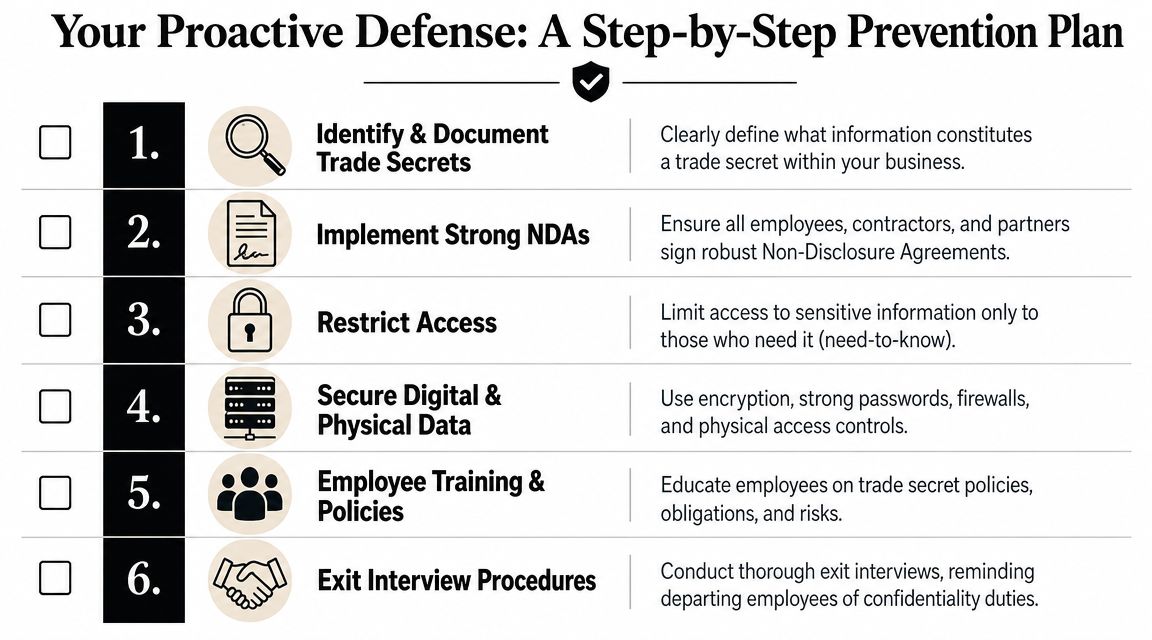
Start with a real trade secret inventory
Most startups skip this step because it feels slow. It saves time later.
Create a list of the company's crown-jewel information. Not every internal file belongs on it. The inventory should focus on the information that gives the business an economic edge because others don't have it.
Examples often include:
Technical assets: Source code, data pipelines, model tuning methods, infrastructure diagrams, unreleased product features
Commercial assets: Customer lists with buying history, pricing logic, deal terms, target account strategy
Operational assets: Supplier relationships, manufacturing methods, QA processes, fraud detection rules
For each item, record where it lives, who needs access, what contracts govern it, and what would happen if it leaked. If that sounds tedious, that's exactly why it works. It forces precision.
Use contracts that match how the business actually operates
A startup often has NDAs, employee agreements, and contractor terms. The issue is usually not absence. It's mismatch.
Some companies use a strong employee confidentiality agreement but weak vendor terms. Others protect code ownership but say nothing about prompts, model inputs, analytics exports, or subcontractor access. The contract set should line up with its tool stack and outsourcing model.
A practical contract baseline includes:
Employee agreements that clearly define confidential information and post-employment obligations
Contractor and vendor agreements that restrict use, retention, disclosure, and further sharing
Invention assignment provisions where appropriate
AI-related provisions addressing tool inputs, logging, training restrictions, and approval rules where needed
This video offers a practical overview of protective measures businesses should consider:
Build controls around systems people already use
A policy that lives in a PDF nobody reads won't help much. Controls should attach to actual systems such as Google Workspace, Microsoft 365, Slack, GitHub, AWS, Azure, Figma, Jira, Notion, Dropbox, and CRM tools.
A sensible baseline usually includes:
| Control | Why it matters | Where founders often miss |
|---|---|---|
| Need-to-know access | Limits internal spread and supports the secrecy showing | Founders give broad admin rights “temporarily” and never clean them up |
| Confidentiality labels | Helps prove the company treated the information as sensitive | Teams assume verbal understandings are enough |
| Password and permission controls | Reduces casual access and evidences restriction | Shared accounts and reused credentials |
| Download and export limits | Important during departures and vendor transitions | No alerts for unusual copying or forwarding |
| Approved AI tool rules | Reduces accidental disclosure through prompts or uploads | Staff use public tools outside procurement and security review |
What works: narrow access, clean logs, consistent labeling, and documented approvals.
What fails: shared folders named “final-final,” personal device sprawl, and undocumented exceptions.
Train for actual behavior not policy theater
Annual legalese-heavy training rarely changes conduct. Teams need short, specific rules tied to real situations.
Good training covers the moments when misappropriation happens:
Before hiring from competitors: Tell managers what candidates should not bring or discuss.
During vendor onboarding: Explain what may and may not be shared.
When using AI tools: Define approved uses and prohibited inputs.
At employee exit: Reconfirm confidentiality duties and recover devices, credentials, and external storage.
The goal isn't fear. It's consistency. If the company can show that it identified sensitive information, restricted access, used contracts, trained personnel, and enforced offboarding, it is in a much stronger position both to prevent misuse and to act when misuse occurs.
Responding to a Suspected Misappropriation Incident
Once a company suspects trade secret misappropriation, speed matters. So does restraint. Leaders often make the situation worse by confronting the wrong person too early, allowing systems to overwrite logs, or launching an informal investigation that destroys privilege and muddies the timeline.
Preserve first then investigate
The first move is preservation. Lock down laptops, cloud accounts, access logs, email records, messaging history, device records, and relevant repositories. Don't let ordinary retention settings clean up the evidence before counsel and forensic professionals can review it.
A founder dealing with this kind of event should think in parallel with broader incident response discipline, including the operational steps outlined in this data breach response planning checklist for Seattle businesses.
According to this discussion of remedies and forensic preservation in technology leakage disputes, to secure remedies, a plaintiff must connect the misappropriation to a measurable harm, and courts may order the destruction or return of files, materials, and even products made from misappropriated secrets. That's why logs showing access, copying, forwarding, device transfers, and post-employment activity are so important from the start.
Define the legal theory early
Not every suspicious event is the same. The company should identify what it believes happened.
Was there improper acquisition, unauthorized disclosure, unauthorized use, or some combination? What specific trade secret is at issue? What duty attached to the person or vendor involved? Which systems show access and movement? Where is the measurable business harm likely to appear?
That discipline matters because legal remedies depend on causation. If the company can't tie the conduct to downstream use, competitive harm, or unjust gain, the case gets harder quickly.
Communicate with precision
The instinct to send an angry cease-and-desist within hours is understandable. It's not always wise. A rushed letter can overstate claims, misidentify the information, or trigger defensive deletion and escalation.
A stronger response usually includes:
A controlled legal hold: Preserve internally before accusations start flying.
A scoped forensic review: Determine what moved, when, and by whom.
Targeted outreach: Send communications that identify duties and demand preservation without guessing at facts.
Decision-making on escalation: Consider injunctions, negotiated return protocols, vendor demands, or litigation depending on the evidence.
The first question isn't “How fast can the company threaten suit?” It's “What evidence exists today that may not exist next week?”
The companies that respond best are methodical. They secure evidence, define the theory, quantify harm, and then act.
Building a Lasting Culture of Confidentiality
A strong trade secret program isn't built from one NDA or one security setting. It comes from repeated business choices. The company decides what matters, limits access to it, documents those limits, and reacts quickly when something goes wrong.
That culture starts at the top. If founders casually paste confidential content into outside tools, tolerate shared logins, or ignore offboarding gaps, the rest of the company will do the same. If leaders treat confidential information as a managed asset, the team usually follows. The legal standard around reasonable secrecy measures ends up looking a lot like good operational hygiene.
What a durable culture looks like
A healthy confidentiality culture is visible in ordinary workflow:
Product teams know which design and code materials are restricted
Sales teams understand that CRM exports and pricing logic are not personal assets
Operations teams control vendor access and retention
Managers know how to onboard talent from competitors without inviting contamination
Executives review AI adoption with confidentiality consequences in mind, not just efficiency promises
This approach does more than reduce litigation risk. It protects valuation. Buyers, investors, and strategic partners want to know whether a company can identify and defend the information that makes it special. A startup that can answer that question clearly is easier to diligence and harder to undermine.
Confidentiality is not just a legal shield. It is part of how a serious company proves that its advantage is real, managed, and worth paying for.
Trade secret misappropriation will remain a live issue for startups because modern businesses create value in information, not just in physical assets. The companies that handle that reality well don't wait for a dispute to become organized. They build the discipline earlier, when it still feels optional.
By Design Law Firm & Legal Consultancy, PLLC helps startups and established businesses put practical legal structure around growth, innovation, and risk. For companies that need help identifying protectable trade secrets, tightening confidentiality agreements, reviewing AI-related disclosure risks, or responding to a suspected misappropriation event, By Design Law Firm & Legal Consultancy, PLLC offers business-focused counsel designed for real operating environments.