A Washington startup founder often sees “SSN trace” for the first time during hiring, right when speed starts colliding with compliance. A background screening vendor lists it near the top of the package. The term sounds official. It also sounds broader than it is.
That gap matters. Many business owners assume an SSN trace is a government identity verification, a criminal check, or a credit report shortcut. It isn't. Used correctly, it helps a business target later searches and catch obvious mismatches early. Used carelessly, it can trigger bad hiring decisions, dispute headaches, and Fair Credit Reporting Act problems that were avoidable from the start.
For Washington businesses, the risk is even more practical. Federal screening rules already require disciplined disclosures, consent, and adverse action procedures. State and local law can add another layer, especially if the company is hiring in Seattle. Founders who understand the tool before they use it usually build cleaner workflows, ask better questions of screening vendors, and avoid treating a preliminary data point like proof.
Table of Contents
Your First Hire and the SSN Trace Question
A common Seattle founder scenario looks like this. The company is finally ready to bring on a first operations lead, engineer, or sales hire. Offer terms are moving, onboarding is being drafted, and the background screening vendor sends over a menu that includes an SSN trace.
The founder's first instinct is usually practical. What exactly is this checking, and is it worth using? The wrong instinct is to assume the trace answers bigger questions than it does.
For an early-stage business, that misunderstanding creates real exposure. If the founder treats the trace like identity proof, or worse, like a basis to reject an applicant without a proper process, the company can drift into a compliance problem before it has even built an HR function. That risk grows when hiring is rushed, delegated informally, or mixed into contractor onboarding without clean paperwork. Founders sorting out workforce classification issues often run into similar process gaps when they haven't built a reliable legal workflow, which is why many start with guidance on working with contractors in Washington State.
A founder's real question isn't technical
The practical question isn't “what database does this vendor use?” The practical question is whether the tool helps the company hire fairly, investigate responsibly, and stay within the rules.
An SSN trace can help with that. It can also be overread.
Practical rule: If a screening item sounds like identity verification, ask whether it actually verifies identity or only helps locate other records.
That distinction is where many startups get tripped up. A founder sees a mismatch in names or addresses and assumes dishonesty. Sometimes that instinct is justified. Sometimes the applicant changed names, moved often, had inconsistent data reported by third parties, or appears in fragmented commercial databases.
What the business needs from the start
A Washington business using background reports needs a basic discipline before ordering anything:
Know the purpose: Is the report for employment, tenancy, or another lawful use?
Know the limit: An SSN trace is an opening screen, not the conclusion.
Know the process: Disclosure, authorization, and adverse action rules apply when the report is part of consumer screening.
The founder who gets those three points right usually avoids the most expensive mistakes.
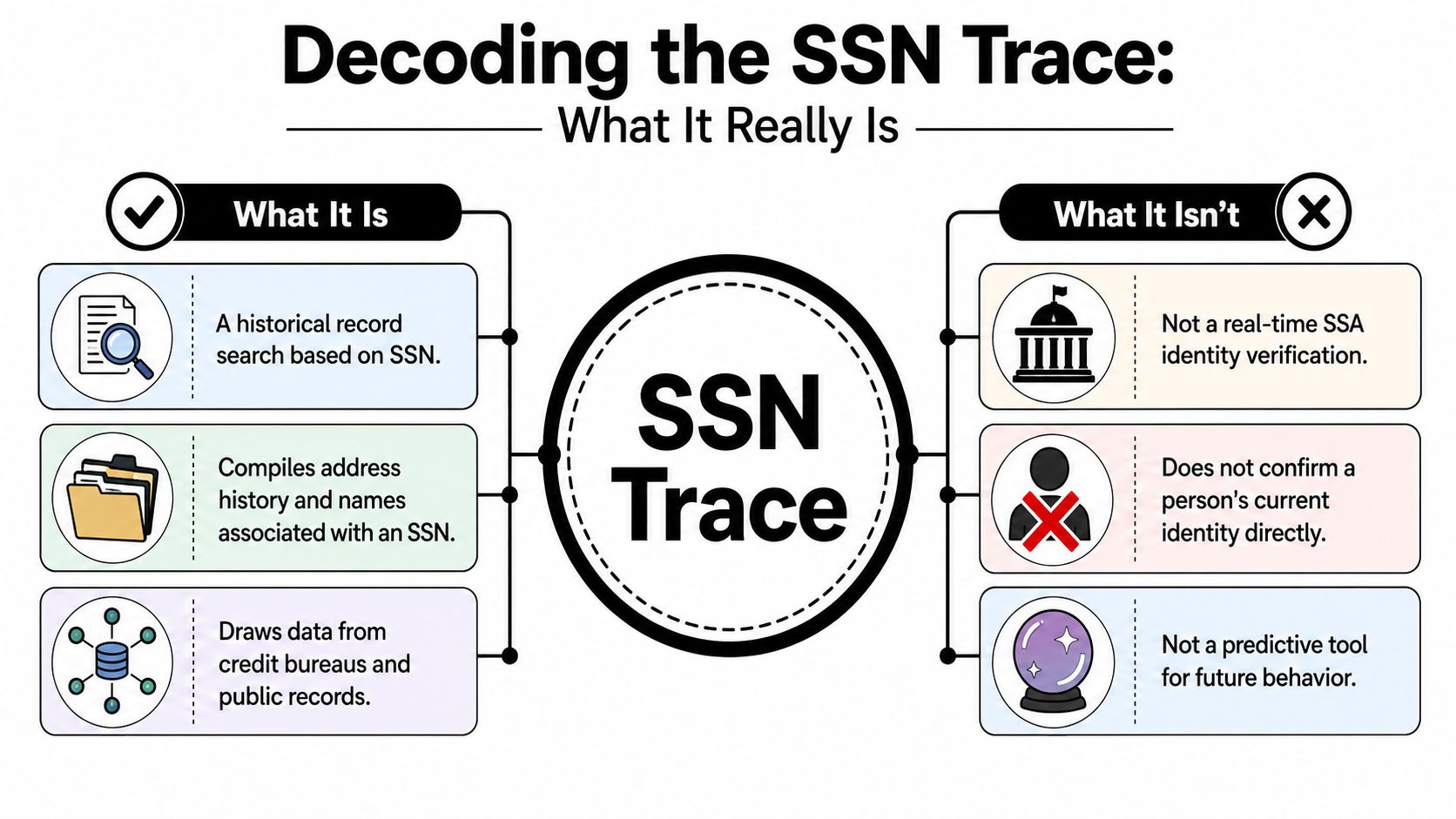
Decoding the SSN Trace What It Really Is
An SSN trace is best understood as a pointer search. It links a reported Social Security number to identity-related records found in commercial databases, then uses those links to help decide where further searches should be run. It is foundational, but it isn't the background check itself.
Historically, the Social Security number became firmly embedded in U.S. record systems after the Social Security Act of 1935, and the Social Security Administration had issued more than 450 million original SSNs by December 2008 according to the SSA's historical review of SSN use. That broad adoption is why SSN-based searches became useful as an identity-linking tool in the first place.
Why the term misleads founders
The phrase sounds more official than the product is. An SSN trace is not a real-time match against the Social Security Administration for hiring purposes. It also doesn't directly pull criminal records, verify that the applicant is the true owner of the number, or operate like a predictive risk tool.
A better analogy is a digital change-of-address history built from scattered commercial records. Screening providers commonly describe it as drawing from aggregated records tied to credit headers, utilities, schools, lending institutions, and similar sources. If a founder wants a broader legal perspective on how companies use and buy identity-linked data, Washington's growing scrutiny of that ecosystem makes the state's focus on data brokers worth following.
What data usually comes back
In practical use, an SSN trace commonly returns a handful of fields that matter because they expand the search footprint. A screening provider may return:
| Returned field | Why it matters to the business |
|---|---|
| Associated names and aliases | Helps reduce missed records when a person has used multiple names |
| Address history | Helps determine which counties or states should be searched |
| Issue year or issue date | Can flag an inconsistency that needs review |
| State of issuance | May appear as a data point in provider results |
| Validity or status indicator | Helps identify obvious data problems before deeper screening |
One industry source notes that an SSN trace often looks back about 3 to 7 years and is used as a preliminary step rather than a final decision tool, as explained in iProspectCheck's overview of SSN trace results and common data sources.
The trace doesn't answer “should this person be hired?” It answers “where else should the business look, and does the data line up well enough to continue?”
That makes the tool useful, but only if the company keeps its role narrow. A disciplined screening process treats the trace as intake intelligence. It doesn't treat it as proof.
Legitimate Business Uses for an SSN Trace
A business shouldn't order an SSN trace because it's available. It should order one because the trace serves a specific function in a larger screening workflow.
Where it earns its place in hiring
In employment screening, the trace is most useful at the front end. It can surface address history and alternate names so the screening company knows which jurisdictions to search for county records. That lowers the chance of running a search that is technically complete but practically too narrow.
It also helps with fraud detection and data quality control. When a trace returns names, issue information, or address history that sharply conflict with the applicant's submission, that creates a risk signal. As explained in Yardstik's discussion of SSN trace risk signals, an issue year that predates the applicant's birth year can indicate identity misuse.
That doesn't mean the applicant committed fraud. It means the file needs review before anyone makes a decision.
Other lawful business contexts
Employment isn't the only context where businesses use the tool. SSN traces also appear in:
Tenant screening: Landlords and property managers may use the trace to connect an applicant to prior names and addresses before other checks are run.
Locating individuals: In some lawful business or legal settings, the same identity-linking logic helps support skip tracing or service-related efforts.
Internal quality control: Screening teams use trace mismatches to catch typos, transposed digits, and identity confusion before deeper reports are ordered.
Each use shares one feature. The trace is a routing tool.
What works and what doesn't
What works is using the trace to sharpen the next search. What doesn't work is taking a mismatch at face value and treating it like a verdict.
A startup hiring a remote employee in Washington, Oregon, and California might see several historical addresses tied to one SSN. That is exactly where the trace has value. It tells the business that a single current address isn't enough for downstream searches.
What doesn't work is a manager seeing an unfamiliar alias and deciding the applicant “must be hiding something.” Name variations can arise from marriage, divorce, inconsistent reporting, data entry errors, or record aggregation problems. A compliant process asks questions and verifies. It doesn't guess.
Navigating the Legal Guardrails FCRA and Washington Law
The legal issue isn't whether an SSN trace is useful. The legal issue is how the business uses it.
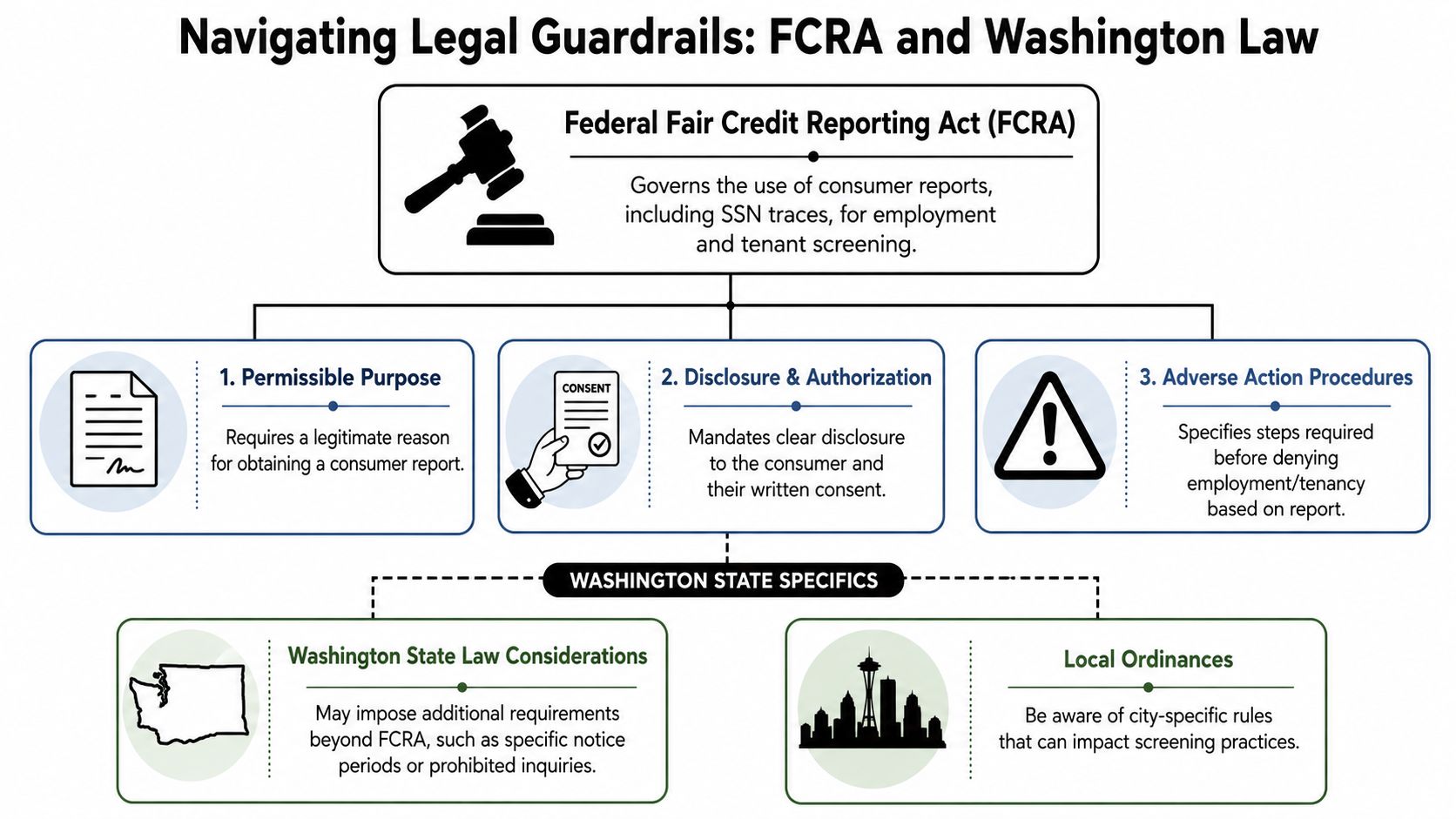
For employment and tenant screening, an SSN trace usually sits inside a consumer report process governed by the Fair Credit Reporting Act. That means the business cannot treat it as casual internet research or an internal hunch. It is regulated workflow.
The federal rules that matter first
At a minimum, a business using a consumer reporting agency for screening should build around three federal requirements:
Disclosure and authorization. The applicant needs a clear disclosure that a background report may be obtained, and the business needs written authorization.
Permissible purpose. The report must be obtained for a lawful screening purpose.
Adverse action procedures. If the business may deny employment, housing, or another opportunity based on report information, it must follow the required pre-adverse and adverse action steps.
A major compliance mistake is assuming the SSN trace sits outside that framework because it feels preliminary. It doesn't. As explained in Checkr's discussion of SSN trace compliance under the FCRA, the trace is part of the regulated screening process, and the Social Security Administration's own SSN verification service is for wage reporting purposes only, not consumer screening.
Legal takeaway: An SSN trace may start the inquiry, but it does not authorize adverse action by itself.
A founder should also pay attention to document design. The disclosure should stand on its own. Consent shouldn't be buried inside a general application packet, onboarding bundle, or offer letter. Startups often fail here because they try to make one form do everything.
A short explainer on the broader state framework is available in this discussion of the Washington Fair Credit Reporting Act.
Washington and Seattle issues founders shouldn't ignore
Washington employers already operate in a state where privacy, screening, and fair process get serious attention. That matters even more in Seattle, where local hiring rules can affect when criminal history may be considered and how hiring decisions are structured.
A founder doesn't need to become a background screening technician. The founder does need to understand that state and local law can narrow what the company may ask, when it may ask it, and how it may use the result.
That usually means building a workflow with these controls:
Sequenced screening steps: Don't collect or use information earlier than allowed.
Manager training: Hiring managers shouldn't improvise around red flags.
Written escalation rules: If a mismatch appears, route it to HR, legal, or the screening vendor instead of letting a recruiter make a snap decision.
Later in the process, teams often benefit from a simple refresher on the federal structure before final decisions are made.
The operational mistake that creates most trouble
The biggest practical mistake is overreliance. A company sees the trace, reads too much into an inconsistency, and treats a probabilistic data point like hard proof.
That can trigger two kinds of problems at once. First, the applicant may dispute the report because the data are wrong, mixed, or stale. Second, the company may have skipped required notice and waiting steps before taking adverse action.
For a Washington startup, the safest posture is simple. Use the trace to direct investigation, not to end it.
Understanding the Limits and Risks of Inaccuracy
The most important thing to understand about an SSN trace is that its usefulness and its weakness come from the same place. It relies on aggregated commercial data.
That means the output can be incomplete, stale, or attached to the wrong person. The business that expects certainty from a trace is asking the product to do something it wasn't designed to do.
Why incomplete traces happen
Some people generate rich data trails. Others don't. Blind spots are common for thin-file consumers, recent immigrants, younger workers, and people who move frequently. NCSI's FAQ also notes that an SSN trace provides name, address, and date-of-birth information associated with an SSN, but doesn't include financial history, making it only a partial identity dataset, as described in NCSI's SSN Trace FAQ.
That matters in Washington's startup market because younger candidates, remote workers, international hires with shorter U.S. histories, and early-career applicants often won't fit the assumptions baked into a standard screening flow.
What businesses should do with a mismatch
A mismatch is a prompt to verify, not a green light to conclude. The most common business errors look like this:
A recruiter assumes intent: An old address doesn't match the application, so the candidate is labeled dishonest.
A manager treats aliases as deception: A maiden name, alternate spelling, or prior legal name is read as concealment.
A founder uses the trace as identity proof: The company skips layered verification and acts as if the trace settled ownership of the SSN.
When the data are messy, a careful process protects both the applicant and the company.
The better approach is procedural. Confirm whether the candidate entered data incorrectly. Ask the screening vendor what fields were matched. Check whether the issue calls for another verification method or a deeper county search. Preserve documentation showing that the company investigated rather than guessed.
A business also needs to respect the possibility of a mixed file. Commercial datasets can combine records from people with similar identifiers. When that happens, bad data can look convincing enough to mislead a rushed decision-maker. The legal fallout from inaccurate screening can be broader than a single bad hire decision, which is why businesses often review how an inaccurate background report can hurt them before they scale hiring.
Conclusion Best Practices for Washington Businesses
A Washington business doesn't need to avoid SSN traces. It needs to use them for the right job.
The cleanest way to think about the tool comes from how screening providers describe it. An SSN trace is not direct identity verification. It is a database pointer search used to expand the search footprint for checks like county criminal searches, a pre-discovery step rather than a standalone verification method, as explained in GoodHire's overview of SSN trace use in screening.
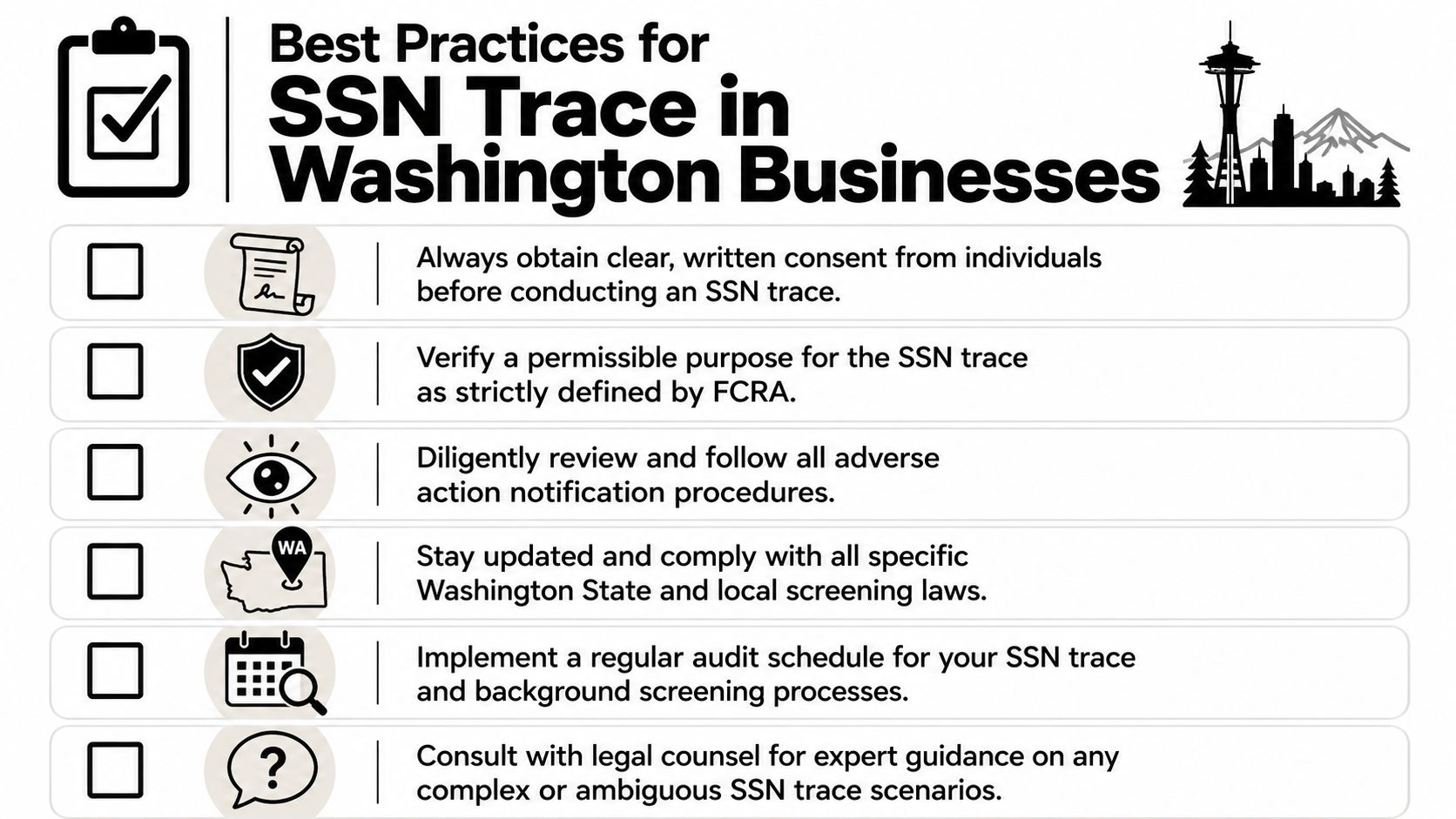
A workable compliance checklist
Founders and operators can translate that into a practical checklist:
Use the trace early, not alone: Order it as part of a structured screening package, not as a substitute for later verification.
Keep forms clean: Use a proper standalone disclosure and obtain written authorization before the report is ordered.
Train decision-makers: Recruiters and managers should know that mismatches are leads to investigate, not proof of fraud.
Escalate discrepancies: Route conflicting names, issue data, or address history through a documented review process.
Follow adverse action rules carefully: If the company may rely on report information to deny employment or housing, the process must be followed in sequence.
Account for Washington and Seattle rules: Hiring policies should reflect local timing and use restrictions, not just federal law.
A compliant screening program doesn't depend on one report being perfect. It depends on the business knowing what each report can and can't do.
That mindset is especially important for startups. Early companies often move fast, centralize decisions with founders, and operate without mature HR infrastructure. Those conditions make overreliance more likely. They also make simple controls more valuable.
A well-run process treats the SSN trace like a map. The map can be useful. It can also be incomplete. The business still needs to verify the route before acting on it.
Washington businesses that want help building compliant hiring, privacy, and screening workflows can work with By Design Law Firm & Legal Consultancy, PLLC. The firm advises startups and established companies on practical risk management, Washington regulatory requirements, and legally sound operational processes that support growth without cutting corners. Contact our law offices today at (206) 593-1519.