A board meeting is underway. The agenda says media rights, realignment risk, athlete compensation, and reputational exposure. Someone asks a simple question that usually isn't simple at all: what governs the conference relationship when interests diverge?
For the Southeastern Conference, the answer isn't a press release, a television contract, or a headline about expansion. It's the governing documents. The SEC's constitution, bylaws, and regulations function much like a corporate charter, board policies, and internal operating procedures. They allocate authority, define voting rights, discipline members, and shape how money moves across the enterprise.
That's why Southeastern Conference bylaws matter well beyond athletics departments. They matter to university counsel, investors tied to sports-adjacent ventures, technology vendors handling athlete data, and executives evaluating exposure around media, sponsorship, and compliance. In practical terms, these bylaws are a mature governance system for a multistakeholder organization with strong brands, shared revenues, and constant legal pressure from outside regulators and markets.
The Unseen Rulebook Governing College Sports Titans
A conference expansion vote is on the agenda. The business case looks attractive. New markets, stronger media inventory, and higher long-term enterprise value all sit on the slide deck. The legal question is less glamorous and more important: which document controls the approval process, the voting threshold, the revenue consequences, and the remedies if member interests split?
That is the practical function of Southeastern Conference bylaws. They are not ceremonial paperwork, and they are not written for fans. They operate as a governance framework for a high-value association of institutions that share brand equity, commercial rights, competitive obligations, and legal exposure. For counsel and decision-makers, the bylaws answer the questions that usually drive disputes: authority, process, economics, enforcement, and exit risk.
The SEC's origins matter because they show how long governance has been treated as an operating asset, not an administrative afterthought. The conference traces its formation to the early 1930s, when member institutions adopted foundational governing documents and formalized a structure for collective decision-making, conference administration, and common competition standards. From the start, the point was organizational control.
That history still matters because the same categories of risk remain in play, just at a larger scale and with more legal pressure. Media rights are more valuable. Athlete compensation questions are more complicated. State law and NCAA policy can point in different directions. A conference that cannot make, document, and enforce decisions consistently invites litigation, internal conflict, and reputational damage.
Why directors and investors should care
A fan sees standings. Counsel sees allocation of power.
For a board, Southeastern Conference bylaws work much like governing documents for a joint venture or trade association with substantial shared assets. Member institutions keep their own identities and priorities, but they also submit to a common rule set that affects strategy and cash flow. The primary trade-off is straightforward. Institutions gain the benefits of scale and collective bargaining power, but they accept constraints on unilateral action.
That creates several business questions with direct legal consequences:
- Control risk: Which body has authority to approve expansion, discipline members, or change policy?
- Economic risk: How are conference-generated revenues allocated, restricted, or conditioned?
- Compliance risk: What internal conduct rules apply beyond NCAA requirements?
- Dispute risk: What procedures govern enforcement, interpretation, and institutional accountability?
In practice, expensive problems rarely begin with headline misconduct. They begin with ambiguous authority, poor documentation, inconsistent treatment across members, or rules that no longer fit the conference's commercial reality.
Viewed that way, Southeastern Conference bylaws are a governance instrument with direct operational value. They set decision rights, assign duties, and reduce the chance that a strategic disagreement turns into a legal crisis.
Accessing and Interpreting the Official SEC Constitution
The first mistake many readers make is treating all SEC rules as a single document. They aren't. The governing framework usually works in layers, and those layers matter because not every provision carries the same purpose or legal weight.
For a business audience, the cleanest analogy is corporate governance. A company has formation documents, bylaws, board resolutions, and internal policies. The SEC's materials function similarly. The constitution handles foundational authority. Bylaws translate that authority into enforceable governance rules. Regulations and related directives tend to address implementation, sport-specific administration, and conduct standards.
How to approach the documents
Start with the official conference materials published or referenced by the SEC. If a question involves discipline, realignment, governance authority, or institutional obligations, the operative language matters more than summaries or social media interpretations.
A practical reading order works best:
- Read the constitution first. It frames the conference's legal identity, powers, and institutional design.
- Move to the bylaws. Here, decision rights, obligations, and procedural rules usually become concrete.
- Check regulations and commissioner directives. These often govern day-to-day compliance questions and public conduct issues.
- Compare against NCAA requirements and applicable state law. Internal conference rules don't override external law.
What each layer does
| Document layer | Business analogy | Main function |
|---|---|---|
| Constitution | Articles of incorporation | Establishes foundational authority and structure |
| Bylaws | Corporate bylaws | Allocates power, procedure, membership rights, and governance mechanics |
| Regulations | Policy manual or operating procedures | Implements detailed, operational rules |
| Commissioner directives | Executive guidance | Addresses interpretation, administration, and conduct expectations |
This hierarchy matters in dispute analysis. If a school challenges a sanction or a vote, counsel should first ask whether the underlying action was authorized at the constitutional level, then whether the bylaws supplied proper procedure, and finally whether implementing regulations were applied consistently.
How to read for risk, not trivia
Individuals often skim sports bylaws for penalties or eligibility. That's too narrow. A better method is to flag provisions that answer four board-level questions:
- Who decides?
- What vote is required?
- What process must be followed?
- What remedy exists if someone breaches the rule?
Read Southeastern Conference bylaws the way a deal lawyer reads an operating agreement. Focus on consent rights, dispute triggers, delegated authority, and economic consequences.
That approach turns an arcane rulebook into a governance map.
Core Governance and Membership Provisions
A membership vote in the SEC is not a ceremonial step. It is the legal point where a university accepts shared control over scheduling, competition standards, voting procedures, and internal discipline. For boards, presidents, and general counsel, that is the moment the conference stops being a brand affiliation and starts operating like a governed enterprise.
The conference has long relied on a defined chain of authority that includes a commissioner, central oversight, and member voting. As noted earlier, that structure is part of the SEC's institutional design. The practical question is not whether authority exists. The practical question is who may act, under what procedure, and with what limit.
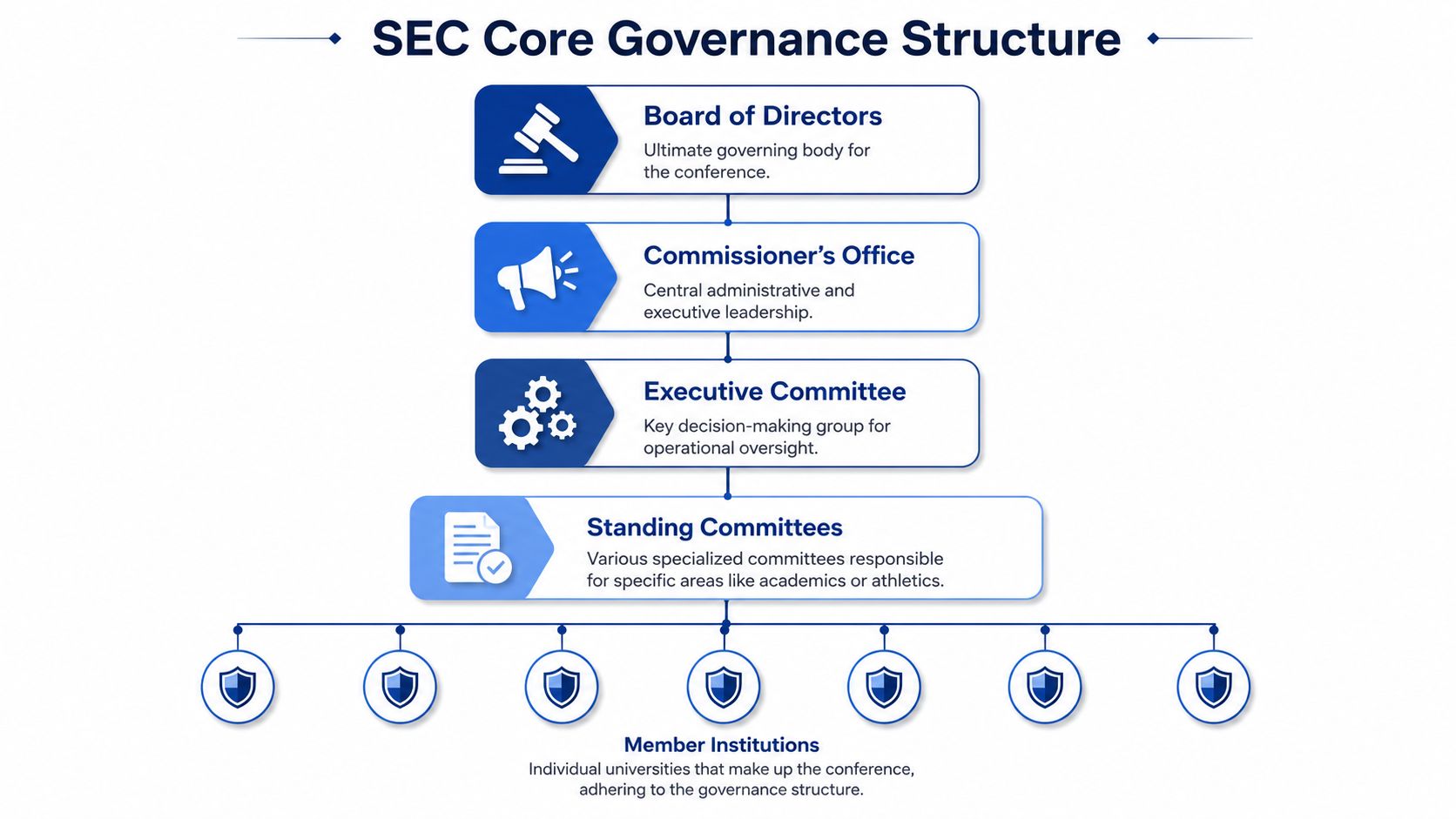
The governance chain
A risk-focused reading of Southeastern Conference bylaws starts with reserved powers. Some decisions stay at the top because they affect the conference's identity, economics, or membership base. Others are delegated for speed and day-to-day administration. That split matters because a procedurally flawed decision can be challenged even when the underlying policy goal is sensible.
Board-level authority
At the highest level, the conference's governing body functions much like a corporate board. It sets strategic direction, protects the collective brand, and keeps control over major structural choices, including membership questions and conference-wide policy.
For readers who work with company governance, the comparison to a board of directors decision-making structure is useful. The same legal questions apply here. Which actions require full-member approval? Which powers can be delegated? What process prevents one influential institution from converting business influence into procedural control?
Those questions are not academic. They determine whether a disputed vote holds up, whether a commissioner acted within delegated authority, and whether member institutions received the process the governing documents require.
Commissioner and executive bodies
The commissioner's office serves as the conference's executive function. It administers policy, interprets rules in real time, and often handles the first layer of dispute management. Executive committees or similar bodies can provide speed and confidentiality when the full membership is not the right forum for every issue.
That arrangement works only if the bylaws draw clean lines. Ambiguity creates governance risk. If the documents blur the line between making policy and enforcing policy, stakeholders start arguing over authority before they ever address the merits. In practice, that raises the cost of enforcement and weakens confidence in the outcome.
Membership is a bundle of rights and obligations
Expansion discussions usually focus on television value, recruiting reach, and market position. Counsel should focus on accession terms and continuing duties. Membership gives a school access to shared benefits, but it also subjects the institution to conference votes, internal procedures, and compliance controls.
That trade-off is the core governance bargain.
A well-drafted membership framework usually addresses four categories of risk:
- Admission standards decide who can enter the conference and on what terms.
- Voting rules protect collective interests by defining consent thresholds for sensitive actions.
- Delegated committee authority allows faster decisions without giving away ultimate control.
- Institutional duties bind each member to operating rules, reporting expectations, and conference discipline.
From a governance perspective, membership works like entry into a closely held venture. The upside is shared scale and brand value. The cost is reduced unilateral freedom.
Where these provisions create legal value
Clear governance provisions reduce avoidable disputes. They tell member institutions where to take an issue, what vote is needed, and what record should exist before action is taken. That predictability helps the conference act decisively without looking arbitrary.
Poor drafting creates the opposite result. If no one can tell whether a matter belongs to the board, the commissioner, or a committee, every contested decision becomes a procedural fight. That is where litigation exposure, reputational friction, and internal political bargaining begin to crowd out the merits.
Good sports governance is disciplined corporate governance in a different setting. Clear authority lines, defined membership rights, and documented voting procedures do more than keep the conference organized. They protect enforceability when a major decision is challenged.
Understanding the SEC Financial Framework and Revenue Distribution
A president walks into a conference meeting after a disappointing season and still expects a substantial distribution check. That outcome is not accidental. It reflects a governance choice about how the SEC spreads financial risk across its members.
The conference's public profile and revenue model are summarized in the Wikipedia overview of the Southeastern Conference. The important point for legal and business analysis is simpler than the headline numbers. SEC economics are built around shared conference value, especially media rights and other centralized revenue streams, rather than allowing each institution's local market to determine its financial position.
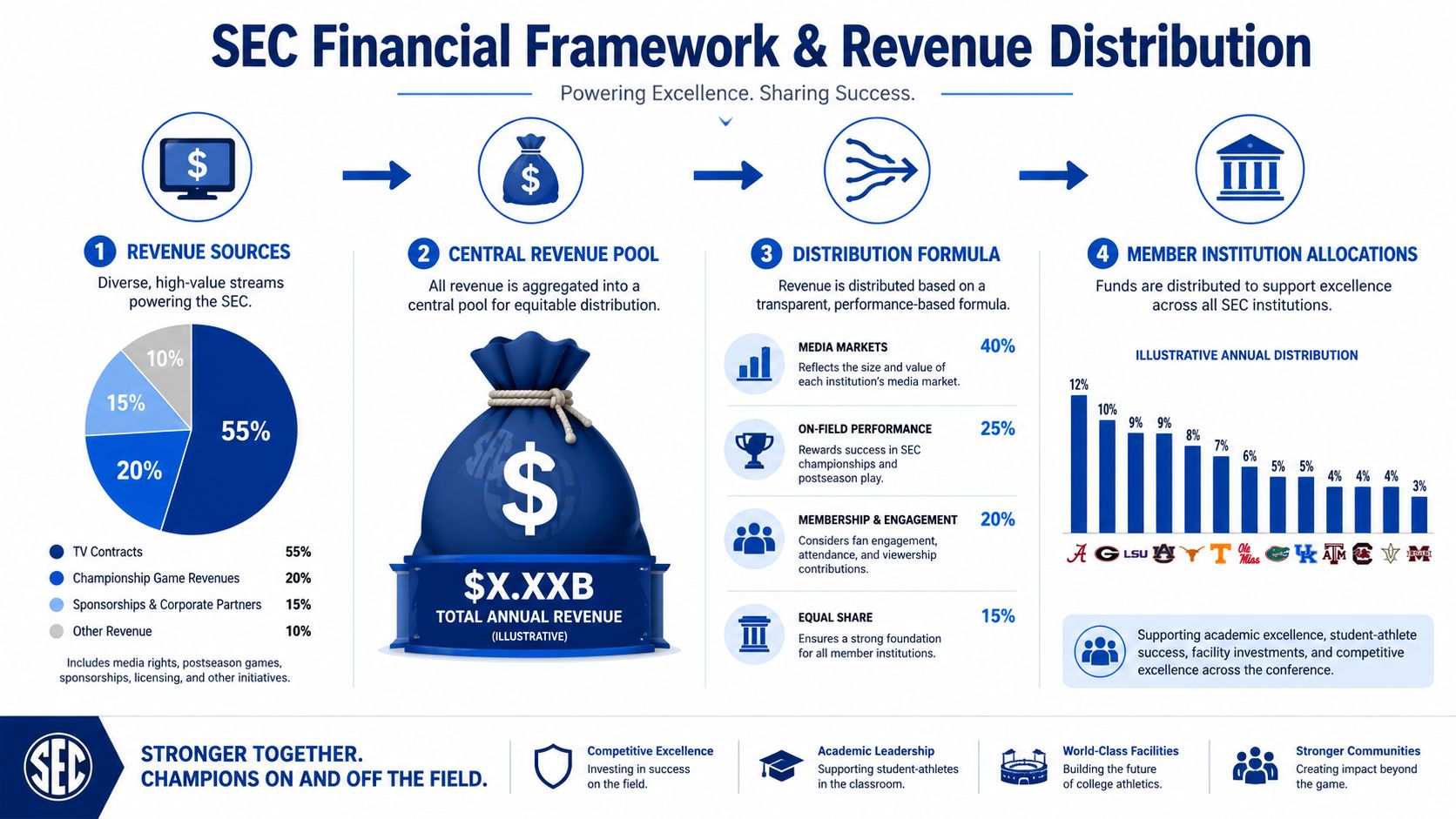
Why the model matters
Equal or near-equal distribution is a risk-management tool.
It lowers the chance that one or two marquee brands become economically untouchable while the rest of the conference slips into a weaker bargaining position. For the conference office, that matters in every major negotiation. Broad-based institutional strength supports scheduling quality, postseason relevance, donor confidence, and media value across the full slate, not only in the highest-profile matchups.
From a board or general counsel perspective, the arrangement also reduces foreseeable conflict over baseline funding. Predictable distributions make budgeting easier, support long-range coaching and facilities commitments, and give each member a clearer basis for financial planning. That predictability does not eliminate disputes, but it narrows the range of fights to formula design, expense allocation, and performance-based exceptions rather than basic access to conference revenue.
Equal allocation is a governance decision
Schools with larger audiences can make a credible argument that they contribute more to the conference's media value. The SEC's approach answers that argument with an enterprise view of value creation. The conference preserves a unified product by treating membership as a long-term commercial partnership, not a week-to-week auction.
That choice carries real trade-offs. High-performing members may question whether equal sharing understates their market contribution. Lower-resourced members will defend the model because it protects competitiveness and institutional stability. Those tensions are familiar to any organization that pools revenue among unequal contributors.
If the allocation formula becomes contested, the dispute does not stay financial for long. It can become a governance fight over voting rights, amendment thresholds, fiduciary expectations, and, in some cases, the kind of internal dispute that can spill into business litigation over revenue-sharing and governance rights.
The compliance angle often gets missed
Revenue systems create operational obligations. A conference that centralizes income and distributes it by rule needs accurate reporting, clear accounting treatment, documented approvals, and controls around restricted or earmarked funds. The discipline looks familiar to anyone who has worked through audit preparation or enterprise control design. The same control mindset described in this practical guide to IT compliance applies here. Written standards only work if the organization can verify that people followed them.
For institutions, the legal question is not just how much money arrives. The harder question is what conditions attach to that money, what records support the distribution, and who has authority to challenge or approve changes to the formula.
| Financial design choice | Primary advantage | Main legal or governance risk |
|---|---|---|
| Equal fixed-fee sharing | Budget stability and lower fragmentation risk | Larger brands may argue the formula misprices their contribution |
| Performance-heavy allocation | Direct reward for competitive or commercial success | Wider resource gaps and stronger incentives for intra-conference conflict |
| Hybrid approach | Balances stability with differentiated incentives | More discretion, more formula disputes, and more pressure on definitions |
The SEC's financial structure favors continuity, bargaining cohesion, and brand preservation. For a mature conference with powerful members and constant public scrutiny, that is usually the safer governance position, even when some institutions believe they could earn more on a stand-alone basis.
Compliance Mechanisms and Enforcement Powers
Rules without enforcement are brand statements. Rules with process become compliance systems. The SEC's enforcement structure matters because conference risk doesn't come only from major scandals. It also comes from day-to-day conduct failures, reporting breakdowns, and inconsistent disciplinary responses.
A recent example shows how operational these rules can be. In a Reuters report carried by WTVB, the SEC fined Kentucky head coach Mark Pope for post-game comments and conduct related to officiating, citing SEC bylaw 10.5.3 on sportsmanship and the commissioner's regulation that bars public criticism of officials or disclosure of officiating-related communications. The specific sanction in that matter is less important here than the enforcement principle. The conference has written conduct rules, identified authority, and a mechanism to impose consequences.
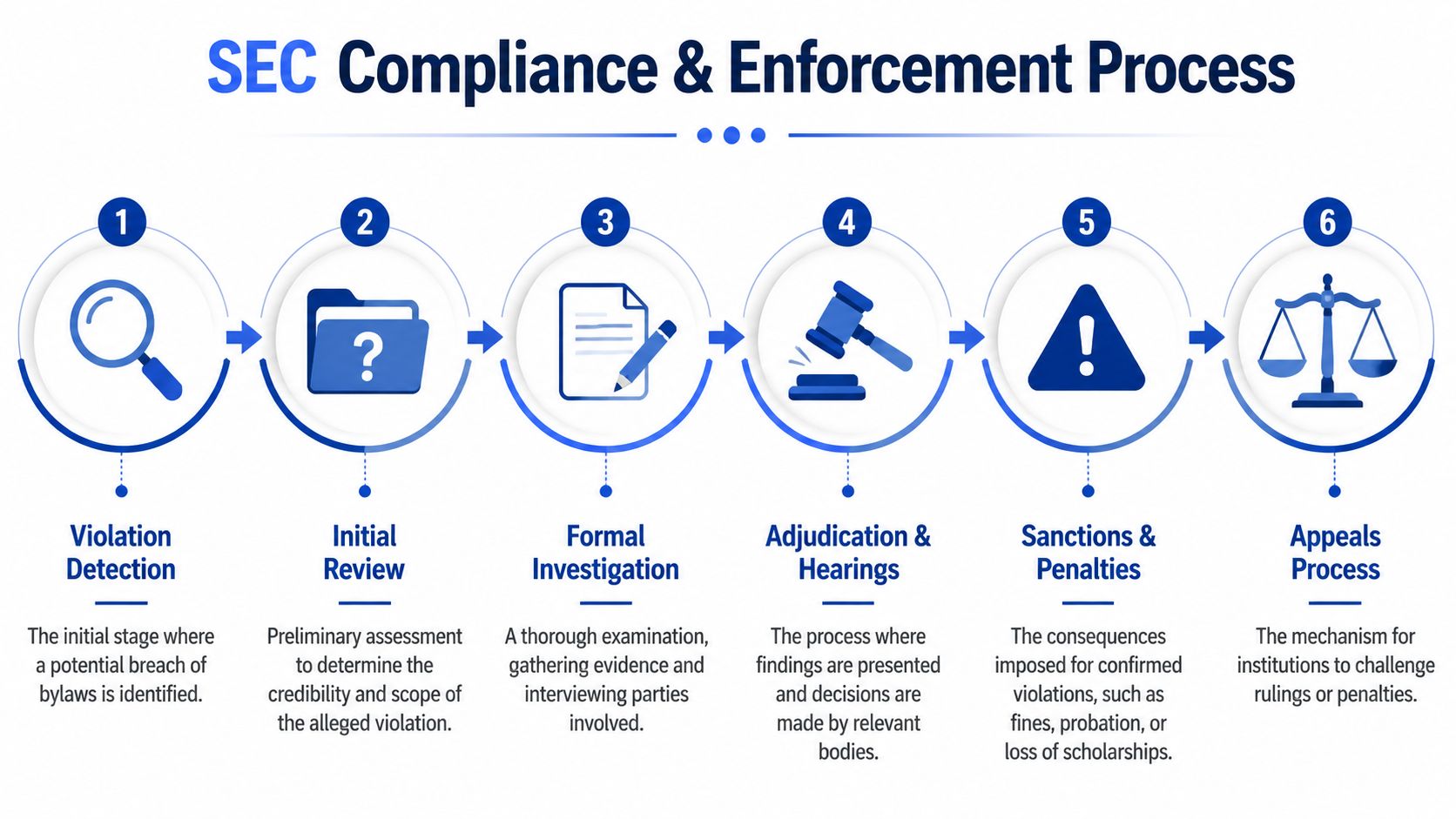
A practical enforcement sequence
For institutions, the process should be managed the way any regulated business manages internal investigations.
Detection
A complaint, public statement, internal report, audit flag, or media event identifies a possible violation.Preliminary review
Conference or institutional personnel assess whether the allegation is credible and whether immediate containment is needed.Formal investigation
Relevant documents are preserved. Witnesses are interviewed. Internal communications are reviewed.Adjudication
The responsible decision-maker or body evaluates facts under the applicable bylaw or regulation.Sanctions
The conference may impose penalties tied to the rule and severity of the conduct.Appeal or challenge
The institution may seek review if the governing documents provide that route.
What institutions should borrow from corporate compliance
Sports departments often underestimate how much they resemble regulated enterprises. A useful comparison appears in this practical guide to IT compliance. The industries differ, but the discipline is similar: documented controls, role clarity, training, reporting lines, and audit readiness.
That same logic helps when the matter turns adversarial. Once a conference investigation matures, the institution may face evidentiary disputes, contractual interpretation fights, employment implications, and reputational fallout. At that point, the matter starts to resemble business litigation, even if it began as an internal governance issue.
Where organizations usually fail
The problem usually isn't the absence of rules. It's the absence of process around the rules.
- Untrained spokespeople make public comments that trigger disciplinary review.
- Fragmented recordkeeping weakens the institution's ability to explain events.
- Informal reporting culture delays escalation until the conference is already involved.
- Role confusion leaves coaches, compliance staff, and communications teams making contradictory decisions.
Institutions should treat SEC investigations the way public companies treat regulatory inquiries. Preserve records early, centralize communications, and avoid improvising legal positions in public.
That approach won't eliminate sanctions. It will reduce preventable damage.
Navigating Modern Legal and NCAA Intersections
A board approves an athletics technology contract, a collective launches a new NIL campaign, and a coach changes a roster plan based on player-tracking outputs. Each decision can comply with internal practice and still create conference exposure if the bylaw framework, NCAA rules, state law, and contract terms do not line up. That is the current legal problem. The risk sits in the overlap.
SEC bylaws now operate less like a closed sports code and more like a governance document under pressure from outside law. Antitrust claims, NIL regulation, transfer eligibility, employment arguments, privacy obligations, and vendor contracting all press on the same set of institutional decisions. For leadership teams, the practical question is not whether the conference rules still matter. It is whether the institution can apply them in a way that holds up under legal scrutiny and public scrutiny at the same time.
NIL, antitrust, and structural tension
The pressure is sharpest where compensation and competition meet.
Conference restrictions can serve legitimate competitive and administrative purposes, but they also affect how institutions recruit, retain talent, structure commercial relationships, and share value around athletics. That creates antitrust sensitivity, especially when rules are applied unevenly or drafted in broad terms that leave too much room for discretionary enforcement. From a governance standpoint, ambiguity is expensive. It increases the odds of internal inconsistency, athlete disputes, and external challenges.
NIL has made that tension harder to manage. Schools, collectives, sponsors, and platforms often move faster than conference guidance. The legal risk is not limited to whether a deal is allowed. The larger issue is whether the institution documented its review process, identified decision-makers, and allocated responsibility for approval, monitoring, and remediation if a deal later draws scrutiny.
Contract structure matters here. Institutions entering athletics-related sponsorship, platform, collective, or data arrangements should scrutinize forum selection, governing law, escalation procedures, document preservation obligations, and approval rights. Well-drafted dispute resolution clauses for commercial agreements will not override a bylaw issue, but they can contain collateral disputes before they spread into a conference matter.
AI, athlete data, and governance lag
Technology raises a different kind of risk. Many athletic departments now use player-tracking, biometric monitoring, video analytics, and performance tools, but conference bylaws were not written with those systems in mind. The result is a governance lag. Operational adoption is ahead of rule design.
That gap matters because these tools do more than assist coaching. They collect sensitive information, generate rankings and predictions, influence health and performance decisions, and shape recruiting and publicity. Once a tool affects a material decision about an athlete, the institution has moved beyond sports science and into questions of consent, privacy, fairness, retention, cybersecurity, and vendor accountability.
The legal exposure is practical, not theoretical. A school may have authority to collect data under one policy, limited ability to share it under another, and no clear conference standard on secondary use, model training, or cross-platform transfers. Counsel then has to resolve the conflict after the program has already bought the tool and built it into decision-making.
What a defensible governance model should cover
Institutions should treat AI and analytics in athletics as a controlled-risk function. At minimum, the review framework should address:
Biometric and performance data rights
Define what data is collected, who can access it, how long it is retained, and when it must be deleted.Consent and disclosure practices
Athlete-facing notices should match actual data use, including sharing with vendors, medical staff, performance personnel, and third parties.Vendor contract controls
Analytics and tracking providers should face clear restrictions on reuse, sublicensing, security standards, incident reporting, audit access, and model training on institutional data.Decision accountability
If analytics influence roster status, playing time, health restrictions, or recruiting evaluations, the institution should be able to explain who made the decision and what role the system played.Rule alignment across regimes
Conference bylaws, NCAA requirements, school policy, state privacy law, and contract terms should point in the same direction before the tool becomes operational.
AI in athletics creates privacy risk, contract risk, and governance risk at the same time. Treating it as a coaching tool alone leaves the institution exposed.
The central legal issue is governance speed. Conferences can amend bylaws, but technology vendors, NIL actors, and litigation theories often move faster. Institutions that wait for perfectly matched rules usually end up operating on informal assumptions. In this environment, informal assumptions are not a strategy. They are a record for the other side.
Institutional Best Practices for Compliance and Risk Mitigation
The most effective compliance posture isn't reactive. It treats Southeastern Conference bylaws as a living governance framework that needs ownership, monitoring, and disciplined implementation across athletics, legal, finance, technology, and communications.
That starts with a simple premise. A university can't delegate conference risk to one compliance office and hope everyone else stays aligned. Coaches create conduct risk. Marketing teams create endorsement risk. IT teams create data governance risk. Business staff create contract risk. Counsel has to connect those functions before a problem reaches the conference.
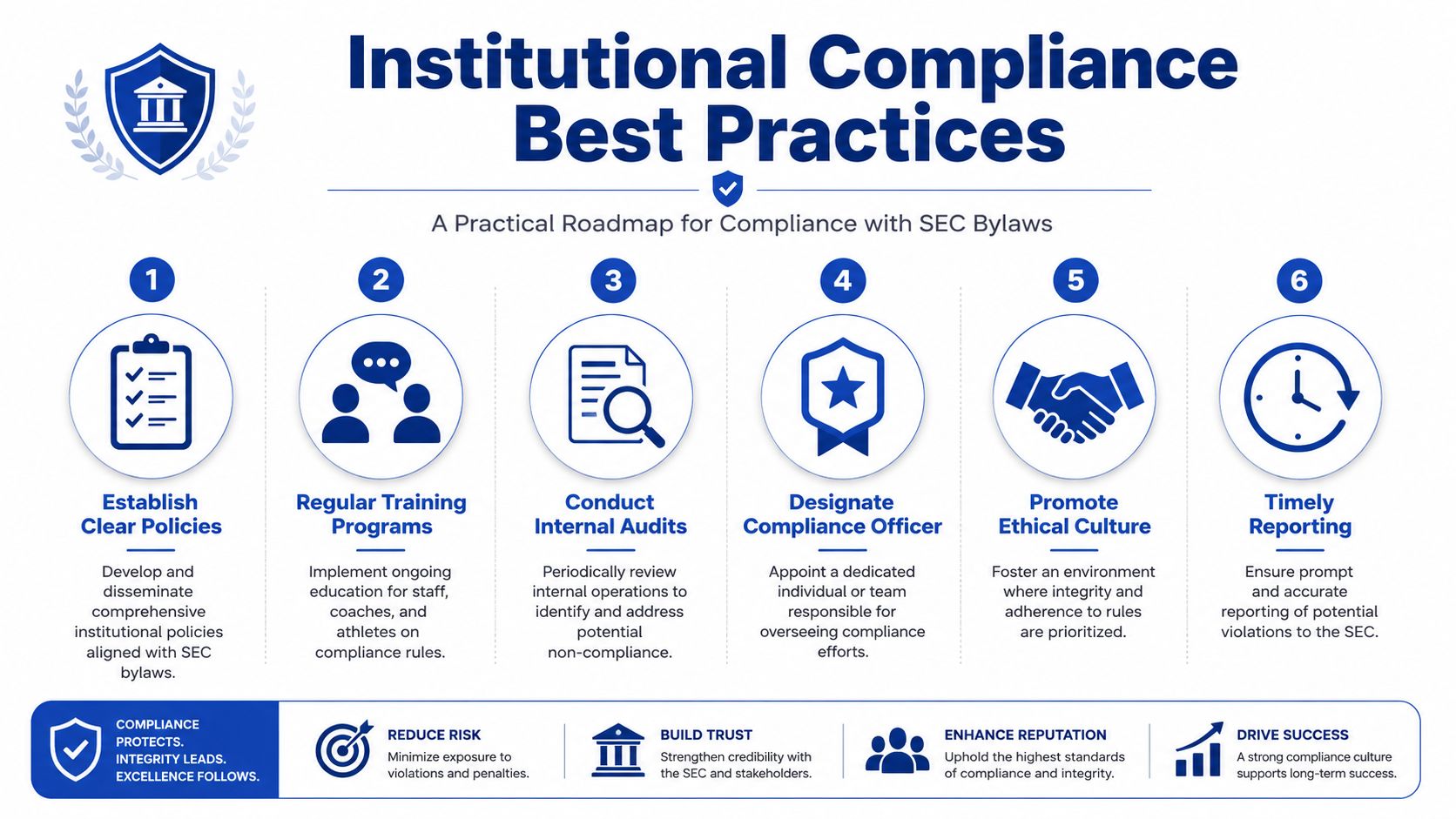
A workable institutional model
The strongest programs usually share a few traits.
Governance ownership
Someone has to own the rulebook. That doesn't mean one person handles every issue. It means one office coordinates interpretation, updates, escalation, and documentation.
Cross-functional review
Material athletics decisions should move through a review path that includes legal, compliance, communications, and relevant operational leaders. That's especially important for public statements, vendor contracts, NIL arrangements, and athlete data tools.
Documented controls
Policies should be written, current, and accessible. Institutions that need help building repeatable controls can borrow from broader corporate methods for crafting effective compliance programs. The context differs, but the legal discipline is the same.
Best practices that reduce exposure
Train the people who create risk. Coaches, assistants, player development staff, collective-facing personnel, and media teams should know the rules that affect public statements, recruiting, data handling, and third-party relationships.
Audit the gray areas. Review processes around NIL support, analytics vendors, sponsorship approvals, and internal reporting. Most governance failures happen where nobody is sure which policy applies.
Escalate early. Small violations become expensive when institutions wait for facts to become public before preserving records or involving counsel.
Separate policy from personality. Strong brands and successful coaches can pressure institutions into ad hoc exceptions. Compliance programs fail when reputation outranks process.
Track bylaw updates centrally. Amendment monitoring should be structured, not informal. A change that looks minor in conference language may materially alter institutional obligations.
What works in practice
Institutions do best when they stop treating compliance as a defensive cost center. In a conference environment shaped by media scrutiny, athlete rights, and technology risk, compliance is operational infrastructure.
A disciplined program protects more than eligibility. It protects revenue expectations, vendor relationships, recruiting credibility, and board confidence. This represents the fundamental value of reading Southeastern Conference bylaws through a governance lens rather than a fan lens.
By Design Law Firm & Legal Consultancy, PLLC helps organizations translate complex governance, compliance, technology, and dispute issues into practical legal action. Businesses, founders, and institutional leaders who need strategic counsel on contracts, corporate structure, data privacy, AI risk, or enforcement exposure can learn more at By Design Law Firm & Legal Consultancy, PLLC.