An NDA agreement is a contract that creates a legal cone of silence around a business conversation. Most NDA confidentiality obligations last one to five years, while trade secrets often require perpetual protection, which is why the right draft matters before a founder shares code, product strategy, or customer data.
A founder in Seattle is about to send a pitch deck to an investor, open a GitHub repository to a freelance developer, or start diligence talks with a larger buyer. That's the moment when “what is an NDA agreement” stops being a basic legal question and becomes a live business risk question.
An NDA, or non-disclosure agreement, is the document that legally binds the people in that conversation to keep defined information secret. Used properly, it creates a protected space for real business discussions. Used badly, it creates false comfort, unnecessary friction, or a document that won't hold up when it matters.
Your Big Idea Needs a Cone of Silence
A startup's most vulnerable moments usually happen early. The product isn't fully launched. The patent strategy may still be developing. The company needs outside help, capital, or a distribution partner before it can scale. Yet those same conversations require disclosing the exact material the company is trying to protect.
That's where an NDA earns its keep. It is a legal cone of silence for business discussions. It doesn't magically prevent leaks, and it doesn't replace operational discipline, but it does define what's confidential, who may use it, and what happens if someone misuses it.
According to Workday's overview of non-disclosure agreements, NDAs serve three core technical functions: they classify information by separating confidential from shareable material, they provide legal protection against unauthorized disclosure, and they create a confidential relationship that allows sensitive business exchanges. The same source notes that a valid NDA must include key elements such as party names, a definition of confidential information, exclusions, permitted uses, and duration.
What founders usually get wrong
Many founders wait too long. They have the first call, send the deck, share the demo login, and only then ask for paperwork. By then, some of the advantage is gone.
Others download a generic template that labels everything confidential. That approach usually sounds strong but often performs poorly in practice. If the document doesn't separate real secrets from ordinary business chatter, enforcement gets harder and negotiation gets slower.
Practical rule: If a company can't clearly say what it needs to protect, the NDA is already weaker than it looks.
A better approach starts with identifying the actual crown jewels. For a tech startup, that might mean source code, model architecture, training methods, customer lists, pricing logic, product roadmaps, unreleased features, or security documentation. A focused confidentiality strategy usually works better than a bloated one.
For founders building around proprietary know-how, a useful companion resource is this guide on how to protect trade secrets. An NDA is only one layer. The business also needs internal controls, access limits, and disciplined handling of sensitive files.
Unilateral vs Mutual NDAs Which One Do You Need
The first fork in the road is structural. Every founder should know whether the deal calls for a unilateral NDA or a mutual NDA. That choice shapes risk, bargaining position, and how much legal clutter ends up in the document.
The one-way street and the two-way street
A unilateral NDA is a one-way street. One party discloses confidential information. The other party agrees to protect it.
A mutual NDA is a two-way street. Both sides expect to exchange sensitive information, and both take on confidentiality obligations.
The legal distinction matters. Georgia Tech's legal guidance on NDAs explains that unilateral NDAs protect a single disclosing party, while mutual NDAs bind both parties to confidentiality. That same framework recognizes unilateral NDAs as standard for investor pitches and mutual NDAs as the norm where information exchange is bidirectional, such as joint ventures or similar collaborations.
Which one fits the startup context
A founder pitching angels or venture funds usually starts with a unilateral NDA, if an NDA is used at all in that setting. The founder is the one sharing sensitive information. The investor typically isn't disclosing proprietary material in return.
A startup evaluating a channel partner, API integration, or acquisition discussion often needs a mutual NDA. Each side may share architecture, customer information, technical documentation, financial data, or product plans.
Here's the practical comparison:
| Situation | Better fit | Why |
|---|---|---|
| Investor pitch | Unilateral | The founder is the disclosing party |
| Freelance developer access | Unilateral | The company shares code and systems, not the other way around |
| Strategic partnership talks | Mutual | Both sides usually exchange sensitive commercial and technical data |
| M&A exploration | Mutual | Diligence is rarely one-directional |
A mismatch at this stage creates avoidable problems. A mutual NDA in a one-way situation can impose obligations the startup never needed. A unilateral NDA in a two-way deal can leave one side exposed.
Washington startups also need to think about who is signing. If employees, contractors, or advisors will touch the information, the document should align with the company’s broader confidentiality workflow. A useful starting point for internal alignment is this employee confidentiality agreement template discussion, especially where founders want outside NDAs and internal confidentiality obligations to work together rather than collide.
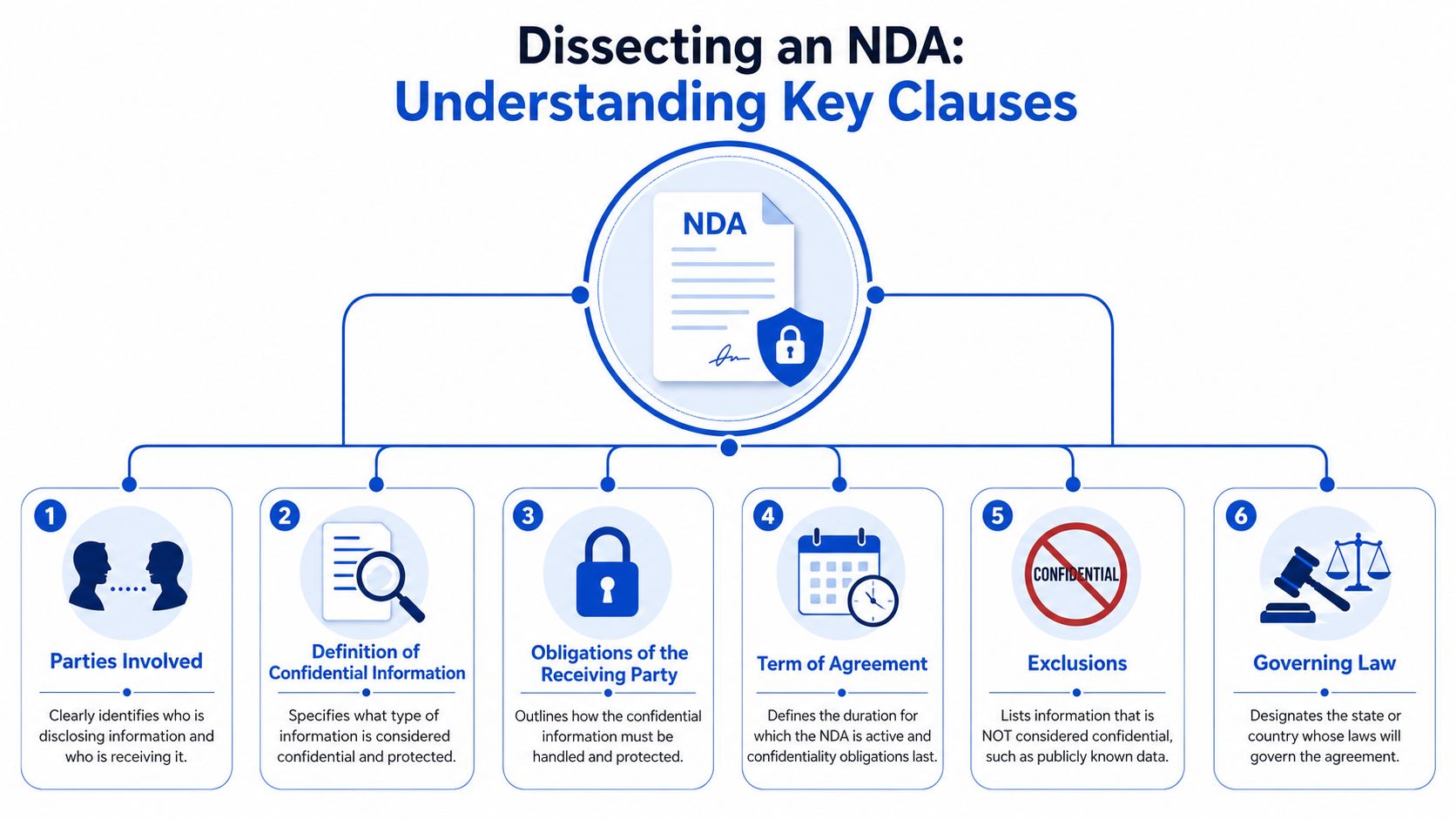
Anatomy of an NDA Key Clauses Explained
A strong NDA is rarely long, but every sentence has a job. The difference between a useful agreement and a decorative one usually comes down to a handful of clauses that are drafted with care.
Start with the scope, not the boilerplate
The definition of confidential information does most of the heavy lifting. If it’s too narrow, important material falls outside the contract. If it’s too broad, the other side may resist signing, and a court may view the language skeptically.
For technology startups, useful definitions often cover both technical and business material. That can include software code, product specifications, architecture diagrams, financial projections, customer data, vendor terms, security materials, and non-public business strategy. The better drafts also identify the permitted purpose of the disclosure. That matters because misuse is often a non-use issue, not just a leak issue.
The exclusions clause is just as important. It typically carves out information that is already public, already known to the recipient, or independently developed. A founder who resists fair exclusions usually weakens the credibility of the whole agreement.
The term is where many templates fail
Not all confidential information deserves the same lifespan. Malbek’s discussion of NDA duration notes that the standard duration of confidentiality typically ranges from one to five years, depending on industry standards, while information classified as a trade secret often requires perpetual protection.
That distinction is central in startup practice. A pricing model or fundraising deck may justify a fixed confidentiality period. Source code, proprietary algorithms, manufacturing methods, or unique internal processes may need protection for as long as they remain trade secrets.
A practical breakdown looks like this:
- General business information: Often fits a fixed confidentiality term.
- Technical materials tied to trade secrets: Often needs longer or perpetual treatment.
- Stale information: Doesn’t need to stay locked up forever if it loses practical sensitivity.
The best term clause matches the information. It doesn’t treat every spreadsheet like a trade secret, and it doesn’t let real trade secrets expire on a calendar by accident.
Clauses that deserve more attention than they get
Founders often focus on the confidentiality definition and skip the enforcement mechanics. That’s a mistake.
- Obligations of the receiving party: The NDA should say how the recipient may use the information, who may access it, and what care standard applies.
- Return or destruction of information: This matters when diligence ends, a contractor is offboarded, or a pilot project ends.
- Remedies for breach: Many NDAs authorize injunctive relief because money alone may not fix a disclosure.
- Governing law and dispute terms: A startup in Washington should pay attention to where a fight would happen and under what law.
When founders want to tighten the enforcement piece, it helps to think through the dispute path before a dispute exists. This overview of dispute resolution clauses is useful because confidentiality rights don’t mean much if the contract makes enforcement slow, expensive, or geographically impractical.
Are NDAs Enforceable in Washington State
The short answer is yes, but only if the NDA is drafted and used in a way that Washington law will respect. A signed document isn’t self-enforcing. Courts look at scope, reasonableness, the surrounding facts, and whether the agreement was specific to the actual business relationship.
What tends to hold up
Washington companies generally do better with NDAs that are specific about the confidential material, realistic about the duration, and limited to actual confidentiality protection rather than disguised competition restraints. A startup can protect source code, product roadmaps, customer information, and diligence materials. It usually should not use an NDA as a back door to control ordinary market behavior that belongs in some other kind of agreement, if it belongs anywhere at all.
Specific adjustments matter at the jurisdictional level too. Icertis explains that an enforceable NDA must be adapted to local law, and that some contexts, including government contracts, have specialized compliance requirements. One concrete example is DFARS 227.7103-7, which requires destruction of technical data within 30 days of termination in the relevant setting. That’s the kind of detail generic templates almost always miss.
Washington-specific caution points
Washington founders should also remember that not every confidentiality provision is enforceable merely because both sides signed it. State-specific policy limits matter. For example, Washington law restricts the use of NDAs to conceal workplace harassment or assault. That means founders and operators can’t treat “confidentiality” as an all-purpose shield.
Another practical issue is proof. In a real dispute, the company may need to show what it shared, when it shared it, who had access, and how the breach occurred. If files were sent informally over personal email, shared in an uncontrolled folder, or shown in a meeting with no record, the legal argument gets harder.
A sound internal process often includes:
- Access logs: Track who opened or downloaded sensitive materials.
- Version control: Keep a record of what was disclosed and when.
- Clean offboarding: Remove access when contractor or deal discussions end.
- Consistent labeling: Mark sensitive documents clearly so there’s less room for argument later.
This short video is useful for founders thinking about enforceability in real-world business settings.
What doesn’t work well
An NDA that tries to cover everything forever, in every context, often creates more theater than protection. So does a contract copied from another deal type, such as an employment form forced into a partnership negotiation.
When a Washington company suspects misuse of confidential material, the next issue is usually no longer abstract drafting. It becomes evidence, injunctive strategy, and trade secret analysis. That’s why founders dealing with active misuse often need to understand trade secret misappropriation in parallel with the NDA itself.
Practical NDA Scenarios for Startups With Sample Language
Legal drafting gets clearer when it’s tied to actual startup situations. The right NDA for a freelance engineer won’t read like the right NDA for an acquisition conversation, and neither should look like a beta tester agreement.
Hiring a freelance developer for the MVP
A startup hires an outside engineer to build part of the product. The company will share code, architecture notes, credentials, and roadmap details. That’s usually a unilateral NDA, but the confidentiality piece should sit alongside intellectual property ownership terms in the contractor agreement.
A focused clause might read like this:
“Confidential Information includes source code, product specifications, development roadmaps, security procedures, customer information, and non-public business plans disclosed by Company for the purpose of developing and supporting the Company’s software product.”
That works because it ties the information to a clear business purpose. It’s better than saying every conversation, idea, or document is confidential without distinction.
Some startups also negotiate a residuals concept carefully, especially when the developer works across multiple clients. If included, the language should be narrow and should never give away actual protected materials by accident.
- Good instinct: Limit use to the project and those who need to know.
- Bad instinct: Drop in a broad residuals clause from a large enterprise template without understanding how it affects proprietary know-how.
- Practical fix: Pair confidentiality terms with clear IP assignment and access controls.
Early acquisition talks
M&A conversations often start before either side knows whether the deal is serious. That’s exactly why the NDA should define the purpose narrowly.
A practical snippet could say:
“Recipient may use Confidential Information solely to evaluate a potential acquisition, investment, or strategic transaction involving Discloser and for no other commercial or competitive purpose.”
That sentence matters because acquisition talks can expose pricing logic, customer concentration, vendor dependencies, and technical stack decisions. Without a purpose limitation, the recipient may still be barred from leaking the information, but the startup has a weaker argument against internal competitive use.
Onboarding beta testers
Beta testers are often overlooked. A startup shares unreleased features, screenshots, workflows, and performance details with a small user group to get feedback. If the product is novel, those disclosures can matter.
A clean beta confidentiality clause might read:
“Tester will not disclose, publish, or share any non-public features, functionality, documentation, screen displays, or feedback materials relating to the beta product without the Company’s prior written consent.”
Timing is critical here. Ironclad’s NDA guidance notes that an NDA can’t retroactively protect information the recipient already knows, and that the agreement must be signed before sensitive disclosure. The same source also highlights the value of severability clauses, which help preserve the rest of the agreement if one provision is later found unenforceable.
Founders usually regret the NDA they signed late, not the NDA they signed on time.
For teams building repeatable HR and contractor workflows around confidentiality, Closer Innovation Labs Corp. HR insights offer a practical operational lens. The legal draft matters, but the onboarding process matters too. Confidentiality obligations are easiest to enforce when they’re embedded in hiring, access, and offboarding routines.
Beyond the NDA Protecting Your Full IP Portfolio
An NDA protects secrecy. It does not create ownership of an invention, register a brand, or replace a clean chain of title for software and content. Founders who treat the NDA as the whole intellectual property strategy usually discover the gap later, during diligence or a dispute.

The NDA’s place in the toolbox
A startup’s IP protection stack usually includes several layers:
- Trade secret controls: Access limits, need-to-know permissions, labeling, and internal confidentiality policies.
- Copyright and assignment documentation: Especially for software, design assets, documentation, and marketing content.
- Trademark strategy: Brand clearance and registration for names, logos, and product lines.
- Patent analysis where appropriate: Particularly if public disclosure timing could affect a filing strategy.
For Washington technology companies, this matters in AI development, product licensing, data privacy compliance, and contractor-heavy build cycles. A founder may have an NDA in place and still lose their advantage if the company never secured assignment of code, never documented access restrictions, or publicly disclosed an invention too early.
A practical founder mindset is simple. Use the NDA to control disclosure. Use the rest of the IP framework to control ownership, exclusivity, and long-term value.
Conclusion Your Next Steps for Secure Collaboration
The answer to “what is an NDA agreement” isn’t that it’s a form. It’s that it’s a risk-allocation tool. It creates a legal obligation around secrecy, but it only works when the document matches the relationship, the information, and the law that governs the deal.
Founders in Washington should be skeptical of one-size-fits-all templates. A generic NDA may be too broad to negotiate efficiently, too weak to protect real secrets, or too disconnected from Washington-specific enforceability issues to be reliable. The stronger approach is narrower, clearer, and grounded in how the company shares information.
Three practical next steps tend to matter most:
- Identify the real confidential assets. Don’t protect everything the same way.
- Match the NDA structure to the deal. One-way and two-way agreements solve different problems.
- Back the contract with process. Access controls, version tracking, and clean offboarding often decide whether enforcement is realistic.
For founders thinking beyond paper, Ciphar’s secure tools roundup is a useful operational resource. Secure collaboration tools won’t replace an NDA, but they can reduce the chances that a confidentiality problem starts in the first place.
A carefully drafted NDA is not legal decoration. It’s part of the infrastructure that lets a startup pitch, hire, test, partner, and negotiate without casually giving away the company’s competitive advantage.
By Design Law Firm & Legal Consultancy, PLLC helps Washington startups and established companies draft, negotiate, and enforce business agreements that fit the transaction. For founders dealing with investor discussions, contractor onboarding, product development, trade secret protection, or sensitive commercial negotiations, the firm offers practical guidance grounded in technology, contracts, data privacy, and intellectual property. Learn more at By Design Law Firm & Legal Consultancy, PLLC. Contact our law office today at (206) 593-1519 for a complementary consultation.