The most popular governance advice is also the least useful: create a policy binder, appoint a board, and revisit everything once the company is larger. That approach confuses having governance documents with operating a company under reliable governance procedures. A startup can have polished bylaws and still lack approval records, conflict disclosures, ownership of compliance tasks, or evidence that anyone followed the controls.
For founders in Seattle, Tacoma, Bellevue, and the broader Puget Sound, corporate governance and compliance is a present-tense operating issue. It affects fundraising diligence, customer contracts, hiring decisions, data practices, related-party transactions, and the company’s ability to respond when something goes wrong. The practical question isn’t whether a company can afford governance. It’s whether the company can afford undocumented decisions and preventable surprises.
Why Governance Matters Long Before You Scale
Governance matters long before a company scales because founders and boards must make accountable decisions even in private companies. Startups create governance exposure when founders issue equity, approve related party contracts, take institutional money, handle sensitive customer data, or choose what benefits insiders over the company.
The stronger framing is operational. Effective corporate governance gives a company a repeatable way to decide who can approve an action, what information decision-makers need, how conflicts are handled, and where the evidence is stored. Founders evaluating the broader principles can also review this effective corporate governance resource for a useful comparison of governance structures and accountability practices.
The diligence problem appears early
A financing or acquisition process rarely begins with a philosophical discussion about governance. Counsel asks for the capitalization table, board and shareholder approvals, equity issuances, intellectual property assignments, material contracts, litigation history, and compliance records. If the company’s documents don’t match its actual history, the legal team has to reconstruct events under time pressure.
A founder may remember approving an equity grant during a meeting, but the company still needs to show the authorization, the terms, the recipient’s acceptance, and the resulting ownership records. A board may have discussed cybersecurity, but that discussion has limited value if no one recorded the risk, assigned an owner, or tracked the response.
Governance is a resilience system
The OECD Corporate Governance Factbook 2025 covers 52 major economies, including OECD, G20, and Financial Stability Board jurisdictions, demonstrating how widely governance frameworks have been standardized across global markets (OECD Corporate Governance Factbook 2025). In that dataset, over 80% of jurisdictions use a non-binding “comply or explain” approach or a similar soft-law model, while 18% use binding or partly binding instruments, according to the same OECD source.
That distinction matters to private companies because soft-law governance still depends on visible accountability. The OECD reports that 73% of jurisdictions publish a national report on adherence to corporate governance codes, up from 59% in 2014, and 42% publish those reports annually (OECD Factbook reporting data). The lesson for a lean company is straightforward: a policy has value only when the company can show how it was implemented, monitored, and revisited.
Washington founders can use corporate law guidance for startups to connect formation documents with the operational decisions that follow. The competitive advantage doesn’t come from adding ceremony. It comes from making important decisions easier to approve, explain, and defend.
Legal Duties of Directors and Officers in Washington
Washington directors and officers don’t satisfy their obligations merely by acting quickly or believing they’re helping the company. They need to act with appropriate care, loyalty, and good faith, while complying with the corporation’s governing documents and applicable law. The exact analysis depends on the entity, its documents, the decision, and the surrounding facts, so founders should treat this as a practical framework rather than a substitute for advice on a specific matter.
Care means creating a usable decision record
The duty of care becomes concrete when a board approves a major contract, acquisition, financing, executive hire, or security investment. Directors should receive enough information to make a reasoned decision, ask questions where the risk is material, and preserve the materials and minutes showing what they considered.
For a Washington technology company, that might mean documenting customer concentration risk before accepting restrictive contract terms, reviewing data-handling obligations before launching a new product, or asking management to explain a material security incident. A short, accurate resolution is more useful than minutes that merely say “discussion held” and “approved.”
Loyalty requires conflict discipline
Conflicts arise frequently in founder-led companies. A director may own a vendor, an officer may have a family relationship with a contractor, or an investor may hold interests in a competing business. The proper response isn’t to pretend the conflict doesn’t exist. The interested person should disclose it, provide the information needed for an independent decision, and avoid influencing the approval where appropriate.
Related-party transactions deserve particular care because hindsight can make a reasonable business decision look self-serving. The file should identify the relationship, describe the terms, show the alternatives considered, and record who approved the transaction.
Practical rule: A conflict disclosure is evidence of governance, not an accusation of misconduct.
Good faith applies during pressure
Good faith matters most when the company faces a crisis, a cash shortage, a threatened claim, or an internal report of misconduct. Directors and officers should not deliberately ignore warning signs, manipulate records, retaliate against a reporting employee, or approve conduct they know violates the company’s obligations.
The Sarbanes-Oxley era made board oversight, internal controls, and executive certification central obligations for public companies after the Enron and WorldCom scandals. The OECD formalized its Principles of Corporate Governance on 8 July 2015, building on earlier versions first developed in 1999, and by 2025 reported that 88% of jurisdictions require or recommend institutional investors disclose voting policies, while 98% require or recommend that they address conflicts of interest (background on Sarbanes-Oxley and governance reform).
Officers also carry operational responsibilities that board-focused discussions often miss. They must implement approved policies, escalate material risks, preserve records, and avoid treating board approval as permission to disregard legal requirements. Founders assessing board composition and authority can review board of directors structure guidance. Directors’ and officers’ insurance may help address covered claims, but it doesn’t replace sound processes, and coverage depends on the policy and facts.
For companies with cross-border operations, governance duties can differ by jurisdiction. A practical explanation of Section 172 compliance for UK companies can help leaders understand how directors’ duties and stakeholder considerations may be documented outside Washington.
Core Governance Documents and How They Work Together
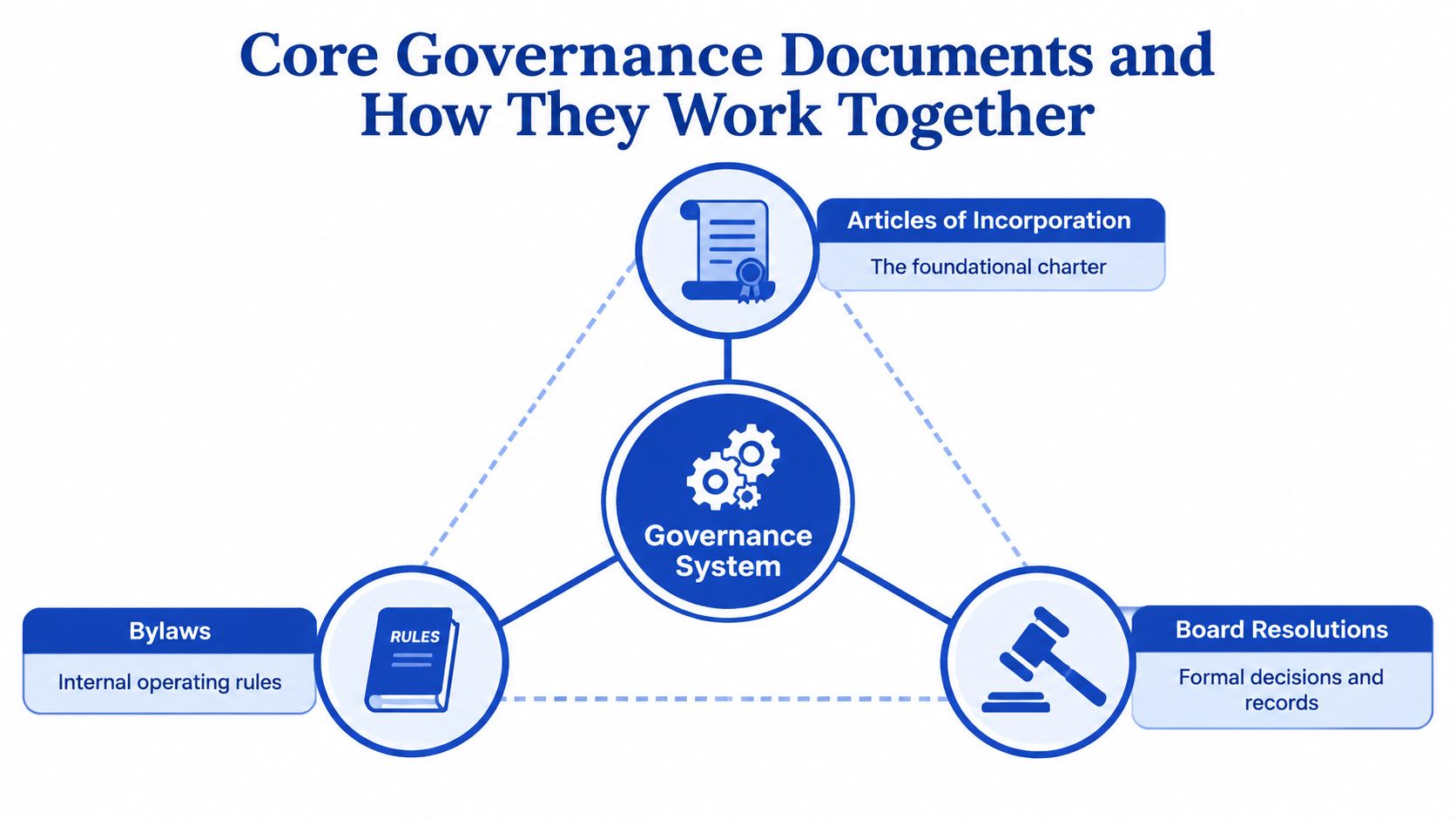
Governance documents work as a system, not a collection of independent templates. The articles of incorporation establish the company’s foundational structure. The bylaws allocate internal authority and describe procedures. Board resolutions record decisions that exercise that authority. Committee charters define delegated work, while operational policies translate legal and board-level expectations into employee behavior.
The weakness appears when those documents disagree. If the bylaws require a particular approval but a resolution uses a different process, the company has created an avoidable question about authority. If an expense policy assigns approval to a finance role that no longer exists, employees may follow an obsolete rule while executives assume an informal practice controls.
Build the architecture in order
A growing Washington company should first confirm its articles, bylaws, ownership records, and director appointments. Next, it should establish a board approval matrix that identifies which actions require board approval, shareholder approval, officer approval, or ordinary operational authorization. That matrix should reflect the governing documents rather than inventing a separate constitution.
A shareholders’ agreement may address transfer restrictions, voting arrangements, information rights, or founder matters. Companies considering those issues can review what a shareholders’ agreement does, then ensure its terms don’t conflict with the articles, bylaws, equity agreements, or board resolutions.
Connect documents to evidence
Every important governance rule should point to an observable action. A conflict-of-interest policy should produce a disclosure and recusal record. A cybersecurity policy should produce access reviews, incident tickets, or training records. An equity approval process should produce a signed consent, updated ledger, and supporting grant documents.
Version control matters because diligence reviewers compare documents across time. A company should maintain a controlled repository with dates, approval status, superseded versions, and a clear owner. Email threads can support a record, but they’re a poor primary system because they scatter approvals and make it difficult to determine which version governed a decision.
A useful test is simple: choose a recent material decision and trace it backward. The company should be able to identify the decision-maker, authority, information considered, conflict handling, approval, implementation, and follow-up. If any link is missing, that gap deserves priority over another round of template drafting.
Building a Compliance Program That Actually Works
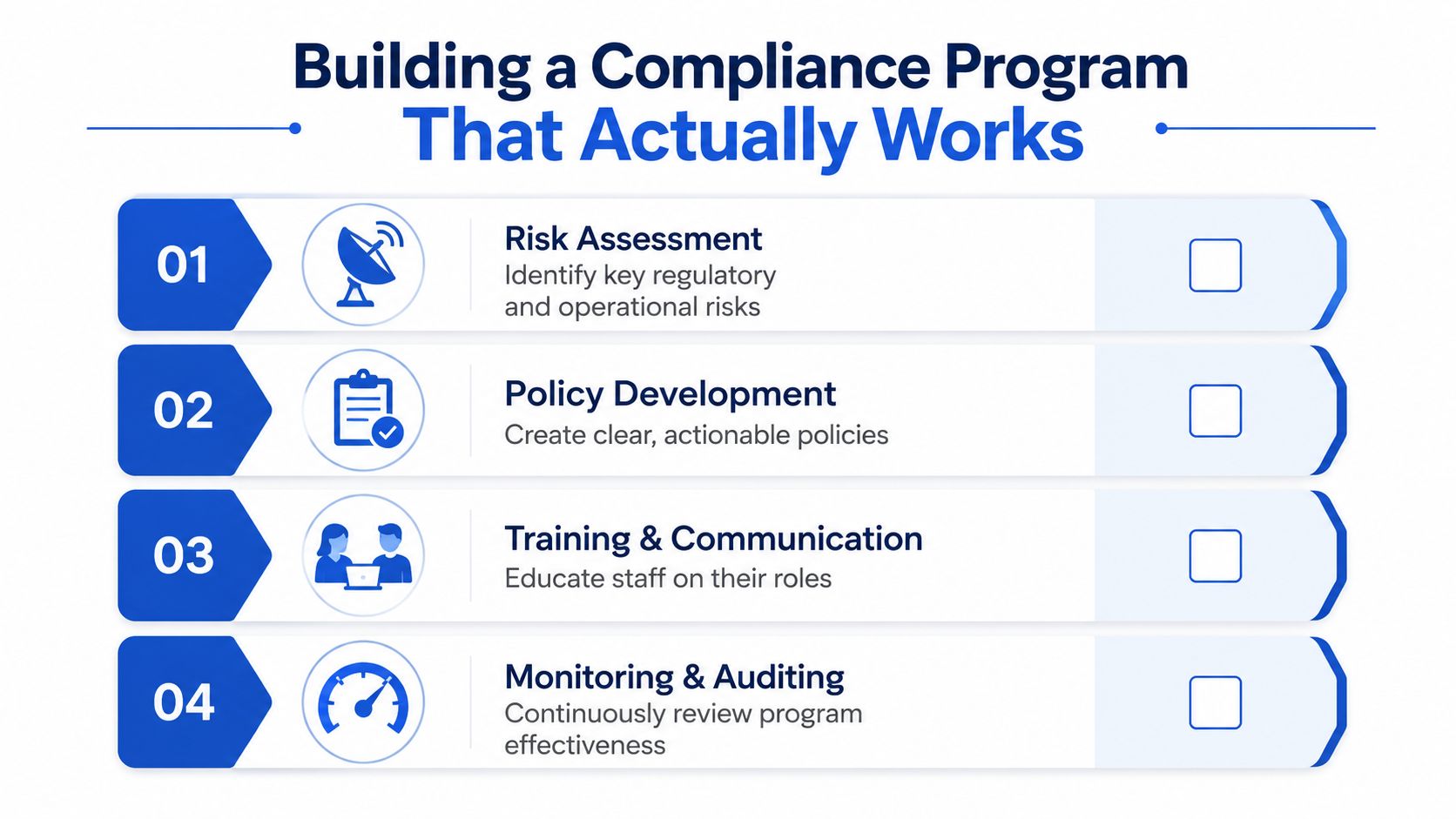
A functional compliance program starts with risk, not paperwork. A Seattle software company handling customer data has a different priority order from a construction business managing subcontractors, a healthcare technology company handling sensitive information, or a consumer brand using a network of franchisees. The company should identify the obligations that can cause the greatest legal, financial, operational, or reputational harm, then build controls around those obligations.
Assess the actual exposure
Risk assessment should identify who owns each risk, what event would trigger action, which control addresses it, and what evidence proves the control operated. For cyber and privacy matters, the inventory may include systems, vendors, data categories, access permissions, retention practices, incident response roles, and customer commitments.
Washington technology companies often fail by separating legal compliance from engineering reality. A privacy policy that doesn’t match product behavior creates risk. A security policy that no engineer can follow creates false comfort. Legal, finance, security, and operations should agree on controls that fit the company’s workflows.
Turn policies into controls
A policy should answer four questions:
- Who acts: Name the responsible role, not merely “management.”
- What happens: Describe the approval, review, training, reporting, or escalation step.
- When it happens: Tie the action to a recurring schedule or triggering event.
- What proves it: Identify the record, ticket, report, or sign-off retained as evidence.
Monitoring should be proportional. A small company may use a central compliance calendar, access-review checklist, contract repository, incident log, and board reporting packet rather than purchasing a large platform. The objective is reliable execution, not an impressive technology stack.
Treat AI as a current governance issue
AI governance now belongs on the board’s risk agenda when employees, vendors, or products use AI systems. The practical controls include an inventory of systems, risk classification for use cases, approved and prohibited data inputs, human review requirements, vendor diligence, documentation, incident escalation, and a clear owner for each deployment.
Recent independent reporting cited in the provided research states that a 2026 survey found 55% of enterprises actively deploying AI while 26% said their governance frameworks were fully aligned with implementation pace (2026 AI governance reporting). The same verified reporting describes gaps involving centralized AI inventories, use-case risk classification, ownership, and accountability. IBM also advised organizations to prepare AI inventories and conformity evidence ahead of the EU AI Act’s August 2026 milestones, as reported in that source.
A company can turn compliance into a strategic advantage by treating these records as operating infrastructure rather than an annual legal exercise. For Seattle companies building or deploying AI, legal guidance on compliance programs can help connect risk assessment, employee training, monitoring, and incident response to the company’s actual product and vendor environment.
Implementing Governance Procedures in Lean Teams
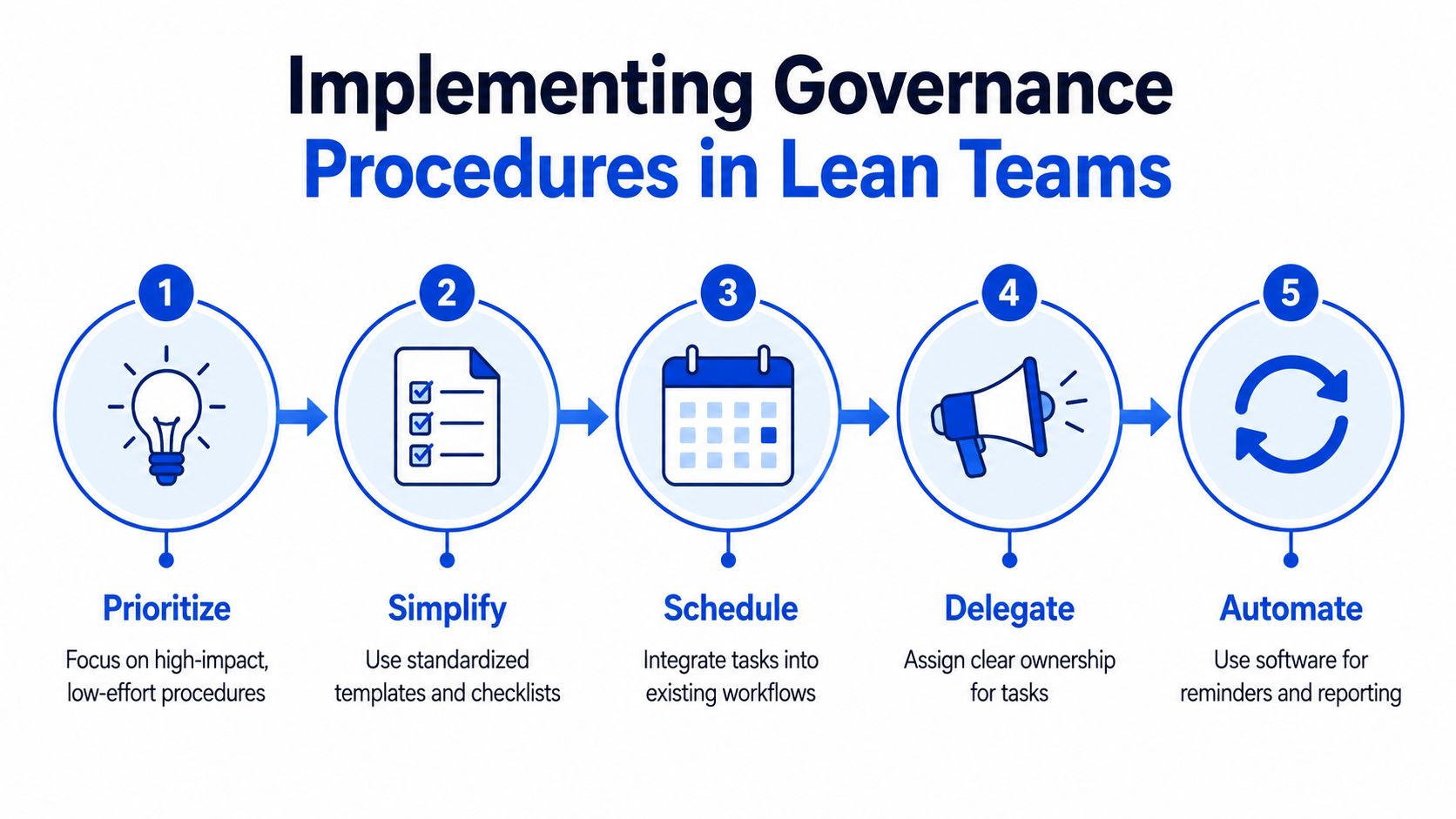
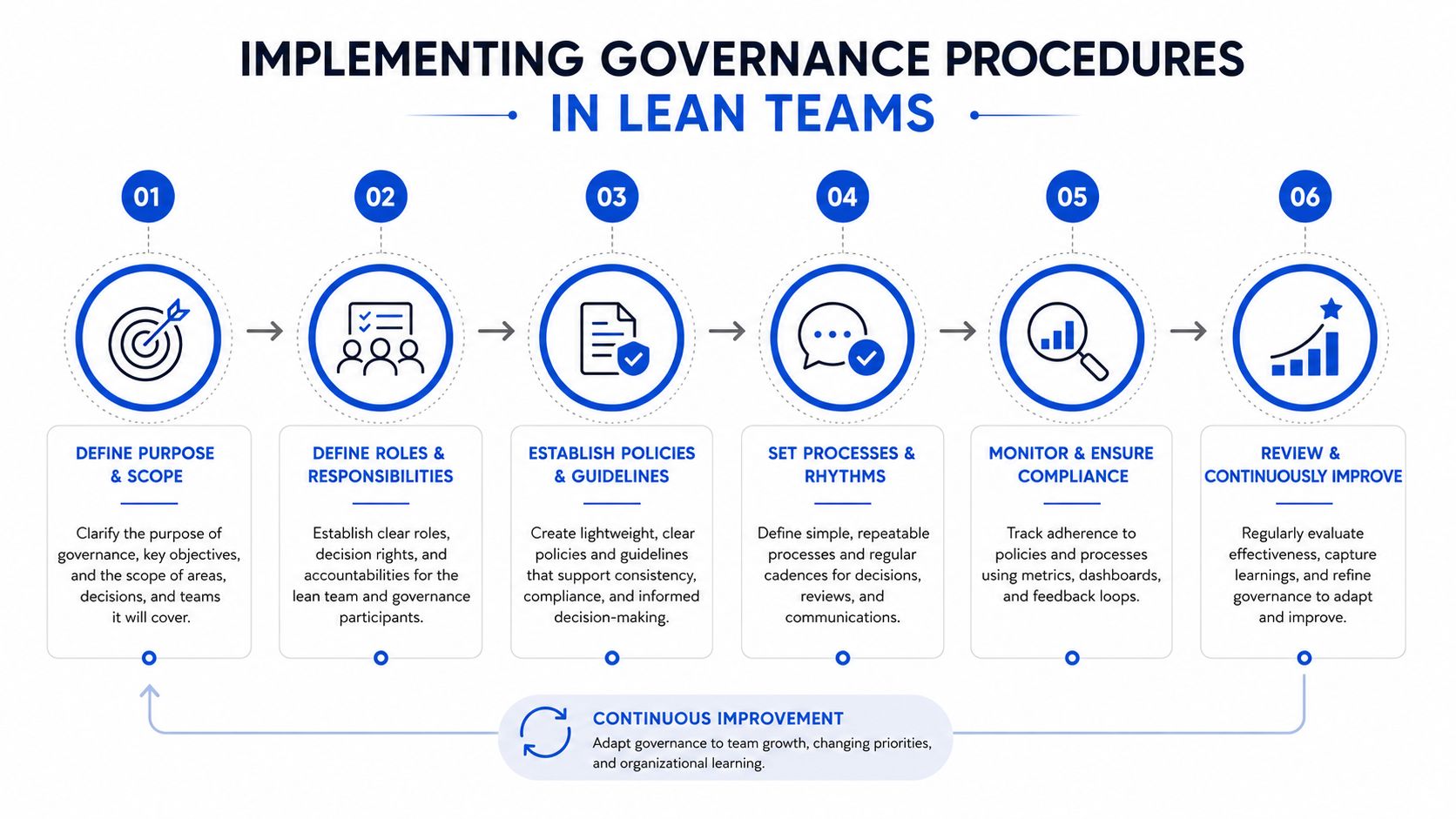
Lean governance works when it fits inside existing operating rhythms. It fails when founders create a second administrative universe that depends on someone remembering to update it. A company without dedicated compliance staff can still build durable procedures by assigning ownership, using recurring meetings, and collecting evidence at the moment work occurs.
Start with a minimum viable operating cycle
The first cycle should establish a regular board or manager meeting cadence, a consistent agenda, decision-focused minutes, and an action register. The agenda should include material financial matters, legal and compliance risks, conflicts, major contracts, security or privacy events, and decisions requiring formal approval. Minutes should record the decision, the key rationale, abstentions or recusals, and assigned follow-up.
The next step is an approval workflow. Create a simple matrix for hiring executives, issuing equity, signing material contracts, borrowing money, entering related-party arrangements, changing banking authority, and responding to significant incidents. The matrix should state who prepares the decision, who reviews it, who approves it, and where the evidence is saved.
Make evidence collection automatic where possible
A lean company can use tools already present in its business:
- Calendar systems: Schedule board meetings, policy reviews, license renewals, training, and access reviews.
- Task platforms: Assign owners, due dates, dependencies, and escalation status.
- Document repositories: Store approved policies, resolutions, minutes, registers, and superseded versions.
- Ticketing systems: Capture incidents, remediation steps, approvals, and closure evidence.
- Finance systems: Preserve approval trails for payments, expenses, vendors, and delegated authority.
The tool matters less than the discipline. A well-designed platform with no accountable owner produces less reliable evidence than a modest system that employees use consistently.
Anticipate the stalls
Founder resistance often comes from a fear that governance will slow decisions. The answer isn’t to eliminate controls. It’s to create fast paths for low-risk decisions and reserve formal review for actions that affect ownership, material obligations, conflicts, security, privacy, or strategic direction.
Tool fragmentation creates a different problem. If the board materials live in one system, contracts in another, and incident records in private messages, no one can assemble a reliable account later. A single governance owner should maintain the index, even when different teams retain the underlying records.
Implementation rule: Every recurring governance task needs an owner, a deadline, a defined output, and a place where the output is retained.
What Investors and Regulators Actually Look For
A founder may expect diligence to focus on growth, product, and revenue. Legal reviewers usually begin with authority and ownership. They want to know whether the people who issued shares had authority, whether the capitalization table matches signed documents, whether intellectual property belongs to the company, and whether material contracts contain restrictions that affect the transaction.
Consider a representative Puget Sound financing. The investor asks for board consents, equity records, founder assignments, conflict disclosures, and privacy or security materials. The company delivers a polished governance policy but can’t produce evidence that directors approved prior issuances or that contractors assigned inventions. The investor may not reject the deal, but the missing records can lead to special conditions, escrow, remediation obligations, or a slower closing.
An acquirer evaluates the same facts differently. It may ask whether a subsidiary, parent, or affiliate approved the contract, whether a customer can terminate after a change in control, and whether the company has documented compliance with its promises. A small inconsistency can become a negotiation issue because the buyer must price unknown exposure.
Regulators also care about implementation. The OECD’s risk-management guidance treats risk management as a core board-level control and states that governance should ensure risks are understood, managed, and communicated when appropriate (OECD risk management and corporate governance guidance). That principle translates into practical questions: Who received the warning? What did they decide? What control existed? What remediation followed?
Cross-border reporting illustrates the same expectation. In the UK, companies above specified employee, turnover, and balance-sheet thresholds must include a corporate governance statement in the directors’ report for financial years beginning on or after 1 January 2019 (UK Companies Miscellaneous Reporting Regulations). The requirement also applies to qualifying subsidiaries, not only parent companies or listed issuers (UK government reporting guidance). In Hong Kong, listing rules require issuers to include a board-prepared Corporate Governance Report in annual reports, and failure to include required information is treated as a breach of the Exchange Listing Rules (Hong Kong Listing Rules Appendix 14).
Common Governance Mistakes and How to Avoid Them
The most damaging mistake is treating governance as a document-production project. A company drafts a conflict policy, approves it, and never asks whether directors and officers disclose conflicts. It adopts an incident response plan, but employees don’t know who receives the report. It creates a board calendar, then records only conclusory approvals.
A 2025 GRC survey illustrates the execution gap. 93% of organizations reported having a corporate governance framework or policy document, but only 52% had governance procedures and 42% had a governance manual (2025 GRC survey). The same survey reported average compliance management of 2.9 out of 4, with improvement needed in risk-based controls, systematic monitoring and reporting, sanctions management, and fulfillment of board and executive duties.
The shortcuts that create exposure
- Rubber-stamp approvals: Replace conclusory minutes with a short decision record that identifies the materials reviewed, questions raised, conflicts, and follow-up.
- Undisclosed interests: Require annual and event-driven disclosures, then record recusals and the independent approval path.
- Broken formalities: Reconcile the articles, bylaws, resolutions, ownership ledger, officer appointments, and actual practices before a financing or acquisition.
- Policy drift: Assign an owner and review trigger to every material policy. Update the procedure when the product, vendor, law, or risk changes.
- Founder-only knowledge: Convert informal knowledge into checklists and delegated responsibilities so the company can operate if a founder is unavailable.
- Scattered evidence: Maintain an indexed repository that links each control to its supporting record.
Lean companies don’t need ceremonial bureaucracy. They need enough structure to show that the right person made an informed decision, handled conflicts fairly, followed the applicable rule, and preserved the evidence.
By Design Law Firm & Legal Consultancy, PLLC helps Washington startups and Puget Sound businesses build governance systems that connect corporate documents, board processes, compliance programs, cybersecurity, privacy, and AI oversight to daily operations. Visit By Design Law Firm & Legal Consultancy, PLLC to discuss the governance gaps that should be addressed before the next financing, audit, major contract, or growth event. Call our law office today at (206) 593-1519.