A founder signs a SaaS agreement late at night because the vendor offers a discount if the contract is executed before morning. The service looks inexpensive, the sales team needs access, and nobody has time to study the renewal section. Twelve months later, the business discovers that the agreement renewed automatically, cancellation required notice during a narrow window, and the company is committed to another term it no longer needs.
That outcome isn't bad luck. It's the predictable result of treating business contract review as a one-time legal chore instead of an operating process. A contract can protect cash flow, preserve negotiating advantage, and clarify accountability, but only when the business knows what enters the review queue, who owns each decision, and which issues require legal judgment.
Why Smart Founders Treat Contract Review as a System
The SaaS example exposes a common failure. The founder focused on the immediate commercial benefit, the quarterly discount, and ignored the obligation that mattered later, the automatic renewal. No one logged the renewal date, assigned an owner, or tested whether actual usage justified another term. The contract did exactly what it said it would do.
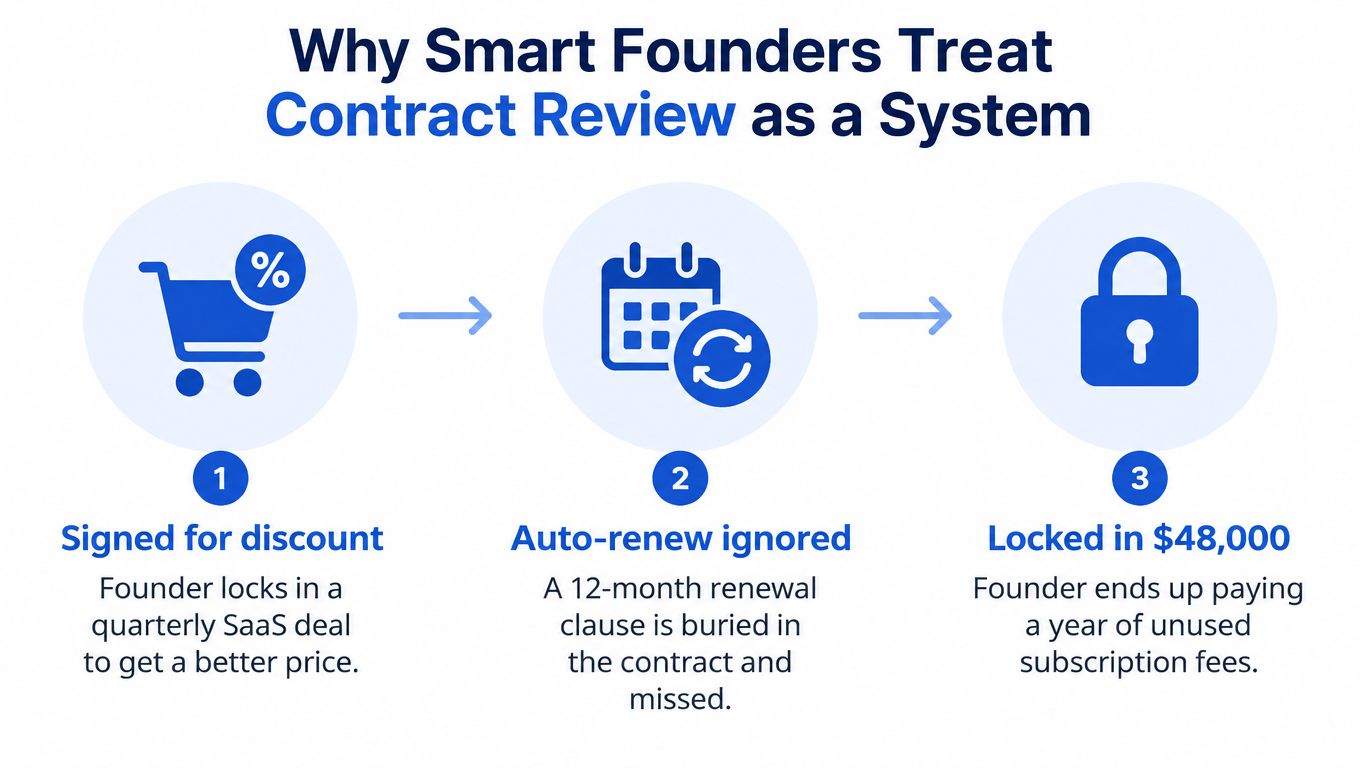
A repeatable system prevents this kind of failure through four operating disciplines:
- Defined intake: The requester records the counterparty, business purpose, deadline, estimated value, data access, and requested term before review begins.
- Risk-based routing: Standard NDAs and approved order forms move through a faster lane. Non-standard liability, IP, privacy, or termination language goes to the right reviewer.
- Clause standards: The business maintains preferred language and fallback positions instead of renegotiating the same point from scratch.
- Post-signature ownership: One named person tracks deliverables, invoices, renewal notices, insurance certificates, data returns, and termination obligations.
Contracts are operational infrastructure. A vendor agreement controls spending and service continuity. A customer agreement determines revenue rights, acceptance, support duties, and liability exposure. A contractor agreement affects ownership of work product and confidential information. Each document either compounds risk or compounds optionality, depending on whether the company can manage it after signature.
Practical rule: A contract isn't complete when it gets signed. It's complete when the business can find it, explain its obligations, and act before its deadlines.
Smaller companies don't need a heavyweight legal department to build this discipline. They need an intake form, a shared repository, a simple approval matrix, and a contract owner. A business reviewing staffing arrangements can also benefit from understanding attorney staffing contract details before assigning responsibility for review and administration.
The economics justify the effort. A widely cited benchmark that analyzed more than 700 organizations placed the average cost of processing a basic everyday contract at $6,900, a mid-complexity contract at $21,300, and a high-complexity contract at $49,000 (contract review cost benchmarks). Those figures aren't a reason to automate judgment away. They're a reason to stop spending expensive human attention on preventable intake errors, missing schedules, and repeated negotiations.
The Clauses That Drive the Most Contract Risk
The highest-risk language usually appears in familiar sections. The problem isn't that founders never see these clauses. The problem is that they accept vague wording because the headline price looks acceptable.
Scope and money come first
Scope of work determines what the business receives and what the vendor can later claim falls outside the deal. The review should tie deliverables to milestones, acceptance standards, dependencies, and a written change-control process. A useful redline is: “Any change to scope, timeline, or deliverables requires a written change order signed by both parties, including the resulting price adjustment.”
Payment terms control cash flow and commitment. The contract should identify currency, taxes, invoicing dates, usage measures, minimum commitments, late fees, and price increases. A safer replacement for open-ended escalation is: “Fees may increase once per renewal term by no more than the increase in the Consumer Price Index, and only after advance written notice.”
Liability and ownership decide the downside
A liability cap should relate to the economic size of the deal. A practical opening position is: “Each party's aggregate liability is capped at the fees paid or payable during the prior twelve months,” with carefully negotiated treatment for confidentiality breaches, data security failures, IP infringement, fraud, and gross negligence. A cap that applies only to one side, or that excludes every meaningful risk, isn't a real cap.
Indemnity should address who handles third-party claims, what losses qualify, who controls the defense, and whether settlement requires consent. For a software vendor, a focused position might read: “Vendor will defend and indemnify customer against a third-party claim alleging that the services infringe intellectual property rights.” Washington businesses should pay particular attention to the allocation of defense and loss because indemnity clauses in Washington State contracts can shift exposure far beyond the contract price.
IP ownership must distinguish pre-existing materials, newly created work product, customer data, and embedded tools. If the customer is paying for custom deliverables, the agreement should state that ownership transfers upon final payment, while the vendor retains only the pre-existing materials needed to deliver the work.
Termination needs cause, cure periods, convenience rights, notice mechanics, renewal treatment, data return, and transition assistance. A company should not discover after a failed implementation that it can terminate only after a prolonged cure period while continuing to pay.
| Clause | Risky Language | Preferred Redline |
|---|---|---|
| Scope | “Services as requested from time to time” | List deliverables, milestones, acceptance criteria, and written change control |
| Liability | “All liability is unlimited” | Cap aggregate liability at prior twelve months of fees, with specific negotiated carve-outs |
| Indemnity | “Customer indemnifies vendor from all claims” | Make indemnity mutual and limit it to defined third-party claims |
| IP | “Vendor owns all materials created in connection with services” | Assign paid-for work product to the customer and reserve only pre-existing tools |
| Termination | “Renews automatically unless notice is provided” | Require advance notice, a clear non-renewal window, and usable exit rights |
| Warranty | “Services provided as is, with no warranties” | Add conformity to specifications, professional performance, and stated service levels |
Confidentiality should define permitted use, exclusions, compelled disclosure, security expectations, and survival after termination. Warranty disclaimers deserve equal scrutiny. If a vendor disclaims every promise while retaining payment rights, the customer may have no practical remedy when the service fails.
Red Flags Worth Walking Away From
A startup can negotiate imperfect language. It should decline a deal when the counterparty refuses reasonable risk boundaries, insists on unilateral control, or makes enforcement impractical. The practical test is simple: send one focused redline, then watch the response. A refusal is a business signal, not merely a drafting disagreement.
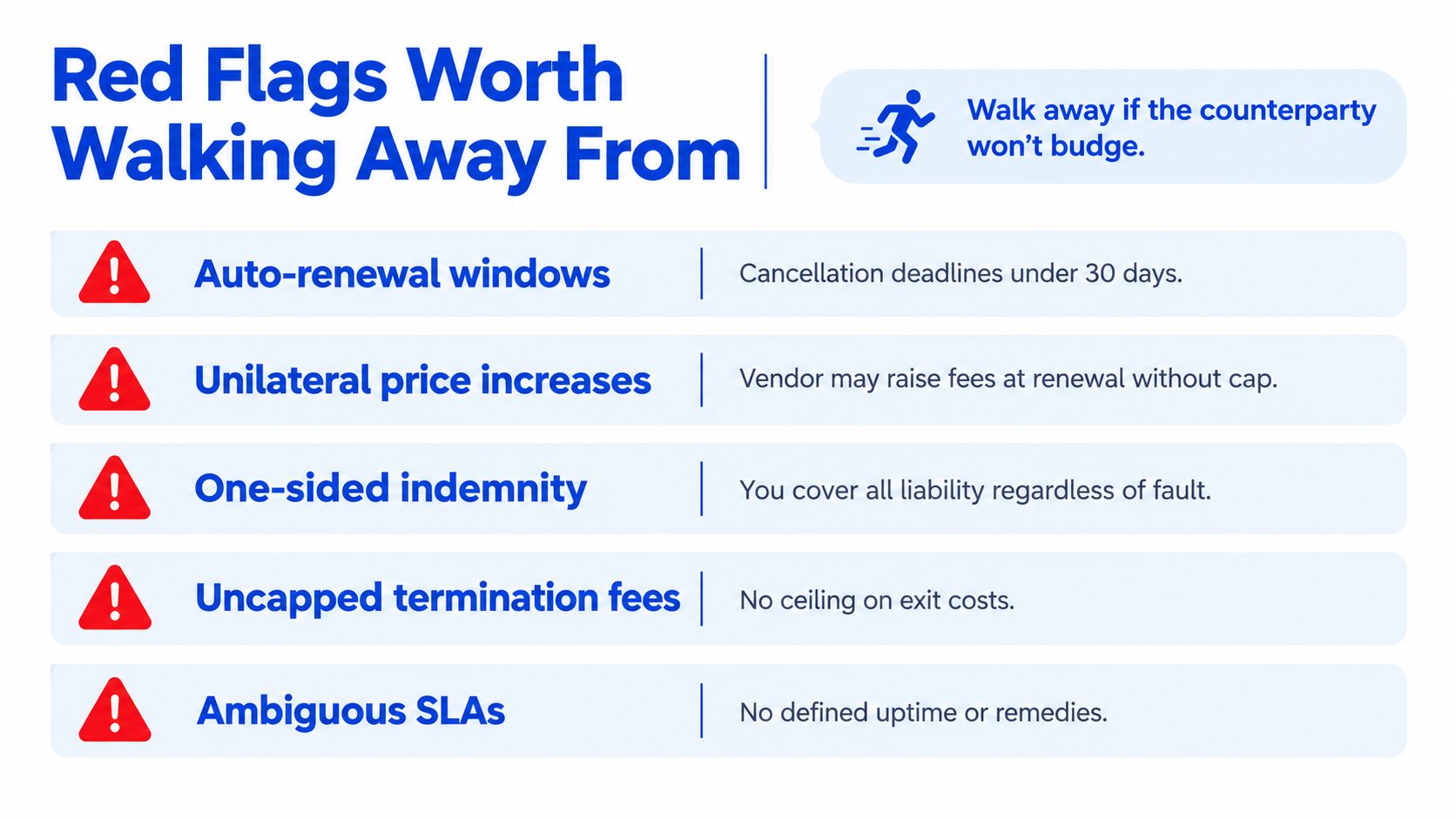
Use a walk-away checklist for each contract:
- Website-based amendments: Require written approval for material changes. An online policy cannot give the counterparty a standing right to rewrite the bargain. If the business must accept updated policies, demand advance notice and a termination right before an adverse change takes effect.
- One-sided indemnity: Reject coverage for claims caused by the other party's negligence, misconduct, or breach. Limit indemnity to defined third-party claims and tie each party's obligation to its own acts.
- Home-court venue: A distant forum can make a valid claim too expensive to pursue. Request a neutral venue or one connected to the customer and transaction.
- Broad assignment rights: Require consent before transfer to an unknown party, with a narrow exception for a merger or sale of substantially all assets.
- Hidden exclusivity: Search the master agreement, order form, and incorporated policies for exclusivity, most-favored-nation pricing, minimum spend, or restrictions on working with competitors.
- Uncapped exit costs: Require a defined ceiling and a clear calculation method. A termination formula that leaves the amount open is not an exit right.
Formation language also deserves escalation. Under Washington contract law, the mirror-image rule for contract formation can treat a counteroffer as a rejection, so do not assume that silence or continued discussions establish acceptance. Make the final offer, acceptance method, incorporated documents, and order of precedence explicit.
The distinction between seat and venue matters in arbitration. The seat supplies the legal foundation of the arbitration and identifies the court with supervisory jurisdiction, while the venue is the physical hearing location (arbitration seat and venue distinction). State the governing law clearly, including the law governing the arbitration agreement. An analysis of the English approach explains that the law of the seat generally fills that gap when the parties have not expressly chosen another law (governing law of arbitration agreements).
Set an escalation rule before negotiations begin. If the counterparty refuses a reasonable liability boundary, rejects mutual indemnity, or keeps unilateral website amendments after one focused redline, send the draft to counsel or decline the deal. Do not let a founder's urgency turn a known exception into an operating liability.
If one clause could cost more than walking away, the business is deciding whether the deal is worth the exposure.
Broad indemnification, unlimited liability, restrictive termination rights, and exclusive jurisdiction requirements warrant serious scrutiny rather than automatic acceptance (business contract red flags). Automatic renewals and unclear exit rights also deserve a documented decision because they can keep the company bound after the commercial relationship has stopped working (automatic renewal and termination red flags).
A Repeatable Business Contract Review Workflow
A startup or mid-sized company without in-house counsel can review contracts consistently, even under deadline. The operating model is simple: route each decision to the person closest to the risk, document the decision, and escalate exceptions before anyone signs.
Five gates create accountability
- Intake triage, owned by operations. Log the contract, identify the business sponsor, record the deadline and commercial value, and flag data access, unusual commitments, and incorporated policies.
- Standard versus non-standard routing, owned by operations with finance input. Send an approved template through the standard lane. Route deviations involving liability, IP, privacy, exclusivity, or unusual payment commitments to the right reviewer.
- Clause-level risk scoring, owned by the functional reviewer. Finance checks price, billing, minimum spend, and renewal economics. The business owner checks scope and deliverability. A technical or security lead checks access and data controls.
- Redline drafting, owned by the person with negotiation authority. Use approved language, record fallback positions, and distinguish legal protections from commercial concessions.
- Final sign-off, owned by the founder or general manager. Confirm that the final draft reflects the negotiated position, every exhibit is attached, and the signer has actual authority.
Set escalation triggers before pressure arrives. Unlimited liability, IP assignment, a non-compete, unusual data obligations, or a multi-year commitment should go to outside counsel. A first-time vendor relationship that creates material operational dependency deserves the same review, even when the price appears manageable.
Store the signed version, negotiation history, key dates, owner, approved exceptions, and related schedules in a lightweight repository. That record creates usable precedent. It shows which positions routinely succeed, which concessions cause problems, and which contract types need a revised template.
Teams exploring tools to automate contract review should use automation for intake, extraction, comparison, and routing. Keep the final judgment with an accountable reviewer. Software should not decide whether uncapped liability, a broad IP grant, or an unusual termination right fits the company's risk tolerance.
The workload justifies this structure. Survey data places contract review at about 3.1 hours per contract, while 52% of respondents said their organizations handle between 101 and 1,000 contracts annually (survey data on AI adoption in contract review). At 500 contracts, that equals roughly 188 working days of review. A queue with clear routing rules is more reliable than a founder's inbox.
Negotiation Tactics That Actually Move the Needle
A SaaS vendor sends a standard agreement with three familiar positions: unlimited customer liability, a vendor-only IP indemnity, and automatic renewal with an unrestricted price increase. The buyer shouldn't mark up every sentence. The buyer should focus the first redline on the provisions that can create disproportionate loss.
Start with the economic exposure
The vendor's clause might say: “Customer is responsible for all losses arising from use of the services.” The buyer's response should be direct: “Customer's aggregate liability will not exceed fees paid during the prior twelve months, except for losses caused by customer's fraud or intentional misconduct.” If the service processes sensitive information, the parties can negotiate a targeted data-breach carve-out rather than leaving every possible claim uncapped.
The vendor may counter with a higher cap or separate cap for security claims. That can be a reasonable compromise if the language defines the covered event, limits recovery to actual losses, and aligns with available insurance. The point isn't to demand a theoretical position that no vendor accepts. The point is to avoid an undefined exposure that could exceed the company's ability to survive.
Trade low-value concessions for real protection
A vendor's original indemnity may require the customer to defend every claim connected to the customer's use of the platform. The buyer should propose mutual protection limited to third-party IP infringement claims, with the vendor controlling defense subject to the customer's consent for settlements that impose an admission or ongoing obligation.
The buyer can offer faster payment, a reference permission, or broader internal reporting rights in exchange for that protection. Those concessions may cost little compared with uncapped risk. The negotiation should document each trade so the business doesn't give away a valuable right without receiving a meaningful safeguard.
Automatic renewal deserves equally concrete language:
“The agreement will not renew unless both parties confirm renewal in writing. If automatic renewal remains, either party may provide notice of non-renewal at least 30 days before the term ends, and renewal pricing may not increase beyond the agreed annual cap.”
The vendor might reject affirmative renewal because its billing system depends on continuity. A workable fallback is a clear notice period, an annual price cap, and a right to terminate if the vendor misses the notice obligation. Guidance on how to negotiate a contract can help the business prepare positions before the first redline.
Before sending edits, the buyer should document the BATNA, or best alternative to a negotiated agreement. That means identifying another vendor, a temporary workaround, or a decision to delay the purchase. A business without an alternative negotiates from fear. A business with a documented alternative can reject a bad clause without bluffing.
Scaling Review Without Adding Headcount
The most effective scaling move isn't asking existing staff to read faster. It's reducing the number of decisions that require fresh analysis.
A clause library stores approved language for liability caps, indemnities, confidentiality, data security, IP ownership, renewal, service levels, and termination. Each completed negotiation improves the library. The improvement compounds because the next reviewer starts with a position that already reflects the company's risk appetite and commercial experience.
A playbook then connects language to contract type and risk tier. It should identify must-have positions, acceptable fallbacks, prohibited terms, required approvers, and escalation triggers. A SaaS playbook might treat ordinary confidentiality and payment language as routine, while routing data-use rights, AI restrictions, training-data ownership, audit rights, subprocessor controls, human oversight, incident response, and termination assistance to legal or security reviewers.
Industry coverage has identified a gap between expected contract volume and staffing capacity. One 2025 survey cited only 29% of organizations using contract AI for analysis, risk assessment, or due diligence, while 79% expected contract volume to increase without more staff (2025 contract AI survey coverage). For startups and mid-sized businesses, that gap makes intake design and routing more important than buying a review tool.
| Risk Tier | Contract Type | Dollar Threshold | Reviewer | Escalation Trigger |
|---|---|---|---|---|
| Low | Approved NDA or standard SaaS order | Under the company's approved low-risk limit | Operations or procurement | Non-standard confidentiality, data use, or renewal terms |
| Medium | Supplier, customer, or services agreement | Within the operating budget but outside the template | Operations and finance | Material changes to liability, IP, payment, or termination |
| High | Strategic, multi-year, data-intensive, or custom technology deal | Above the company's approved escalation limit | Founder, finance, and outside counsel | Uncapped liability, IP assignment, cross-border data, or exclusivity |
The dollar thresholds should be set by the company's own cash position, insurance, and risk tolerance. They shouldn't be copied from another business.
Lightweight AI can compare a draft against the playbook, identify non-standard terms, extract renewal dates, and surface missing exhibits. ContractScrub's benchmark illustrates why human review remains necessary. Across 3,014 annotated tasks involving 44 contracts, the best model achieved only 0.750 macro-average recall, all evaluated models stayed below 0.650 F1, and performance was stronger on explicit lexical issues, about 0.835, than on context-dependent undefined-term checks, about 0.427 (ContractScrub benchmark). The sensible workflow is two-stage: automate obvious text-level checks, then send intent and consistency questions to a human reviewer.
Teams considering contract administration support can also review contract management best practices, particularly around repositories, ownership, obligation tracking, and renewal controls.
When to Bring in an Attorney and Your Next Steps
Outside counsel should enter before the company is committed, not after the counterparty threatens enforcement. The trigger isn't just contract length. It is the combination of exposure, novelty, dependency, and uncertainty.
Counsel should review any agreement involving a material multi-year commitment, cross-border parties, IP assignment, sensitive data, regulated activity, unusual insurance requirements, non-compete language, or a liability position the internal reviewer can't confidently revise. A contract can be short and still deserve legal attention if one sentence transfers an outsized risk.
| Contract Scenario | Risk Level | Recommended Action |
|---|---|---|
| Approved NDA with no unusual data or IP terms | Low | Use the approved template and log the executed copy |
| Standard SaaS order with known pricing and service terms | Low to medium | Operations reviews against the playbook and escalates exceptions |
| Customer or supplier agreement with custom scope and payment mechanics | Medium | Operations and finance review, with counsel for material deviations |
| Agreement granting or assigning IP | High | Require attorney review before signature |
| Contract containing unlimited liability or broad indemnity | High | Pause signature and require counsel-led redlining |
| Multi-year, cross-border, data-intensive, or strategically essential deal | High | Require outside counsel and executive sign-off |
A practical 30-day reset can be completed without rebuilding the company:
- Assemble the clause library. Collect the strongest existing language and label preferred, fallback, and unacceptable positions.
- Assign one contract owner. Give that person responsibility for intake, repository hygiene, renewal tracking, and escalation.
- Log every executed agreement. Record the counterparty, term, value, obligations, notice dates, owner, and approved exceptions.
- Schedule quarterly audits. Review upcoming renewals, unused services, price changes, open deliverables, and expired insurance or certifications.
- Rehearse escalation. Make sure operations, finance, technical staff, and leadership know exactly when a contract stops being routine.
Legal teams reviewing narrowly scoped extraction tasks can use attorney-validated answers and sampled agreement cases as a quality-control model. Harvey’s benchmark methodology structured review around 22 to 37 data points per contract type, used transactional attorneys and independent legal researchers to resolve disagreements, and reported a cost comparison of roughly $74 per contract for a junior lawyer versus about $0.02 for the fastest LLM on the same task (contract review benchmark methodology). Those figures don’t eliminate legal judgment. They reinforce the business case for reserving attorney time for exceptions, negotiation, and high-risk decisions.
By Design Law Firm & Legal Consultancy, PLLC provides contract drafting, review, negotiation, and practical support for vendor, customer, technology, and data-related agreements. Founders and growing companies can visit By Design Law Firm & Legal Consultancy, PLLC to discuss a repeatable review workflow, targeted redlines, and escalation support before a risky contract reaches signature. Contact our law office at (206) 593-1519.