Most contract advice tells founders to negotiate harder, trade concessions, and celebrate a lower headline price. That advice misses the expensive part. A contract can look favorable on signing day and still lose value through uncontrolled renewals, vague deliverables, weak indemnity language, unusable intellectual property, and exit rights that work only on paper.
A better answer to how to negotiate a contract starts with a different objective: protect the value the agreement is supposed to create after the ink dries. That means preparing carefully, using credible benchmarks, allocating risk deliberately, documenting every change, and making sure the business can manage the deal long after legal teams leave the room.
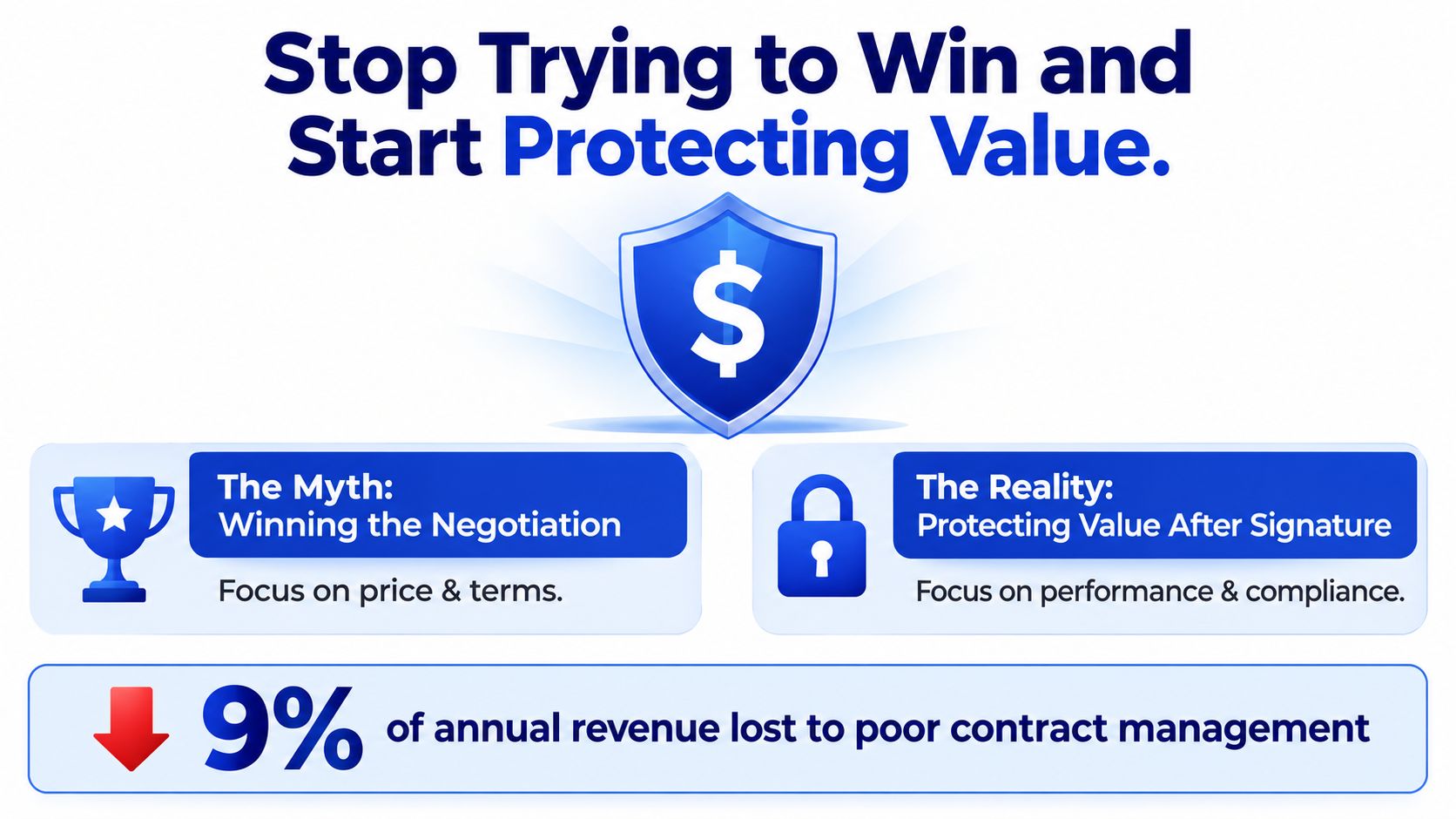
Stop Trying to Win and Start Protecting Value
“Winning” a negotiation usually means getting a concession the other side didn't want to give. That can be satisfying, but it isn't the same as creating a durable contract. A 2025 contracting report found that 90% of CEOs believe their companies leave money on the table during contract negotiations, while 82% of CFOs agree negotiations don't create the value they should. The same report says nearly 40% of legal operations leaders evaluate contract programs using business measures such as revenue and cost savings, rather than legal efficiency alone. The 2025 State of Contracting report summary supports a practical conclusion: price concessions matter, but contract performance matters more.
A founder who spends the meeting chasing a modest discount may overlook an automatic renewal, a broad vendor license, or an uncapped data-loss obligation. Another negotiator may accept the quoted price while tightening renewal mechanics, defining acceptance criteria, limiting liability, and securing a usable termination right. The second negotiator may have “won” fewer visible concessions, but may protect substantially more value over the contract's life.
Define value before discussing concessions
Value protection is a measurable contracting objective. It includes:
- Capped liability, so one operational failure doesn't threaten the company beyond an agreed risk boundary.
- Defined IP ownership, so the business receives the rights it paid for and can keep using the deliverables.
- Controlled renewal, so the relationship doesn't continue by accident or at an unreviewed price.
- Enforceable exit rights, so the company can respond to chronic underperformance, security concerns, or a strategic change.
These terms require more than aggressive bargaining. They require the business team to identify what could leak value, the legal team to draft a workable remedy, and the contract owner to monitor performance afterward. Founders looking for a broader operational approach can also review resources on how to improve team productivity with Voice Control Pro when internal coordination is slowing approvals and contract review.
A contract negotiation is therefore a business design exercise. Preparation establishes the objective, BATNA protects against panic concessions, clause tactics allocate risk, redlines preserve the record, and sign-off discipline prevents unauthorized commitments. A practical starting point for drafting and negotiation support is By Design Law's contract drafting and negotiation service, particularly where a commercial agreement affects technology, data, IP, or long-term operating flexibility.
Practical rule: A concession is valuable only if the business can use it, measure it, and enforce it after signature.
Preparing Your Negotiation Playbook
Preparation should produce a written playbook before the first negotiation call. The meeting is where positions are exchanged. The work that determines the outcome happens earlier, when the team decides what matters, what can move, and what ends the discussion.
Start with an objective sheet. Record the financial target, three must-have clauses, two tradeable points, and the walk-away position. The walk-away position should be specific enough that an executive can approve it without reopening the entire analysis. “Get better protection” isn't a position. “No uncapped liability for ordinary service failure” is.
Build the evidence file
Use the company's own contracts as a clause inventory. Pull the last five agreements of the same type, identify the standard language, and tag every deviation. This shows whether the proposed draft is unusual or different from the company's preferred form.
Benchmark the deal using comparable terms, not the counterparty's opening draft. Effective price analysis should normalize unit rates and then account for total contract value, commitment length, payment terms, geography, and bundled support tiers. Historical discounts can mislead because a vendor may reset pricing at renewal. Guidance on IT contract benchmarking explains why current market rates should anchor the ask.
The benchmark-to-playbook process is straightforward: define the objective, isolate clauses that drive risk and value, collect comparable data, investigate outliers, and convert findings into fallback positions and escalation thresholds. A contract benchmarking workflow describes this progression as a way to replace intuition with evidence.
A 2025 academic study found that B2B organizations spend about 25% of their time on contract creation, 30% on negotiation, and 45% on review. It also found that a typical negotiation session includes an average of five people on each side, lasts about one hour, and is often followed by three hours of internal discussion involving five to seven participants. The study's reported negotiation statistics explain why a short call can generate a long approval cycle.
Map people and deadlines
List the economic buyer, legal reviewer, operational user, security contact, procurement lead, and executive sponsor on both sides. The executive sponsor may never attend the meeting, but that person can still stop the deal.
Set internal deadlines before the counterparty's deadline. Assign owners for pricing, security, implementation, legal terms, and final approval. Preparation isn't a document exercise. It is the company's protection against rushed concessions.
| Dimension | Your Objective | Their Draft | Gap |
|---|---|---|---|
| Commercial terms | Sustainable price and payment structure | Counterparty's price and billing schedule | Compare normalized effective price |
| Renewal | Deliberate renewal decision | Automatic continuation | Add notice, review, and pricing controls |
| Performance | Measurable deliverables and remedies | General service description | Define acceptance and service standards |
| Risk allocation | Proportionate liability and indemnity | Broad exclusions or one-sided risk | Narrow scope and align remedies |
| Ownership | Rights to paid-for work product and data | Vendor ownership or broad license | Separate background IP from deliverables |
Understanding BATNA, Position, and What You Can Trade
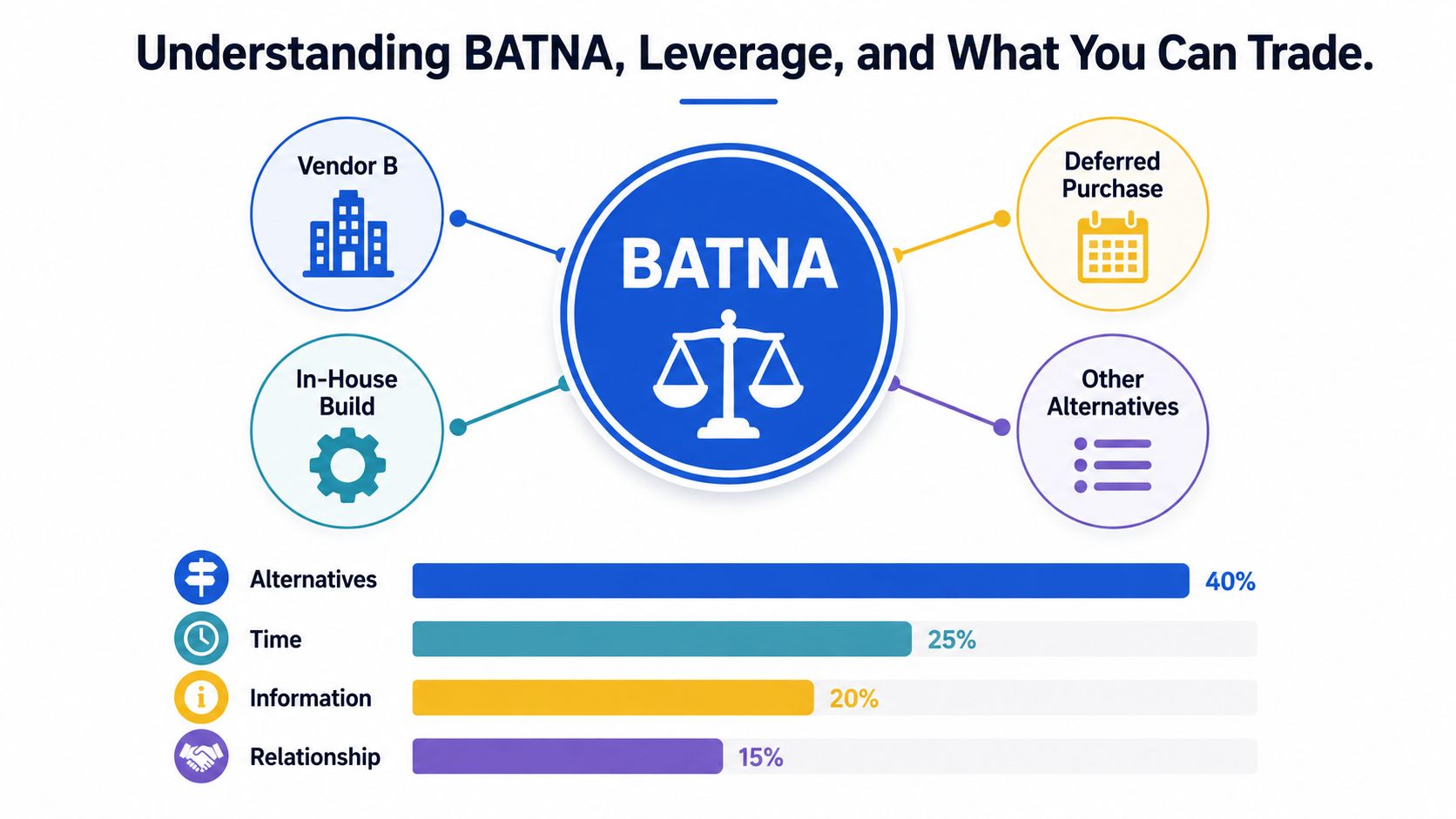
BATNA means Best Alternative to a Negotiated Agreement. It should be a ranked list of realistic options, tested against the same commercial, operational, and legal requirements. A vague sense that alternatives exist will not protect value after signing.
For a software purchase, options might include Vendor B, an in-house build, a delayed purchase, or a narrower implementation. Give each alternative an owner, a rough cost model, an implementation assessment, and the approvals needed to pursue it. An option that exists only in a slide deck will not support a credible decision to walk.
Measure your position without posturing
A company's position comes from facts that affect the other side's choices. Review five areas before the first call:
- Alternatives: How many credible substitutes can the business pursue?
- Expertise: Does the company understand the product, market, and technical risks well enough to challenge assumptions?
- Timing: Is the counterparty approaching a quarter close, while the buyer faces a renewal date or funding milestone?
- Switching cost: How difficult would it be for the other side to replace the company, its access, or its specialized capability?
- Information: Which side knows more about usage, costs, implementation requirements, and market terms?
A strong BATNA must be comparable to the proposed deal. A cheaper vendor with weaker security, limited integration, or unacceptable IP terms may fail the business's actual requirements. Compare the full contract package, including implementation burden, risk allocation, exit rights, and renewal exposure. Headline price alone can hide value leakage after signature.
Create disciplined trade-offs
Classify every open point as a firm requirement, tradeable concession, or nice-to-have. Firm requirements may include data ownership, a reasonable liability cap, governing law, or protection against misuse of confidential information. Tradeables could include payment timing, training, warranty scope, or support hours. Nice-to-haves may include branding rights or an extended support window.
Assign each issue a numerical weight internally, even if the number never appears in the negotiation. A high-weight data-use restriction should not be exchanged for a low-weight formatting preference. The purpose is practical. It keeps an exhausted team from surrendering several important protections for one visible concession.
A SaaS buyer might offer a longer payment term for stronger IP indemnity and an express termination-for-convenience right. If the vendor keeps broad liability exclusions and rejects a workable exit, the buyer's BATNA should determine whether the deal still protects value.
A trade is not balanced because both sides changed language. It is balanced when each side receives something that matters to its business.
Clause-by-Clause Tactics That Hold Up Over Time
The clauses that create the most post-signature trouble are often the ones that receive the least attention during price negotiations. Renewal, indemnity, IP, liability, and performance language should be reviewed as a connected risk system.
Renewal and effective price
Automatic renewal clauses commonly require notice 30, 60, or 90 days before expiration, while enterprise agreements may require 180 days or more. Renewal clause guidance from Sirion illustrates why the calendar matters. A missed notice deadline can preserve an unwanted relationship and undermine price negotiations.
A stronger provision might read:
“The Agreement will not renew automatically. The parties will begin good-faith renewal discussions 90 days before expiration, and neither party is required to renew unless the parties agree to replacement terms in writing.”
If automatic renewal remains, require a defined notice period, a written pricing mechanism, and a renewal term that the business can manage. Normalize the effective price by unit, commitment, payment timing, region, and support tier. A discount that disappears at renewal isn't durable value.
Indemnity
Indemnity should identify the protected party, the covered claim, control of defense, settlement restrictions, and the remedy. A buyer commonly seeks protection for third-party IP infringement, confidentiality breaches, and serious misconduct. The scope should be mutual where the parties create comparable risks.
A useful redline might say:
“Provider will defend, indemnify, and hold harmless Customer from third-party claims alleging that the Services or deliverables infringe intellectual property rights, and will pay resulting damages, settlements approved in writing by Provider, and reasonable attorneys' fees.”
The phrase defend, indemnify, and hold harmless does different work from a promise merely to defend. The agreement should also address what happens if continued use becomes impossible, such as obtaining a license, replacing the affected material, or refunding fees.
For Washington businesses, counsel should evaluate how indemnity interacts with the agreement's governing law, insurance, and liability provisions. A focused resource on the importance of indemnity clauses in Washington State contracts can help identify issues requiring legal review.
IP ownership and liability
Work product should belong to the party paying for it when the commercial arrangement calls for bespoke deliverables. The contract should distinguish vendor background IP from newly created work product and grant a perpetual license fallback if ownership cannot transfer.
A practical provision could state:
“Customer owns the deliverables created specifically for Customer under this Agreement upon payment. Provider retains ownership of pre-existing materials and grants Customer a perpetual, irrevocable, worldwide, transferable license to use any Provider materials incorporated into the deliverables.”
For limitation of liability, establish a clear cap and define carve-outs carefully. The cap may be tied to fees paid over an agreed lookback period, while super-cap or uncapped exposure may apply to narrowly defined IP infringement, confidentiality breaches, fraud, or gross negligence.
Reject language stating that “consequential damages” are waived if the definition or drafting effectively waives direct damages such as paid fees, remediation costs, or replacement expenses. The remedy needs to match the risk.
| Clause | Weak Default | Stronger Redline | Why It Matters |
|---|---|---|---|
| Renewal | Automatic renewal with unclear notice | Written renewal discussion and defined pricing | Prevents accidental continuation |
| Indemnity | One-sided defense promise | Defined defend, indemnify, and hold harmless obligation | Makes the remedy usable |
| IP | Vendor owns all materials | Customer owns bespoke deliverables, vendor retains background IP | Preserves operational freedom |
| Liability | Broad cap with hidden exclusions | Clear cap and narrow, matched carve-outs | Aligns exposure with risk |
| Price | Headline discount | Normalized effective price and renewal control | Protects value beyond signing |
Redlines, Scripts, and the Track Changes Workflow
Microsoft Word Track Changes remains the dominant method for exchanging commercial contract edits, with one survey-based source reporting that 92% of contract professionals prefer it. Commercial contract redlining guidance distinguishes redlines, which display edits during negotiation, from blacklines, which compare versions and show only differences.
A clean workflow starts with a saved baseline. Open the document in Word, enable Track Changes, select All Markup, make the Reviewer Pane visible, and preserve the original formatting. Use comments to explain material changes rather than burying rationale inside the text. Rename each file with the date and version, and never overwrite the last circulated draft.
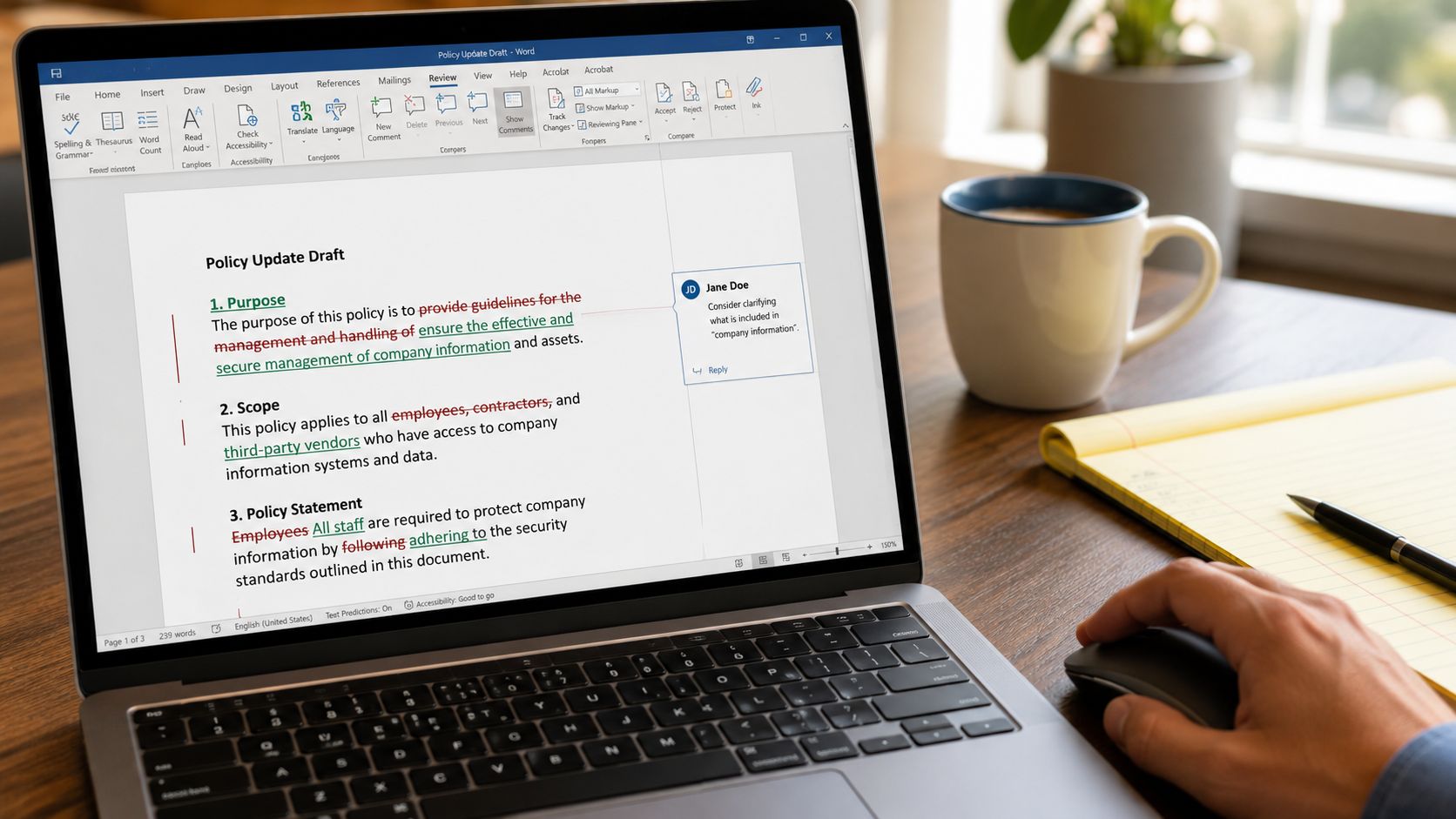
A redline lets counsel trace who changed a liability cap, whether a concession was accepted, and which language survived into the execution copy. A blackline can be useful for a final comparison, but it doesn’t preserve the negotiation history as clearly. That history helps resolve “we never agreed to that” disputes before signature.
Three scripts keep the process orderly:
Kickoff email
Subject: Contract redline process and review timing
“Attached is the company’s marked draft. Please return comments in Track Changes, with material issues explained in comments. The company will target a five-business-day turnaround for each complete draft. Please identify any business-critical blocker in the cover email.”
Liability comment
“The carve-out is limited to the risks most directly controlled by the provider. Ordinary performance claims remain subject to the negotiated cap, while the specified carve-out preserves a remedy for the identified high-severity risk.”
Clean replacement fallback
“The company can review a clean replacement only if it is accompanied by a comparison against the last agreed draft and a written list of every substantive change. Without that comparison, the company will treat the replacement as a new draft and restart review.”
Teams handling large volumes may also consider AI contract review support from By Design Law, provided human counsel validates the output and the workflow protects confidential information.
The following video can supplement Word-based review training:
Escalation, Deadlines, and Sign-Off Discipline
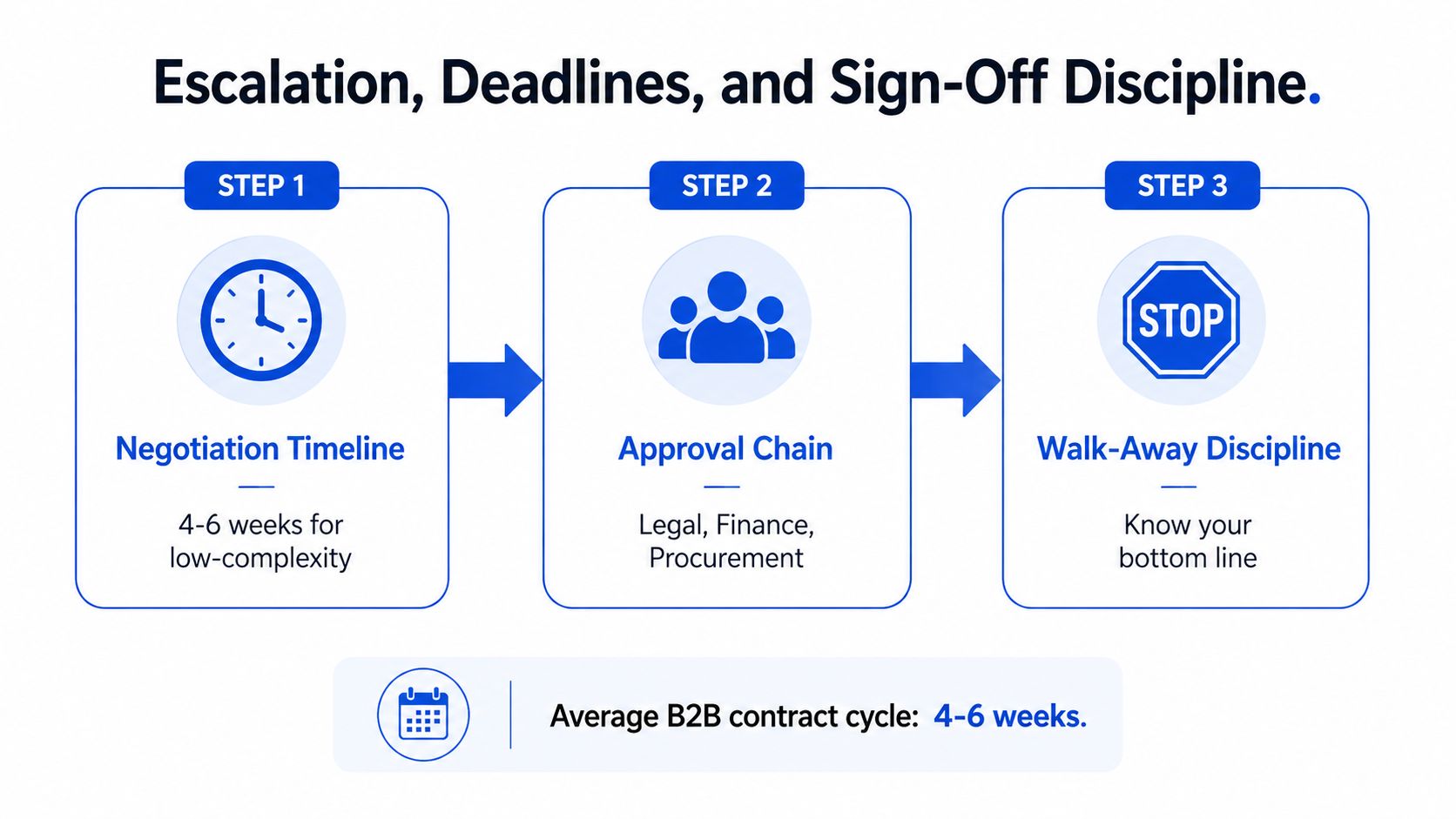
Negotiation discipline fails when the person negotiating lacks authority, the person with authority lacks context, and the deadline belongs only to the other side. A usable process connects the calendar, approval chain, and walk-away point before negotiations become urgent.
The historical record shows why this matters. A U.S. Government Accountability Office report on major airline labor contracts found that the median time to reach agreement rose from nine months for contracts negotiated between 1978 and 1989 to 15 months for contracts negotiated from 1990 to 2002, a six-month increase. The underlying report and accepted research version provides a clear example of multi-issue bargaining taking longer as complexity grows.
Put authority on paper
An SMB sign-off matrix might assign authority as follows:
- Business owner: signs agreements under $25K.
- COO and legal: approve agreements under $100K that carry operational or legal risk.
- CEO and finance committee: approve agreements above $100K.
- Board: approves multi-year commitments above $250K.
Those thresholds should be adapted to the company’s governance documents, financing arrangements, and actual risk profile. They shouldn’t be invented during the final call.
Set a hard walk-away date tied to a renewal deadline, fiscal-quarter close, or funding milestone. Add an internal escalation rule such as: “If no response is received within 48 hours, authority defaults to the designated deputy.” The rule doesn’t force a concession. It prevents silence from becoming an accidental decision.
Three habits protect the process:
- Send a written summary after every session, listing open points, accepted language, owners, and next dates.
- Maintain one decision log, rather than allowing positions to scatter across email, Slack, and separate documents.
- Require a trade for every extension, such as additional diligence time, improved payment terms, or a completed security response.
A board or investor approval question may require a formal corporate action. Washington companies can review what a board resolution is before treating an executive email as sufficient authority.
Your Negotiation Checklist Before You Sit Down
A founder should not enter a material contract call with only the latest draft and a pricing target. The folder should contain the company’s authority, evidence, alternatives, and decision rules.
Assemble the deal folder
Before the first call, collect:
- Signed authorization letter: Identify who can negotiate, approve, and sign.
- BATNA inventory: Rank realistic alternatives and compare them on equivalent terms.
- Redlined draft: Use a dated Word file with Track Changes and comments enabled.
- Clause priority matrix: Mark each term as a fixed requirement, tradeable concession, or nice-to-have.
- Approval chain memo: Name the required reviewers, dollar thresholds, and escalation path.
- Benchmark file: Save the comparable contracts, current market evidence, and assumptions behind the effective-price analysis.
- Performance schedule: Define deliverables, acceptance criteria, service levels, reporting duties, and remedies.
The company should defer issues that lack enough information. That may include a disputed implementation estimate, an unclear data-processing obligation, or a liability position that depends on insurance coverage. Deferral works only when the open issue has an owner and a decision date.
Know when outside counsel belongs in the room
Outside counsel should be involved when indemnity exposure is substantial, when the counterparty seeks IP assignment beyond defined deliverables, or when an automatic renewal can trap the company. Legal review also makes sense when benchmarking flags a term as materially outside the company’s normal market position, when the contract handles sensitive data, or when the governing law and dispute process create unfamiliar risk.
The immediate operating plan is simple:
- Hold a 30-minute internal alignment meeting before contacting the counterparty.
- Schedule the first redline pass within 48 hours of receiving the draft.
- Set the hard walk-away deadline in writing.
- Name the contract owner who will monitor renewal dates, deliverables, invoices, and remedies after signature.
- Prepare an execution copy only after the final redline and decision log reconcile.
A contract is negotiated successfully when the business can operate under it, enforce it, exit it when necessary, and preserve the value it paid to receive. Headline concessions are only one input. The result is a document that survives performance problems, renewal cycles, changing priorities, and scrutiny from the next executive who inherits the relationship.
By Design Law Firm & Legal Consultancy, PLLC offers contract drafting, review, negotiation, and transaction support for technology, IP, data privacy, and commercial risk allocation matters. Founders and businesses in Washington can visit By Design Law Firm & Legal Consultancy, PLLC to discuss a contract that needs stronger value protection before signature. Contact our law office at (206) 593-1519.