The most popular contract advice is also the least useful: start with a strong template and move quickly to redlines. A polished document can still sit unsigned while sales, legal, procurement, security, and finance argue over who may approve the next concession. Faster drafting helps only when the business has already decided what it can trade, what it must protect, and who has authority to decide.
That distinction matters because contract drafting and negotiation create measurable bargaining costs. In a study of 290 franchise renewal agreements, disclosing a supplier's poor-performance history increased negotiation time by 74%, while a 1% increase in contract value increased negotiation time by 18%. The participation of an expert reduced negotiation time by 24%. The researchers measured negotiation length as the days between the initial proposal and the final agreement, linking the information in a deal and its economic stakes to the cost of reaching signature. The underlying study offers a useful warning for founders: document quality matters, but preparation and governance often matter more.
Why Most Contract Advice Gets Negotiation Wrong
A founder can spend hours perfecting an indemnity clause and still lose weeks because nobody knows whether the head of sales, the general counsel, or the board may approve a liability-cap change. The document becomes a visible record of a private decision problem. Each reviewer adds comments because the organization hasn't agreed on who owns the risk.
That's why faster drafting doesn't automatically produce faster deals. Rushed preparation pushes unresolved commercial questions into the redline process, where every issue looks like legal language. A procurement manager may ask for broader termination rights because the budget owner hasn't confirmed the renewal plan. A security team may reopen data obligations because the sales team circulated a draft before collecting the required technical answers.
The hidden sources of delay
Complex transactions take time even when experienced parties are involved. Research covering 147 M&A takeover negotiations reported an average negotiation time of 170 days and a median of 141 days. The same research identified substantial variation in contract design, including an average of 97.5 warranties in the sample. That research supports a practical conclusion: contract drafting isn't clerical formatting. It's a structured exercise in allocating risk, preserving deal purpose, creating durability, and leaving room for future renegotiation.
A startup scenario makes the point. The customer's lawyer proposes a lower liability cap, the founder agrees in principle, and the sales lead promises a faster implementation. Then the insurer rejects the exposure, the security lead objects to the service levels, and the board asks why the company accepted uncapped obligations. The counterparty receives three different answers, so its counsel reopens provisions that had already been settled.
Practical rule: Treat every redline as a business decision with an owner, a limit, and an exchange value.
Negotiation governance should therefore sit beside the draft, not behind it. Before circulation, the team needs a decision chain, an issue register, a concession strategy, and a clear record of what the other side has already accepted. Template quality still matters. It can't compensate for fragmented authority or unplanned concessions.
Preparing Before the First Draft Is Written
Preparation works best when it produces visible decisions rather than general confidence. A founder should be able to hand the team a short negotiation brief showing the transaction's purpose, the company's risk boundaries, the counterparty's likely priorities, and the people authorized to respond.
A practitioner-data study identified four repeatable stages, preparation, information exchange, solution seeking, and concession management, and found that deals took about 46 days on average to close. The study's findings make front-loading useful because issue spotting and concession planning can prevent surprises after the first draft.
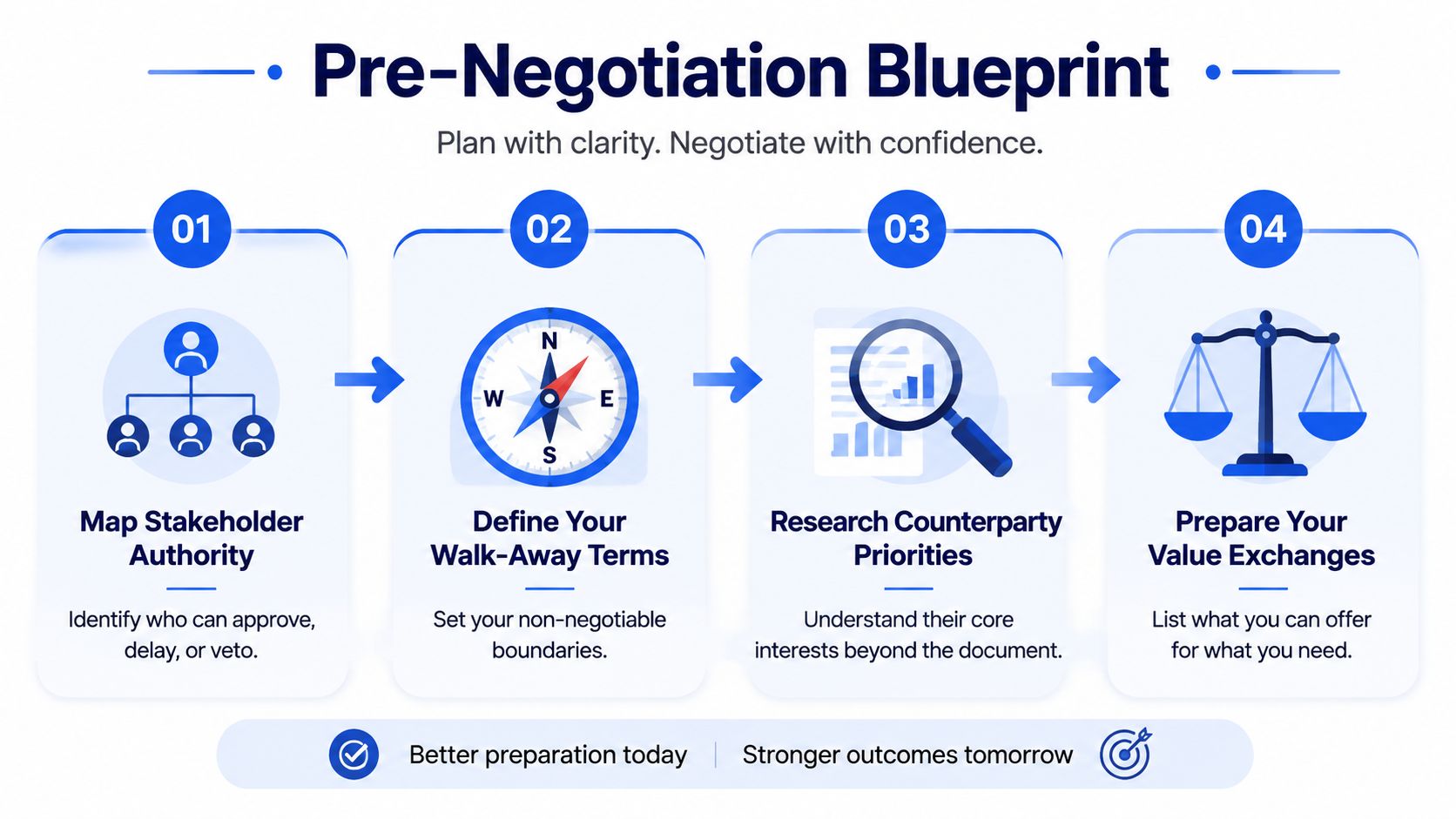
Map authority before mapping clauses
Create a one-page authority chart. List pricing, payment timing, service levels, intellectual property, confidentiality, data protection, indemnity, liability caps, insurance, termination, and dispute resolution. Beside each topic, name the person who can approve a change, the person who must be consulted, and the person who can veto it.
The chart should also identify escalation triggers. A cap above the company's insurance limit, an assignment of background intellectual property, an unusual audit right, or a customer's unilateral termination right may require executive or board review. The point isn't to involve everyone in every comment. It's to stop unauthorized promises from reaching the counterparty.
Define the walk-away line
Separate clear boundaries from preferences. A boundary might protect ownership of the company's core platform, prevent unlimited liability for ordinary service failures, or require payment protection for a resource-constrained startup. A preference might be a shorter notice period, a particular governing-law clause, or a preferred invoice format.
Rank each term by business impact. “Market standard” isn't a sufficient reason to defend language. The correct question is whether the term creates a loss the business can't price, insure, perform, or survive.
Research the counterparty's pressure points
The counterparty's legal markup rarely reveals the entire negotiation. Ask who uses the product, who bears operational risk, whether the agreement supports a launch or a renewal, and what internal deadline is driving signature. A procurement team may care about predictable spend, while an operating team cares about continuity and a security team cares about evidence.
Write down the likely interests, then test them in information exchange. A direct question about implementation timing may reveal that a broad termination right is really a response to deployment uncertainty. Solving that uncertainty may be cheaper than arguing over termination language.
Prepare value exchanges
Build a concession ledger before sending the draft. For every requested change, record its cost to the company, its perceived value to the counterparty, and what the company wants in return. Payment timing, notice periods, reporting frequency, implementation sequencing, and renewal mechanics often provide trading space without giving away ownership or uncontrolled liability.
The contract-management best-practices guide can help a growing company turn these decisions into a repeatable internal process. The final preparation document should fit on a few pages and include the opening position, fallback position, approval owner, and walk-away point for each material issue.
Essential Clauses That Protect Your Business
Clause selection should follow the company's risk allocation, not the order of a template. The provisions below determine who carries financial exposure, who controls the relationship, and who owns the work product. Boilerplate supports those outcomes, but it should not draw attention away from them.
Limitation of liability and insurance
A liability cap should match the risks the business can control and the insurance it can obtain. A general cap tied to fees may leave important gaps for confidentiality breaches, intellectual-property claims, fraud, or intentional misconduct. Carve-outs can eliminate the protection entirely, turning a reasonable cap into an obligation with no practical ceiling.
Review insurance beside the cap. If a customer demands substantial technology errors-and-omissions protection while the startup carries narrower coverage, the contract creates exposure that drafting cannot solve. The business may need to narrow the obligation, obtain additional coverage, or price the risk into the deal.
Termination rights and the cost of exit
Termination for cause gives a party an exit after a defined breach, usually subject to notice and an opportunity to cure. Termination for convenience permits an exit without proving breach, but it can leave a vendor with stranded hiring, implementation, or infrastructure costs.
The termination clause should answer the operational questions founders often discover too late. Does the customer receive transition assistance? Does the vendor get paid for committed resources? Do licenses end immediately? Can either party retain data required for legal compliance or dispute defense? Without clear answers, termination language can trap a company in an unprofitable relationship or create an abrupt service interruption.
Intellectual property ownership
IP language should distinguish background materials, newly created deliverables, tools, improvements, and third-party content. “Work made for hire” does not resolve every ownership question, especially when contractors or other nonemployee creators contribute. A separate assignment should address rights that do not transfer automatically while preserving the company's ownership of its pre-existing platform and know-how.
Ownership also affects later financing and sale discussions. If the language is vague, a future investor may question whether the startup owns the code or designs it claims to commercialize. That problem can surface during diligence, when the company has less bargaining power to repair the chain of title.
Indemnification
Indemnification may require one party to defend, reimburse, or hold the other harmless for specified claims. Those obligations differ in cost and control. The contract should state who controls the defense, whether the protected party may participate with separate counsel, whether settlement requires consent, and whether indemnity payments fall inside or outside the liability cap.
The discussion of indemnity clauses in Washington State contracts offers useful context for reviewing this allocation. A vendor that accepts a broad duty to defend without control over the defense may pay legal costs for a dispute it cannot manage.
Payment protection
Payment terms should address invoice timing, disputed amounts, late charges, interest where permitted, collection costs, suspension rights, taxes, and expense reimbursement. A startup delivering substantial work before payment may need milestone billing, deposits, or a right to pause work after an uncured nonpayment.
Payment administration can create contract risk for companies paying contractors across jurisdictions. The OneSafe contractor payments page may help founders examine whether their payment workflow supports the obligations promised in the agreement.
| Clause Type | Business Impact | Common Pitfall |
|---|---|---|
| Liability cap | Limits catastrophic financial exposure | Carve-outs can eliminate the protection entirely |
| Termination | Controls exit, continuity, and stranded costs | Rights are stated without transition mechanics |
| IP assignment | Establishes ownership of valuable work product | Background IP and contractor rights remain unclear |
| Indemnification | Allocates defense costs and claim exposure | Defense control and settlement approval are omitted |
| Payment terms | Protects cash flow and collection rights | The contract lacks suspension or late-payment remedies |
Negotiation Tactics That Move Deals Forward
The strongest negotiator isn't the person who rejects the most edits. It's the person who knows which edits change the company's economics and which ones merely reflect the other side's preferred drafting style.
A useful first pass divides open issues into three groups. Value terms affect money, control, ownership, or material exposure. Operational terms affect how the relationship functions day to day. Process terms affect review mechanics, notices, records, and dispute procedures. The categories aren't absolute, but they help a founder avoid spending the same energy on a notice address and an uncapped indemnity.
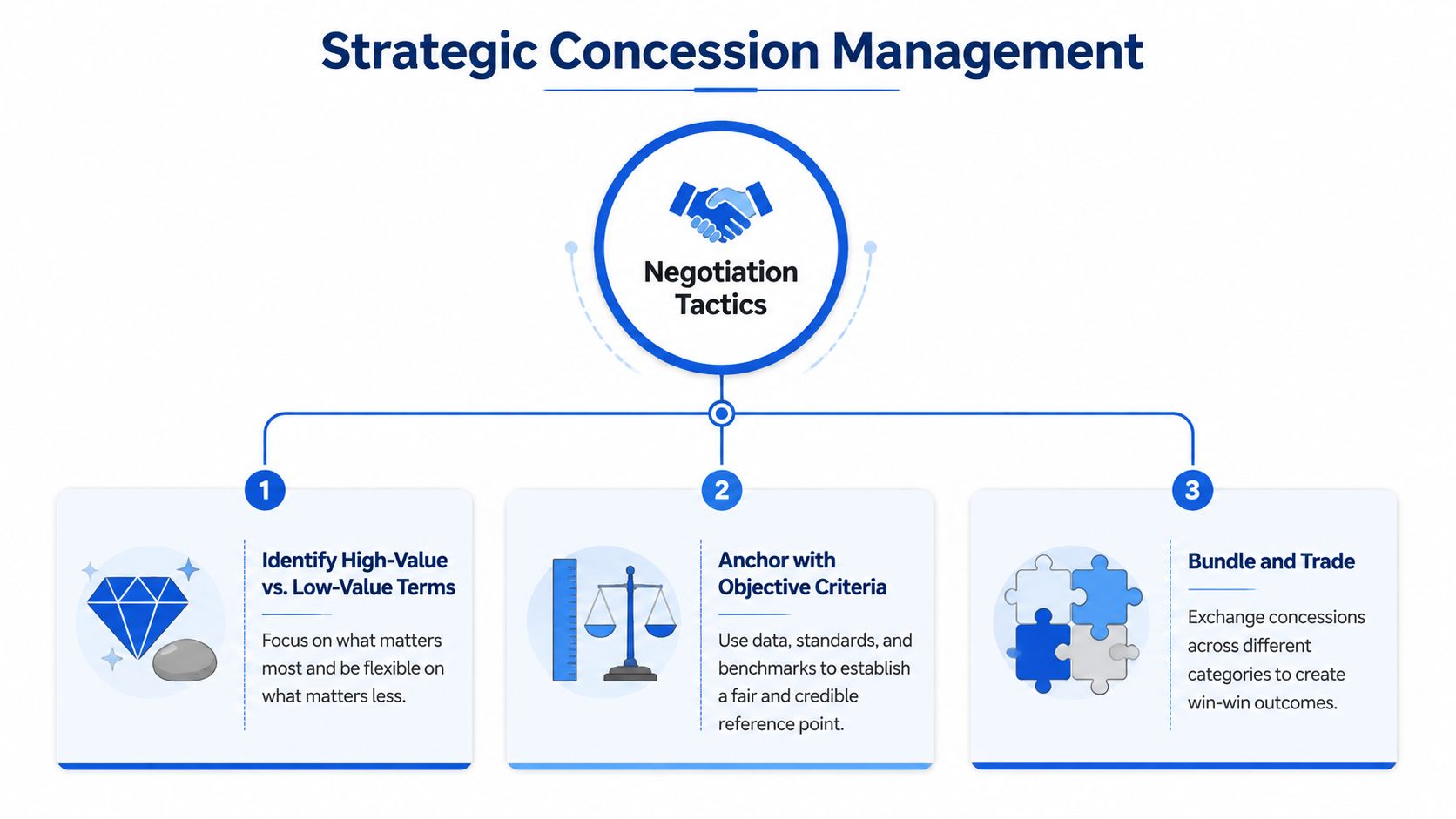
Trade deliberately
Low-cost concessions can build momentum when they solve a real concern. A founder might accept a longer notice period in exchange for a narrower termination trigger, agree to a reporting format in exchange for predictable payment timing, or offer a transition obligation in exchange for a firm end date.
Conditional language prevents a concession from becoming a free transfer:
“The company can accept the proposed indemnity wording if the liability cap applies to the obligation and the termination notice period is extended.”
The exchange should be specific. “If you move on this, we can move on that” invites another round of bargaining because neither side knows what has been purchased.
Anchor with reasons, not bravado
Circulating a complete draft sets a baseline, but the draft should reflect a defensible commercial rationale. A liability cap tied to fees, insurance, or a defined exposure model is easier to discuss than a number selected without explanation. A termination provision tied to implementation milestones is more credible than an arbitrary demand for control.
Authority fragmentation creates a second problem. The lawyer across the table may not control procurement, security, or the business sponsor, just as the founder's lawyer may not control the founder's sales commitments. Ask early who must approve each high-impact topic and request a joint decision call when the same issue keeps returning.
Recognize process bottlenecks
Repeated redlines don't always signal substantive disagreement. Sometimes counsel is waiting for a business owner, a security questionnaire, or an insurance confirmation. The negotiation log should record the issue, the current proposal, the decision owner, the next action, and the date for escalation.
Dispute resolution language deserves attention because it affects the cost and forum of a later conflict. The guidance on dispute-resolution clauses can help a founder distinguish a genuine forum decision from wording that merely reflects stylistic preference.
A short negotiation call can outperform a long email chain when the parties have reached a package decision. The following video offers another way to think about moving from isolated redlines to structured exchanges.
The objective isn't to win every clause. It's to protect the terms that shift risk and value, then remove procedural friction everywhere else.
Where AI Helps and Hurts in Contract Work
AI tools are useful when the task is bounded, repetitive, and reviewable. They can help produce a first-pass comparison of two drafts, identify missing standard provisions, summarize obligations, and flag inconsistent defined terms. Those functions can reduce the mechanical burden on a founder or junior reviewer.
The danger begins when an output looks complete enough to approve. A clause can appear ordinary while changing the relationship between indemnity, insurance, limitation of liability, governing law, and termination. AI may also suggest an edit in one provision without recognizing that another provision now conflicts with it.
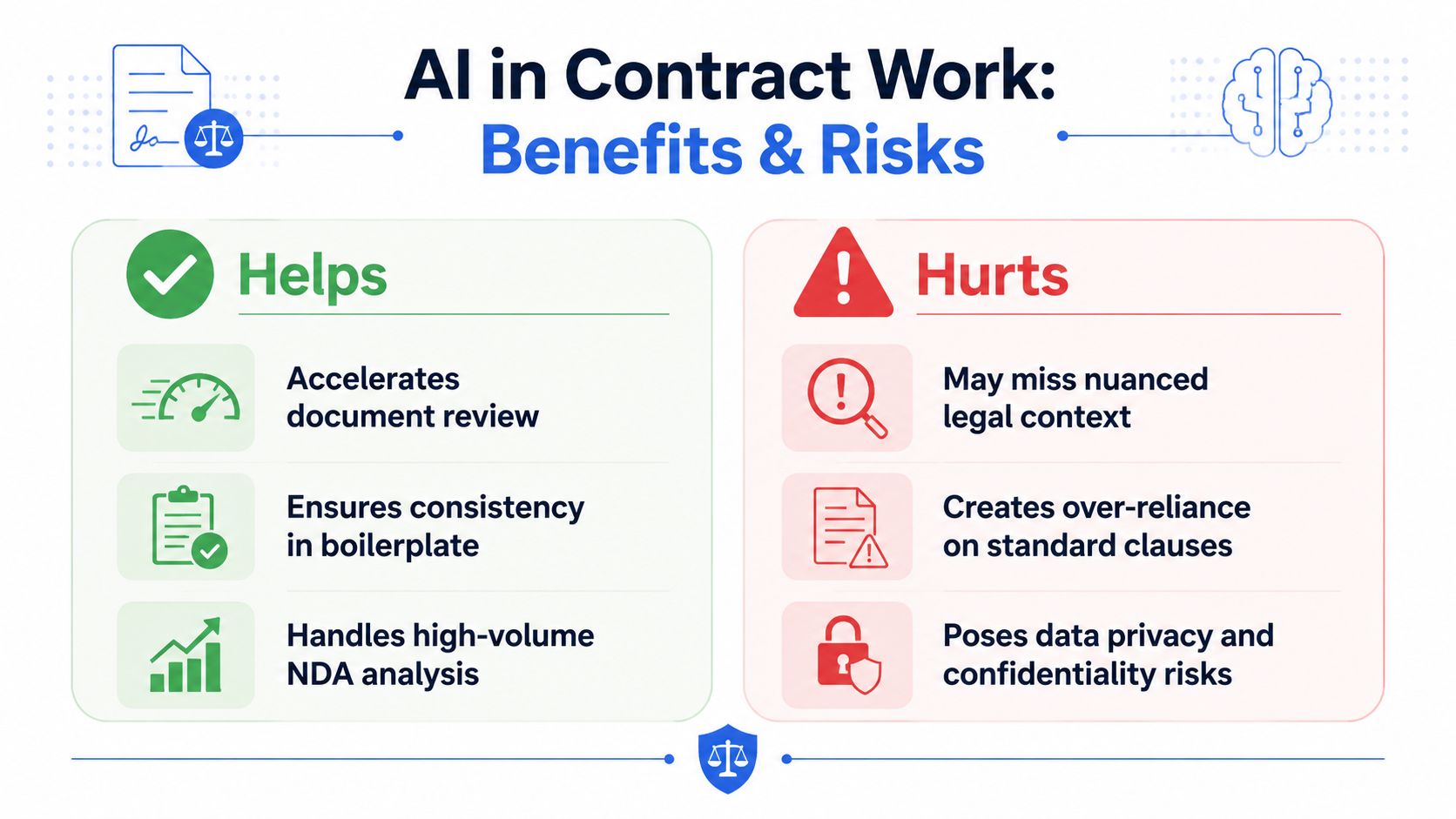
Use automation for the first pass
A sensible workflow assigns AI narrow jobs:
- Surface differences: Compare versions and group edits by topic.
- Find omissions: Check whether the draft addresses confidentiality, payment, IP, insurance, termination, and dispute handling.
- Create an issue list: Convert dense markup into questions for the business owner.
- Improve consistency: Identify defined terms used inconsistently or obligations that lack an owner.
Human review should follow each task. The reviewer must verify the exact text, the surrounding provisions, and the commercial consequence.
Keep risk allocation human-led
AI struggles with persuasion, relationship management, and business context. It may not know that a broad force majeure clause threatens a startup's supply chain, that a customer's requested audit right creates a security burden, or that a “standard” IP provision captures the company's reusable product.
The benchmark testing clause-level legal risk review evaluated 19 models across 41 legal risk categories using correctness, output effectiveness, and incorrect “no related clause” responses. The best models reached only about 0.64 F1, roughly the level of a junior legal assistant. That result doesn't make AI useless. It makes unchecked reliance unacceptable.
A 2025 survey reported that 65% of respondents didn't use AI for automated redlining, clause extraction, or drafting, while 66% believed AI would reduce the number of lawyers needed for contract negotiation. Respondents also identified persuasion, relationships, and business context as areas where AI struggles. The survey coverage captures the central tension: adoption may grow, but high-value negotiation still depends on judgment.
The AI contract review guidance is relevant when a company needs a human-controlled workflow. Internal policy should define approved tools, confidential-data restrictions, review responsibilities, escalation thresholds, and the records retained for AI-assisted edits.
When to Handle It Yourself and When to Call Counsel
Legal spend should follow risk concentration, not document length. A short agreement can create more exposure than a long one if it transfers ownership, imposes uncapped liability, or controls a critical customer relationship.
A founder can often manage a routine NDA or a standard vendor agreement when the template is familiar, the parties' roles are clear, the information is limited, and the counterparty hasn't introduced material changes. A lawyer should review once the other side changes liability, IP, data rights, exclusivity, insurance, or termination.
| Agreement Type | Risk Tier | Recommended Approach | WA State Notes |
|---|---|---|---|
| Routine NDA | Lower | Use a known template and check scope, duration, and permitted disclosures | Confirm the agreement fits the intended Washington business relationship |
| Standard vendor agreement | Moderate | Self-manage routine terms, obtain counsel review for material redlines | Review governing law, remedies, and data obligations |
| Employment or contractor agreement | Moderate to high | Start with a template, then obtain legal review | Address ownership, confidentiality, classification, and Washington restrictions |
| Founder agreement | High | Retain counsel for structure and execution | Consider community-property implications and ownership records |
| Equity transaction | High | Use counsel from the beginning | Coordinate corporate approvals, securities issues, and ownership documentation |
| Complex license or MSA | High | Have counsel lead or closely support negotiation | Align IP, privacy, indemnity, limitation, and dispute provisions |
Washington founders should pay particular attention to RCW 49.62, which governs the state’s non-compete restrictions. Founder arrangements can also raise community-property questions, and dispute-resolution provisions should be reviewed for the intended Washington forum and remedy structure.
A company using AI in its contracting workflow should evaluate data handling and approval controls as part of the legal budget. A practical guide to AI compliance management can help frame those operational questions, but it doesn’t replace advice on a specific transaction.
Counsel is most valuable before the company commits to structural terms. A lawyer can help decide what the company should promise, what it can insure, and what it should trade. Founders can then handle routine scheduling, document collection, and low-impact formatting without paying counsel to manage every email.
Closing the Deal Without Leaving Money on the Table
A deal can be commercially agreed and still fail at the finish line. One founder may approve the business terms on Monday, discover on Wednesday that the customer requires a security exhibit, and learn on Friday that the signature platform contains an older version of the MSA. The counterparty’s counsel then raises a late objection, and the team starts negotiating from memory.
A controlled close uses a short escalation sequence:
- Freeze the current version. Name the document, date, and version. Stop parallel edits.
- Classify the objection. Decide whether it changes money, control, ownership, liability, compliance, or only drafting style.
- Confirm authority. Identify the person who can accept the change and the person who must be consulted.
- Trade or reject clearly. If the demand matters, make a conditional exchange. If it doesn’t, accept cleanly and move on.
- Complete the package. Finalize exhibits, schedules, order forms, statements of work, and incorporated policies before signature.
A founder shouldn’t sign an agreement that refers to an undefined attachment or a schedule still marked “to be completed.” The final file should contain the operative terms, the correct exhibits, signature blocks, and any required authority approvals. Washington’s Uniform Electronic Transactions Act may support electronic contracting, but transaction-specific rules, record requirements, notarization, and the counterparty’s execution policy can still make a wet signature relevant.
Closing discipline: A signature is an event. Contract closure is a process.
After execution, calendar renewal and notice dates, distribute the fully signed copy to the business owner and finance team, store it in a retrievable contract system, and record the obligations that require action. A company that can’t locate the final agreement or identify its renewal window has surrendered part of the value it negotiated.
The commercial stakes remain substantial. In a 2025 State of Contracting report, 90% of CEOs said their companies were leaving money on the table during contract negotiations. The report’s coverage reinforces the practical lesson: contract drafting and negotiation should end with controlled execution and follow-through, not the relief of seeing a signature.
Founders and growing businesses can work with By Design Law Firm & Legal Consultancy, PLLC on contract drafting, review, negotiation, and transaction support, including agreements involving technology, IP, data privacy, and commercial risk allocation. Visit the firm to discuss a practical legal workflow for the next agreement before unresolved authority or liability issues slow the deal. Contact our law office in Seattle today at (206) 593-1519.