A critical vendor misses a delivery, a development partner stops work with unfinished source code, or a customer refuses to pay after accepting the product. Within days, a startup may face delayed launches, strained cash flow, frustrated customers, and a leadership team asking a deceptively simple question: should the company demand money, force performance, unwind the deal, or pursue several remedies at once?
Breach of contract remedies are business decisions, not just legal labels. The remedy that looks strongest in a pleading may be too slow to protect operations, too limited by the contract, or impossible to collect from an insolvent counterparty. A disciplined response starts by identifying what would make the company whole, then testing that objective against the agreement, available evidence, timing, and the counterparty’s ability to perform or pay. Early decisions also shape negotiation strategy, as practical guidance on contract dispute resolution recognizes.
When a Contract Breach Hits Your Startup
A software startup has paid a development partner to build a security-sensitive feature. The launch date is approaching, the customer rollout depends on the feature, and the partner suddenly claims it can’t continue until the parties renegotiate the scope. The startup’s first instinct is often to demand a refund. That may recover some cash, but it might leave the company without the source code, technical documentation, or working product needed to serve its customer.
The business problem is therefore larger than the unpaid invoice or missed milestone. The startup needs to determine whether it wants replacement performance, access to essential assets, compensation for measurable loss, or a clean exit from the relationship. Each objective points toward a different remedy and a different evidence strategy.
Practical rule: A remedy is useful only if it solves the business problem created by the breach.
Damages are the ordinary starting point in common law systems. Historical scholarship traces the preference for damages over specific performance as far back as 1616, including Lord Coke’s opinion in Bromage v. Genning, and courts have continued to treat specific performance as supplementary when money can’t adequately compensate the claimant historical analysis of specific performance and damages. That default matters because a founder who wants a court to compel delivery of a unique dataset or source code must explain why a monetary award won’t provide a realistic substitute.
The first response should preserve optionality rather than lock the company into an emotional demand. The team should collect the signed agreement and amendments, identify the missed obligation, preserve communications, record operational effects, and review notice and dispute-resolution requirements. It should also avoid conduct that could look like acceptance of termination or refusal to mitigate loss.
A customer payment dispute presents the opposite problem. If the startup delivered the contracted service and the customer refuses to pay, a demand for the contract price may be more practical than seeking an injunction. The right answer depends on the company’s actual objective, not on the most dramatic remedy available in theory.
The Main Categories of Contract Remedies
Most breach disputes begin with monetary damages. Expectation damages aim to place the non-breaching party in the position it would have occupied if the contract had been performed. Depending on the facts, the claim may include the value of the promised benefit, consequential losses, and incidental expenses, subject to foreseeability, certainty, and mitigation limits overview of expectation damages.
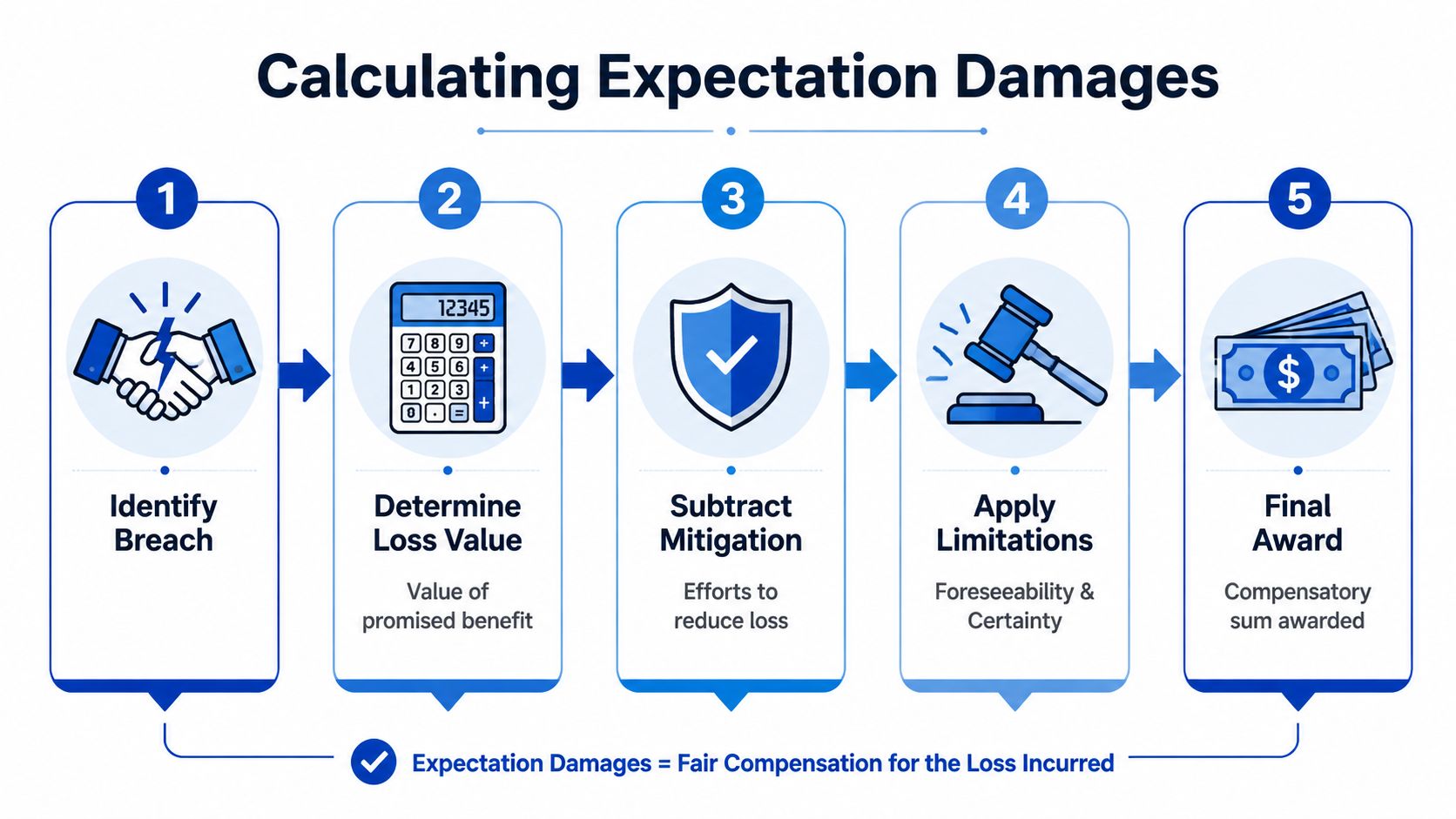
A SaaS vendor that fails to provide contracted functionality may expose the customer to replacement costs, documented incidental expenses, or other losses caused by the failure. Nominal damages may apply where a breach occurred but the claimant can’t prove meaningful loss. Punitive damages generally aren’t a standard contract remedy and usually require an independent legal wrong, such as fraud, rather than a simple failure to perform.
Equitable relief addresses non-monetary needs
Specific performance orders the breaching party to perform instead of paying money. Courts generally reserve it for unique subject matter or circumstances where a market substitute isn’t realistically available. Under UCC Article 2, a buyer may obtain specific performance for goods when the goods are unique or other proper circumstances exist UCC Article 2 remedies for buyers and sellers.
An injunction works differently. It can prohibit conduct, such as using confidential information or transferring an asset while the dispute is pending. Rescission seeks to unwind the transaction, while restitution may return value already transferred when the agreement is cancelled or treated as invalid.
Contract terms can change the baseline
The agreement may create additional remedies or limit default recovery. Liquidated damages establish a pre-agreed amount, while attorneys’ fees provisions may shift enforcement costs if the clause is enforceable. Indemnity language can also allocate specific third-party or regulatory risks, as discussed in this Washington contract indemnity analysis.
These categories can overlap. A startup might seek damages for costs already incurred, an injunction to protect source code, and declaratory relief clarifying ownership. The contract, governing law, evidence, and urgency determine whether that combination is sensible.
How Expectation Damages Are Calculated and Limited
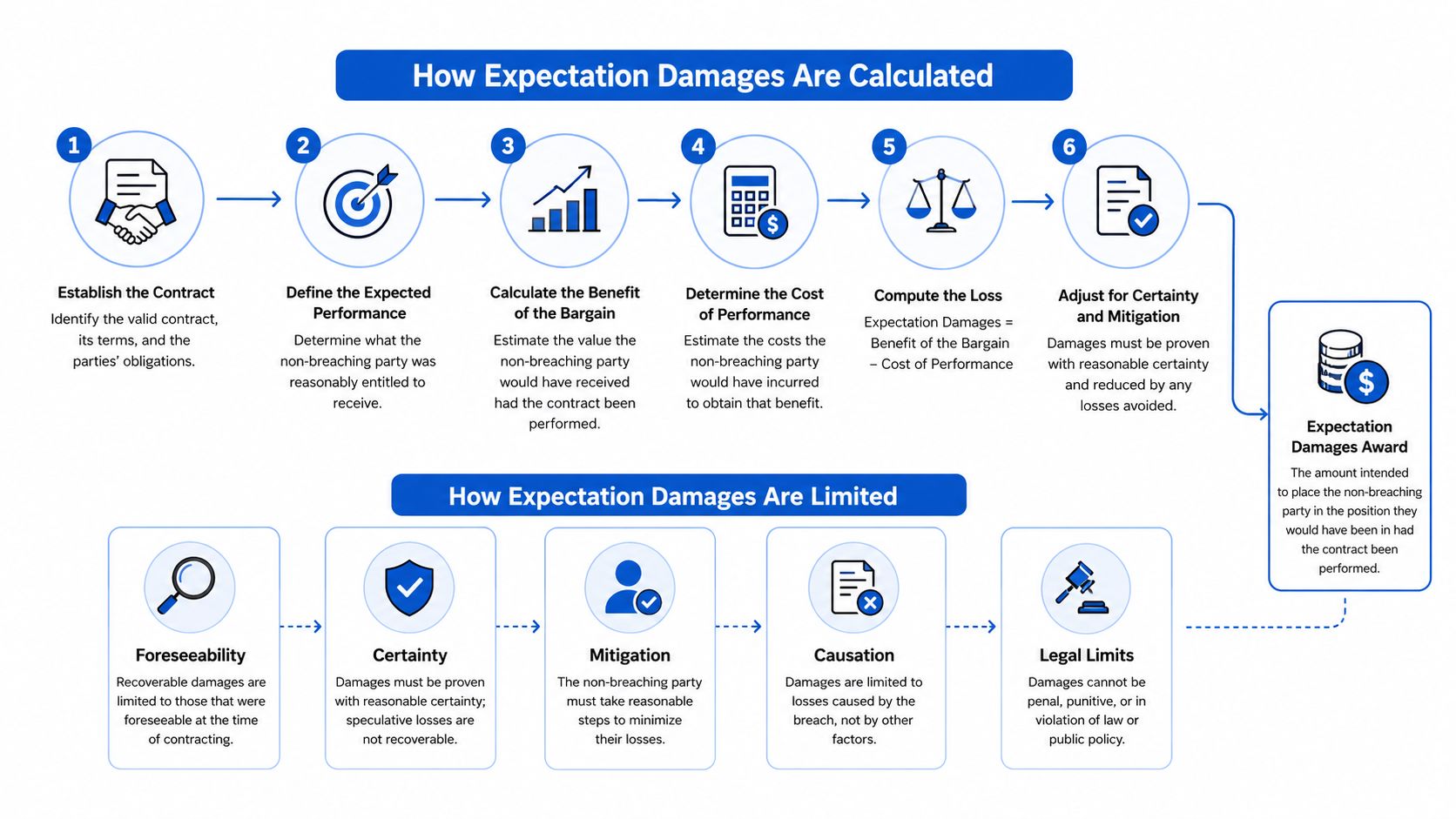
Expectation damages are designed to compensate for the gap between promised performance and what the claimant received. A practical starting model is:
Value of promised performance minus value of actual performance, plus qualifying consequential and incidental losses, minus costs saved.
The formula is only a framework. Courts examine causation and proof rather than accepting a founder’s projected loss at face value. A startup that paid a vendor to deliver a working integration may compare the contracted result with the cost or value of the incomplete result, then add documented replacement expenses and subtract costs the startup no longer had to pay because the vendor stopped work.
Three limits decide whether the claim survives
Foreseeability restricts losses that the breaching party couldn’t reasonably have anticipated when the agreement was formed. If a startup expects a vendor delay to jeopardize a major customer, that risk should be communicated and documented before the dispute. A hidden internal projection won’t necessarily establish that the vendor had reason to anticipate the claimed loss.
Certainty is equally important. A company may struggle to recover speculative profits from a product that had no reliable sales history, incomplete pricing data, or uncertain customer demand. Stronger proof usually comes from signed customer agreements, historical revenue records, invoices, payroll data, project milestones, and contemporaneous forecasts tied to identifiable transactions.
Mitigation requires reasonable efforts to reduce avoidable loss. A startup may need to seek substitute performance, reallocate staff, pause spending, notify customers, or pursue commercially sensible cover. The claimant doesn’t have to eliminate every consequence, but avoidable losses can be excluded or reduced expectation damages and mitigation principles.
Records matter before litigation begins
A damages file should connect each claimed amount to a contract obligation and a business consequence. Useful records include the original scope, acceptance criteria, delivery logs, customer notices, replacement quotes, invoices, staff time records, and board or management decisions responding to the breach.
A simple damages ledger can separate direct loss, consequential loss, incidental expense, saved cost, and mitigation action. That structure helps counsel assess the claim and gives the counterparty a credible basis for settlement. It also exposes weak assumptions early, before the company spends heavily pursuing a recovery that can’t be proved with reasonable certainty.
When Equitable Remedies Make Sense for Tech Companies
Money works well when the market offers a genuine substitute. It works poorly when the counterparty controls an asset that can’t be recreated quickly, purchased elsewhere, or valued reliably. For technology companies, that distinction often determines whether a damages claim is enough.
Specific performance may be relevant to source code, proprietary datasets, domain names, custom integrations, or access credentials when the contract makes the company’s rights clear and the asset’s value can’t be captured through a simple replacement purchase. A startup seeking source code shouldn’t merely say the code is valuable. It should show why the code is unique, how access affects operations, what alternatives were investigated, and why a damages award wouldn’t restore the company’s position.
Injunctions protect against continuing harm
An injunction may be more urgent than a final damages award when a former employee, contractor, licensee, or competitor threatens to use confidential information. The company must identify the protected information, establish the contractual or legal duty, and show the practical harm that continued use could cause. A broad request to stop all competition is less persuasive than a narrowly focused request addressing identifiable confidential material or restricted conduct.
Trade secret disputes require disciplined handling. A company should limit internal distribution, preserve access logs and repository history, and avoid careless disclosure during negotiations. Guidance on trade secret misappropriation is particularly relevant where the alleged breach involves source repositories, product roadmaps, customer data, or machine-learning datasets.

Rescission can be the better exit
Rescission may make sense where a fundamental breach, misrepresentation, or serious defect undermines the transaction itself. It’s not a way to escape an inconvenient bargain. The company must be prepared to address what happens to money, assets, licenses, data, and benefits already exchanged.
Equitable relief is discretionary. Courts consider practical enforceability, the parties’ conduct, urgency, and whether the requesting party has acted fairly. A startup that waits while continuing to accept performance may weaken its argument that immediate court intervention is necessary. The stronger approach is to document the unique value and urgency as soon as the risk appears, while keeping monetary relief available as an alternative.
How Contract Clauses Reshape Your Remedies
The remedy conversation often starts before anyone signs the agreement. A contract can make recovery more predictable, cap exposure, exclude important categories of loss, or create a negotiated path to payment. Founders who skim these provisions may discover after a breach that the contract has already removed the remedy the business expected to use.
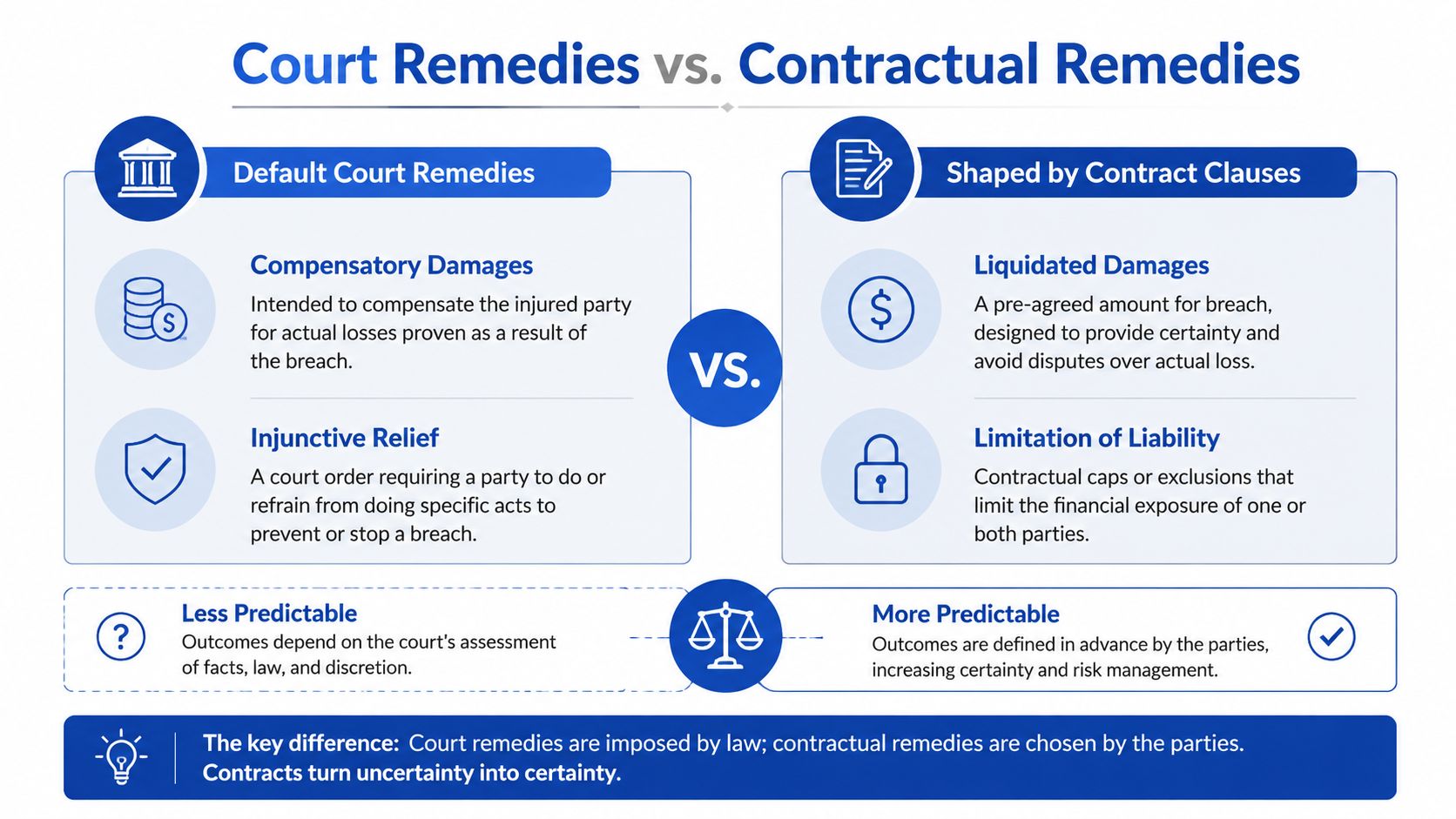
Liquidated damages are enforceable only when they represent a reasonable forecast of anticipated or actual loss and actual damages would be difficult to prove when the parties contract. A clause designed mainly to punish the breaching party may be treated as an unenforceable penalty liquidated damages standards.
Liability caps deserve operational review
A limitation of liability clause may cap total recovery or exclude consequential, incidental, special, or lost-profit damages. That can be acceptable in a low-risk software subscription, but dangerous when the vendor controls production data, security functions, customer-facing infrastructure, or a critical launch dependency.
The review should ask:
- What is capped: Does the cap apply to all claims, or are confidentiality, intellectual property, data security, indemnity, and payment obligations treated separately?
- What is excluded: Could the exclusion of consequential losses remove the startup’s most important recovery?
- What is the financial ceiling: Is the cap connected to a meaningful commercial measure, or merely a small fee?
- What survives termination: Do confidentiality, data return, audit, and transition duties continue after the relationship ends?
Attorneys’ fees provisions can alter settlement negotiations, but they don’t automatically guarantee reimbursement. Washington generally follows the American Rule, under which each party pays its own fees unless a statute, contract, or recognized exception supports an award. The clause should identify the covered claims, prevailing-party standard, and whether fees apply to arbitration, litigation, collection, and appeals.
Remedy drafting should also address service credits, transition assistance, data export, source-code escrow, audit rights, suspension, termination, and emergency cooperation. These operational terms may prevent a dispute from becoming a lawsuit. They can also give a startup a workable off-ramp when a court award would arrive too late.
Procedural Considerations and Washington-Specific Pointers
A strong substantive claim can fail if the company misses a notice requirement, destroys evidence, files in the wrong forum, or waits beyond the applicable limitations period. The first operational response should therefore include a litigation hold for relevant emails, chat messages, repository records, invoices, contract versions, and customer communications.
Written contracts in Washington generally carry a six-year statute of limitations under RCW 4.16.080, although the correct period depends on the claim and governing law Washington statute of limitations provision. The limitations clock, accrual rules, tolling questions, and contractual notice provisions require fact-specific analysis. A founder shouldn’t assume that ongoing negotiations pause every deadline.
Preserve the claim and the business position
A notice of breach should identify the agreement, obligation, breach, date, known consequences, requested cure, and reservation of rights. It should remain accurate and measured. An exaggerated demand can undermine credibility, while an incomplete notice may fail to satisfy the contract.
Washington’s independent duty doctrine can affect whether a claim belongs in contract, tort, or both. The analysis becomes especially important where a dispute involves data security, professional services, misrepresentation, or duties allegedly existing outside the agreement. Counsel should assess the contract and related legal duties together rather than attaching every business injury to the contract label.
Forum-selection and choice-of-law clauses also deserve immediate attention. A Seattle startup may need to arbitrate elsewhere, litigate in another state, or apply a law that changes available remedies. The agreement may require mediation before filing, impose a shortened notice period, or specify how emergency injunctive relief can be requested.
Choose the process that preserves leverage
Negotiation can be effective when the relationship still has value and the counterparty can cure. Mediation may help when both sides need a structured resolution but don’t want a public fight. Litigation or arbitration becomes more attractive when the counterparty denies obvious obligations, threatens confidential information, or refuses to preserve essential assets.
A practical overview of business litigation in Washington can help founders understand how negotiation, alternative dispute resolution, filing, discovery, and enforcement fit together. The company should evaluate collection risk at the outset. Winning a judgment against a counterparty with no reachable assets may not restore the business.
Choosing and Pursuing the Right Remedy for Your Situation
The remedy decision should begin with four questions:
- What does the company need now? Cash, performance, access to code or data, protection from misuse, or termination?
- What does the contract permit? Review cure periods, termination rights, liability caps, liquidated damages, fee shifting, arbitration, mediation, and forum clauses.
- What can the company prove? Separate documented loss from projections, and preserve evidence supporting causation and mitigation.
- Can the counterparty pay or perform? Collection and practical enforceability matter as much as legal merit.
Internal handling is appropriate for a contained payment or delivery issue when the facts are clear and the relationship remains productive. A formal demand letter becomes useful when the breach continues, the counterparty disputes responsibility, or the company needs to establish a clear record. For invoice-specific disputes, a practical guide to resolving invoice disputes can help organize notice, documentation, negotiation, and escalation.
Counsel should be engaged promptly when source code, trade secrets, personal data, customer commitments, emergency relief, or significant operational disruption is involved. The strongest strategy often combines a credible damages analysis with a narrowly focused request for performance or protection. That approach gives the startup room to negotiate without pretending that every dispute requires a courtroom.
By Design Law Firm & Legal Consultancy, PLLC advises startups and established businesses on contract drafting, breach response, technology transactions, data privacy, intellectual property, negotiation, and business disputes. Visit By Design Law Firm & Legal Consultancy, PLLC to discuss the remedy options, evidence, and Washington procedures that apply to your situation. Contact our law office in Seattle today at (206) 593-1519.