A Washington founder signs a development agreement with confidence. The vendor promises a clean integration, the startup promises quick approvals, and both sides assume the statement of work is “clear enough.” Three months later, invoices are disputed, deliverables are half-accepted, Slack messages say one thing, the contract says another, and a once-promising relationship turns into a threat of formal claims.
That's how most business disputes begin. Not with fraud, and not with dramatic bad faith. They begin with drift. A missed milestone. A vague change request. A customer who thought support was included. A supplier who thought “best efforts” gave them room to improvise.
For Washington startups and SMEs, contract dispute resolution is less about courtroom theater and more about preserving cash, momentum, and optionality. A founder dealing with a contract fight usually isn't asking abstract legal questions. Instead, the questions are practical. Should the company push for a business fix, force mediation, file arbitration, or prepare for litigation? How much evidence needs to be preserved? Which path protects the company without burning a valuable commercial relationship?
When Handshakes and Contracts Collide
When Handshakes and Contracts Collide, contract conflict starts when scope shifts and work delays happen, then each side reads the contract differently. Approvals slow, deliverables disappoint, and trust breaks.

The dangerous part is that the dispute often looks small at first. It may start as a payment hold, a demand letter, or a tense meeting between operations teams. But unresolved contract conflicts can become expensive very quickly, especially when the agreement touches critical infrastructure, customer data, product launch timing, or a core vendor relationship.
One benchmark is sobering. Globally, the average value of contract disputes in high-stakes industries can reach figures as high as US$42.8 million, which shows why businesses need clear dispute mechanisms before a deal goes sideways, according to the Arcadis global construction disputes report.
Practical rule: Most contract disputes don't turn on one explosive event. They turn on a chain of small decisions that nobody documented well enough.
What founders usually get wrong
Many business owners wait too long to treat a brewing conflict as a legal and operational issue. They keep negotiating informally after positions have hardened. They allow key employees to keep discussing fault in email. They miss notice deadlines in the contract. Or they invoke “breach” before reading the dispute clause they already agreed to.
That approach forfeits an advantage.
A better approach starts with understanding that contract dispute resolution isn't one thing. It's a range of tools, each with a different purpose. Some are designed to save a relationship. Others are designed to force a result. The right choice depends on the contract, the amount at stake, the evidence available, and whether the company wants a practical business settlement or a binding legal outcome.
The goal isn't always to win
For many startups and SMEs, the best outcome isn't a dramatic legal victory. It's a controlled solution that protects cash flow, avoids operational paralysis, and keeps leadership focused on the business. Sometimes that means hard negotiation. Sometimes it means a neutral mediator. Sometimes it means accepting that the clause in the contract already selected the battleground.
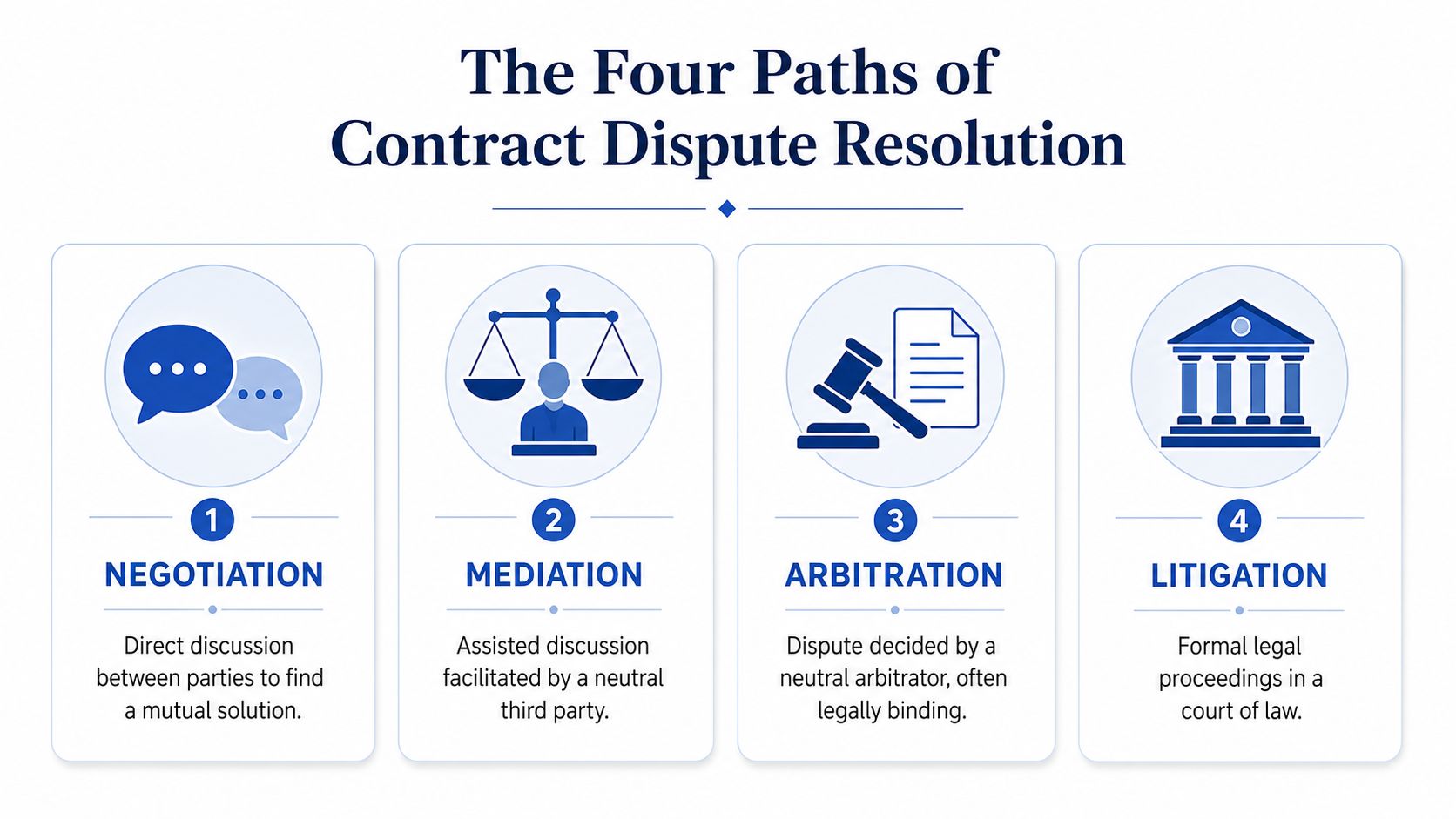
The Four Paths of Contract Dispute Resolution
Contract dispute resolution works like a business toolkit. A company wouldn't use a financing document to solve an HR problem, and it shouldn't use litigation thinking for every contract disagreement. The main tools are negotiation, mediation, arbitration, and litigation. Each has a place.
Negotiation
Negotiation is the first tool. The parties talk directly, usually through business leaders, project managers, or counsel, and try to reach a deal without involving a neutral decision-maker.
This works best when both sides still want the relationship, the facts are still developing, and the dispute can be framed in business terms instead of legal accusations. A supply delay, a disputed invoice, or a missed feature release may be fixed through credits, revised milestones, narrowed deliverables, or a change order.
A practical parallel appears outside contract law too. Owners handling insurance disputes often need a disciplined approach to framing claims, preserving documents, and negotiating from the written record. That same discipline shows up in this guide for property owners negotiating claims, and the lesson carries over well to commercial contract disputes.
Mediation
Mediation adds a neutral third party, but that person doesn't decide the case. The mediator helps the parties reach their own settlement.
Mediation is often useful when the parties are talking past each other, when emotions are running high, or when a structured conversation could uncover a compromise neither side wants to propose first. It can be especially effective where the dispute is partly legal and partly commercial, such as software acceptance criteria, service failures, or payment timing.
A good mediation doesn't just test legal claims. It tests whether each side can live with the business consequences of being right.
Arbitration
Arbitration is more formal. A neutral arbitrator, or sometimes a panel, hears the dispute and issues a decision that is often binding under the contract. Arbitration usually offers more structure than mediation and less public exposure than court.
In technology disputes, clause details matter. DLA Piper notes that effective dispute provisions should define the dispute, specify the trigger mechanism, and address continued performance during the process. The same discussion also highlights document identification and witness selection as early strategic issues in tech disputes, and provides a fee benchmark for some arbitration tiers in India. The broader lesson is that arbitration can become expensive and technical if the clause is vague, as discussed in DLA Piper's piece on maximising tools during a technology dispute.
For readers comparing arbitration with court, this overview of business litigation basics is a useful companion.
Litigation
Litigation is the formal court process. A judge, and sometimes a jury, decides the dispute under procedural rules, evidence rules, and public filing requirements.
Court is often the right tool when emergency relief is needed, when one side refuses to engage, when third parties must be brought into the case, or when the contract doesn't require arbitration. Litigation can also be the better forum when the dispute involves fraud claims, injunctions, or a factual record that needs compulsory discovery.
A short primer helps frame the core differences:
A quick side-by-side
| Method | Who controls the outcome | Formality | Best use case |
|---|---|---|---|
| Negotiation | The parties | Low | Early-stage disputes and preserved relationships |
| Mediation | The parties, with a neutral facilitator | Moderate | Stalled talks and business-sensitive conflicts |
| Arbitration | Arbitrator | Moderate to high | Contracts requiring a private binding result |
| Litigation | Court | High | Deadlocked disputes, urgent relief, complex procedure |
Choosing Your Path A Comparative Analysis
A founder choosing a dispute path should think like an operator, not just a litigant. The right question isn't “Which option is best in theory?” It's “Which option fits this contract, this evidence, this relationship, and this budget?”
Cost and speed
Negotiation is usually the leanest option because the parties control the process. That advantage disappears if the discussions drag on without a deadline or if too many people become involved without authority to settle.
Mediation can be efficient when both sides are prepared and realistic. It becomes wasteful when one side attends only to posture, or when the dispute turns on a narrow legal issue that needs a binding ruling instead of a facilitated conversation.
Arbitration sits in the middle for many businesses. It can move faster than court and stay more contained, but it isn't automatically cheap. Filing fees, arbitrator fees, expert costs, and document-heavy process can make arbitration feel a lot like private litigation.
Litigation is usually the most procedurally demanding path. That can be a feature, not a flaw, when a company needs subpoena power, a judicial order, or a structured process to force disclosures.
Confidentiality and leverage
Arbitration and mediation often offer more privacy than court. That matters for startups dealing with proprietary code, customer information, pricing terms, security architecture, or internal governance disputes.
Court filings are generally more visible. Sometimes that's a drawback. Sometimes public process strengthens one's position, especially if the other side has been avoiding accountability and a formal complaint is the first thing that forces action.
Confidentiality is valuable, but it shouldn't be treated as a goal by itself. Privacy matters only if it serves a business purpose.
Relationship preservation and enforceability
If the company still needs the other side after the dispute ends, negotiation and mediation usually offer the best chance of preserving a workable relationship. They let the parties craft outcomes a judge or arbitrator may never impose, such as revised service levels, phased payments, limited credits, or a re-scoped statement of work.
If the relationship is broken and a final answer is needed, arbitration or litigation usually makes more sense. Those processes deliver enforceable outcomes. They also impose discipline. Deadlines matter. Evidence matters. Informal storytelling stops mattering quite so much.
A decision frame for SMEs
| Business priority | Usually points toward | Warning sign |
|---|---|---|
| Preserve a key vendor or client relationship | Negotiation or mediation | The other side has no authority to settle |
| Need a binding private decision | Arbitration | The clause is vague about procedure |
| Need emergency relief or broad court powers | Litigation | Delay is increasing operational damage |
| Need a fast business fix | Negotiation | Nobody is documenting the terms |
The strongest choice usually comes from matching the forum to the actual dispute, not the one each side claims to be having. A billing conflict dressed up as a fraud case still needs disciplined contract analysis. A true performance failure hidden behind “commercial disagreement” may need formal process much sooner.
Proactive Protection Drafting an Effective Dispute Resolution Clause
Most businesses spend more time negotiating price than process. That’s a mistake. The dispute clause decides where the fight happens, how fast it escalates, who participates, and whether the company has room to solve the problem before fees mount.

What a strong clause actually does
A useful dispute resolution clause does more than name arbitration or court. It creates a sequence. It tells the parties when a dispute is formally triggered, who must meet first, how long negotiation lasts, whether mediation is required, and what happens if the process fails.
For high-stakes contracts, the most effective clauses mandate a multi-tiered escalation process: project-level negotiation, then senior executive review, then formal mediation. That structure reduces premature litigation and improves the odds of a practical solution, according to BCLP’s discussion of dispute resolution in data centre projects.
That sequencing is especially useful in technology deals. Technical teams often understand the root problem before lawyers do. Executive escalation matters because many disputes aren’t really about breach. They’re about a business issue nobody with authority addressed soon enough.
Clause elements worth insisting on
A startup or SME should push for terms like these:
- A clear trigger: Define what counts as a dispute and how notice must be given.
- Named escalation levels: Require project managers first, then business leadership.
- Set response windows: Open-ended “good faith discussions” clauses often fail because nobody knows when the next step begins.
- Continued performance language: If appropriate, require the parties to keep performing non-disputed obligations while the issue is being resolved.
- Forum and governing law clarity: Ambiguity here creates procedural fights before the merits are even reached.
A deeper look at dispute resolution clauses in business contracts can help founders spot weak language before signing.
Washington-specific drafting judgment
Washington businesses should also think carefully about whether arbitration makes sense for the actual size and likely profile of their disputes. The Washington Uniform Arbitration Act can support enforcement of arbitration agreements, but enforceability isn’t the only question. The practical question is whether the clause fits the company’s deal structure, vendor base, and likely claims.
A clause isn’t “market” just because it appears in the other side’s template. It’s market for them.
For technical contracts, precision matters more than boilerplate. Scope should be objective where possible. Acceptance criteria should be measurable. Service levels and performance standards should be tied to defined obligations, not broad promises like “commercially reasonable” unless the parties intend that flexibility. The more ambiguity left in the contract, the more likely the company will later pay lawyers and experts to explain what everyone could have defined in advance.
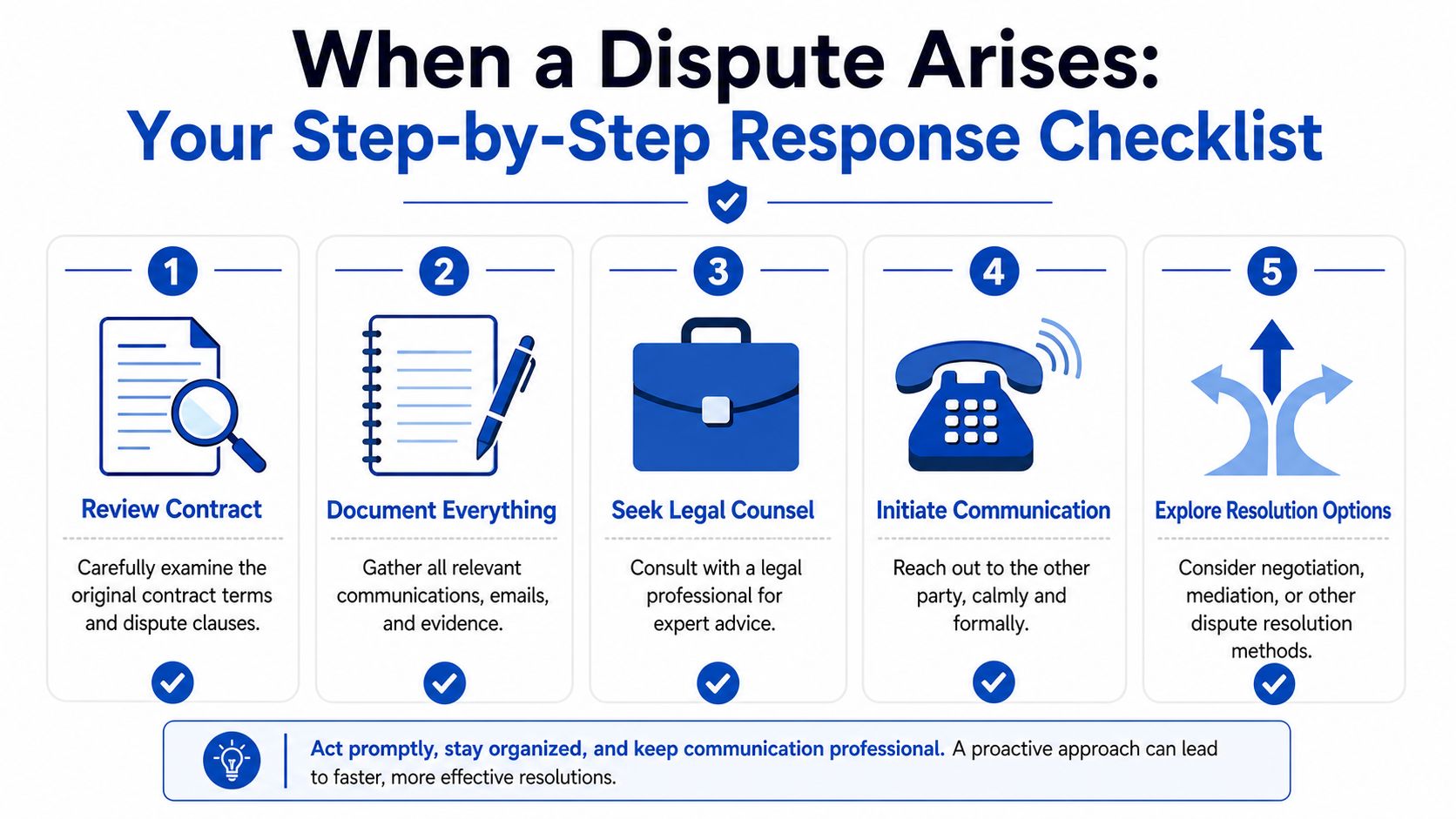
When a Dispute Arises Your Step-by-Step Response Checklist
A dispute notice can rattle even experienced operators. The first response should slow things down, not speed them up. Panic creates bad emails, missed deadlines, and accidental admissions.
Step 1 Review the contract
Pull the signed agreement, every amendment, every statement of work, and any incorporated policies or order forms. Confirm the notice clause, dispute procedure, limitation of liability language, acceptance terms, and any requirement to continue performance.
If the company is thinking about sending a formal warning before filing a claim, it also helps to understand what a cease and desist letter does in business disputes and when that tool fits.
Step 2 Preserve the record
Lock down documents fast. That includes email, Slack, Teams, text messages used for business, ticketing systems, invoices, version histories, meeting notes, and change approvals.
For technology disputes, witness selection matters early. The most important people are often the project manager, the engineer who attended governance meetings, the finance lead who approved billing, and the executive who negotiated deviations from the papered terms.
Step 3 Control communications
One calm, accurate point of contact is better than five employees arguing in parallel. Internal teams should stop casual commentary about who “blew it.” External responses should be deliberate and usually written with the contract in hand.
The first bad email in a dispute is often written by someone trying to be helpful.
Step 4 Check insurance and procedural risk
Some disputes trigger coverage questions, defense obligations, or notice duties under business policies. That review shouldn’t wait. Neither should planning for testimony if the conflict escalates. Teams that may face sworn questioning often benefit from practical preparation, and this overview of legal deposition guidance for professionals explains the basics in plain language.
Step 5 Get strategic legal advice early
Early advice is usually cheaper than late cleanup. Counsel can help assess whether the company should negotiate, mediate, arbitrate, or prepare for court, and can also stop the business from taking a procedurally damaging step in the first week.
A disciplined opening response doesn’t guarantee victory. It does protect its advantage, preserve evidence, and give the company room to choose its next move instead of reacting under pressure.
Strategic Guidance for Washington Startups and SMEs
Generic contract advice often misses the pressure points that matter most in the Washington startup market. Two stand out. One is the hidden cost of “mandatory mediation” in small claims. The other is the rise of AI-related scope disputes inside otherwise ordinary service contracts.
The small business mediation trap
Mediation is often presented as the sensible first step in every dispute. For many companies, it is. But small businesses shouldn’t assume that “best practice” equals best economics.
For claims under $50,000, data from Washington State indicates that the upfront cost of mediation can lead 35% of SMBs to abandon valid claims, making the clause a real barrier rather than a practical solution, as discussed by Rendigs in its article on navigating contract disputes and key strategies for resolution.
That matters for startups collecting overdue invoices, recovering retainers, or pursuing modest vendor failures. If the likely dispute value is limited, a mandatory ADR staircase can become a cost screen that benefits the larger party. A founder reviewing contract paper should ask a blunt question: if this deal goes bad at a modest dollar amount, will the chosen process let the company enforce its rights?
The AI-induced scope creep problem
AI has made old contract language less reliable. A classic SaaS or services agreement assumes outputs are relatively stable. AI features don’t always behave that way. The system may improve, drift, degrade, require retraining, or produce results that trigger disputes over whether the vendor missed the mark or the customer changed the target.
A provided industry source frames this as an “AI-Induced Scope Creep” problem and states that 42% of technology contract disputes in 2025-2026 involved undefined AI performance metrics or data usage rights in that source’s discussion of contract dispute issues in AI-era contracting. Because that source refers to future-dated periods, it should be treated as a projection rather than a settled current fact.
The practical takeaway is still useful. Washington startups adding AI terms by email, redline, or side letter are creating disputes that older templates were never built to manage.
Drafting moves that fit the local tech market
For AI, software, and data-heavy deals, startups and SMEs should push for:
- Defined outputs: State whether the vendor promises a tool, a process, or a result.
- Performance metrics: If the deal depends on model quality, uptime, response accuracy, or data use restrictions, put those standards in the contract.
- Change control: Require written approval for scope expansion, retraining requests, new integrations, or additional datasets.
- Evidence rules: Identify what records will matter if performance is challenged, such as logs, reports, acceptance testing, or version histories.
- Exit mechanics: Include off-ramp rights, transition support, and data return obligations.
These issues are particularly important in Seattle-area contracting because startups often move faster than their paper. Product teams may add AI features midstream. Sales teams may overpromise outcomes. Founders may accept ambiguous vendor language because the launch timeline feels more urgent than the legal cleanup that may follow. That trade-off rarely stays cheap.
Building a Resilient Business Foundation
The strongest contract dispute resolution strategy starts long before anyone sends a breach notice. It starts with agreements that match the business deal, escalation steps that real people can follow, and operating habits that preserve a usable record when something goes wrong.
Disputes can’t be eliminated. Business moves too fast for that. But many of the worst disputes are preventable. They grow out of vague scopes, copied boilerplate, undocumented changes, and procedures nobody reads until the relationship is already damaged.
For founders and SMEs, legal work should be treated as business infrastructure. A well-built master services agreement, a disciplined statement of work, and a realistic dispute clause often do more to protect the company than any aggressive posture taken after the conflict begins. Companies that want long-term resilience should invest in contract systems that support growth, not just signatures.
A practical starting point is understanding how a master services agreement supports ongoing business relationships. For many Washington companies, that document becomes the backbone of consistent expectations, cleaner statements of work, and fewer expensive surprises.
Washington businesses that want contracts built for real-world growth, technology risk, and durable dispute prevention can work with By Design Law Firm & Legal Consultancy, PLLC. The firm advises startups and established companies across the Greater Puget Sound on business agreements, technology transactions, AI-related legal risk, and dispute strategy designed to protect momentum as well as legal rights. Contact By Design Law Firm PLLC today at (206) 593-1519 for a complementary consultation.