A Master Service Agreement, or MSA, is the foundational contract that sets the general terms for an ongoing business relationship so future projects can move faster without renegotiating core terms each time. For startups, that usually means one master agreement governs the relationship, then later project documents handle the specific work.
A familiar scene plays out in early-stage companies. A founder finally lands the enterprise client the team has been chasing, procurement sends over a long contract, and the first question isn't about product delivery. It's, “What is an MSA agreement, and why does this thing control so much?”
That reaction is normal. An MSA often arrives before revenue, before kickoff, and before the startup has built an in-house legal function. It can look like boilerplate. It isn't. This document often decides who owns new work product, who carries risk if something breaks, how disputes get handled, and what happens if the relationship ends badly.
For a tech startup, the risks involved are greater than most generic contract guides acknowledge. A software company isn't just selling hours. It's protecting code, product know-how, customer data, integrations, security obligations, and sometimes AI features that create fresh liability questions. A weak MSA can inadvertently grant an advantage to the larger party before the first invoice goes out.
Your Guide to Master Services Agreements
A startup signs its first meaningful customer. The sales team celebrates. Then the customer's legal department sends a “simple MSA” that runs longer than the product spec. The founder scrolls past clauses on indemnity, IP ownership, confidentiality, security, venue, and termination, then realizes this isn't just a formality. It's the operating manual for the relationship.
That's the right way to think about it. An MSA isn't a hurdle between the deal and the work. It's the framework that decides how the work will be managed if things go well, and how damage gets contained if they don't.
Under the standard commercial definition, a Master Service Agreement, sometimes also called a framework agreement, establishes the general terms and conditions governing an ongoing relationship between two parties and creates a reusable structure for later project documents such as Statements of Work, as described in Wikipedia's overview of master service agreements. For a founder, the practical point is simpler. Negotiate the core legal rules once, then reuse them.
Practical rule: If the company expects repeat work with the same customer, vendor, or implementation partner, the MSA matters more than the first project order.
This matters operationally too. Teams that handle repeat contracting often pair the legal framework with an enterprise contract lifecycle management system so approvals, versions, renewals, and downstream obligations don't disappear into inboxes. That's especially useful once a startup has multiple customers on different paper.
A good MSA gives predictability. It tells the parties how money flows, what information stays confidential, who owns intellectual property, what law applies, and how changes must be documented. A bad one creates false comfort because it looks routine while shifting real risk onto the smaller company.
Founders don't need to become contract scholars to read one intelligently. They need a practical lens. What is the relationship? What work will recur? What assets need protection? What risks could threaten the company if the relationship goes sideways? Those questions turn the MSA from legal noise into a business tool.
What Is an MSA and Why Does It Matter
The clearest way to understand an MSA is to treat it like the constitution of a business relationship. It sets the governing rules. Later project documents operate underneath it.
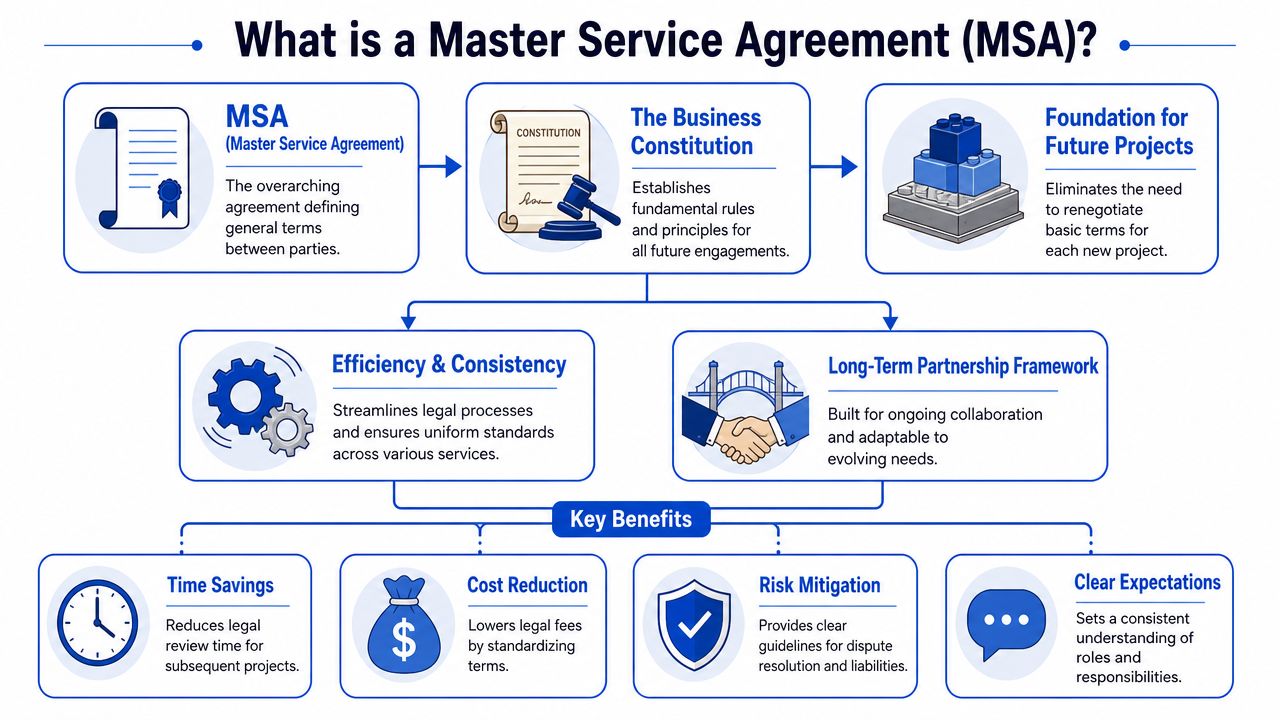
The umbrella over future work
An MSA works as an umbrella contract. Malbek explains that it eliminates the need to renegotiate foundational terms such as payment methods, intellectual property rights, confidentiality requirements, and dispute resolution procedures for every new project or transaction between a provider and client.
That's why mature companies like them. The legal team negotiates the base rules once. Business teams can then launch future work with much less friction.
A startup founder usually feels this benefit in three places:
- Sales cycles move more cleanly: Once the base contract is signed, new projects can often be documented with shorter follow-on paperwork.
- Internal decisions get easier: Finance, product, and operations know which standard rules apply.
- Disputes get narrower: The parties argue about the specific project, not every legal term from scratch.
Why repeat relationships need one
An MSA matters most when the parties expect multiple engagements. That could mean a SaaS company onboarding one customer across several implementation phases, a development agency handling recurring product releases, or a startup buying ongoing cloud, support, and security services from one vendor.
Ironclad describes the MSA as the “parent document” in these ongoing relationships, with later Statements of Work sitting beneath it and applying the master terms to a particular engagement in its discussion of MSA versus SOW. That hierarchy is what makes the system efficient.
A founder should also care because the MSA often becomes the single source of truth on legal risk. It typically addresses governing law, jurisdiction, confidentiality, ownership rights, termination, and dispute rules before any service begins. If those points are vague, every future project inherits the same uncertainty.
A signed MSA doesn't just speed up paperwork. It standardizes expectations before pressure, deadlines, and project changes make rational negotiation harder.
What readers often confuse
The phrase “what is an MSA agreement” also creates a niche but important confusion in healthcare. Jackson LLP notes that people often mix up Master Service Agreement with Management Services Agreement, even though the healthcare version serves a different legal and regulatory purpose tied to separating clinical from business operations and complying with CPOM and fee-splitting rules in its discussion of Management Services Agreements in healthcare.
For most startups outside healthcare, “MSA” means the commercial master contract described above. In healthcare-adjacent deals, the label can mean something more specialized, so parties should confirm which type of agreement applies.
Deconstructing the Key Clauses in Your MSA
Most MSAs look dense because they combine legal concepts with operational detail. The fastest way to read one is clause by clause, asking a business question instead of a legal one: what happens to cash, work product, data, risk, and exit options?
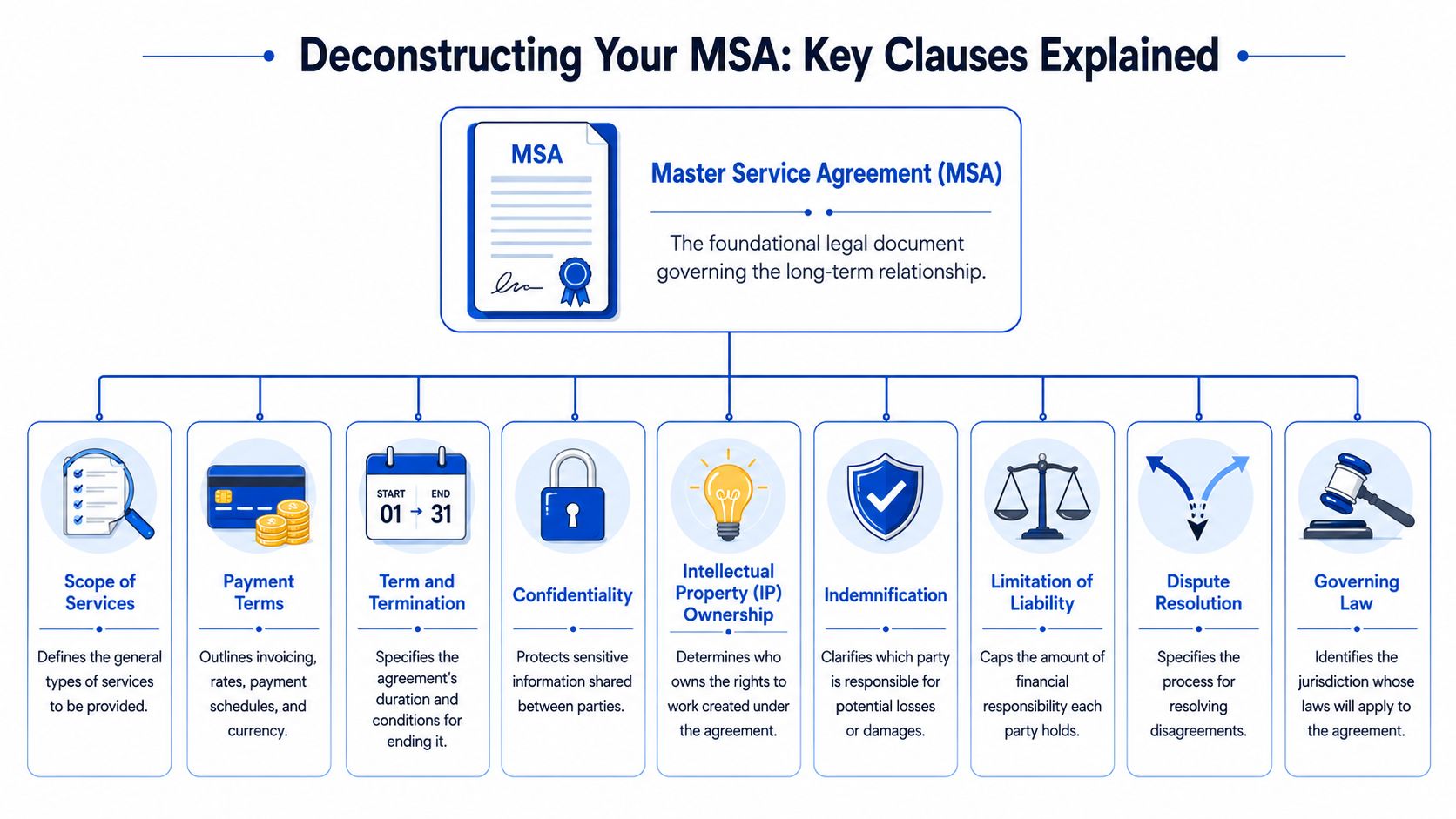
The clauses that deserve real attention
Thomson Reuters notes that an MSA should explicitly include services to be furnished, delivery dates and timelines, payment terms and conditions, indemnification and termination clauses, confidentiality provisions, and intellectual property rights, while also prioritizing the names and addresses of all parties so they can be legally identified. That sounds basic, but each item has real business consequences.
A practical reading guide looks like this:
| Clause | What it means in plain English | Why a startup should care |
|---|---|---|
| Scope of services | The general categories of work covered | It limits arguments about what was promised |
| Payment terms | Rates, invoicing, due dates, and disputes | Cash flow problems usually start here |
| Confidentiality | What information must be protected | Product plans and customer data often sit inside it |
| IP ownership | Who owns code, designs, deliverables, and pre-existing tools | This can affect the company's core asset base |
| Termination | How the relationship ends | Exit rights matter when a client becomes high-friction |
| Liability and indemnity | Who pays if something goes wrong | One bad clause can create outsized exposure |
| Governing law and dispute process | Which law applies and where conflicts get handled | Venue can shape leverage and cost |
Payment, scope, and change control
Founders often skim payment terms because the numbers in the order form feel more important. That's a mistake. The MSA usually decides invoice timing, late payment mechanics, dispute windows, and whether fees can be withheld.
eCapital's discussion of MSAs adds two useful drafting points. A strong MSA should include detailed service descriptions or attachments, specify exclusions, and define clear triggers for price adjustments, sometimes with notice periods of 30-60 days. It also says the agreement should function as the entire agreement, with amendments in writing and signed. That written-change rule is how companies prevent quiet scope creep.
If a client can expand the work through email threads and meeting notes without a signed change document, the startup is financing risk with its own labor.
Liability, warranties, and dispute mechanics
Liability language deserves slower reading than almost anything else in the contract. If the startup needs a practical primer on the issue, BoloSign for contract risk is a helpful starting point for understanding how limitation clauses work in commercial agreements.
The surrounding clauses matter too. DocuSign's overview of MSAs highlights legal elements that many generic summaries skip, including geography, delivery milestones, work standards, taxes and fees, warranties, legal venue, insurance requirements, and indemnification terms. Those items often decide whether a disagreement becomes a routine correction or an expensive legal fight.
For dispute language specifically, startups should pay close attention to forum, procedure, and escalation terms. A useful practical reference is this guide to dispute resolution clauses, because venue and process can matter almost as much as the underlying claim.
A short clause translation
Some founders benefit from seeing legal clauses translated into operational meaning.
- “Client owns all deliverables” can be reasonable for custom work, but it shouldn't accidentally transfer the startup's pre-existing platform, templates, libraries, or know-how.
- “Provider will perform services in a professional and workmanlike manner” sets a quality standard. It should not inadvertently become an open-ended performance guarantee.
- “Either party may terminate for material breach after notice and cure” means there's a path to fix the problem before the relationship blows up.
The best MSAs don't try to cover every future disagreement. They define enough clearly that most disagreements never mature into real disputes.
MSA vs SOW vs SLA How They Work Together
A startup signs a customer. Everyone is aligned on price, timeline, and launch goals. Then the main work starts, and three different documents appear in the deal file: the MSA, the SOW, and sometimes an SLA. If no one is clear on which document controls what, a routine project can turn into a contract argument.
The easiest way to read the stack is this: the MSA sets the ground rules for the relationship, the SOW describes the specific work, and the SLA sets the measurable service levels.
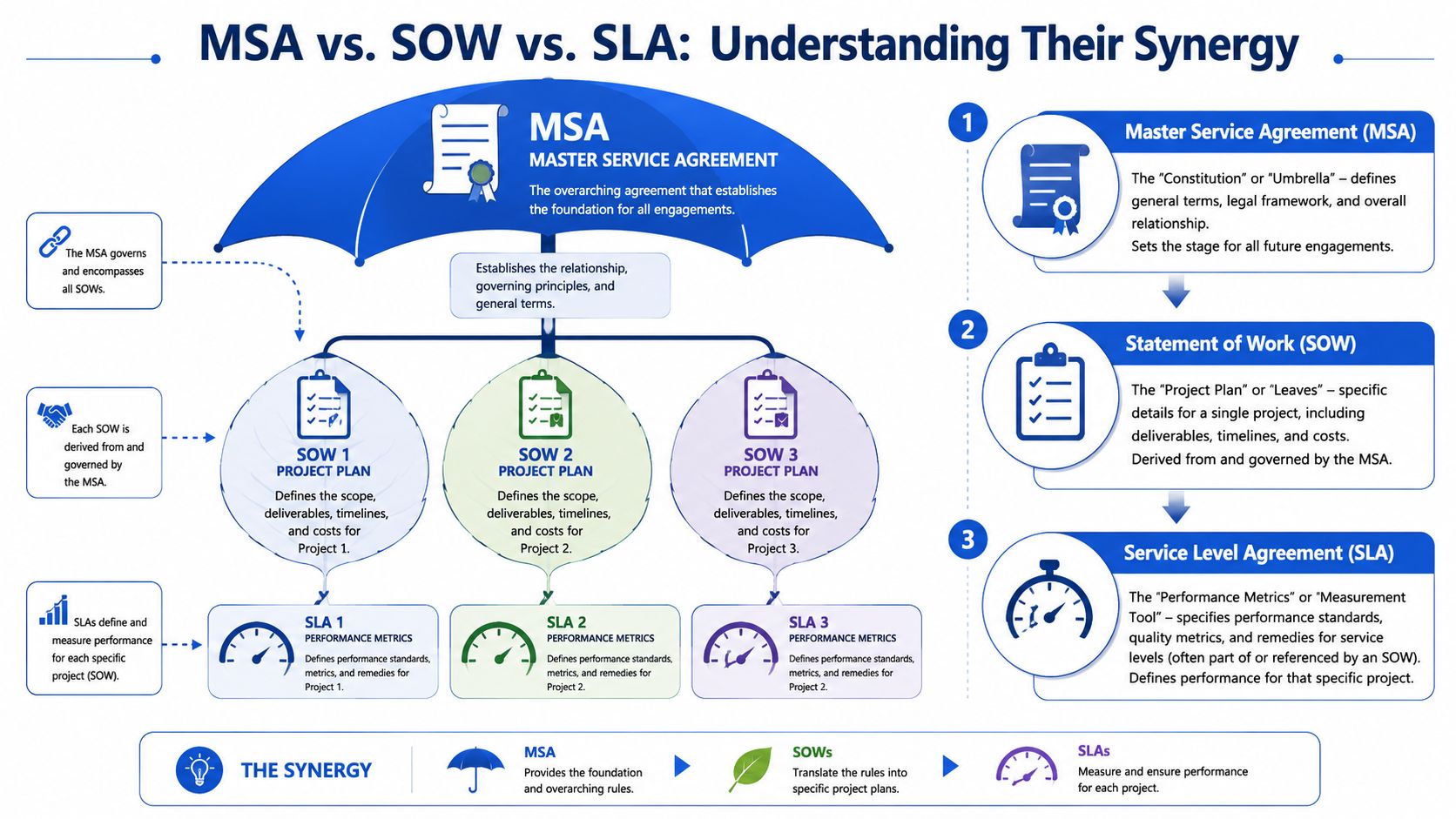
How the contract stack works
The MSA works like the operating system for the deal. It usually covers payment terms, confidentiality, ownership, liability limits, security obligations, dispute procedure, and termination rights. You negotiate those once so you do not have to renegotiate them every time a new project starts.
The SOW is different. It is the build sheet. It should say what is being delivered, who is doing what, when milestones happen, what assumptions the pricing depends on, and how acceptance works.
The SLA is narrower still. It answers a specific question: how will service performance be measured? For a SaaS or AI-enabled product, that can include uptime, response times, support windows, incident handling, service credits, and exclusions for scheduled maintenance or customer-caused outages.
That structure matters because startups often sell more than one kind of work to the same customer. One MSA might govern the relationship, while separate SOWs cover implementation, integration, model tuning, data migration, or later feature work. If the product includes ongoing hosted services, the SLA may be attached to the SOW or incorporated by reference.
A practical comparison
| Document | Main job | Typical contents |
|---|---|---|
| MSA | Sets the legal framework | payment rules, confidentiality, IP, liability, termination |
| SOW | Defines a specific engagement | deliverables, timeline, pricing, project assumptions |
| SLA | Measures service quality | uptime targets, support response, remedies |
A founder who wants a practical scoping reference can review this statement of work template to see how project-specific obligations are separated from the broader master contract.
Later in the contract stack, performance language often matters just as much as scope language. This short explainer can help ground the distinction:
Where startups get tripped up
Problems usually start with overlap.
A common example is an SOW that promises delivery by a fixed date, while the MSA says the customer has ten business days to review and accept each milestone. Another is an SLA that offers service credits for downtime but never says whether those credits are the customer’s only remedy. That gap matters a lot if the customer later argues for both credits and broad damages.
Tech startups face a newer version of the same problem. The SOW may promise AI outputs, model tuning, or customer-specific workflows, while the MSA says little about training data, output ownership, or responsibility for third-party model errors. If those issues are left floating between documents, the customer may claim rights your company never meant to give away, or push AI-related risk back onto your startup by default.
Read the documents together before signing. The MSA should govern relationship-wide legal terms. The SOW should govern what is being built or delivered. The SLA should govern measurable service performance. If the same issue appears in all three, add an order-of-precedence clause so everyone knows which document controls when the language conflicts.
Critical MSA Negotiation Points for Tech Startups
A startup shouldn’t negotiate every clause with equal energy. Some terms are manageable. Others can affect the company’s valuation, product roadmap, and survival.
Protect the company’s IP before discussing custom deliverables
Tech founders often focus on the customer’s statement that “the client will own the work.” That phrase is only safe if the contract sharply separates client-specific deliverables from the startup’s pre-existing materials and underlying platform.
Monjur explains that a strong MSA must define intellectual property rights and stipulate ownership of ideas, concepts, and designs created during the relationship. The same source notes that standard liability caps are often tied to fees paid over the past 12 months. Those two points belong in the same negotiation conversation because IP and liability often collide in custom software and AI work.
A startup should usually push for language that protects:
- Pre-existing IP: code libraries, APIs, workflows, documentation, models, prompts, and internal tools created before the deal.
- Residual knowledge: general know-how employees carry from one project to the next.
- Platform rights: the underlying SaaS product doesn’t become customer property because the startup configured it.
- Feedback rights: if the client suggests improvements, the startup should preserve broad rights to use the ideas in its product unless the deal says otherwise.
Data rights need separate treatment from IP
Founders often assume data ownership is covered by the IP clause. It usually isn’t. The contract should address who owns uploaded customer data, who may use de-identified or aggregated data, what happens on termination, and whether any customer data may be used for analytics, support improvement, or AI training.
If the startup provides AI-enabled features, this point becomes sharper. The company should define whether prompts, outputs, logs, training artifacts, and model performance telemetry count as customer confidential information, provider operational data, or both. Vague drafting creates future conflict.
A practical negotiating position is to separate data categories instead of forcing one ownership rule across everything.
Liability and security need disciplined limits
Unlimited liability is rarely appropriate for an early-stage tech company. Even broad indemnity language can be dangerous if it turns routine service mistakes into existential financial exposure.
A more balanced structure usually does three things:
- Caps direct damages using a clear liability limit.
- Excludes special categories like indirect or consequential damages, if the deal permits.
- Carves out only narrow exceptions for areas both sides agree warrant different treatment, such as confidentiality breaches or IP infringement claims.
Security obligations belong here too. If the startup commits to encryption, access controls, incident notice, or vendor oversight, the contract should state those duties precisely. It shouldn’t accept broad promises that every subcontractor, integration partner, or infrastructure issue becomes the startup’s legal problem in all circumstances.
A founder shouldn’t leave the table with a contract that treats a young company like an insurer.
Don’t ignore termination mechanics
Termination clauses look procedural until the relationship deteriorates. Then they become operationally urgent. The startup should understand whether the customer can terminate for convenience, what notice applies, what fees are owed for completed work, and what transition help must be provided after termination.
For recurring services, a customer’s right to walk away on short notice can be commercially acceptable. It becomes dangerous when paired with heavy staffing commitments, broad transfer obligations, or delayed payment rights.
The strongest startup position is simple. Keep ownership clean, define data use precisely, limit liability rationally, and make exit terms workable before the first project begins.
MSA Red Flags and Modern Risks to Avoid
A founder signs an MSA that looks clean, standard, and familiar. Six months later, the customer claims the startup promised perfect security, broad ownership rights, and responsibility for faulty AI outputs produced by a third-party model. The dispute did not start with obvious bad language. It started with ordinary language applied to a modern product.
That is what makes this section hard. Many MSAs still read like they were written for consulting projects or basic software hosting. A tech startup selling SaaS, handling customer data, or using AI needs a closer read.
The red flags that deserve a second look
Some warning signs still show up in plain sight:
- Unlimited liability. One customer dispute should not threaten the whole company.
- Overbroad IP assignment language. Phrases like “all work product” can accidentally pull in pre-existing code, internal libraries, model tuning methods, or reusable product components.
- Vague security promises. “Industry-standard security” sounds safe, but it often creates a moving target no one can measure later.
Those problems are familiar. The newer trouble usually sits in the definitions, data terms, and AI provisions.
AI risk now belongs in the MSA
Ironclad notes in its article on what an MSA is and how AI terms are entering these agreements that enterprise contracts increasingly include AI governance language. Startups should treat that as a drafting issue, not a future issue.
An AI product can create liability in several directions at once. A customer may want broad promises about accuracy. A regulator may care about explainability or data use. A model provider may impose its own restrictions upstream. If the MSA ignores that stack, the startup can end up promising more to the customer than it is allowed to promise under its own vendor terms.
A good review starts with four practical questions:
- Can the startup use customer prompts, inputs, or outputs to train or improve models?
- What disclosures are required about model sources, third-party providers, or automated decision-making?
- Who is responsible if an AI output is wrong, biased, infringing, or unsafe to rely on?
- Does the contract require human review before the customer acts on the output?
A founder should also test whether the company can meet any security promises tied to those tools. A structured vendor security assessment helps identify weak points before they become contractual obligations, especially where the product depends on subprocessors, cloud vendors, or external model providers.
Silence can be as dangerous as bad language
Some of the worst MSAs do not contain an obviously hostile clause. They leave out terms the startup needs.
For data-heavy deals, missing rules on deletion, return, retention, breach notice, audit limits, and subprocessor use can create operational confusion fast. If a customer asks, “When will our data be deleted?” and the MSA has no answer, the startup has already lost control of the issue.
The same problem appears in AI contracting. An MSA may cover confidentiality and ownership in old-fashioned terms but say nothing about prompts, generated outputs, model improvement rights, hallucination risk, or whether the customer may rely on automated results without review. That gap matters because courts and counterparties will still expect an answer when something goes wrong.
Older templates work like a paper map from the wrong city. They still look useful. They just do not get a startup where it needs to go.
Practical red flags founders often miss
A careful founder should slow down if the MSA does any of the following:
- Defines customer data too broadly, so it may include the startup’s analytics, usage logs, derived insights, or de-identified learnings.
- Defines deliverables too broadly, so ordinary service outputs get treated as custom IP transfers.
- Promises legal compliance in blanket terms, without limiting the promise to laws that apply to the service.
- Accepts customer policies by reference, especially security, procurement, or AI ethics policies the startup has not reviewed.
- Commits to future standards, such as security controls or AI rules that may change during the contract term.
- Requires indemnity for all infringement claims, even where the customer supplied inputs, training materials, or instructions that caused the problem.
The pattern is simple. If a clause sounds flexible, modern, or customer-friendly but does not say who decides, who pays, and what the limit is, it needs revision.
Your MSA Pre-Signature Checklist
Before signing, a founder should stop reading the MSA like a legal document and start reviewing it like an operating risk file. The right final check is a list of questions.
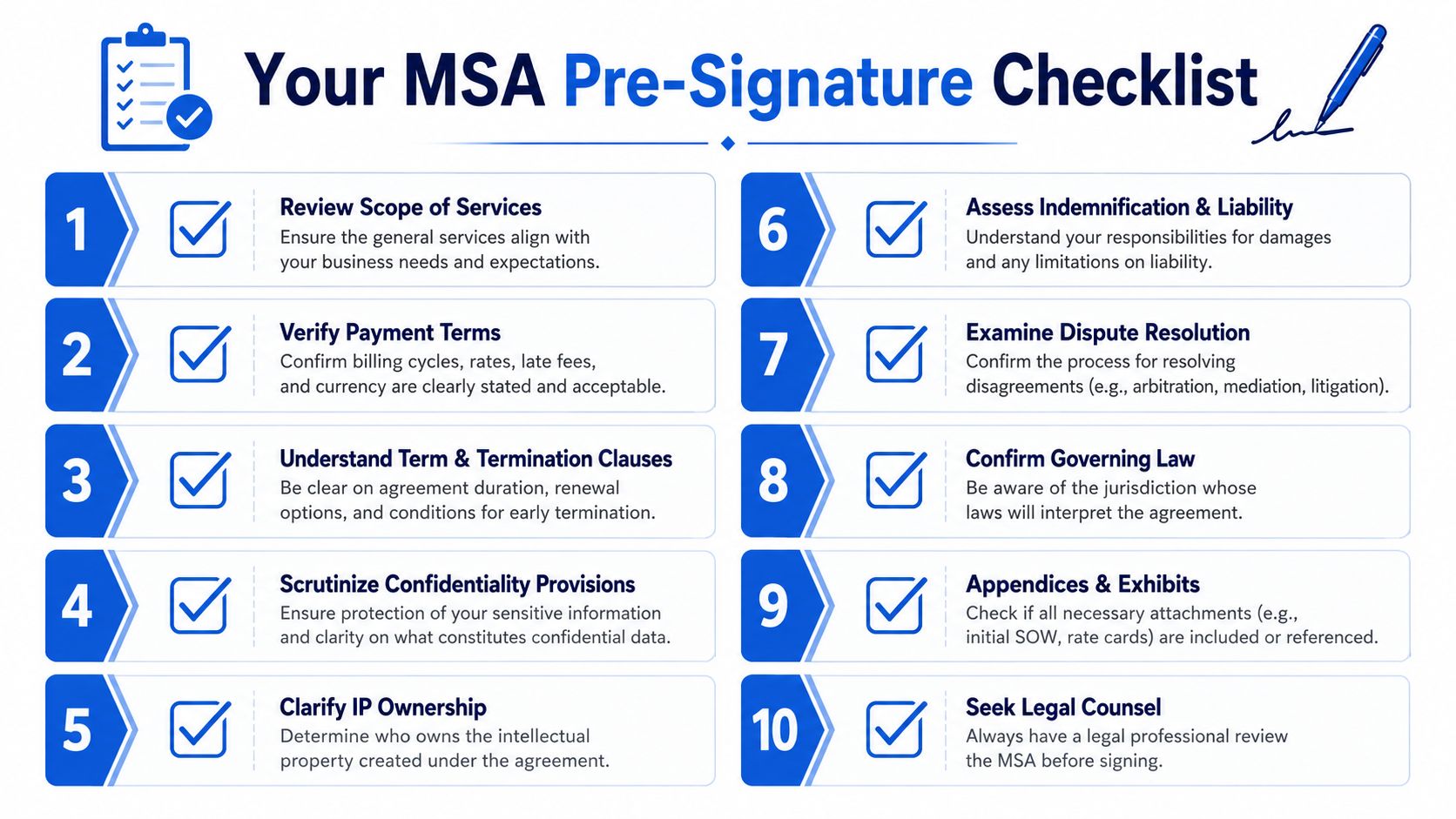
The questions worth asking before signature
- Do the named parties match the actual business entities? Legal names and addresses should be correct.
- Is the scope clear at the right level? The MSA should frame the relationship without stuffing project details where they don’t belong.
- Are payment rules workable? Billing timing, disputes, and acceptance mechanics should support cash flow, not choke it.
- Is IP ownership segmented correctly? The contract should distinguish pre-existing IP, custom deliverables, and underlying tools.
- Are confidentiality duties realistic? The startup should know what must be protected and for how long.
- Is the liability cap stated clearly? A cap that can be calculated is better than a vague risk allocation clause.
- Are indemnities narrow enough to understand? If a founder can’t explain when the company must defend or reimburse the other party, the clause needs work.
- Do dispute terms create practical advantage? Governing law, forum, and process all affect cost and speed.
- Have data-handling terms been separated from general IP language? If needed, a dedicated data processing agreement template can help structure privacy and processing obligations more cleanly.
- Do AI features create additional obligations that the contract hasn’t addressed? Silence isn’t safety.
The final screen
A useful final test is this. If the customer relationship became tense six months after signature, would the startup still be comfortable with the contract language on money, ownership, data, security, and exit?
If the answer is unclear, the agreement probably needs revision before the signature block gets filled.
By Design Law Firm & Legal Consultancy, PLLC helps startups, technology companies, and growth-stage businesses build contract systems that protect IP, manage data risk, and support durable commercial relationships. Businesses that need practical guidance on MSAs, technology contracts, privacy terms, AI risk, or negotiation strategy can learn more at By Design Law Firm & Legal Consultancy, PLLC. Contact our law office today at (206) 593-1519.