A Washington founder hires a developer to build an internal dashboard. The parties trade a few emails, agree on a rough budget, and kick off fast because the sales team wants the tool live before the next quarter. Two weeks later, the developer says single sign-on was never included. The founder assumes mobile responsiveness, admin controls, and documentation were part of the deal. Nobody is lying. Nobody is aligned.
That is how small contract problems turn into business problems.
For Washington technology companies, especially those moving quickly with contractors, agencies, and specialized vendors, a Statement of Work template is not busywork. It is the document that turns a loose idea into an enforceable operating plan. A good SOW defines what gets built, what gets delivered, who does what, when approvals happen, and what falls outside the deal. A weak one invites delay, invoice fights, and damaged relationships.
The problem with most free templates is not that they are short. It is that they leave out the clauses that matter most when a software, AI, or data project changes midstream. Two omissions show up again and again: Exclusions and Change Management. Those are the clauses that often decide whether a project stays contained or becomes an expensive argument.
Why a Handshake Agreement Is Not Enough
A founder usually doesn't mean to rely on a handshake. It happens because the project feels straightforward. The vendor seems competent. The team wants speed. So the agreement lives across an email thread, a proposal PDF, a kickoff call, and a few Slack messages.
Then the project starts moving.
Where informal agreements break down
The first failure point is usually scope. One side thinks “build a customer portal” includes integrations, migration, and testing. The other side thinks it means a basic front end and limited functionality. By the time that mismatch shows up, time has already been spent and invoices have already gone out.
The second failure point is approval. If nobody defined acceptance criteria, a vendor may claim a deliverable is complete because it technically works. The client may reject it because it is missing practical business requirements. Both positions can sound reasonable, which is exactly the problem.
Practical rule: If the parties can't tell a neutral reviewer exactly what “done” means, the agreement isn't ready for signature.
A proper SOW fixes this before work starts. The University of Mississippi Medical Center explains that a Statement of Work is a mandatory contractual element in every subcontract or contract for research and service delivery and must define scope, deliverables, timelines, payment terms, and acceptance criteria to support legal compliance and accountability, serving as the contractual foundation for vendor and contractor engagements (UMMC Statement of Work guidance).
What a solid SOW does in practice
A strong SOW does more than document intentions. It creates operational discipline. It tells the contractor what must be produced, tells the client what inputs must be provided, and gives both sides a reference point when the project changes.
A practical statement of work template should help a business owner answer questions like these:
- What is being delivered: A prototype, production-ready code, a policy set, a migration, or managed support.
- What is not being delivered: Ongoing maintenance, employee training, third-party licensing, or compliance advice.
- Who has decision authority: A founder, CTO, operations lead, or procurement contact.
- When approval happens: At milestone review, user acceptance testing, or final deployment.
- What happens if the work changes: Whether there is a written change order, revised fee, or adjusted timeline.
Without that framework, a “simple project” becomes a referendum on memory. Memory is a terrible contract management system.
The Anatomy of an Ironclad Statement of Work
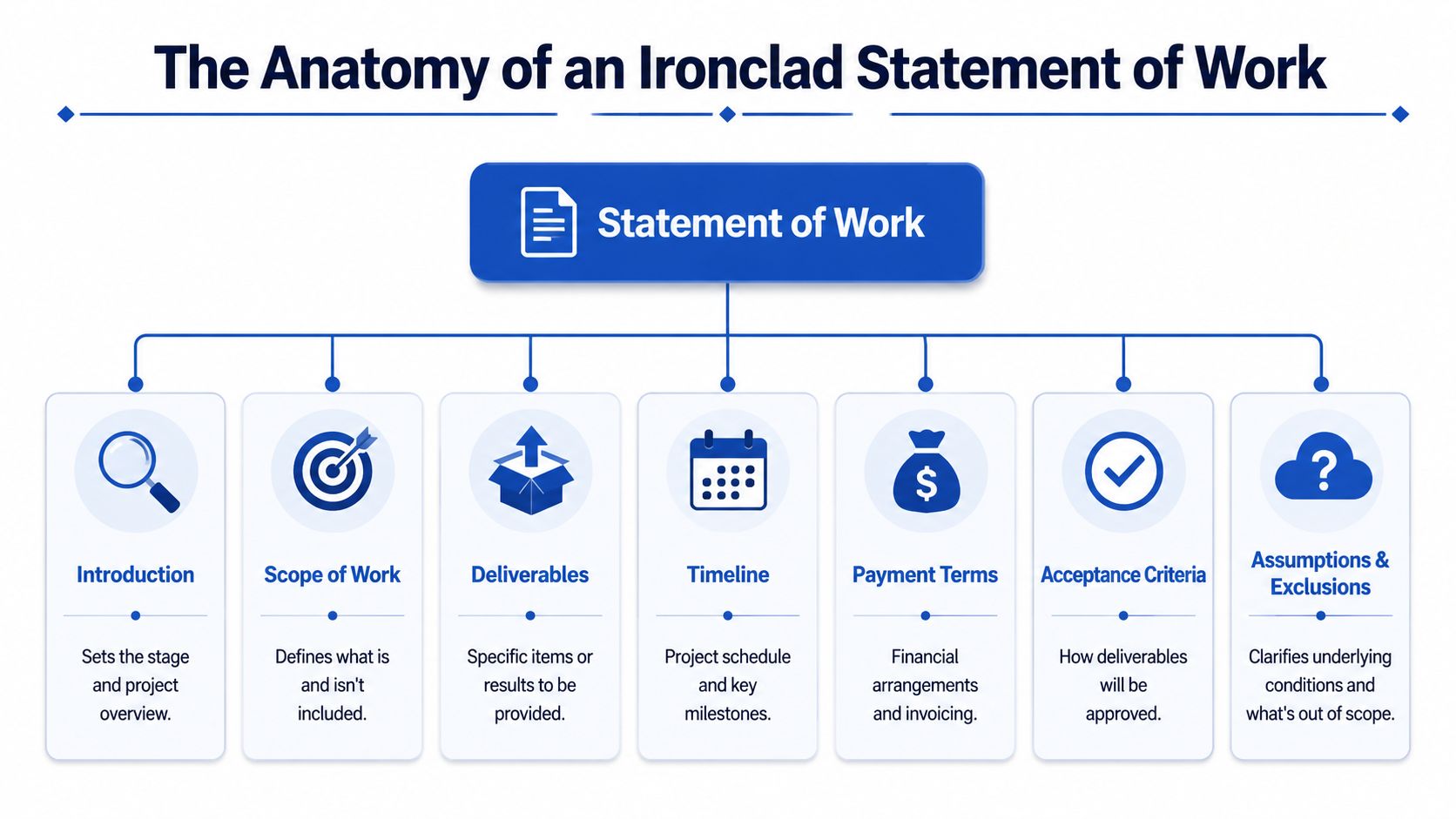
A good SOW works like a blueprint. It does not just name the project. It translates the commercial deal into terms that operations, finance, and legal can all use without guessing.
The core sections that belong in every template
The most useful statement of work template includes these components:
| Section | Why it matters |
|---|---|
| Introduction | Identifies the parties, project, and business context |
| Scope of work | Defines the tasks, boundaries, and methods |
| Deliverables | States the actual outputs the vendor must provide |
| Timeline and milestones | Sets dates, dependencies, review points, and sequencing |
| Payment terms | Connects money to milestones, invoices, or acceptance |
| Acceptance criteria | Defines how the client decides whether work is complete |
| Assumptions and exclusions | Clarifies what the deal depends on and what is outside it |
The scope of work is where many templates go soft. It should identify what is included and what is outside the engagement. For startups using blended delivery models, that distinction matters even more. A company using staff augmentation may expect day-to-day direction and internal task assignment, while a managed-services vendor may expect outcome-based autonomy. That team-design issue shapes the SOW itself, and founders weighing those models may find the ThirstySprout perspective on team structures useful before drafting responsibilities.
Legal weight, not administrative fluff
An SOW is often attached to a larger contract such as an MSA. But the SOW is where the business deal becomes concrete. If the parties later dispute what was promised, this is usually the exhibit everyone reads first.
Some clauses also need to work with the rest of the contract set. For example, if a project timeline depends on outside events like vendor outages, natural disasters, or supply chain interruptions, the SOW should line up with the underlying contract's treatment of unexpected disruptions. A related discussion appears in this guide to a force majeure clause.
A vague SOW doesn't create flexibility. It shifts risk to the point in the project when change is most expensive.
Details that separate workable SOWs from decorative ones
Strong templates also address the practical details people skip in early drafts:
- Work location: Onsite, remote, hybrid, or access-restricted.
- Roles and authority: Who approves requirements, who signs off, who provides client materials.
- Monitoring and review: How often status meetings occur and what triggers escalation.
- Quality standards: Security requirements, coding standards, documentation expectations, or testing obligations.
When those details are omitted, the parties often keep working anyway. That can feel efficient in the moment, but it usually means the project is running on assumptions nobody wrote down.
Drafting Your SOW Section by Section
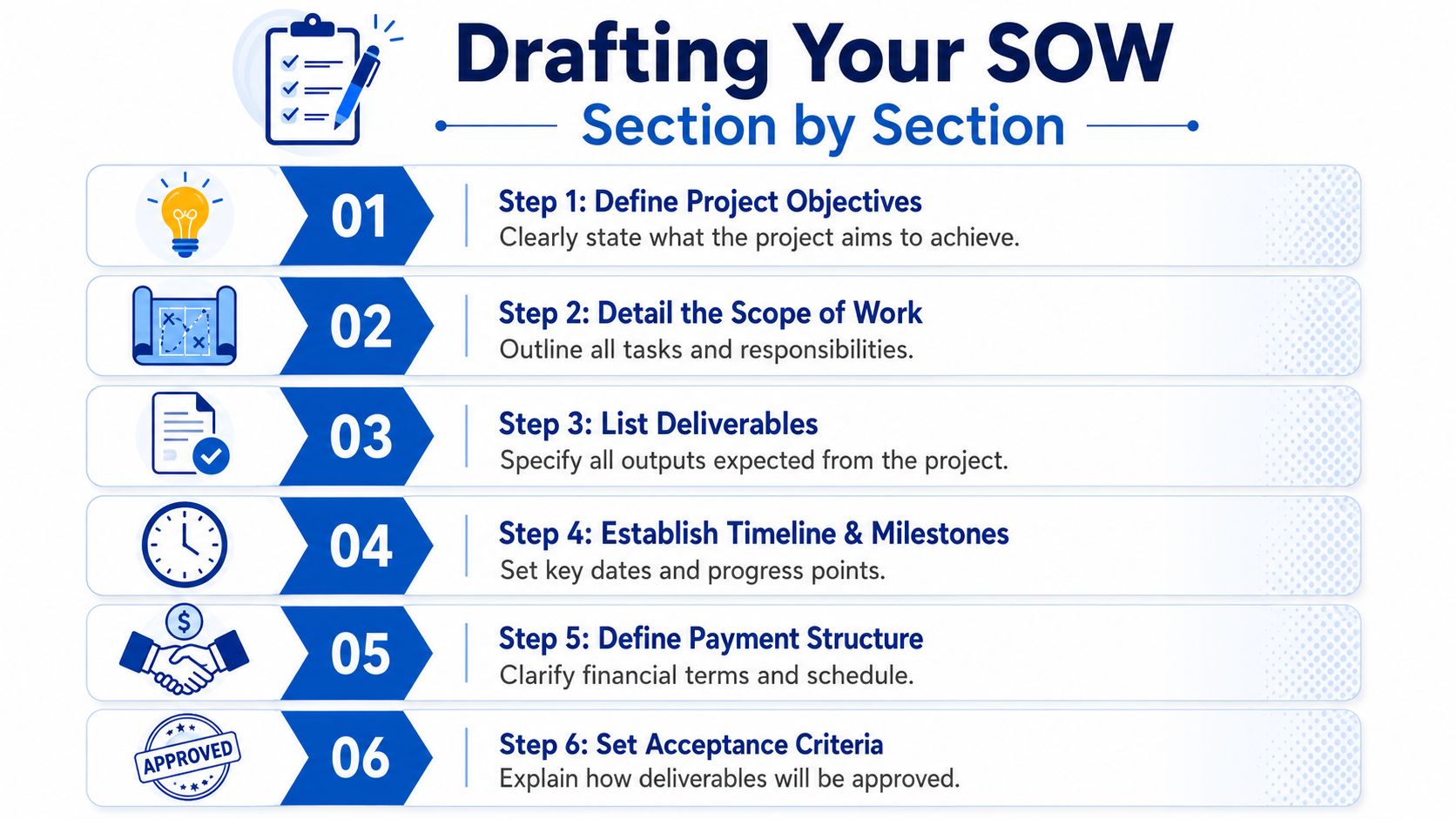
The fastest way to draft a useful SOW is to stop thinking of it as a narrative and start thinking of it as a controlled checklist. The Institute of Project Management describes a robust SOW process as one that begins with clear project objectives and then details deliverables, timelines, roles, payment terms, acceptance criteria, and a change management process before stakeholder approval (Institute of Project Management on writing a Statement of Work).
A template earns its keep. The right one doesn't just provide headings. It forces decisions.
Start with objectives, not tasks
Many founders start by listing features. That's backwards. The SOW should first state the business objective in plain English.
Examples of workable opening language:
- For an AI tool: “Vendor will configure and deploy a customer-support triage workflow for internal use by Client's support team.”
- For a software build: “Contractor will design and implement a web-based inventory dashboard for Client's operations team.”
- For a privacy project: “Consultant will prepare a data mapping and retention framework for Client's Washington and multistate operations.”
Then define what success means operationally. Keep it concrete. “Improve workflow” is too soft. “Deliver a functioning dashboard for internal inventory review” is clearer.
Build the scope with a WBS mindset
A Work Breakdown Structure helps break the project into tasks, sub-tasks, and outputs. That matters because broad scope descriptions create room for conflicting expectations. Even if the SOW does not include a formal project-management chart, it should reflect the same discipline.
A useful drafting sequence looks like this:
- List major phases such as discovery, design, development, testing, deployment.
- Break each phase into tasks with named outputs.
- Tie each output to a responsible party so there is no confusion over ownership.
- Add dependencies such as “Client must provide API documentation before integration work begins.”
Don't write “Vendor will support implementation as needed.” Write what support means, who requests it, and how much of it is included.
Describe deliverables so a stranger could verify them
A deliverable is not “development services.” A deliverable is “staging environment deployed with agreed feature set and administrator access.” The test is simple: could someone unfamiliar with the project review the SOW and determine whether the item was delivered?
That means each deliverable should include:
- Name of the output: prototype, policy draft, migration plan, dataset, training session
- Format: PDF, Figma file, Git repository access, recorded training, spreadsheet
- Version or stage: draft, final, production-ready
- Review path: client review, revision cycle, final acceptance
For projects with recurring invoices, founders often need a payment attachment that tracks milestone billing cleanly. A simple operational companion can be a set of invoice templates for any business, especially when finance wants billing documentation to match the milestone structure in the SOW.
Before setting service metrics, it also helps to distinguish the SOW from a service-level document. A useful comparison appears in this service level agreement template, which addresses performance commitments differently from project-defined work.
A short training resource can also help teams see how the sections fit together in practice:
Set the schedule like a manager, not a marketer
Timelines fail when they are written for optimism instead of administration. Dates should reflect review windows, client response times, and third-party dependencies.
A stronger schedule section includes:
| Item | Weak wording | Better wording |
|---|---|---|
| Start date | “Project begins in May” | “Project begins on the effective date after receipt of initial materials” |
| Milestone | “Design review” | “Design review meeting to occur within five business days after delivery of wireframes” |
| Delay trigger | “Timeline may change” | “Dates extend by the number of days Client approval or required materials are delayed” |
Colorado State University’s procurement guidance is especially practical here. It notes that a thorough SOW should include a timeframe stating maximum billable hours per time period and specific review times, plus a schedule assigning responsibility for tasks by date (Colorado State University on developing a Statement of Work).
Write payment and acceptance together
Payment fights often stem from separating money from approval. Those sections should talk to each other.
Instead of “50 percent up front, balance on completion,” use language that answers three questions:
- When is an invoice issued
- What event makes it payable
- What happens if the client disputes the deliverable
Sample language:
“Vendor may invoice upon delivery of Milestone 2. Client shall review the deliverable within the stated review period and either accept it in writing or provide a written list of nonconformities tied to the acceptance criteria.”
That kind of sentence prevents the classic drift where one side says the work is complete and the other says the work is still under review.
Advanced SOW Clauses for Tech and AI Projects
Generic templates usually assume stable requirements and ordinary services. Technology projects rarely behave that way. AI projects behave that way even less. A statement of work for a website refresh is one thing. A statement of work for model development, sensitive data handling, or software tied to regulated workflows needs tighter language.
Change management is not optional in tech work
The DocuSign template guidance notes that the lack of standardized change management processes contributes to 35% of project delays in tech and data-driven sectors and that many templates fail to provide practical mechanisms for handling scope changes or measuring performance against evolving requirements (DocuSign Statement of Work template guidance).
That tracks with what founders see on the ground. Requirements change after product demos. Security teams ask new questions. A third-party API behaves differently than expected. The project should be built to absorb those shifts through process, not argument.
A useful change-management clause should state:
- Who can request a change
- What must be in the request
- Who approves the change
- How fees and dates adjust
- Whether work pauses pending approval
Clauses that matter in software and AI engagements
For Washington businesses, several issues deserve special attention.
Intellectual property ownership. If a contractor writes code, custom prompts, workflows, training materials, or documentation, the SOW should say who owns each output and when ownership transfers. It should also carve out the vendor’s preexisting tools, libraries, and know-how where appropriate.
Data use and model training. If the vendor touches customer data, support transcripts, health data, or employee records, the SOW should say whether that data may be retained, de-identified, or used for model improvement. Silence here is dangerous.
Security obligations. The SOW should specify baseline expectations for access control, storage limits, incident reporting, and subcontractor use. If the vendor will interact with regulated datasets, the SOW should point to the relevant security addendum or data processing terms.
Compliance assumptions. In Washington, privacy-sensitive work may require close alignment with sector-specific obligations and state law developments. For AI-specific governance issues, a practical companion is this AI risk assessment template.
Founders also sometimes forget that workforce classification and restrictive covenant terms can affect who is doing the work and under what post-engagement constraints. For companies staffing projects with independent specialists, this discussion on navigating independent contractor clauses is a useful commercial cross-check.
If the project involves code, data, or automated decision-making, the SOW should identify what the vendor may access, what the vendor may keep, and what the vendor must return or delete.
A running example for an AI build
Assume a Seattle startup hires a vendor to build an AI triage assistant for inbound support tickets. A generic template might say “Vendor will develop and deploy an AI customer service workflow.” That is far too thin.
A stronger SOW would address data inputs, testing environment, model boundaries, escalation rules, prohibited uses, human review requirements, and post-deployment tuning. It would also clarify whether the vendor is delivering a custom model workflow, a configuration of an existing platform, or both. Those distinctions affect ownership, liability, and support.
Common SOW Pitfalls and How to Avoid Them
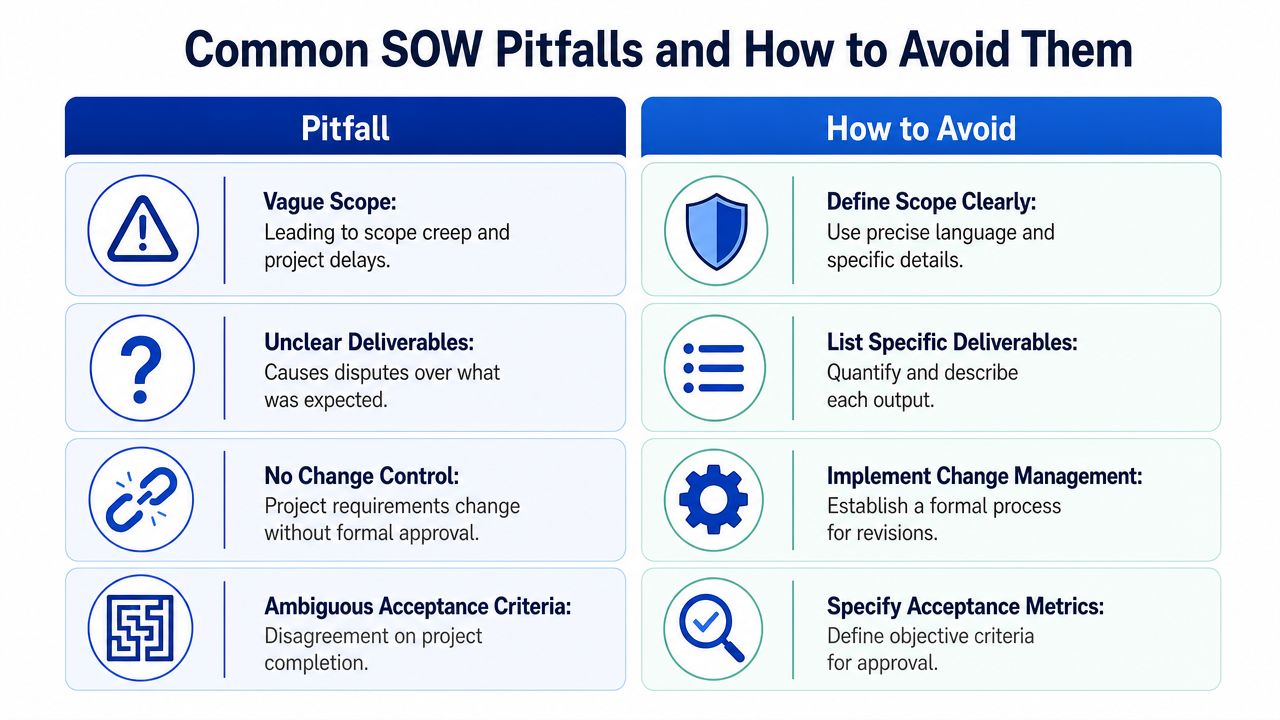
The most expensive SOW mistake is believing that an in-scope list is enough. It isn’t. A contract can describe the work in detail and still fail if it never says what is outside the deal.
The exclusions problem
According to 2025 UNTS training data, 40% of contract disputes arise from undefined exclusions, where vendors make incorrect assumptions about tasks that are not expressly listed as out of scope (UNTS training material on SOW exclusions).
That number matters because it highlights a drafting habit seen constantly in startup work. The client writes what it wants built. The vendor writes what it plans to do. Neither side writes the sentence that would have avoided the fight: “The following items are expressly excluded from this SOW.”
A good exclusions section often includes things like:
- Third-party costs: software licenses, cloud fees, paid APIs, outside audits
- Client-side work: internal data cleanup, stakeholder training, policy implementation
- Future phases: maintenance, enhancements, new integrations, multilingual support
- Regulatory advice: legal compliance opinions, privacy notices, employment review
Other mistakes that create avoidable disputes
A few pitfalls show up repeatedly, even in otherwise decent templates.
- Ambiguous acceptance criteria: “Client approval” is not a standard. Approval should tie to objective requirements, test steps, or review periods.
- Undefined dependencies: If the vendor needs credentials, data exports, or access to the client’s technical lead, the SOW should say so.
- Role confusion: “Client will provide feedback” is vague. Name the role with authority to approve, reject, or request changes.
- No formal revision path: Revision rounds should be counted or bounded. Open-ended revisions are a dispute waiting to happen.
The strongest SOWs read almost a little stiff on first pass. That is usually a sign the parties did the hard thinking before the money was spent.
A practical fix
A fast way to improve an existing statement of work template is to add two final review questions before signature:
- What work might the client assume is included even though the vendor did not price it?
- What event would cause the timeline or fee to change, and where is that stated?
If those questions cannot be answered by pointing to the draft, the SOW still has gaps.
Finalizing Your SOW in Washington State
A Washington business does not need a bloated procurement document for every project. It does need a SOW that is clear enough to negotiate, manage, and enforce. That means translating project language into defined obligations.
What legal sufficiency looks like
Thomson Reuters notes that a legally sufficient Statement of Work should explicitly define the size of the project, the responsibilities and roles for each party, and the criteria acceptance expectations, and that scope exclusions should be stated definitively rather than implied (Thomson Reuters on what a SOW must include).
That guidance is especially useful for Washington companies because many startup contracts are negotiated quickly by founders, operators, or product leads rather than dedicated procurement teams. In that environment, the most important drafting move is often simple precision.
A pre-signature review checklist
Before signing, a founder or operations lead should review the SOW from three perspectives.
Commercial review
- Does the pricing model match the project reality: fixed fee, milestone-based, or time and materials?
- Does the scope reflect the actual business goal: not just a feature list, but the intended use?
- Are excluded items visible enough that no one can miss them?
Operational review
- Is there one named owner on each side: someone with authority to approve and escalate?
- Are dependencies listed: data access, client materials, technical approvals, third-party tools?
- Does the timeline account for review and delay periods rather than assuming instant feedback?
Dispute-prevention review
- Can a neutral person tell when a deliverable is accepted?
- Does the draft say what happens when requirements change?
- Do the dispute provisions in the main contract line up with the project workflow? A useful reference point is this discussion of dispute resolution clauses.
Washington-specific business reality
Washington companies, particularly in Seattle and the broader Puget Sound region, often contract for specialized work involving software development, cybersecurity support, AI integration, cloud migrations, and privacy-sensitive data handling. Those projects move fast and involve cross-functional teams. A solid SOW should reflect that reality by naming the business owner, technical owner, and approval owner separately when needed.
That discipline doesn’t slow deals down. It keeps deals from drifting after signature.
Protect Your Project with a Professional Review
A statement of work template is one of the best low-cost risk controls a business can use. It aligns expectations before kickoff, gives finance and operations a common reference point, and reduces the chance that a project turns into a dispute over memory, assumptions, or unwritten side conversations.
But a template is still a starting point. The legal risk usually sits in the custom language. That is where project-specific issues appear, especially in software, AI, data use, intellectual property, payment triggers, and change control. A founder can draft a solid first version internally. That often makes sense. The prudent next step is having someone review whether the document matches the deal the business thinks it made.
A short legal review is often much cheaper than fixing a broken vendor relationship, absorbing unpaid rework, or arguing over whether a key deliverable was ever part of the contract.
If a Washington business wants a Statement of Work reviewed, tightened, or drafted to fit a technology, data, or AI project, By Design Law Firm & Legal Consultancy, PLLC helps startups and growing companies turn rough project terms into clear, enforceable agreements that protect the budget, the timeline, and the business relationship. Contact our law office today at (206) 593-1519 for a complementary consultation.