A founder can have a clean-looking compliance binder and still be one bad week away from a mess. The typical pattern is familiar, the SOC 2 window is close, the enterprise buyer wants security answers by Friday, and nobody can say who owns the production cloud account, where the backup evidence lives, or whether EU data ever left the intended region. That's the point where cloud security compliance stops being paperwork and becomes proof, ownership, and liability.
The hard truth is that the business pressure is already here. A 2025 industry compilation reported that 72% of organizations said regulatory requirements such as GDPR, HIPAA, and SOC 2 directly drive cloud-security spending, while 57% said they were out of compliance with at least one framework because of cloud-related issues, and 45% of all data breaches in 2025 involved cloud-based assets, with the average cost of a cloud-related breach reaching $5.12 million (industry compilation). In practice, that means cloud compliance is no longer a policy appendix. It's tied to diligence questionnaires, contracting friction, breach economics, and whether a customer's legal team will green-light the deal.
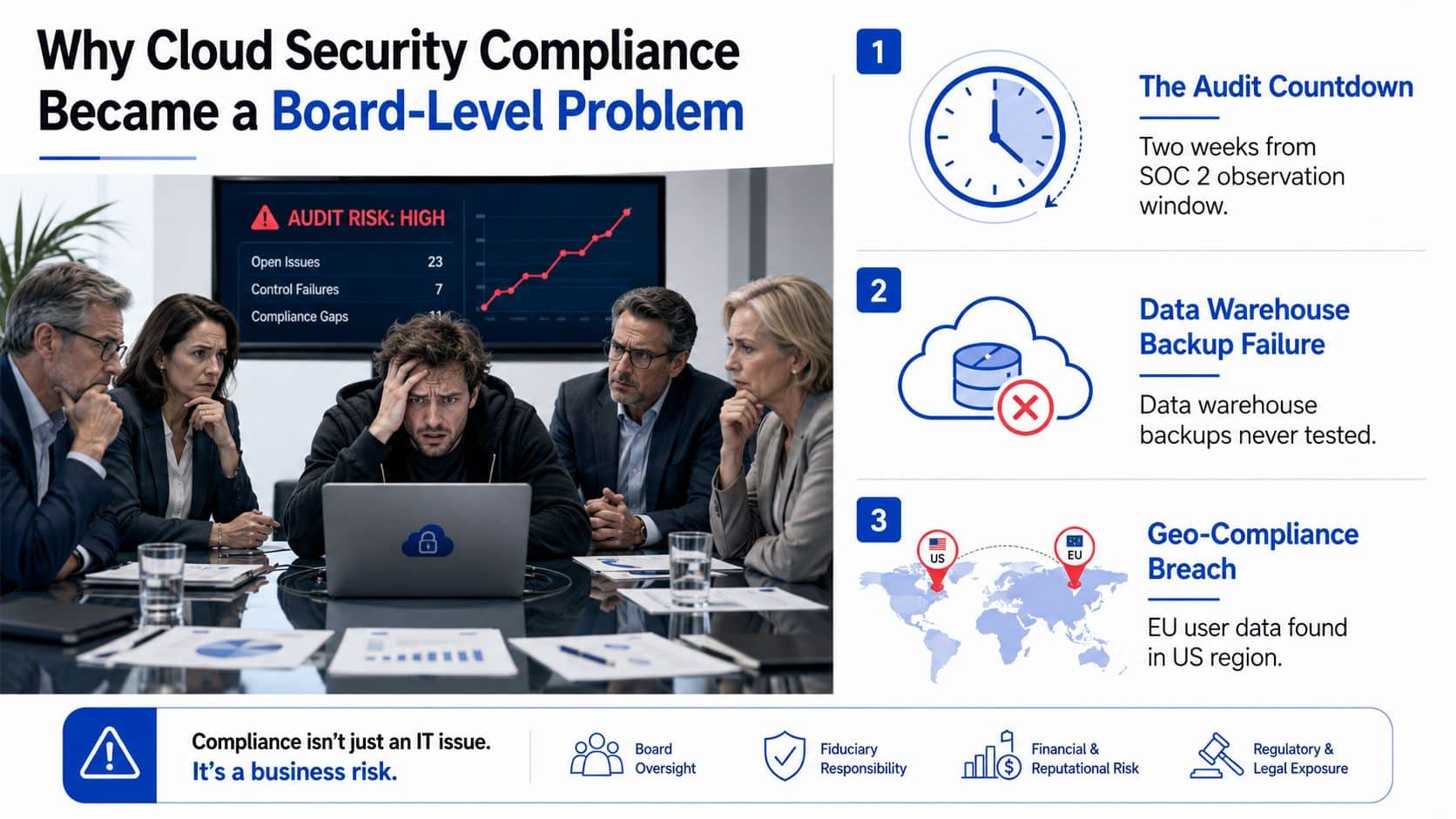
Why Cloud Security Compliance Became a Board-Level Problem should read like a board deck because that's what these issues have become. A distressed startup founder in a boardroom, with clock pressure, broken backups, and a geo-compliance miss, is not a hypothetical, it's a familiar audit-season reality. The practical read on executive risk is also captured in cybersecurity advice from Reworx Recycling, which lands on a simple point, leaders get pulled in once cyber risk is operational, not theoretical.
For founders who are also trying to understand disclosure risk, the legal backdrop matters too. The SEC's public-company cybersecurity rule analysis at this overview from By Design Law is useful because it frames cyber controls as governance, not just IT hygiene. That's the lens here. Cloud compliance is an operating system for evidence, not a shelf full of policies.
Why Cloud Security Compliance Became a Board-Level Problem
Cloud security compliance became board-level because cloud controls now affect breach exposure and disclosure risk. It ties IT choices to deal terms and governance, not just server work.
That moment feels chaotic because it is. It also explains why compliance pressure has moved from the server room to the boardroom. Cloud controls now sit inside breach exposure, deal terms, and disclosure risk, not just IT process. For public companies, the SEC cybersecurity rule analysis in this overview from By Design Law shows how quickly those obligations become governance questions, not side issues for the security team.
What founders actually feel
The first pain usually is not a regulator knocking. It is a procurement questionnaire, a customer security review, or a customer lawyer asking for proof that the company handles data the way the contract says it does. The second pain is internal. Engineers are asked to produce logs, screenshots, and ticket histories that never got preserved in the first place.
That is why cloud compliance now behaves like a legal-risk problem. If evidence is missing, the organization cannot show that controls were operating when it mattered. A policy statement that says backups exist does not answer the harder question, which is whether a backup restore was tested, recorded, and tied to a named owner.
Practical rule: if the company cannot tie a control to a person, a system, and a dated artifact, it does not really have the control in audit terms.
The board-level shift is also about environment complexity. The same industry compilation notes that many enterprises now run multi-cloud or hybrid-cloud infrastructure. That means more accounts, more vendors, more evidence sources, and more places for ownership to disappear. A founder who treats cloud compliance as paperwork ends up chasing screenshots. A founder who treats it as an operating discipline can answer diligence questions without panic. The practical read on executive risk is also captured in cybersecurity advice from Reworx Recycling, which lands on a simple point, leaders get pulled in once cyber risk is operational, not theoretical.
Defining Scope Before You Pick a Framework
The fastest way to blow up an audit is to start with a framework before defining what is in scope. The better sequence is simpler. Inventory the assets, map the data, assign the owner, then decide which obligations touch each asset. That scope-then-evidence workflow is what separates a program that survives scrutiny from one that only looks tidy on paper (cloud security compliance guide).
Start with the asset list, not the logo list
A 30-person SaaS company usually has more in scope than it first admits. There's the production AWS account, a Snowflake warehouse, a Postgres database, a backup bucket, maybe an Intercom workspace, and often a few shadow tools that engineering or support adopted without legal review. Each of those systems can hold personal data, customer data, or both, which means each one needs a scoping decision.
The right question isn't “Are we doing GDPR or SOC 2?” It's “Which assets hold regulated data, and what evidence would prove the controls on those assets were working?” That is where scope becomes operational. It's also where ownership gets concrete.
Assign a human to every cloud object that matters
One accountable person should own each subscription, project, bucket, and critical SaaS workspace. That person's job isn't to do all the work. Their job is to make sure the evidence exists, the access review happens, and the remediation ticket doesn't go stale.
A practical mapping looks like this:
- Postgres database: owned by the engineering lead, because schema, access, and backup evidence are usually engineering-managed.
- Snowflake warehouse: owned jointly by data operations and the product owner, because retention, sharing, and data lineage matter.
- Intercom workspace: owned by customer support with legal oversight, because personal data and message retention often flow there.
The cleanest audit file is rarely the biggest one. It's the one where each asset has a named owner and a current evidence packet.
The legal reason this matters is simple. A scope problem turns into an evidence problem, then into an argument about whether the company knew what it was protecting. A useful complement for contract-heavy teams is this data privacy and compliance resource from By Design Law, which fits well when the company is tracing which workflows touch personal data and which internal teams are responsible for them.
Mapping Your Cloud Workload to the Right Frameworks
The main frameworks aren't competing products. They're different lenses on the same workload. A startup often needs SOC 2 to satisfy customers, ISO 27001 to signal process maturity, HIPAA if it touches health data, GDPR if it processes EU personal data, and PCI DSS if it handles card data. The framework choice usually comes from customers, regulators, and contracts, not from abstract preference.
| Framework | Typical Trigger | Evidence Style | Cloud-Specific Demand |
|---|---|---|---|
| SOC 2 | Enterprise customer trust and procurement | Control narratives, access reviews, operating evidence | Prove controls operated during the review period |
| ISO 27001 | Formal information security management | Risk treatment records, policy and control artifacts | Show the management system is maintained over time |
| HIPAA | Covered health data and business associate obligations | Policies, access logs, incident records | Protect ePHI and document administrative, physical, and technical controls |
| GDPR | EU personal data processing | Data maps, transfer basis records, retention logs | Follow residency, minimization, storage limitation, and access rights |
| PCI DSS | Payment card environments | Scans, access logs, segmentation evidence | Restrict cardholder access and show ongoing monitoring |
The practical difference is often in the evidence burden, not the control itself. A database encryption control can satisfy several frameworks, but the proof package changes. One customer wants a SOC 2 narrative. Another wants retention logic. Another wants a transfer mechanism for cross-border processing.
GDPR gets specific fast
For cloud environments, GDPR turns quickly from principle into configuration. CrowdStrike highlights several concrete requirements, including data residency in the EEA or another permitted country unless another transfer basis applies, data minimization, storage limitation, and the right of access (CrowdStrike cloud compliance overview). Those aren’t abstract privacy ideas. They affect where data lands, how long it stays, and how access requests are handled.
That’s why the company can’t treat cloud region selection as a pure engineering preference. If a warehouse or backup system sits in the wrong geography, the compliance problem is already technical and legal at the same time. A well-built stack still fails if its retention or access workflow doesn’t match the obligation.
Some regimes ask for time-bound proof
Certain government and healthcare requirements go even further. CMS requires SCAP-compliant FISMA reporting for cloud infrastructure and support systems, including hypervisors and physical hosts, and it requires unauthorized firewall modifications and unauthorized hypervisor modifications to be reported within 60 minutes in specified circumstances. It also requires hypervisor audit logs to be reviewed weekly (CMS cloud security requirements). That’s a reminder that some frameworks care less about annual certification and more about whether a control can be shown to work on a clock.
A useful cross-border planning note appears in this Seattle-focused guide to cross-border data transfers after Schrems II, especially for teams that keep finding EU data in U.S. tooling and need a legal path that matches the actual cloud architecture.
Building the Technical Controls Auditors Test
Auditors do not test aspiration. They test configuration, operating history, and exception handling. In practice, the controls that survive review are the ones that produce evidence on demand, because the file has to show who owns the system, how it is configured, and what happens when something goes wrong. Identity, logging, encryption, backups, and shared-responsibility documentation are the core of that file.
Identity and access come first
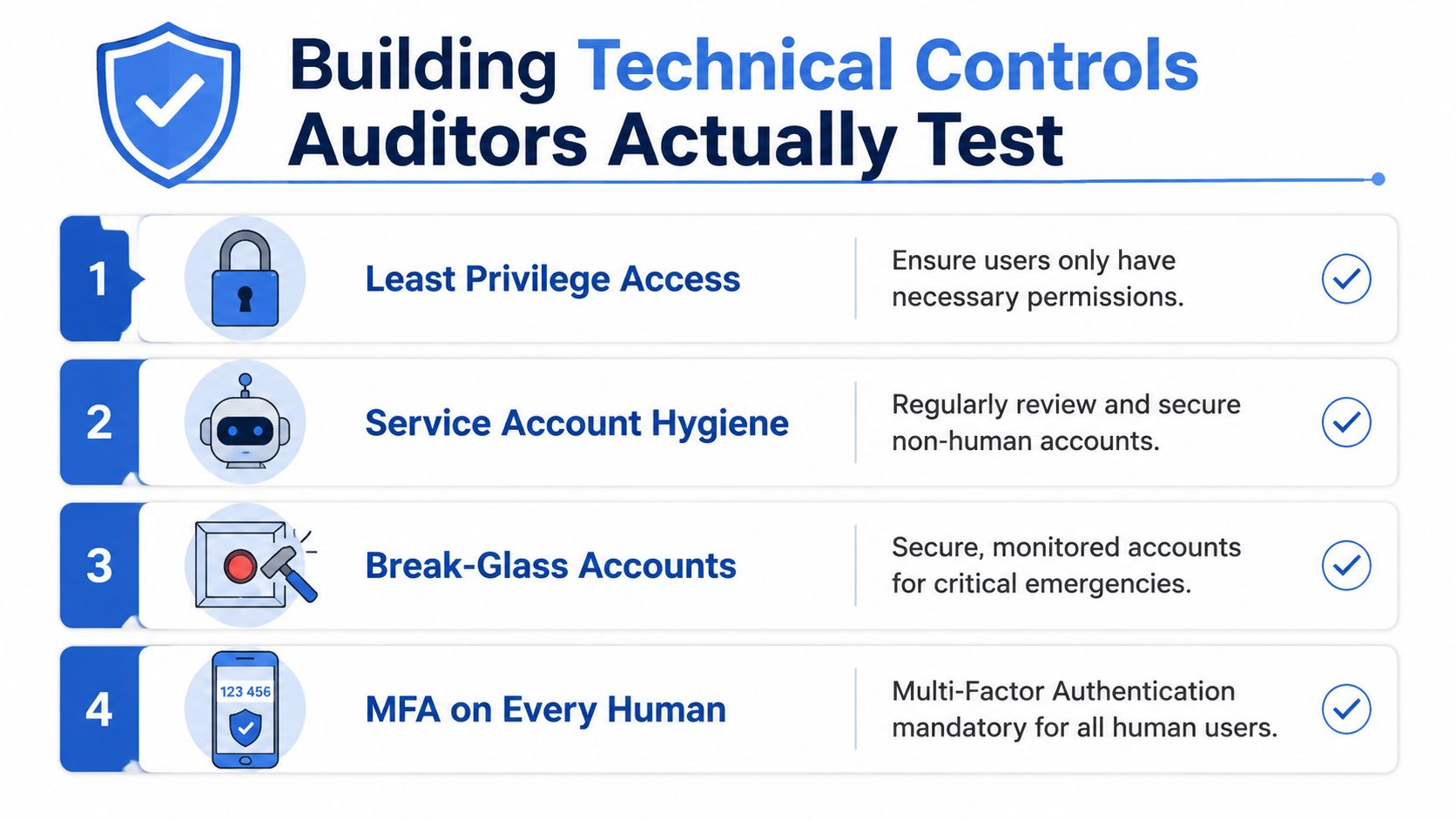
IAM is where cloud programs most often fail in practice. QuickStart’s 2026 readiness guidance points to IAM policy errors, public storage, and logging gaps as common breach drivers, not exotic exploits (QuickStart cloud readiness guidance). The fix is not just MFA. It is least privilege, service-account hygiene, break-glass accounts that are monitored and documented, and MFA on every human identity that can touch production.
Review cadence matters because access changes faster than policy decks do. Service accounts drift. Engineers leave. Contractors keep access too long. Auditors want proof that access was reviewed, exceptions were approved, and stale credentials were removed, not a generic statement that the company has an access policy.
Logging has to be usable, not decorative
A useful logging program centralizes events into a SIEM or other searchable system, preserves the right retention periods, and shows review activity for sensitive control-plane logs. A logfile that exists but nobody reviews is weak evidence. A logfile that feeds alerting, ticketing, and escalation is much easier to defend because it shows the company can see and act on material events.
The control should also make ownership obvious. If security owns the platform but engineering owns the alerts, or if the cloud team collects logs but no one is assigned to review them, auditors will press on that gap. That is where many otherwise solid programs get stuck, since the technical setup looks fine while the operational handoff is fuzzy.
Encryption and recovery need proof of operation
Encryption at rest and in transit should be treated as control requirements, not security slogans. Backups and recovery testing deserve the same treatment. A snapshot policy is not enough. The company needs evidence that a restore test happened, that the right data came back, and that the asset owner accepted the result.
The Cloud Security Alliance’s cloud-services guidance is helpful here because it insists that the provider and customer responsibilities be defined, that cloud-use policies be topic-specific, that roles be assigned, and that incident-handling and change or exit procedures exist in writing (Cloud Security Alliance cloud services guidance). That is the shared-responsibility model in operational form.
One practical option for Seattle-area startups that want the legal side aligned with cloud operations is By Design Law Firm & Legal Consultancy, PLLC, which advises on cyber and data privacy issues alongside contracts and governance. That matters because the control stack and the contract stack have to match.
Evidence Collection and Audit-Grade Documentation
First-time programs often fail. The control may exist, but the evidence trail doesn’t. Auditors usually ask the same set of questions, which means the company should prepare the same set of answers every quarter, not only during fieldwork.
What the evidence file has to answer
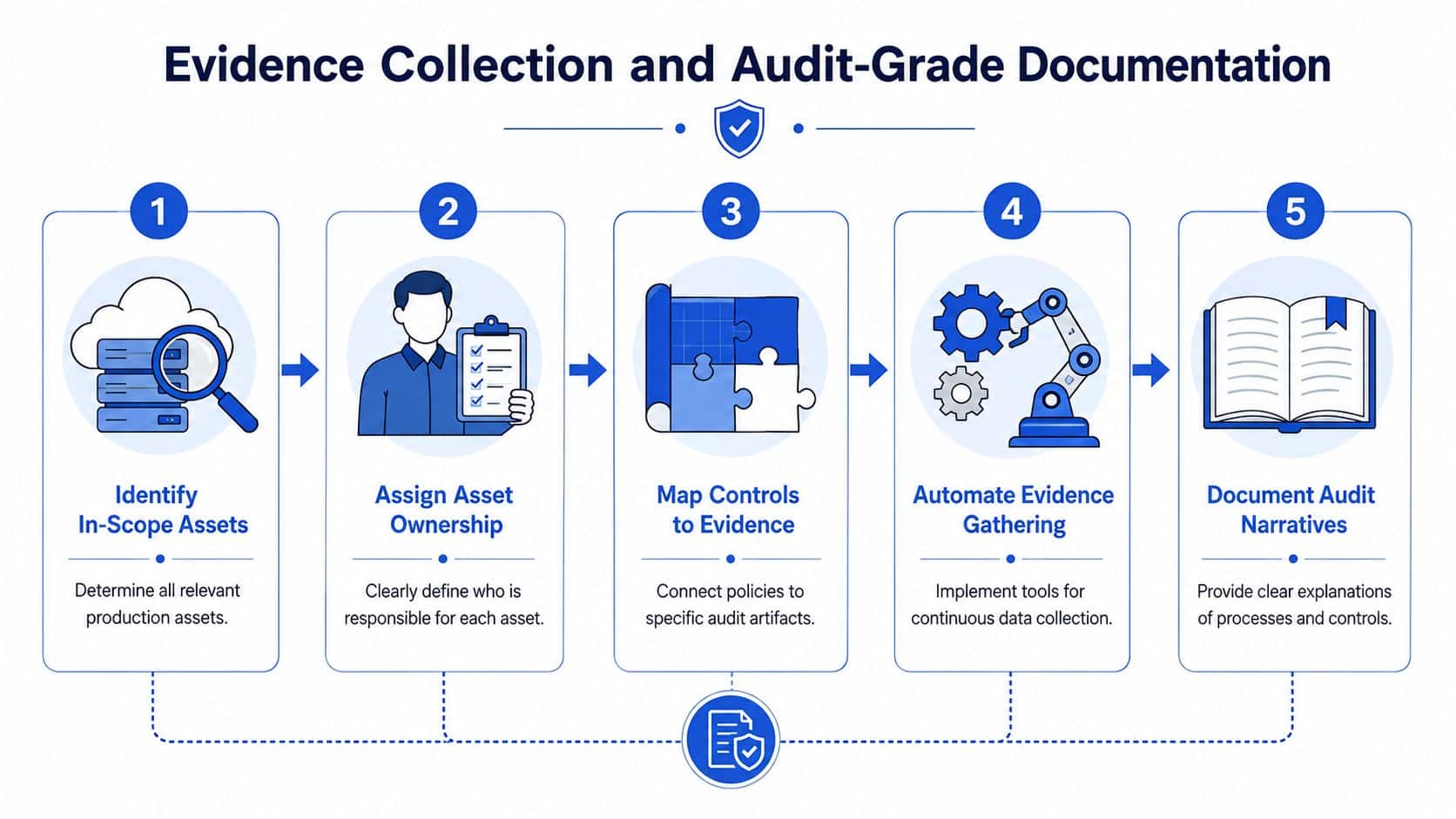
The evidence package should show which assets were in scope, who owned them, what the exception state was, and whether every failed control had remediation or approved risk acceptance. That’s the primary audit question. Not “Did policy exist?” but “Did the company know what failed, fix it, or formally accept the risk?”
The useful artifacts are specific:
- Exported configurations with timestamps that show the control state at a point in time.
- Ticket-linked remediation records that tie an issue to a fix.
- Change-management approvals that explain who authorized the modification.
- Quarterly access reviews that show ongoing human oversight.
MTTD and MTTR are legal-defensibility metrics
Check Point identifies Mean Time to Detect and Mean Time to Remediate as core cloud security metrics because they quantify how quickly incidents and failed controls are found and fixed (Check Point metrics guidance). That matters in a breach response. Counsel, regulators, and customers all ask some version of the same question, how fast did the company know, and how fast did it act?
A policy that says an issue is “handled promptly” does not help much. A log showing detection, escalation, assignment, and closure does. The same is true for backups. A snapshot policy by itself is weak. A restore test record with the asset owner present is strong evidence.
A defensible program can prove the journey from finding a problem to closing it.
CloudAware’s audit-readiness guidance is helpful because it frames cloud compliance around scope, asset owner, exception state, and remediation status, which is the practical shape of defensible evidence (CloudAware cloud security compliance guidance). The missing skill in many teams is not control design. It’s evidence management over time.
A concise process write-up from Learniverse on documenting IT processes is useful here because it reinforces the idea that evidence is a workflow, not a last-minute artifact dump. That distinction matters when a lawyer has to explain the timeline after something goes wrong.
Operating Metrics That Survive Audit and Legal Scrutiny
A lot of dashboards look impressive and say almost nothing. Open tickets, colored risk scores, and control counts can all be real, but they don’t tell counsel whether the environment got safer. The metrics that matter are the ones an auditor can repeat and a lawyer can defend when the questions start after an incident.
Use time-bound metrics, not vanity metrics
The core measures are MTTD, MTTR, violation counts, exception aging, and evidence-coverage rate. A report that says “critical misconfiguration detected and remediated within 24 hours” tells a story. A report that only counts open tickets does not. That difference matters because legal review focuses on whether the company knew, acted, and documented.
Violation counts are useful when tied to remediation status. Exception aging is useful when the company tracks how long a risk has been formally accepted and who approved it. Evidence-coverage rate is especially important because it tells the team what percentage of in-scope assets have current proof on file. Without that, the company may be “compliant” in narrative terms while missing evidence for important systems.
Counsel’s question is usually simple: if a control failed, who knew, when did they know, and what changed after that?
The contrarian point is uncomfortable but necessary. A SOC 2 report or an ISO 27001 surveillance audit does not prove the organization reduced risk. It proves the organization satisfied the scope and evidence test at a point in time. That’s useful, but it isn’t the same thing as security maturity.
Identity sprawl is where certified programs still break
The undercovered problem is identity sprawl across cloud and SaaS. Shadow cloud assets sit outside the normal inventory. Edge and hybrid visibility gaps hide systems that nobody reviews. Workforce skill gaps mean the team may know the framework, but not the environment.
That’s why a company can have a clean audit report and still keep unmanaged service accounts in a forgotten GCP project, discover public S3 buckets months later, or let AI tools ingest customer data through a convenience integration. Compliance that stops at the audit report treats the report as the finish line. Legal counsel should treat it as the starting line for risk reduction.
Doczen’s enterprise compliance ROI guidance is a useful lens here because it points toward continuous compliance rather than one-time prep. The value is not just speed. It’s that continuous monitoring keeps the evidence current enough to matter when the legal and operational teams need it.
What actually works in practice
The best programs keep monitoring running between audits, not just before them. They review control-plane changes continuously, preserve evidence automatically where possible, and make ownership visible enough that nobody can hide behind the phrase “someone else handles that.”
The weakest programs rely on annual attestation and hope. That’s not a strategy. It’s a delay mechanism.
A 90-Day Operating Cadence and First-Audit FAQ
A startup or SMB doesn’t need a giant compliance machine to stay sane. It needs a calendar, named owners, and a habit of collecting evidence before someone asks for it. A workable cadence looks like this. Monthly evidence refresh by the control owner. Quarterly access review by the security or IT lead. Semi-annual penetration testing by an outside tester. Annual framework re-scoping with legal, security, and the business owner in the room.
That rhythm works because it matches how cloud environments change. Accounts drift. Access expands. Data footprints move. A quarterly cycle forces the company to revisit scope before the next external review creates urgency.
First-audit questions that come up all the time
How long should a SOC 2 Type II observation period be?
The answer is usually driven by the trust target and the auditor’s plan, but the key point is not the calendar length. It’s whether the company can produce consistent operating evidence for the controls it said were in place.
What should go to an enterprise security review?
Send the minimum package that proves ownership and operation, not a random pile of screenshots. That usually means scope, access controls, logging summary, backup and restore proof, and the current exception list.
What happens if a control fails mid-audit?
Document it immediately, assign the owner, create the remediation record, and preserve the approval trail if the company chooses formal risk acceptance. Silence is worse than a controlled failure.
When should outside counsel be involved versus a compliance automation platform?
Use outside counsel when the issue touches contracts, transfer terms, breach response, or regulatory exposure. Use automation when the problem is recurring evidence collection, access review, or configuration drift. The two often work together.
A durable cloud compliance program is really a quarterly operating system with legal oversight. The auditor is just one of the people who gets to inspect it.
By Design Law Firm & Legal Consultancy, PLLC helps founders and growing companies structure cyber and data privacy programs, align cloud contracts with real operational responsibilities, and prepare for audits without turning everything into a last-minute scramble. If your team needs cloud security compliance advice that connects legal risk, evidence, and ownership, visit By Design Law Firm & Legal Consultancy, PLLC to start a conversation about the controls, contracts, and documentation your business needs. Call our law office today at (206) 593-1519.