A founder launches a product, turns on analytics, adds Stripe, plugs in HubSpot, and hires a customer support team. A few months later, an enterprise prospect sends a security questionnaire. A customer asks what data the company holds. A vendor wants broad rights to use service data. Suddenly, "we take privacy seriously" isn't enough.
That moment arrives earlier than many startups expect. Data privacy and compliance now sit inside routine business decisions: product design, sales cycles, hiring, vendor procurement, fundraising diligence, and incident response. What looked like a legal side issue becomes a practical operations problem.
For startups and SMBs, the goal isn't to build a giant bureaucracy. It's to build a lean system that answers basic but important questions quickly: What data is being collected, why is it being collected, who can access it, where does it go, how long is it kept, and what happens when someone asks about it or when something goes wrong. Done well, privacy work reduces risk, shortens customer diligence, and prevents the company from collecting data it never needed in the first place.
Your Business Runs on Data Now What
A common pattern plays out the same way. A company starts with a simple product. Then the stack expands. Google Analytics tracks behavior. Meta pixels feed ad campaigns. Intercom stores chats. AWS or Microsoft hosts infrastructure. An AI feature appears in the roadmap. The team moves fast, and the data footprint grows faster than anyone intended.
The legal issue usually doesn't start with a regulator. It starts with business friction. A larger customer asks for a data processing addendum. A bank partner wants answers about retention. An investor asks whether the company can support deletion requests. The company realizes it can't answer without Slack searches and guesswork.
Practical rule: If the business can't explain its data flows in plain English, it probably can't defend them in a contract negotiation, customer complaint, or audit.
This is why data privacy and compliance shouldn't be treated as a binder of policies. For smaller companies, the useful version of compliance is operational. It helps product teams decide what not to collect. It helps sales teams answer diligence questions without improvising. It helps engineering teams know which systems need tighter access and clearer deletion rules.
What founders usually get wrong
Three mistakes show up repeatedly:
- Treating the privacy policy as the program. A website notice matters, but it doesn't tell the team what happens inside Airtable, Salesforce, Jira, Snowflake, or a support inbox.
- Collecting first and rationalizing later. Teams often keep logs, recordings, exports, and backups because storage is cheap. Regulatory exposure isn't.
- Assuming privacy only matters for health or finance. Any business that handles personal information, employee data, customer communications, or behavioral data is already in the field.
A lean privacy program doesn't need to be fancy. It needs to be accurate, current, and tied to the way the company works.
Understanding Data Privacy Versus Compliance
Data privacy and compliance are related, but they aren't the same thing. Confusing them causes bad decisions.
Privacy is the underlying principle. It asks whether people have meaningful control over personal information and whether a business is handling that information fairly, transparently, and within reasonable limits. Compliance is the operating system built around that principle. It includes notices, contracts, workflows, access controls, retention rules, and response procedures.
A simple analogy
Think about building safety. The goal is keeping occupants safe. Fire codes, exit signage, sprinkler inspections, and occupancy limits are the compliance tools used to support that goal. A building that technically posts the right signs but blocks the exits provides no actual safety.
Privacy works the same way. A company can publish a polished notice and still collect too much data, give broad internal access, and keep records forever. That's formal compliance without real privacy discipline.
| Concept | What it asks | What it looks like in practice |
|---|---|---|
| Privacy | Should the company collect and use this data at all? | Limiting collection, respecting expectations, avoiding unnecessary surveillance |
| Compliance | What processes and records are needed to satisfy legal obligations? | Notices, RoPA entries, vendor terms, rights response workflows, training |
Why the distinction matters for SMBs
A compliance-only mindset often creates paperwork that doesn't lower risk. Teams produce policies copied from larger companies, but nobody updates them when a new CRM field, AI tool, or ad platform is added. The result is false confidence.
A privacy-first mindset starts with restraint. It asks narrower questions:
- Necessity: Does the product really need this field, cookie, or dataset?
- Clarity: Would a customer reasonably understand this use?
- Containment: Who inside the company needs access?
- Exit: When is this data deleted?
The strongest privacy programs often look simpler than weak ones. They collect less, share less, and keep less.
That distinction also changes how founders prioritize work. If the company focuses only on legal checklists, every new law looks like more admin. If it focuses on privacy principles, many obligations become easier because the company has already reduced the underlying risk.
Navigating the Global and Local Legal Landscape
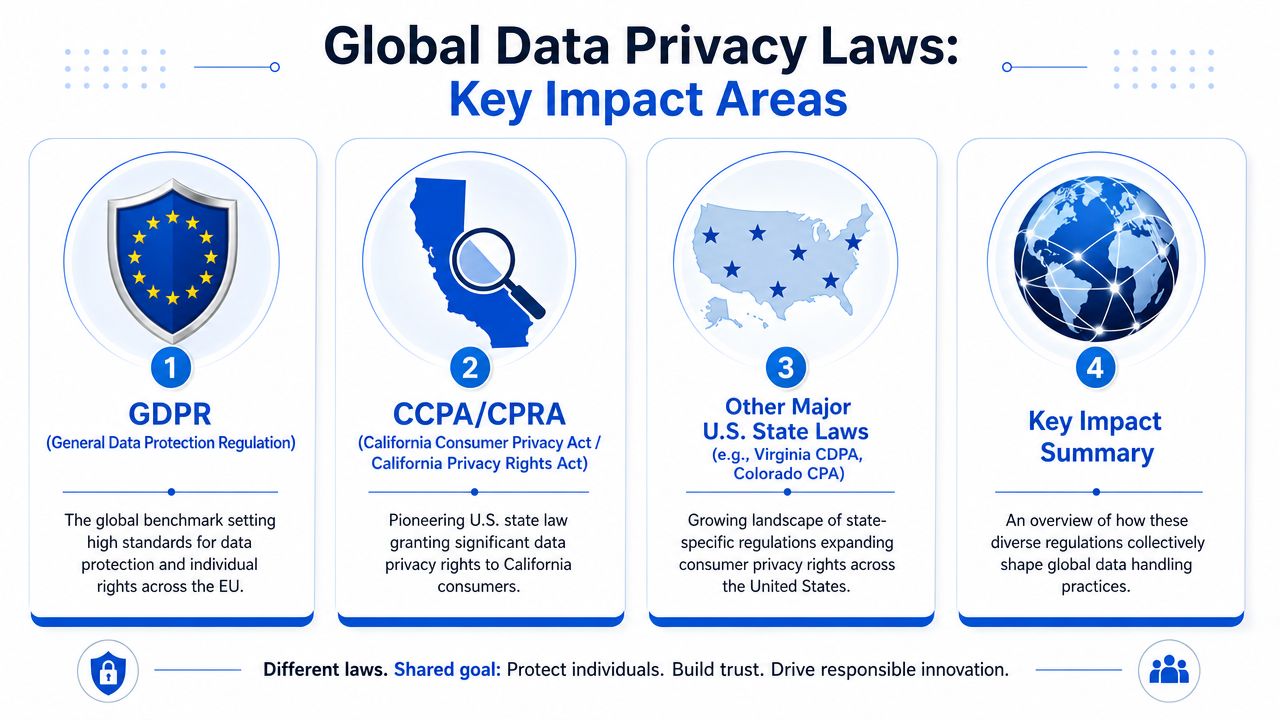
Privacy law is no longer a niche issue for multinationals. By the end of 2024, data protection laws covered 6.3 billion people, or 79% of the global population, and by early 2025 there were 144 countries with data and consumer privacy laws in force. The same overview notes that more than 20 U.S. states had enacted extensive consumer privacy legislation by early 2025, which makes privacy a mainstream business issue for companies of almost any size handling personal data across borders or state lines, as summarized by Usercentrics' privacy law statistics overview.
What matters more than memorizing statutes
Most founders don't need a law school survey course. They need to understand the recurring themes that show up across major regimes.
GDPR remains the reference point for many business customers, even when a startup isn't based in Europe. California's CCPA and CPRA changed buyer expectations in the U.S. Other state laws continue to expand that operational baseline. Washington businesses also need to pay attention to state-specific rules when product design touches sensitive categories, especially health-related information that may fall outside traditional healthcare regulation.
A practical reading of these laws usually turns on four business questions:
- What data is covered
- Whose data is protected
- What rights or disclosures are required
- Which processing activities create heightened risk
The operational themes behind the laws
Across jurisdictions, the same pressure points keep appearing:
- Transparency: Tell people what is collected, why, and with whom it is shared.
- Purpose limits: Use data for the reason it was collected, not for vague future possibilities.
- Data minimization: Avoid collecting more than the product or service needs.
- Access and deletion workflows: Be able to find, export, correct, or delete relevant data when required.
- Vendor oversight: Know which processors touch personal data and what contracts govern that relationship.
That is why evidence matters. A company may believe it's compliant, but customer diligence and regulatory scrutiny often focus on proof. For teams that need a practical resource on documenting that proof, this guide on how to manage GDPR evidence is useful because it treats compliance as an evidence problem, not just a drafting exercise.
Where startups often underestimate risk
Washington and Seattle companies frequently assume privacy laws only become relevant when they expand internationally. That's too narrow. A startup can trigger meaningful obligations through ordinary operations: website tracking, employee monitoring, app telemetry, geolocation, wellness features, or marketing data sharing.
Cross-border transfers add another layer. If a company stores or accesses personal data across jurisdictions, legal analysis around transfer mechanisms and vendor architecture may become unavoidable. For that issue, this guide to cross-border data transfers after Schrems II for Seattle companies frames the problem in business terms rather than abstract doctrine.
The useful question isn't "Which law applies in theory?" It's "Which promises has the business made about data, and can operations actually support them?"
That is the common denominator in data privacy and compliance today. The legal map is broad, but the business discipline is consistent.
Building Your Privacy Program Foundation
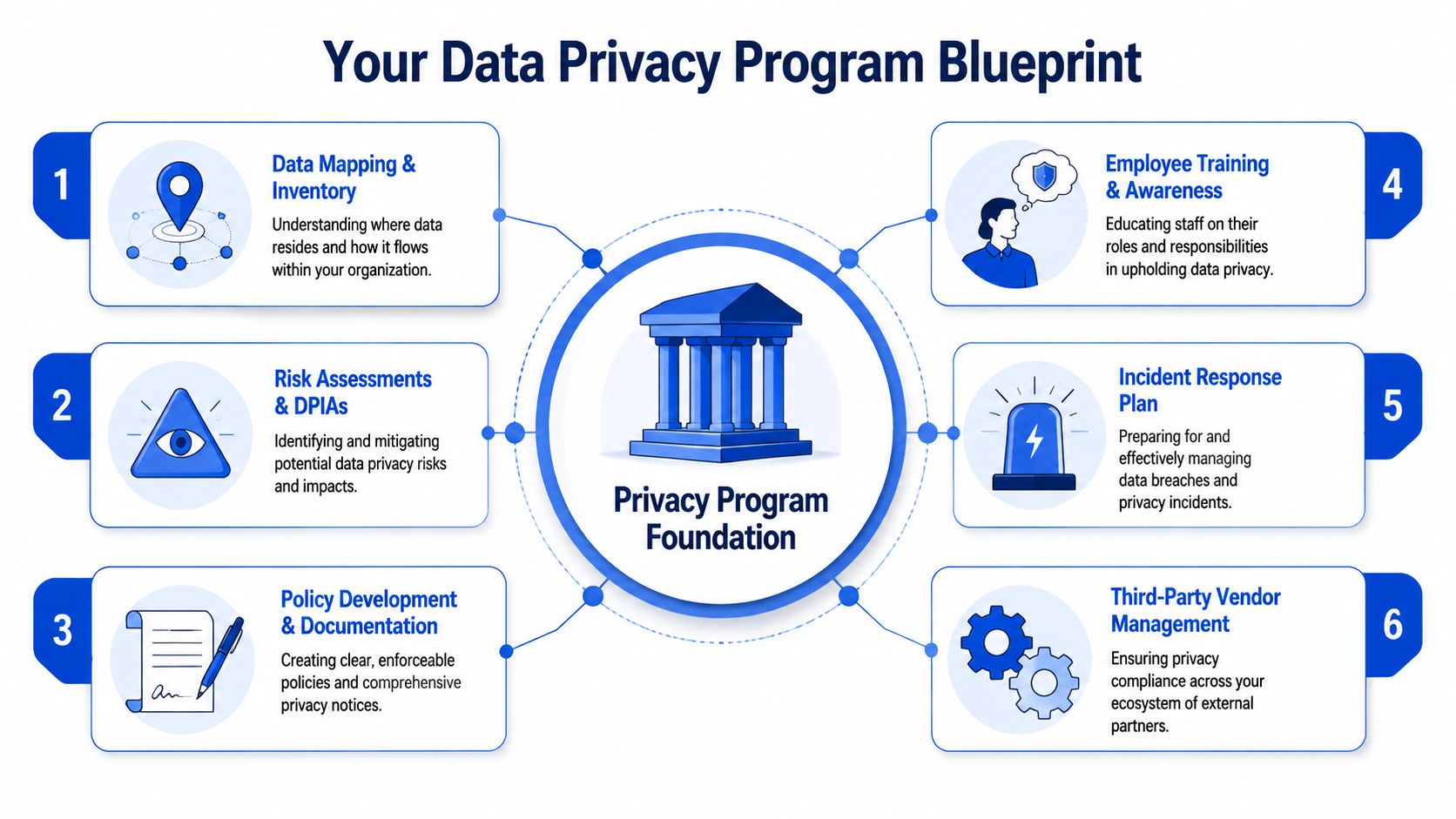
The first durable privacy control isn't a policy. It's visibility. A high-quality compliance program is data-driven rather than policy-driven, which means the company needs a live inventory, a Record of Processing Activities, and a documented data map tied to purpose, lawful basis, retention, access paths, and third-party processors. That sequence, starting with gap analysis and then moving into RoPA creation, risk assessment, and policy implementation, is laid out well in Valuementor's readiness framework for privacy compliance.
Start with the systems, not the policy deck
An SMB can map its data environment without buying a large enterprise platform. The first pass can happen in a shared spreadsheet, Airtable, Notion, or a GRC tool the company already uses. What matters is completeness and ownership.
A workable map should answer these questions:
- Collection point: Where does the data enter the business, such as web forms, contracts, app events, support tickets, or HR onboarding?
- Data type: Is it contact data, payment data, health-related data, employee data, behavioral data, or something more sensitive?
- Business purpose: Why is the company collecting it?
- System location: Which tools store or process it?
- Access path: Which teams, roles, and vendors can reach it?
- Retention and deletion: How long is it kept, and how is it removed?
What a lean RoPA should actually capture
Founders often hear "RoPA" and imagine paperwork for a much bigger company. In practice, a lean version is one of the most useful operating documents the business can have.
A good RoPA should tie together:
| Field | Why it matters |
|---|---|
| Processing activity | Defines what the company is doing with data |
| Purpose | Prevents vague or expanding uses |
| System and owner | Assigns operational accountability |
| Recipients and vendors | Supports contract review and oversight |
| Retention rule | Avoids indefinite storage by default |
The biggest mistake is drafting documents that describe an idealized company. Privacy notices, internal handling rules, cookie disclosures, and employee-facing policies should reflect what the stack does today. If Salesforce syncs with marketing automation, if Zendesk tickets are exported, or if OpenAI-enabled features process prompts that may include personal data, the documentation should match that reality.
A privacy notice that overpromises creates as much risk as one that omits key practices.
Risk assessment belongs in the foundation too. Not every feature needs a heavyweight review, but anything involving sensitive data, behavioral profiling, large-scale monitoring, or AI-assisted decision support deserves closer scrutiny. Teams that want a business-oriented explanation of that process can use this resource on building a cybersecurity strategy with PIAs.
For Washington companies, minimization and purpose discipline should be built into the foundation from the outset. This discussion of data minimization and purpose limitation under Washington law is especially relevant for startups that are adding analytics, personalization, or health-adjacent features and want the legal framework to track actual product choices.
Implementing Key Operational Privacy Controls
Once the map exists, the company needs controls that work in daily operations. The practical model is lifecycle-based: collect only what’s necessary, classify it by sensitivity, restrict access by role, encrypt it in transit and at rest, and define deletion rules before collection begins. That approach, along with the importance of vendor controls and recurring audits, is summarized in Salesforce’s guidance on lifecycle privacy controls.
Controls that reduce risk instead of creating noise
A startup doesn’t need every control at once. It does need the controls that stop common failures.
- Role-based access: Limit HR data to HR, finance data to finance, support exports to support leadership, and production databases to staff with a real need.
- Sensitivity classification: Not all personal data needs the same handling. Basic contact details, payment information, employee records, and health-related inputs shouldn’t sit under one generic label.
- Retention triggers: Define when deletion starts. End of contract, rejected applicant, closed support account, expired trial, and completed billing cycle are all useful operational triggers.
- Encrypted storage and transfer: This reduces avoidable exposure and supports a defensible baseline.
- Vendor review: Map each processor, review core terms, and revisit the assessment when the service scope changes.
Vendor management is where many SMB programs break down
Third-party tools create convenience and hidden complexity. A company might use Slack, Google Workspace, AWS, Mailchimp, HubSpot, Stripe, DocuSign, and a transcription tool, all before the team has a formal vendor list. If each tool can receive or generate personal data, each one belongs in the privacy program.
A useful vendor review doesn’t have to be theatrical. It should ask:
- What data goes to the vendor?
- Is the vendor acting on the company’s instructions or using the data for broader purposes?
- What security and deletion commitments exist?
- Will the vendor help the company respond to access, deletion, or incident obligations?
Incident readiness and training
Policies don’t respond to incidents. People do.
Every business handling personal data should know who decides whether an event is a reportable breach, who preserves logs and evidence, who contacts insurance, who informs customers, and who manages outside communications. This data breach response planning checklist for Seattle businesses is a practical starting point for assigning those responsibilities.
Test the plan before it’s needed. A tabletop exercise will expose confusion faster than any policy review.
Employee training should be short, role-based, and tied to real behavior. Engineers need guidance on logs, staging data, and vendor integrations. Sales teams need guardrails for customer diligence responses. HR needs discipline around personnel records. Generic annual slides rarely change conduct.
A Practical Compliance Roadmap for Startups
The smartest startup privacy programs are phased. Trying to implement a mature enterprise framework too early usually creates shelfware and frustration. For SMBs, the sharper strategy is data minimization. Recent guidance aimed at smaller and mid-sized organizations notes that the challenge is keeping up with expanding obligations without over-collecting data to prove compliance, and that a minimization-centered approach helps reconcile auditability with privacy principles across a patchwork of laws in more than 160 jurisdictions, as discussed in Thomson Reuters’ overview of modern data privacy obligations.
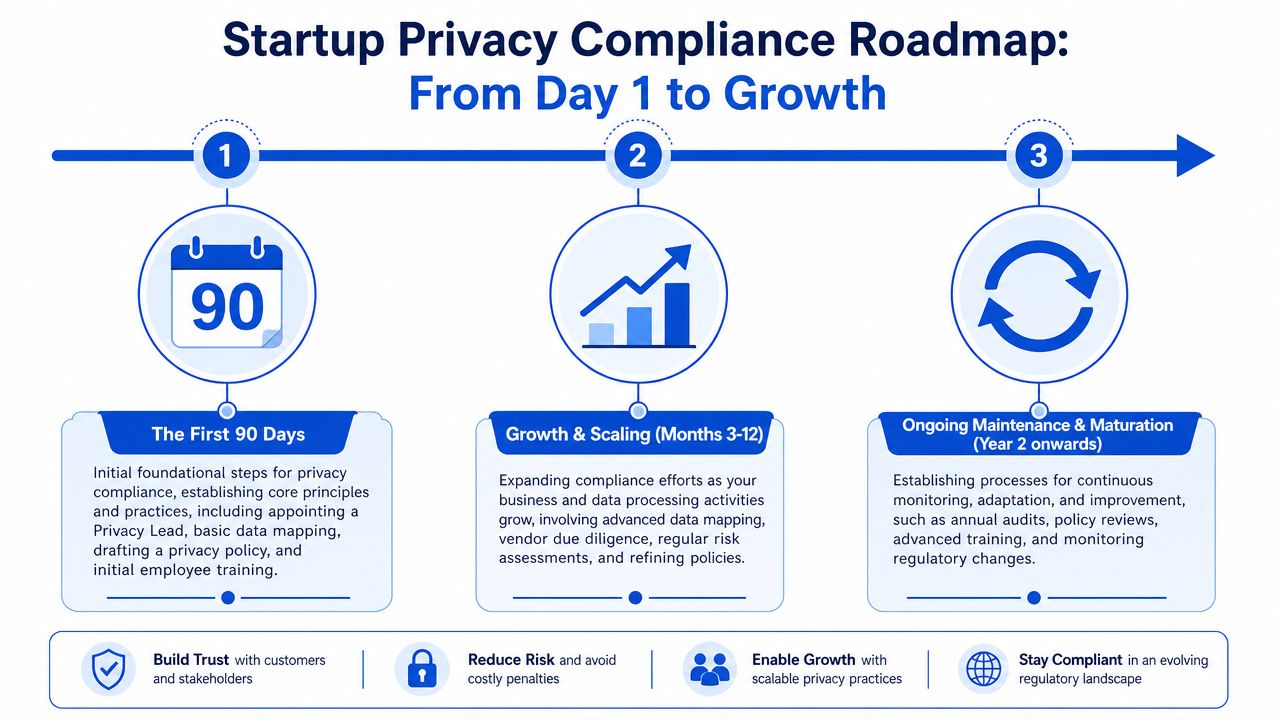
A visual overview helps frame that progression:
The first 90 days
Founders should focus on controls that create immediate visibility and reduce unnecessary collection.
- Assign ownership: Pick a privacy lead. It doesn’t need to be a full-time role, but someone must own the inventory, vendor list, and response workflows.
- Map the current stack: Identify data in core systems such as Google Workspace, Microsoft 365, AWS, HubSpot, Salesforce, Zendesk, Stripe, QuickBooks, and the product database.
- Draft an accurate notice: The website privacy notice should match actual collection and sharing practices, not a generic template.
- Set retention defaults: If the company can’t explain why a category should be kept, it shouldn’t be retained indefinitely.
- Create a vendor register: Start with the processors already in use and the contracts already signed.
At this stage, success means the company can answer straightforward customer and investor questions without scrambling.
Months three through twelve
This is the period to formalize what the company has learned.
A useful sequence looks like this:
- Run a gap review against actual processing.
- Build a lightweight RoPA for major business functions.
- Review one high-risk feature or workflow using a structured assessment.
- Tighten customer and vendor contract positions on data handling.
- Rehearse breach escalation with a tabletop exercise.
This is also where outside help can become efficient. By Design Law Firm & Legal Consultancy, PLLC provides legal support for compliance program design, policy work, and incident response, which is the kind of targeted counsel many Washington startups use when a customer contract or product launch raises privacy issues that internal teams can’t comfortably resolve alone. For a broader legal framework on governance, this guide to crafting effective compliance programs for Seattle corporations is a useful companion.
The following video gives a practical overview worth sharing internally before the company starts formalizing procedures.
Year two and beyond
More mature work usually includes recurring policy reviews, stronger evidence collection, tighter deletion automation, and more disciplined assessments for new vendors, AI tools, and product changes. The key is not size. It’s repeatability.
A lean privacy program scales when each new product feature has to answer the same questions before launch: what data, what purpose, what access, what retention, what vendor exposure.
That is how data privacy and compliance become manageable. The company stops reacting from scratch each time something changes.
Knowing When to Engage Legal Counsel
Some privacy work can be handled internally. Some can’t. The dividing line isn’t company size. It’s consequence.
Many privacy guides focus on policies and training, but organizations still face practical weaknesses tied to outdated systems, weak encryption, and uneven enforcement. Recent research also highlights the harder question businesses should ask: which compliance steps improve real security outcomes and which mainly expand documentation burdens, especially in hybrid, AI-assisted, and distributed environments. That is where experienced counsel adds value, as discussed in this research review on privacy-by-design gaps and operational challenges.
The moments that justify legal help
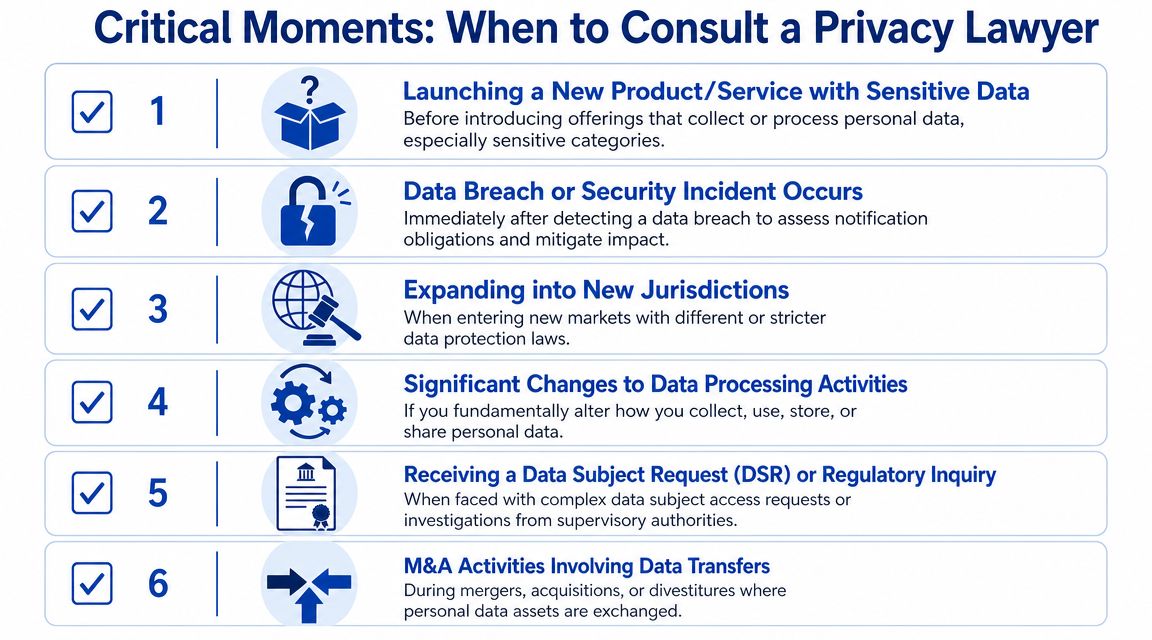
A founder should strongly consider counsel when any of the following happens:
- A major customer sends a DPA or security addendum. Contract language on processor obligations, subprocessor use, audit rights, and liability can reshape product operations.
- The company launches a feature involving sensitive or health-adjacent data. Legal analysis should happen before release, not after customer complaints.
- There is a breach, ransomware event, or suspicious access incident. Notification obligations, privilege, and communications strategy matter immediately.
- The company expands into new jurisdictions or supports international users. Cross-border handling and local disclosure requirements can become material quickly.
- An AI workflow touches personal data. Standard privacy templates often don’t address training data, prompts, outputs, model providers, or retention in a useful way.
- A regulator, attorney general, or discerning enterprise buyer starts asking detailed questions. At that point, imprecise answers create risk.
What good counsel should help the business do
Legal counsel shouldn’t just produce more documents. Good counsel helps the business choose controls that regulators, customers, and courts will view as credible. That often means narrowing data collection, clarifying roles with vendors, revising notices to match operations, and deciding where the company needs formal assessments instead of informal assumptions.
The best use of counsel is targeted. Bring a lawyer in when the business is making commitments, facing exposure, or entering ambiguity it can’t responsibly resolve on its own.
By Design Law Firm & Legal Consultancy, PLLC helps startups and established businesses translate privacy obligations into practical business decisions. Companies that need support with privacy program design, policy drafting, contract review, cross-border issues, AI-related data questions, or breach response can learn more through By Design Law Firm & Legal Consultancy, PLLC. Call us today at (206) 593-1519.