A founder can sit down with a clean term sheet, skim the business terms, and still miss the clauses that matter most. The hidden risk usually lives in the reps and warranties, the statements that tell the buyer what the business is, what it owns, and what risk the seller is willing to stand behind after closing. In a tech deal, that can mean the difference between a smooth acquisition and a dispute over code ownership, customer data, or a shaky open-source stack.
The Critical Clauses in Your Next Big Deal
A founder reviewing a first acquisition offer often feels relief when the price looks right. That feeling usually lasts until counsel flags the reps and warranties section, where the seller starts making detailed promises about the business.

The clauses are not boilerplate. They set the factual baseline for the deal, and if the baseline is wrong, they can drive indemnification, price adjustments, or termination rights. By 2024, the American Bar Association reported that approximately one-third of M&A deal disputes in North America arise from alleged breaches of seller representations and warranties, which shows how often these clauses become the center of post-closing conflict, not just closing paperwork. That is why a practical guide to representations and warranties can be useful before a founder signs anything.
The modern market has also changed how these clauses are used. Representations and warranties insurance has become a major part of deal structure in larger transactions, and policy design can shift who bears the risk after closing. A founder who assumes the buyer will “just take the risk” can end up with a long tail of liability if the wording is broad and the disclosure package is thin.
The real question is not whether the clause sounds standard. The real question is what happens when the statement turns out to be wrong.
A well-advised founder treats these clauses like a financial backstop, not legal decoration. That mindset usually changes the negotiation immediately.
The Foundation of Trust in Any Deal
A simple way to think about these clauses is a home inspection report. The seller says the roof is sound, the wiring is safe, and the plumbing works. If any of that turns out to be false, the buyer has a basis to complain, ask for money, or unwind the deal in some cases.
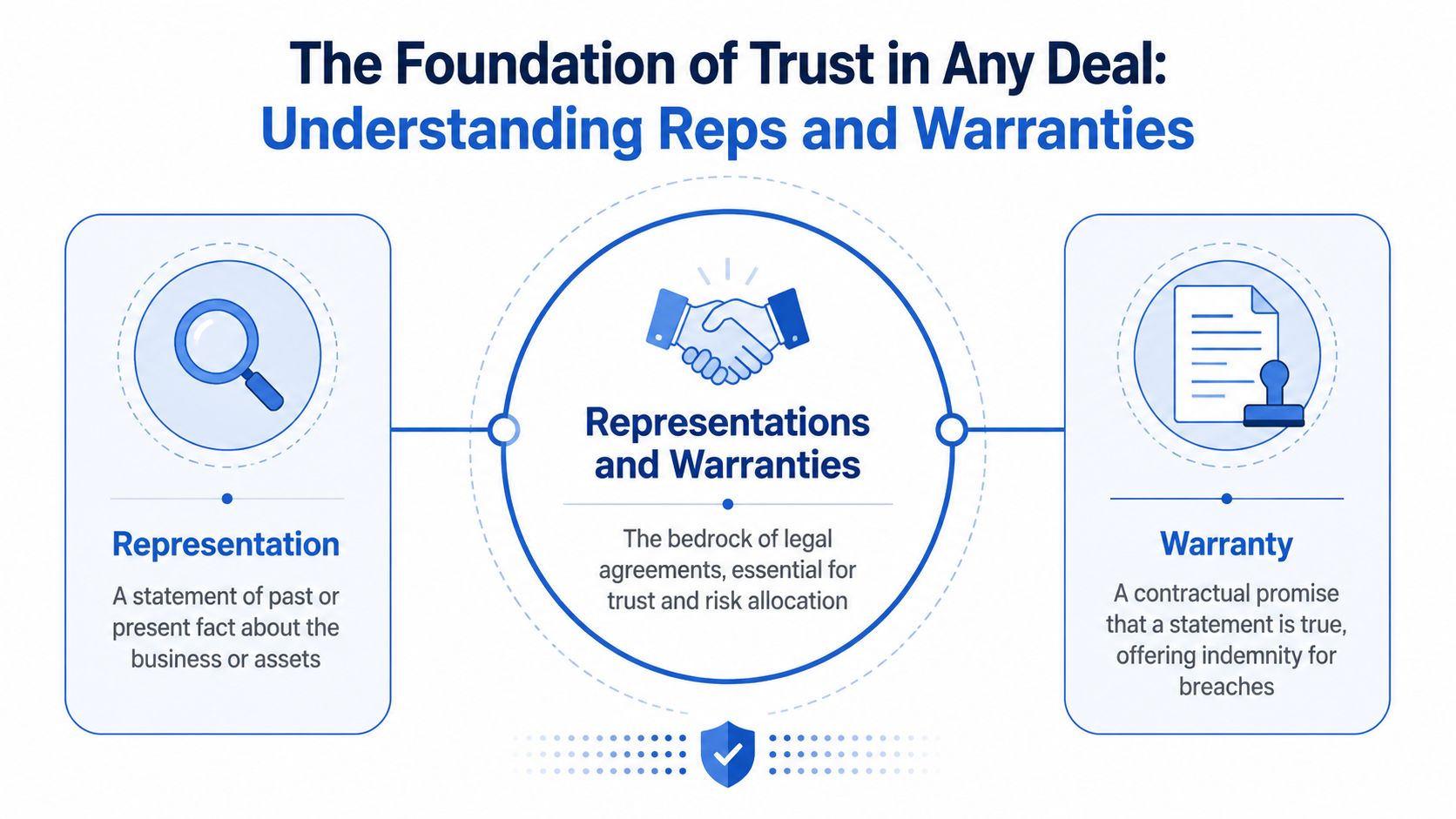
A representation is generally a statement of present or past fact made to induce the other party to enter the deal, while a warranty is a contractual promise that a fact is true and will remain true. The practical distinction matters because a false representation can support rescission or a misrepresentation claim, while a breached warranty usually supports damages for breach of contract, as explained in this legal overview of the difference between the two concepts in contract law: Lexology's discussion of representations and warranties.
Why buyers care so much
The buyer rarely has perfect visibility into every corner of a business. That is especially true in a startup, where a small team may own critical IP, sensitive customer data, and contractual commitments that are hard to fully validate in a short diligence window.
The rep gives the buyer a written factual statement. The warranty gives the buyer a contractual remedy if that statement is wrong. In practice, the combination turns diligence findings into enforceable promises.
A practical translation for founders
A founder should read each rep like a sworn statement about the company's condition. If the clause says the company owns its software, the buyer is not just hearing a hopeful business story. The buyer is buying a promise that can later support a claim if the statement was inaccurate.
For a more detailed diligence perspective, counsel often points founders to the practical framework at By Design Law's venture capital due diligence page. That kind of resource helps a founder see how reps connect directly to the diligence file, not just the final purchase agreement.
If the facts are messy, the drafting should be, too. Clean words do not fix dirty records.
Key Distinctions Your Business Must Understand
The four most confused deal terms are representations, warranties, covenants, and indemnities. They sound similar, but they do different jobs in different timeframes.
| Concept | What It Is | Time Focus | Remedy for Breach |
|---|---|---|---|
| Representation | A statement of present or past fact | Signing or closing, focused on what is true now or was true before | Misrepresentation claim, rescission in some cases, or damages depending on structure |
| Warranty | A contractual promise that a fact is true and will remain true | Signing, closing, and sometimes post-closing survival | Contract damages for breach |
| Covenant | A promise to do, or not do, something in the future | Future conduct after signing or closing | Breach of contract remedies, often specific performance or damages |
| Indemnity | A promise to cover specific losses if a defined event happens | Usually post-closing and loss-based | Payment for covered losses under the indemnity mechanics |
A useful way to read the table is to notice the timing. Reps and warranties mostly describe what is true. Covenants govern what must happen later. Indemnities answer the harder question, who pays when the thing goes wrong.
A contrarian view in legal literature argues that the phrase “represents and warrants” is often redundant and confusing, and that drafters should state facts clearly and address remedies directly because the actual economic effect comes from the indemnity, cap, and basket structure rather than the label itself. That argument appears in the American Bar Association’s discussion of the phrase’s virtue and limits: ABA Business Law Today on “represents and warrants”.
What founders should actually focus on
The label matters less than the consequences. A clause can be called a warranty and still have weak remedies if the indemnity is narrow, the cap is low, and the basket blocks small claims. A clause can also be labeled a representation and still carry serious risk if it is broad, absolute, and tied to uncapped liability.
Why precision beats ritual wording
Good drafting treats the contract as a system, not a vocabulary exercise. Buyers want clear factual promises, sellers want controlled exposure, and both sides need to know how the loss calculation works when a breach is alleged.
For founders trying to understand that vocabulary in plain language, a practical explainer like Ivory Mind’s warranty term comprehension resource can help anchor the terminology before negotiations get technical.
Common Reps and Warranties in Tech Deals
Tech deals live and die on intangible assets. Code, data, product architecture, customer contracts, and employee know-how can be far more valuable than office furniture or equipment, which is why the rep package has to track the actual business risks.
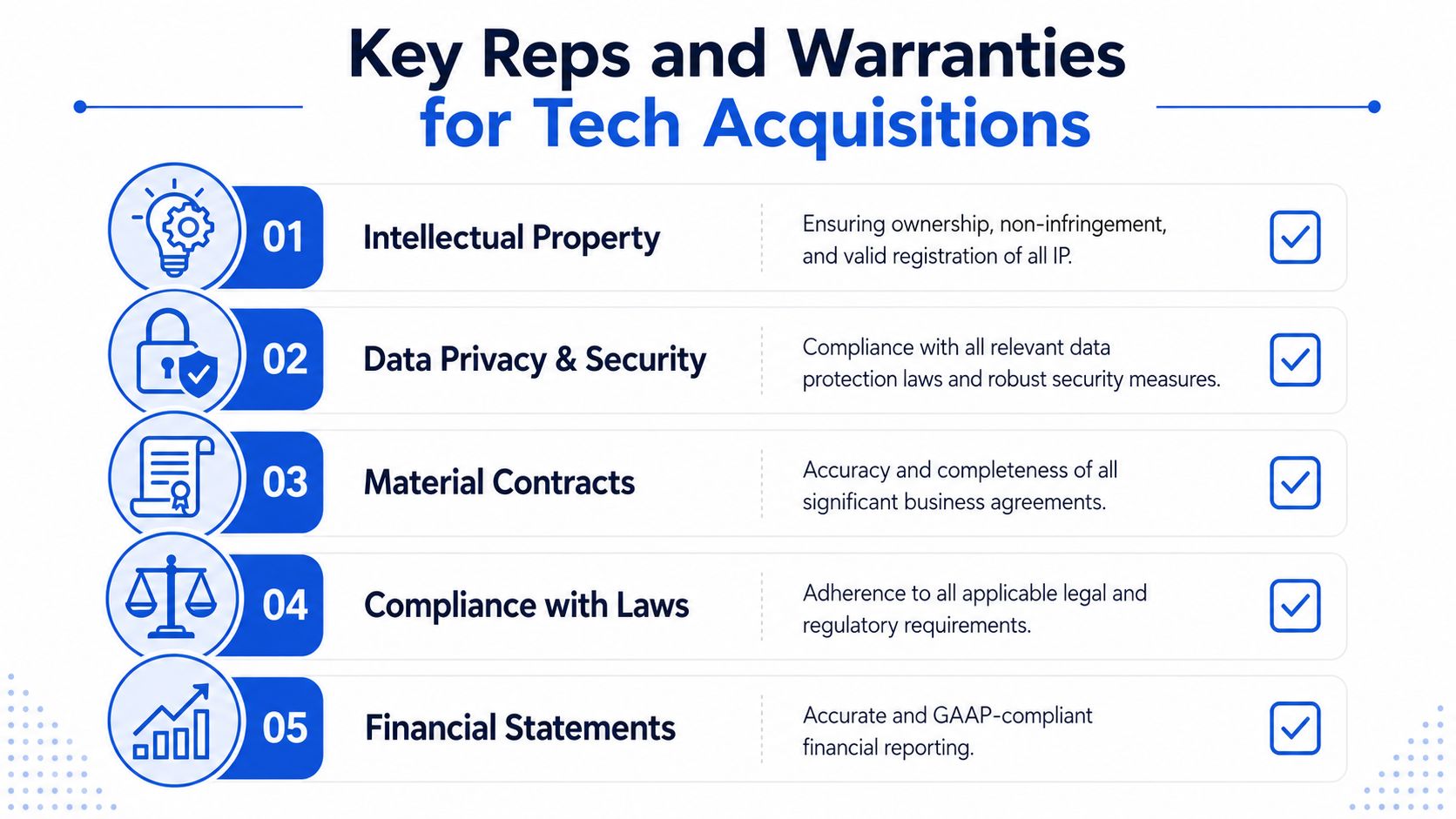
The core checklist for startup and software acquisitions
- Intellectual Property. The buyer wants a promise that the company owns, or validly licenses, the code, inventions, trademarks, and patents it depends on. In a software business, unclear contractor assignments can create bigger problems than a bad balance sheet.
- Data Privacy and Security. The promise should track compliance obligations and security practices. For a startup handling personal data, a buyer verifies whether the company’s process matches its public promises and contract commitments.
- Open-Source Software. Buyers care because license terms can create unexpected obligations if the company has mixed permissive and restrictive code without a clean review process.
- Material Contracts. The company should identify the agreements that matter to revenue, delivery, and customer retention. If a key customer contract is missing or inaccurately summarized, the buyer may inherit a business with a different risk profile than expected.
- Compliance With Laws. This covers the legal framework that governs the business model, including sector-specific obligations that affect operations and product use.
The strongest tech reps are tied to diligence findings, not generic templates. Practitioners are advised to prioritize the mission-critical risks and define terms like Intellectual Property, Open Source Software, and Personal Data with precision, because ambiguity creates coverage gaps and disputes, as noted in Mayer Brown’s discussion of tech M&A safeguards: Key representations and warranties in tech M&A.
What a buyer is really checking
A buyer is asking whether the company can keep operating the product after closing without surprise liabilities. That means checking who wrote the code, who owns the data rights, how the company handles security issues, and whether a customer can later claim a breach of contract tied to privacy or IP promises.
For a founder, the practical move is to line up every rep with a due diligence file. If legal can’t map the promise to documents, audits, assignment agreements, or policy records, the clause needs work before signing. A usable starting point is By Design Law’s checklist due diligence page.
In tech transactions, the clause is only as good as the evidence behind it.
Allocating Risk with Strategic Levers
Once the reps are drafted, substantive negotiation begins. The seller wants to narrow exposure. The buyer wants meaningful recourse if the facts are wrong.
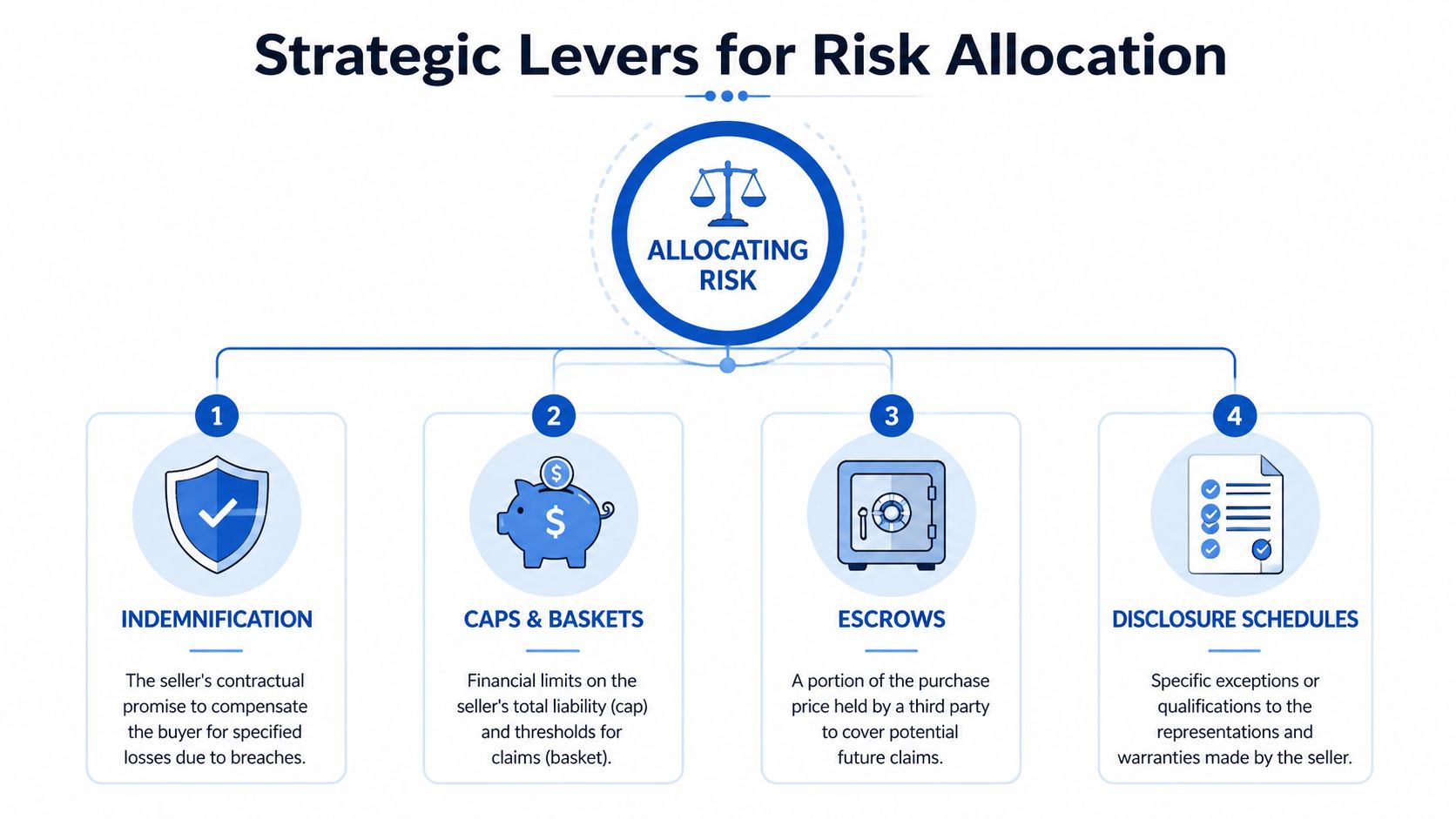
The four levers that actually move the money
Disclosure schedules let the seller list exceptions to the promises. If a rep says there is no litigation, but a dispute already exists, the schedule is where that exception belongs. A careful buyer reads these schedules as part of the rep, not as an appendix to skim later.
Survival periods set the deadline for bringing a claim. In modern transaction practice, standard survival periods are often 12 to 18 months for general representations, with 15 months cited as the market median, while fundamental representations commonly survive 3 to 6 years or even indefinitely, according to this seller-focused guide: Linden Law Partners on survival periods in M&A agreements.
Baskets work like thresholds. Minor issues stay below the line, so the seller does not get dragged into disputes over trivial problems. Caps set the maximum exposure. Those two terms usually decide whether a breach is a nuisance or a real balance-sheet event.
Why this feels like an insurance policy
The logic is familiar. The buyer pays for protection, but not for unlimited protection. The seller accepts some exposure, but not open-ended liability. Escrows often sit between the two, holding part of the price back until the survival period passes or the risk clears.
The smartest negotiations rarely ask for perfect protection. They ask for protection that matches the actual diligence gap.
A founder should treat these levers as business terms, not legal trivia. If the rep package is broad but the cap is narrow, the buyer may not care. If the seller is asked to give a long survival period on a fundamental ownership issue, the seller should understand why that risk remains live for so long after closing.
For a Washington-focused drafting perspective on how indemnity language carries the practical burden, a useful reference is By Design Law’s indemnity clause analysis.
Drafting and Negotiating for Success
The best deal documents do not try to sound balanced. They are balanced because each side knows exactly what risk it is taking and what proof supports the promise. That starts with the buyer and seller wanting different things for understandable reasons.
The buyer usually wants broad reps, fewer knowledge qualifiers, and strong remedies. The seller usually wants narrow language, explicit materiality limits, and schedules that carve out known issues. Neither side gets everything, so the deal gets done through a series of trade-offs tied to diligence quality and bargaining power.
What founders should push for
A founder should ask whether each rep matches a real business fact, not a template habit. If the company does not have a certain regulated activity, a blanket clause may create unnecessary exposure. If a real risk exists, hiding it usually backfires because the disclosure schedule becomes the only honest place to address it.
A founder should also make the schedules complete and current. Incomplete disclosure is one of the fastest ways to turn a manageable issue into a post-closing claim. If a customer dispute, open-source concern, contractor assignment gap, or policy mismatch exists, it belongs in the paper trail before closing, not after.
What buyers should insist on
Buyers should tie the reps to the diligence record and to the specific risks that matter in the deal. In a software acquisition, that often means focusing on code ownership, privacy compliance, security history, and customer contract accuracy rather than boilerplate corporate statements alone.
Buyers also need to think about remedies before they think about style. If the reps are broad but the indemnity is weak, the protections may not be worth the paper they’re written on. That is where precise drafting and a good model form can save a negotiation from becoming a fight over every sentence.
For teams that want to compare baseline transaction language against a more structured starting point, By Design Law’s NVCA model forms resource can be a practical reference point alongside outside counsel review.
The founder who approaches reps and warranties as a risk map, not a legal ritual, usually negotiates better and closes with fewer surprises. The right move is to match each promise to a document, each document to a business fact, and each remedy to the actual economic risk. If a transaction is on the table right now, By Design Law Firm & Legal Consultancy, PLLC can review the rep package, disclosure schedules, and indemnity structure before signatures go on the page. Call our office today at (206) 593-1519.