A Seattle startup has just signed its first customer in the European Union. The customer's data will sit in a U.S. cloud environment, pass through a customer-support platform, and reach an analytics vendor. Nothing about the architecture feels unusual, yet each movement of personal data outside the European Economic Area can create a separate compliance question.
The immediate answer is simple: a company needs a recognized transfer mechanism before sending EEA personal data to a third country, unless a narrow exception applies. The harder question is which mechanism fits the destination, the parties, the data, and the company's operating model.
This guide treats cross border data transfer mechanisms as operational decisions, not a checklist. It explains how adequacy decisions, Standard Contractual Clauses, Binding Corporate Rules, certifications, codes of conduct, and derogations work, then connects that EU framework to APAC and China. The practical objective is to help founders decide what to document, what to change technically, and when counsel should review the plan. A startup can also use privacy and compliance counsel to align contracts, vendor controls, and governance before an international customer or investor asks difficult questions.
Introduction Why Transfer Mechanisms Matter Now
A transfer mechanism determines whether a company can lawfully move personal data into another legal environment. It doesn't eliminate every risk, but it gives the transfer a recognized legal structure and identifies the safeguards the exporter must maintain.
For a Washington company, the first warning sign may be a routine commercial request. An EU customer asks the startup to process employee information. A U.S. software provider stores the account in a U.S. region. A support contractor accesses tickets from another country. The company may still be responsible for understanding the entire flow, including subprocessors and remote access.
The GDPR's international transfer rules were formalized through Chapter V in 2016. That chapter created a diversified toolkit, including adequacy decisions, standard contractual clauses, binding corporate rules, certification mechanisms, codes of conduct, and narrow derogations. The framework separates two questions that founders often combine:
- Is the processing otherwise lawful? The company still needs an appropriate legal basis, transparency, security, and processor governance.
- Is the international movement lawful? The company needs an applicable Chapter V route or a valid narrow exception.
Adequacy is the cleanest route when it exists because the European Commission has recognized the destination's protection as equivalent. Otherwise, the business commonly turns to contractual or organizational safeguards. A contract can be appropriate, but the exporter still needs to understand whether destination-country law could undermine the promised protection.
Practical rule: A signed transfer document records the legal arrangement. It doesn't prove that the company understands where data goes or how the recipient can access it.
That distinction matters for customer trust. A startup that can explain its data routes, mechanism, security measures, and review process gives enterprise buyers something more useful than a generic privacy statement. By the end of this guide, founders should be able to identify the relevant transfer, choose a plausible mechanism, recognize when an exemption or derogation is too narrow to support routine operations, and prepare the evidence needed for a focused legal review.
How Cross Border Transfers Work Under GDPR Chapter V
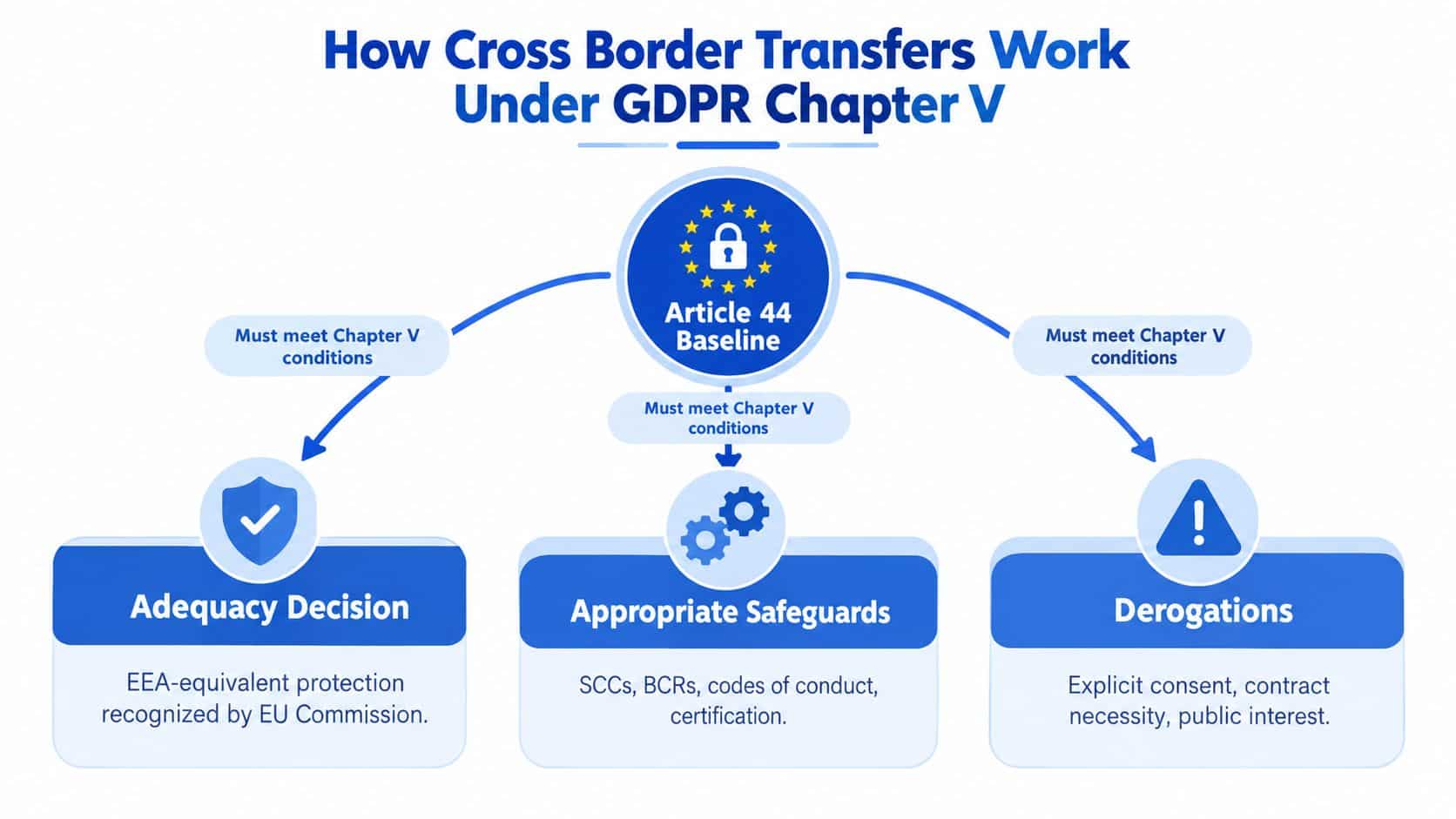
The starting point is Article 44 of the GDPR. Transfers of personal data from the EEA to a third country must satisfy the conditions in Chapter V. The rule applies whether the data moves through a database, a cloud service, a support tool, or an overseas employee's access session.
The European framework works like a passport and visa system. An adequacy decision functions like country-level clearance. The Commission has assessed the destination and decided that transfers can proceed without additional transfer-specific safeguards for that destination. The European Data Protection Board explains that an exporter generally doesn't need to add further transfer safeguards once adequacy exists, although the other GDPR obligations still apply.
When adequacy isn't available, the exporter needs an individual legal route. Article 46 safeguards include the 2021 Standard Contractual Clauses, Binding Corporate Rules, approved codes of conduct, certification mechanisms, and other recognized safeguards. The exporter is the organization sending or making the data available. The importer receives or processes it. The third country is the destination outside the EEA.
Transfers to a third country need an applicable Chapter V pathway. The absence of an adequacy decision doesn't end the analysis, but it changes the work required.
The remaining route is a derogation under Article 49. Derogations can cover situations such as explicit consent, necessity for a contract, or an important public interest. They aren't designed to support a company's ordinary, repeated transfer architecture when a safeguard-based mechanism could be used.
The practical sequence looks like this:
- Identify the flow. Determine whose data moves, from where, to which recipient, and for what purpose.
- Check adequacy. If the European Commission has recognized the destination, assess whether the decision covers the relevant transfer.
- Select safeguards. If adequacy doesn't apply, evaluate SCCs, BCRs, certification, or a code of conduct.
- Assess destination law. The exporter must examine whether local rules could interfere with the safeguards.
- Document the decision. The record should connect the data flow, mechanism, risk analysis, and technical or organizational measures.
A data processing agreement remains part of the broader governance picture. Founders handling processor relationships may benefit from a practical resource on GDPR DPA essentials, especially when the processing agreement and transfer terms need to work together.
The framework became influential because it gives multinational companies a common vocabulary for international data movement. It doesn't make every country's law identical. It gives companies a structured way to distinguish country approval, contractual safeguards, corporate rules, certification, and exceptional circumstances. A Seattle company working with EU customers can use the guide for Seattle companies after Schrems II to connect that legal structure to its own vendors and architecture.
Comparing Your Main Transfer Mechanisms and When Each Applies
A Washington startup may begin with an EU customer, add an APAC vendor, then centralize support in another country. Each new flow can require a different legal route. Choose the mechanism by looking at the destination, relationship, scale, and repeatability, then fit that choice into the company's operating model.
Adequacy decisions
Adequacy is usually the simplest country-based route. The European Commission has determined that the destination provides an equivalent level of protection, so the exporter does not need additional transfer-specific safeguards for that destination. This works well for recurring flows because the clearance applies at the destination level, rather than requiring a separate transfer contract for every relationship.
Coverage remains limited. A mid-2026 summary describes 17 entities covered by adequacy, including the UK, Switzerland, Japan, South Korea, New Zealand, Israel, Argentina, and Uruguay. That coverage can also change, so adequacy should be checked during vendor onboarding and revisited when the transfer changes. It is a country-level permission, not a general approval for every data flow or supplier.
Standard Contractual Clauses
SCCs suit transfers to destinations without adequacy, particularly where an exporter works with a vendor, customer, or service provider. They provide standardized terms that procurement and legal teams can incorporate into different controller and processor arrangements. The company still needs the correct modules, complete transfer details, and an assessment of destination-country law.
For an operating team, SCCs are often the practical default for a new EU workflow. They can be added to the relationship while the company documents access, storage, subprocessors, and technical safeguards. The contract starts the control process. It does not end it.
Binding Corporate Rules
BCRs are designed for multinational groups that transfer personal data among their own entities. They create one internal governance system, which can reduce the need to negotiate separate terms across every affiliate. This structure may fit a company with stable, repeated intra-group transfers across regions.
The tradeoff is substantial design, approval, and operating work. BCRs generally make less sense for a young company whose main transfers involve outside vendors or customers.
Certification and codes of conduct
Certification mechanisms and approved codes of conduct can give participating organizations or sectors a repeatable trust framework. They may help an importer demonstrate accountability without relying only on a bilateral contract. Their value depends on the scheme's scope, enforceability, availability, and fit with the specific participants and transfers.
Derogations
Derogations are narrow, fact-specific exceptions. Explicit consent, contract necessity, or an important public interest may support a particular transfer when the facts satisfy the relevant condition. They are a poor foundation for routine analytics, hosting, or customer support because repeated operational flows rarely fit comfortably within an exception.
| Mechanism | Best For | Key Requirement | Limitation |
|---|---|---|---|
| Adequacy decision | Routine transfers to an approved destination | Destination covered by a Commission decision | Coverage is limited and can change |
| SCCs | Transfers to vendors, customers, or processors in non-adequate destinations | Correct modules, implementation, and destination-law assessment | Contract terms alone may not address local legal risk |
| BCRs | Repeated intra-group transfers | Binding internal rules and approval process | Resource-intensive and limited to group structures |
| Certification | Participating organizations seeking a recognized trust framework | Compliance with the applicable certification scheme | Scope and availability depend on the scheme |
| Codes of conduct | Sector or ecosystem-based transfers | Approved code and binding commitments | Not universally available or suitable |
| Derogations | Exceptional, fact-specific transfers | A narrow Article 49 condition | Not intended for routine, repeated flows |
Use the table as a routing tool, not a checklist. A startup might use adequacy for one EU workflow, SCCs for an APAC service provider, and BCRs only after its own international group structure becomes stable. China-related operations may require separate analysis of local rules and access patterns rather than assuming that one mechanism covers every transfer.
Revisit the decision when the destination, vendor chain, data category, or processing purpose changes. The mechanism is one operating choice among several, not a permanent label attached to a country or supplier.
Why Standard Contractual Clauses Dominate and What Else You Must Do
A Seattle SaaS startup may need to send EU customer-support data to a U.S. cloud provider before it has a country-level adequacy decision to rely on. That recurring vendor relationship explains why SCCs became the practical workhorse for international transfers. The European Commission describes them as “by far the most used data transfer instrument” for European companies. The Commission’s standard contractual clauses guidance provides the primary reference for selecting and using them.
SCCs fit ordinary customer and vendor relationships. A startup selects the relevant module, records the transfer details, and aligns the clauses with its data processing agreement resource. This route is usually more practical than building BCRs and does not require waiting for an adequacy decision. It remains one operating choice, not a universal answer for every destination or workflow.
Signing the clauses starts the work. The exporter must examine whether the destination’s legal system could interfere with the protections promised in the contract. Companies commonly record that examination in a Transfer Impact Assessment, or TIA. The resulting risk analysis may call for encryption, pseudonymization, access controls, shorter retention, or contractual limits on access and onward transfers.
For the Seattle startup, the data path matters as much as the document. The team should identify which support records leave the EU, map who can access them, confirm the SCC module, review the provider’s subprocessors and government-access information, assess relevant U.S. legal exposure, and document the safeguards. Readable content creates a different risk from encrypted data that the provider cannot decrypt.
SCCs alone are insufficient when the destination’s law could interfere with the promised protection.
Records should cover processing instructions, security measures, subprocessors, transfer terms, access routes, and review triggers. Product teams should apply the same discipline to measurement workflows. Auditable analytics tools can help document what information an analytics process receives and where that process operates.
The practical question is not whether a vendor signed the SCCs. It is whether the startup can explain the full transfer, the destination-law assessment, the importer’s access, the supplementary measures, and the event that will trigger review. That explanation turns a contract into an operating control. For a Washington startup serving the EU, APAC, and China, the sequence may differ by workflow: use adequacy where it covers the destination, SCCs for a provider relationship that needs them, and reserve BCRs for a stable international group structure.
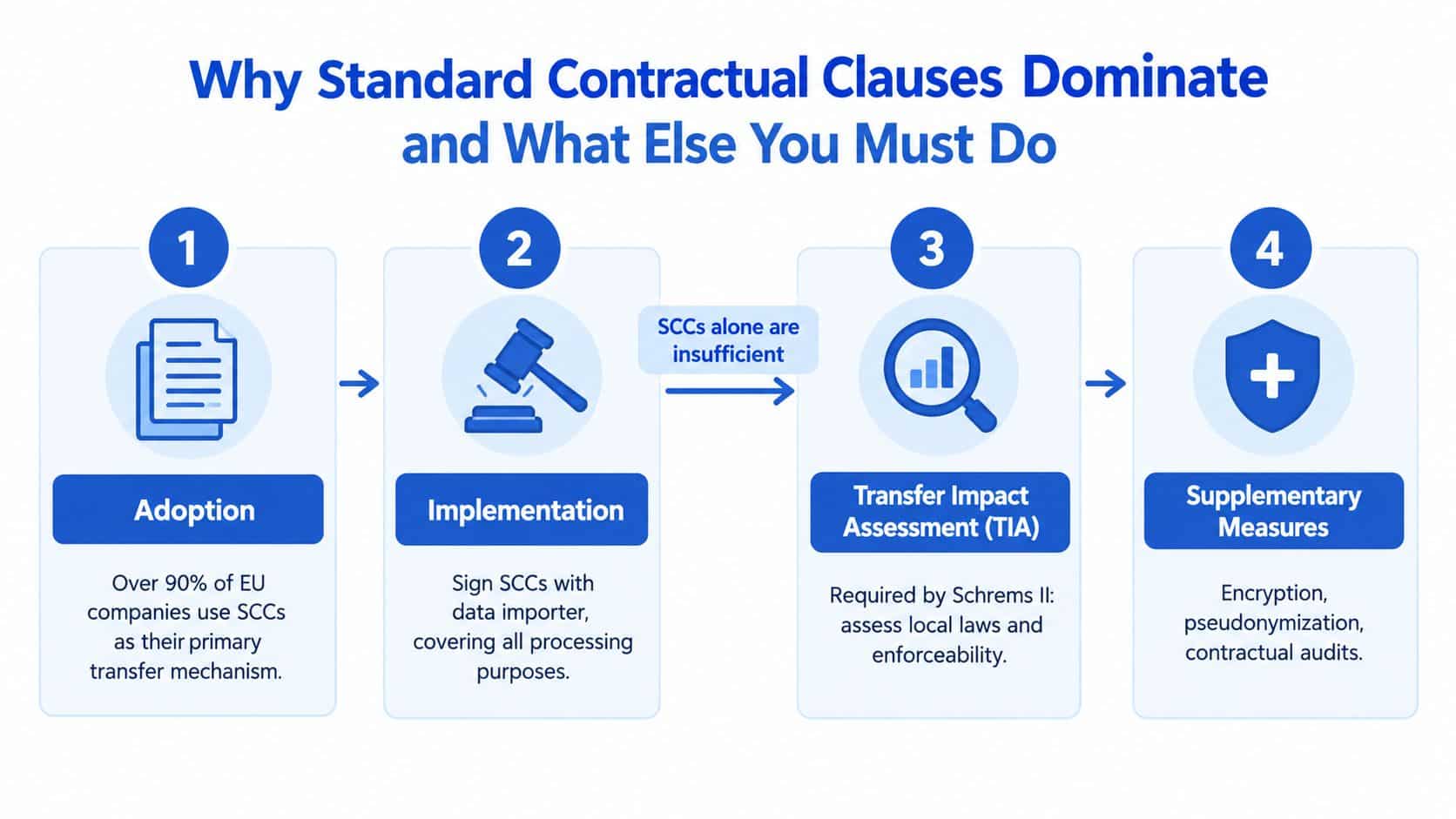
A short visual explanation can help non-lawyers distinguish execution from assessment:
Global Parallels That Change Your Planning From APAC to China
The EU model isn’t the only way governments structure international data movement. APAC frameworks show a parallel preference for accountability and safeguards, but the implementation details remain local. A founder who treats an EU SCC as a universal permission slip can miss certification requirements, filing obligations, thresholds, or exemptions elsewhere.
The APEC Cross-Border Privacy Rules system is a voluntary certification-based mechanism built on the APEC Privacy Framework. OECD analysis describes it as a system intended to facilitate cross-border information transfers while preserving personal-data protections and supporting enforcement cooperation. Operationally, certification can give a multinational company a repeatable trust framework across participating APEC economies rather than forcing a complete redesign for every country.
The system has historical depth. An APEC workshop report described the CBPR System as “just over 3 years old” by February 2016, showing that Asia-Pacific economies had already developed a parallel certification approach before later regional transfer rules expanded.
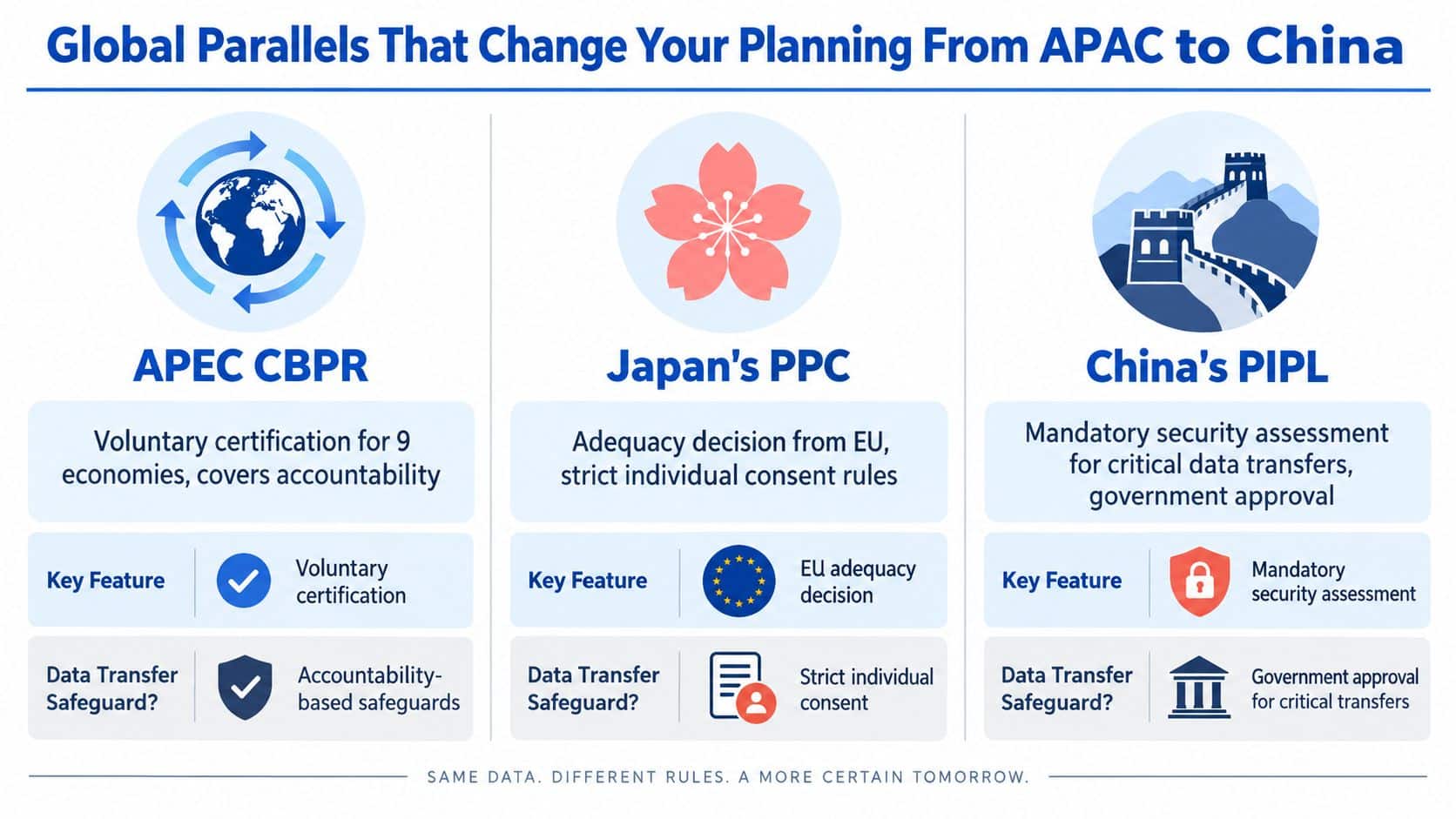
China requires a more granular workflow. Under the PIPL framework, the three main outbound mechanisms are CAC security assessment, personal information protection certification, and the CAC standard contract. The security-assessment route applies to higher-risk or larger-scale transfers. One published summary states that an organization exporting personal information of 100,000 people, or sensitive personal information of 10,000 people, since January 1 of the previous year must undergo a security assessment. Those thresholds are described in this China transfer compliance summary.
The standard-contract route is narrower. A processor must not be a critical information infrastructure operator, must process personal information of fewer than 1 million people, and must have transferred fewer than 100,000 people’s personal information overseas since January 1 of the previous year. It also must not have transferred sensitive personal information of 10,000 people or more during that period, as summarized by Pillsbury’s China transfer analysis.
Recent Chinese guidance also added six exemption scenarios, including small-volume transfers, HR transfers, emergency transfers, and transfers of data collected outside China. The validity period of a security-assessment result was extended from 2 years to 3 years, which changes renewal planning. Arnold Porter’s analysis of the clarified China rules explains why the first question should be whether the regime applies at all.
The broader APAC pattern is convergence without uniformity. A 2026 APAC issue brief describes increasing convergence around safeguards such as SCCs and BCRs, while also emphasizing differences in thresholds, approvals, and exemptions. For a Washington startup, contracts may be the sensible EU and APAC foundation, but China planning should begin with scope and exemption analysis rather than assuming a contract is always available.
Practical Assessment Workflow for Startups to Prepare With Confidence
A lean team doesn’t need to solve every country’s privacy law at once. It needs a reliable sequence that identifies the highest-risk flows first and creates a record that can survive customer diligence.
Start with the actual data map
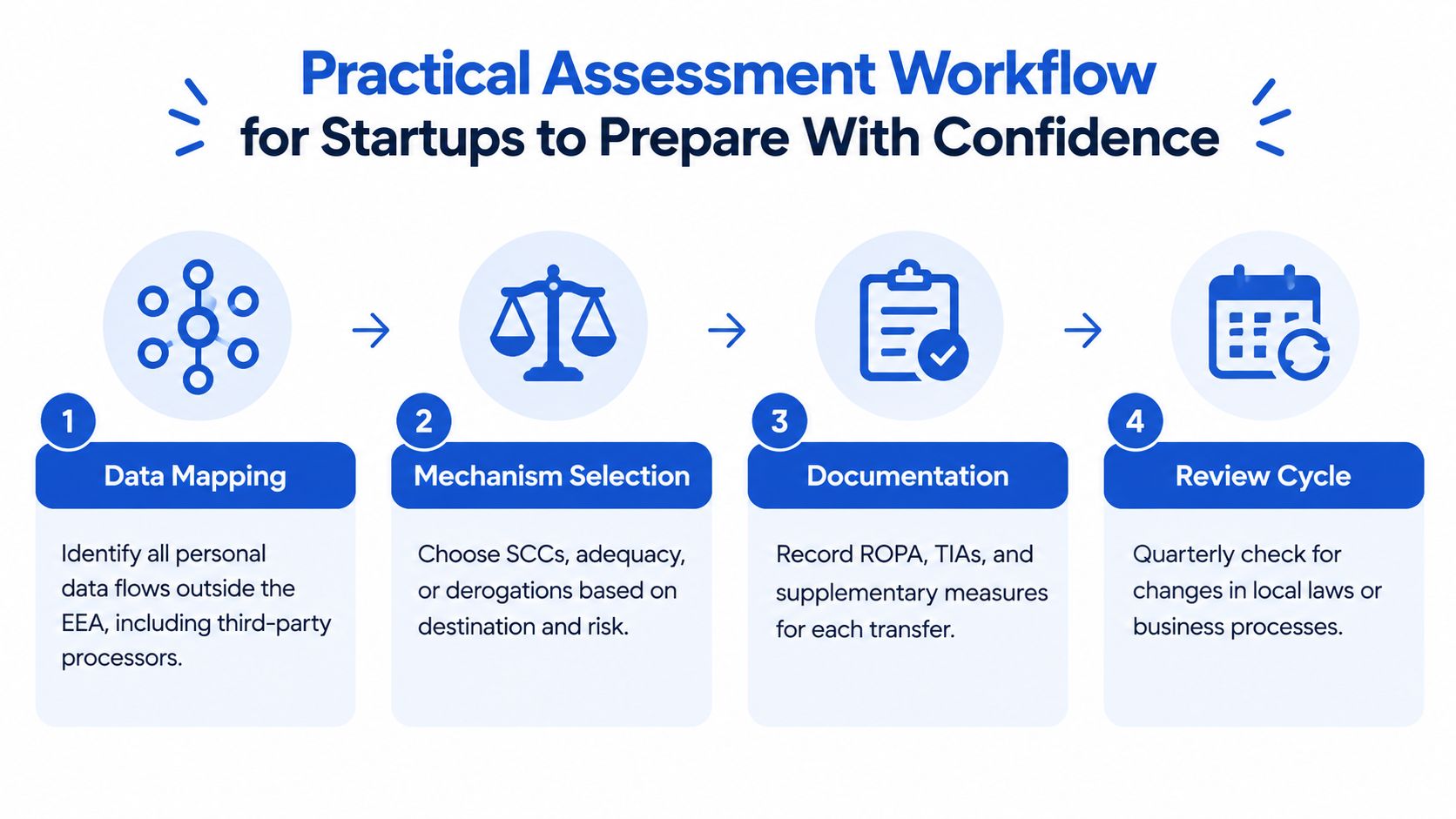
List each product, vendor, subprocessor, and support function that can receive personal data. Record the origin, destination, data categories, purpose, access method, storage location, and onward transfers. Include remote access, because a support employee viewing EEA data from outside the EEA can raise the same practical transfer question as a server movement.
Select the mechanism after mapping
Check adequacy before reaching for a contract. If adequacy doesn’t apply, evaluate SCCs, BCRs, certification, or a code of conduct based on the relationship and operating model. Treat a derogation as an exceptional path, and assess China’s exemptions before assuming that a formal mechanism is required.
Build the evidence file
For each material flow, preserve the relevant contract, transfer details, TIA where needed, vendor responses, security measures, and approval record. A vendor risk assessment process can help connect procurement review with privacy and security decisions instead of leaving transfer analysis in a separate spreadsheet.
Set review triggers
A review should occur when a vendor changes subprocessors, the product adds a new data category, the company enters a new market, or local law changes. The provided startup readiness workflow calls for a quarterly check of local laws and business processes, as shown in the assigned assessment visual. That cadence gives a small team a practical control point without requiring constant legal monitoring.
Washington startups often have a mixed profile: U.S.-based engineering, global cloud services, European customers, and contractors or vendors distributed across APAC. Counsel should review the architecture before a major enterprise launch, especially where sensitive data, artificial intelligence features, or extensive subprocessor access is involved.
Building Compliant Growth and Next Steps With Trusted Counsel
Transfer planning supports more than regulatory compliance. It gives founders a defensible explanation for how the company handles customer information, helps procurement teams answer diligence questions, and exposes architectural decisions that may create avoidable risk.
The decision logic is manageable. Adequacy is the simplest route when it covers the destination. SCCs are the common operational route when it doesn’t, but they require a destination-law assessment and appropriate supplementary measures. BCRs fit internal multinational structures, certifications and codes can support repeatable accountability, and derogations belong to narrow circumstances. China requires separate attention to formal mechanisms, thresholds, and exemptions.
A practical next move is to prioritize the highest-volume or most sensitive flows, inventory every subprocessor, calendar contract and assessment reviews, and obtain focused counsel before expanding the transfer pattern. By Design Law Firm & Legal Consultancy, PLLC can help technology companies align transfer paperwork, vendor terms, privacy governance, and practical risk controls across international operations.
By Design Law Firm & Legal Consultancy, PLLC advises Washington startups and growing companies on cross-border transfer planning, privacy programs, vendor agreements, and Transfer Impact Assessments. Founders can visit By Design Law Firm & Legal Consultancy, PLLC to discuss a transfer workflow that fits the company’s customers, vendors, and technical architecture. Contact our law office today at (206) 593-1519.