A Seattle startup has just shipped an AI support agent to customers in France and Germany. The product team added a disclosure in the help center, but nobody knows whether the chatbot identifies itself inside the conversation, whether generated replies carry machine-readable markings, or who owns the evidence showing how the system works. Then a headline says the EU delayed high-risk AI rules, and the team wonders whether the entire compliance project can wait.
That conclusion would be risky. The EU AI Act entered into force on 1 August 2024 after the European Parliament adopted it on 13 March 2024 and the Council formally adopted it on 21 May 2024. The Parliament's vote was 523 to 46, and the Act was published in the Official Journal on 12 July 2024, according to the EU AI Act legislative timeline. It is now a binding framework that can affect a Washington company when its AI product reaches people in the EU.
The most important current eu ai act news is narrower than the headlines suggest. High-risk obligations have been postponed for certain systems, but transparency duties, governance expectations, prohibited-practice restrictions, and general-purpose AI obligations still shape what companies must do. The next major date for customer-facing teams is 2 August 2026, with a limited transition until 2 December 2026 for specific marking obligations involving certain systems already on the market, as described by the European Commission's AI regulatory framework.
A practical explanation is available in Humantext.pro's EU AI Act guide, while Washington businesses can also review By Design Law's EU AI Act resource. The central question is simple: which AI systems touch EU users, what role does the company play, and what evidence can the company produce today?
Introduction Why EU AI Act News Matters Right Now
For a Washington founder, EU exposure doesn't require a European office. A SaaS platform based in Seattle may serve EU customers through the same login used by customers in Washington. A Puget Sound retailer may use an AI recommendation engine for shoppers in the EU. A developer may sell an application programming interface that European companies embed in their own products. In each case, the product team's location doesn't answer the regulatory question by itself.
The relevant facts are more practical. Does the system interact with people? Does it generate or manipulate text, images, audio, or video? Does it infer emotions or categorize people through biometric information? Does the company provide the system, deploy a vendor's system, or perform both roles in different parts of the business?
Why the August date deserves attention
The European Parliament adopted the Act in 2024, and the rules have been rolling out in stages. General provisions and AI literacy duties applied from 2 February 2025, while rules for general-purpose AI models applied from 2 August 2025, according to the European Commission's implementation timeline. The broad enforcement phase began on 2 August 2026, but later deadlines now matter for particular high-risk categories.
That phased approach creates a trap for smaller companies. A founder may hear “high-risk obligations delayed” and treat the entire Act as delayed. A product manager may assume a chatbot can wait because a formal conformity assessment is not immediately due. A legal team may write a policy without checking whether the product itself tells users that they're interacting with AI.
Practical rule: A delayed high-risk deadline doesn't erase transparency work or eliminate the need to understand the company's AI inventory.
The issue also reaches beyond the AI feature itself. Customer notices, model records, vendor contracts, data flows, incident procedures, and engineering logs can all become part of a defensible compliance program. For a startup with limited staff, the sensible response isn't to recreate a multinational governance department. It is to identify the systems that matter, assign ownership, and address the obligations that are already closest to enforcement.
Understanding the EU AI Act in Plain Language
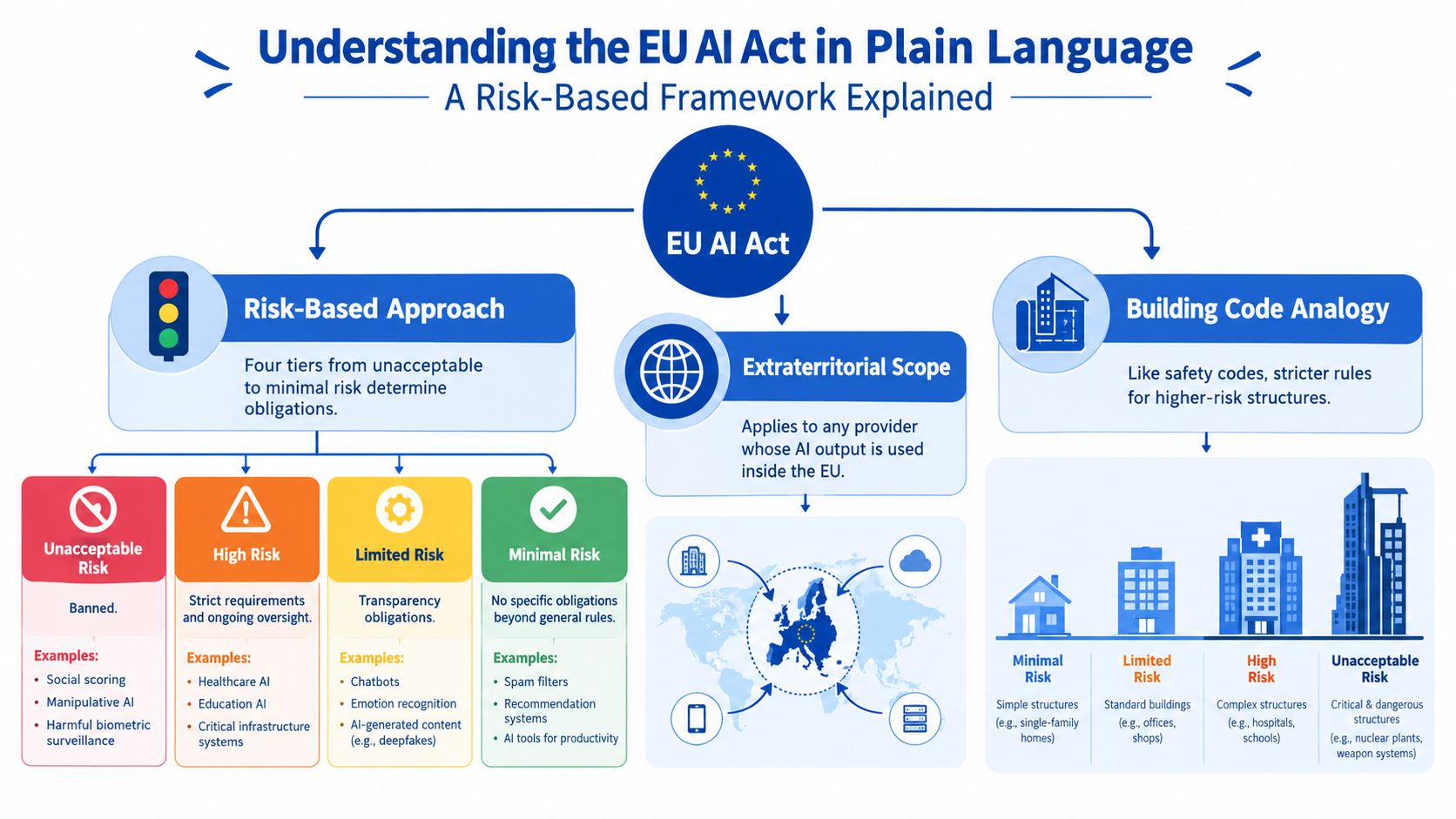
The Act is easiest to understand as a building code combined with traffic signals. A small garden shed doesn't require the same structural review as a hospital. Likewise, an AI tool that drafts an internal outline generally doesn't create the same regulatory concerns as a system used in employment, credit, education, or other sensitive settings.
The risk-based structure works in layers:
- Prohibited practices: Some uses are treated as unacceptable and are banned.
- Transparency duties: Some systems can be used, but people must receive clear information about the AI interaction or content.
- High-risk controls: Systems in sensitive categories face technical, operational, and documentation requirements.
- Lower-risk uses: Many ordinary tools remain subject to lighter obligations, although privacy, confidentiality, consumer protection, and contractual duties can still apply.
Start with the company's role
A company can occupy more than one position. A startup that builds a customer chatbot may act as a provider for that product. The same startup may be a deployer when its employees use an outside coding assistant or customer relationship tool. The label depends on what the company does with the system, not merely where the software was purchased.
The distinction matters because responsibilities follow the activity. A vendor contract may address one side of the relationship, but the customer using the system still needs to understand its own deployment, data, oversight, and user-notice responsibilities.
Scope follows the use of the output
A Washington company shouldn't assume that EU law stops at the border. The Act can matter when an AI system or its output is used in the EU, even when the provider operates from the United States. The practical screening question is whether EU users, customers, employees, or business partners encounter the relevant system or output.
The traffic-light analogy helps founders make an early assessment:
- Red: Stop and investigate whether the use falls within a prohibited practice.
- Yellow: Identify transparency, documentation, human oversight, or monitoring duties.
- Green: Confirm that the use remains outside the Act's stricter categories, then check other legal obligations.
This isn't a substitute for a legal classification. It is a way to prevent a common mistake, treating “AI” as one regulatory category. A marketing copy assistant, a customer support agent, a hiring screener, and a biometric tool may all use machine learning, but their legal treatment can differ sharply.
Latest Timeline and What Was Actually Delayed
For a Washington company selling an AI product into the EU, a headline saying “delayed” can sound like permission to wait. The timeline works more like a building inspection schedule: some requirements already apply, others have later scheduled dates, and preparation still takes time. The European Parliament adopted the law on 13 March 2024, the Council adopted it on 21 May 2024, and the Act entered into force on 1 August 2024, according to the published EU AI Act developments timeline.
The first operational dates arrived in 2025. General provisions and AI literacy applied from 2 February 2025. General-purpose AI model rules applied from 2 August 2025. The framework had pointed to August 2026 for broad application, while the 2026 Omnibus changes postponed some high-risk obligations.
That creates two practical buckets: duties already in force and duties scheduled for later.
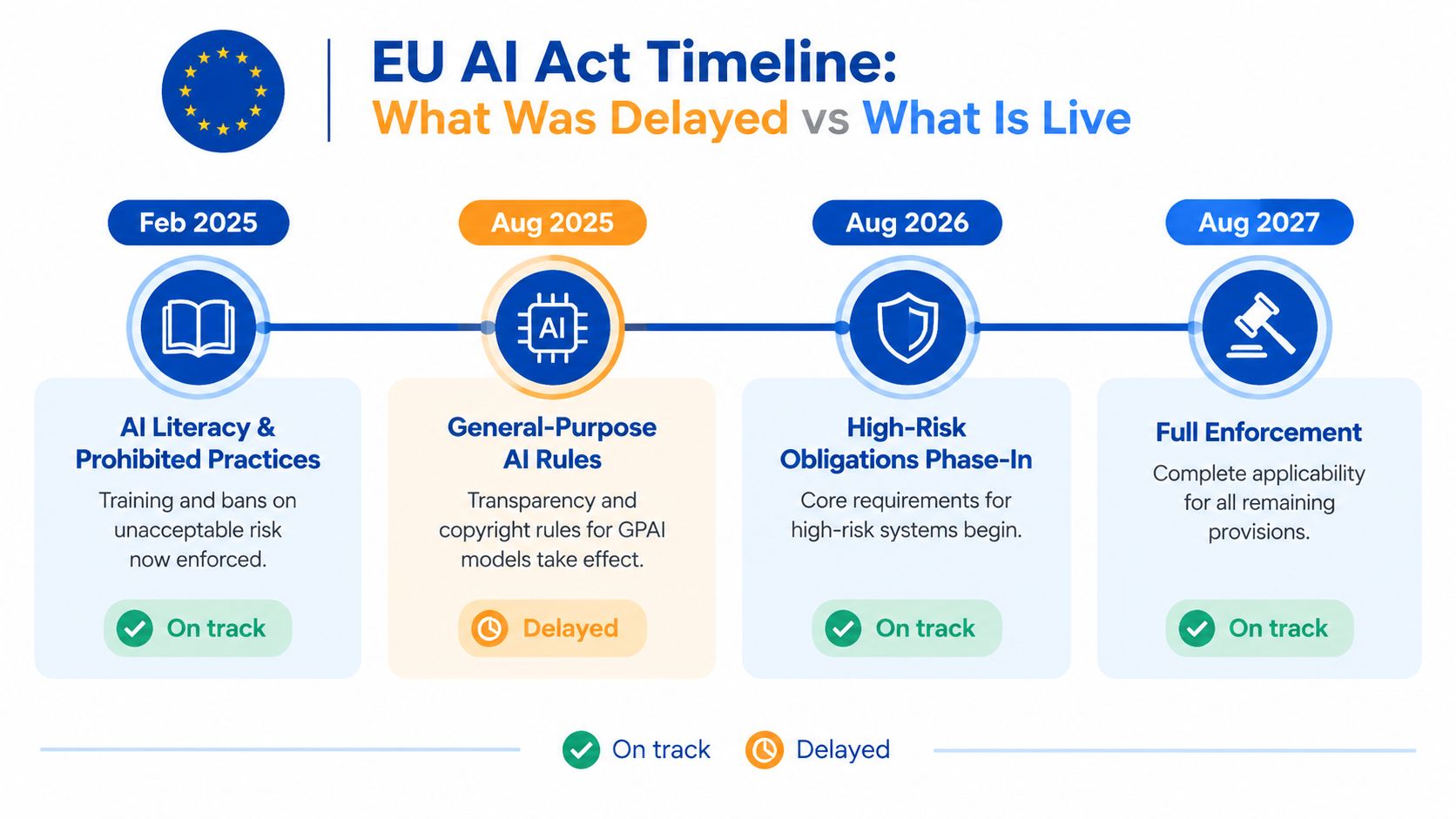
| Date | What Applies | Who Is Affected |
|---|---|---|
| 2 February 2025 | General provisions, AI literacy, and prohibited-practice rules | Providers and deployers covered by those duties |
| 2 August 2025 | General-purpose AI model rules | Providers of general-purpose AI models |
| 2 August 2026 | Broad applicability and key transparency enforcement | Customer-facing AI teams and other covered providers or deployers |
| 2 December 2026 | Certain transition and later requirements | Providers of qualifying pre-existing systems and affected organizations |
| 2 December 2027 (scheduled) | Postponed obligations for certain standalone high-risk systems are set to apply | Organizations operating covered high-risk systems |
| 2 August 2028 (scheduled) | Later obligations for AI embedded in regulated products are set to apply | Providers and deployers of affected product-embedded systems |
The European Commission identifies 2 August 2026 as the point when the Act will become broadly applicable and enforcement will begin for key rules. Its implementation timeline also lists 2 December 2026, 2 December 2027, and 2 August 2028 for specific categories, including certain deepfake prohibitions, Annex III high-risk systems, and AI embedded in regulated products, as explained in the EU AI Act implementation timeline.
For a US company with EU exposure, postponement narrows one deadline. It does not erase the work. Sort each system by type, confirm whether EU users encounter it, and record the applicable date. Keep system inventory, user disclosures, content-labeling design, AI literacy, vendor review, and basic logging on the readiness list. A formal high-risk package may wait where a scheduled date permits, but those foundations should already be under review.
The following video offers another overview of the implementation sequence and the issues founders should separate when reading current coverage:
Transparency Rules Every Customer Facing AI Team Must Meet
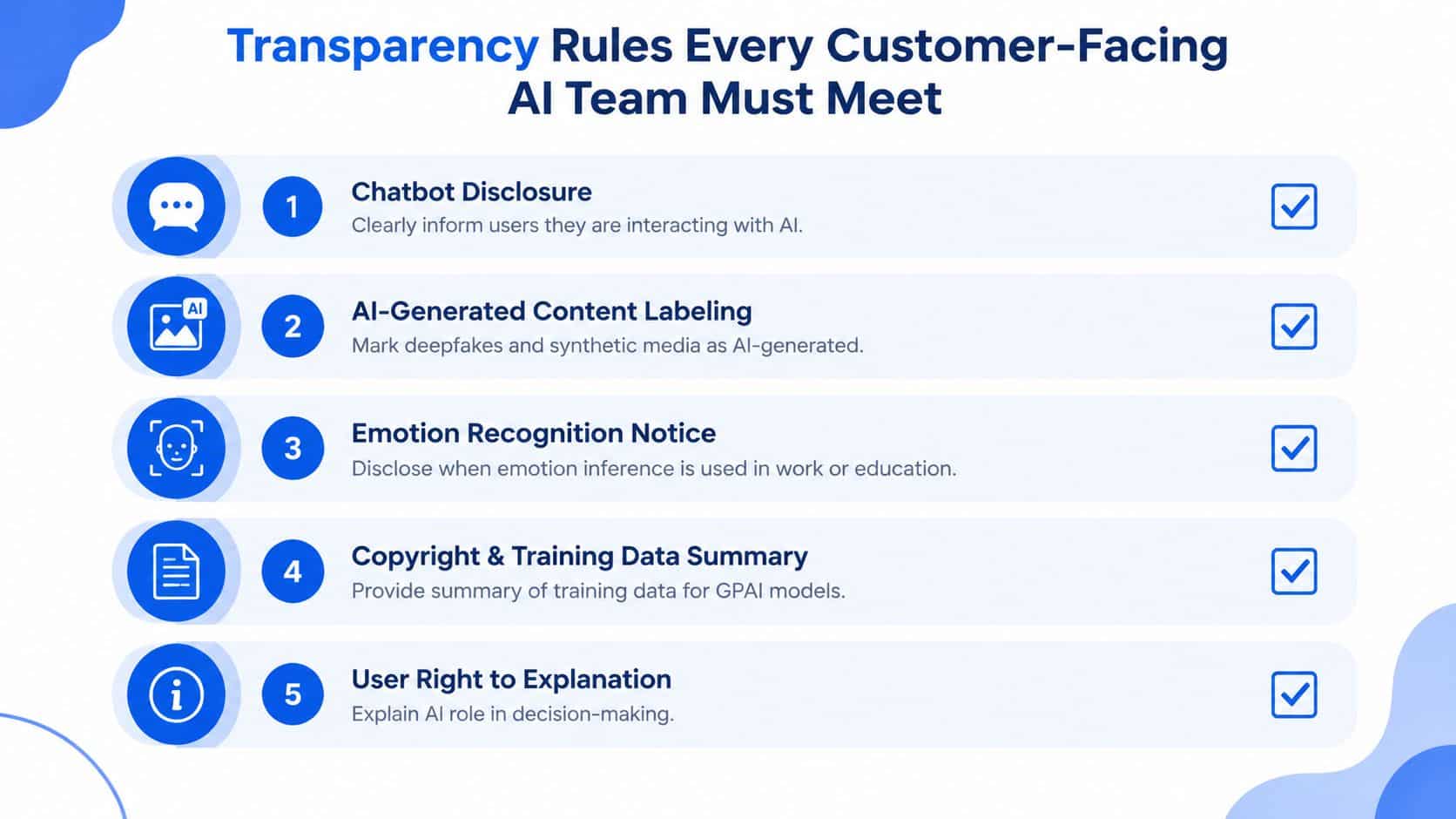
A customer opens your support chat believing a person will answer. The first message comes from an AI agent. That moment creates a practical compliance question: Does the person know that AI is involved? The disclosure should appear where the interaction occurs, not depend on finding a distant help-center page.
The rules apply to several customer-facing patterns:
- Chatbots and agents: A support bot, sales assistant, or voice agent should identify the AI interaction unless its artificial nature is obvious.
- Synthetic content: Providers need technical measures that let people or systems identify AI-generated or manipulated content.
- Emotion recognition and biometric categorization: People exposed to these functions need appropriate notice.
- Deepfakes and certain public-interest text: Deployers need clear labeling when AI-generated or manipulated material is presented to inform the public.
Convert legal duties into product requirements
For a marketing-copy generator, identify where output is displayed, exported, or published. For an image tool, determine how content receives a machine-readable mark and how downstream systems can detect it. For a support chatbot, place a plain disclosure in the first interaction instead of relying on a buried policy link.
The main deadline is 2 August 2026, when the relevant transparency rules will apply. A narrower grace period extends until 2 December 2026 for providers of certain AI systems already placed on the market before the August date, specifically for certain marking and detection obligations, according to the European Commission’s AI regulatory framework.
That distinction should shape sprint planning. A new customer-facing deployment should be designed for the August deadline. An existing system may have additional time for a specific marking obligation, but the grace period is not a general exemption from every transparency duty. For a Washington company serving EU users, the useful question is where those users encounter the system, not where the company is incorporated.
Treat labels as system behavior
A label is more than a sentence in a privacy notice. It may include interface text, an audio disclosure, visible markings, metadata, machine-readable signals, detection tools, and records showing when controls were tested. Teams assessing how content markers behave can consult this overview of text watermark removal, not as a compliance shortcut, but as context for why marking and detection require deliberate design.
A written AI governance policy should connect those controls to business ownership. It can identify who approves a launch, reviews complaints, monitors model changes, and preserves evidence when a notice or label fails.
Before the August date, ask four questions: Where does the disclosure appear? Can the intended audience understand it? Can the content signal travel with exported material? Can the team test and document the control? Those answers turn a broad EU AI Act requirement into work that product, engineering, legal, and support teams can assign.
Design principle: The disclosure should be visible at the moment of use, understandable to the intended audience, and connected to a technical process the company can test.
High Risk Systems and the Hidden Readiness Gaps
High-risk obligations resemble an engineering control stack more than a one-page policy. The required areas include risk management, data governance, technical documentation, logging, transparency, human oversight, accuracy, resilience, and quality management. These controls work together. A company can’t demonstrate responsible operation if it has a polished policy but no reliable record of model versions, inputs, outputs, incidents, or corrective actions.
Logging deserves special attention. Event records should support incident reconstruction, post-market monitoring, and evidence of conformity. That means logging belongs in the system lifecycle, with version-controlled documentation and structured audit trails, rather than in a rushed project immediately before a deadline. The technical compliance discussion from SureCloud’s EU AI Act requirements overview explains why these controls need to be designed into the system.
Separate formal readiness from sensible readiness
A company facing a postponed high-risk date can still take low-cost actions now:
- Inventory: Record each AI system, its purpose, vendor, users, data, market, and business owner.
- Classification: Decide whether the company is a provider, deployer, or both.
- Documentation: Preserve the intended use, known limitations, data sources, testing approach, and change history.
- Logging: Capture the events needed to understand important system behavior.
- Oversight: Define when a person must review, correct, reject, or override an output.
- Quality controls: Establish repeatable testing for accuracy, security, and material changes.
The contrast is useful. Formal conformity work may require specialized assessment and detailed records. Lightweight governance can begin with a controlled inventory, named owners, a vendor questionnaire, launch criteria, and an incident path. The second approach doesn’t replace the first, but it prevents a company from reaching the formal deadline without the facts needed to complete it.
Delay headlines can create operational risk
Readiness gaps are already substantial. The Reuters reporting supplied for this analysis states that 83% of organizations lacked a formal AI inventory, 74% lacked a designated AI compliance owner, and 61% lacked a process for technical documentation (Reuters coverage of the EU AI Act changes). Those figures point to a management problem, not merely a legal calendar problem.
A postponed deadline can encourage companies to pause the inventory that would reveal which systems are in scope. A company that starts with a focused AI risk assessment framework can distinguish a low-risk internal assistant from a customer-facing system or a sensitive decision tool without applying the same process to everything.
Penalties Enforcement and Real World Examples for SMBs
For a small business, EU AI Act penalties turn classification and evidence into operating decisions. Tier 1, covering prohibited AI practices that have applied since 2 February 2025, can reach EUR 35 million or 7% of worldwide annual turnover. Tier 2, covering most other obligations under the Article 99 regime applicable since 2 August 2025, can reach EUR 15 million or 3%. Supplying incorrect information can trigger EUR 7.5 million or 1.5%. The Article 99 penalty analysis explains the penalty framework, while the European Commission’s implementation timeline places these dates in the wider rollout.
The practical distinction is simple: a future compliance deadline does not make an already prohibited use acceptable. On 2 August 2026, companies should also treat transparency and governance as live operating requirements, even when headlines focus on delayed high-risk obligations. For a Washington-state company selling into the EU, the relevant question is whether its product, users, outputs, or customers create an EU connection, not where the engineering team sits.
A Seattle SaaS company releases an AI sales assistant to EU customers. The bot does not clearly disclose the AI interaction, and the company cannot identify which version produced a disputed answer. That combination creates a transparency and evidence problem. Product notices, test records, model versions, escalation rules, and customer communications should be preserved in a shared record.
A Puget Sound retailer uses an AI recommendation engine for EU shoppers. The feature may not automatically be high-risk, yet the retailer still needs to know what data enters the system, what vendors retain, what information users receive, and whether recommendations influence a sensitive decision. Calling the feature “personalization” does not settle its risk classification.
A US vendor supplies a platform that European clients configure for recruitment or credit-related workflows. The vendor may provide the technology while customers control deployment. Contracts should clearly allocate roles, documentation duties, human oversight, testing, and incident cooperation, particularly as high-risk requirements approach.
Priority order: Stop prohibited uses first. Correct live transparency failures second. Then build the records and controls needed for systems that may receive high-risk treatment.
Your Next Steps Checklist for August 2026 Readiness
A lean team can create momentum with a short, documented routine:
- List every AI system. Include approved tools, employee subscriptions, embedded vendor features, chatbots, content generators, and internal agents.
- Map EU exposure. Record which products, outputs, customers, employees, or business partners reach the EU.
- Assign an owner. Give one person responsibility for classification, evidence, vendor coordination, and escalation.
- Test customer disclosures. Confirm that chatbot notices and AI-interaction information appear at the right point in the user experience.
- Build content controls. Decide how generated images, audio, video, and text receive markings or labels, and how the company detects them.
- Start the evidence file. Preserve intended use, system versions, testing, incidents, approvals, and material changes.
- Review sensitive data access. AI use doesn’t transfer responsibility for personal, confidential, or obsolete information.
Teams needing a structured starting point can use the AI risk assessment template. A directory such as the AI Compliance Index can also help teams compare compliance tools, but no software replaces ownership, classification, or legal judgment.
Counsel becomes especially useful when a product serves EU users, a vendor contract assigns unclear roles, a system affects employment or credit decisions, a model produces public-facing synthetic content, or an incident raises questions about notice and evidence. The fastest readiness check is practical: identify the systems, identify the people responsible, test the user experience, and confirm that the company can produce records explaining what happened.
By Design Law Firm & Legal Consultancy, PLLC helps startups and established businesses assess AI roles, review vendor contracts, develop transparency and governance programs, and prepare risk and incident procedures for EU exposure. Washington founders and Puget Sound companies can visit By Design Law Firm & Legal Consultancy, PLLC to discuss a focused compliance review before the August 2026 transparency deadline. Contact our law office today at (206) 593-1519.