A Seattle startup often reaches the same moment at roughly the same stage of growth. Product wants to ship an AI feature fast. Sales wants “AI” in the deck. Ops wants a support bot to cut queue volume. Someone signs up for OpenAI, Anthropic, Microsoft Copilot, Google Workspace AI, or a niche vendor built into the SaaS stack, and the company only asks hard questions after customer data has already started flowing.
That's where problems usually begin. The issue usually isn't that the tool is obviously unlawful or obviously unsafe. The issue is that no one wrote down what the system does, what data it touches, who owns the vendor relationship, whether outputs will be reviewed by a human, or what happens when the model changes under the hood. For a Washington company serving U.S. customers, those gaps create legal exposure, procurement friction, and credibility problems with enterprise buyers.
A solid AI risk assessment template fixes that by turning a vague internal conversation into a documented governance record. Done properly, it becomes more than a checklist. It becomes evidence that the business identified risks, assigned owners, chose controls, and revisits those decisions when facts change.
Why Your Business Needs an AI Risk Framework Now
The usual fact pattern is ordinary. A startup adds an AI note summarizer to customer success workflows. A recruiter starts using an AI screening tool. Engineering connects an LLM to support tickets so customers can get answers after hours. The decision looks operational, not legal.
Then legal and business issues stack up quickly.
The tool may ingest personal information. Employees may paste proprietary material into prompts. Output may sound authoritative while being wrong. Sales may market the feature more aggressively than the product team can substantiate. Procurement may ask for security terms the vendor won't accept. If a regulated customer asks for documentation, the company may realize there isn't any.
Ad hoc AI adoption breaks at the first serious review
That's why an AI risk framework matters now, even for companies that are nowhere near Fortune 500 scale. According to Moody's 2025 risk and compliance survey, more than half of respondents said they were using or trialing AI for risk and compliance, up from 30% in 2023, a 20-percentage-point increase. The practical takeaway is straightforward. AI has moved into routine business functions, and governance expectations have moved with it.
For founders, the framework's value is simple. It forces the company to ask, before deployment:
- What exactly is this system doing
- What data enters the system
- Who can rely on the output
- What harms are realistic if it fails
- Who approves use and who monitors it later
A founder who already understands application security will recognize the pattern. The same discipline used in a Guide to continuous app security applies here. Inventory first. Define risk ownership. Build repeatable review gates. Treat AI as part of the operating environment, not as a novelty exception.
Practical rule: If a company can't explain an AI system's purpose, inputs, outputs, owner, and fallback process in one page, it shouldn't be in production.
Washington and U.S. businesses need a defensible record
For a Washington company selling nationally, the AI assessment also functions as a legal translation layer between product, security, privacy, and contracts. It helps answer customer diligence requests, board questions, and internal escalation decisions. It also supports data governance analysis when teams are already wrestling with issues discussed in this overview of generative AI and U.S. data privacy laws.
A founder doesn't need a giant governance program to start. But a founder does need a repeatable process. Without one, each new AI tool becomes a one-off judgment call made by whoever is moving fastest that week.
Anatomy of a Defensible AI Risk Assessment
A defensible assessment isn't a paragraph in a policy or a spreadsheet of “yes/no” answers. It's a structured record that shows what the company reviewed, how it evaluated risk, and what it did in response.
Start with inventory and context
The first section should identify the system with enough detail that someone outside the project team can understand it later. That means naming the product or model, the vendor, the internal owner, the business use case, affected users, and whether the company is building, fine-tuning, embedding, or consuming third-party AI.
This sounds basic, but it's where weak templates fail. They ask abstract ethics questions before documenting the actual deployment context. A support chatbot connected to a public knowledge base is not the same as a hiring tool, a medical triage assistant, or an internal coding assistant with repository access.
A useful intake section should cover:
- System identity. Product name, vendor, internal team, deployment environment.
- Use boundaries. Intended task, prohibited uses, and who may rely on outputs.
- Lifecycle stage. Pilot, internal-only use, limited customer launch, or full production.
- Dependency map. Upstream data sources and downstream business decisions.
Score risks in a way people can repeat
Modern assessment frameworks increasingly rely on structured scoring rather than vague discussion. NVIDIA's frontier AI risk framework describes hazards scored on a scale from 1 to 64 using likelihood × severity × observability, and also classifies models by capabilities, deployment use case, and level of autonomy, as shown in NVIDIA's frontier AI risk assessment framework. The same source also references a standardized questionnaire with 24 questions aligned to lawfulness, minimisation of harm, human autonomy, fairness, and good governance.
That matters because legal defensibility depends on consistency. If one team marks a customer-facing AI assistant as “low risk” based on instinct while another applies a scoring method, the record won't hold up well in diligence or a dispute.
A useful template converts judgment into criteria. It doesn't eliminate discretion, but it makes discretion visible.
A practical assessment usually separates at least these domains:
| Domain | What to ask | Why it matters |
|---|---|---|
| Data | What goes in, and does it include personal, confidential, or regulated data? | Data use often drives privacy, security, and contractual risk. |
| Model and output | Can the output be wrong, biased, misleading, or hard to explain? | Output risk usually determines whether human review is required. |
| Impacted people | Who is affected by the system's use or errors? | Stakeholder impact often changes the acceptable risk level. |
| Controls | What technical, process, and contractual safeguards exist? | A risk record without controls is just an admission. |
Tie each section to governance outputs
The best templates don't stop at analysis. They trigger action. A good form should end with required decisions, such as approval conditions, monitoring requirements, contract changes, or escalation to legal and security.
That's also where marketing claims should be tested. If the company describes a feature as “safe,” “responsible,” or “bias-checked,” the assessment should back that up. If it doesn't, the company may drift into the territory discussed in this legal guidance on AI washing.
A defensible template should produce an auditable file with three clear outputs:
- A risk classification
- A required control set
- A named owner for follow-up
If those outputs aren't visible, the document is still just a questionnaire.
The AI Risk Assessment Template You Can Use Today
Most founders don't need a theoretical model. They need a form their team can complete this week for the chatbot, summarizer, recommendation engine, or vendor plug-in already sitting in procurement or staging.
A practical template should function as a workflow, not a dead PDF. ServiceNow's AI risk management guidance describes a mature process as intake → classification → impact assessment → rule evaluation → analyst review, with answers mapped to risk statements and control objectives in a machine-actionable way, as outlined in ServiceNow's assessment template workflow guidance. For a startup, that doesn't require a full GRC platform. It does require separating the questions from the decisions those answers trigger.
One practical resource for companies that want a related intake process on the vendor side is this vendor risk assessment template. It's relevant because many AI deployments are really vendor deployments with AI layered inside.
A realistic example for a Seattle SaaS company
Assume a Seattle-based B2B SaaS company wants to add a third-party AI assistant to customer support. The assistant drafts responses, summarizes tickets, and suggests help-center articles. Support managers can edit outputs before sending them.
A usable AI risk assessment template would capture entries like these.
Section one system profile
System name: Third-party AI support assistant integrated into Zendesk.
Business owner: Head of Customer Support.
Technical owner: Engineering manager for integrations.
Deployment scope: Internal drafting assistance for support agents.
Prohibited use: No fully automated final responses to customers without human review.
This section matters because it narrows the use case. If the vendor later pitches autonomous outbound resolution or sentiment scoring tied to employee performance, that's a materially different use and should trigger reassessment.
Section two data and inputs
Inputs: Customer support tickets, account metadata, product documentation, internal macros.
Data concerns: Tickets may contain personal information, credentials shared in error, screenshots, billing details, or customer confidential material.
Initial control choice: Redact avoidable sensitive data before model ingestion where feasible. Restrict agent instructions against entering secrets into free-text prompts.
Many businesses often discover they don't know what support data contains. A founder may believe the system handles only “routine customer requests,” while the support queue in reality contains password resets, payroll questions from admins, or uploaded files.
The legal question is rarely “does the vendor use AI.” The better question is “what information enters the system, and who bears the consequences if that information is mishandled.”
Section three output and decision impact
Output type: Draft text, article suggestions, summarization.
Reliance level: Advisory only. Human agent must review before sending.
Potential failure modes: Hallucinated policy statements, inaccurate refund guidance, overconfident troubleshooting steps, inappropriate tone.
The business determines the distinction between assistive AI and delegated decision-making. If the company allows direct customer reliance, the control posture should become much stricter.
A short walkthrough can help teams visualize the process:
What the approval block should require
A good template ends with decisions, not commentary. For the support assistant example, the approval conditions might look like this:
- Human review required before any customer-facing message is sent.
- Vendor contract review focused on data use rights, confidentiality, security commitments, and change notification.
- Prompt and usage policy for support staff.
- Monitoring trigger if the vendor changes model provider, training practices, or core features.
- Reassessment event if the tool moves from drafting assistance to automated customer communication.
The template itself can live in Notion, Airtable, Jira, Confluence, or a GRC tool. The format matters less than the discipline. What matters is that the company can retrieve the record later and show who approved what, under which assumptions.
For businesses that want formal legal support around these artifacts, By Design Law Firm & Legal Consultancy, PLLC is one option among others for AI risk assessment and related contract work. The more important point is that counsel, procurement, and product should all be reading from the same document.
From Identification to Action Scoring and Mitigation
Once the risks are listed, the company has to decide what deserves immediate attention and what can be managed with ordinary controls. That's where scoring becomes useful, but only if it drives action.
The most workable approach for smaller U.S. businesses is usually a phased review. The UC AI Council guide recommends starting with an initial assessment of core risks, then moving to a fuller assessment for higher-risk systems. It evaluates each risk by determining relevance, reviewing aggravating factors, identifying mitigating factors, and assigning an outcome using a rubric, as described in the UC AI Council risk assessment guide. That structure fits startups well because it avoids turning every AI use case into a heavyweight review.
Use scoring to prioritize, not to impress
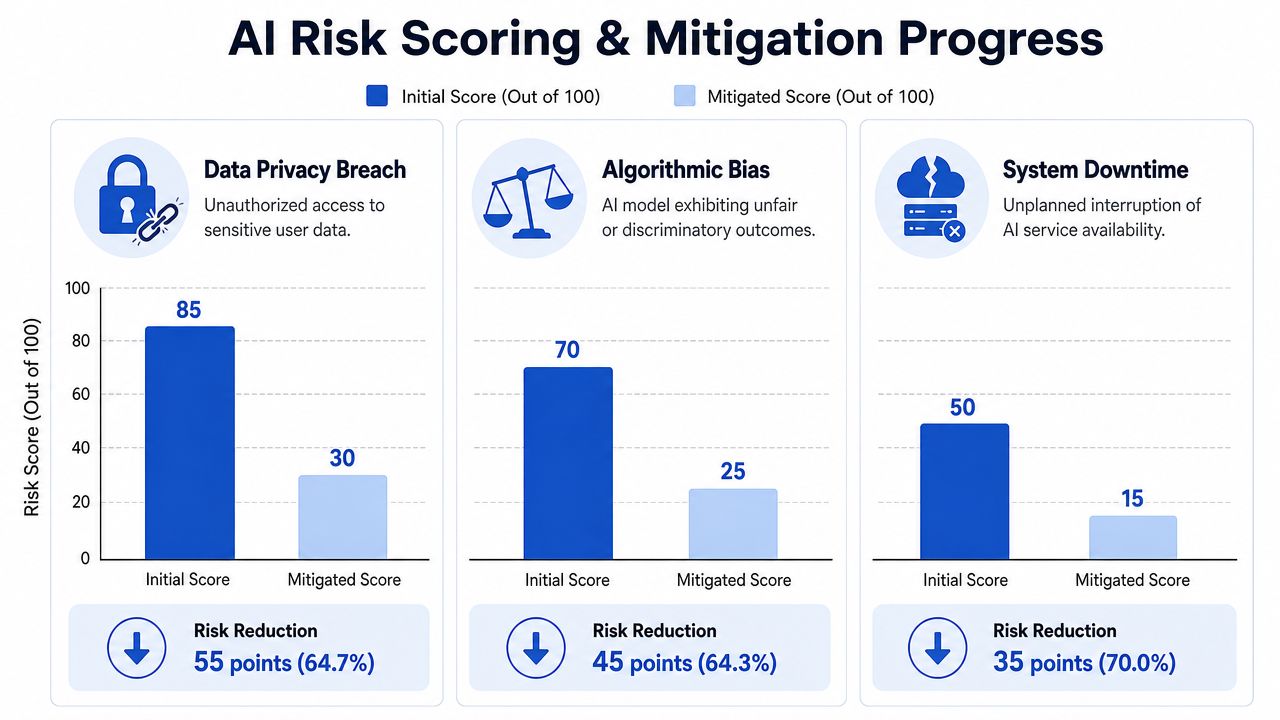
A practical scoring model should answer three questions:
- How serious is the harm if the system gets it wrong
- How likely is that harm in the actual deployment
- How detectable is the problem before someone relies on it
A support drafting tool with mandatory agent review may score lower than an AI feature that influences hiring, pricing, benefits, access control, or fraud determinations. The difference isn't whether one system is “ethical” and the other isn't. The difference is how directly the output affects people and how easily errors can be caught.
Match scores to concrete controls
The mitigation discussion should move across three lanes.
- Technical controls such as data minimization, access restrictions, output filtering, logging, and environment separation.
- Process controls such as human review, escalation paths, training, and documented prohibited uses.
- Contract controls such as vendor representations, audit cooperation, update notification, confidentiality, and breach terms.
Here's a practical mapping:
| Risk pattern | Typical control response |
|---|---|
| Sensitive data may enter prompts | Limit input types, redact where possible, tighten user instructions, review vendor data handling terms |
| Output may be inaccurate but user-facing | Require human review and add customer-safe fallback language |
| Vendor can change the model without warning | Add notice obligations and internal reassessment triggers |
| System supports consequential decisions | Escalate for deeper review and require stronger oversight |
Legal lens: A completed assessment helps most when it leads to changed behavior. If no policy, workflow, or contract changes after a “high” score, the score itself won't protect the company.
Revalidation has to be scheduled
AI assessments go stale faster than ordinary software reviews. Vendors change models. Product teams expand use cases. Employees find shortcuts. A low-risk internal tool can become a much more sensitive system without a formal relaunch.
That's why the scoring result should always include one of three operational outcomes: approve with controls, escalate for deeper review, or reject pending redesign. It should also include a review trigger tied to model changes, new data categories, or expanded reliance on outputs.
Integrating Assessments into Your Broader AI Governance
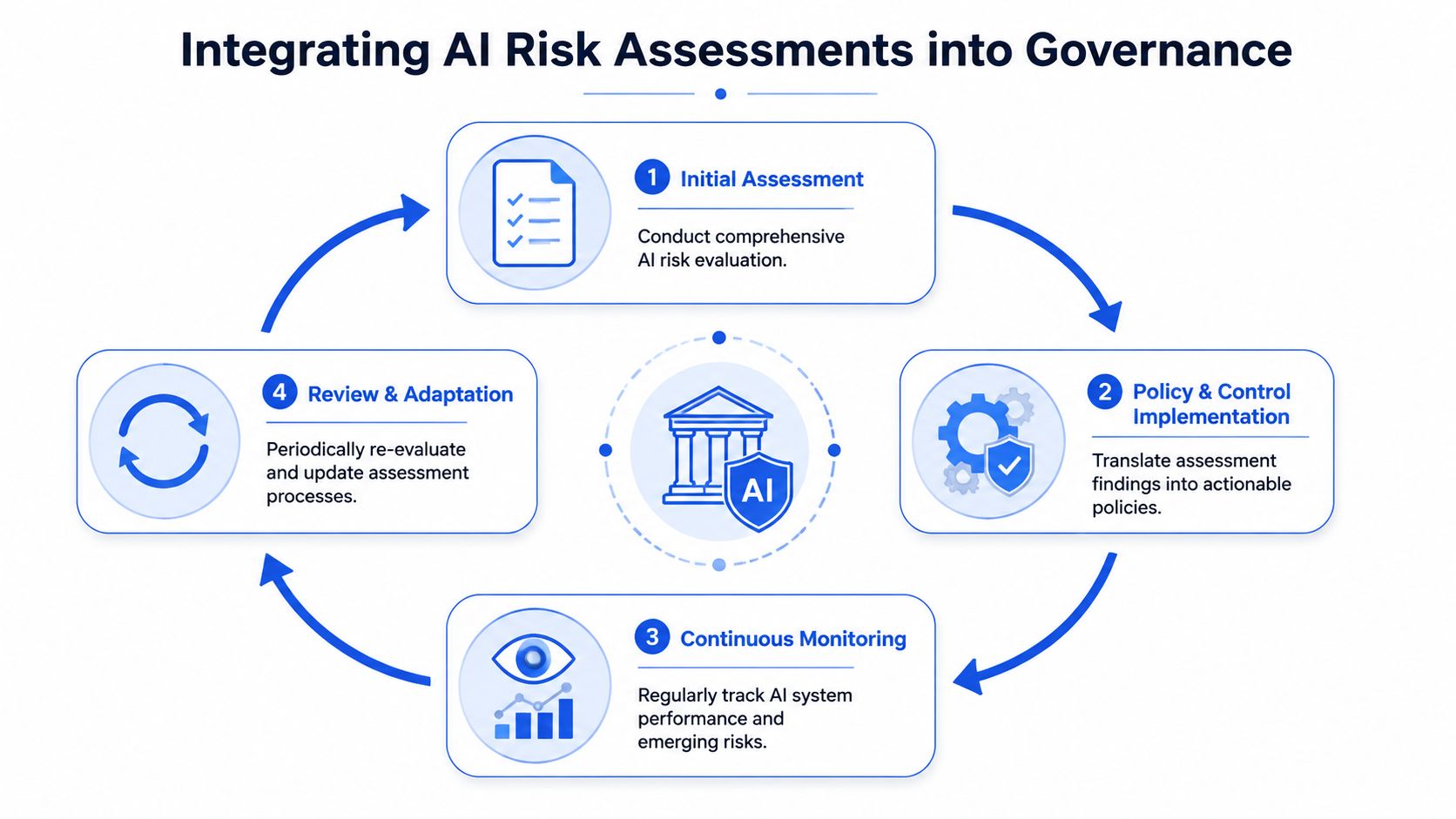
A single assessment document won't do much if it lives in a shared drive and nobody looks at it again. The full value appears when the assessment becomes a gate in procurement, product development, and incident response.
Put the template into procurement
A major weakness in many AI programs is ownership across the supply chain. As summarized in SentinelOne's discussion of AI risk assessment frameworks, organizations increasingly need to assess AI they develop, acquire or procure, deploy, and operate. For a startup using embedded or third-party AI, that means procurement cannot treat AI as just another SaaS checkbox.
A workable procurement gate should ask:
- Is the vendor using customer data for training or model improvement
- Will the vendor notify customers about major model or subprocessor changes
- Who investigates incidents tied to output failures or data leakage
- Can the company suspend or narrow the use case if risk changes
This is also where ordinary data governance becomes part of AI governance. Teams that need a visual way to frame baseline controls may find these key data protection strategies useful as a companion reference when mapping where AI touches sensitive information.
Add review gates to product and engineering
The product lifecycle should include AI-specific approval points before launch and again before any major use expansion. Engineering shouldn't be the sole owner, because engineering usually sees technical implementation while legal and operations see reliance and downstream consequences.
A simple governance model often works best:
| Business moment | Required AI governance action |
|---|---|
| New AI vendor request | Intake and vendor due diligence |
| New AI feature in roadmap | Initial risk assessment before build or beta |
| Expansion to customer-facing automation | Deeper review and control validation |
| Material model or data change | Reassessment and approval refresh |
Treat vendor management as part of legal risk allocation
Many companies still write assessments as if they own the full stack. They often don’t. They may use a customer support platform that embeds an LLM from one provider, moderation tooling from another, analytics from a third, and data hosting from a fourth. When something goes wrong, responsibility gets blurry fast.
That’s why a strong AI risk assessment template should include a dedicated supply-chain section for:
- Vendor due diligence
- Contractual responsibility splits
- Audit rights or cooperation rights
- Notification obligations for updates
- Incident handling roles
- Fallback or exit planning
If a company can’t identify who controls model updates, training conditions, and response obligations, it hasn’t finished the assessment.
Governance becomes real when the template changes approvals, contract language, and launch timing. Without those operational hooks, the document is just paperwork.
Your Legal and Contractual AI Checklist
Founders usually don’t need more AI principles. They need a short list of actions that will still matter when a customer complaint, regulator question, or contract dispute lands on counsel’s desk.
The checklist that holds up under pressure
- Document the decision trail. Keep the completed AI risk assessment template, the approval record, the named owner, and the conditions for use. A missing record is hard to defend after deployment.
- Review vendor terms for AI-specific issues. Focus on data use rights, confidentiality, model update notice, incident cooperation, output-related liability, and any language that shifts risk back to the customer.
- Set marketing guardrails. Product claims about safety, accuracy, fairness, or automation should match what the assessment supports.
- Require reassessment triggers. New data, new users, new autonomy, or a new vendor model should reopen the review.
- Connect AI review to privacy compliance. The same business that needs an AI assessment often also needs stronger baseline privacy governance, especially around collection, use, retention, and disclosures. This data privacy and compliance resource is a useful starting point for that broader legal framework.
- Look for real examples of public privacy commitments. When evaluating vendors, it helps to compare how providers explain their own practices. For example, this summary of how Ekipa AI protects user data shows the kind of disclosures teams should read critically rather than accept at face value.
A strong AI program doesn’t start with a board deck. It starts with disciplined intake, realistic scoring, contract review, and follow-through. For Washington and U.S. businesses, the AI risk assessment template is one of the few governance artifacts that can help product, legal, procurement, and security act on the same facts at the same time.
By Design Law Firm & Legal Consultancy, PLLC helps Washington startups and growing businesses translate AI risk, privacy, contracting, and governance issues into practical legal decisions. Businesses that need help building or reviewing an AI risk assessment template, negotiating vendor terms, or integrating AI review into product and procurement workflows can learn more at By Design Law Firm & Legal Consultancy, PLLC. Call our law office today at (206) 593-1519.