A founder is ready to sign with a new SaaS vendor. The demo was smooth. The pricing works. The team wants implementation to start next week. Then someone asks the question that usually arrives too late: what data will this vendor touch, where will it go, and what happens if something breaks?
That pause is healthy. For Washington startups and SMBs, vendor selection is no longer just a product and procurement decision. It's a legal, operational, and valuation decision. A cheap tool can become an expensive problem if it mishandles customer data, relies on weak subcontractors, or refuses to accept reasonable contract terms.
A solid vendor risk assessment template helps a business slow down in the right place. It creates a repeatable way to ask better questions before access is granted, money changes hands, and obligations to customers are put at risk.
Why Your Next Vendor Contract Needs More Than a Handshake
The fastest way to create avoidable risk is to treat a vendor contract like a routine purchase order. That might work for office snacks. It doesn't work for a payroll platform, a cloud analytics provider, or an AI tool that ingests internal files.

A founder in Washington often faces a familiar tension. The business needs speed, but the vendor needs access to sensitive systems, customer records, employee information, or product data. Once access is granted, the business inherits consequences it doesn't fully control. If the vendor has weak security, poor incident response, or unclear subcontractor practices, the startup may still face customer claims, contract disputes, and regulatory scrutiny.
That risk isn't theoretical. Vendor risk management became a critical control after incidents like the 2017 Equifax breach, which affected 147 million people and was tied to third-party weaknesses, while IBM's 2024 report found the average global data breach cost reached USD 4.88 million, up 10% from the prior year, making structured vendor questionnaires a financial necessity rather than an administrative exercise, as noted in Cynomi's discussion of vendor risk assessment templates.
What founders usually miss
Early-stage companies often focus on the vendor's feature list and implementation timeline. The harder questions get postponed:
- Data scope: What exact data will the vendor store, process, or transmit?
- Access rights: Will the vendor have admin access, API access, or employee account access?
- Downstream risk: Does the vendor rely on subprocessors that haven't been disclosed?
- Contract allocation: Who pays if the vendor causes a breach, outage, or IP dispute?
Those questions sit at the intersection of legal drafting, security diligence, and governance. They also connect directly to culture. A company that takes third-party diligence seriously usually takes internal accountability seriously too. Founders thinking about vendor governance often benefit from broader guidance on shaping your business's ethical blueprint, because vendor decisions reflect the standards a company is willing to live by.
Practical rule: If a vendor will touch sensitive data or business-critical workflows, diligence should happen before signature, not after onboarding.
Indemnity is where many founders discover whether the contract matches the sales conversation. A vendor that promises reliability but refuses meaningful risk allocation is sending a message. Washington businesses negotiating those provisions should understand the legal and commercial stakes around indemnity clauses in Washington State contracts.
What a template actually does
A vendor risk assessment template is useful because it turns vague concern into a documented process. It captures what was asked, what evidence was reviewed, what issues were found, and what remediation was required before approval. That record matters when customers ask about diligence, investors review internal controls, or regulators expect proof that the company didn't act blindly.
A handshake starts the relationship. A template helps keep it from becoming a liability.
Building Your Vendor Risk Assessment Template
A good vendor risk assessment template shouldn't read like a giant compliance spreadsheet copied from a Fortune 500 procurement team. Startups need something tighter. It should be detailed enough to identify legal and operational risk, but practical enough that a strong vendor can complete it without abandoning the deal.
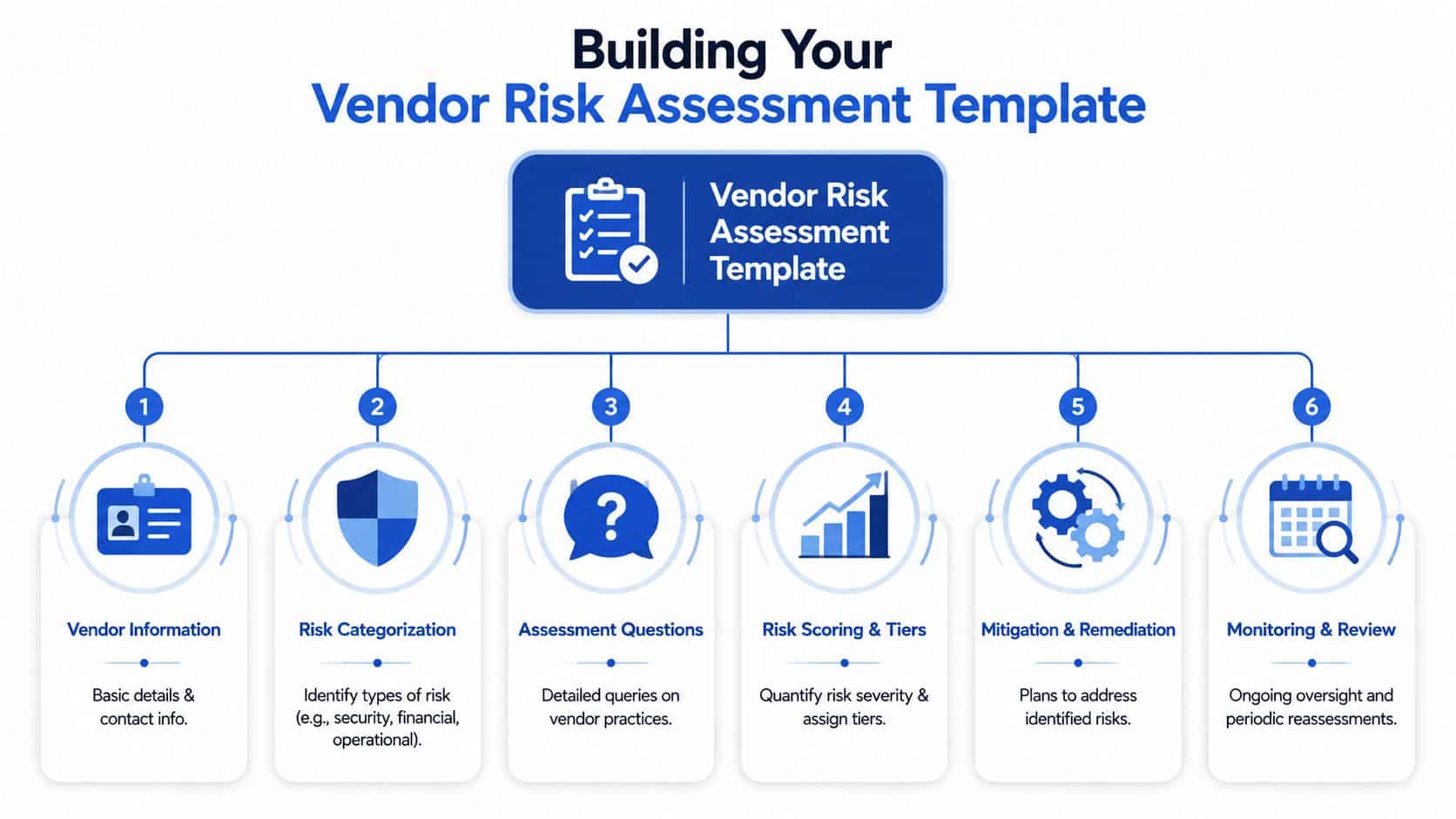
Six modules that belong in the template
The template works best when it follows a clear architecture.
| Module | What to collect | Why it matters |
|---|---|---|
| Vendor profile | Legal name, headquarters, service description, business owner | Identifies who is being vetted and how critical the relationship is |
| Data and access mapping | Types of data, system access, integrations, user roles | Determines legal exposure and technical blast radius |
| Security controls | Encryption, access control, incident response, logging | Tests whether baseline safeguards exist |
| Privacy and compliance | Privacy commitments, regulatory alignment, data location | Helps align vendor conduct with customer and statutory obligations |
| Resilience and operations | Business continuity, disaster recovery, support model | Measures outage risk and service dependability |
| Contract and remediation | Exceptions, open issues, action items, deadlines | Prevents the assessment from dying in a folder |
Questions that produce useful answers
A weak template invites weak answers. Instead of asking, "Do you take security seriously?" ask questions that force specifics.
- For access control: Does the vendor use role-based access controls for customer environments, and who approves privileged access?
- For encryption: Is sensitive data encrypted in transit and at rest, and can the vendor describe exceptions?
- For incidents: What is the process for notifying customers after a security incident, and who owns communications?
- For continuity: Does the vendor maintain a tested recovery plan for material outages?
- For subprocessors: Which subcontractors support the service, and what categories of data do they receive?
These questions matter because modern templates evolved beyond ad hoc intake forms. High-profile breaches and the cloud boom pushed companies toward formal frameworks, and Censinet reported that 74% of healthcare breaches involved third parties, which is why mature templates now focus on evidence around incident response, data encryption, and business continuity in Censinet's guide to vendor risk scoring.
A short explainer can help teams align before they build or revise the template.
Keep the template narrow where it should be
Not every vendor needs the same questionnaire. A startup buying swag doesn't need the same diligence package it uses for a cloud hosting provider or a telehealth integration partner. The template should branch by risk type and access level.
A template becomes effective when it reflects the actual relationship, not an abstract ideal customer profile.
That usually means separating vendors into categories such as low-touch service providers, internal operations tools, and high-impact processors of customer or employee data. For companies that want help turning those categories into a repeatable workflow, tools for automated risk intelligence can reduce manual sorting and help surface follow-up questions faster.
What belongs in the evidence column
A questionnaire alone isn't enough. The template should include a place for supporting materials and notes. Depending on the vendor, the business may ask for:
- Policy evidence: Security policies, privacy notices, or internal control summaries.
- Contract support: A data processing addendum, service commitments, or subprocessor terms.
- Operational proof: Incident response summary, continuity documentation, or access management description.
The template should also include an internal reviewer note. That's where legal, security, or operations can record whether the answer is acceptable, incomplete, or contractually fixable.
A useful template doesn't chase perfection. It creates enough structure to make a defensible decision.
Designing a Practical Scoring Rubric
A completed questionnaire is only raw material. The decision comes from the scoring rubric.
Many founders make one of two mistakes. They either avoid scoring entirely and rely on instinct, or they build a scoring model so complex that nobody applies it consistently. The better approach is simple: score by business impact, weight the categories that matter most, and tie each result to a required next step.
Weight what can actually hurt the company
A startup shouldn't give equal importance to every answer. Office location and billing workflow may matter, but they usually don't carry the same risk as privileged system access or health-related data handling.
A practical scoring rubric often gives the most weight to categories that create legal exposure, customer harm, or operational disruption:
| Risk Category | Weight | Sample Question Score (1-5) | Weighted Score |
|---|---|---|---|
| Information security | 5 | 4 | 20 |
| Data privacy and compliance | 5 | 3 | 15 |
| Business continuity | 4 | 2 | 8 |
| Subcontractor and fourth-party risk | 4 | 3 | 12 |
| Contract alignment | 3 | 2 | 6 |
| Financial and reputational stability | 2 | 4 | 8 |
That table is a model, not a mandated formula. The point is the logic. A weak answer on encryption or incident response should count more heavily than a minor issue in onboarding convenience.
Turn scores into approval paths
The scoring rubric should do more than label vendors low, medium, or high risk. It should tell the team what happens next.
For example:
- Low risk: Approve with standard terms.
- Moderate risk: Approve if identified issues are addressed in the contract or implementation plan.
- High risk: Escalate to legal, security, and the business owner before signature.
- Critical risk: Pause onboarding unless a senior decision-maker accepts the exposure in writing.
This keeps the process from becoming arbitrary. It also prevents a salesperson, department head, or rushed founder from overriding obvious concerns without accountability.
The best scoring model isn't the most complicated one. It's the one the company will actually use every time.
Use comments to explain judgment calls
Not every vendor answer fits neatly into a numeric box. A vendor may lack a formal policy but show mature operational behavior. Another may provide polished paperwork while dodging direct questions about access and subprocessors. That's why every scored category should include a short comments field.
The comments should answer three things:
- What was the issue
- Why it matters to this business
- Whether contract language or remediation can reduce the risk
That note becomes important later. If a vendor suffers an outage or the company revisits the relationship at renewal, the team can see why the vendor was approved and what assumptions supported that decision.
Keep the model stable
A scoring rubric loses value if the company changes standards every quarter without documenting why. Founders should calibrate the rubric, use it consistently, and revise it only when the business model, data profile, or regulatory obligations materially change.
Consistency matters more than false precision. The goal isn't to pretend risk can be reduced to a perfect number. The goal is to compare vendors using the same lens and to catch the deals that need deeper review.
From Assessment to Action Plan
A vendor risk assessment template earns its keep after the form is completed. That's the point where legal terms, operational controls, and internal ownership need to line up.
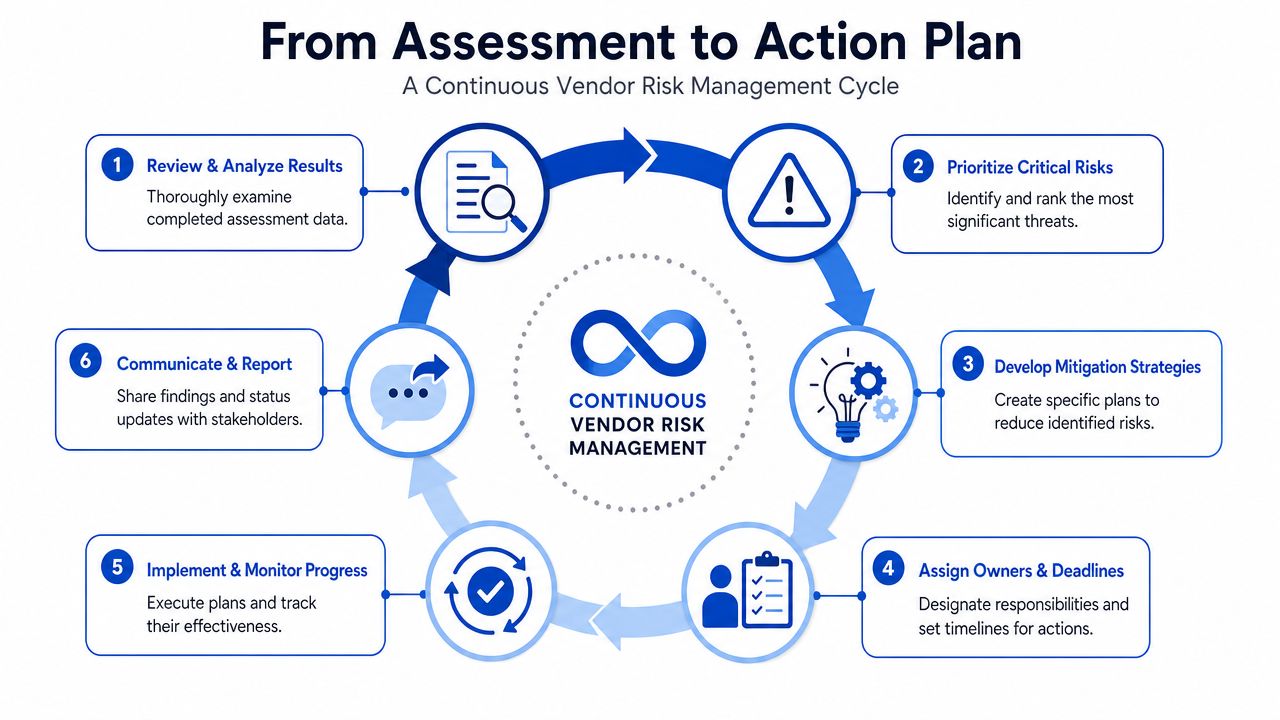
Too many companies stop at collection. They gather answers, file the questionnaire, and move on. That creates a false sense of diligence. The strongest programs treat the template as part of a continuous monitoring lifecycle, and a common failure is stopping after the initial questionnaire, which creates stale risk profiles; best practice is to integrate the assessment into procurement before contract execution and use the results to define remediation terms in the MSA or DPA, as described in Monday.com's guidance on vendor risk assessment templates.
Match findings to contract terms
Every material issue in the assessment should trigger a contract question. If the vendor's controls are weaker than the business would like, the agreement should narrow the gap where possible.
A founder should usually ask whether the contract addresses:
- Security obligations: Clear commitments on access controls, data handling, and incident management.
- Breach notification: A defined notice obligation, with practical communication expectations.
- Audit and evidence rights: The ability to request updated documentation or confirmation of controls.
- Subprocessor restrictions: Notice obligations, approval rights, or at least transparency about downstream vendors.
- Data return and deletion: What happens to company data at termination.
- Remediation terms: Specific obligations to fix identified gaps by an agreed date.
Service levels matter too. If the vendor supports a critical workflow, legal and operational teams should align around measurable uptime, response, support, and escalation terms. Businesses that need a starting point for this part of the process often look at a service level agreement template to identify what should be documented before the relationship goes live.
Assign owners inside the company
A vendor risk program breaks down when everyone assumes someone else is handling it. Every approved vendor should have an internal owner. Usually that's the department using the tool, with legal or security involved for escalated issues.
A clean action plan identifies:
| Action item | Internal owner | External owner | Status |
|---|---|---|---|
| Confirm subprocessor list | Procurement or legal | Vendor contact | Open |
| Revise DPA language | Legal | Vendor counsel | In negotiation |
| Validate incident notice path | Security or operations | Vendor security team | Pending |
| Review renewal conditions | Business owner | Vendor account team | Scheduled |
Reassess on a schedule that reflects risk
Not every vendor needs the same follow-up cadence. A critical cloud processor, payroll provider, or health-data tool deserves more attention than a low-access service provider. The company should decide when reassessment is triggered by contract renewal, data expansion, incident history, or a meaningful change in the vendor’s business.
Approval isn’t the end of diligence. It’s the start of managed reliance.
The action plan should also feed into incident response. If a vendor suffers a breach or major service interruption, the business shouldn’t be scrambling to figure out who signed the contract, where the data sits, or what notice rights exist. The template should already have captured those details.
That is what makes a vendor risk assessment template useful in practice. It doesn’t just produce a report. It drives decisions, contract language, accountability, and follow-through.
Red Flags and Washington State Legal Considerations
Many vendor questionnaires look thorough but miss the issue that causes the most trouble later: the vendor’s own dependencies. A polished SaaS company may have strong front-end controls while relying on a stack of subprocessors that handle hosting, support, analytics, communications, or data enrichment behind the scenes.
That gap matters. Many templates mention subcontractors, but they don’t explain how to verify flow-down obligations or how to evaluate the risk created by a vendor’s hidden providers. Panorays highlights this as a major blind spot in its guide to vendor risk assessment, especially where exposure comes from fourth parties rather than the vendor itself.
Red flags that deserve immediate follow-up
A vendor doesn’t need to be perfect. It does need to be clear, responsive, and contractually accountable. These answers should trigger closer review:
- Vague security responses: The vendor says it follows industry best practices but won’t describe actual controls.
- No clear incident path: There is no named contact or process for breach or outage escalation.
- Undisclosed subcontractors: The vendor uses subprocessors but can’t explain which ones handle customer data.
- Loose contract posture: The vendor demands broad disclaimers but resists practical data protection language.
- No retention discipline: The vendor can’t explain how data is deleted, returned, or segregated at termination.
A founder shouldn’t treat those issues as mere paperwork defects. They often signal a deeper governance problem.
Washington law changes the diligence questions
Washington businesses have an extra reason to sharpen their templates. State-specific privacy obligations can turn a generic vendor questionnaire into an inadequate one.
The Washington My Health My Data Act is especially important for startups and SMBs that collect, infer, analyze, or share consumer health data outside traditional healthcare settings. That can reach wellness apps, reproductive health tools, location-enabled services, and consumer platforms that infer health-related status from user behavior. A vendor that touches this category of data should be assessed with more precise questions about collection purpose, sharing practices, deletion, consent support, and downstream disclosures.
For Washington companies, that means the template should ask:
- Health-related data scope: Does the vendor receive data that may qualify as consumer health data under Washington law?
- Purpose limits: Can the vendor use the data only to perform the contracted service?
- Sharing controls: Does the vendor disclose data to affiliates, analytics tools, or subprocessors?
- Deletion support: Can the vendor assist with deletion and access requests in a usable timeframe?
- Contract fit: Do the vendor’s standard terms conflict with Washington-facing privacy commitments?
The local legal overlay founders should expect
A Washington startup also needs to think about what happens when a vendor incident becomes the startup’s incident. Customer notifications, regulator questions, and internal response timelines move quickly. If the vendor contract is silent, the business may find itself responsible without the information needed to respond.
That is why vendor diligence should connect directly to breach planning. Companies that want a practical framework for the response side should review a data breach response checklist for Seattle businesses.
A vendor’s weak answer today often becomes the customer’s complaint tomorrow.
A good vendor risk assessment template for Washington businesses doesn’t stop at security hygiene. It asks whether the vendor can support the company’s actual legal duties under state law, customer contracts, and its own public privacy promises.
Frequently Asked Questions About Vendor Risk
Does every vendor need a full vendor risk assessment template
No. The review should match the relationship. A company usually needs deeper diligence for vendors that access sensitive data, integrate with internal systems, support critical operations, or affect customer-facing services. A low-risk vendor can go through a shorter intake process.
What if a critical vendor scores poorly
A poor score doesn’t always mean the deal dies. It means the company should stop pretending the risk is minor. Sometimes the answer is contract remediation. Sometimes it’s technical limits on access. Sometimes it’s a business decision to choose a different vendor. What matters is that the exception is conscious, documented, and approved by the right person.
When should legal review the vendor package
Legal should usually review the relationship when the vendor will process personal data, receive confidential information, support a regulated workflow, or insist on one-sided contract language. If the business is in Washington and the vendor may touch health-related or otherwise sensitive consumer data, legal review should happen early rather than at the end of procurement.
How should a founder handle vendor pushback
Pushback is normal. Strong vendors are used to diligence. The question isn’t whether the vendor negotiates. The question is whether the vendor gives direct answers and offers workable compromises. Evasive answers are more concerning than reasonable limitations.
What if the company already has cyber insurance
Cyber insurance helps, but it doesn’t replace vendor diligence. Coverage may have exclusions, notice conditions, panel requirements, and limits that don’t solve the underlying operational disruption. Founders evaluating that overlap should understand what cyber insurance covers before assuming the policy fills every gap.
How often should vendors be reassessed
The cadence should reflect criticality and change. Reassessment often makes sense at renewal, after a security incident, when the vendor adds new subprocessors, or when the business expands the vendor’s access to new data or systems. High-impact vendors deserve more frequent attention than low-access suppliers.
What’s the simplest version of this process for a small company
Start with three moves:
- Classify the vendor: What data and systems will it touch?
- Ask targeted questions: Focus on security, privacy, continuity, and subprocessors.
- Tie the result to the contract: Fix what can be fixed on paper before signature.
That alone is far better than approving vendors based on a demo, a discount, and a handshake.
By Design Law Firm & Legal Consultancy, PLLC helps Washington businesses build durable legal foundations around contracts, technology, privacy, and cyber risk. Founders and operators who need practical guidance on vendor diligence, contract negotiation, data privacy compliance, or incident readiness can learn more at By Design Law Firm & Legal Consultancy, PLLC. Call us today at (206) 593-1519.