You usually hear about transfer pricing the hard way. A founder has a healthy operating company in Washington, a related sales entity abroad, maybe a shared services team somewhere else, and then a CPA or tax advisor asks for the report on transfer pricing right before a filing deadline. That is the moment many realize this is not a paperwork chore. It is the document that has to defend how money moved across the group, and if it is thin, the company is exposed the next time an examiner asks questions.
That is why the report matters long before anyone opens an audit file. It gives tax authorities a framework for testing whether intercompany prices sit at arm's length, and it gives the business a way to explain its structure before someone else tells the story for it. Treat it like a yearly checkbox and the risk compounds because the same weak assumptions get copied forward, year after year. A better approach is to treat the report like a living defense file, one that has to survive scrutiny from a skeptical reviewer who wants receipts, not slogans. For a broader governance lens, many companies pair transfer pricing with a formal compliance program, similar to the discipline discussed in this Seattle corporate compliance guide.
Why Your Transfer Pricing Report Demands Real Attention
A founder can run a clean business and still end up with a weak transfer pricing file. That happens when the finance team treats the report as a tax binder instead of part of the company's risk posture. An examiner will use it first to test whether the group's intercompany pricing makes sense on paper and in practice.
The report also has to stand up as audit evidence, not marketing copy. Tax authorities want to see the legal entities, the transactions, the method, and the numbers tied together without gaps, because that is how they test whether the file reflects the actual business. For companies that already think in terms of governance and controls, the discipline looks a lot like the approach set out in this Seattle corporate compliance guide.
Practical rule: if a finance team cannot explain why a transfer price was set the way it was, a tax authority will assume the report was built backwards.
A multi-entity Washington company feels this pressure fast. One entity books the revenue, another books the costs, and a third may own the intellectual property or perform support work. If the report does not explain who does what, who owns what, and who bears what risk, the company gives the government an opening to reallocate profit.
The true test is data lineage. Source contracts, intercompany invoices, management reports, and local financials have to line up, or the file starts to look assembled after the fact. Examiners notice that immediately, and they press on the mismatch between the story in the report and the story in the books.
Annual preparation is not enough on its own. Intercompany operations change, people change, margins change, and contracts drift away from the operating reality. The report has to keep pace with the business, or it becomes a stale explanation that examiners can pick apart line by line.
The Three Tiers of OECD Documentation
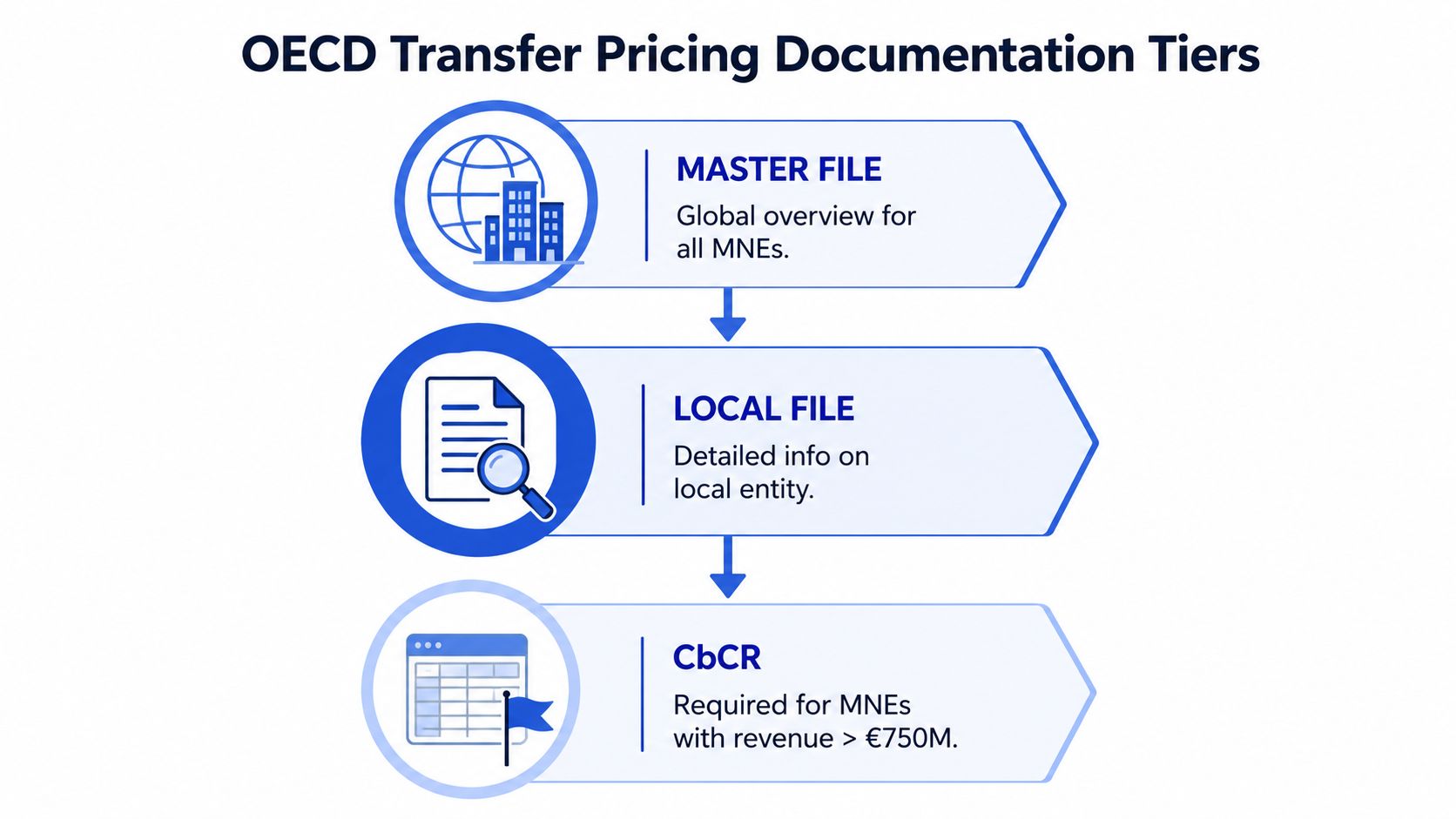
The OECD model works because each tier answers a different question. The master file gives the group-wide story, the local file shows what one entity did, and the country-by-country report, or CbCR, gives tax authorities a high-level view of where profits, taxes, and business activity sit across the group.
What goes in each file
The local file carries the most weight in an audit. It should show the comparability and functional analysis, the transfer pricing method chosen, comparable uncontrolled transactions, and the annual local financial accounts. In plain English, it has to prove what the entity did, what it earned, and why the pricing method fits those facts.
The master file sits above that. It sets out the group structure, the value chain, and the broader business context that lets a reviewer understand how the entities fit together. If a multinational enterprise operates in several jurisdictions, the master file should let each tax authority see the full picture, not one isolated entity.
Bottom line: the tiers are not duplicates. They are layered disclosures, and the local file is usually where the fight starts.
For U.S.-resident ultimate parents or surrogate parents, Form 8975 is the country-by-country filing vehicle, and it applies only when the multinational enterprise has more than $850 million in annual revenue (Taxand guide on Form 8975). That threshold is the gatekeeper for the regime. U.S. groups and U.S. subsidiaries in foreign-owned structures still need to coordinate carefully, because the CbCR file can expose mismatches between the group's narrative and where the numbers land.
The OECD also ties the documentation tiers together in its BEPS Action 13 guidance, which includes the standard three-part structure tax authorities expect to see in a serious report. A diagram illustrating the three-tier OECD transfer pricing documentation structure: Master File, Local File, and CbCR. helps make the point, but the key test is whether the files match each other and match the books.
A weak report fails fast. If the master file describes one business model, the local file tells a different story, and the CbCR points to yet another version of events, examiners do not give the company the benefit of the doubt.
Building the Functional Analysis and Choosing Your Method
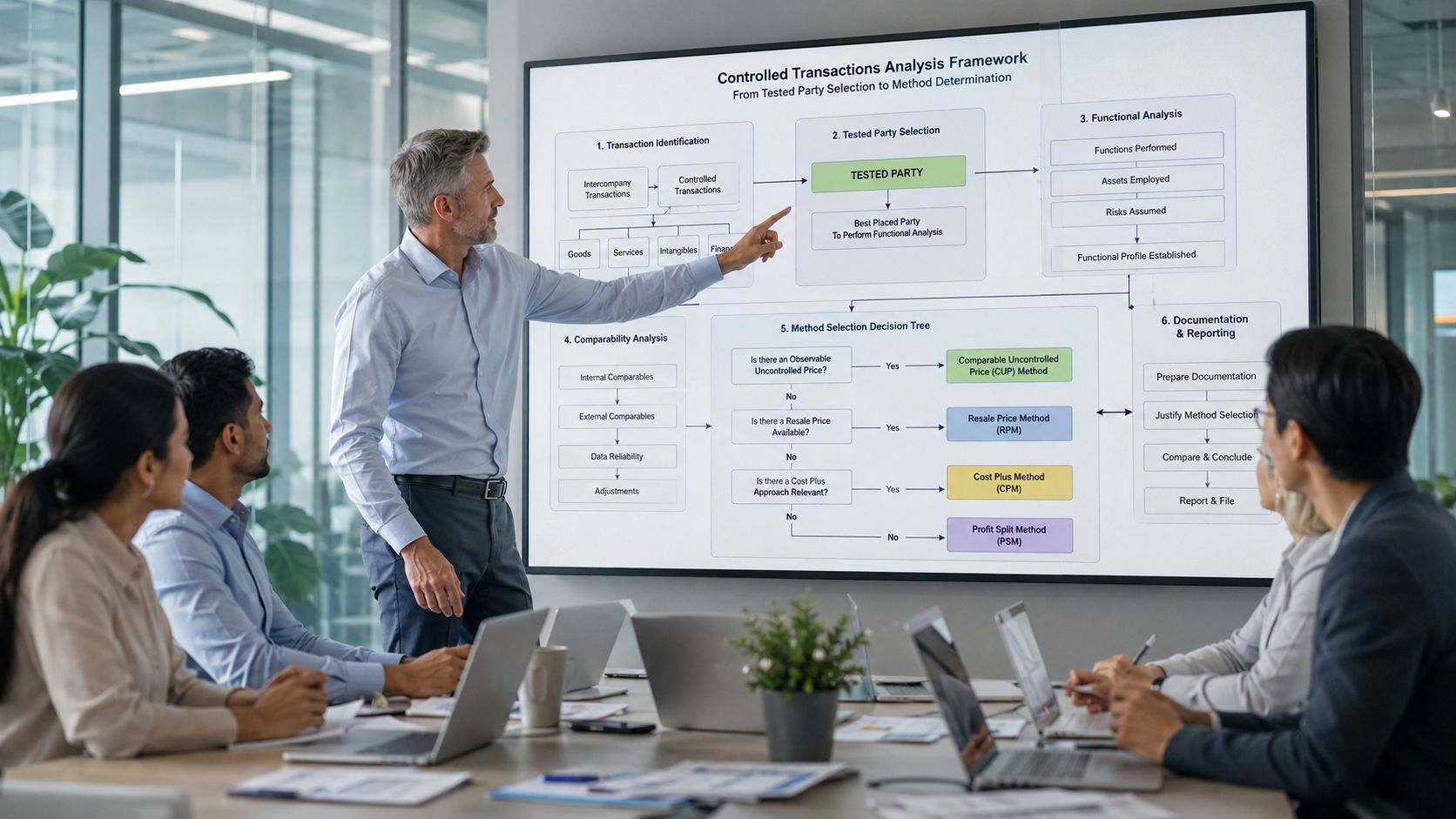
A transfer pricing report starts to fail the moment a team treats method selection like a box-ticking exercise. Tax authorities do not read it that way. They look for a clean line from the facts, to the functions performed, to the risks assumed, to the method that fits the transaction. The OECD's workflow moves in that order, from the years under review to the functional and risk analysis, then to the controlled transactions, comparables, and finally the most appropriate method and tested party (OECD Transfer Pricing Guidelines 2022). Reverse that sequence and the report loses credibility fast.
Start with functions, assets, and risks
The functional analysis is the spine of the report. It asks who performs the work, which assets are used, and which risks each entity bears. That analysis drives the tested party, the financial indicator, and the method, because the OECD ties those choices to the transaction facts and the parties' real operating profile (OECD Transfer Pricing Guidelines 2022).
The standard methods are the CUP, resale price, and cost plus methods. The transactional profit methods are the TNMM and profit split. None of them wins by default. The right method matches the business model and the comparability facts. A limited-risk distributor does not deserve the same treatment as a contract manufacturer, and a routine services entity should not be benchmarked like a company that owns the key intangibles and sets the commercial direction.
The first mistake many teams make is choosing the easiest entity as the tested party. That is the wrong instinct. The tested party should be the least complex participant, the one with the cleanest functional profile and the fewest non-routine issues. If the file hides that choice behind convenience, an examiner will spot it immediately.
Keep the report reproducible
A report has to let someone else follow the trail. Analysts at the IRS and other tax authorities expect to see the underlying calculations preserved in spreadsheets, complete income statements and balance sheets for the tested party, and a clear explanation of any segmented data or unusual business circumstances so the analysis can be reproduced without guesswork. That is plain from the OECD documentation guidance and the way reviewers approach these files in practice (OECD Transfer Pricing Guidelines 2022).
A final margin with no working papers is weak. A report that shows how the margin was built, where the data came from, and why the method fits the facts is the one that can survive questions.
Finding Comparables and Stress-Testing Your Benchmarking Study
A benchmarking study lives or dies on comparables. A weak set of comparables can make a method look polished and still collapse under audit. Start with the closest evidence, then move outward only when the facts support it.
Use the closest evidence first
Internal comparables usually carry more weight because they come from the taxpayer's own business. If a company already sells the same product, or something close to it, in an uncontrolled setting, that evidence should be tested before anyone starts a database search. External comparables still have a place, but they should not be the default choice when better internal evidence is available.
A lot of reports get lazy at this point. Teams pull a few names from a database, call it a benchmark, and move on. A reviewer will ask a simple question, whether those companies match the tested entity's functions, product mix, geography, customer base, and risk profile. If they do not, the range may look tidy, but it is not persuasive.
Practical rule: a comparable is only comparable if the report can explain why a reviewer would keep it after reading the facts.
The file also has to be reproducible. Analysts expect the underlying calculations to be preserved in spreadsheets, complete income statements and balance sheets for the tested party, and a clear explanation of any segmented data or unusual business circumstances. That is the standard reviewers apply in practice, and it is the same standard reflected in the OECD documentation guidance referenced earlier. A clean data trail from legal entity accounts into the benchmark is what makes the analysis defensible.
A comparable set should also survive a basic audit-readiness test. If the business has been reshaped by transactions, restructuring, or a purchase agreement that changes how functions and risks sit inside the group, the benchmark has to reflect that reality. Common pitfalls in business purchase agreements often show up here, because sloppy deal drafting can distort the very facts the benchmarking study is supposed to measure.
Transfer Pricing Methods at a Glance
| Method | Best Suited For | Financial Indicator |
|---|---|---|
| CUP | Closely comparable uncontrolled transactions | Price or gross margin |
| Resale Price | Distributors that resell without major value addition | Gross margin |
| Cost Plus | Routine manufacturers or service providers | Markup on costs |
| TNMM | Entities with fewer reliable gross-level comparables | Net margin |
| Profit Split | Integrated operations with unique intangibles or closely linked transactions | Combined profit allocation |
The table is only the starting point. The real work is stress-testing whether the benchmark still holds after adjustments, business changes, and data lineage checks. Stale comparables are a recurring problem because a file can look clean and still rely on facts that no longer match the operating model.
Common Pitfalls That Trigger Reassessment
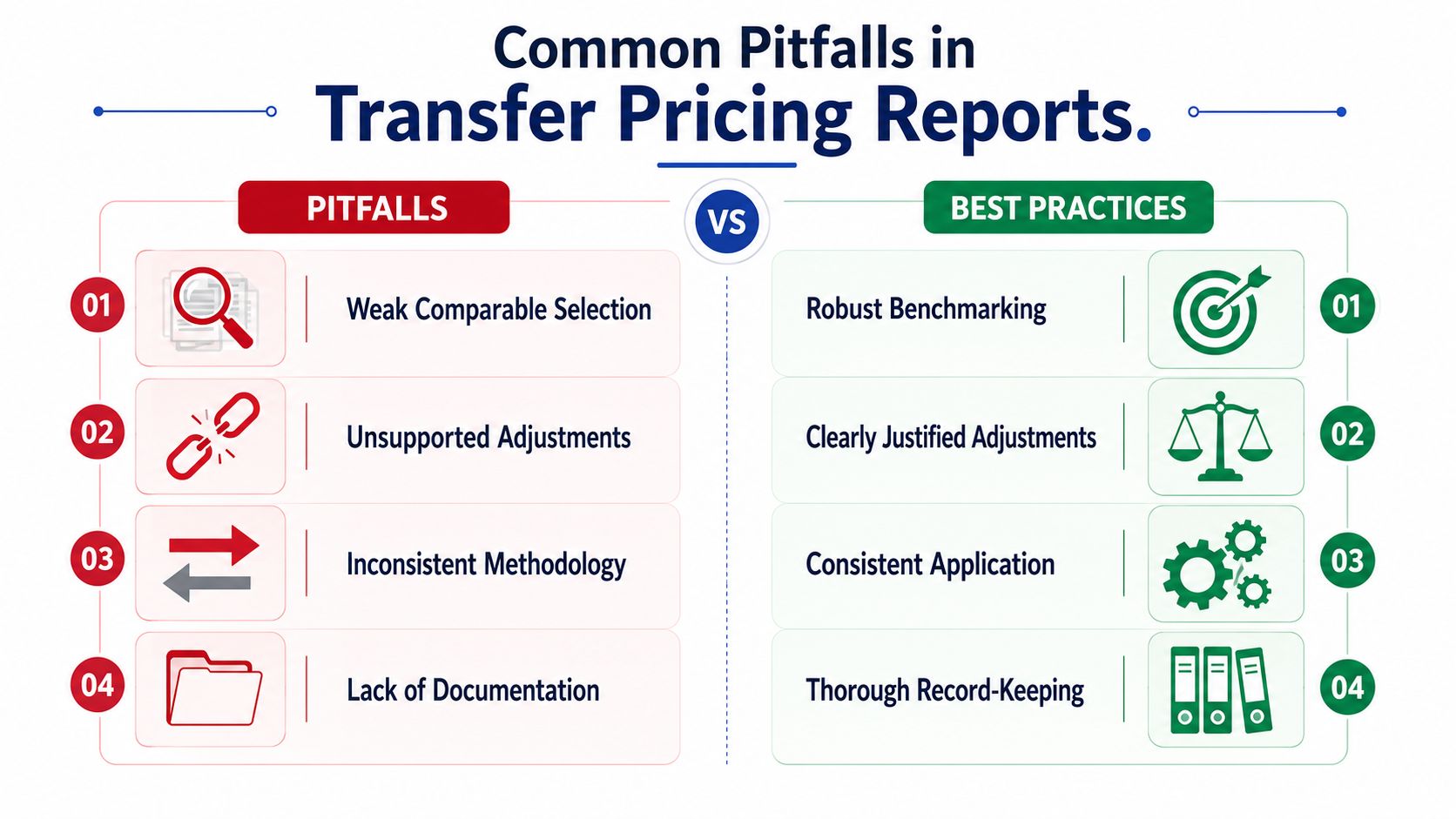
Transfer pricing reports usually fail for boring reasons, which is exactly why they are dangerous. The weak points are predictable. A bad comparable set. An unsupported adjustment. A method that was selected because it was convenient. A file that cannot be tied back cleanly to the ledger.
The narrative problem is real
Many reports recite the arm’s-length principle and stop there. That sounds compliant, but it does not tell the company’s story. The IRS says strong documentation should “tell [the taxpayer’s] story” through a functional and industry analysis, including special business circumstances, year-end adjustments, and a clear description of the data and method-selection process (IRS transfer pricing documentation FAQs).
That point matters more than most finance teams admit. If the report leaves gaps, the examiner fills them in. Those assumptions tend to be unfavorable. A missing explanation for a segmented-data build can turn into a challenge to the segment itself. A missing explanation for a risk allocation can turn into a reallocation of profit.
Weak files invite reassessment, not just penalties
The hidden cost is usually reassessment exposure and management distraction. When a report is thin, the company spends time responding to questions that should never have been necessary in the first place. The report then stops being a defense file and becomes a credibility test.
That is also where dispute tools matter. Advance pricing agreements and mutual agreement procedure processes are not last resorts. They are risk-management tools for groups that know their intercompany model is complex and want a cleaner path if a tax authority disagrees. For companies that also face contract and dispute issues beyond tax, the same discipline applies in broader commercial conflict work, as reflected in this business dispute resolution resource.
Disputes, APAs, and the Real Cost of Weak Documentation
Transfer pricing is not a niche dispute category. It is a high-volume international fight, and the recent OECD Mutual Agreement Procedure statistics make that plain. In 2024, 1,265 transfer pricing cases were started and 1,119 were closed, while 75.7% fully eliminated double taxation and another 12.5% secured partial or domestic relief, with average processing time falling from 32 months to just under 31 months (OECD MAP statistics reported by BDO).
Those numbers say two things at once. First, disputes are common. Second, international administrative processes do resolve a large share of them. The smartest companies do not wait for that stage if they can avoid it.
APAs are a planning tool, not a panic button
Advance Pricing Agreements, whether unilateral, bilateral, or multilateral, work best when the group already knows the facts are complex and wants to settle the method before a controversy hardens. A company with recurring intercompany flows, a complicated distribution footprint, or unique intangibles should think about APAs early, not after the first audit letter lands.
The report matters here too. A contemporaneous file signals discipline. It tells an examiner that the company thought about the method, the data, and the comparables before the fight started. That credibility helps in a MAP, in domestic review, and in internal settlement discussions.
Weak documentation magnifies every other problem
A bad file turns a routine inquiry into a long management drain. Someone has to reconstruct the data, explain the assumptions, and answer why the report was not usable when it mattered. That is expensive even before anyone talks about tax.
The cleaner path is to build for dispute readability from the start. For a broader legal support framework around conflict handling, the business dispute resolution page is a useful reminder that process discipline beats improvisation once the file is under challenge.
Putting It All Together and How Outside Counsel Helps
A defensible transfer pricing program is not a one-time memo. It is a repeatable workflow. The finance team reviews the functions during the year, refreshes the benchmark annually, and keeps the documentation contemporaneous so the file is ready before anyone asks for it. That is how the business avoids scrambling when the tax authority starts reading line by line.
A defensible report must contain the basics
A strong report should always include the group structure, controlled transactions, the chosen methodology, comparable data, functional-risk allocation, and clean data lineage. If any one of those pieces is missing, the report becomes harder to defend and easier to challenge. That is especially true when the company operates across entities with different roles, or when segment reporting has to be built from messy operational data.
A practical internal rhythm looks like this.
- Quarterly Functional Review: Confirm that contracts, people, and actual conduct still line up.
- Annual Benchmarking Refresh: Revisit comparables and method support before the year closes.
- Contemporaneous Documentation: Build the file while the facts are still fresh.
- Dispute-Readiness File: Keep the calculation trail, source data, and explanation package in one place.
Outside counsel adds value where the pressure is highest
Outside counsel earns its keep in the review stage, where technical judgment matters and internal teams are often too close to the facts. Counsel can spot the weak comparable, the unsupported adjustment, or the method choice that will not survive examiner review. In an audit, counsel helps keep the response disciplined and prevents the company from overproducing the wrong documents.
The same applies in disputes and APAs. Counsel can translate the business story into a file that tax authorities can use, and then keep that story consistent when the facts get tested later. For companies that need a broader corporate-law backbone around this work, the business and corporate law practice overview shows how transfer pricing fits inside a larger governance and transaction framework.
A company that waits until a notice arrives is already behind. The better move is to review the intercompany model now, clean up the data trail, and make sure the report can survive a hard read from an examiner who is looking for gaps. For Washington businesses and multi-entity groups that want a serious review of their documentation, reach out to By Design Law Firm & Legal Consultancy, PLLC and get the file in shape before the deadline turns into a dispute. Contact our law office today at (206) 593-1519.