A founder gets an email at 6:12 a.m. The vendor missed a delivery milestone, the customer is withholding payment, and the project manager has already sent three messages nobody wants read aloud in court. By 9:00 a.m., the question isn't who's morally right. The question is how to contain the damage before the dispute starts draining cash, management attention, and trust.
That's where business dispute resolution becomes practical rather than academic. Most conflicts don't begin with a lawsuit. They begin with a missed deadline, a pricing change, a failed integration, a shareholder disagreement, or a contract that sounded clear until something went wrong. For Washington businesses, especially in tech, professional services, manufacturing, and cross-border trade, the right response usually depends on speed, influence, evidence, and whether the relationship still has value.
When Business Relationships Break Down
A business dispute often starts with a sentence that sounds small. “We need to revisit scope.” “Payment is delayed pending review.” “Your team didn't meet the spec.” Within days, a normal commercial problem turns into a control problem. Who holds the money, the data, the inventory, the customer relationship, or the narrative?
That shift catches many companies off guard. They think they're arguing about one invoice or one missed deliverable. In reality, they're deciding whether the matter will stay in a conference room or spread into operations, financing, employee morale, and future deal flow.

The common scenarios are familiar:
- A partner deadlock: Owners agree on growth, but not on spending, compensation, or exit terms.
- A contract failure: A software implementation slips, then both sides start rewriting history through email.
- A competitive threat: A former employee walks out with sensitive know-how, raising concerns closer to trade secret misappropriation than a routine commercial disagreement.
- A supply-chain dispute: The product arrived late, the buyer backcharged the seller, and now each side says the other caused the delay.
Business disputes rarely destroy a company in a single moment. Poor decisions made in the first two weeks often do.
The practical response is to treat the dispute like any other business risk. Preserve facts. Stop unhelpful internal chatter. Review the contract. Identify what matters most. Sometimes that's collecting money fast. Sometimes it's protecting confidential information. Sometimes it's preserving a relationship that took years to build.
The available paths range from direct negotiation to mediation, arbitration, and litigation. Each has a purpose. None is automatically correct. The strongest strategy starts with the business objective, then chooses the process that serves it.
The Four Paths of Business Dispute Resolution
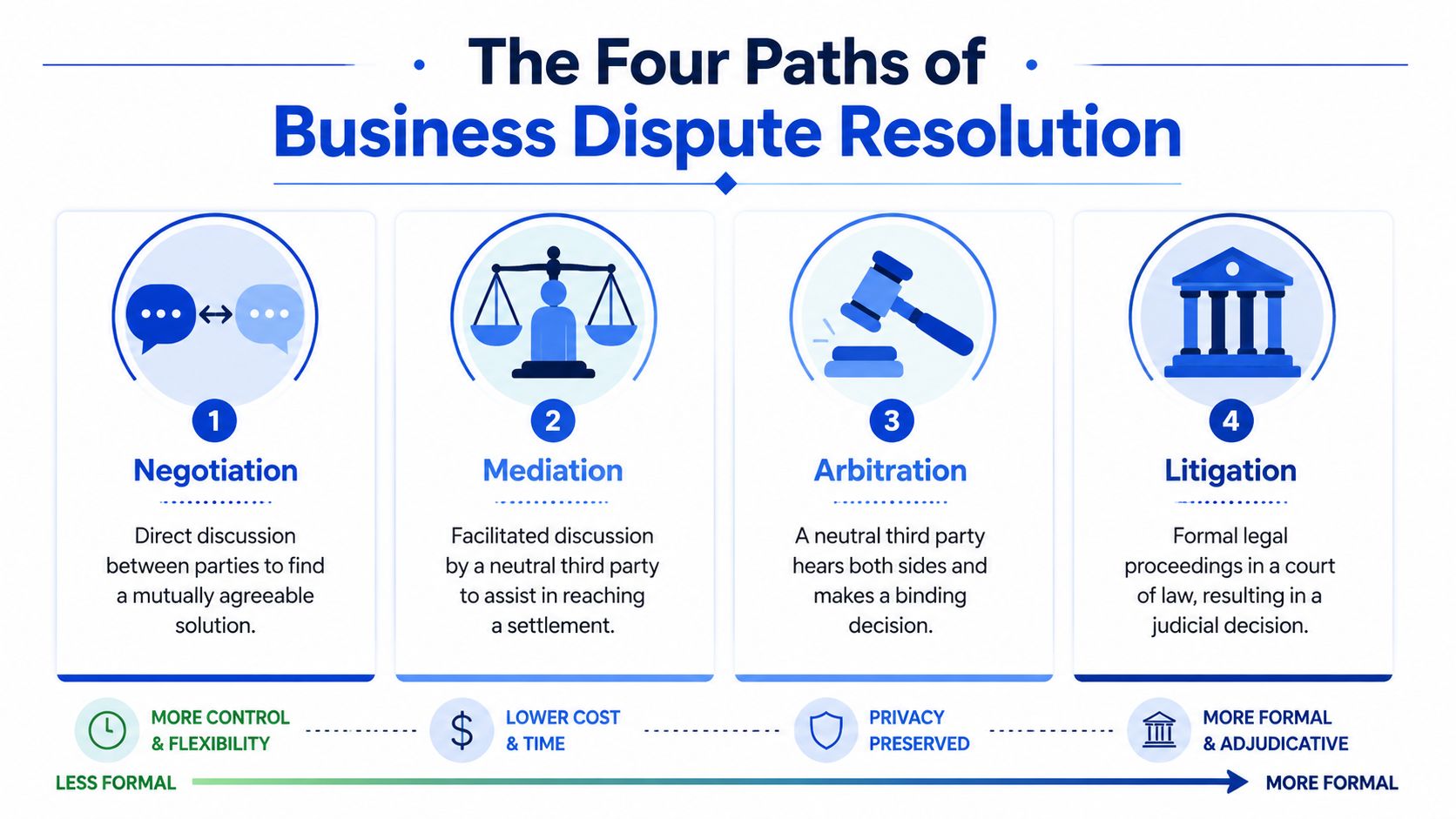
A dispute usually starts with a practical question, not a legal one. Do you want payment, a forced stop to harmful conduct, a quiet exit, or a decision that ends the argument for good? The answer should drive the process. Each path gives up some control in exchange for more structure and, in some cases, more enforcement power.
Negotiation
Negotiation is the first and often the best tool. The parties, usually with business leaders and counsel involved, try to solve the problem directly before procedure starts consuming time and money. In the right case, that can mean a payment plan, a revised statement of work, a delivery reset, a buyout, or agreed guardrails around confidential information.
The main advantage is business control. The parties can shape a result a judge or arbitrator would never order, such as phased performance, pricing adjustments, release terms tied to milestones, or a planned separation that lets both sides keep operating.
Negotiation works well when the other side still has a reason to deal rationally and the core facts are not heavily disputed. It is also useful when speed matters but formal relief is not yet necessary.
Its weakness is simple. If the other side is using discussions to run out the clock, move assets, or keep exploiting your information, direct talks become expensive delay.
Mediation
Mediation brings in a neutral to help the parties reach a voluntary deal. The mediator does not decide who wins. The mediator pressures weak assumptions, tests settlement ranges, and helps the parties move from accusations to terms.
For many business disputes, mediation is the point where a real solution becomes possible. A mediated settlement can address money, timing, confidentiality, future work, non-disparagement, inventory returns, ownership of work product, and tax allocation in one document. That range matters because commercial disputes rarely fit neatly into a damages model.
Mediation also gives decision-makers a controlled setting to evaluate risk. A good mediator can tell a founder that a courtroom argument sounds much better internally than it will under oath. That kind of reality check has value.
A short explanation helps before the next level:
Arbitration
Arbitration is private adjudication by contract. One arbitrator or a panel hears the dispute and issues a binding award. In Washington business agreements, arbitration clauses often appear in operating agreements, vendor contracts, construction documents, and deals involving proprietary technology or multi-state parties.
The appeal is straightforward. Arbitration can keep the fight out of the public record, limit some procedural sprawl, and put the dispute in front of someone who understands the industry. That can be a real advantage if the case turns on technical performance, accounting treatment, software implementation, or specialized trade practice.
The trade-off is equally real. Arbitration is not always faster or cheaper than court, especially when the clause is poorly drafted, discovery becomes contested, or the amount at stake pushes the parties toward motion practice and multiple hearing days. Appeal rights are narrow. If the arbitrator gets a close call wrong, the business usually has to live with it.
Litigation
Litigation puts the dispute in court, where a judge, and sometimes a jury, can issue orders that private processes cannot. If you need a temporary restraining order, broad third-party discovery, or relief against someone who never signed the contract, litigation may be the only path that fits the business problem.
Court also creates pressure in a different way. Deadlines are mandatory. Orders carry contempt risk. Third parties can be subpoenaed. For a company dealing with hidden financial records, diverted customers, or misuse of trade secrets, those tools can matter more than privacy.
The cost is public exposure, longer timelines, and less control over pace and outcome. Many cases still settle, but they settle after the parties have spent money building a record and testing each other's witnesses and documents. Sometimes that investment is necessary. Sometimes it is strategic waste.
A side-by-side view
| Path | Who controls outcome | Best use case | Main risk |
|---|---|---|---|
| Negotiation | The parties | Early disputes where business terms can still solve the problem | Delay, incomplete information, and no forced compliance |
| Mediation | The parties, with help from a neutral | Conflicts that need a flexible settlement and a realistic discussion of risk | No result unless both sides agree, and weak settlement drafting creates future enforcement problems |
| Arbitration | Arbitrator or panel | Private disputes, technical matters, and contracts that already require a binding private forum | Limited appeal rights, clause fights, and costs that can approach litigation |
| Litigation | Court | Injunctions, third-party discovery, public rulings, and disputes involving non-signatories | Expense, publicity, and a process that can outlast the underlying business issue |
Practical rule: Choose the path that fits the business objective, the urgency, and the likely enforcement problem at the end. A quick deal that cannot be enforced is not a win.
How to Choose Your Resolution Strategy
A vendor stops shipping. Your customer is threatening chargebacks. Someone on the other side still has access to shared systems, and the contract says disputes go to mediation first. At that point, the question is not which process sounds civilized. The question is which path protects the business, preserves evidence, and produces an outcome you can enforce.
Start there. Good strategy begins with the business objective, the time pressure, and the likely endgame in Washington if the other side refuses to comply.
Start with the real objective
“Win” is not a decision standard. A useful objective is concrete enough to drive process choice and settlement terms.
Examples look like this:
- Collect the receivable without blowing up a profitable account
- Shut down misuse of confidential information before more damage occurs
- Separate from a failing partner with the least operational disruption
- Get a clear ruling because the same contract issue will come up again
Each objective points to a different process. If the goal is preserving a customer relationship, negotiation or mediation may make sense. If the problem is active misuse of data or trade secrets, court intervention may be the right first move. If the dispute turns on a narrow contract interpretation with future impact across deals, a court ruling may carry more value than a private compromise.
Use a business screen, not a legal label
I usually advise clients to test four points before they commit to a forum: speed, privacy, decision-maker, and enforcement risk. That keeps the analysis grounded.
| Business driver | Usually favors | Strategic reason |
|---|---|---|
| Preserve a working relationship | Negotiation or mediation | The parties keep more control over business terms, timing, and tone |
| Keep the dispute out of public filings | Mediation or arbitration | Private process may protect customer, pricing, and operational information |
| Need immediate court power | Litigation or a hybrid approach | Temporary restraining orders, injunctions, and third-party subpoenas may matter more than privacy |
| Need industry-specific judgment | Arbitration, neutral evaluation, or expert fact-finding | A decision-maker with technical knowledge can narrow the real dispute faster |
The trade-offs are real. Arbitration may be private, but it is not always faster or cheaper once motion practice, hearings, and arbitrator fees are added. Mediation may preserve a relationship, but only if both sides come prepared with authority, information, and a practical range for settlement. Litigation can be expensive and public, yet it may be the only forum that can stop ongoing harm quickly.
For companies reviewing contracts before a dispute starts, well-drafted dispute resolution clauses for business contracts help prevent a bad process fit later.
Treat urgent cases differently
Some disputes should not wait for a polite escalation ladder. A former contractor downloads source code before leaving. A channel partner begins contacting your customers with your pricing data. Shared accounts are still live. In those cases, delay is a business risk, not just a scheduling problem.
Rutkin & Wolf PLLC discusses this in its analysis of resolving business disputes without litigation. ADR can work well, but immediate evidence preservation, forensic review, and injunctive relief may need to happen first.
That is especially important for Washington businesses in software, ecommerce, healthcare support, manufacturing, and professional services. If evidence is changing, cloud permissions remain open, or customer data may be exposed, the first step may be securing records and filing for emergency relief, then returning to settlement discussions once the immediate threat is contained.
A process that looks cooperative on paper can be the wrong choice when evidence is disappearing or access is still live.
Match the process to the technical problem
General process often becomes expensive noise when the actual disagreement is technical. If the case turns on uptime metrics, security controls, acceptance testing, system logs, or implementation milestones, a neutral with subject-matter knowledge can save time by identifying what is really disputed and what is not.
The U.S. General Services Administration explains that ADR techniques guidance can include fact-finding by a neutral with specialized expertise who reviews the record and provides an independent analysis or recommendation. In practice, that can help parties settle before they spend months arguing over technical points a qualified reviewer could sort out early.
This approach is often useful in disputes involving:
- Service levels and performance metrics
- Cybersecurity obligations and incident response
- Privacy roles and data-handling responsibilities
- Testing criteria, milestones, and acceptance standards
A judge or jury can decide those issues. The better question is whether that route fits the problem, the budget, and the company's tolerance for delay.
Account for the Washington endgame
Washington-specific procedure should influence the choice at the front end, not after the dispute is underway. If you expect to need a quick injunction, third-party discovery, or court enforcement of a settlement, that points in one direction. If the dispute is contract-bound, private, and highly technical, that points in another.
The post-settlement piece is often missed. A signed deal is only useful if payment terms are clear, release language is precise, deadlines are measurable, and the enforcement forum is obvious. Mediation can resolve a case efficiently, but a vague settlement often creates a second dispute about what the first one meant.
Choose the process with the finish line in mind. That is how businesses avoid spending twice on the same conflict.
Drafting Proactive Dispute Resolution Clauses
Most business disputes are harder than they need to be because the contract says too little about what happens after a problem appears. A strong clause doesn't just pick a forum. It creates an escalation system.
Build an escalation ladder
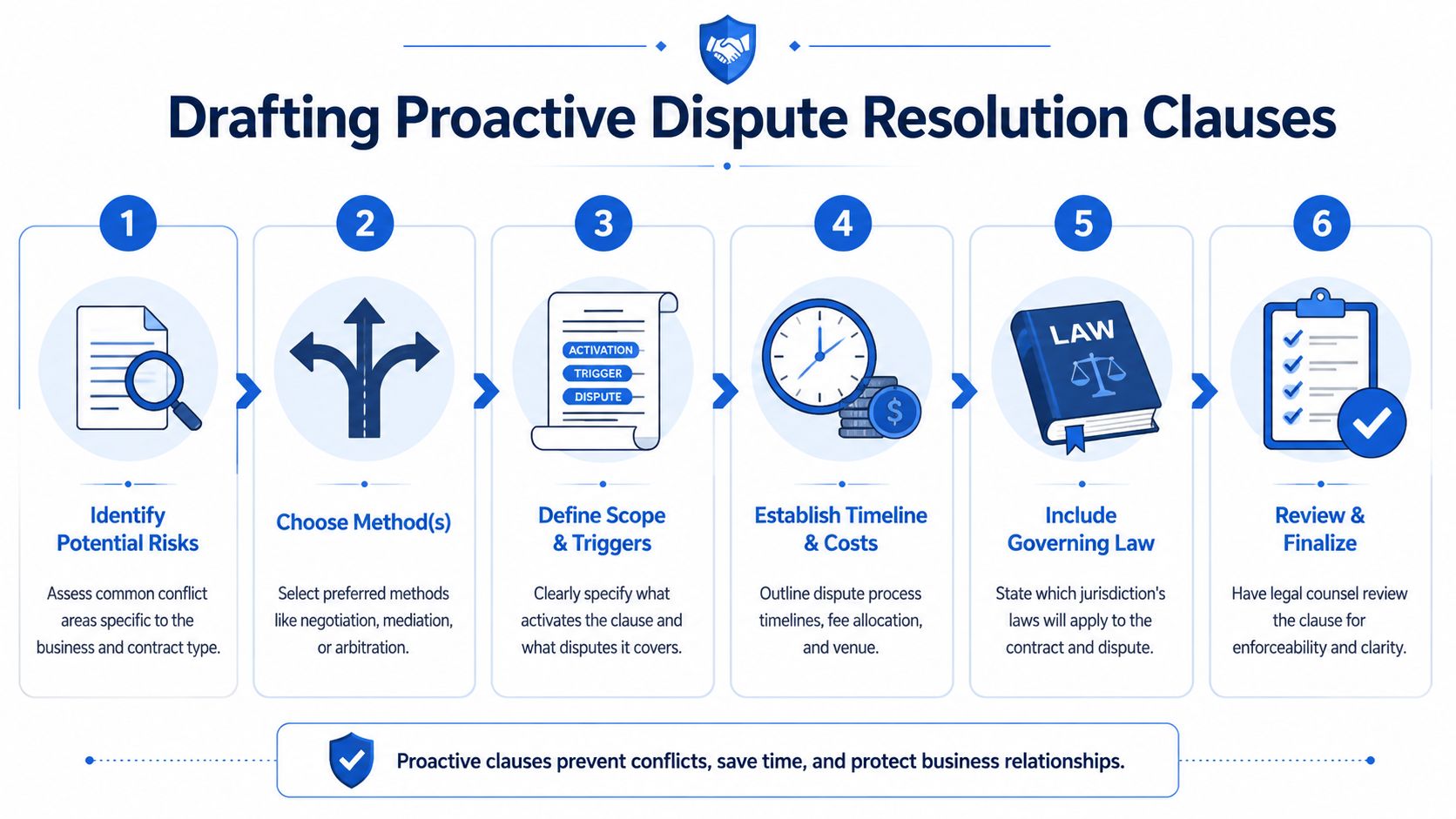
The technically strongest structure is a multi-tier dispute resolution clause. The sequence is straightforward. First, project-level negotiation. If that fails, senior executive negotiation. If that still fails, confidential mediation. Only then does the dispute move to arbitration or litigation.
That sequence matters because it forces the issue to be addressed at the lowest sensible level first while preserving strategic advantage for later stages. According to analysis on dispute design in high-stakes projects, the most effective clauses are time-bound, define who has settlement authority, and include objective trigger points for moving to the next stage (dispute resolution in data centre projects).
What a good clause actually needs
A weak clause says the parties will “attempt in good faith” to resolve disputes. That sounds cooperative and often performs badly. It invites arguments about whether enough effort was made, who had authority, and whether the precondition to arbitration or suit was satisfied.
A better clause answers operational questions:
- Who attends each step: name the role, not just “representatives”
- How long each stage lasts: measured deadlines prevent stall tactics
- What triggers escalation: missed response date, written impasse notice, failed meeting
- What's covered: all disputes, only payment disputes, only technical disputes, or exclusions for emergency relief
- Where the process happens: forum, venue, governing law, and remote participation rules
For companies that want a deeper look at the drafting mechanics, this guide on dispute resolution clauses is a useful starting point.
Integrate the clause with the rest of the contract
The best dispute clauses aren't isolated. They work with the commercial terms around them. That means pairing the clause with objective performance measures, clear scopes of work, risk allocation, acceptance procedures, change-order language, and documented responsibility for delays or specification changes.
That integration is especially important in technology and infrastructure deals, where the later dispute often turns on a simple question the contract failed to answer. Who owned the dependency? Who approved the change? What counted as acceptance? Which delays were excused?
A dispute clause can't rescue a contract that leaves core performance standards vague.
Common drafting failures
Three mistakes show up repeatedly:
-
Undefined authority
The people required to negotiate can't settle anything. -
No emergency carve-out
The clause forces mediation first even when a company needs immediate court relief to protect data, trade secrets, or business continuity. -
Procedure without substance
The contract describes a resolution path but never defines measurable obligations, making the fight more subjective than it should be.
A proactive clause is preventive maintenance. It won't stop every dispute. It can stop a manageable problem from becoming a procedural mess.
Navigating the Process in Washington State
A founder in Seattle discovers on Monday morning that a former contractor still controls part of the company's code repository. By noon, the company is also fielding customer complaints, investor questions, and a threat of nonpayment from a vendor tied to the same product launch. At that point, the dispute is not just a legal problem. It is an operational risk issue that requires a sequence of decisions.
Washington disputes often arrive that way. A payment claim can sit alongside IP ownership, data access, employment departures, confidentiality concerns, and business continuity pressure. In that setting, the right question is not which forum sounds best in the abstract. The right question is which path protects the company fastest, preserves useful evidence, and puts real settlement pressure on the other side without creating unnecessary cost.
Businesses that need a baseline understanding of court-based disputes can start with this overview of what business litigation is.
Washington procedure shapes strategy
In Washington, the early judgment calls matter. Venue, the location of witnesses and records, the need for immediate injunctive relief, and the court or arbitration rules built into the contract can change the value of each option.
A company dealing with misuse of trade secrets or loss of system access may need court action first because speed matters more than privacy. A dispute over earn-outs, buyouts, or technical performance may be better suited to a private process if the parties need a decision-maker who understands the business context and can keep sensitive material out of the public file.
Sometimes the first move is neither a lawsuit nor a demand for arbitration. A well-built legal demand letter for payment or performance can frame the breach, preserve business advantage, and test whether the other side is posturing or preparing to fight.
Forum selection is a business decision, not a reflex
Washington companies regularly see mediation and arbitration through providers such as JAMS and the American Arbitration Association in the Seattle market. The harder question is whether the forum fits the dispute.
A technology company may need a neutral who understands software implementation failures, security obligations, service levels, and change orders. A closely held company in a shareholder dispute usually needs someone who can handle governance breakdowns, deadlock, and separation terms without pouring fuel on personal conflict. The fit of the decision-maker affects cost, timing, and the odds of reaching an outcome the business can live with.
By Design Law Firm & Legal Consultancy, PLLC, advises Washington businesses on contracts, compliance, technology issues, and disputes. For companies trying to align dispute strategy with day-to-day operations, that business and technology overlap can matter.
Washington businesses often face cross-border pressure
Companies in Washington frequently sell, source, license, and collaborate across state and national borders. That changes the analysis. A local court may be the best tool for fast relief against someone or something in Washington. Arbitration may be the better choice if enforcement is likely to matter outside the United States or if the contract involves parties, assets, and witnesses spread across several jurisdictions.
That means the strategy should account for three practical points:
- Governing law, venue, service, and enforcement should work together rather than conflict with each other.
- Cross-border evidence collection can slow a case and raise costs quickly.
- The preferred remedy matters. Immediate local relief and long-term enforceability do not always point to the same forum.
Washington-specific questions to ask early
Before taking the next step, ask:
- Are the key assets, witnesses, and documents in Washington?
- Does the company need a court order now to protect operations, data, or customer relationships?
- Would a private process better contain reputational harm or protect confidential business information?
- Is the contract forcing a procedure that no longer matches the actual risk?
- If the dispute settles, what mechanism will make payment, transfers, or performance easy to enforce?
Strong dispute strategy in Washington usually involves a sequence, not a single choice. The goal is to use the available tools in the right order, with enough pressure to resolve the conflict and enough control to keep the business intact.
Beyond the Handshake Enforcing Your Agreement
A settlement conference ends, everyone shakes hands, and the executives finally exhale. That moment feels like closure. Legally, it may be only halftime.
Settlement is not self-executing
One of the most overlooked risks in business dispute resolution is the post-settlement enforcement gap. Many discussions focus on how to get to agreement. Far fewer address what happens if the other side doesn't pay on time, refuses to sign final paperwork, violates confidentiality, or interprets the deal differently later. JAMS notes this problem directly, emphasizing that mediated agreements and arbitration awards may still require court involvement to become enforceable (agreeing to disagree in business disputes).
That gap matters most when the business assumes “settled” means “finished.” It doesn't. The settlement document has to function like a contract built for default.
Terms that protect enforceability
A durable settlement should address more than headline dollars. It should spell out the machinery of performance.
- Payment mechanics: amount, due dates, wire instructions, late-payment consequences
- Release language: who is released, for what claims, and on what effective date
- Confidentiality and non-disparagement: scope, exceptions, and remedy for breach
- Dismissal timing: whether dismissal happens immediately or after full performance
- Default remedies: confession of judgment may not fit every case, but the agreement should say what happens after breach
- Venue and governing law: where enforcement occurs if the deal breaks down
A pre-suit demand often fits into this stage as well. Businesses that need a structured example of how a payment claim is framed before or after settlement talks may find this resource on a legal demand letter for payment useful for understanding tone, content, and influence.
Don't confuse pressure tools with final resolution
A strongly worded notice can move a dispute, but it isn't the same as an enforceable settlement. For some disputes, especially involving unfair competition, misuse of confidential information, or public claims, counsel may begin with a cease and desist letter. That can be an effective opening move. It still needs a follow-through plan if the recipient ignores it.
The settlement nobody can enforce is often more expensive than the dispute that produced it.
Practical enforcement mindset
Companies should think about enforcement before signing, not after breach. If the other side misses one installment, what happens next Tuesday? Is there a consent judgment path? Is arbitration required for enforcement? Does the case stay open until payment clears? Are security interests, collateral, or source code transfers tied to performance milestones?
Those questions feel unglamorous in the final hour of a mediation. They're often the most important questions on the page. A weak settlement can create a second dispute over the first dispute, which is about as efficient as fixing a leaking roof by adding a second bucket.
Your Dispute Resolution Checklist and Next Steps
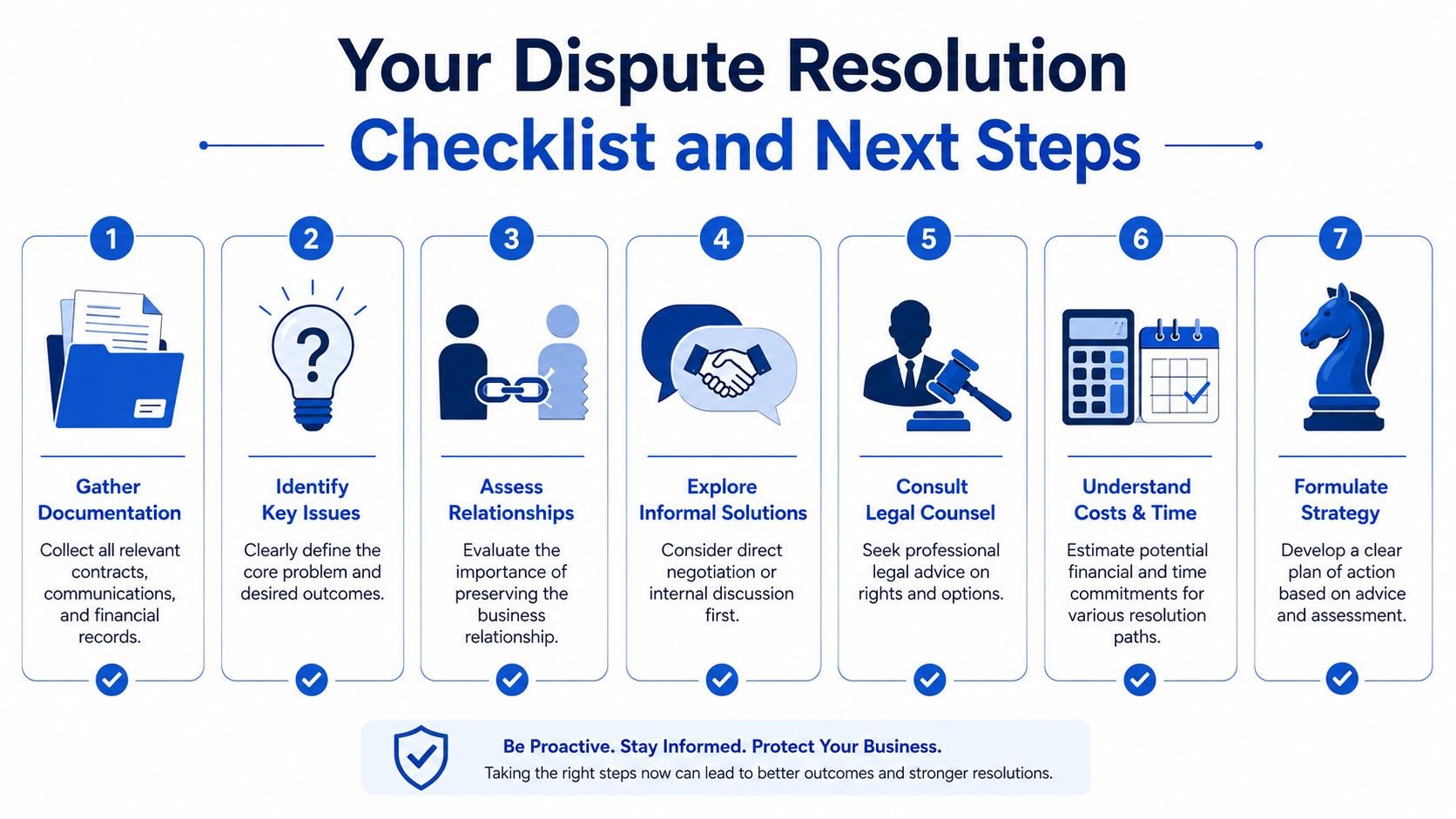
When a business dispute lands on a founder's desk, urgency pushes people toward bad habits. They send emotional emails, make broad accusations, promise things they shouldn't, or wait too long because they hope the problem will disappear. A checklist slows the panic and restores sequence.
First moves in the first 48 hours
Start with facts, not arguments.
-
Collect the operative documents
Pull the signed contract, statements of work, amendments, purchase orders, emails, text messages, invoices, acceptance records, meeting notes, and internal issue logs. Missing paperwork quickly shifts the advantage. -
Freeze informal commentary
Tell the team to stop editorializing in Slack, email, and text. Internal messages written for venting often become external exhibits. -
Review the dispute clause
Check notice requirements, cure periods, forum selection, venue, escalation steps, and any emergency-relief carve-out.
Clarify the business objective
A dispute strategy fails when the company doesn't know what outcome matters. Before choosing a path, leadership should answer a few concrete questions:
- What must be protected now: money, data, inventory, customer access, IP, reputation
- Is the relationship salvageable: yes, no, or only on revised terms
- What timeline matters: immediate stabilization, quarter-end recovery, or final legal resolution
- What can be traded: payment timing, scope changes, transition assistance, mutual releases
Those answers usually narrow the field faster than legal theory does.
Match the process to the problem
Use a simple filter:
| Situation | Likely starting move |
|---|---|
| Invoice or milestone dispute with a workable relationship | Direct negotiation, then mediation if needed |
| Deadlocked owners or shareholder conflict | Structured negotiation or mediation with decision-makers present |
| Technical performance dispute | ADR with subject-matter expertise or focused fact-finding |
| Data misuse, cyber issue, or trade secret threat | Hybrid strategy with immediate evidence protection and possible court relief |
Bring in counsel before the record gets worse
Legal counsel adds the most value early, when the company still has room to shape the record, preserve options, and avoid procedural mistakes. Waiting until after the wrong email goes out or the wrong deadline passes usually costs more than the early review would have.
Counsel should be able to help with:
- Risk triage: what matters now versus what can wait
- Contract analysis: forum, remedies, notice, indemnity, and fee-shifting
- Evidence preservation: especially in technical or employee-related disputes
- Negotiation posture: what to say, what not to say, and when to escalate
A good dispute strategy doesn’t start with aggression. It starts with clarity.
A final working checklist
- Gather documentation: complete the factual file before making accusations
- Identify the key issue: separate the legal claim from the business pain point
- Protect evidence: preserve documents, devices, logs, and access records where relevant
- Measure relationship value: don’t destroy a useful commercial tie by reflex
- Check enforceability: know whether the contract requires mediation, arbitration, or court
- Choose a sequence: negotiation, ADR, litigation, or hybrid
- Draft for the endgame: any settlement should be written for enforcement, not optimism
When a dispute threatens revenue, operations, or long-term business value, By Design Law Firm & Legal Consultancy, PLLC advises Washington companies on contracts, technology-related conflicts, risk management, and business litigation strategy. A focused legal review can help determine whether the smartest next step is negotiation, mediation, arbitration, court action, or a combination that protects the business without wasting momentum. Contact our office today at (206) 593-1519.