A founder can lose a clean deal over a dirty NDA. A Seattle startup shares a deck with a prospective investor, a contractor forwards a model to the wrong inbox, or a friendly introduction turns into a document with no signature, no real scope, and no practical way to enforce anything. By the time the mistake is visible, the information is already out, and the paper trail is too weak to do much about it.
That's why how to draft a non disclosure agreement is really a question about control, not ceremony. A good NDA tells both sides what stays secret, why it's being shared, who can see it, how long the obligation lasts, and what happens when the relationship ends. A sloppy one creates friction, weakens trade secret arguments, and can even scare off the next investor or vendor who has to read it.
The part most founders miss is simple. An NDA is not a polite formality. It's an operational risk-control document, and the details matter.
Why Most Founders Get the NDA Wrong
Most founders get the NDA wrong because pressure pushes them to grab a fast template, a borrowed form, or a one size fits all PDF. These can lack real authority, be too broad, and show up only after sensitive material is already shared.
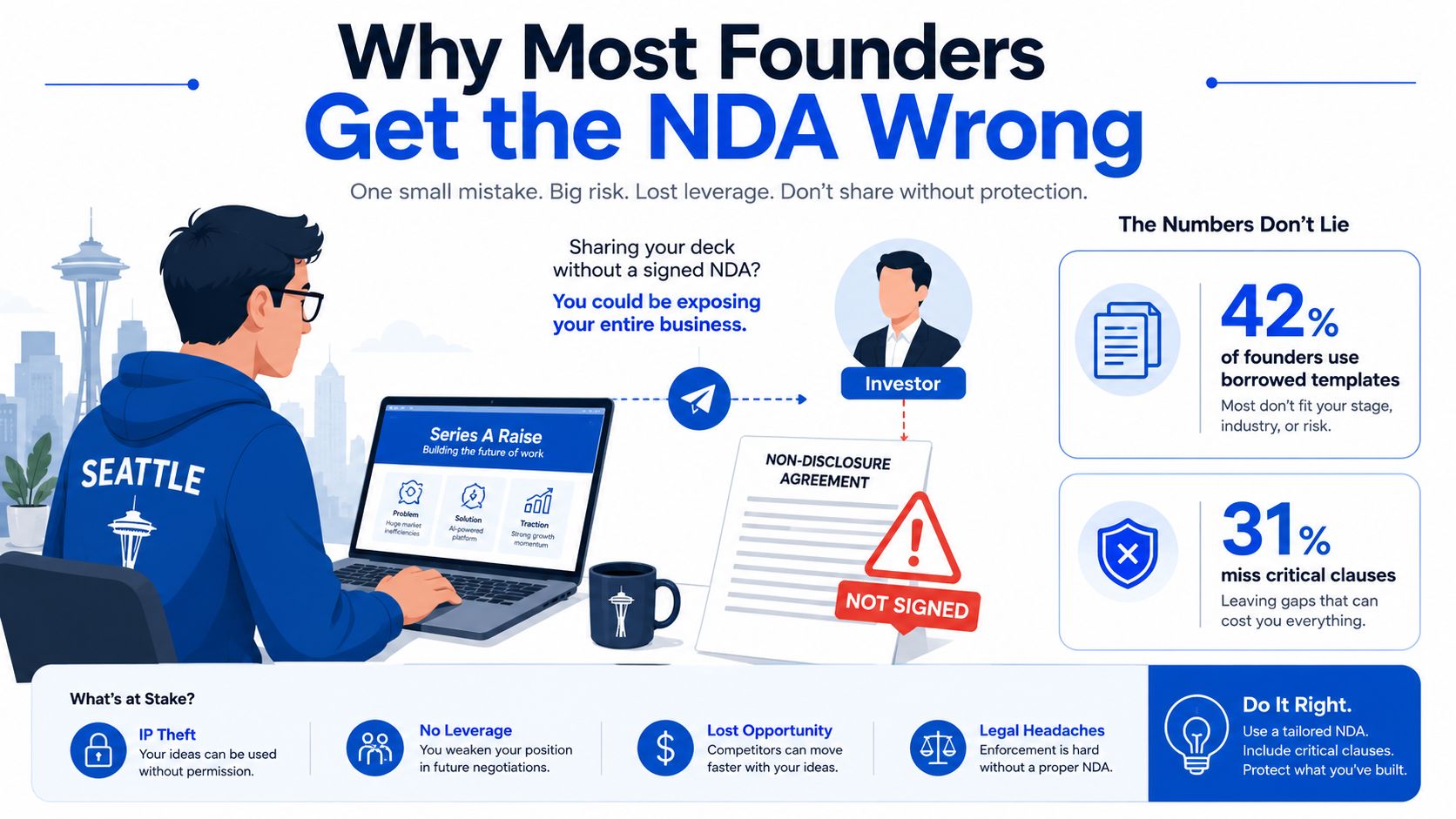
The common failure pattern is not mysterious. Practitioners distinguish unilateral, bilateral, and multilateral NDAs depending on who is sharing information, but the core drafting logic stays the same, define the information, state the purpose, identify who is bound, set the duration, and specify remedies. That structure matters because vague language can weaken enforceability, and an NDA has to be signed before disclosure if it is going to do any real work.
The business cost shows up later
The immediate problem is not always theft. It's ambiguity. If the draft protects “all business information” without explaining what that means, the receiving side may treat it like noise, while a court may treat it like overreach.
The deeper cost is strategic. NDA drafting discipline affects trade secret protection, later financing discussions, and the way counterparties view the founder's legal maturity. The Foundation for Economic Security cites estimates that between 33% and 57% of U.S. workers are constrained by an NDA or similar confidentiality mechanism, which means the document reaches far beyond elite M&A deals and into ordinary startup operations. In that kind of environment, a narrow, operational agreement is usually more defensible than a dramatic one. Foundation for Economic Security
A cleaner mental model helps. The NDA should answer seven questions in plain English, who are the parties, what is confidential, what may it be used for, what is excluded, how long does it last, what happens if it ends, and what happens if someone breaches it. That is the difference between a paper shield and a working contract.
Practical rule: If the NDA would make a reasonable business person pause for five minutes just to understand it, it probably needs to be narrower.
Pre-Drafting Checklist Before You Open a Template
A strong draft starts before anyone types a clause. The first decision is whether the deal is unilateral, bilateral, or multilateral, because that choice shapes who is bound and who carries the risk if information moves the wrong way. If only one side is sharing, the document should say that directly, rather than pretending the relationship is symmetric.
Build the one-page brief first
Before drafting, identify the exact categories of information that will travel. In startup work, that often includes customer lists, source code, financial models, security logs, product roadmaps, and AI training inputs. It also means mapping who inside the receiving organization needs access, because “the company” is not a real access control plan.
A useful working brief usually contains the parties, the purpose, the categories of confidential information, the term, and the governing law. That brief makes the NDA mechanical instead of improvised. It also helps avoid the ambiguity traps that show up when a founder tries to retrofit business intent into generic template language.
For teams that manage templates at scale, automation can help keep the intake consistent. EDocGen's discussion of template automation is useful for founders who want to standardize inputs before legal review rather than hand-edit every document from scratch. template automation insights
The other point to settle early is internal authority. If the sender side is a startup, LLC, or foreign company, someone should confirm who can sign. That question sounds procedural, but it's often the first place a draft fails in the world. A clear internal brief reduces that risk before any confidentiality language is negotiated.
For a plain-language overview of what an NDA is and how it fits into business relationships, this overview of NDA basics is a useful companion.
Drafting habit that works: write the business purpose in one sentence before writing the definition of confidential information. If the purpose is fuzzy, the rest of the contract will be too.
Core Clauses Every NDA Needs in Order
An NDA reads best when it follows a sequence, not a grab bag of legal language. The strongest drafts are narrow, operational, and easy to follow because each clause does one job. That's the model founders should use when learning how to draft a non disclosure agreement.
Start with the parties, then define the guardrails
The opening block should name the parties with precision and identify who is disclosing and who is receiving. The definition of confidential information should be specific enough to stand up in a dispute, not a catch-all that sweeps in every scrap of paper or every conversation. A practical formulation says the term includes listed categories like source code, pricing, customer data, and prototype specs, plus any materials marked confidential or reasonably understood to be confidential under the purpose of the deal.
The permitted purpose needs the same discipline. “For evaluation of a potential partnership” is better than “for business purposes,” because the second phrase invites misuse. The receiving party should be limited to a need-to-know group, and access should be conditioned on secure storage, no copying beyond what is necessary, and prompt return or certified destruction at the end of the relationship.
Add exclusions and post-termination mechanics
A good draft also excludes public-domain information, materials already known to the recipient, and information independently developed without use of the disclosing party's confidential material. Those exclusions are not decorative. They protect the agreement from becoming overbroad and help the recipient accept it without feeling trapped by ordinary market knowledge.
Post-termination handling deserves its own clause. The agreement should say what must be returned or destroyed, when that happens, and whether backups or legal archives are carved out. The American Bar Association's drafting guidance also points to remedies, including whether injunctive relief is available, because money alone may not fix the loss once confidential information escapes. American Bar Association NDA drafting guidance
| Core NDA Clauses and What They Must Contain | Must Contain | Common Failure |
|---|---|---|
| Parties | Exact legal names, who is disclosing, who is receiving | Wrong entity or unclear signatory |
| Confidential information | Specific categories, marked or clearly identified material | “All information” language that is too broad |
| Permitted purpose | One stated business use | Hidden reuse for unrelated commercial purposes |
| Exclusions | Public, prior, independently developed information | Buried or missing exceptions |
| Term and survival | Clear duration and post-termination survival | Perpetual obligations with no justification |
| Return or destruction | Process, timing, and any backup handling | No cleanup mechanics at all |
| Remedies | Injunctive relief and other available remedies | No real enforcement leverage |
| Signature block | Authority and execution details | Document signed by the wrong person |
A compact drafting style helps. For a founder-facing trade secret lens, this trade-secret protection resource is a good reference point for turning confidentiality language into actual control.
Useful clause logic: if a clause doesn’t tell the recipient exactly what to do, when to do it, and what happens if they don’t, it’s probably not doing enough work.
High-Risk Drafting Errors and How to Fix Them
The most expensive NDA mistakes are usually boring. They show up as overbroad definitions, weak operational controls, buried exclusions, and signature problems that nobody notices until there’s a dispute. That’s why the best fix is often not a grand rewrite, just tighter language and better execution.
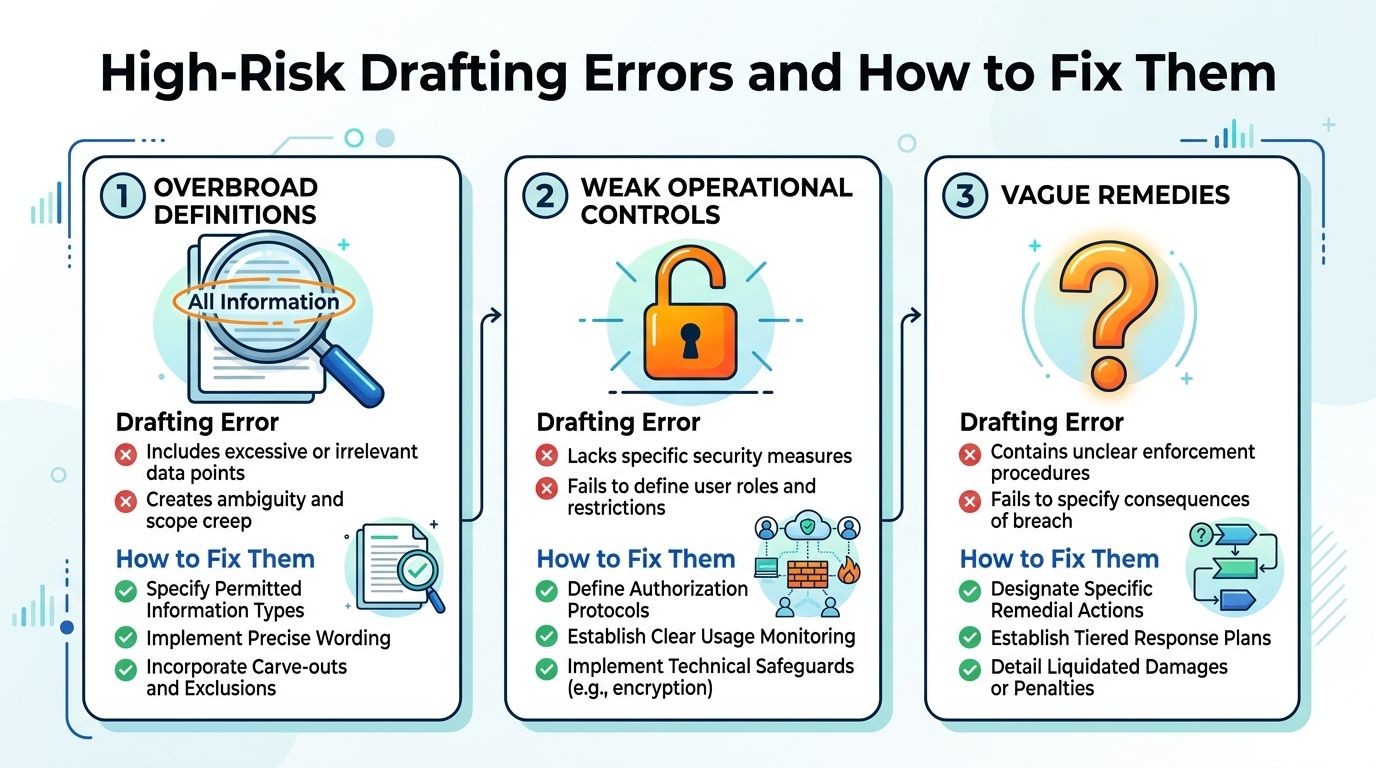
Overbroad scope and weak controls
A sentence like “all information disclosed in any form is confidential” sounds protective, but it often reads like a trap. A better version limits the clause to the information exchanged for the stated purpose and excludes public, prior, and independently developed material. That narrower approach tracks the practical drafting guidance that warns against definitions so broad they undermine enforceability. ContractCounsel NDA drafting guide
The same problem shows up in operational language. If the draft does not say who may see the information, how it must be stored, and whether compelled disclosure requires notice, the document lacks real control points. A working fix is straightforward, “recipient may disclose only to personnel with a need to know, shall safeguard the information using reasonable security measures, and shall give prompt notice of any legally compelled disclosure to the extent permitted by law.”
Signature authority is the quiet failure mode
Many templates stop at party names and signature blocks, then assume the signing person can bind the entity. That assumption is risky, especially with LLCs, startups, and foreign companies where authority may depend on manager approval, board action, or internal delegation. The problem is not just technical. If the wrong person signs, the counterparty may later argue that no enforceable agreement ever existed.
A cleaner signing clause can help. “The undersigned represents and warrants that they have authority to bind the entity named above.” That sentence does not solve every authority question, but it forces the signer to make the issue explicit and gives counsel a place to verify the file before execution.
For teams that rely on template libraries, automation can reduce the slippage between a clean draft and a bad execution event. Superdocu’s material on legal document automation is useful in that context because it focuses on consistency, review, and repeatability rather than just generating more forms. Superdocu’s document automation
The reason these errors matter is practical. Vague scope invites a court to reject the claimed coverage, and missing authority language can leave the receiving party room to argue that the contract never properly attached. A founder does not need an aggressive NDA. A founder needs one that binds the right people on the right terms.
When an NDA Should Stay Short Instead of Bulking Up
A lot of bad NDAs try to do the job of four different agreements. They smuggle in non-competes, non-solicits, IP assignment, data-processing terms, and employment restraints that don’t belong in a confidentiality instrument. That usually makes the document slower to negotiate and easier to attack.
Keep the confidentiality contract focused
A confidentiality-only agreement is the right tool when the issue is disclosure, use, and return of information. If the relationship also requires data privacy obligations, a separate data processing addendum usually fits better. If ownership of inventions is the issue, an employment IP assignment or contractor invention assignment does the cleaner job. If source code access, incident response, or security duties matter, a separate technology or security agreement often gives those obligations better structure.
That separation matters because overloading the NDA can create enforceability and velocity problems at the same time. One contract-management source notes that NDAs with non-standard terms take three times longer to process, which is a real cost when a startup is trying to close a vendor, investor, or contractor relationship quickly. Agiloft on effective NDA drafting
The practical test is simple. Before adding a clause, ask whether the clause is really about confidentiality, whether it will be enforceable in the relevant jurisdiction, and whether it slows the deal more than it protects it. If the answer to any of those is no, the clause probably belongs somewhere else.
Don’t force one document to do every job
Founders often get their timing wrong. They want one document to prevent theft, control personnel movement, assign inventions, regulate privacy, and cover future disputes. That instinct is understandable, but it tends to produce a bloated form that counterparties redline aggressively.
A good rule of thumb is that a properly scoped startup NDA can often stay to one page. That doesn’t mean it should be thin on substance. It means the document should stay focused on confidentiality, not drift into every other legal issue in the relationship. For a separate employment-focused template, this employee confidentiality agreement resource is the better home for those broader employment concerns.
Bottom line: use the NDA for secrecy, and use separate agreements for ownership, privacy, and workforce restrictions.
Washington and Federal Overlays That Change the Draft
Washington deals need a little more care than a generic national template. The most common mistake is assuming that a clean confidentiality clause is enough when the transaction also touches trade secrets, employee data, or sensitive technical inputs. It often isn’t.
Federal trade secret notice language matters
For employee and contractor NDAs that seek federal trade secret remedies, the Defend Trade Secrets Act notice language has to be included. A major drafting checklist from Holland & Hart flags this as a specific compliance step, which makes it more than a best-practice nicety. The practical takeaway is simple, if the NDA will be used with people who handle trade secrets in the U.S., the notice text should be checked before signature. Holland & Hart drafting checklist
Washington law adds another layer because trade secret and misappropriation issues are often analyzed through state law as well. That means the agreement should not just define confidential information loosely. It should fit the business’s actual trade secret posture and the governing law chosen for enforcement.
Privacy, AI inputs, and local compliance
Washington practice now has to account for personal data and AI workflows. If the confidential material includes customer records, security logs, or model inputs, the NDA should align with secure storage, access control, and disclosure procedures that match privacy obligations. The firm’s data privacy guidance on Washington data privacy and compliance is a good reminder that confidentiality language cannot operate in a vacuum.
The point is not to turn an NDA into a data security manual. The point is to avoid contradictions. If the contract says information can be shared broadly but the business only has limited privacy permissions, the paper will not match reality.
Drafting discipline for Washington deals: pick governing law and venue that fit the transaction, match the confidentiality language to the actual data involved, and add the federal notice language whenever the NDA is being used as a trade-secret instrument.
Negotiation Tactics and When to Bring in Counsel
The fastest way to lose a deal is to argue over language that has a better home elsewhere. Counterparties usually push back on perpetual terms, broad remedies, indemnities, and invention assignment language hidden inside the NDA. A founder should answer with narrow fallback language, not panic.
A good response to perpetual confidentiality is time-limited survival tied to the life of the information, or a defined period that matches the project. If the other side wants unilateral remedies, the better fallback is mutual remedies with express injunctive relief for actual misuse. If indemnity language appears, it should usually be moved out of the NDA unless the transaction requires it.
If the redline tries to bury assignment of inventions in the confidentiality document, that is a signal to separate the issues. The same goes for non-competes. If a counterparty insists on one, the deal has likely crossed the line where outside counsel should review the full package before anyone signs.
A practical escalation filter
Bring in counsel early when the deal is cross-border, investor-facing and tied to cap table information, or being used with employees or contractors who will handle trade secrets. The same is true if the agreement touches AI training inputs, security logs, or regulated personal data, because those issues often call for a broader compliance view than a standard NDA template can provide. For teams building internal controls around that kind of risk, VCISO services for AI compliance can also be a useful reference point for understanding how confidentiality, security, and governance fit together.
A junior teammate should be able to run a quick checklist before anything is sent out, confirm the parties, confirm authority, confirm the purpose, confirm the exclusions, and confirm whether the draft needs jurisdiction-specific review. That process should not turn into a marathon. A well-drafted NDA is usually a 90-minute conversation, not a 90-page document.
If your team is negotiating NDAs that need to hold up in the real world, By Design Law Firm & Legal Consultancy, PLLC helps startups and growing businesses tighten the drafting, clean up signature authority, and align confidentiality terms with privacy, trade secret, and AI risk. Visit By Design Law Firm & Legal Consultancy, PLLC to get practical help on an NDA that matches the deal instead of slowing it down. Contact our law office today at (206) 593-1519.