A startup usually realizes it has a trade secret problem at the wrong moment. A lead engineer gives notice, a contractor asks for broader repository access, or a founder learns that customer pricing logic has been pasted into a personal workspace. By then, the central question isn't abstract. It's whether the company can prove that it treated that information like a secret.
That proof matters because trade secret protection doesn't come from filing a registration. In the United States, modern trade secret law was strengthened by the Economic Espionage Act of 1996 and the Defend Trade Secrets Act of 2016, and the USPTO explains that protection can last indefinitely so long as the owner takes reasonable efforts to keep the information confidential. For a software, AI, or data-heavy company, that turns trade secret protection into an operational discipline, not just a legal theory.
The practical version of how to protect trade secrets is straightforward. Identify what matters, limit who can reach it, document the rules, enforce those rules at departure, and move fast if something goes wrong. The harder part is doing those things in a way that still works when the assets aren't formulas in a safe, but source code, model weights, internal datasets, prompts, deployment scripts, and customer intelligence spread across cloud tools.
Identifying Your Company's Crown Jewels
A company can't protect everything equally. It shouldn't try.
Trade secret law generally protects information that has commercial value because it's secret, is known only to a limited group, and is guarded by reasonable steps such as controlled access and confidentiality obligations. In practice, founders often over-focus on obvious assets like source code and under-protect less glamorous assets such as pricing logic, vendor terms, internal playbooks, unreleased product roadmaps, or negative know-how about what failed and why.
Start with a real audit
A defensible program starts with a formal inventory. Tangibly recommends beginning with a trade secret audit that inventories each asset, classifies it by sensitivity, and maps who has access, because periodic review becomes part of the evidentiary record for reasonable measures. That recommendation matches what courts tend to care about. Can the company identify the secret with specificity, and can it show concrete steps taken to protect it?
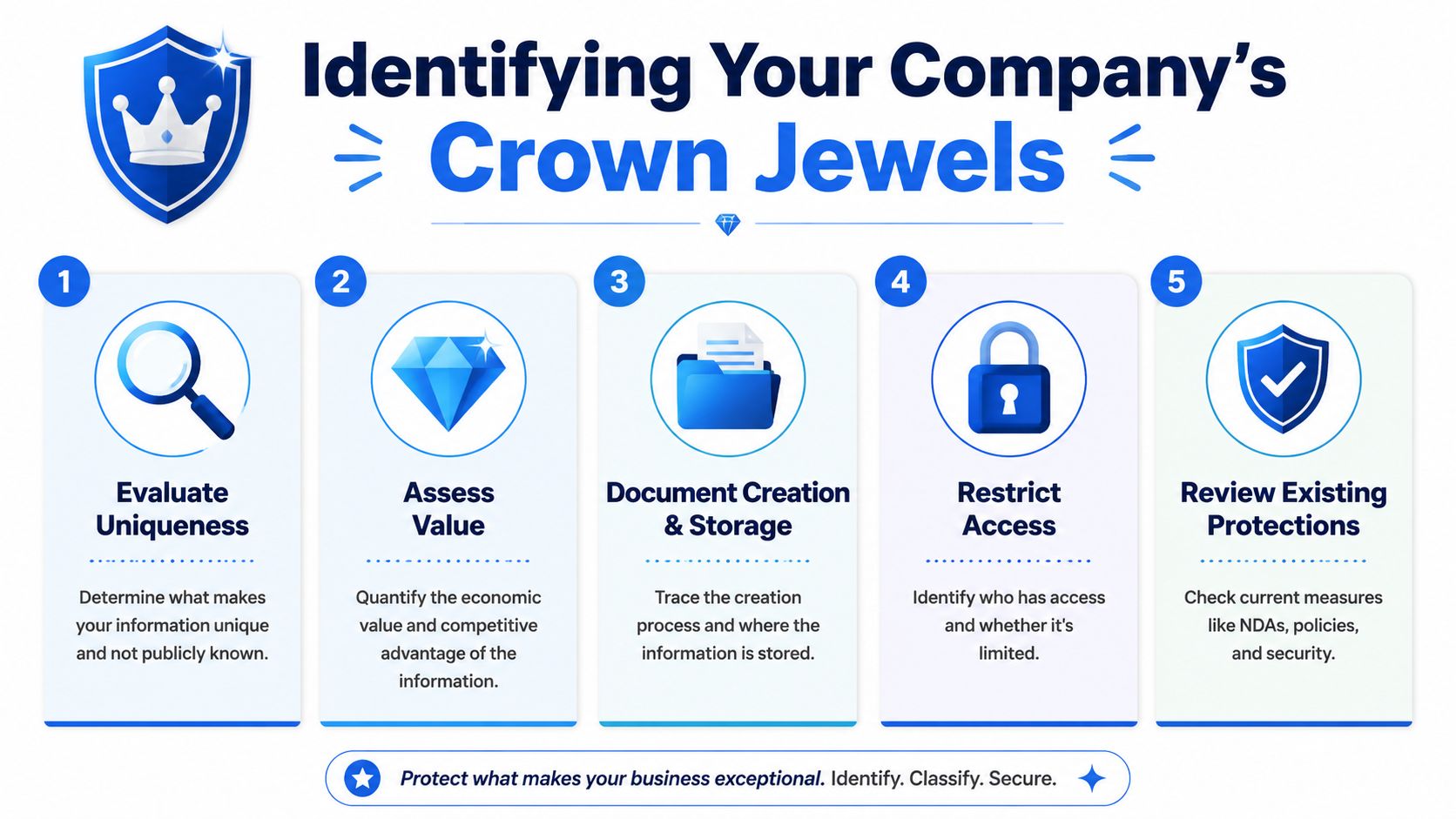
A useful audit usually includes:
- Asset identification. List what gives the company an edge. That may include code repositories, fine-tuned prompts, customer segmentation models, manufacturing methods, margin assumptions, and internal tooling.
- Business value review. Ask whether a competitor would gain an advantage from having it.
- Secrecy review. Check whether the information is already public, easily reverse engineered, or casually shared inside the business.
- Access mapping. Record which employees, contractors, vendors, and systems can reach it.
- Control review. Match each asset to existing protections such as NDAs, role-based permissions, logging, and secure storage.
Practical rule: If a company can't answer “what exactly is the secret, where is it stored, and who can access it,” it isn't ready to enforce trade secret rights.
Classify by sensitivity, not by department
Many startups organize information by team. Legal should push them to organize by exposure risk instead.
A lightweight classification table often works better than a long policy memo:
| Classification | Typical examples | Typical controls |
|---|---|---|
| Restricted | Core algorithm, model weights, source code for key product features | Tight role-based access, logging, NDA coverage, limited export rights |
| Confidential | Pricing strategy, pipeline forecasts, vendor terms, launch plans | Need-to-know access, confidentiality markings, internal policy controls |
| Internal | Routine operating documents | Basic access controls and standard employee obligations |
That approach also helps founders understand where trade secrets fit within the broader set of intellectual property rights types. Not every valuable business asset is a trade secret, and not every secret should be treated like a patent substitute. Some information belongs in a patent strategy, some in copyright, and some should stay secret as long as secrecy is realistic.
What founders miss most often
The biggest blind spots are usually these:
- Negative know-how. Failed experiments, abandoned product paths, and training methods that didn't work can save a rival time and money.
- Data relationships. A raw dataset may be replaceable, but the cleaned version, labeling method, or metadata schema may not be.
- Workflow secrets. A company's edge may sit in process, not invention. Think handoff sequences, QA methods, deal desk rules, or deployment shortcuts.
- Scattered storage. Information spread across GitHub, Google Drive, Slack, Notion, Figma, and local devices is harder to defend if nobody owns the map.
A trade secret inventory should be short enough to use and detailed enough to defend. If it becomes a theoretical spreadsheet nobody updates, it won't help in a dispute.
Building Your Legal Fortress with Contracts
A founder hires a machine learning engineer, gives broad access to the training pipeline, and rushes through onboarding with an offer letter and a generic NDA pulled from an old folder. Six months later, the engineer leaves with a clear memory of the model tuning process, data cleaning logic, evaluation thresholds, and deployment shortcuts. If the paperwork never clearly defined what was confidential, who owned improvements, and what had to be returned or deleted, the company starts that dispute from a weaker position.
Contracts matter because they create evidence. They show that the company identified specific confidential assets, limited permitted use, and imposed clear duties before a problem surfaced. That paper trail is often what separates a credible trade secret claim from a founder's hindsight argument that “everyone knew” the information was sensitive.
This has become more important as non-competes face tighter limits and, in some states, are functionally unreliable for large parts of the workforce. Startups still need a way to protect AI models, source code, internal tools, customer data structures, and deployment know-how. The answer is usually tighter confidentiality language, stronger IP assignment terms, narrower access by role, and better exit documents, not wishful thinking about restraining competition itself.
The contract stack that does the work
Most startups need four agreement categories working together, with definitions that match the actual business.
- Employee confidentiality agreements. These should define confidential information with real examples, restrict use to company business, require prompt return or deletion of materials, and confirm that confidentiality duties continue after employment ends.
- Invention and IP assignment agreements. These should state, in plain terms, that work product created within the scope of the relationship belongs to the company, subject to any state-law carveouts.
- Contractor and consultant agreements. These need tighter drafting than many founders expect, especially where outside developers touch repositories, model training, product specs, or customer environments.
- Partner and vendor NDAs. These should fit the transaction. A short mutual NDA may be enough for initial diligence, but pilots, integrations, and data-sharing relationships often need use limits, security commitments, and return or destruction obligations.
If you need a starting point, this employee confidentiality agreement template for startup teams is useful for issue-spotting. It still needs to be customized to the company's assets, hiring model, and state law.
Draft around actual digital assets
Founders often sign documents that protect “business information” in the abstract. That wording is too thin for a company whose value sits in code, data, and internal systems.
For a software or AI business, the definition of Confidential Information should usually name the categories people handle. That may include source code, repositories, model weights, training and fine-tuning methods, prompts, retrieval pipelines, evaluation frameworks, internal benchmarks, labeling rules, cleaned datasets, architecture decisions, product analytics, security settings, pricing logic, customer usage patterns, and roadmap materials.
Specificity helps for a practical reason. If a dispute later turns on whether a prompt library, feature engineering method, or internal scoring rubric was treated as secret, the agreement should already answer that question.
Three clauses that founders should read closely
A workable confidentiality agreement usually answers three points clearly:
| Issue | Weak drafting | Better drafting approach |
|---|---|---|
| What is protected | Broad references to nonpublic business information | Defined categories tied to code, data, systems, customer information, and internal processes |
| How it may be used | No clear use restriction | Use allowed only to perform services for the company or the stated transaction |
| What happens at the end | Generic return language | Return, deletion, and certification obligations, plus a ban on retention in personal tools or accounts |
That last point matters more than many founders realize. In digital-first companies, “return” is not enough. Information may sit in personal GitHub forks, local downloads, browser-based AI tools, exported Slack files, notebooks, or home devices. The contract should require deletion where appropriate, permit the company to request a certification of compliance, and prohibit copying company material into personal systems.
Sample language that matches real disputes
Legal prose does not need to be ornate to be effective. In fact, plain language often performs better because people can understand it, managers can enforce it, and a court can read it without guessing at the business point.
A useful confidentiality clause often sounds like this:
The recipient may use Confidential Information only as needed to perform services for the company or evaluate the parties' business relationship, and for no other purpose. The recipient may disclose Confidential Information only to authorized persons with a need to know the information for that purpose, and must protect it with at least reasonable care.
For ownership, the business issue should be just as direct:
The individual assigns to the company all right, title, and interest in work product, inventions, code, documentation, data-related materials, and other deliverables created within the scope of the relationship or through use of company Confidential Information, except for any rights that cannot be assigned by law.
That language still needs review for employee invention statutes, contractor classification issues, and state-specific limits. But the structure is sound.
Replace non-compete assumptions with enforceable alternatives
A lot of founders still draft as if a broad non-compete will carry the load. In many cases, it will not. The better approach is to protect the asset directly.
That usually means:
- confidentiality terms that identify modern trade secrets with precision
- invention assignment clauses that capture code, model improvements, and related documentation
- non-solicit terms where permitted
- no-conflict representations at the start of the relationship
- exit certifications confirming return and deletion of company information
- records showing who received which confidential materials and why
This is also where vendor and disposal language gets overlooked. If old devices, backup media, or test hardware contain sensitive code or data, disposal should not be treated as an office-cleanup task. Companies handling those assets should use defensible destruction practices, such as the methods described in Reworx Recycling hard drive destruction.
Contracts will not save a company that shares its crown jewels casually. They do, however, give the company a much better record when it needs to prove ownership, notice, misuse, and post-employment obligations. That is often the difference between a credible enforcement posture and an expensive argument with holes in it.
Implementing Technical and Physical Security Measures
The fastest way to weaken a trade secret claim is to treat sensitive information like ordinary office clutter. If everyone can open the folder, clone the repository, or export the data, the company will struggle to argue that secrecy was taken seriously.
WIPO's guidance emphasizes marking information as confidential, limiting access with physical and technological restrictions, using NDAs with relevant parties, and using tools such as MFA, encrypted storage, and DLP to monitor abnormal transfers. That's the right baseline for startups too, even if the tooling is simpler.
Build layers, not one barrier
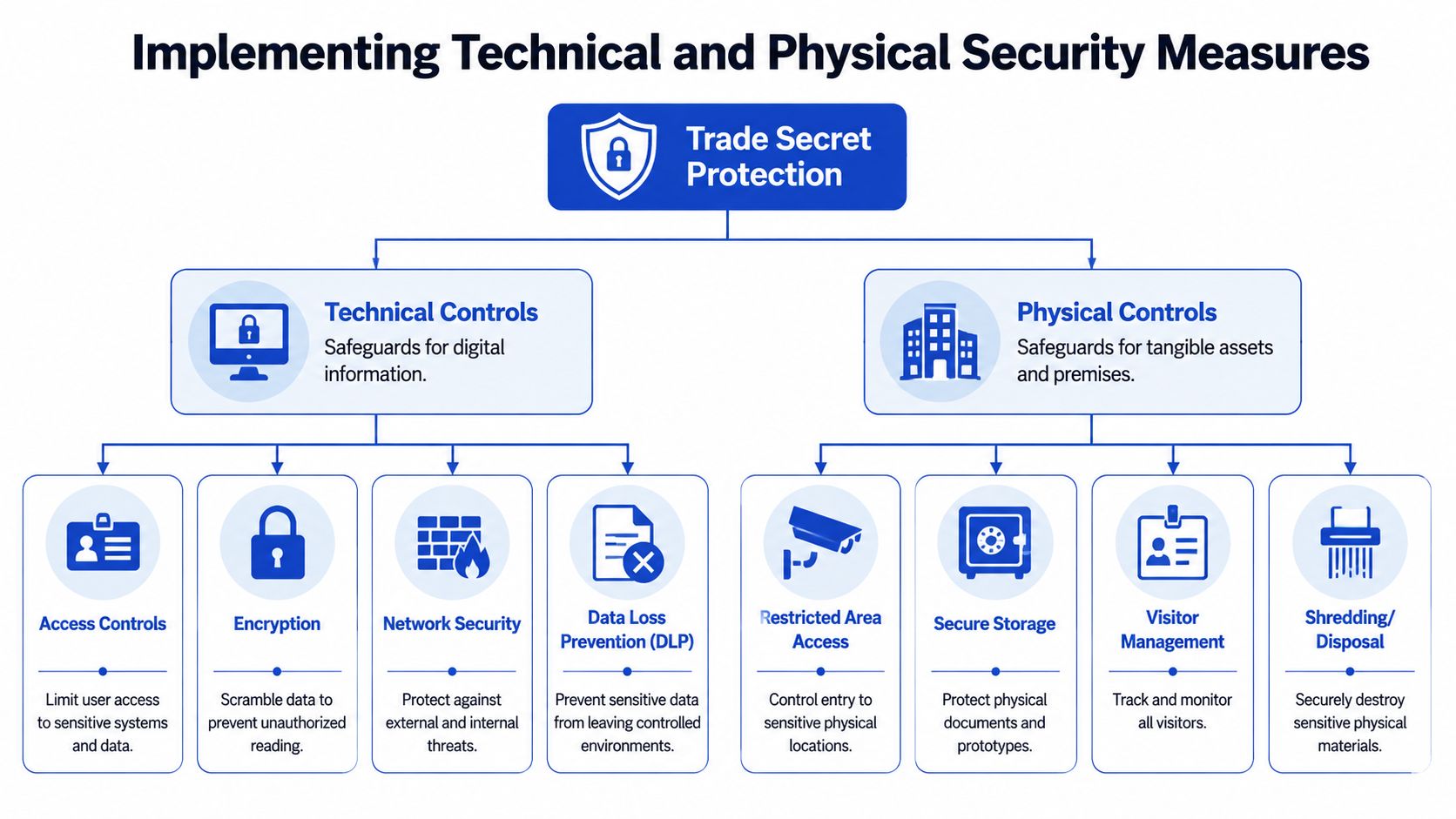
A practical program usually combines administrative, technical, and physical controls.
- Administrative controls. Written information security policies, access approval rules, onboarding and offboarding procedures, confidentiality training, and document classification standards.
- Technical controls. Multi-factor authentication, encrypted storage, role-based permissions, DLP tools, repository logging, and alerts for abnormal downloads or exports.
- Physical controls. Locked offices or labs, badge-restricted areas, secure storage for prototypes and paper files, visitor sign-in, and secure disposal.
A small company doesn't need enterprise sprawl. It does need consistency. If engineering uses GitHub, product uses Notion, sales uses HubSpot, and leadership stores strategy files in Google Drive, each environment needs an access model and a decision-maker.
What to lock down first
The first controls should follow the crown jewels identified earlier.
| Asset type | Immediate control |
|---|---|
| Source code and repos | Limit admin rights, restrict cloning where possible, log unusual activity |
| Datasets and model assets | Segmented storage, approval-based access, export review |
| Customer and pricing data | Least-privilege access, encrypted storage, no personal account forwarding |
| Physical prototypes and records | Locked storage, controlled room access, visitor limits |
This is also where remote work changes the risk profile. A company with distributed staff needs rules for local downloads, personal devices, and cloud sync behavior. Founders who want a legal-operational checklist for that environment often need guidance that connects trade secret controls with broader cybersecurity risks in remote work.
Disposal is part of protection
Not every leak happens through a live system. Old laptops, decommissioned drives, printed notes, and discarded prototypes can be just as damaging.
For hardware disposal, a specialized resource on Reworx Recycling hard drive destruction is useful because trade secret protection doesn't end when equipment reaches end of life. If a storage device held source code, customer data, or internal models, disposal needs the same seriousness as storage.
A short explainer on layered safeguards fits well here:
Security point: Need-to-know access beats broad trust-based access every time. Trade secret law asks what the company did, not what it hoped employees would do.
What doesn't work is buying one tool and calling it solved. DLP without role restrictions, MFA without logging, or a locked server room with unrestricted cloud sharing all leave obvious gaps.
Auditing Defenses and Managing Employee Departures
A key engineer resigns on Monday. She's been central to the company's product architecture, she knows where the shortcuts are buried, and she still has active access to repositories, internal docs, and a shared dataset used by the AI team. The founder says she's trusted and probably won't do anything improper.
That's exactly the moment to follow process, not instinct.
The highest-risk window is the exit window
As noncompete clauses have become less reliable, practitioners have increasingly focused on narrower tools. Phelps discusses nondisclosure agreements, fast post-exit access revocation, exit interviews, account shutdowns, and written reminders of ongoing confidentiality duties as practical substitutes where broad noncompetes may not hold up.
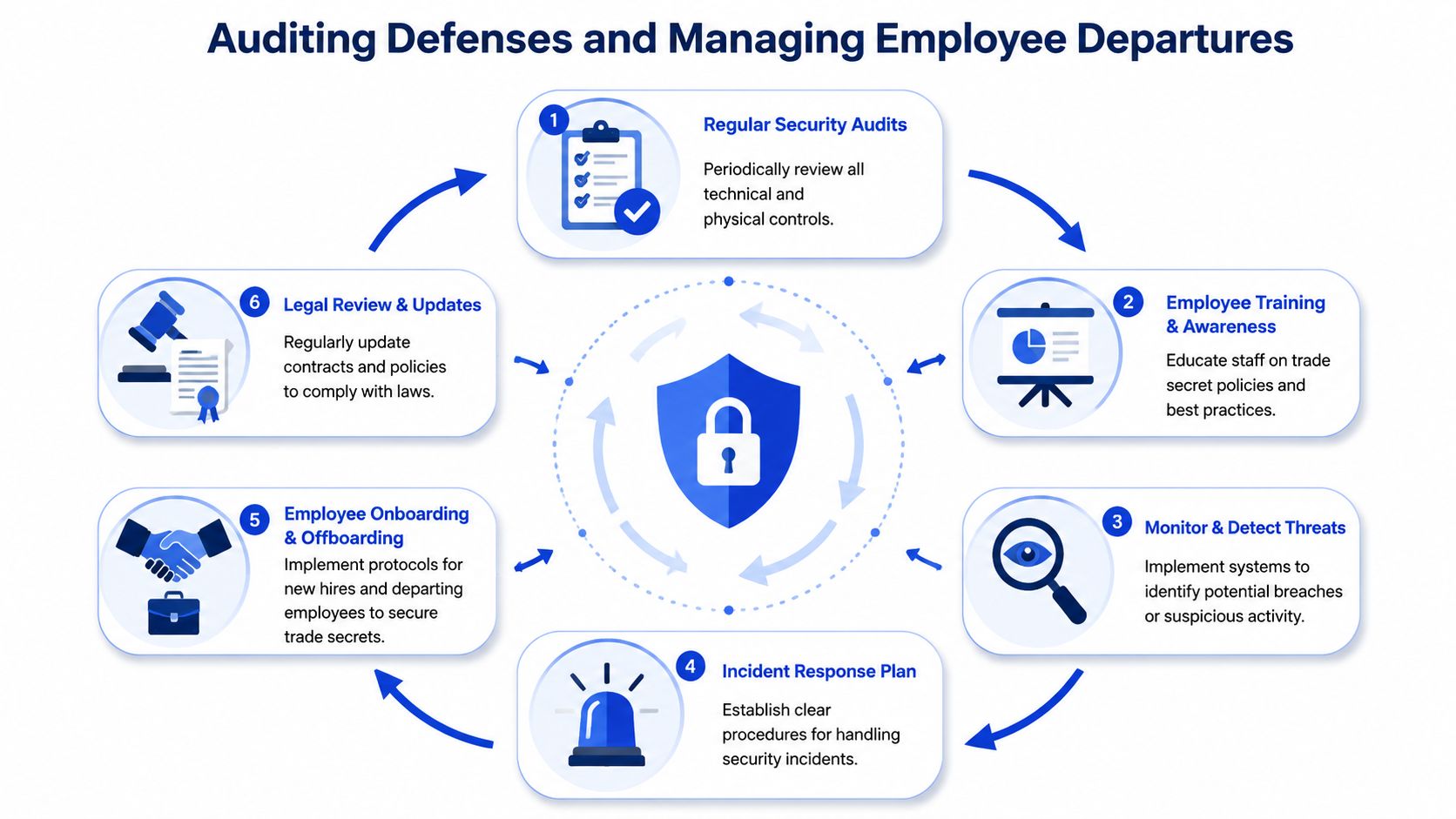
A sound offboarding sequence usually looks like this:
- Limit access immediately. Don't wait until the final hour if there's a real risk of copying or misuse.
- Review recent activity. Look for unusual downloads, repository access, exports, or forwarding behavior.
- Collect devices and credentials. Laptops, tokens, external drives, test devices, and shared admin credentials all count.
- Conduct an exit interview. Remind the employee what remains confidential and what documents govern that duty.
- Send a written reminder. Confirm continuing confidentiality obligations and return-of-property requirements.
What a strong exit interview actually does
An exit interview isn't a ritual. It creates evidence.
The company should identify the categories of information the departing employee had access to, ask whether any company data was stored in personal accounts or devices, confirm return of materials, and document the reminder that confidential information can't be used after departure. If deletion certifications are appropriate, they should be handled carefully and consistently.
Companies often lose leverage because they treat offboarding as an HR formality instead of a legal event.
When a key employee is headed to a competitor, there's also a judgment call. Overreaction can create unnecessary conflict. Underreaction can destroy the record. The right tone is factual, calm, and documented.
Audits keep the record alive
Employee departures get the attention, but regular audits do the preventive work. A company should periodically review:
- Access lists to confirm only current personnel still have permissions.
- Repository and storage logs for abnormal cloning, downloads, or exports.
- Vendor access to make sure third parties still need what they can reach.
- Policy drift caused by tool changes, acquisitions, reorganizations, or new AI workflows.
This is also the point in the process where legal and operational review should meet. A business counsel with trade secret, contract, and data governance experience, such as By Design Law Firm & Legal Consultancy, PLLC, can help align employment documents, offboarding practices, and technical controls when a founder's current setup has grown informally.
What doesn't work now, especially in states skeptical of broad restraints, is assuming a noncompete will carry the load. The stronger substitute is disciplined onboarding, limited access, rapid shutdown, and written reminders that survive the employment relationship.
Responding to a Breach and Enforcing Your Rights
Trade secret theft is often quiet. A bulk export to a personal account. A repository clone before resignation. A vendor using shared data for a side purpose. The company's first response should be controlled and deliberate, because panic damages evidence.
Trade secret theft is estimated to cost the U.S. economy between $300 billion and $600 billion annually, which underscores why companies need both internal controls and an enforcement plan when misuse is suspected, as discussed in Lumenci's trade secret protection overview.
The first moves after suspicion arises
The opening steps should be practical, not theatrical.
- Preserve evidence. Don't wipe devices, reset accounts, or “clean up” logs.
- Contain access. Suspend or narrow permissions where necessary to stop further movement.
- Identify the information at issue. Be specific about what may have been taken or exposed.
- Map the repositories and systems involved. Email, cloud drives, GitHub, messaging tools, laptops, mobile devices, and removable media may all matter.
- Engage counsel early. Early legal direction helps preserve privilege and avoid procedural mistakes.
For founders who need a broader incident checklist that overlaps with trade secret loss and cybersecurity response, a practical guide on handling a business data breach can help frame immediate containment and communication steps.
Enforcement options under federal and state law
The Defend Trade Secrets Act matters because it created a federal civil cause of action for trade secret misappropriation tied to interstate or foreign commerce, giving owners a uniform route into federal court under the USPTO's trade secret policy overview. In the right case, that means a company may seek injunctive relief quickly to stop use or disclosure.
A founder should think in terms of remedies, not just lawsuits:
| Remedy | When it matters |
|---|---|
| Injunction | When the company needs the court to stop use, disclosure, or transfer now |
| Seizure in extraordinary circumstances | When there's a serious need to prevent propagation before notice can be given |
| Damages | When misuse has already caused measurable loss or unjust enrichment |
| Preservation and return orders | When devices, files, or accounts may still contain the secret |
Washington businesses will also evaluate state trade secret claims where appropriate, but the central issue remains the same. The company must identify the secret and show reasonable efforts to maintain secrecy before the dispute began.
What strengthens leverage before filing
A company is in a better position when it can show:
- The secret was identified clearly
- Access was limited to people with a legitimate need to know
- Contracts imposed confidentiality and use restrictions
- The company reacted quickly once suspicious conduct appeared
- Logs, communications, and offboarding records back up the claim
Courts tend to move faster when the plaintiff’s own documentation is clean and specific.
That’s why enforcement starts long before any complaint is filed. The legal case usually rises or falls on the company’s pre-breach behavior.
Protecting Modern Assets and Planning Your Next Steps
Modern trade secrets rarely sit in a single locked cabinet. They sit in version control, cloud buckets, prompt libraries, internal notebooks, deployment scripts, benchmark results, and training pipelines. That changes how a company should think about how to protect trade secrets.
Recent practitioner guidance emphasizes updating agreements and controls for source code, AI model weights, and proprietary datasets, because these assets are easy to copy and hard to notice when exfiltrated, making access logging as important as contracts. That’s the right frame for digital-native businesses. The old playbook of “have everyone sign an NDA” is no longer enough.
A realistic next-step list
- Refresh definitions. Make sure contracts and policies expressly cover code, model assets, prompts, documentation, and internal tooling.
- Tighten repository and dataset access. Broad engineering convenience often creates legal weakness.
- Review vendor pathways. AI and software teams often expose sensitive material through integrations, shared workspaces, and outsourced labeling or development.
- Pressure-test offboarding. If a key contributor left tomorrow, the company should know exactly who revokes access, who reviews logs, and who sends the written reminder.
- Escalate before a dispute. Once suspicious copying appears, the business should stop improvising.
For founders, the dividing line is simple. If the company’s value depends on information that outsiders can’t easily recreate, and that information lives across people, tools, and contracts that have grown informally, legal cleanup shouldn’t wait for a resignation or a leak. That’s when trade secret advice shifts from optional hygiene to risk control.
A founder who wants to turn an informal set of habits into a usable trade secret protection program can work with By Design Law Firm & Legal Consultancy, PLLC on the legal and operational pieces that matter most: identifying sensitive assets, tightening agreements, aligning access controls with business reality, and preparing for disputes before they become emergencies. Contact us today at (206) 593-1519.