The complaint lands in the founder's inbox on a Thursday afternoon. A customer says the AI feature made a decision no one on the team can explain, support can't trace the input, engineering can't find the approval trail, and legal can't tell whether the model used customer data, vendor data, or both. That's the moment most startups realize they never had an AI governance policy, they just had a collection of assumptions.
The expensive mistake is waiting for a regulator, a customer escalation, or a board question to force the conversation. By then, the team is reconstructing choices from Slack threads, version histories, and memory. A written policy is cheaper than that mess because it proves the process existed before anyone asked.
The gap is not theoretical. AI adoption is already broad, but mature governance is still rare. One 2026 industry synthesis reports that 88% of organizations now use AI in at least one business function, up from 78% the previous year, while fewer than 1% have fully operationalized responsible AI and 81% remain in the earliest maturity stages AI governance statistics. That mismatch is why founders keep getting surprised by issues that were never really surprises, only undocumented decisions waiting for a trigger.
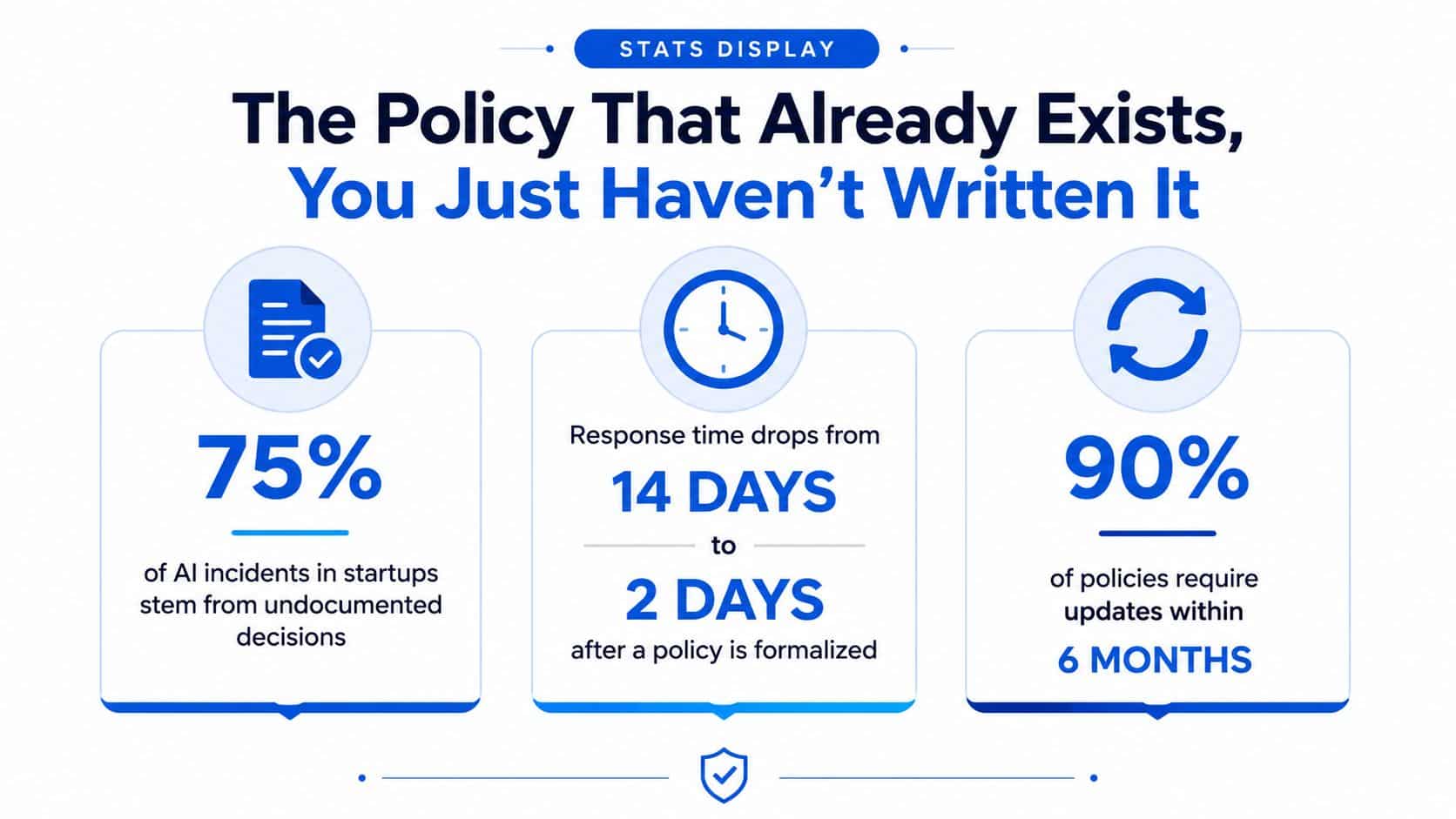
The regulatory climate has also changed fast enough that “we'll deal with it later” is now a bad strategy. Across 75 major countries, AI mentions in legislative proceedings rose 21.3% in 2024, from 1,557 mentions in 2023 to 1,889 in 2024, and Stanford's AI Index shows U.S. state-level AI-related laws jumping from 1 law in 2016 to 49 by 2023, then 131 in the past year Stanford AI Index 2025. That's not abstract policy chatter. It's a signal that AI is being treated as a distinct governance category, with real expectations around risk assessment, documentation, accountability, and oversight.
Practical rule: if the team can't answer who approved a system, what data it used, and how it was tested, the policy doesn't exist in any useful sense.
That's why the right mindset is simple. An ai governance policy is the company's written explanation, in advance, of how AI gets built, approved, monitored, and changed. It's not a manifesto. It's evidence.
A useful outside reference point is the CISO AI governance overview, which is a good reminder that security leaders already think in terms of controls, approvals, and evidence trails. Founders should think the same way, just with less bureaucracy and faster execution.
The global direction is also clear. The EU AI Act uses a risk-tiered framework that bans certain practices and layers obligations on top of higher-risk systems EU AI Act framework. Japan's updated 2026 guideline requires named AI governance officers and lifecycle controls Japan AI governance guideline. India's 2025 guidelines establish an AI Governance Group as a permanent policy body India AI Governance Guidelines. For a U.S. founder, the takeaway is blunt. The market is moving from ethics language to administratively enforced controls.
The Policy That Already Exists, You Just Haven't Written It
A founder usually discovers the need for an AI governance policy after the first complaint. A customer raises a concern, an internal escalation lands in Slack, or procurement sends a questionnaire that nobody can answer cleanly. Who approved the tool? What data did it touch? Was it tested before launch? If those answers live only in people's heads, the company does not have governance, it has folklore.
A policy is an evidence trail, not a philosophy essay
The fastest way to fix that is to write down how the company already makes decisions. A useful draft states, in plain English, which AI systems are allowed, who owns them, what risk tier they sit in, what controls they need, and what happens when something goes wrong. The point is not to sound polished. The point is to make the next uncomfortable conversation short, factual, and documented.
That is also why the policy belongs on paper before the incident, not after it. Reconstructing a model's approval path from tickets and chat logs is slow, expensive, and usually incomplete. A written policy turns a scramble into a review.
For a lean team, the policy should sit close to how work already happens. Intake, approval, deployment, monitoring, and incident response should all be visible in one place. If the engineering lead, the product lead, and the operations lead cannot point to the same document, the policy is not operational yet.
The legal exposure is broader than most founders think
The risk is not limited to one bad output. A missing policy can create exposure around regulatory non-compliance, contractual liability, privacy violations, and IP contamination. A vendor tool that ingests confidential customer data without a clear review path can cause trouble long before anyone calls it an AI incident. A customer-facing system that makes unreviewed decisions can create the kind of paper trail that regulators and counterparties love to inspect.
The OECD's policy work describes governance as a cycle of assessing conditions and risks, setting goals, designing the system, and reviewing it as conditions change OECD AI Principles and governance work. In plain terms, governance is a management function, not a slide deck.
Japan's guideline makes that concrete by requiring named officers and lifecycle control, and India's governance structure does the same at the institutional level Japan guideline, India guidelines. Founders do not need to copy those structures line for line. They do need to copy the discipline. A policy without ownership is just a Google Doc with nice formatting.
A practical clause can be this direct:
Operating principle: no AI system moves into production until it has a named owner, a documented risk tier, a documented review, and a monitoring plan.
That one sentence forces the rest of the policy to be real. If a system cannot satisfy it, it should not ship.
A good benchmark is the CISO AI governance overview, which shows how security teams already approach controls, approvals, and evidence trails. Founders should use the same discipline, without adding unnecessary bureaucracy. Keep the policy tied to the way the business ships software.
If you need a governance reference for how ownership should sit inside the company, use the board structure guidance for governance roles as a practical reminder that accountability works best when names are attached to decisions.
Set Objectives, Scope, and Named Owners First
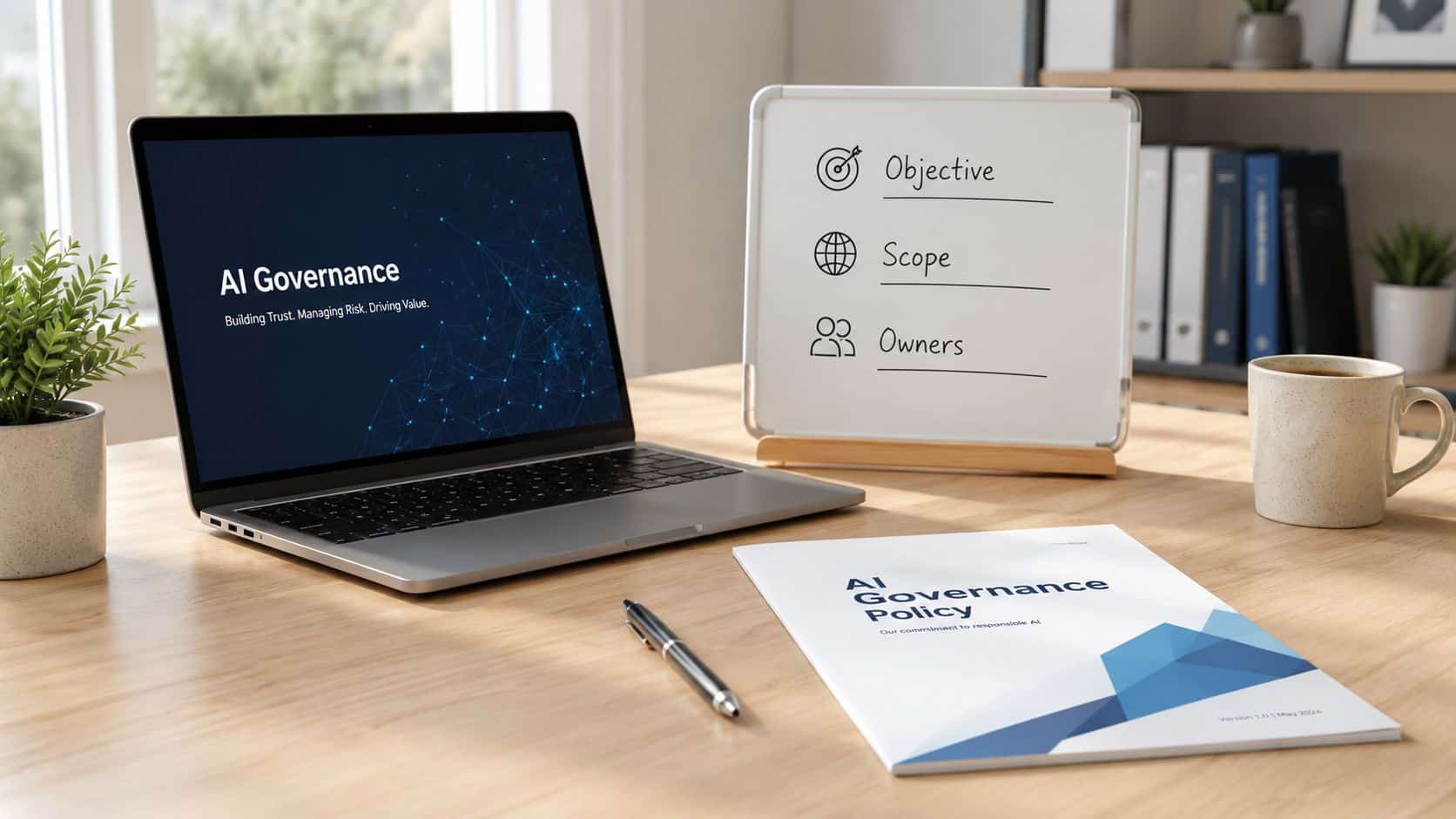
A policy that tries to cover everything usually controls nothing. Start with one sentence on purpose, one sentence on scope, and one line that names who owns enforcement. That is where most startups get sloppy, then regret it later when product assumes legal owns the issue and legal assumes engineering does.
The objective should be boring and specific. This works: “This policy governs the evaluation, approval, deployment, monitoring, and review of AI systems used by the company to reduce legal, security, privacy, and operational risk.” That is stronger than vague language about “responsible AI,” because it tells people exactly what the document is for.
Scope should be broad enough to catch the world. It should cover systems the company builds, buys, or meaningfully integrates, including third-party models, embedded APIs, copilots, and tools that employees use in the course of work. If a vendor touches company data or influences customer outcomes, it belongs in scope. As noted earlier in the international guidance, the point is discipline, not paperwork for its own sake.
Use this kind of clause:
Scope clause: this policy applies to all AI systems, including internally developed tools, vendor-provided models, embedded AI features, and employee-approved external services that process company data or support company decisions.
Owners matter more than org charts
Founders should name the roles that make the policy real.
- Policy owner: the person who keeps the policy current and enforces intake.
- Executive sponsor: the leader who can break ties when product pressure collides with risk.
- Cross-functional reviewers: legal, security, product, and data stakeholders who sign off on higher-risk uses.
That structure keeps the policy alive without turning it into a bureaucracy. It also makes turnover survivable because the roles live in the policy, not just in a headcount spreadsheet.
For a practical reference on how oversight can be mapped to company governance, the board of directors structure guide is worth reviewing alongside the policy draft. The point is not to turn the board into a product committee. The point is to make sure oversight exists at the right level, with real names attached to real decisions.
Governance fails when everyone is consulted and nobody is accountable.
That is the cleanest way to say it. If the company cannot name the person who can stop a launch, the policy is decorative.
Classify Every AI Use Case by Risk Before You Write a Single Control
A startup that gives the same approval path to a customer support bot and a resume screen is doing one of two things, wasting time or missing real exposure. The policy should start with classification, because the controls only make sense after the team knows what kind of system it is dealing with.
The EU AI Act provides a useful tiering model, prohibited, high-risk, limited-risk, and minimal-risk systems. That framework is a reference point, not a legal assignment every founder has to memorize. The practical move is to sort use cases into tiers before anyone argues about documentation depth, testing cadence, or approval level.
| AI Use Case Risk Classification Matrix | |||
|---|---|---|---|
| Risk Tier | Example Use Cases | Approval Required | Key Controls |
| Prohibited | Uses that the company will not deploy because they create unacceptable legal or ethical exposure | Executive and legal review, typically a stop decision | Block by policy, do not deploy |
| High-Risk | Resume screening, credit-like scoring, safety-critical workflow support, major customer decisions | Formal cross-functional approval | Documentation, testing, human oversight, logging, periodic review |
| Limited-Risk | Customer service chatbots, sales copilots, internal drafting tools that affect work quality but not high-stakes outcomes | Policy owner or designated reviewer | User disclosure, prompt controls, output checks, logging |
| Minimal-Risk | Internal summarization, meeting note cleanup, low-impact productivity tools | Lightweight approval or registration | Inventory entry, acceptable use rules, basic monitoring |
A resume screening system should never be treated like an internal summarizer. A customer support chatbot should not receive the same controls as a system that shapes employment or access decisions. That distinction sounds obvious, but companies miss it all the time because they classify by vendor name instead of by consequence.
Build the matrix from the use case, not the tool
Every request should start with a short intake. What does the tool do? Who sees the output? Does it affect rights, access, compensation, or safety? Does it use confidential, personal, or regulated data? If those answers point to high stakes, the system moves up the tier ladder.
Use the intake to make the classification repeatable, not ornamental. The point is to force the team to answer the same questions before launch, so nobody can later claim the risk was “obvious” after the fact.
A simple working rule helps. The more the AI can change a person’s outcome, the more review the policy should require. The more the AI stays inside drafting and summarizing, the lighter the controls can be.
For a starter template on the review workflow, the AI risk assessment template is a useful internal anchor for the policy package. Use it to standardize the questions, then keep the decision tied to the actual use case. The goal is consistency, so one team does not label something “low risk” just because that is the easiest path.
Practical rule: if the team can’t explain why a use case belongs in a tier, it isn’t classified yet.
That is the standard worth using. A policy that cannot defend its labels will fold the first time someone asks hard questions.
Build the Controls Layer for Data, Models, Transparency, and Vendors
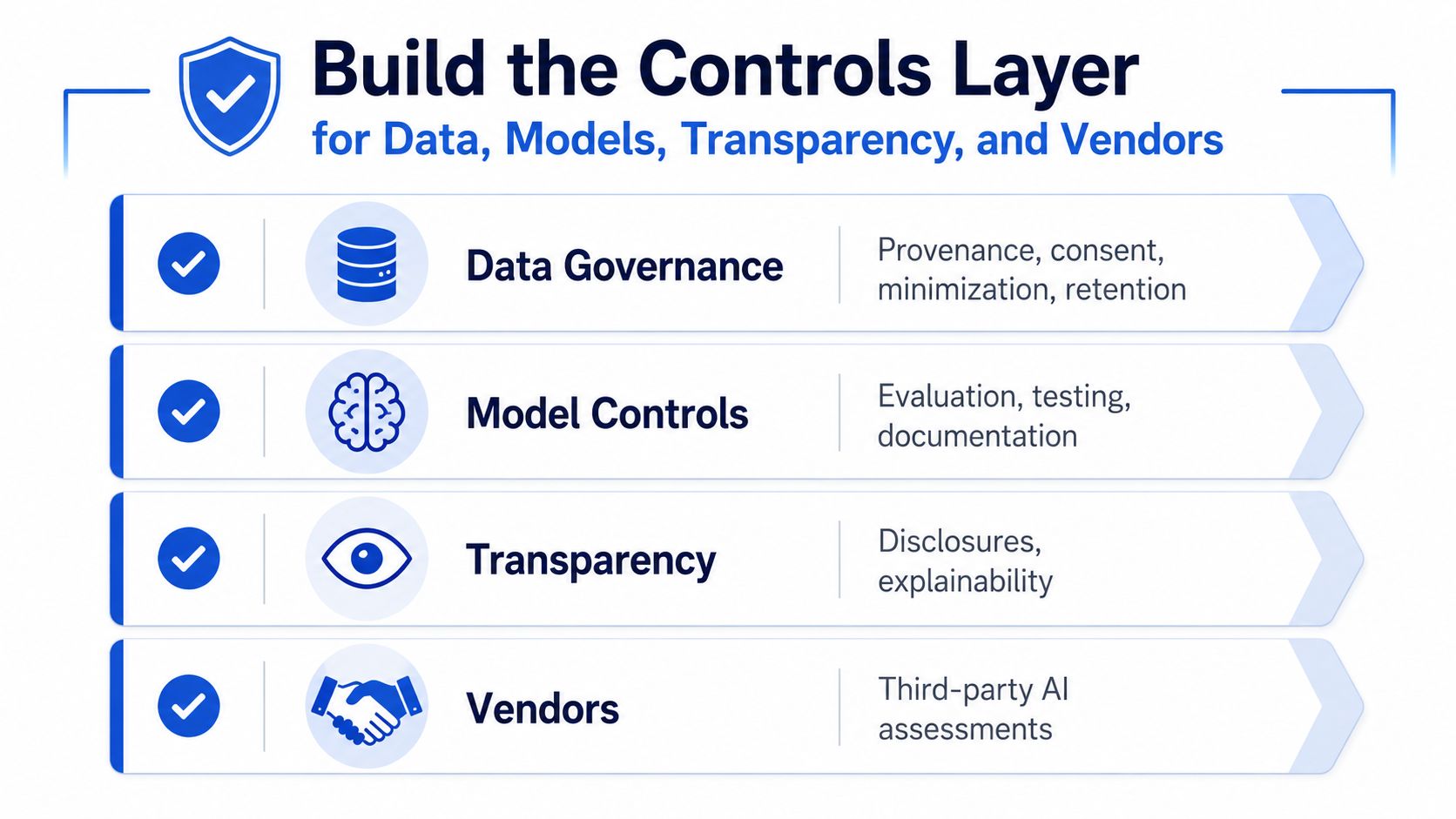
Risk tiers only matter if the controls underneath them are concrete. The policy should break controls into four buckets, data, models, transparency, and vendors. That keeps the team from writing a vague “be careful with AI” clause that nobody can operationalize.
Data controls need provenance and minimization
Data governance starts with a blunt question. What data went in, and why was it allowed in? The policy should require provenance, consent review where relevant, minimization, retention limits, and a ban on feeding sensitive data into tools that were never approved for it.
A useful reference on vendor privacy and data protection is how protects data, which reinforces the practical point that privacy controls need to be designed into workflows, not bolted on afterward. For a founder, the core move is simple. Use only the data necessary for the task, and document where it came from.
Model controls should include evaluation and rollback
The policy also needs model-level controls. That means pre-deployment evaluation, accuracy checks, bias review where relevant, documented testing, and rollback criteria before production. If a model can’t be reverted safely, it’s not ready for real use.
That sounds strict because it is. A startup doesn’t need a huge ML organization to do this well. It needs a lightweight approval gate, a template for results, and a rule that no material update ships without re-validation.
Transparency and vendor terms are not optional
Transparency is where many policies get weak. Users should know when they’re interacting with AI, and internal teams should know when a tool is producing automated output that needs human review. The policy can also allow model cards or similar documentation where they’re available, but it shouldn’t depend on vendor generosity.
Vendor management needs its own lane because a lot of AI risk arrives through procurement. The contract should require AI-specific terms, subprocessor disclosure, security commitments, and audit or evidence rights where the company can negotiate them. The policy should also say that no team may adopt a third-party AI tool outside the approved intake process.
For a practical vendor review structure, the vendor risk assessment guide is the right internal companion piece. The big idea is that shadow AI is easier to register and approve than to chase after launch.
A short policy clause can say this:
Vendor clause: no third-party AI service may process company data or support customer-facing work until it has been reviewed for data handling, security, transparency, and contractual controls.
That’s the level of specificity founders need. Anything softer turns into a loophole.
Monitoring, Logging, and Incident Response After Launch
Most policy drafts stop at launch. That’s where the liability starts. Once a model is live, the company has to assume it will drift, get misused, or surprise someone, and the policy needs to say what evidence gets kept, what gets watched, and who gets called when the system misbehaves.
The Atlantic Council’s point about governance gaps around model provenance, data integrity, and common standards for tracking model origin, training data, and modifications is the right place to begin Atlantic Council governance of AI. This is no longer a drafting problem. It’s an evidence-management problem.
Logging should be detailed enough to reconstruct the decision
At minimum, the policy should require logs for model version, input, output, user identity or role, override events, approval events, and any exception handling. If a developer changed a prompt, or an operator bypassed a guardrail, that should be visible later. If the company can’t reconstruct what happened, it can’t defend the decision.
That’s the practical logic behind the OECD’s emphasis on lifecycle soundness, transparency, accountability, and review OECD AI Principles. Those principles should show up in the policy’s preamble, but the enforceable body should say things like “all high-risk systems must retain decision logs” and “all model changes require re-evaluation before release.”
A monitoring tool like Administrate n8n monitoring tool is useful here because operational oversight only works if the team can see what’s happening across workflows. The exact stack matters less than the habit. Someone needs to watch the system before a customer complains.
Thresholds need to trigger action, not just dashboards
Monitoring should track drift, anomalies, bias metrics where relevant, complaint volume, and unusual override patterns. The policy should define thresholds that force human review. A dashboard without a threshold is just a graph. A dashboard with an escalation trigger is a control.
The best practice is to automate the review path where possible. Manual-only enforcement gets uneven fast, especially across product teams, regions, and release schedules. A policy that depends on someone remembering to check a spreadsheet will fail.
Incident response needs a real playbook
The response plan should say how to suspend a model, who preserves evidence, when legal gets involved, and how affected users get notified. It should also say who decides whether to keep the system offline until the issue is fixed. Those decisions should not depend on improvisation in a Slack thread.
A practical response sequence looks like this:
- Contain fast: pause the system or disable the feature if the issue can affect users or data.
- Preserve evidence: retain logs, prompts, outputs, version history, and vendor correspondence.
- Escalate early: notify legal, security, product, and the executive sponsor.
- Review root cause: identify whether the failure came from data, model behavior, prompt design, vendor changes, or human override.
- Document remediation: record what changed before the system returns to service.
For a broader structure on how incident handling should work, the cyber incident response plan guide is a strong internal reference because the same discipline applies here. AI incidents are different in detail, not in the need for speed, evidence, and coordination.
The audit trail built today is the defense used tomorrow.
That line matters because post-launch behavior is where regulators, customers, and counterparties will look first. The policy should assume that every material AI decision may eventually need to be explained.
Your 30-60-90 Day Rollout and Refresh Triggers
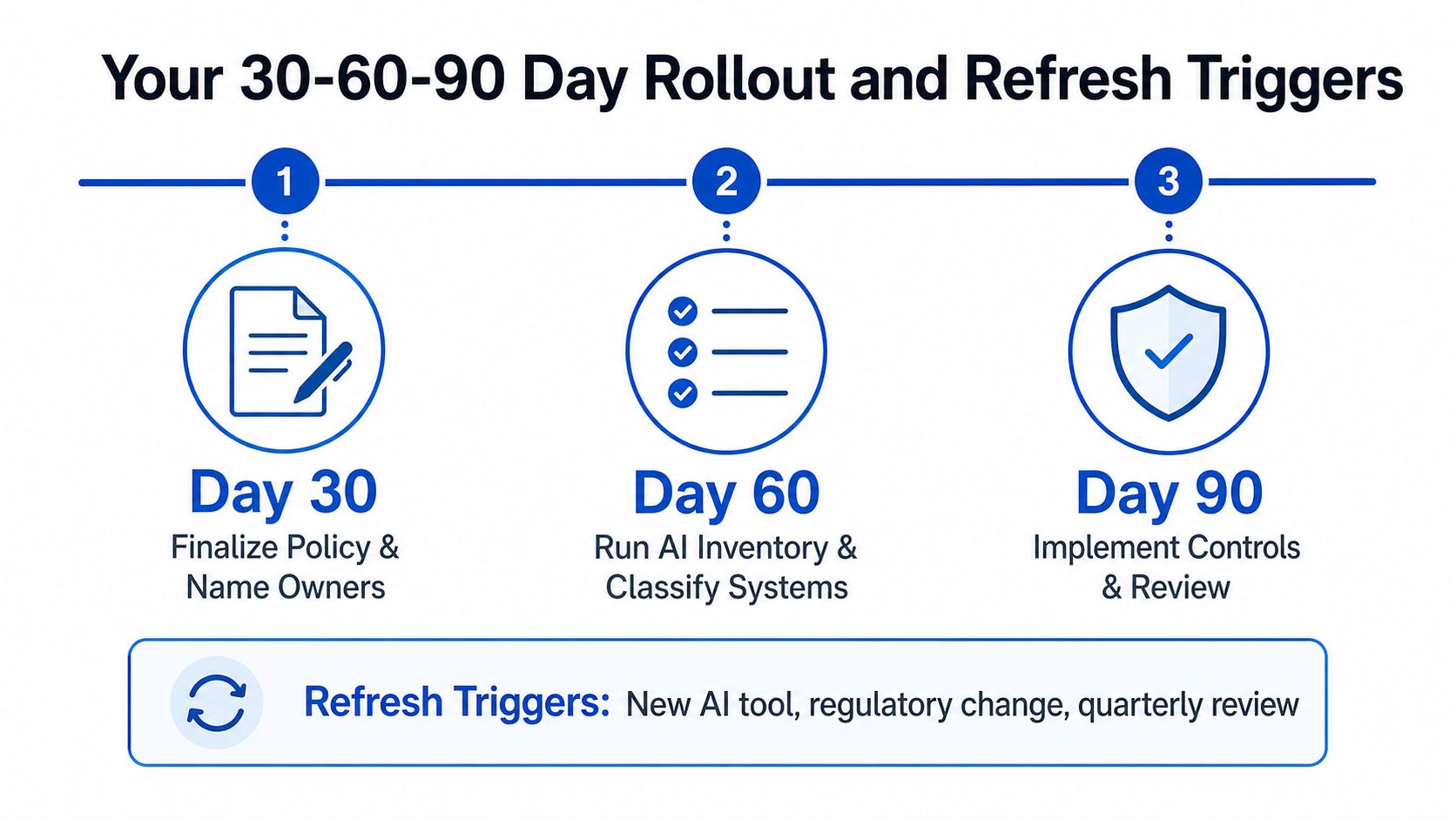
A good policy fails if rollout drifts for six months. The fix is a tight sequence with visible milestones and a few essential refresh triggers. Founders need a timeline that fits the actual calendar, not a theoretical compliance program.
Days 1 through 30
Finalize the policy draft, name the policy owner, name the executive sponsor, and run a full AI inventory. That inventory should include internal tools, vendor tools, shadow tools, and any system that touches customer data or business decisions. If a team can’t list it, the company can’t govern it.
Days 31 through 60
Classify each use case by risk, build intake and approval forms, and train the teams that ship products. Product, engineering, operations, and customer-facing leaders need the same definitions, or the policy will fracture the first time someone uses a different label.
Days 61 through 90
Run a tabletop incident drill, finalize vendor terms, and brief the board or leadership team on the policy’s operating rhythm. Governance becomes routine instead of aspirational. If the drill surfaces confusion, the policy still has work to do.
The refresh triggers should be written into the policy, not left to memory. Update it when a new AI tool is deployed, a vendor changes its model or terms, an incident happens, a new regulation lands, or the company materially changes its data sources. That keeps the policy from becoming shelfware.
A simple founder checklist helps keep momentum:
- Inventory complete: every AI use case is recorded.
- Owners named: each material system has a responsible person.
- Risk tiers assigned: each use case has a classification.
- Controls active: logging, review, and approval steps are live.
- Incident path tested: the team knows how to pause and escalate.
- Vendor terms updated: AI-specific contractual language is in place.
- Refresh rule set: triggers for updates are written and visible.
The point is not to build a perfect program on day one. The point is to build a repeatable one. Governance that doesn’t change with the company is just paperwork.
What Founders Actually Ask After the First Draft
The first question is usually about shadow AI. If a team already uses an unsanctioned tool, the answer is not to shame them and move on. The policy should create a fast registration path, a review gate, and a rule that anything touching company data gets assessed before it keeps running. Hidden tools create hidden risk, and hidden risk always gets expensive later.
The next question is what belongs in a vendor AI addendum. The answer is straightforward. It should cover data use restrictions, security commitments, disclosure of subprocessors, notice of model or material workflow changes, and the company’s ability to review evidence where the deal allows it. If the vendor won’t commit to those basics, the company should think hard before putting customer data in the product.
Overlapping laws are not a reason to stall
Founders also worry about multiple state laws or mixed jurisdictional obligations. The practical move is not to build a separate policy for every location. It’s to write a central policy with risk tiers and controls that can be tightened by region when needed. That keeps the core program usable while leaving room for local variation.
Another common mistake is writing the policy in legal language nobody reads. That usually happens when the draft is written to impress a board instead of to guide a product team. The fix is shorter sentences, named owners, and specific triggers. If the engineering lead can’t use the policy during a release review, the draft is too abstract.
Bottom line: a usable policy beats a perfect policy every time.
The other mistake is treating the policy as a one-time project. AI changes too fast for that. Every major model change, vendor change, incident, or regulatory shift should force a review, and that review should be short enough to happen.
The OECD’s principles and the NIST-style operational logic behind governance become useful only when they’re translated into accountable clauses, audit triggers, and named roles. That’s the difference between a concept and a control. Start there, keep it simple, and make sure the company can prove what it did.
By Design Law Firm & Legal Consultancy, PLLC helps founders and operators turn AI governance from a vague risk into a working policy, with practical counsel on controls, contracts, privacy, and incident readiness. For teams that need a policy they can use, not just file away, visit By Design Law Firm & Legal Consultancy, PLLC to connect with a Seattle-based firm that translates legal requirements into clear, durable operating steps. Call our law office today at (206) 593-1519.