A founder checks the USPTO filing status between product launches and discovers that the application needs a response. The brand name is already on packaging, the website, and investor materials, so the filing felt like the final protective step. It isn’t. Trademark registration creates a legal asset that requires planning before filing, evidence during examination, and management after registration.
For a U.S. business, the central question behind what is trademark registration is practical: how does a company turn a name, logo, slogan, or other source identifier into enforceable rights, and how does it keep those rights useful as the business changes? The answer involves distinctiveness, filing basis, goods and services classes, evidence of marketplace use, enforcement, and maintenance.
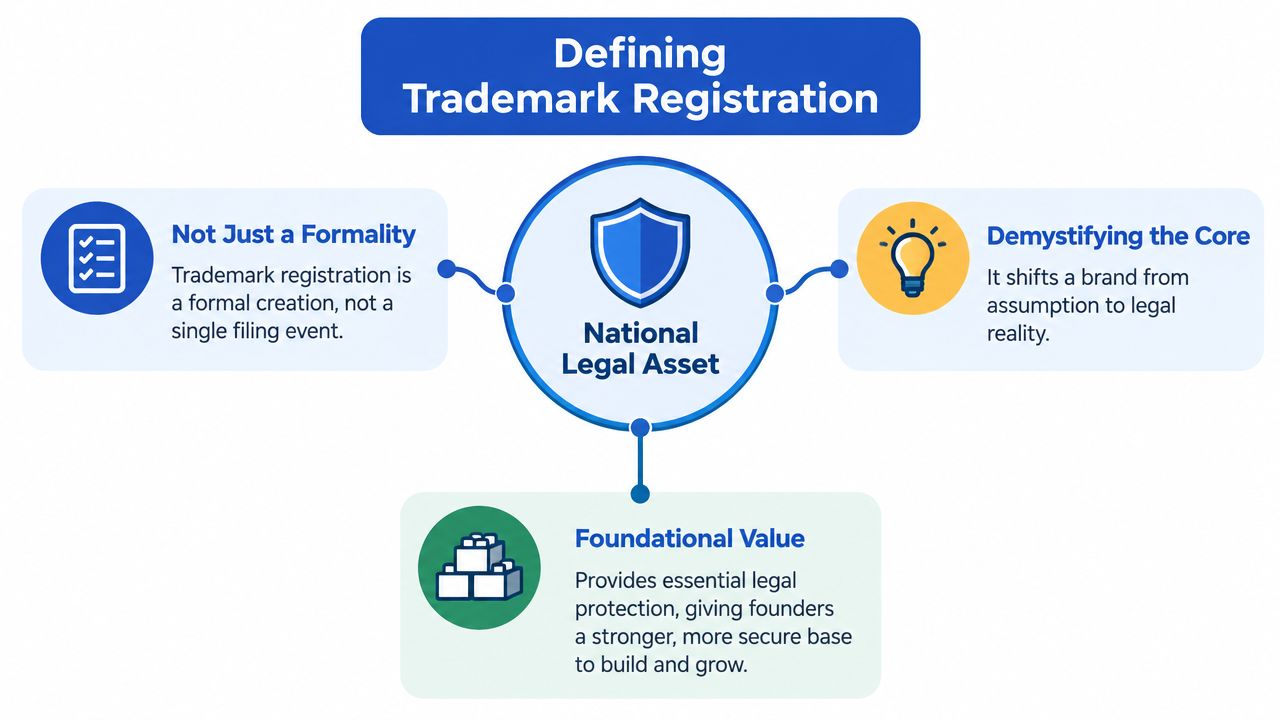
Defining Trademark Registration
Trademark registration is the formal legal process of registering a distinctive source identifier with a government trademark office. In the United States, federal registration proceeds through examination by the United States Patent and Trademark Office. The resulting registration can support ownership, enforcement, licensing, marketplace complaints, and broader brand strategy.
A trademark can include a business name, product name, logo, packaging design, sound, or another sign that helps customers distinguish one source from another. Registration doesn’t give a company ownership of every use of a word. Rights depend on the mark, the goods or services, the territory, and the evidence supporting the application.
The scale of the system shows why founders should treat registration as property management rather than paperwork. WIPO estimated 8.3 million trademark registrations worldwide in 2024, along with 93.2 million active registrations across 155 IP offices. Those registrations represent continuing commercial assets, not merely historical filing events.
Registration is more than a certificate
A registration has value only if the underlying strategy is sound. A founder can obtain a registration for a narrow description that doesn’t cover the company’s real products, or preserve a mark that the business later stops using. A certificate won’t repair a poorly chosen brand, an inaccurate identification, or unsupported evidence.
The process begins with a business decision. The applicant must identify the mark, determine who owns it, select the goods and services, assess conflicts, and choose an appropriate filing basis. The office then evaluates whether the mark is registrable and whether earlier marks create a conflict.
Practical rule: A trademark registration should be managed like an operating asset. The legal file, proof of use, renewal calendar, product roadmap, and enforcement decisions all matter.
Registration also sits within a wider intellectual property portfolio. A logo may raise copyright questions, a technical invention may require patent analysis, and confidential methods may belong in a trade secret program. Founders comparing those protections can use this overview of trademark versus copyright versus patent. For online sellers, registration may also support platform enforcement, including the practical steps described in this guide to blocking unauthorized Amazon resellers.
The Strategic Value of Federal Registration
A founder can acquire limited common-law trademark rights through use in commerce without obtaining a federal registration. That protection is real, but it generally follows the market where the mark has been used and the scope that the evidence can establish. A growing company that sells through a website, distributors, marketplaces, and national advertising needs a stronger foundation than scattered local recognition.
Federal registration changes the enforcement posture. It provides nationwide constructive notice of the registrant’s claim and creates important legal presumptions concerning ownership, validity, and the exclusive right to use the mark in connection with the listed goods or services. Those presumptions don’t make every dispute easy, but they can shift the starting position in a meaningful way.
What registration gives a growing business
A federal registration can help a company:
- Establish a public claim: The register gives competitors, investors, licensees, and potential acquirers a clearer way to identify the claimed owner.
- Support enforcement: Registration can strengthen demand letters, marketplace complaints, opposition strategy, and infringement litigation.
- Record rights with customs: A federal registration is required before a brand owner can record the mark with U.S. Customs and Border Protection to help address counterfeit imports.
- Improve transaction readiness: Buyers and investors can evaluate a registered mark more efficiently than an informal collection of unregistered uses.
- Streamline licensing: A documented registration and controlled quality program can make brand licensing more structured.
These benefits still depend on accurate ownership and a defensible scope. A company shouldn’t list products it has no bona fide plan to offer merely to make an application appear broad. Overreaching can create evidentiary problems, invite challenges, and complicate future maintenance.
Registration doesn’t eliminate disputes
The USPTO examines applications, but it doesn’t conduct every investigation a business needs. The office may identify an earlier registration or another statutory issue, while a separate unregistered user, domain owner, marketplace seller, or foreign brand creates a practical conflict. A clearance search should therefore examine more than an exact match in the federal database.
The value of registration becomes clearest when a business is preparing to expand. Before filing, founders should compare the cost of changing a brand with the cost of clearing and protecting it. A practical resource on the broader filing decision is this explanation of how to trademark a business name.
A registration is a protective moat only when the company uses the mark consistently, monitors relevant markets, and responds to conflicts before they become entrenched.
Understanding the Registration Examination Process
The USPTO doesn’t register a mark merely because an applicant submitted a form and paid a fee. Examination focuses on whether the sign can identify source and distinguish the applicant’s goods or services. Distinctiveness is the threshold issue. A coined or arbitrary term usually starts from a stronger position than a term that directly describes the product.
The examiner also considers conflicts with earlier marks. The question isn’t limited to whether two names are identical. The analysis can involve similarity in sound, appearance, meaning, and commercial impression, together with the relationship between the goods or services. Opposition procedures give third parties an opportunity to challenge an application, which helps preserve the integrity of the register. INTA’s examination guidelines discuss distinctiveness, conflicting marks, and opposition procedures.
Choosing the U.S. filing basis
A U.S. applicant generally needs to choose between two common bases:
- Use in commerce under Section 1(a): The applicant is already using the mark in commerce for the listed goods or services. The application requires a specimen and dates showing first use anywhere and first use in commerce.
- Intent to use under Section 1(b): The applicant has a bona fide intention to use the mark in commerce but hasn’t yet made qualifying use. The application can move forward without a specimen at filing, but the applicant must later prove actual use before registration issues.
The USPTO’s filing-basis guidance explains that intent-to-use generally concerns a mark not yet used in commerce but intended for use within the next three to four years. That basis can help a startup secure an early filing position while preparing a launch, but it creates a later evidence obligation.
Why specimens matter
A specimen isn’t a marketing mockup or a drawing created only for the application. It must show the mark used in commerce in a way that creates a consumer association between the mark and the listed goods or services. For goods, that may involve product packaging, labels, or a point-of-sale display. For services, the evidence may involve advertising or a service webpage that connects the mark to the offered services.
The USPTO specimen guidance explains that an intent-to-use applicant can submit evidence through an Amendment to Allege Use before publication or a Statement of Use after a Notice of Allowance. The safest practice is to preserve dated examples as the business launches, rather than trying to reconstruct evidence later.
Under the Madrid System, an international application can designate participating jurisdictions, but each designated office applies its own domestic law and may issue a refusal within its applicable review window. WIPO explains the Madrid System’s national examination structure. International filing simplifies administration, not substantive approval.
Navigating Fees, Classes, and Timelines
Trademark protection is class-based. The applicant doesn’t buy a universal right to a word. The application identifies particular goods and services, and the number and accuracy of those classes affect both the scope of protection and the work required to support it.
A narrow identification can reduce cost and administrative burden, but it may leave important business activity outside the registration. An overly broad identification can create problems when the company can’t show use or a bona fide intention to use every listed item. The right description tracks the actual business and a credible near-term expansion plan.
Classes drive international cost
The Madrid System illustrates the relationship between scope and fees. WIPO lists a basic fee of 653 Swiss francs for a black-and-white mark or 903 Swiss francs for a color mark, plus a complementary fee of 100 Swiss francs for each designated member and a supplementary fee of 100 Swiss francs for each class beyond the first three. WIPO’s Madrid fee schedule also notes that some jurisdictions use an individual fee instead of the complementary fee and that eligible applicants from a least-developed country may receive a 90% reduction.
The first three classes are therefore included in the basic Madrid fee structure, while each additional class adds 100 Swiss francs under the supplementary-fee rule. WIPO’s registration-cost estimator helps applicants model the class and designation choices before filing.
The Madrid route isn’t always the cheapest or safest option. A company may prefer a national application where it has a core market, where local counsel is needed anyway, or where the international filing would depend on a vulnerable basic application. National filings can also make sense when the business’s target countries don’t fit a single coordinated strategy.
Timelines require operational planning
A U.S. application can encounter examination, an Office Action, amendment negotiations, publication, opposition, and post-notice evidence requirements. The process may take a year or more, particularly when the applicant must respond to substantive refusals or prove use after an intent-to-use filing. A founder shouldn’t promise investors, retailers, or licensees that registration will arrive by a particular launch date without accounting for these variables.
The registration date also isn’t the end of the calendar. Maintenance filings keep the registration live, and the business must retain evidence that supports the goods and services it continues to offer. A practical overview of how long trademarks are good for can help founders distinguish the registration term from the continuing obligations that preserve it.
Common Misconceptions About Trademark Protection
A federal registration doesn’t protect a brand everywhere in the world. Trademark rights are territorial. A U.S. registration addresses the rights available under U.S. law, while overseas protection requires national filings or an applicable international mechanism.
The international picture is more complicated than the phrase “global trademark.” WIPO reported 15,228,300 worldwide trademark filings in 2024, with activity concentrated in major markets. The same source reports that Madrid System applications fell 1.5% in 2025 while Madrid registrations rose 0.9%, a reminder that filing volume, registration outcomes, and country strategy are separate questions.
Registration isn’t permanent by default
A registration can become vulnerable when the owner stops using the mark, fails to file required maintenance documents, or claims goods and services that aren’t supported by actual use. The USPTO’s modern systems also place greater importance on identity verification, specimen scrutiny, and accurate classification.
The USPTO retired its older TEAS initial filing forms in 2025, moved new applications to a single Trademark Center platform, and introduced stronger authentication measures. Cooley’s discussion of trademark and copyright developments describes the operational shift. Founders who delegate the filing but don’t assign ownership of the maintenance calendar may miss obligations long after the application team has moved on.
A unique name may still fail
Distinctiveness matters more than personal attachment to a name. Generic terms cannot function as trademarks for the goods or services they name, and descriptive terms may face registration barriers unless the applicant can establish acquired distinctiveness. A clever spelling doesn’t automatically solve a descriptive meaning or a conflict with an earlier mark.
A logo and a business name can also create separate protection questions. Founders evaluating the copyright side of brand assets can review this resource on how to copyright a logo and name, while keeping in mind that copyright and trademark rights protect different interests.
Next Steps for Securing Your Brand
A founder preparing to launch a Washington company may begin with a name that feels available because the exact domain is open. That isn’t enough. The safer process examines federal registrations, state and common-law uses, marketplace listings, social platforms, and related goods and services before the company spends heavily on packaging or advertising.
The review should answer three questions:
- Can the mark distinguish source? Avoid generic or strongly descriptive wording unless counsel identifies a viable strategy.
- Who owns the mark? Confirm that the applicant is the correct legal entity and that assignments from founders, contractors, or related companies are documented.
- Can the company prove use? Preserve specimens, launch records, packaging, invoices, advertising, and other evidence that matches the listed goods or services.
The filing basis should match the company’s actual position. A business already selling the product may need a use-based application. A business preparing a genuine launch may consider intent to use, provided it can later submit acceptable evidence. Class selection should reflect the real business, not an aspirational catalog that the company may never offer.
After filing, someone should own the docket. That person needs to track Office Actions, publication, specimen deadlines, maintenance filings, ownership changes, marketplace enforcement, and periodic searches for confusingly similar marks. A founder seeking a broader planning framework can consult this Reddog Consulting Group trademark guide, then coordinate the filing with counsel through a broader brand protection strategy.
By Design Law Firm & Legal Consultancy, PLLC provides trademark clearance, filing strategy, class selection, application preparation, prosecution support, and ongoing brand protection guidance for businesses in Seattle, the Greater Puget Sound, Washington State, and beyond. Founders can discuss their mark and next filing decision by visiting By Design Law Firm & Legal Consultancy, PLLC or calling (206) 593-1519. Contact our law office at (206) 593-1519.