A Washington startup founder sends a vendor a purchase order for equipment. The vendor replies, “Accepted,” then adds a different delivery condition and a limitation-of-liability clause in the same email. The founder forwards the message to operations and schedules the rollout, assuming the contract is complete.
That assumption may be wrong in two different ways. Under common law, the added language may turn the response into a counteroffer, meaning the original offer is no longer available for acceptance. In a sale of goods governed by U.C.C. Section 2-207, however, the response may form a contract even though the forms differ, leaving the business to argue about which terms control.
That distinction makes mirror image rule contracts a practical risk issue, not just a law-school concept. Founders, procurement teams, and sales leaders need to know whether a transaction involves services, real estate, or goods, whether the parties are merchants, and whether an email contains an acceptance or a conditional proposal. The sections below use plain-language examples to answer those questions, explain the history behind the rule, and provide safeguards for Washington businesses.
Introduction Why a Tiny Change Can Kill Your Contract
A founder approves a consulting proposal for a fixed scope and payment schedule. The consultant responds, “Agreed, subject to the attached terms,” and the attachment adds a cancellation fee and a broader use-of-data provision. Everyone starts work. Later, the founder argues that the proposal controls, while the consultant points to the attachment.
The legal result depends on the transaction and the governing law. In a common-law services agreement, the consultant's response may not be an acceptance at all. A response that changes, adds, or omits a term can operate as a counteroffer, so the parties may not have formed a contract on the original proposal. The risk is especially serious when employees treat routine email language as administrative detail rather than as a change to the deal.
Founder's rule: An acceptance should be reviewed as carefully as an offer. The word “accepted” doesn't erase conditions that follow it.
The mirror image rule offers a simple starting point. Under traditional common law, an acceptance must match the offer exactly. If the response varies from the offer, the response is treated as a counteroffer instead of a binding acceptance. The original offer is extinguished, and the parties must analyze whether someone later accepted the counteroffer.
That strict framework still matters for many service, real estate, and bespoke commercial arrangements. It also matters because businesses often use one workflow for every transaction, even though a sale of equipment can receive different treatment under the UCC.
For Washington companies, the practical question isn't merely, “Did the terms differ?” It's, “What kind of transaction is this, what did the response communicate, and what terms did the parties carry into performance?” That question becomes more important as teams exchange proposals, purchase orders, order acknowledgments, electronic signatures, and platform terms through multiple systems.
How the Mirror Image Rule Works in Plain English
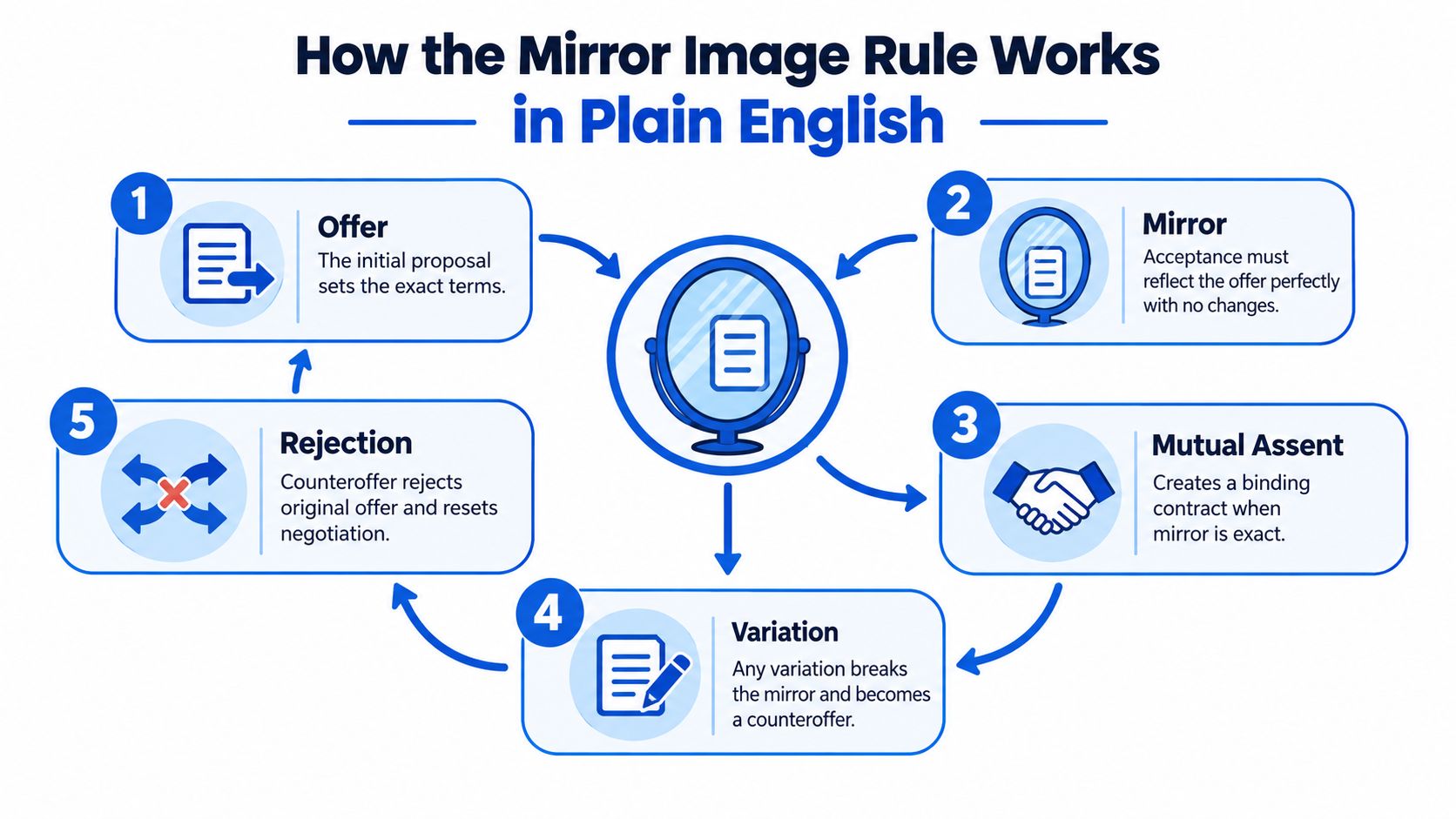
Think of an offer as a document placed in front of a mirror. The acceptance must reflect the same price, scope, timing, conditions, and other terms. A response that says “yes” while editing the document is not a perfect reflection.
The process works in a sequence:
- One party makes an offer. The offer proposes terms sufficiently definite for the other party to accept.
- The recipient reviews the terms. The recipient can accept, reject, ask a question, or propose a change.
- An exact acceptance forms the mirror. If the response accepts the offer without changing its terms, mutual assent can exist.
- A deviation changes the legal character of the response. Adding, omitting, or modifying a term can make the response a counteroffer.
- The counteroffer replaces the original offer. The original offeror can accept, reject, or make another counteroffer.
What counts as a change
A change can be obvious, such as a different price or delivery date. It can also appear in less visible language, including a new warranty disclaimer, an arbitration provision, a confidentiality obligation, or a condition that the recipient must sign an attached document.
The wording matters. “I accept the offer” generally communicates assent. “I accept, provided that the limitation-of-liability clause applies” communicates assent only if a new condition is accepted. Under common law, that conditional wording points toward a counteroffer.
A question can be different from a counteroffer. “Would the vendor consider delivery on another date?” may be an inquiry. “Acceptance is conditioned on delivery on another date” proposes a new bargain. Contract teams should preserve the exact message, attachment, and version because a later dispute may turn on the words surrounding the apparent acceptance.
Under common law, a response that changes, adds, or omits a term can be a counteroffer rather than an acceptance.
Businesses can learn more about how express agreement operates through this overview of an express contract.
Where the Rule Came From and Why It Still Matters
The mirror image rule emerged from 19th-century English common law, when commercial parties often negotiated through simpler correspondence or face-to-face bargaining. A strict exact-match test gave each side a clear answer to a basic question: did the parties assent to the same bargain?
The doctrine became firmly associated with Hyde v. Wrench (1840). A buyer responded to an offer with a proposal on modified terms. After the seller rejected that proposal, the buyer attempted to accept the original offer. The court treated the modified response as a counteroffer that extinguished the original offer. Legal summaries identify the case as a foundation of the doctrine and describe the rule as a strict test of mutual assent rather than a flexible balancing exercise. (Legal definition and history of the mirror image rule)
That historical logic is easy to understand. If a person offers to sell a particular asset at a stated price and the recipient proposes a different price, the recipient has not said yes. The recipient has asked the offeror to accept a new bargain. Treating the first offer as still open could allow a party to move between competing terms without a clear act of assent.
The modern boundary
The rule later became the default common-law position in both the United Kingdom and the United States. It remains important for transactions that fall outside UCC Article 2, including many services, real estate arrangements, and bespoke agreements.
The historical rule becomes less comfortable when businesses exchange standardized purchase orders and order acknowledgments. Commercial forms frequently contain prewritten terms drafted for different risk preferences. Applying exact-match logic to every mismatch could make a contract disappear even while both businesses order, ship, pay, and perform.
That tension explains the modern shift for sales of goods. The UCC created a more practical framework for commercial forms while leaving the common-law approach relevant elsewhere.
Common Law vs UCC Battle of the Forms
The first classification question is simple: what is being exchanged? A consulting engagement is generally analyzed under common-law principles. A transaction for movable goods may fall under U.C.C. Article 2, including Section 2-207. A blended deal, such as equipment bundled with installation and support, may require closer analysis of the transaction's dominant character and the governing agreement.
The second question is whether the response is an unequivocal acceptance or expressly conditional. Under UCC Section 2-207, a definite and seasonable expression of acceptance can form a contract even when the response includes additional or different terms, unless the response is expressly made conditional on assent to those terms. (U.C.C. Section 2-207 and battle-of-the-forms analysis)
| Scenario | Common Law Result | UCC 2-207 Result |
|---|---|---|
| Service provider accepts a proposal but changes the scope | The response may be a counteroffer, not an acceptance | UCC treatment generally doesn't govern a services transaction |
| Buyer sends a purchase order for goods and adds terms | The added terms can prevent exact acceptance | A definite and seasonable acceptance may form a contract despite added terms |
| Merchant adds a term to an acceptance | The response may terminate the original offer | The added term may enter the contract unless an exception applies |
| Offer states that acceptance is limited to its terms | Exact acceptance remains central | The limitation can prevent additional terms from becoming part of the contract |
| Offeror promptly objects to a new term | The objection reinforces that no matching acceptance occurred | Timely objection can prevent the added term from becoming part of the contract |
| New term materially alters the bargain | The changed response is generally a counteroffer | The material alteration can keep the term out of the contract |
The merchant and non-merchant distinction
Between merchants, additional terms in an acceptance can become part of the contract unless the offer limits acceptance to its terms, the new term materially alters the bargain, or the offeror objects within a reasonable time. (Text of the battle-of-the-forms framework)
If one or both parties aren’t merchants, additional terms generally receive less automatic force and may be treated as proposals requiring separate acceptance. That split prevents a business from assuming that every additional clause has the same effect in every transaction.
The UCC therefore changes the central risk. Under common law, the issue often is whether a contract formed at all. Under Section 2-207, a contract may form despite mismatched forms, and the dispute may shift to which boilerplate survives. Legal scholarship describes Section 2-207 as a response to the “battle of the forms,” moving commercial sales away from rigid exact-match logic. (Legal scholarship on the UCC response to conflicting forms)
Businesses can use an MSA agreement to establish a stable framework for recurring services, but the master agreement should still identify how purchase orders, statements of work, and later forms interact.
Mailbox Rule Timing and Offer Acceptance Disputes
Timing creates a second layer of uncertainty. A business may know that a response changed the terms, yet still disagree about whether the original offer had already been accepted, revoked, or replaced.
Under the traditional mailbox rule, an acceptance sent through an authorized method can become effective on dispatch rather than receipt. The rule is associated with Adams v. Lindsell (1818), although the application depends on the communication method, the offer’s language, and applicable law. A revocation generally raises a different timing question because receipt can matter.
Dispatch, receipt, and counteroffers
Consider a services proposal sent by email. The recipient replies, “Accepted,” and sends a second sentence changing the payment schedule. If the response is a counteroffer, the original offer is no longer the operative proposal. The timeline must then focus on whether and when the original offeror accepted the counteroffer.
A purchase-order workflow creates similar friction. A buyer sends terms, a seller sends an order acknowledgment with a warranty exclusion, and the buyer later receives the acknowledgment after goods have shipped. The parties may argue about whether the acknowledgment was an acceptance, a counteroffer, or evidence of a contract formed through conduct. A UCC goods analysis may focus on Section 2-207, while a services analysis may begin with exact matching.
Email makes the problem harder because employees often send short messages from shared accounts, automated systems generate acknowledgments, and attachments can contain terms that aren’t mentioned in the body. A procurement platform may record a click, but the business still needs to know which version the click accepted and whether another document attempted to condition acceptance.
Timing control: Every offer and response should carry a clear date, version identifier, sender, recipient, and statement of whether acceptance is effective on dispatch or receipt.
A practical review sequence
- Identify the communication: Determine whether the message is an offer, acceptance, counteroffer, inquiry, revocation, or administrative acknowledgment.
- Compare versions: Review price, scope, quantity, delivery, warranties, liability, dispute resolution, and incorporated attachments.
- Check conditional language: Flag “subject to,” “provided that,” “only if,” and similar phrases.
- Confirm authority: Verify that the employee or automated workflow had authority to bind the business.
- Preserve the record: Retain emails, attachments, click records, signature certificates, and later performance evidence.
A business facing uncertainty should use a defined contract dispute resolution process before employees make statements that could create additional ambiguity.
Common Exceptions and Modern Gaps Most Guides Miss
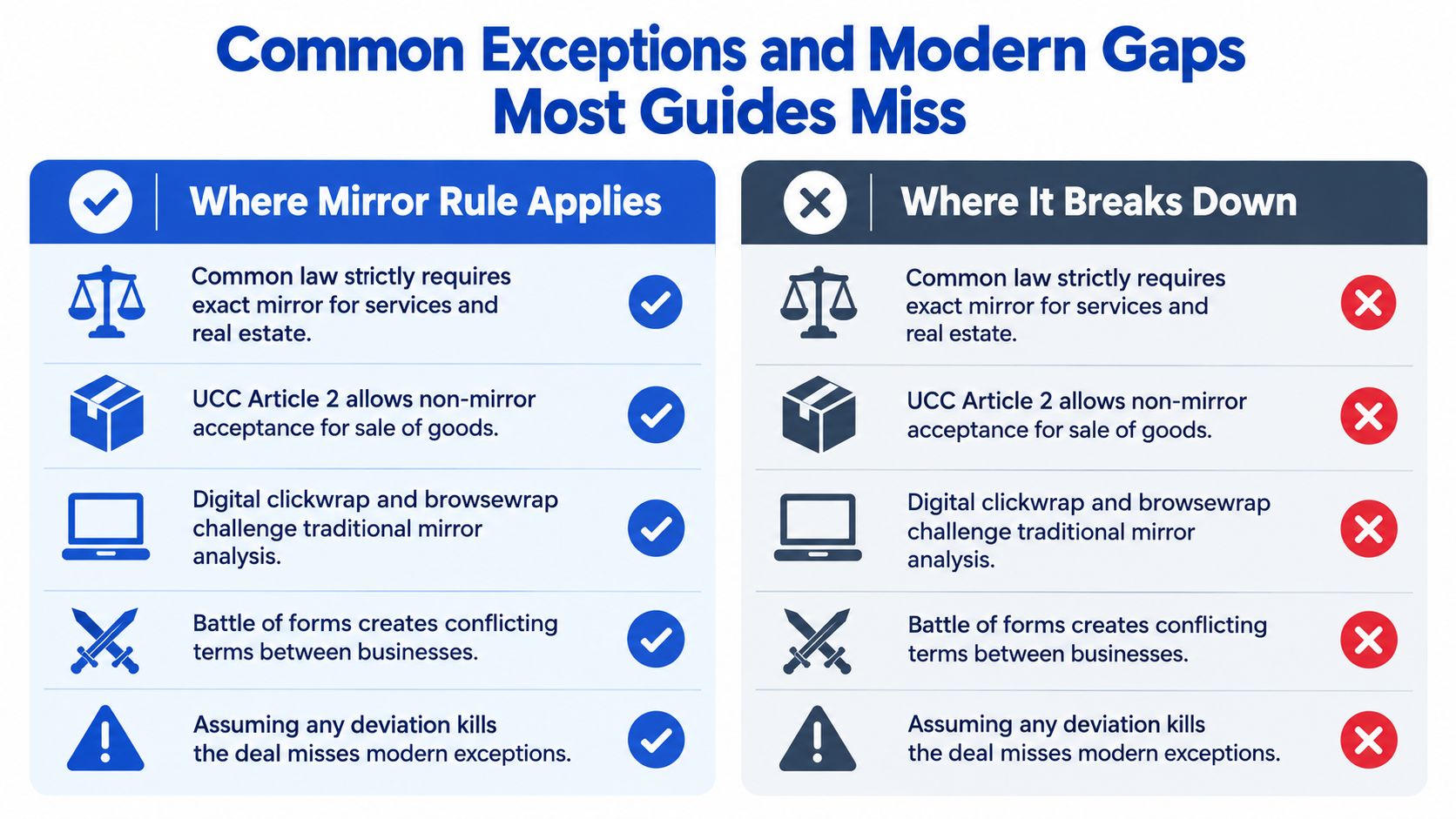
The simplest explanation of the mirror image rule says that any deviation kills the deal. That explanation is useful for common-law services contracts, but it can mislead a business buying goods. Section 2-207 can allow contract formation despite changed or additional terms, so the modern danger may be a contract formed on unexpected terms, not the absence of a contract.
The boundary problem
A founder may ask, “Does adding privacy, indemnity, or limitation-of-liability terms prevent formation?” There isn’t one answer.
For a common-law services contract, a response that makes acceptance conditional on those terms may be a counteroffer. For a sale of goods, a definite and seasonable acceptance may still form a contract, while the additional term receives separate treatment. Between merchants, the term may become part of the contract unless the offer limits acceptance, the term materially alters the bargain, or the offeror objects within a reasonable time. (Cornell Law School explanation of the mirror image rule and its UCC boundary)
The business should therefore separate two questions:
- Did a contract form?
- Which additional or conflicting terms became part of it?
That separation prevents teams from treating a disputed clause as proof that no agreement exists.
Digital contracting changes the workflow
Electronic order flows, clickwrap agreements, automated procurement, and platform terms can produce several overlapping records. A customer may click acceptance of online terms, receive an invoice containing different conditions, and later exchange an email that references a purchase order. Traditional paper-form assumptions don’t always identify the decisive act.
A digital workflow should show what the user saw, what the user accepted, which terms were incorporated, and whether the system preserved the relevant version. Washington businesses also need to distinguish a visible acceptance process from a link that users may never have encountered. The legal issue isn’t whether technology is involved. It’s whether the evidence demonstrates assent to identifiable terms.
The practical lesson is uncomfortable but useful: a company can lose control of risk without losing the contract. A supplier’s added indemnity, warranty disclaimer, or forum clause may become a serious issue after performance begins, even if nobody on the business team noticed it during intake.
Practical Tips to Draft and Manage Contracts Safely
Contract control starts before anyone types “accepted.” A business should decide whether it wants exact-term acceptance, a flexible goods workflow, or a negotiated master agreement that governs later orders. The documents and systems should then reinforce that decision.
Build the drafting controls
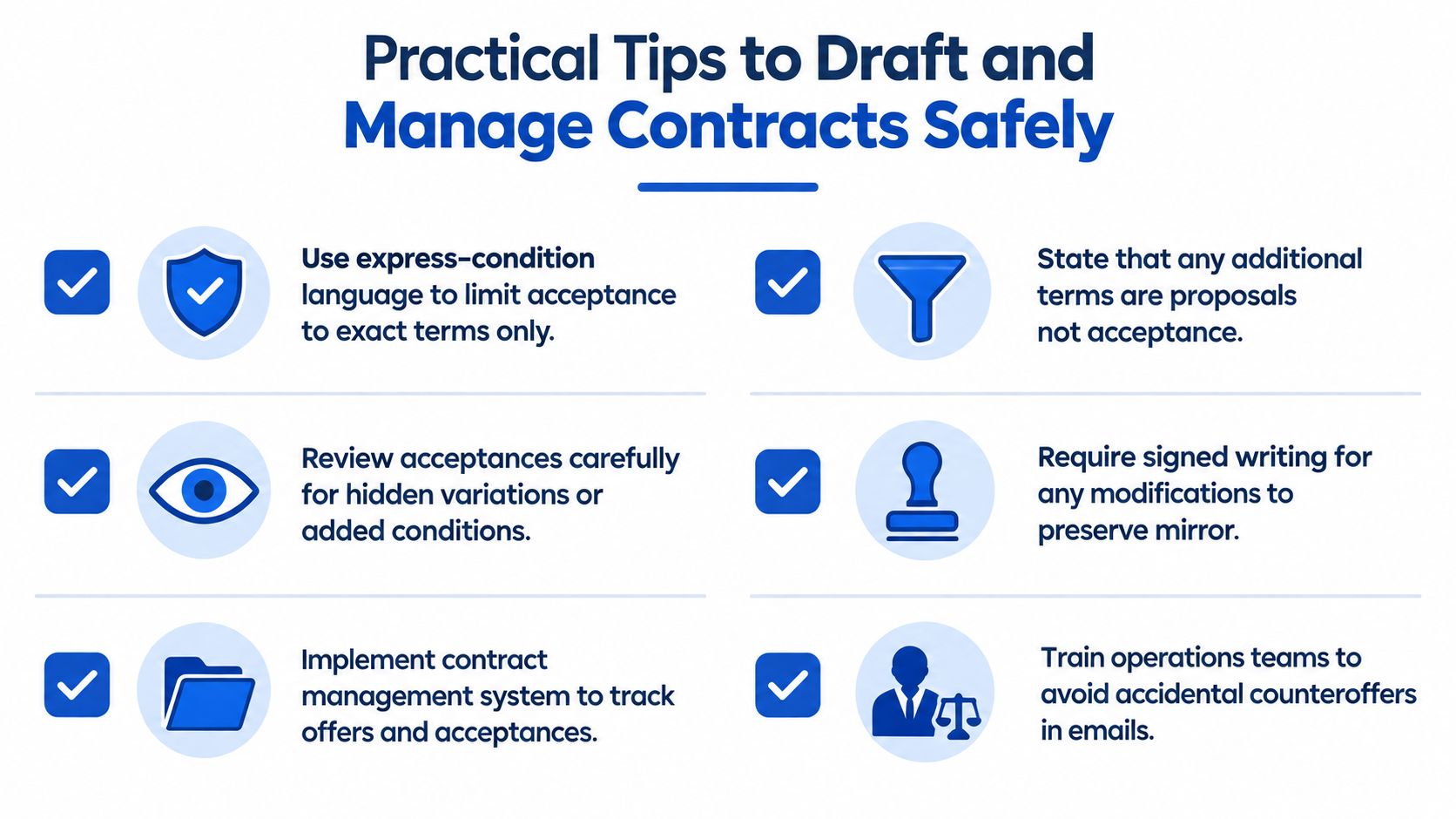
Use express-condition language. An offer can state that acceptance is limited to the offer’s terms and that acceptance is effective only through the specified method. Counsel should tailor the wording to the transaction instead of copying a clause into every form.
Separate acceptance from proposed changes. A response should not say “accepted” and then add new conditions. If a team wants to negotiate a privacy, indemnity, or liability term, it should label the response as a counterproposal and wait for documented assent.
Control form priority. Purchase orders, order acknowledgments, statements of work, online terms, and invoices should identify which document controls if terms conflict. A master agreement can establish that hierarchy for recurring relationships.
Train the operating workflow
- Review every acceptance: Compare the response with the offer, including attachments and linked terms.
- Flag material alterations: Escalate provisions affecting liability, warranties, indemnity, payment, delivery, dispute resolution, and data use.
- Object early: In goods transactions, send a clear and timely objection to unacceptable additional terms.
- Keep versions intact: Store the offer, response, revisions, signature record, and performance documents together.
- Limit email authority: Tell operations staff which employees can accept, reject, or counteroffer on behalf of the company.
- Use a contract system: A contract lifecycle platform can maintain version history and approval records, but it can’t replace legal judgment about governing law or material alteration.
A practical contract drafting guide can help teams turn these controls into repeatable templates and approval steps. For Washington transactions involving online assent, data handling, or recurring vendor forms, By Design Law Firm & Legal Consultancy, PLLC provides contract drafting, review, negotiation, dispute, and online terms support.
The durable takeaway is straightforward. For common-law agreements, treat every deviation as a potential counteroffer. For goods transactions, don’t assume a mismatch means no contract. Classify the deal, compare the forms, object to unwanted terms promptly, and preserve the evidence showing what each party accepted.
By Design Law Firm & Legal Consultancy, PLLC helps Washington founders and established businesses draft, negotiate, review, and manage contracts, including offer-and-acceptance workflows and online assent terms. Businesses dealing with conflicting forms, unexpected boilerplate, or a developing contract dispute can visit By Design Law Firm & Legal Consultancy, PLLC to request practical counsel. Contact our law office at (206) 593-1519.