A Seattle founder can spend months building a memorable business name, register an LLC, secure the domain, print packaging, and launch a website, only to receive a cease-and-desist letter from a company that already owns a federal trademark. That founder didn't necessarily make a bad business decision. The mistake was treating a business-name filing as brand protection.
Learning how to trademark a business name means treating the name as an intellectual-property asset from the start. The practical sequence is clear: search before launch, choose the right filing scope, identify the correct goods and services, submit an accurate application, respond to examination issues, and keep monitoring the mark after registration. The United States Patent and Trademark Office reported 672,691 trademark applications and 434,132 registrations in FY 2026 Q3 (USPTO trademark dashboard). A crowded register makes casual name selection increasingly risky.
Why Trademarking a Business Name Matters
A Seattle coffee roaster launches under a distinctive name after checking Washington business records. The founders invest in signage, bags, social accounts, and local advertising. Later, they discover that a Chicago café already holds a federal registration for the same or a confusingly similar name. The Washington filing didn't clear the brand, and the founders now face a choice between rebranding and defending a position that was weak from the beginning.
Trademarking isn't a single form. It's a staged clearance-and-filing decision that should answer three questions before money goes into packaging:
- What protection is needed? A name, logo, slogan, product line, or several of those assets may require separate analysis.
- Where will the business operate? A local Washington service business may start with state protection, while an online seller, software company, or expanding retailer usually needs a federal strategy.
- Is the mark already in use? A business can file based on current use in commerce or a bona fide intent to use the mark later.
A federal registration can provide nationwide priority, constructive notice, presumptive validity, access to federal court, and the ability to seek customs recordation. It also gives the owner a stronger platform for challenging later applications and marketplace misuse. Those benefits are materially different from the limited common-law rights that arise through actual use in a particular geographic market.
A Washington LLC registration or assumed business name registration doesn't create trademark rights. The National Association of Secretaries of State's explanation of business names and trademarks makes the distinction important: state approval addresses business-name records, while trademark rights concern brand use and conflicts in the marketplace. Founders should understand the broader difference between trademarks, copyrights, and patents before selecting the protection that matches the asset.
Practical rule: A state filing can help a business operate under a name. It doesn't prove that the name is available as a trademark.
Clearing the Name Before You File
The cheapest trademark mistake to prevent is the one made before launch. A founder should run a quick knockout search before ordering signs, filing an application, or announcing the name publicly.
Start with obvious conflicts
The first pass can be practical and fast. Search the proposed name in Google, social platforms, app stores, domain records, trade publications, and Secretary of State business registries. Search exact matches, plural forms, abbreviations, alternate spellings, and obvious phonetic variations. A business that finds an active competitor selling related goods under a nearly identical name shouldn't pay a filing fee first and investigate later.
A domain search isn't a trademark search, but it can reveal earlier commercial use. Social handles and app listings can expose unregistered users that won't appear in a federal database. A useful reference for organizing the online portion of this review is Domain Drake's guide on how to run a trademark check.
Search the federal record correctly
The USPTO's trademark database, historically known as TESS and now accessed through the agency's current search tools, requires more than typing the exact name into a search box. Review live and dead records, then compare:
- Sound: Would customers pronounce the names similarly?
- Appearance: Do the words share a distinctive visual structure?
- Meaning: Do they convey the same commercial idea?
- Commercial relationship: Would customers expect the goods or services to come from the same source?
The relevant question isn't whether two marks are identical. It's whether their similarities and commercial relationship create a likelihood of confusion. The USPTO case-file documentation identifies likelihood of confusion as the most common refusal ground, and the agency's dataset reported that about 8.3% of applications ended in a final refusal after examination responses were exhausted (USPTO case-file documentation).
Check common-law use
The USPTO examiner won't perform every marketplace investigation for an applicant. A founder should look for unregistered trade names, industry directories, product listings, local news, domain ownership records, and social accounts. An earlier user may have common-law rights even without a federal registration.
Cybersquatting is a separate problem from trademark infringement, but a domain obtained in bad faith can create another layer of cost and dispute. Founders dealing with a domain that appears to target their brand should understand what cybersquatting is before sending a demand.
Counsel becomes worth the cost when the search returns a federal hit, the relevant class is crowded, the proposed name is descriptive, or the launch investment is substantial. A legal review can identify related marks and common-law uses that a basic exact-match search misses. It also gives the founder a reasoned decision to proceed, modify the name, narrow the goods and services, or abandon the name before public investment compounds.
Federal vs State Registration Compared
Washington State registration and USPTO registration serve different purposes. The right choice depends on the market the business serves, not where the founders formed the company.
| Dimension | USPTO Federal Registration | Washington State Registration |
|---|---|---|
| Geographic scope | Nationwide rights connected to the registered goods or services | Rights limited to Washington State |
| Priority | Constructive nationwide use and stronger priority against later users | State-based priority under the state system |
| Eligibility | Actual use in interstate commerce or a bona fide intent to do so | Useful for businesses operating within Washington that don't yet fit a federal strategy |
| Enforcement | Federal courts, TTAB proceedings, and broader enforcement tools | Washington administrative and state-court remedies |
| Commercial value | Better suited to online, national, licensing, franchising, and expansion plans | Practical for a genuinely local operation |
| Duration and renewal | Requires continuing declarations and periodic renewals | Governed by Washington renewal rules and filing requirements |
| Strategic role | Usually the primary registration for a mark with interstate ambitions | A limited state option or supplemental layer where appropriate |
Federal registration offers nationwide constructive use, presumptive validity, access to federal courts, and access to the Trademark Trial and Appeal Board. Those benefits don't eliminate the need for actual use or a properly supported intent-to-use application. The federal register also doesn't give an owner unlimited rights across every industry. The registration remains tied to the listed goods and services.
Washington registration can make sense for a purely local business that can't yet show interstate commerce and has no immediate expansion plan. A neighborhood service provider with a narrow geographic market may value a state filing while validating demand. But a business selling online, shipping across state lines, licensing its name, or seeking outside investment should usually assess federal filing first.
A mark that qualifies for both paths will usually gain more value from federal registration. State registration rarely adds meaningful power when a federal registration already covers the same mark and commercial activity. Founders should avoid confusing speed with protection. A quick state filing can coexist with a federal strategy, but it can't substitute for federal clearance when the business is already operating across state lines.
Choosing the Right Trademark Classes
Class selection defines the commercial territory your registration covers. The USPTO uses the 45-class Nice classification system, with goods generally in Classes 1 through 34 and services in Classes 35 through 45. A strong name filed in the wrong class can leave the business exposed where customers encounter the brand.
Match the filing to the business
Choose classes based on revenue-generating activity, not every possible future idea. A Seattle coffee roaster selling packaged beans may consider Class 30. A café providing food and drink services may consider Class 43. If the same brand covers both activities, a multi-class application may make sense. If the company sells beans only, adding unrelated classes creates extra cost and can make the application harder to support.
Use the USPTO's Acceptable Identification of Goods and Services Manual to draft the description. Select wording that accurately reflects what the business offers and use accepted language where possible. Free-form descriptions can create extra fees. The USPTO's fee information explains that incomplete applications and lengthy free-form identifications may cost more, but those fees should be checked in the filing section because the fee page is cited there.
| Class | Type | Covers | Sample ID Wording |
|---|---|---|---|
| 30 | Goods | Coffee, tea, baked goods, and other food products | Packaged coffee |
| 35 | Services | Retail, advertising, business management, and online retail services | Online retail store services featuring coffee |
| 41 | Services | Education, training, and entertainment | Providing online non-downloadable training |
| 42 | Services | Software, technology, and design services | Software as a service featuring business management software |
| 43 | Services | Restaurants, cafés, and hospitality | Café services |
A multi-class application can cover distinct activities under one mark, but each added class creates another filing and maintenance obligation. File in one class when the business has one established offering. Add another class when the second activity is real, commercially important, and supportable with evidence.
Relatedness also affects risk. Coffee beans and café services may be commercially connected, while coffee and unrelated construction services usually are not. Similar names create a stronger conflict when customers could reasonably expect the goods or services to come from one source. Class selection is therefore part of clearance strategy, not an administrative checkbox.
Build the evidence package
A goods specimen may be a label, product package, tag, or point-of-sale display showing the mark with the goods. A service specimen may be an advertisement, webpage, or screenshot that connects the mark to the services. The specimen must show genuine commercial use. A mockup created solely for filing will not do the job.
Founders preparing a logo alongside a name should review how to trademark a logo. Protecting the wording and protecting the design can require separate applications, specimens, and evidence. Decide which version customers recognize, then build the filing around that actual use.
Filing a TEAS Application With the USPTO
The filing basis controls both the evidence required and the timing strategy. A founder who is already selling goods or providing services in interstate commerce may use Section 1(a). A founder with a real brand and a bona fide plan to launch, but without qualifying current use, may consider Section 1(b).
Section 1(a) requires actual use in commerce and a specimen showing that use. Section 1(b) reserves the application position based on intent to use, but registration won’t issue until the applicant later proves use and satisfies the related requirements. Filing intent too casually is a bad strategy. A pivot can leave the application attached to a brand the company no longer intends to build.
The application should identify the owner accurately, depict the mark clearly, identify the filing basis, list the goods and services, provide dates of first use when required, attach the specimen for a use-based filing, and include the verified declaration. The owner should be the entity that controls the brand, not an individual founder by accident.
Understand current filing costs
Current USPTO materials require careful attention because fee labels and application requirements can change. The agency’s fee information lists a $350 base electronic fee per class for an application meeting the base requirements (USPTO trademark fee information). The USPTO fee schedule lists $850 per class for paper filings, compared with $350 per class for electronic Section 1 or Section 44 applications (USPTO fee schedule).
The application cost is only part of the budget. Counsel fees vary with the search, number of classes, ownership structure, evidence, and refusal risk. A straightforward filing may be manageable without counsel, while a crowded name or multi-class launch justifies paying for clearance and application drafting rather than treating the government form as the entire legal task.
Track the filing after submission
The USPTO issues a filing receipt, assigns the application for examination, and communicates through the application record. The agency’s current timeline page shows new applications reaching a first examining action in roughly 4.2 months, with average time to registration or abandonment around 9.7 months (USPTO application timeline).
Those are processing averages, not promises. An office action, amendment, opposition, incomplete specimen, or intent-to-use follow-up can extend the process. Founders who want a plain-language overview of the sequence can review this trademark process explained, then verify the current requirements directly in the USPTO application system.
Handling Office Actions and Oppositions
An office action is a formal communication from the examining attorney. It doesn’t necessarily mean the application is doomed. It means the USPTO has identified a substantive refusal, a procedural defect, or a requirement that must be addressed before the application can advance.
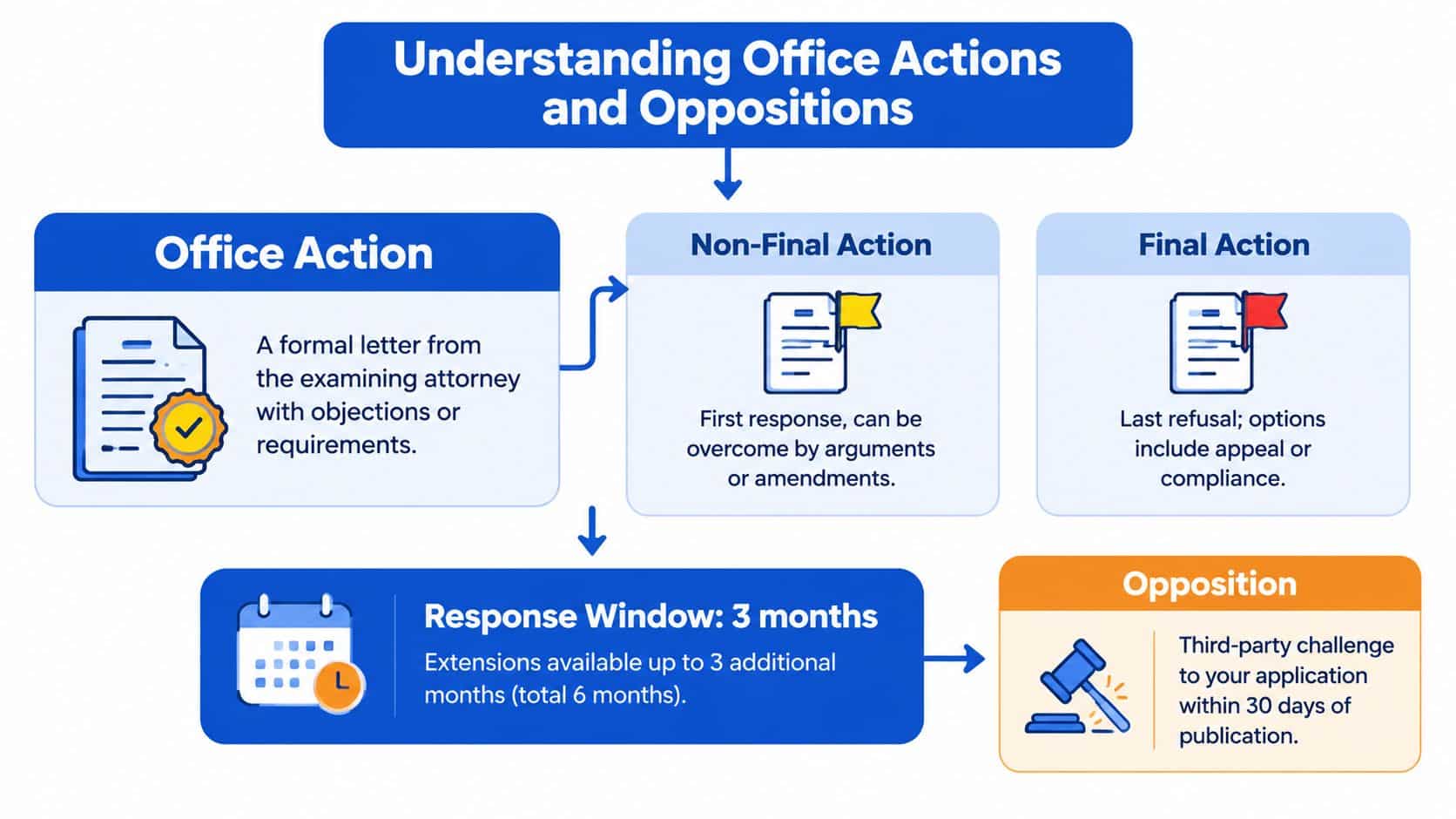
A non-final action gives the applicant an initial opportunity to respond. A response might amend the identification, provide a substitute specimen, clarify ownership, submit an argument, or add a disclaimer for matter that can’t function independently as a source identifier. A final action means the examiner maintains the refusal after the response, although the applicant may still have appeal, amendment, or other procedural options.
Common substantive issues include:
- Likelihood of confusion under Section 2(d): An earlier mark may be similar in sound, appearance, meaning, or commercial context.
- Mere descriptiveness under Section 2(e)(1): The wording may directly describe an ingredient, feature, function, or characteristic.
- Failure to function: The matter may appear ornamental, informational, or otherwise fail to identify a single source.
- Specimen defects: The evidence may not show the mark used with the identified goods or services.
- Declaration problems: The application may contain an unsigned or inaccurate verification.
The response deadline is generally three months, with an extension available for up to three additional months for a fee. Missing the deadline can abandon the application. An applicant should never respond by arguing every point reflexively. The better question is whether a narrower identification, stronger specimen, disclaimer, consent arrangement, or focused legal argument creates a defensible path.
After approval, the mark is published in the Official Gazette. Third parties generally have 30 days to oppose or request an extension. A challenge proceeds before the Trademark Trial and Appeal Board, where the parties address pleadings, discovery, evidence, and briefing.
A coexistence agreement can resolve a legitimate conflict when the parties’ markets, channels, and branding can be separated. An amendment may solve a scope problem, but it can’t erase a conflicting name. If the cited mark is strong and the business hasn’t invested heavily, withdrawal and rebranding may be the financially disciplined choice. Counsel becomes particularly valuable when the refusal threatens a core brand or when an opposition could affect launch timing.
Maintaining and Enforcing Your Registration
Registration starts the ownership work. The owner must keep using the mark, file maintenance documents, monitor conflicting applications, preserve evidence, and decide when enforcement matches the commercial risk. A registration gives you a stronger position, but it does not watch the market or protect itself.
Put the maintenance calendar on the company calendar
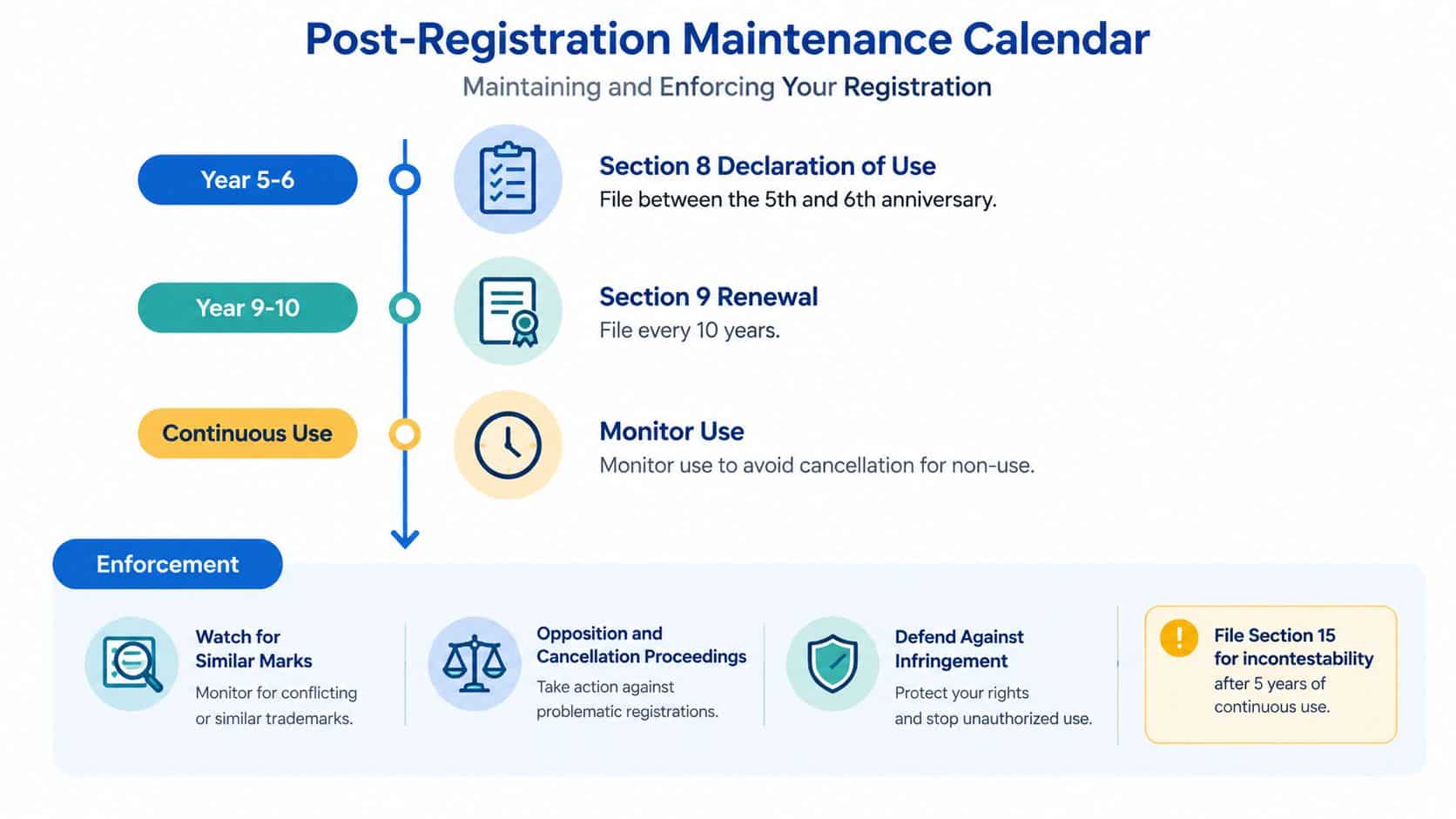
Federal registration requires recurring filings. The Section 8 declaration of use is due between the fifth and sixth anniversaries. The Section 9 renewal is due at 10 years and every 10 years thereafter. At the 10-year milestone, the owner files the combined Section 8 and Section 9 documents. Each filing requires evidence showing continued use for the covered goods or services, subject to the applicable rules and available exceptions.
The listed government fees create real exposure. The Section 8 filing carries a $225 per-class fee, and the Section 9 renewal carries a $525 per-class fee under the stated fee schedule and filing context. Missed deadlines can cause cancellation or loss of the registration. Track these dates independently of any outside lawyer or filing service, and keep a copy of each submission and specimen with the company’s brand records.
Review the identification before every maintenance filing. If a listed good or service is no longer in use, keeping it on the registration creates accuracy and vulnerability problems. A clean portfolio is more useful than a broad list the company cannot support. The filing should describe the business the company operates, not an old product roadmap.
Monitor before a dispute becomes expensive
Monitoring should match the brand’s exposure and sales channels. A practical program can include USPTO TSDR review, trademark watch services, domain and social-handle sweeps, marketplace searches, and Google Alerts for the exact mark, common misspellings, and distinctive portions of the name.
Watch both new applications and marketplace use. A later applicant may create a problem before the allegedly infringing product reaches a major retailer. Early discovery preserves more choices, including a warning letter, negotiated coexistence, opposition, platform complaint, or a quiet decision to tolerate low-risk use.
The registration creates legal standing, but only an owner who watches the market can use that standing in time.
International sales require a separate clearance plan. The Madrid System shows how widely trademark filings can extend across borders. WIPO reported about 64,150 international trademark applications and 63,001 international registrations in 2025, with U.S.-based applicants filing 10,997 applications, the highest national total. About 80% of international applications covered one to three classes, and active international registrations reached 943,000 by 2025 (WIPO Madrid Yearly Review 2026 executive summary). A founder planning international sales should clear foreign rights before assuming a U.S. registration applies automatically elsewhere.
Escalate enforcement in stages
A cease-and-desist letter should identify the registration, describe the confusing use, preserve a professional tone, and request specific action. Do not overclaim rights outside the registered goods, services, or relevant geographic context. Avoid factual allegations the owner cannot prove, and preserve screenshots, purchase records, dated advertisements, and customer confusion evidence before sending the letter.
The response options generally escalate:
- Marketplace action: Amazon Brand Registry and Etsy reporting tools may address listings that misuse the mark or create customer confusion.
- Direct resolution: A warning, coexistence agreement, license, or rebrand may resolve a manageable conflict.
- TTAB action: A pending application can create a 30-day opposition window after publication, so monitoring must include the Official Gazette.
- Federal litigation: A serious infringement dispute may warrant action under 15 U.S.C. § 1114, particularly when the registration, evidence, and commercial harm support the expense.
A registered mark left undefended can face abandonment arguments or challenges based on nonuse, genericness, or improper control. The owner can also weaken the mark by licensing it without quality control. License agreements should define the permitted goods, channels, territory, quality standards, inspection rights, and consequences for noncompliance.
Avoid the recurring landmines
The three traps deserve a direct answer.
First, a Washington LLC or trade-name registration does not create trademark rights. It establishes a state record and may address name uniqueness within that system, but it does not clear marketplace conflicts or give the owner federal priority.
Second, filing too early can waste strategic attention. A Section 1(b) intent-to-use application can reserve a path for a genuine planned launch, but a startup that pivots may spend time and money protecting a name it abandons. File promptly when the name is central, the launch is funded, and clearance supports the choice. Waiting may make sense while the business tests several identities, but delay increases exposure to later adopters.
Third, registration is not the finish line. The owner has a continuing 10-year maintenance commitment, recurring evidence obligations, and an enforcement program to run. Treat those responsibilities as part of the brand budget from the start.
Other risks include genericness, which can prevent exclusive ownership of a category term without acquired distinctiveness; descriptiveness refusals under Section 2(e); surname-based refusals; likelihood-of-confusion citations involving phonetically similar live marks; and uncontrolled licensing. These issues should shape the name before the application, rather than become emergency problems after launch.
Use a founder-ready action plan
- Clear the name: Search federal, state, marketplace, domain, social, and common-law sources.
- Consult counsel when risk is visible: Escalate when a live similar mark, crowded class, or major launch investment changes the stakes.
- Select the classes: Match the filing to current goods and services, with expansion decisions made deliberately.
- Prepare specimens: Gather genuine packaging, labels, advertisements, or service webpages that show the mark in context.
- File electronically: Use accurate ownership, acceptable identification wording, dates, basis, and verification.
- Calendar Sections 8 and 9: Record the fifth-to-sixth-anniversary window and the 10-year renewal cycle.
- Monitor continuously: Use USPTO records, marketplace searches, domain and social checks, and alerts for variations.
Washington founders should verify Secretary of State standing separately from trademark status. For trademark infringement concepts and enforcement decisions, use the overview as general context, then obtain advice specific to the mark, markets, and evidence when a live conflict appears.
By Design Law Firm & Legal Consultancy, PLLC helps founders plan clearance searches, select trademark classes, prepare filing strategies, respond to USPTO issues, and manage brand enforcement after registration. Visit By Design Law Firm & Legal Consultancy, PLLC to discuss a business-name trademark strategy before launch investments make a rebrand more expensive. Contact our law office at (206) 593-1519.