Trademark infringement is the unauthorized use of a trademark or service mark in a way that's likely to cause confusion about who makes, sponsors, or sells the goods or services. In 2020, 11,941 trademark infringement lawsuits were filed in the United States, plaintiffs won about 55% of them, and the highest damages award in a single trademark case in 2023 reached $190 million.
A Washington business owner usually learns what trademark infringement is in a very practical way. A new Seattle software company launches under a name it loves, invests in a logo, secures a domain, starts running Google Ads, and then notices another company using a name that sounds close enough to trigger customer mix-ups. Sales calls get misdirected. LinkedIn messages land in the wrong inbox. A buyer asks whether the two companies are affiliated.
That's the core problem. Trademark infringement isn't about hurt feelings or ownership of a word in the abstract. It's about marketplace confusion. If consumers are likely to think another company's product, website, app, or service is connected to the brand they already know, the law may step in.
For companies in Washington, this issue shows up everywhere: SaaS naming, Amazon listings, food packaging, apparel drops, franchise expansion, and search results. It also shows up earlier than many founders expect. By the time a copycat appears, the business has often already tied its reputation to the mark.
Protecting Your Brand from Copycats
A founder in Seattle launches a line of wellness drink mixes under a polished new brand. Packaging is printed. Influencer samples go out. Then a competitor appears with a pouch design and name that feel uncomfortably close. Customers don't write legal memos when this happens. They ask a simpler question: “Is this the same company?”

That reaction is why trademark law exists. A trademark identifies source. It tells buyers who stands behind the product or service. When another business uses a similar mark in a way that's likely to confuse buyers about source, sponsorship, or affiliation, that's the legal problem.
Why this matters beyond one local dispute
This isn't a niche issue limited to big consumer brands. The economic scale of infringement is enormous. The global trade of counterfeit trademark goods was estimated at more than USD 464 billion in 2019, making up 2.5% of total world trade, according to Michigan State University's anti-counterfeiting analysis.
That number matters because it reframes the question. Trademark infringement isn't just a branding annoyance. It's part of a much larger commercial risk environment where copycats, counterfeiters, and opportunistic competitors exploit goodwill that someone else paid to build.
Practical rule: If another brand makes buyers stop and wonder whether the two businesses are connected, the issue deserves immediate review.
What business owners often miss
A mark doesn't have to be identical to infringe. Slight spelling changes, sound-alike names, similar logos, overlapping packaging cues, or closely related services can all create legal exposure.
A startup choosing a logo should think about names and visual identity together. Businesses that are still at the early build stage often benefit from a disciplined process for trademarking a logo, not just designing one that looks good on a website.
Common situations that deserve attention include:
- Similar business names: A new consulting firm chooses a name that sounds like an existing Washington company.
- Lookalike packaging: Competing product labels copy the same color palette, layout, and product naming style.
- Marketplace listings: A seller uses a rival's brand name to attract searches on Amazon or another platform.
The Foundation of Your Trademark Rights
Before a company can accuse someone else of infringement, it needs rights worth enforcing. In the United States, those rights usually arise in two ways: through actual use in commerce and through federal registration.
The distinction matters. Many founders assume forming an LLC or buying a domain secured the brand. It didn't. Corporate filings and domain registrations serve different functions. Trademark rights come from brand use, and much stronger enforcement tools come from registration.
Common law rights start with use
A business can develop common law trademark rights by using a mark in commerce for goods or services. In practical terms, that means the mark isn't just sitting in a pitch deck or Figma file. It appears in the marketplace where customers encounter it.
For a Washington SaaS company, that may mean the mark appears on a live product, pricing page, or service offering sold to customers. For a coffee roaster, it may mean the mark is on bags, menus, and point-of-sale materials connected to actual sales.
Common law rights can be valuable, but they're often narrower and harder to enforce. They tend to track the geographic area and market presence the business has built.
Federal registration changes the enforcement posture
The USPTO states that trademark infringement requires a plaintiff to prove valid ownership of the mark, priority of rights, and a likelihood of confusion among consumers regarding source or sponsorship, as explained on the USPTO's trademark infringement page. Registration helps with the first two points in a concrete way.
If a mark is listed on the Principal Register, that gives the owner important procedural advantages. Thomson Reuters notes that in litigation, plaintiffs may need to show that Principal Register listing to establish the legal presumption of validity and exclusive nationwide rights, and it estimates that trademark lawsuits going to trial cost between $375,000 and $2 million and usually take at least one year to conclude, according to its trademark litigation overview.
That's why federal registration is usually the smarter long-term move for a growth-oriented business.
A practical comparison
| Rights source | What it gives a business |
|---|---|
| Use in commerce | Localized rights based on actual marketplace use |
| Federal registration | Stronger nationwide enforcement position and procedural advantages |
| Both together | A much sturdier brand asset for investment, licensing, and disputes |
Businesses often treat trademarks as marketing decisions first and legal assets later. The market usually punishes that order of operations.
A broader understanding of where trademarks sit within a company's legal strategy helps. For owners sorting out patents, copyrights, trade secrets, and marks at the same time, this overview of intellectual property rights types is a useful starting point.
Proving Infringement The Likelihood of Confusion Test
A court does not decide trademark infringement by checking one detail in isolation. It compares the overall commercial impression and asks a practical question. Are buyers likely to believe the goods or services come from the same source, are connected, or are approved by the same business?
That standard matters in Washington because federal courts here apply the Ninth Circuit's likelihood of confusion analysis, usually through the Sleekcraft factors. No single factor controls every case. In practice, the analysis works more like a weighted checklist than a math formula, and the factors that matter most often depend on how the business reaches customers.
Harvard's discussion of trademark doctrine explains that trademark infringement is established by the likelihood of confusion standard, and evidence of actual confusion is powerful but not required if other factors strongly suggest a likely misunderstanding. That framework appears in its overview of the confusion standard.
A useful way to approach this is to ask how a customer encounters the brands in real life. On a phone screen. In an Amazon search result. In a Google ad. On packaging seen for two seconds at retail. Businesses often defend a case by pointing out small differences they can see side by side in a conference room. Courts care more about what a customer is likely to remember in the market.
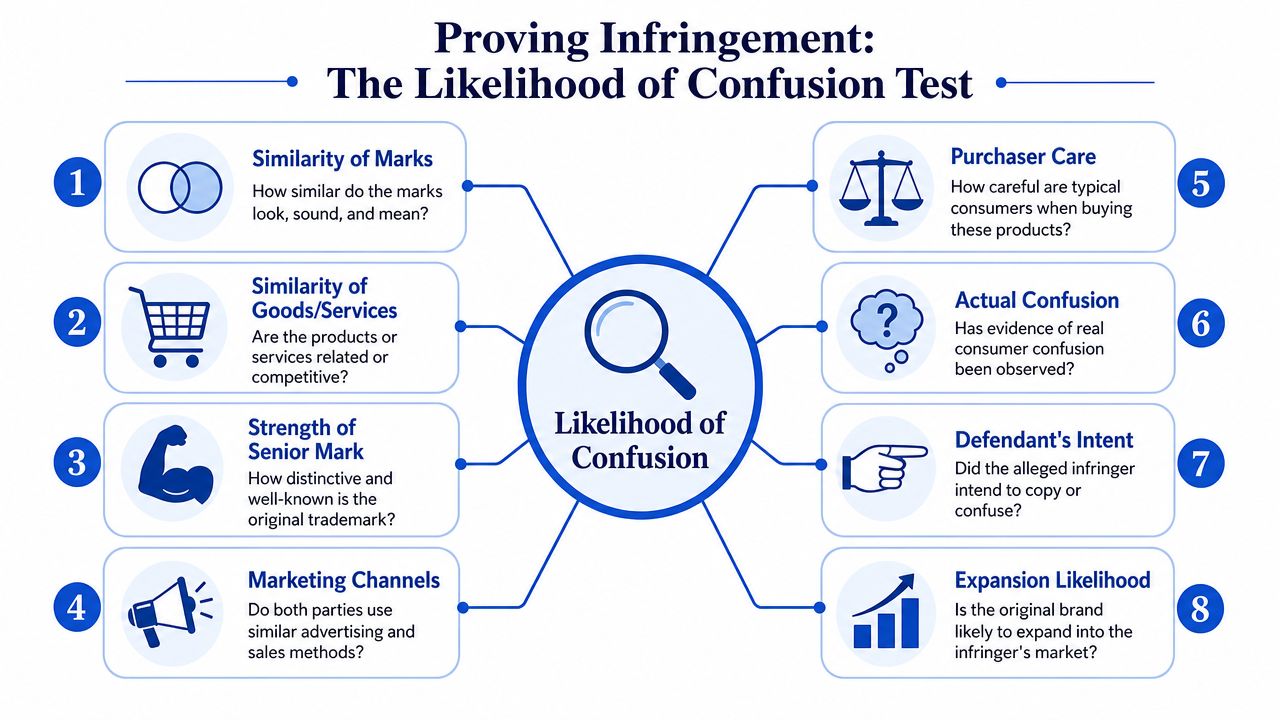
The Ninth Circuit factors in plain English
| Factor | What it Means |
|---|---|
| Similarity of Marks | How similar the marks look, sound, and mean in the market |
| Similarity of Goods or Services | Whether the products or services are related enough that buyers could assume a connection |
| Strength of Senior Mark | Whether the earlier mark is distinctive and memorable |
| Marketing Channels | Whether both businesses reach customers in the same places, such as Amazon, Instagram, retail shelves, or trade shows |
| Purchaser Care | How careful the typical buyer is likely to be before purchasing |
| Actual Confusion | Whether there is real-world evidence such as mistaken emails, wrong-number calls, or customer comments |
| Defendant's Intent | Whether the later user appears to have copied on purpose or tried to trade on goodwill |
| Expansion Likelihood | Whether either business is likely to expand into the other's market space |
A quick visual can help frame how these pieces fit together:
What these factors look like in an actual dispute
Similarity is rarely just a spelling exercise. If two names share the dominant term, target the same buyers, and show up in the same online channels, small differences in font or wording may not save the junior user. I often tell clients to stop asking, “Can we spot differences?” and start asking, “Would a rushed customer assume a connection?”
Marketing channels have become more important as disputes move online. If both brands compete through Amazon listings, Instagram ads, search ads, and Shopify stores, overlap in channels can push a case closer to infringement even when the packaging is not identical. The same point applies to what I would call invisible infringement. A competitor may use your mark in page titles, ad keywords, meta descriptions, or marketplace copy to intercept buyers before they ever see a storefront sign. That conduct does not always create liability by itself, but in the right case it becomes strong evidence that confusion is likely or that the user intended to capture your traffic.
Purchaser care can cut both ways. A knowledgeable industrial buyer making a six-figure purchase usually investigates carefully. A consumer buying coffee, cosmetics, supplements, or apparel on a phone may spend seconds, not minutes, on the decision. Lower-cost, impulse-driven sales usually carry more confusion risk.
Evidence that helps, and evidence that usually falls flat
Evidence that helps:
- Customer mix-ups: Misaddressed emails, confused inquiries, mistaken reviews, or screenshots.
- Side-by-side branding records: Product pages, labels, ad copy, app store listings, and metadata.
- Channel overlap: Both companies sell through the same marketplaces, social platforms, or retailer networks.
- Search and platform evidence: Keyword ads, SEO copy, backend marketplace fields, and archived webpages showing how the junior user captured branded traffic.
Evidence that often disappoints:
- Only saying the marks “feel similar”: Courts want specifics tied to appearance, sound, meaning, and market context.
- Focusing on one shared word in isolation: The whole commercial impression matters.
- Waiting too long to preserve proof: Search ads, listings, and webpages change quickly.
- Treating intent as required: Deliberate copying helps, but a plaintiff can still win without proving bad motive.
For e-commerce sellers, registration and infringement analysis often intersect with platform enforcement. Businesses considering filing a trademark for Amazon Brand Registry are usually trying to do two things at once: strengthen legal rights and improve day-to-day control over listings, takedowns, and counterfeit complaints.
Real-World Examples of Infringement
A good infringement analysis usually gets clearer when it leaves legal jargon and returns to the market. Consider a Seattle coffee roaster called “Emerald City Roasters.” A new café opens under “Emerald Coffee House” and begins selling packaged beans online. The names aren't identical. Still, they share a dominant term, operate in a related market, and target overlapping buyers.
That doesn't automatically mean infringement. A lawyer would still ask practical questions. Are the logos close? Are both companies selling in the Puget Sound region? Have customers or wholesale buyers mixed them up? Does one brand have stronger distinctiveness than the other?
A classic storefront example
Suppose the original roaster has used its mark consistently on bags, menus, event banners, and a Shopify storefront. The newer café adopts a script logo, green-and-gold packaging, and a product page optimized around “Emerald” coffee subscriptions.
In that setting, several risk signals line up:
- Related goods: Both sell coffee products.
- Overlapping channels: Online orders, local retail, and social media.
- Commercial impression: Similar naming plus similar presentation.
A close case often turns on evidence. If a distributor emails the wrong company or customers tag the wrong Instagram account, that can matter.
Invisible infringement online
Some of the most important trademark problems aren't visible at all. Berry Moorman describes “invisible trademark infringement” as a rising issue where competitors use a brand's mark in hidden meta-tags or code to manipulate search engine results and divert traffic, creating confusion algorithmically even if consumers never see the mark on the page, in its discussion of hidden online use.
That matters for Washington companies that depend on organic search, paid search, and marketplace discovery. A competitor might not copy the logo on the front end. Instead, it may use the brand name behind the scenes in page metadata, source code, or search-facing signals to intercept demand.
A business can lose customers before the buyer ever reaches the website. That's why screenshots, cached pages, and search-result captures often matter as much as packaging photos.
A modern tech example
Take a Bellingham software company with a registered product name. A rival launches a landing page that never visibly uses the product name, but the HTML title tag, meta description, and hidden page elements include that mark. Those seeking the original company begin seeing the rival's page.
That's not the old-fashioned counterfeit problem. It's still a trademark problem if the use creates marketplace confusion or wrongfully diverts traffic by exploiting the earlier brand's goodwill.
Common Defenses to Infringement Claims
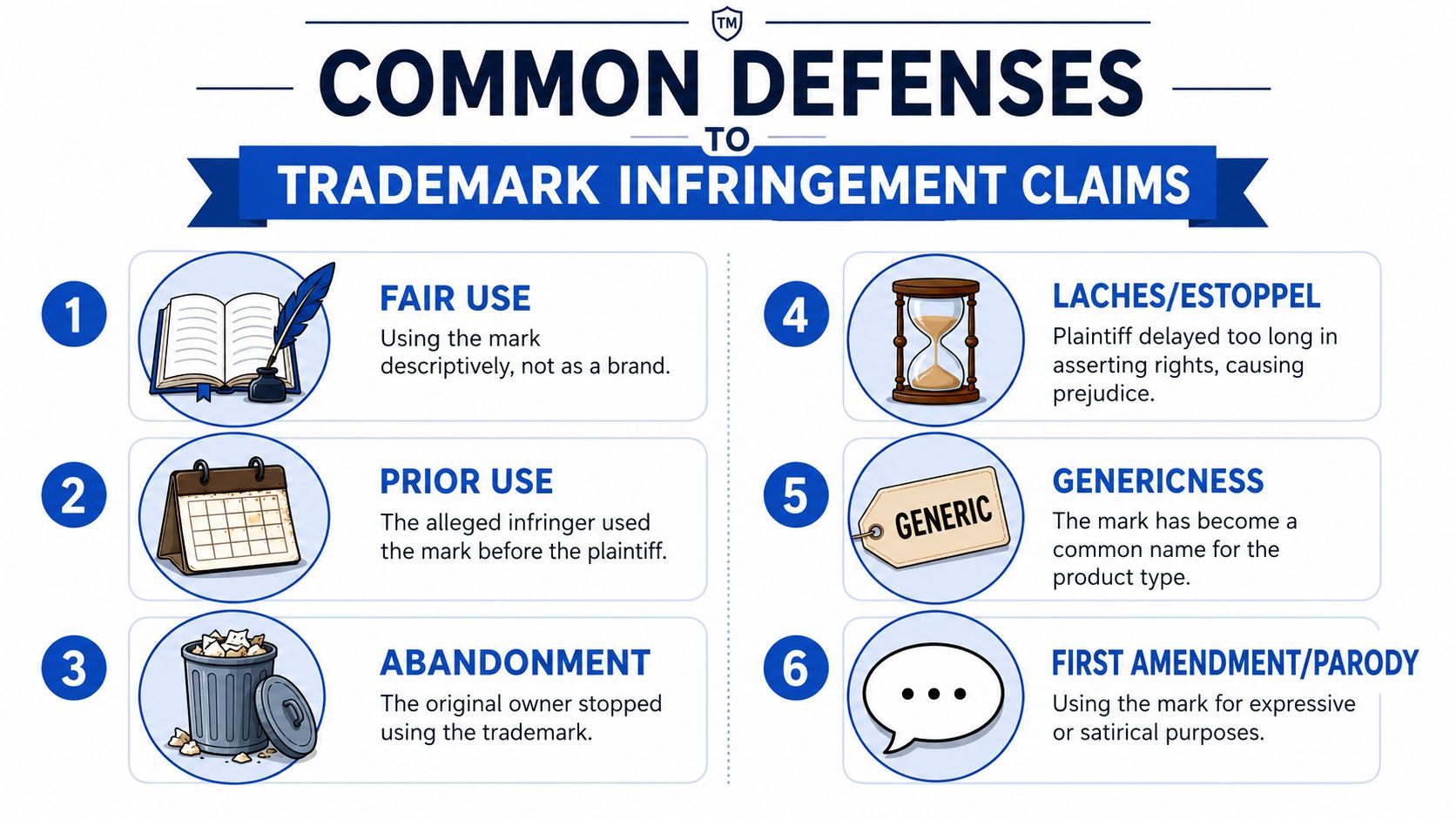
Not every use of someone else's mark is unlawful. Businesses that overreact can damage their credibility, escalate ordinary disputes, and spend money chasing weak claims. A sound enforcement strategy includes knowing when the other side may have a legitimate defense.
The accused party usually bears the burden of proving affirmative defenses. Even so, a brand owner should evaluate them early before sending demands that overstate the case.
Fair use and descriptive use
A company may use a term descriptively rather than as a trademark. If a business uses ordinary language to describe its own product rather than to indicate source, that may be lawful.
Nominative fair use is different. That applies when someone needs to refer to the actual brand to identify it, such as repair services for a named product, compatibility references, or some forms of comparison advertising. The key question is whether the user is referring to the brand or trying to pass off its own goods as connected to that brand.
Prior use and abandonment
A plaintiff doesn't win just by being louder or better funded. If the defendant used the mark first in the relevant market, priority may favor the defendant.
Abandonment can also matter. If a trademark owner stopped using the mark and didn't maintain rights, an infringement claim may weaken substantially.
Delay, genericness, and speech defenses
Some defenses don't focus on the mark itself but on the plaintiff's conduct or the broader legal context.
- Laches or estoppel: The trademark owner waited too long and that delay prejudiced the defendant.
- Genericness: The claimed mark became the common name for the product type, not a source identifier.
- Parody or expressive use: The use may be protected because it comments on, criticizes, or artistically references the mark rather than competing in a confusing commercial way.
An important modern wrinkle involves speech and expressive works. The interaction between trademark law and free expression has become more contested in digital and AI-related settings. The American University Law Review discusses those tensions in its analysis of raising the threshold for trademark infringement to protect free expression.
Caution: A weak infringement claim can invite a strong response, especially where parody, commentary, or comparative reference is involved.
Enforcement and Remedies What Are the Stakes
A valid infringement claim needs a business answer, not just a legal answer. The first remedy most owners want is simple: stop the other side from using the mark. In trademark litigation, that usually means injunctive relief, a court order requiring the infringing use to stop.
Money can also be on the table. Depending on the facts, courts may award the plaintiff the defendant's profits, actual damages, and in bad-faith cases potentially enhanced damages and litigation costs, as outlined in Trestle Law's discussion of trademark infringement elements and bad faith remedies.
The numbers explain why early action matters
Trademark disputes are common and expensive. In the United States, 11,941 trademark infringement lawsuits were filed in 2020, with plaintiffs succeeding at an approximate 55% rate, according to PatentPC's litigation statistics discussion. The same source states that the highest damages awarded in a single trademark case in 2023 reached $190 million.
Those figures don't mean every dispute belongs in court. They mean the exposure can become severe if a company ignores a credible claim or if a brand owner delays while the infringement spreads through online channels, retail accounts, or distributor relationships.
Remedies usually unfold in stages
A practical enforcement sequence often looks like this:
- Preserve evidence first: Archive listings, search results, packaging, timestamps, and customer confusion records.
- Assess business objectives: Some owners want coexistence boundaries. Others need a complete rebrand by the other side.
- Escalate proportionally: Marketplace takedowns, negotiated resolutions, and formal demands may come before suit.
That last point matters outside trademark law too. Claims made in ads, product pages, and marketplace content can trigger compliance issues of their own. For companies reviewing marketing risk while they enforce a brand, the Defacto Labs guide to compliance is a useful companion read.
When the first formal demand is appropriate, many owners benefit from understanding the anatomy of a cease and desist letter. A strong letter is specific, fact-supported, and tied to a realistic next step. An angry one usually performs worse.
A Proactive Plan to Protect Your Brand
Most trademark disputes are cheaper to prevent than to win. Thomson Reuters estimates that trademark infringement lawsuits going to trial cost between $375,000 and $2 million and usually take at least a year to conclude in its earlier-cited litigation overview. Those are not startup-friendly numbers.
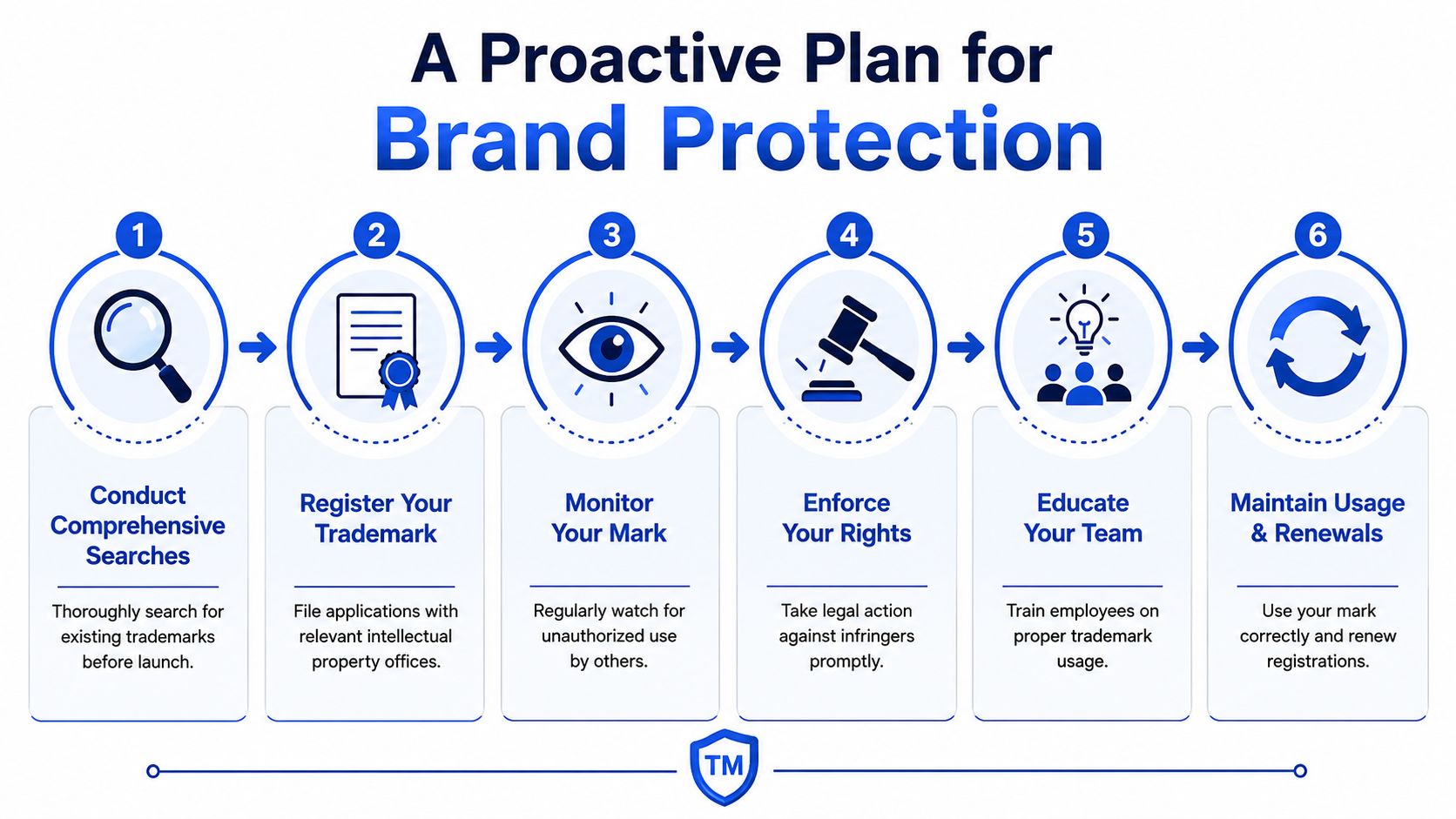
A practical protection plan has two tracks: build rights early, then monitor and enforce them before confusion hardens into market damage.
Before launch
-
Clear the name properly.
Don't stop at a Washington Secretary of State search or a quick Google check. Review USPTO records, domain results, app stores, Amazon, LinkedIn, and industry-specific directories. -
Choose a stronger mark.
Fanciful and arbitrary marks are easier to protect than names that merely describe the product. -
Document first use.
Keep dated screenshots, product images, invoices, and launch materials showing when and how the mark entered commerce.
For product-based businesses, especially print-on-demand sellers, a screening tool can help flag obvious issues before investing in designs. One example is this tool for checking POD design trademarks, which can support an early-stage naming and design review process.
After launch
Protection becomes operational once the brand is live.
- Monitor marketplaces: Watch search results, social handles, Amazon listings, and new business names in your space.
- Train internal teams: Marketing, sales, and product teams should know the approved form of the mark and how to spot misuse.
- Renew and maintain: Registration isn't self-executing. Ongoing use and timely filings matter.
Strong brands rarely stay protected by accident. Someone inside the business has to own the process.
When a possible infringement appears
A disciplined response usually works better than immediate outrage:
| Step | What to do |
|---|---|
| Gather proof | Save webpages, ads, packaging images, and evidence of confusion |
| Check your rights | Confirm ownership, scope, and any registration status |
| Assess the market overlap | Compare goods, channels, geography, and audience |
| Decide the objective | Takedown, coexistence, licensing, or full stop-use demand |
| Escalate carefully | Use counsel when facts are mixed or the other side is entrenched |
For businesses building a more durable system around these issues, a broader brand protection strategy helps connect clearance, registration, monitoring, and enforcement into one process.
Frequently Asked Questions About Trademark Infringement
Is unintentional trademark infringement still infringement
Yes. Intent can matter, especially when a court considers bad faith and remedies, but intent usually isn’t required to establish infringement. The main question remains whether the accused use is likely to confuse consumers.
A business can infringe because it skipped a clearance search, copied too closely without realizing it, or relied on a branding agency that didn’t check the legal environment carefully enough.
Does a mark have to be identical to infringe
No. Similarity is evaluated through the overall commercial impression, not exact duplication. Names can differ in spelling or design and still be close enough to create confusion if the goods, audience, and channels overlap.
That’s why “close enough” is often the danger zone. Small changes don’t automatically solve the problem.
What’s the difference between infringement and dilution
Infringement focuses on consumer confusion. Dilution is a different theory aimed at protecting especially strong marks from uses that blur distinctiveness or tarnish reputation, even in some situations where confusion is less central.
Many small and midsize businesses should focus first on confusion analysis because that is the issue most likely to drive ordinary commercial disputes.
Can a company in another state infringe a Washington business
Yes. Geography still matters, but online commerce narrows practical distance quickly. If the out-of-state company sells into Washington, targets Washington customers, or uses overlapping digital channels that create confusion here, the dispute may still be very real.
Federal registration becomes especially valuable when a company expands beyond one city or region.
Is using a competitor’s trademark in SEO always unlawful
Not always. Context matters. Some uses may be legitimate references. Others may support a claim, especially where the use is hidden, misleading, or designed to divert buyers by exploiting brand recognition.
The key is proof. Search-result captures, page source records, ad text, and customer behavior often determine whether a complaint is persuasive.
Should a business send a cease and desist letter right away
Not automatically. A rushed letter can create strategic problems if the claim is weak, the facts are incomplete, or the accused party has a plausible defense. It’s often smarter to gather evidence first, confirm rights, and choose the remedy that fits the business goal.
By Design Law Firm & Legal Consultancy, PLLC helps Washington businesses protect brands, manage infringement risk, and build practical IP strategies that support growth. Businesses that need guidance on trademark clearance, registration, enforcement, or dispute response can learn more at By Design Law Firm & Legal Consultancy, PLLC.
Contact our law offices at (206) 593-1519 for a complementary consultation.