A Seattle founder launches a clean new product line, locks in early customers, and finally sees traction. Then a fake Instagram profile starts answering customer messages. A marketplace seller posts a lookalike listing with copied photos. Someone else grabs a close-match domain and points it to a thin landing page that harvests leads. None of that feels like “IP strategy” in the abstract. It feels like lost revenue, support chaos, investor friction, and a credibility problem at exactly the wrong time.
That's why a brand protection strategy has to start early for Washington startups. In Seattle's market, founders are often building in public, selling online from day one, hiring contractors across state lines, and mixing software, content, and physical product elements into one brand. That creates opportunity. It also creates exposure. If the company waits until a copycat appears, the legal and operational options get narrower and more expensive.
For a startup, brand protection isn't just about stopping bad actors. It's about preserving the company's ability to scale under one recognizable identity, sell confidently across channels, and keep trust intact when customers can't easily tell the difference between the actual business and a fake one.
Why Your Brand Is an Asset Worth Protecting
Your brand is an asset worth protecting because it compresses trust into clear customer signals, like your name and logo. If those signals get diluted or hijacked, customers lose clarity in the market.
A brand is a business asset because it compresses trust. Customers don't evaluate the company from scratch each time. They rely on signals: the name, logo, product appearance, website, packaging, app listing, social profile, and buying experience. If those signals get diluted or hijacked, the startup loses more than a legal claim. It loses clarity in the market.
Trust affects revenue faster than many founders expect
Security and brand integrity are tied together more tightly than many early-stage companies assume. 87% of consumers would not do business with a company if they had concerns about its security practices, according to data privacy statistics on brand trust. That matters because many brand attacks don't look like classic trademark disputes. They show up as phishing pages, impersonation accounts, spoofed domains, and fake support messages.
Practical rule: If a customer can be confused about who is behind a message, listing, or login page, that's a brand protection issue, not just a marketing issue.
For Seattle startups raising capital or pursuing strategic partnerships, that distinction matters. Investors and acquirers don't just value awareness. They value control. A company that can prove ownership of its identifiers, monitor misuse, and respond quickly presents a cleaner risk profile than a company that says, “We've seen some fakes online, but we're handling it informally.”
Brand value includes more than the name
Most founders think first about trademarks. They should. But the brand asset itself is broader than the word mark on a slide deck.
A practical inventory often includes:
- Core identifiers such as the company name, product names, logos, taglines, and domain names
- Visual signals such as packaging, interface elements, icon sets, and potentially trade dress and brand identity
- Commercial touchpoints such as Amazon listings, Shopify pages, app store entries, ad creative, and customer support channels
Founders selling on major marketplaces should also understand platform-specific tactics. For Amazon sellers, AMZ Sellers Attorney's brand advice is a useful companion resource because it gets into the practical friction of enforcement where listings, resellers, and counterfeit risks collide.
A startup's strongest brand advantage is often speed and focus. The downside is that bad actors can move fast too. A founder who treats the brand as a protected operating asset, not just a design choice, is in a much stronger position when growth starts attracting attention.
Laying the Groundwork with Risk Audits and Trademark Registration
A good brand protection strategy starts with paperwork and discipline. That sounds less exciting than product development or demand generation, but it's the part that gives the company an advantage later.
The first step in any brand protection strategy is the registration of trademarks with the USPTO and relevant foreign IP offices, as registration is the prerequisite that legally allows a brand owner to take action against infringers, as explained in Michigan State University's guide to brand protection.
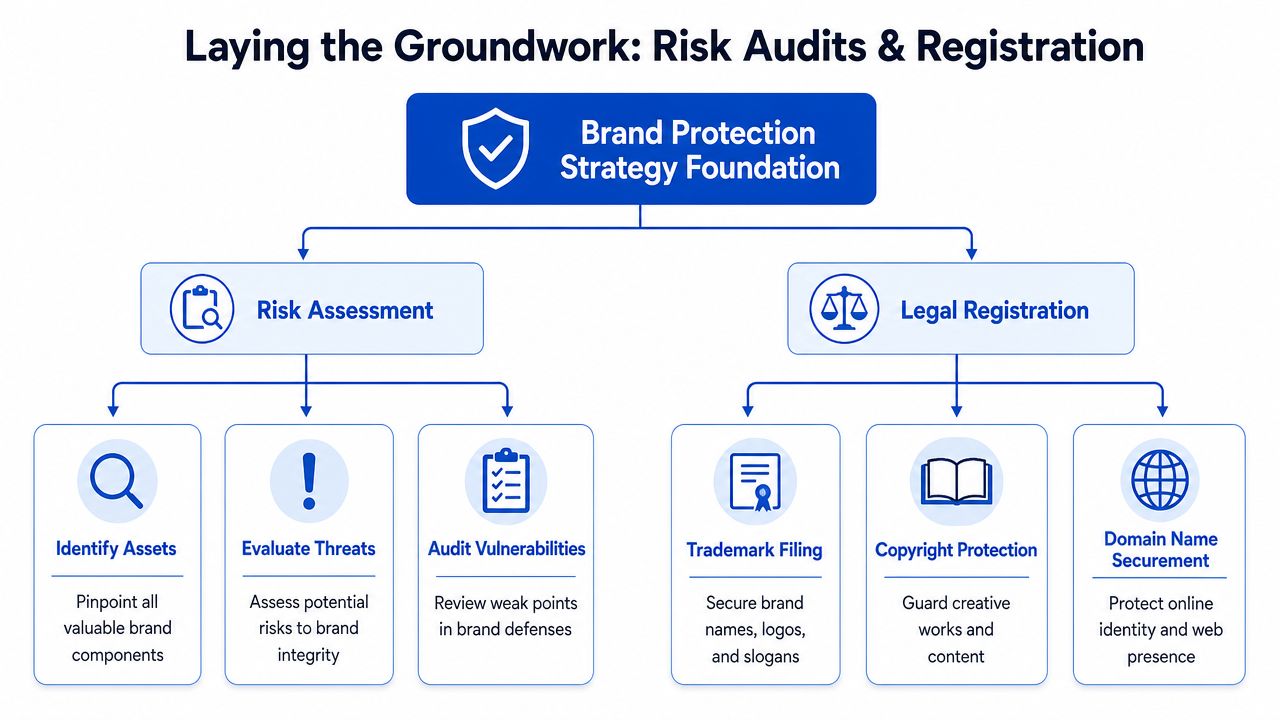
Start with a brand asset audit
Before filing anything, the company should identify what it owns, what it uses, and what it hasn't documented well. That audit should be practical, not academic.
A startup brand audit usually covers:
- Names in use. Company name, DBA, product names, feature names, podcast names, course names, and event names.
- Visual assets. Logos, icons, packaging, website design components, ad creative, and original product photography.
- Content assets. Website copy, user guides, video explainers, pitch visuals, and software screens.
- Digital territory. Domains, social handles, app listings, seller accounts, and marketplace storefronts.
- Ownership records. Who created the asset, under what agreement, and whether the company has a signed assignment.
This is also the point to separate trademark, copyright, patent, and trade secret issues. Founders often bundle them together and miss important gaps. A short explainer on trademark vs copyright vs patent can help clarify what should be filed, what should be assigned, and what should stay confidential.
Washington-specific priorities
For Washington startups, the registration strategy should match the business plan. A company selling SaaS nationwide, consumer goods through Amazon, or a mobile app in multiple states usually shouldn't treat a Washington-only filing as the main solution. Federal registration is generally the key step because online commerce crosses borders immediately.
That said, local-first businesses still need a filing map. A Seattle retail concept, food brand, or regional services business may start with near-term use concentrated in Washington, then expand into Oregon, California, or international manufacturing channels. The legal strategy should follow actual expansion plans, not vague ambition.
A practical sequence looks like this:
- Clear the mark early before naming is embedded in product, packaging, and ad spend
- File priority marks first such as the main brand name and core logo
- Match goods and services carefully so the filing supports how the business operates
- Reserve supporting assets including important domains and social handles while applications are pending
- Plan foreign filings intentionally where manufacturing, licensing, or market entry is likely
A weak filing strategy creates expensive cleanup. A focused filing strategy creates options.
Risk audits should test exposure, not just ownership
Registration alone doesn't solve the problem. The company also needs a risk audit that asks where misuse is most likely to happen. For one startup, the threat is counterfeit goods. For another, it's fake recruiter emails, cloned websites, or unauthorized partner marketing.
A useful audit asks:
| Risk area | What to check |
|---|---|
| Marketplace sales | Are unauthorized sellers already listing similar goods? |
| Search and ads | Is anyone bidding on branded terms in misleading ways? |
| Domains | Are close variants, misspellings, or country-code domains exposed? |
| Social media | Are handles secured on the platforms customers actually use? |
| Contractors | Are logos, packaging files, and source materials controlled by the company? |
Founders don't need a massive compliance department to do this well. They need a current asset list, clear ownership, a filing plan, and a realistic view of where a copycat would strike first.
Establishing Your Digital Watchtower Through Monitoring and Detection
Once the legal foundation is in place, the company needs a monitoring system that catches misuse before customers do. That's the operational heart of a brand protection strategy.
A robust program must address the channels where attackers and imitators operate. That includes domains, social media, paid ads, app stores, and e-commerce marketplaces, which are identified as the primary vectors for impersonation, phishing, and counterfeit listings in Doppel's explanation of brand protection channels.

Build monitoring around customer confusion
The right question isn't “Where can the brand be mentioned?” The right question is “Where can a customer be misled?” That shifts monitoring from vanity alerts to risk-based detection.
A startup watchtower usually needs coverage in five places:
- Domain monitoring for typo domains, brand-plus-keyword domains, and suspicious registration patterns
- Marketplace surveillance on Amazon, Walmart Marketplace, Etsy, eBay, and niche channels relevant to the product
- Social platform review for fake accounts, cloned profile images, impersonation bios, and unauthorized support responses
- Paid ad checks for misleading search ads using the brand name to divert traffic
- App and browser ecosystem checks for fake extensions, app clones, or unofficial downloads
Google Alerts can help, but they're too blunt on their own. Founders often set one alert for the company name and assume they're covered. That misses image theft, slight spelling variations, fake seller names, and private marketplace activity. For online reputation issues that bleed into trust and search visibility, RepErase reputation monitoring tips offer a useful checklist for tracking what customers see first.
Monitoring needs owners and response rules
A tool without a workflow becomes inbox clutter. Someone has to review alerts, classify them, and decide whether the issue is legal, security, customer support, or channel management.
A simple startup model works well:
| Alert type | Owner | First action |
|---|---|---|
| Fake social account | Marketing or brand lead | Capture evidence and report through platform tools |
| Suspicious domain | Security or ops lead | Assess impersonation risk and preserve screenshots |
| Counterfeit listing | E-commerce lead or outside vendor | Verify seller details and submit marketplace complaint |
| Copied website content | Legal or founder | Preserve page copies and evaluate trademark or copyright claim |
This is also where companies should document escalation thresholds. A dormant fake account isn't the same as an active phishing page. A reseller with poor branding isn't the same as a counterfeit seller using copied packaging.
Catching misuse early matters less because the screenshot looks bad, and more because bad actors tend to test weak resistance before they scale.
The Washington startup angle
Seattle companies often operate with lean teams and broad digital exposure. A B2B startup may think it has low brand risk because it doesn't sell a consumer product. Then a fake invoice email goes out using a similar domain. A health-tech company may focus on compliance but overlook impersonation on LinkedIn. An AI startup may face misuse of synthetic voice, cloned visuals, or fake product pages that misuse its demos. Issues tied to synthetic media and identity abuse are getting harder to ignore, especially for founder-led brands. That's one reason startups should pay attention to protecting digital rights in the age of deepfakes.
The best watchtower isn't the one with the most dashboards. It's the one that tells the company, quickly and reliably, where confusion is already happening.
The Modern Enforcement Playbook From Takedowns to Litigation
Detection only matters if the company can move. The strongest enforcement programs don't jump to litigation first. They use the fastest mechanism that fits the problem, preserve evidence properly, and escalate when the other side shows persistence or bad faith.
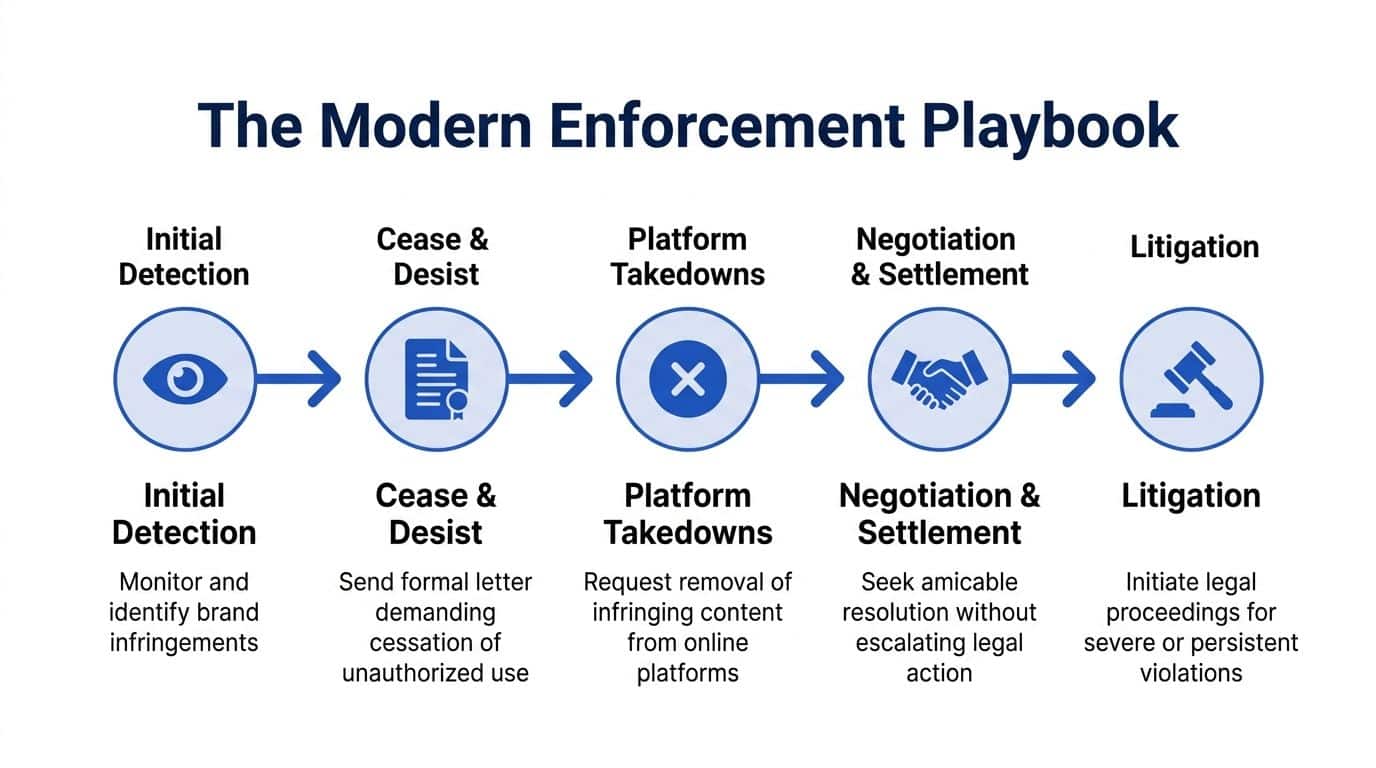
Start where the platform gives leverage
When a founder finds a fake listing, cloned profile, or infringing ad, the first move usually isn't a lawsuit. It's a targeted platform complaint. A successful brand protection strategy requires swift action within hours when illicit content is detected to prevent scaling, and that often means reporting the conduct as a breach of a platform's terms, especially under its Intellectual Property Policy or Trademarks Policy, as described in Lewis Silkin's discussion of online enforcement tools.
That approach works because platforms care about policy enforcement at scale. A founder who files a focused report tied to the correct policy lane often gets further than one who sends a long legal essay to generic support.
A solid first-response file should include:
- Clean evidence with screenshots, URLs, seller names, timestamps, and copies of the listing or profile
- Ownership proof such as trademark registration details, product images, and authorized channel information
- A precise theory. Is it trademark infringement, counterfeit sale, copyright misuse, impersonation, or terms-of-service abuse?
- A requested action such as listing removal, account disablement, ad takedown, or preservation of account records
Match the tool to the violation
Not every infringement should be treated the same way. A copied product photo and a cybersquatted domain call for different tools.
Here's a practical decision view:
| Problem | Best first move | Escalation path |
|---|---|---|
| Marketplace counterfeit listing | Platform report through brand or IP portal | Counsel letter, seller investigation, litigation if repeat conduct continues |
| Copied website text or images | Copyright complaint or DMCA-style notice where applicable | Formal demand and damages analysis |
| Fake social profile | Impersonation and trademark report | Counsel contact to platform if account stays active |
| Cybersquatted domain | Domain registrar complaint or UDRP analysis | Litigation for broader relief if needed |
| Unauthorized reseller issue | Contract review, MAP enforcement, channel policy action | Trademark or unfair competition claims where facts support it |
Many startups lose time. They send a cease and desist letter because it feels serious, even when the platform would have removed the content faster through its own process.
Later in the response timeline, a founder may need guidance on what a cease and desist letter does, especially when the issue involves a repeat infringer, distributor conflict, or a party that's likely to preserve or destroy evidence based on how contact is made.
A short explainer can also help founders think through escalation before spending heavily on formal disputes.
When a simple takedown isn't enough
Consider a Seattle consumer brand selling through Shopify and Amazon. It finds one fake Amazon listing, two Instagram impersonation accounts, and a close-match domain that routes users to a fake giveaway page. The Amazon listing and social accounts are usually takedown problems first. The domain may require a deeper review. If the registrant is anonymous, overseas, or clearly targeting the brand to gain an advantage, the company may need to consider a UDRP proceeding or court action.
A founder should escalate when the problem is coordinated, persistent, or connected to fraud. That's the point where “cheap and quick” can become “slow and ineffective.”
Cease and desist letters have value, but only when used deliberately. They can be useful against a domestic competitor, a former partner, an unauthorized reseller with identifiable ownership, or a service provider that's ignoring prior notices. They're less useful against disposable scam accounts and offshore operators who can relaunch tomorrow under a different name.
Litigation is a business decision, not a reflex
Founders often ask whether litigation is “worth it.” The better question is whether the company needs one or more of these outcomes:
- An injunction to stop conduct that won't stop voluntarily
- Subpoena power to identify a hidden actor
- Damages to strengthen the brand's position for serious brand harm
- A precedent effect that deters future copycats, license violations, or ex-partner misuse
In Washington, that analysis should also account for venue, cost discipline, evidentiary quality, and whether the business can tolerate the distraction. Some cases deserve immediate counsel involvement. Others are best solved through fast platform pressure and careful documentation.
The best enforcement playbook is proportionate. Fast where speed matters. Formal where strategic advantage is key. Relentless where the brand is being used to commit fraud.
Fortifying Your Business from Within Using Policies and Contracts
A Seattle startup usually finds its internal brand gaps at the worst possible moment. The company is raising money, onboarding a national reseller, or trying to remove a copycat seller. Then someone asks a basic question. Who owns the logo files, the product photos, the ad account, or the storefront content? If the answer is fuzzy, enforcement gets harder and the business looks less disciplined than it is.
Internal controls decide whether the company can prove ownership and control use of its brand. They also decide how quickly the team can contain a problem before it spills into customer confusion, channel conflict, or a financing diligence issue.
Contracts define who owns what
Founders should review every agreement tied to brand assets with one practical question in mind: if this relationship ends badly tomorrow, what does the company clearly own and what can the other side still use?
That review usually starts with employee offer letters, invention assignment agreements, contractor agreements, agency SOWs, software development contracts, and distributor terms. In early-stage companies, the risk is rarely one dramatic failure. It is a series of small shortcuts. A developer opens an app store account under a personal login. A freelance designer keeps the editable files. An agency reuses campaign assets because the SOW never limited post-engagement use.
The contract stack should cover:
- IP assignment for logos, packaging, code, designs, copy, photography, and campaign assets
- Confidentiality for launch plans, source files, customer data, pricing strategy, and vendor information
- Use restrictions for agencies, affiliates, distributors, implementation partners, and resellers
- Account ownership and transfer terms for domains, seller accounts, social profiles, ad platforms, and analytics tools
A clean paper trail matters in diligence too. Investors and acquirers regularly ask for confirmation that core IP was assigned correctly, especially when the company relied heavily on contractors in its first two years.
Policies control day-to-day brand use
Contracts set the legal baseline. Internal policies keep the team from undermining that baseline through sloppy operations.
The most useful policies are concrete and boring. Who can approve a co-branded landing page? Who can change product claims on Amazon? Where are source files stored? What happens if a team member spots a phishing account impersonating the founder? Good policy work answers those questions before a crisis starts.
A practical internal framework usually includes:
- Access controls for customer-facing channels, creative files, and seller accounts
- Approval rules for public messaging, promotions, product claims, and partner marketing
- Incident response steps for impersonation, account compromise, and unauthorized listings
- Record retention rules so screenshots, account logs, and communications are preserved if a dispute develops
One sentence in a policy can save weeks of cleanup later.
Washington founders should draft for enforceability, not intimidation
Washington startups need to be careful with restrictive covenants. Overbroad language copied from a California, New York, or Delaware template can create unnecessary fights and may not help much in practice. A better approach is usually narrower and more operational: confidentiality terms that precisely match the company's information flows, invention assignment language that captures what the team is building, customer non-solicit terms where the role justifies them, and clear return-of-property obligations tied to devices, credentials, and files.
That matters in Seattle's hiring market, where employees and contractors often move between startups, agencies, and larger tech companies. Aggressive paper does not fix weak process. If offboarding is loose, passwords stay active, cloud folders remain shared, and brand assets walk out the door even if the agreement looked tough on signing day.
Channel policy deserves the same attention. If the company sells through resellers or distributors, price presentation, marketplace rules, and approved product claims should line up with the broader brand strategy. For companies dealing with unauthorized discounting or off-channel presentation issues, guidance on enforcing MAP policies can help, especially when price erosion starts hurting the brand before a textbook infringement claim exists.
Internal discipline does not get much attention in board decks. It prevents expensive self-inflicted mistakes, strengthens the company's enforcement position, and makes the brand easier to scale.
Measuring ROI and Knowing When to Engage Counsel
Founders eventually ask the right question: is this effort producing a business return, or just generating legal bills and screenshots? A brand protection strategy should answer that with evidence.
According to MarqVision's discussion of measuring brand protection ROI, ROI can be measured through data-driven methods such as quantifying revenue recovered using a lost-sale rate model and calculating cost savings from labor and legal avoidance. The same source notes that top-performing firms report monthly enforcement volumes and quarterly ROI summaries. That cadence matters because it forces the company to stop treating enforcement as episodic cleanup and start treating it as an operating function.
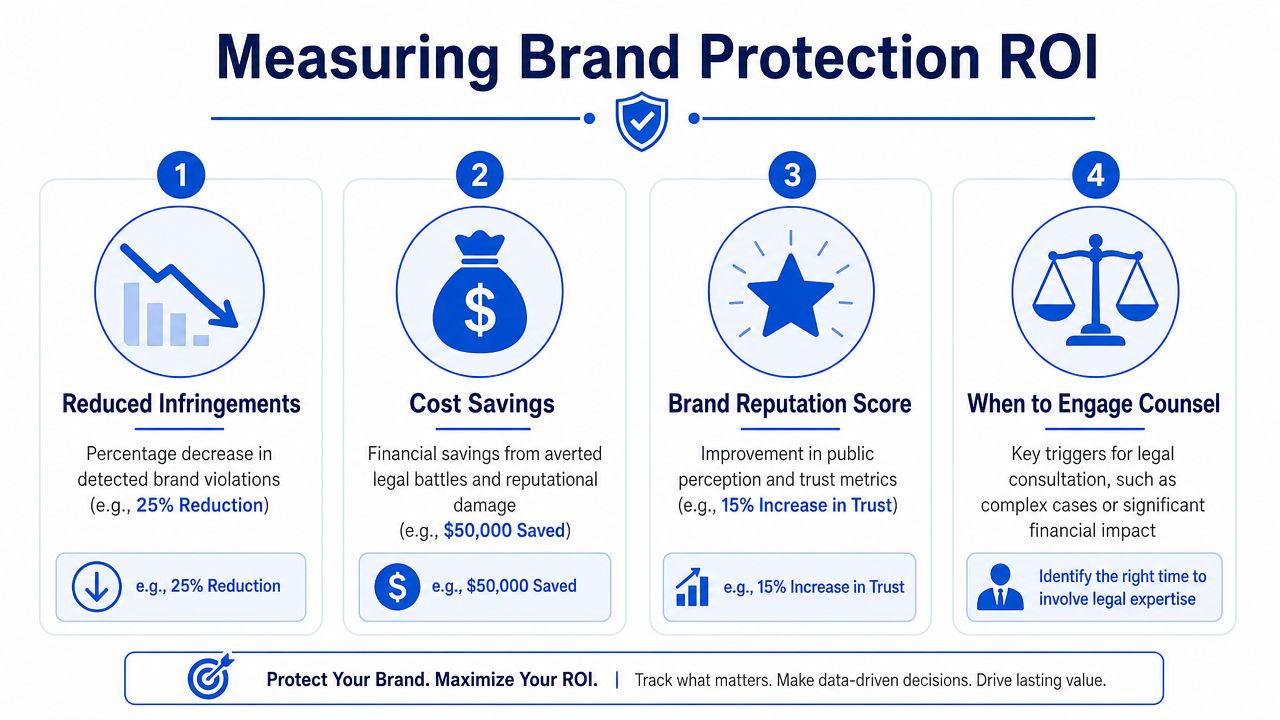
What to measure in practice
A startup doesn't need a complicated dashboard at first. It does need consistency. The most useful metrics are the ones that show whether risk is being identified faster, removed faster, and repeated less often.
A clean monthly report might track:
| Metric | Why it matters |
|---|---|
| Number of infringing listings or accounts detected | Shows current exposure and trend direction |
| Number removed | Measures enforcement output |
| Median time from detection to report | Tests internal responsiveness |
| Median time from report to removal | Tests partner and platform effectiveness |
| Repeat offender count | Shows whether actions are actually deterring conduct |
| Staff time spent per case | Helps estimate labor savings from better process or vendors |
Some companies also maintain a running estimate of preserved sales using their own transaction data and enforcement records. Others track customer complaints tied to confusion events, such as fake support messages or suspicious order confirmations. The point isn’t to create perfect precision. It’s to build a defensible picture of whether the brand is becoming easier or harder to defend.
Know the line between DIY and counsel-led work
Founders can and should handle some issues internally. Basic marketplace reports, fake social profile complaints, and obvious impersonation reports are often manageable if the company has clean evidence and registered rights. The trouble starts when a founder mistakes platform familiarity for legal strategy.
Counsel should usually get involved when:
- A repeat offender keeps returning after takedowns
- The infringer is a competitor, former partner, distributor, or ex-contractor
- The issue crosses borders or raises foreign filing and enforcement questions
- The company receives a cease and desist letter or threat first
- Fraud, phishing, or customer harm is involved
- Evidence needs preservation for a potential court or domain dispute
- The startup is preparing for financing, acquisition, or expansion and wants the IP record cleaned up
Legal counsel adds the most value when the company needs leverage, not just language.
Seattle founders often wait too long because they want to stay lean. That instinct is understandable. But there’s a point where delay raises the cost. If the company is spending executive time on repeat takedowns, losing channel trust, or facing counterparties who know how to exploit ambiguity, it’s already beyond a purely DIY problem.
A strong brand protection strategy doesn’t try to eliminate all misuse. That’s unrealistic. It creates ownership clarity, surveillance discipline, and response speed that keep misuse from controlling the narrative around the business.
By Design Law Firm & Legal Consultancy, PLLC helps Seattle and Washington businesses build that kind of legal foundation. The firm advises startups and established companies on trademarks, contracts, cybersecurity, data privacy, enforcement strategy, and the practical systems needed to protect brands while the business grows. For founders who want clear guidance without unnecessary legal friction, it’s a strong place to start.
Contact our law office today at (206) 593-1519.